






Abstract
This paper introduces womanist archival praxis as an endarkened, arts-based, and spiritually grounded approach to historical inquiry. It explicitly centers Black women’s intellectual, spiritual, and embodied lives, and reimagines the archive as both a site of violence and of possibility. Responding to the erasure and distortion of Black women within dominant historical narratives, this paper proposes the (re)search for goodness as a methodological and ethical stance that centers care, creativity, and relationality. Grounded in Black feminist and womanist traditions, and drawing on Black women’s quilting as metaphor and method, this praxis treats archival work as a sacred craft—a process of piecing, stitching, and binding fragmented histories into collective wholeness. By stitching historical analysis, creative expression, and ethical reflection, this praxis cultivates a multi-layeredapproach to archives. Ultimately, the womanist archival praxis of (re)searching for goodness transforms the process of coming to know, through the archive, into a reparative, love-infused act of remembrance that honors Black women’s lives and living, wisdom, and enduring presence across time.
Black women were creators, constantly making the slate of things necessary to sustain the life of the family, “one of the supreme social achievements of African-Americans under conditions of enslavement.” These made things included clothing, brooms, quilts, meals, medicines, and an array of mementos, like buttons and beads, that might one day be pressed into the palm of a parting loved one’s hand. Black women fashioned and gathered these things into emotional nets that affirmed their love for self and others, channeling visions of perseverance through the work of their thoughts and hands, often at their own risk.
The Archive as a Site of (Re)search, an Introduction
The archive is both a site of promise and a site of violence. For Black women, it has too often functioned as a space of absence, distortion, and erasure, where their lives are rendered marginal or misrepresented within dominant narratives of history and education. Black women scholars have explicitly named these violences, illuminating how power shapes whose voices are preserved and whose are silenced (Farmer, 2018; Fuentes, 2023; Warren, 2016). Yet, alongside this critique, Black feminist and womanist thinkers remind us that the archive also holds possibilities for survival, wholeness, and (re)membering (Dillard, 2012; Williams, 1993). Out of this tension emerges a central question: how might researchers of Black women approach the archive not merely as a repository of documents, or a site a violence; but as a living, spiritual, and creative space for healing, storytelling, relationality, and envisioning liberatory futures?
This paper proposes a womanist archival praxis—an endarkened method of (re)searching for goodness (Dillard, 2021; Lawrence-Lightfoot & Davis, 1997)—that is at once scholarly, spiritual, and artistic. This approach to this historical inquiry resists the typical preoccupation with documenting pathology and insufficiency in the histories of the African American experience with schools in America (Anderson, 1988; Siddle-Walker, 1996). Goodness here does not suggest naiveté or obscuring the shadows of historical Black women’s nuance and multifaceted lives. Rather it represents a spiritual striving (Dillard, 2006) and communal commitment to wholeness, justice, and care, one which animates Black feminist and womanist traditions (Austin, 2022; Cannon, 1985; 1988, Dillard, 2000; Wade-Gayles, 1995).
I engage in what Dillard (2021) has theorized as (re)search, or the ways in which we search again for something about Black heritage that we believe will teach us something new about our history, humanity, and culture, as well as an openness to being changed in the process. To (re)search for goodness, then, is to acknowledge the incompleteness of the archive while listening for ancestral voices that speak through fragments (Hartman, 2008; Teague & Nagbe, 2024), guiding how we engage, imagine, teach, and (re)search. The nuance in this work is that it is a quest for beauty in the midst of terror, a “celebration of and in and through our suffering” (Moten, 2017, p. xiii). Yet, at its core is the pursuit of ethical, life-affirming ways of coming to know, and an intentional searching for what has been obscured or misnamed in the archive. The (re)search for archival goodness, then, is a communal and ancestral obligation to developing methods of radically loving and (re)membering Black womanhood in a world premised on our erasure.
The urgency of this work lies in education, where the archival erasure of Black women’s intellectual and pedagogical contributions remains profound. They are too often relegated to sanitized footnotes rather than recognized as architects of liberatory education (Acosta, 2018; Baumgartner, 2019; Beauboeuf-Lafontant, 2004; de Royston, 2020; Johnson et al., 2014). A womanist archival praxis counters these erasures by treating the archive as a site of creative and spiritual (re)membering, one that insists on Black women’s centrality in educational history, practice, and theory (Baumgartner, 2019; Collier-Thomas, 1982; Dillard, 2021; Dillard & Neal, 2020; Irvine & Hill, 1990; Johnson et al., 2014; McCluskey, 2014; Muhammad et al., 2020; Neal & Dunn, 2020; Neal-Stanley, 2023, 2024; Perkins, 1987) while also modeling ways of knowing that nurture survival, wholeness, and community.
In this work, womanist archival praxis provides the methodological grounding—the conceptual, ethical, and spiritual orientation that shapes how I enter and interpret the archive. It is a collective quilt, assembled in dialogue with foremothers, stitched within communities, and extended toward future generations. The (re)search for goodness, in turn, is the method through which data is generated and analyzed; the lived, creative, and relational enactment of that praxis. It is a communal and ancestral obligation to develop methods of radically loving and (re)membering Black womenhood in a world premised on our historical erasure, with the belief that history is our future. What follows is a closer look at the violence, silence, and limits of the archive, tracing how its power both constrains and necessitates the very practices of care, imagination, and justice that animate this praxis.
Archival Violence and Black Women’s Methodological Reorientations
The institutional archive, whether housed in state repositories, university special collections, or historical societies across the U.S., have long been imagined as a neutral space safeguarding objective knowledge for future generations. This presumption of neutrality obscures the fact that archives are created within relations of power, shaped by decisions about what is preserved, whose lives are documented, and which narratives are privileged. For Black women, the archive often registers absence, distortion, or silence, making it both indispensable and deeply fraught as a site of research.
The Violence of the Archive
Archives, often revered as repositories of truth, are also spaces of violence that fragment, misrepresent, dismember, misremember, and outright erase Black women’s histories in the U.S. (Farmer, 2018; Gordon, 1997; Gross, 2015; Harris, 1996; Hartman, 2007, 2008; Trouillot, 2015; van der Merwe, 2019; White, 1987). Scholars of archival studies and Black studies have named this phenomenon the “violence of the archive.” Harris (2002) notes that archives are always partial, shaped by bureaucratic logics and political interests that privilege some voices while silencing others. Trouillot (2015) demonstrates how silences enter the historical record at multiple stages—what gets recorded, preserved, catalogued, and narrated. For Black women, these silences are structural, reflecting the racial and gendered hierarchies that undergird knowledge production.
The violence of the archive is starkly evident in the ways poor and working-class Black women are rendered invisible or misrepresented. The records that do exist frequently reflect the perspectives of elites, state authorities, or institutions of surveillance, rather than the voices of Black women themselves. Plantation ledgers, court documents, missionary reports, and welfare records often frame Black women as problems to be managed rather than as intellectual and cultural agents (Fuentes, 2016; Morgan, 2021). Such documents capture encounters with the state—arrests, institutionalization, welfare surveillance—while omitting the richness of Black women’s everyday lives: their labor, kinship networks, cultural practices, and spiritual traditions.
Even when Black women educators appear in archives, their presence is often filtered through respectability politics or reduced to narratives of exceptionalism. Figures such as Anna Julia Cooper, Nannie Helen Burroughs, or Septima Clark are too often sanitized into assimilationist icons, stripped of their radical commitments to Black freedom struggles (Givens, 2021; May, 2021). Meanwhile, the lives of everyday Black women teachers, community leaders, and mothers remain under-documented, reproducing hierarchies within Black women’s histories themselves (Carby, 1987; Higginbotham, 1994). This dynamic perpetuates epistemic injustice, narrowing the historical record and denying future generations access to fuller accounts of Black women’s intellectual, pedagogical, and spiritual work.
Black Women’s Herstorians’ Methodological Reorientation
Confronted with archives that fragment, silence, and erase Black women’s histories, Black women historians of Black women, or herstorians, have developed innovative strategies for uncovering and interpreting the traces of lives often rendered invisible. These practices offer both a critical lens for understanding the structural and epistemic violences embedded in archival collections and a set of approaches for transforming archival research into acts of care, justice, and reclamation (Collier & Sutherland, 2022). Such methodological reorientations demonstrate that archival work is not only about recovering what has been lost but also about honoring the intellectual, spiritual, and creative legacies of Black women.
Hine, 1997 called for methodological reorientation beyond factual recovery, urging scholars to develop explanatory frameworks that illuminate Black women’s agency, social strategies, and decision-making within oppressive structures, saying, At some fundamental level all black women historians are engaged in the process of historical reclamation, but it is not enough to simply uncover the hidden facts…In synchrony with the reclaiming and narrating must be the development of an array of analytical frameworks that allow us to understand why black women of all classes behave in certain ways, and how they acquired agency. (p. 47, emphasis added)
Hine’s insights highlight that methodological reorientation is inseparable from theoretical and ethical commitments, that archival work must attend to context, intention, and the relational dimensions of research, producing interpretations that are rigorous, nuanced, and deeply grounded in Black women’s lived experiences.
Taylor (2008) extends this work by situating archival recovery as a political intervention. She emphasizes that centering Black women within historical inquiry disrupts hegemonic narratives that privilege white, male, and elite voices, exposing the ideological frameworks that shape archives. Archival research thus becomes an act of resistance: each recovered life challenges dominant historical narratives while revealing the complexity of Black women’s intellectual, spiritual, and pedagogical contributions.
Fuentes (2016) challenges the assumption that uncovering new sources alone drives historical recovery. She emphasizes the richness embedded within preexisting archival materials. She suggests reading “along the bias grain” (p. 15), deliberately working against the archive’s dominant, rigid, colonial structure of recordkeeping. Instead, she “stretches” the fragments—reading between the lines, imagining what’s missing, and pulling new meanings from silences and partial records. By engaging deeply with what is preserved—diaries, letters, legal documents, photographs—we can reconstruct narratives that foreground the humanity, spirituality, and agency of Black women across time. This approach acknowledges that archives are not neutral—they are structured by colonial violence and erasure. But rather than abandon the archive, Fuentes bends it, pulling at its seams, making it give a little more space for lives otherwise cut out of history.
Farmer (2018) also foregrounds the persistence of Black women’s voices in unexpected and overlooked spaces, noting that their stories reside “in the casual omissions, the deliberate silences, their traces left in images, court records, bodily scars, and jail cell confessions” (p. 293). Her work underscores that archival research demands interpretive, imaginative, and patient engagement with materials never intended to fully represent Black women’s lives. In this way, she challenges the longstanding claim that Black women are absent from the archive, arguing instead that the issue lies in the limitations of traditional historical methods, which have not been designed to recognize, value, or interpret the evidence that does exist.
In different ways, each of these scholars offer critical, feminist, and justice-oriented approaches to recover historical Black women in the archive (Punzalan & Caswell, 2016). By not merely attending to absences and gaps and developing critical analytic and interpretative frameworks for redress and recovery (Helton et al., 2015; Hughes-Watkins, 2018; Powell et al., 2018), Black women herstorians have invited researchers and scholars to similarly read against the grain, discerning patterns of resilience, intellectual labor, and spiritual agency that survive, albeit in fragmentary form. Johnson and colleagues (2017) discuss this in relation to reparative archival praxis, saying, “For us, memory work is not just about remembering the past, but about reckoning with it - that is, establishing facts, acknowledging, apologizing, stopping ongoing violence, and repairing the harm that was done through both material and immaterial forms of reparation” (p. 2). Building on this lineage, womanist archival praxis extends these Black feminist methodological insights by explicitly centering spirituality, relationality, and care as integral to archival and historical research.
Womanism as a Grounding Framework
Womanism, as articulated by Alice Walker (1983) refers to the courageous, audacious, willful behavior of Black women committed to the flourishing of the entire Black community, and all of humanity (Beauboeuf-Lafontant, 2004; de Royston, 2020; Hill Collins, 1996; Hudson-Weems, 2000; Maparyan, 2012; Paris, 1993). Katie Cannon (2006), celebrated as the foremother of womanist theology, explains that “[womanism] connects our cultural values, oral traditions, and social experiences to our spirit forces in the quest for meaning amid suffering” (p. 20). As such, womanist theology extends key womanist principles to think more critically about Black womanhood and the role of faith and spirituality in their lives. Williams (1993), defined womanist theology as, …a prophetic voice concerned about the well-being of the entire African-American community, male and female, adults and children. Womanist theology attempts to help black women see, affirm, and have confidence in the importance of their experience and faith for determining the character of the Christian religion in the African-American community. Womanist theology challenges all oppressive forces impeding black women's struggle for survival and for the development of a positive, productive quality of life conducive to women's and the family's freedom and well-being. Womanist theology opposes all oppression based on race, sex, class, sexual preference, physical ability, and caste. (p. 67)
Womanist theology employs works by and about Black foremothers as resources for contemporary reflection and provides a conscious background for “God-talk” (Townes, 2003). As a result, womanist theological thought and inquiry can be prominently traced in the writings, oral stories, thinking and cultural productions of Black women. These include historical Black women cultural producers, activists, speakers, preachers, teachers, and abolitionists, all resources for contemporary theological reflection.
While I marshal womanist theology as a necessary and important framework, I recognize and honor that many of the historical Black women in this study did not or would not have named themselves as such. Nevertheless, I have brought them together using the framework of womanist theology in order to place their religious, theological and ethical perspectives at the center of my method making and analysis (Cannon; 1985; 1988; 1996, Grant, 1989; Townes, 2003). In this way, womanist theology provides the theological, theoretical and ethical grounding for this methodological reorientation.
Toward a Womanist Archival Praxis
Unlike frameworks that prioritize abstract analysis or universalizing principles, womanism explicitly centers Black women’s lived experiences, spiritual wisdom, and relational ways of knowing and being. It insists on the interconnectedness of our intellectual, emotional, and spiritual lives, insisting that scholarship must nurture life and livingness, resist oppression, and cultivate goodness alongside rigor. In this sense, archival engagement is not only a critical and analytical task but also a practice of ethical and spiritual stewardship: attending to silences, reading for traces, and reconstructing agency becomes an act of care, honoring the fullness of Black women’s humanity.
Womanist thought foregrounds three interrelated principles that are central to a womanist archival praxis: relationality, spirituality, and ethical imagination. Relationality in womanist thought emphasizes the interconnectedness of all knowledge, the researcher, and the communities under study. Knowledge is not produced in isolation but emerges through sustained attention, dialogue, and ethical engagement with others (Hudson-Weems, 2000; Walker, 1983). In the context of archival work, relationality demands that researchers attend not only to the documents themselves but also to the lives they represent and the legacies they carry (Sutton, 2024). This orientation encourages attentiveness to both historical actors and contemporary communities, recognizing that archives are not repositories of dead people, but living spaces where past, present, and future collide. It is as Isoke (2018) suggests, The archival of black life is more than counting the dead, the maimed, and the dispossessed. Rather, it holds a possibility of deep remembrance of the freedom dreams of our ancestors, those who walked before us, and walk beside us, and those yet to come. Freedom dreams don’t live in real time. They live in epiphenomenal time—that black (w)hole of our existence in which the past, present and future are coiled around each other like that tiny black curl at the nape of your neck your grandmama used to call a “kitchen.” (p. 149)
Ethical imagination in womanist thought involves a commitment to justice, care, and the restoration of dignity. It requires reading “along the bias grain” of archival violences, attending to absence as well as presence, and engaging creatively with fragments to reconstruct lives ethically (Fuentes, 2016; Hartman, 2008). Womanist ethics demands that scholars consider the impact of their interpretive choices, not only on the historical record but also on the lives and legacy in which they represent, as well as the communities whose histories are being reclaimed. It reframes archival research as a moral and relational practice where knowledge production becomes inseparable from the cultivation of goodness, care, and community.
Spirituality is also inseparable from womanist methodology. Black women’s intellectual labor has long been intertwined with spiritual practice, from the liberatory pedagogy of Septima Clark’s Freedom Schools to the communal rituals of Black church based education. Womanism insists that research must honor these spiritual dimensions, recognizing prayer, reflection, meditation, and ancestral listening as legitimate modes of inquiry (Dillard, 2012). Within womanist archival praxis, engagement with documents into a sacred act. Researchers are called to bear witness with humility, to honor the presence of those whose voices have been silenced, and to cultivate insight through attentive and reflective practice.
In this way, womanist thought presses us further, asking not only how violence distorts knowledge, but how communities live, endure, (re)member, and heal in its wake. Rather than positioning this as merely an epistemological concern, womanism understands such violence as a spiritual wound, a disruption of communal memory that calls for practices of healing, re-storying, and survival. The question, then, is not only what the archive fails to say, but how Black women reimagine and reconstruct their stories in ways that affirm life, dignity, and goodness despite erasure.
In sum, womanism and womanist theology provide the theoretical and ethical foundation for this methodological orientation toward archival goodness. This way of being with/in the archive is a relational stance and mode of engagement, a practice of attending, an ethical/spiritual grounding that validates spiritual, relational, and aesthetic modes of inquiry as central to archival and historical research. It reframes the archive as a living site of possibility, and grounds scholarly work in the pursuit of community and humanity. This framework directly informs the practices and methods described in subsequent sections, guiding the translation of theory into womanist archival praxis.
Quilting a Womanist Archival Praxis: Methodological Groundings
Womanist archival praxis is a womanist-centered approach to historical inquiry with Black women that integrates diverse methodologies drawn from education, ethnography, and arts-based research. This approach is inspired by McKittrick (2021, 2022) who implores us to think about Black methodologies, and method making, as how we come to know Black life. Importantly, she frames her methodological practice as one of gathering, affixing, juxtaposing, and weaving together a variety of texts, images, songs, stories, genres, and narrative fragments. McKittrick also plays with form, repetition, remixes, footnotes, parentheticals, caveats, etc., as part of the praxis of method making. By invoking the practices of layering and stitching akin to Black quilters, this inquiry fosters an ethical, relational, and spiritually attuned archival praxis that transcends conventional methodologies. What follows are the “patches” that compose this methodological quilt, each carrying its own texture, thread, and design,—an archival bricolage of sorts (Tanksley, 2024)—together informing a womanist archival praxis.
Patch One: Relational Engagement
Zora Neale Hurston, often celebrated as a literary figure, was also a pioneer of qualitative and ethnographic research whose work modeled relational and ethical engagement with Black life (Mikell, 1999). By immersing herself in the communities she studied, she captured not only sociocultural realities but also the emotional and spiritual textures of everyday Black experience (Strong & Jones, 2022). The Hurstonian method emphasizes immersion, relational engagement, and an ethic of answerability (Patel, 2016) and responsibility toward the people whose lives are studied. Hurston’s research resisted deficit framings of Southern Black folk life, instead honoring complexity, rhythm, voice, and humanity. Her praxis exemplified scholarship that is rigorous yet spiritually and culturally grounded, a model that continues to inspire womanist archival praxis. Through this lens, relationality and aesthetic attentiveness are not methodological options but ethical imperatives for reconstructing the fragmented histories of Black women.
Patch Two: Goodness
Sara Lawrence-Lightfoot’s Portraiture (1983); 1997 offers a methodological framework that blends narrative inquiry, ethnography, and phenomenology to illuminate the culture of institutions and the lives of individuals. Distinguished from traditional social science, Portraiture centers the search for goodness rather than pathology, emphasizing the complexity and dignity of human experience (Lawrence-Lightfoot & Davis, 1997). Within this paradigm, goodness is understood as an intentional pursuit of authenticity and beauty—an inquiry into what sustains, uplifts, and connects. For womanist archival praxis, this orientation toward goodness reclaims the narratives of Black women from deficit frameworks, highlighting their agency, resilience, and spiritual fortitude (Chapman, 2005). Portraiture thus becomes a means of reconstructing and reinterpreting archival fragments through voice, ethical responsibility, and relational empathy. It reinforces a womanist ethic that views historical recovery as an act of honoring beauty, agency, and the wholeness of Black women’s lived experience.
Patch Three: Contextuality/Texture
Historical ethnography merges ethnographic attentiveness to culture and meaning with historical tools such as archival analysis and document study, enabling researchers to “listen” ethnographically across time. Vanessa Siddle Walker’s (1996) Their Highest Potential exemplifies this approach, revealing segregated Black schools as sites of care, excellence, and self-determination rather than deficit or deprivation. Her work bridges archival records with ethnographic sensibility, reconstructing the lived experiences of Black educators and students within broader social and political contexts. For womanist archival praxis, this method models contextuality—situating archival fragments within ecosystems of kinship, pedagogy, and spirit. It insists that interpretation must honor both structure and agency, connecting material traces to the affective and communal worlds that produced them. Through historical ethnography, archives become living sites of relational meaning, offering texture and depth to the re-membering of Black women’s lives.
Patch Four: Reclamation
Cynthia Dillard’s concept of (re)search (2021) frames inquiry as a cyclical, reflective, and spiritual process that joins intellectual rigor with relational and ethical consciousness. For Black women, (re)search is an act of returning—toward self, ancestry, and collective memory—constituting research as both knowledge-making and soul work. It honors (re)membering as an embodied process of tracing ancestral legacies and confronting the entanglements of oppression, resilience, and creativity (Dillard, 2012). Within womanist archival praxis, (re)search expands the archive into a spiritual and ethical terrain where knowledge is sought for liberation rather than validation. This orientation transforms historical recovery into an act of reclamation, one that foregrounds spiritual imagination and communal accountability. Ultimately, (re)search reminds us that to engage the archive as Black women scholars is to participate in a sacred process of healing, remembering, and transforming knowledge.
Patch Five: Archival Optimism
Kabria Baumgartner’s (2019) notion of archival optimism reframes archival gaps and silences as opportunities for creative and ethical reconstruction. It rejects despair by embracing the archive as a site of possibility, inviting researchers to reimagine absence as generative space for Black women’s voices (Gerstenblatt, 2013). Baumgartner underscores how racism and sexism shape the archive while urging scholars to use what is available to reconstruct historical agency with care and imagination. For womanist archival praxis, archival optimism aligns with an ethic of hope, creativity, and responsibility, enabling scholars to honor Black women’s pedagogies and spiritual lives even amid fragmentation (O’Neil et al., 2022). This approach transforms archival work into an act of faith—one that seeks not perfection but promise in the partial. Through optimism, the archive becomes a site of renewal and ethical engagement rather than despair.
Patch Six: Mosaic
Venus Evans-Winters’ mosaic methodology foregrounds multiplicity and intersectionality as central to understanding Black women’s lives. By weaving diverse sources and interpretations, mosaic work produces layered, multidimensional narratives that resist reduction and embrace complexity (Straka, 2019). Evans-Winters (2019) writes, Mosaic as an artform is the process of creating images with an assortment of small pieces of colored glass, stone, or other objects put together to create a pattern or picture. In most instances, the mosaic has cultural and spiritual significance. Black feminist scholars bring a wealth of knowledge, skills, talents, and experiences into the research process. These bits of experiences mold together to construct our multiple identities. And, from these multiple identities, yields a creative, distinctly mosaic worldview. (p. 41)
In this way, mosaic is an ethos that rejects western and androcentric notions of scientific research, and invites new possibilities when we center all the aspects of Black women’s lifeworlds including their/our race, class, gender, religious beliefs, birth order, region, geography, sexuality, etc.
Mosaic is also a Black feminist-based approach to qualitative inquiry that invites researchers to lean into multilayered methods of data generation, data analysis and data re/presentation to provide a mosaic of Black women’s voices and experiences. This includes drawing from multiple sources in the data generation and analysis process, including interview transcripts and field and lifenotes (Bell-Scott, 1994), and primary and secondary sources, as well as non-traditional methods and sources like self-observation, journal entries, tweets, text messages, blogs, and memes. For womanist archival praxis, this approach affirms that history is never singular but a constellation of voices, fragments, and perspectives. Mosaic methodology mirrors womanist commitments to community, spirituality, and the wholeness of lived experience. It challenges the linearity of traditional historical accounts by emphasizing that meaning is constructed relationally—through tension, texture, and care. In doing so, it enables researchers to reconstruct the fragmented record of Black women’s lives into ethically grounded, holistic narratives that honor their multiplicity and humanity.
Patch Seven: Endarkened Storywork
Stephanie Toliver’s (2021) endarkened storywork validates narrative, speculative, and diasporic storytelling as rigorous and ethical forms of knowledge production. Grounded in Black feminist and womanist epistemologies, it invites researchers to engage imagination and spiritual activism as vital to archival interpretation (Strong & Jones, 2022). For womanist archival praxis, endarkened storywork transforms research into narrative restoration—honoring silenced voices through creative and ethical storytelling. It centers the affective and spiritual dimensions of Black women’s experiences, demonstrating that speculative and embodied forms of knowing can illuminate what the archive cannot. By foregrounding care, creativity, and cultural accountability, endarkened storywork aligns with womanist ethics of survival, beauty, and relationality. It thus becomes a bridge between historical recovery and imaginative worldmaking, transforming the archive into a site of liberation and story-healing.
Patch Eight: Critical Fabulation
Saidiya Hartman’s (2008, 2019) method of critical fabulation fuses historical rigor with speculative imagination to address the absences, erasures, and violences of the archive. Through narrative invention grounded in archival evidence, Hartman restores presence and agency to those rendered voiceless by the record. For womanist archival praxis, critical fabulation affirms that creative speculation is not fabrication but a necessary mode of ethical witnessing. It allows scholars to reconstruct interior lives, spiritual practices, and pedagogies obscured by dominant narratives. This method acknowledges that the archive is both a site of trauma and possibility, requiring interpretive care and moral imagination. By practicing critical fabulation, womanist researchers resist epistemic violence and breathe vitality into historical silences, crafting stories that honor the fullness of Black women’s humanity.
Patch Nine: Visual Approaches
Black feminist memory work, articulated by Esther Ohito, and visual methodologies advanced by Tina Campt (2017), expand womanist archival praxis through multimodal and embodied ways of engaging history. Ohito’s visual and affective methods foreground how images, artifacts, and creative representations can recover and reanimate Black women’s stories (Dickerson & Rousseau, 2009; VanderStaay, 2007). Campt’s Listening to Images challenges scholars to approach photographs as active interlocutors, attuned to their affective and political resonance. These methods center relationality, reflexivity, and emotion, transforming the archive into a dialogic and participatory space. For womanist archival praxis, visual and embodied forms of inquiry complement textual and narrative approaches by making visible the affective and spiritual dimensions of Black women’s lives. Through creative seeing and listening, researchers can engage the archive as a living, relational space of care and re-membering.
Patch Ten: Material Culture
Grounding archival praxis in womanism expands the archive beyond institutional records to include the material artifacts of everyday Black women’s lives—quilts, recipes, church bulletins, and family photographs (hooks, 1990; Ewing, 2022). These objects embody memory, creativity, and survival, challenging what counts as legitimate historical evidence. As Miles (2020) notes, the gardens and garments of past generations reveal strategies for surviving “the shadowland,” binding blood-relations through feeling and continuity (p. 115). For womanist archival praxis, such materials are sacred texts that bridge interior and exterior worlds, challenge archival violence, and teach goodness through sensory and affective engagement. By recognizing objects as carriers of divine-like care and embodied knowledge, this approach redefines historical recovery as both spiritual and pedagogical.
Material culture further expands the quilt, recognizing that the most vital traces of Black women’s lives often reside outside official repositories—in quilts, photographs, church bulletins, recipes, and other everyday artifacts (Miles, 2020). These objects embody memory and survival strategies, bridging interior and exterior worlds, countering archival violence, and offering pedagogical possibilities for teaching goodness in tangible, sensory ways. In womanist praxis, such objects are not marginal ephemera but sacred carriers of memory, love, and divine-like care across generations. Material culture thus grounds archival goodness in touch, sight, and memory, transforming everyday life into counterarchives of sacred knowing.
Synthesis
The (re)search for archival goodness is a Black feminist and womanist approach to historical inquiry that draws across education, ethnography, arts-based research, and womanist thought to foreground the ways of knowing, being, and believing of historical Black women. Like quilters who gather scraps and remnants to fashion something whole, this praxis works with the fragments, silences, and distortions of the archive to stitch together narratives that honor Black women’s intellectual, pedagogical, and spiritual lives. It refuses the presumption that historical recovery requires pristine or “new” materials, instead embracing patchwork as method: layering, re-stitching, and re-membering fragments into relational, ethical, and spiritually attuned stories of survival and creativity.
This methodological quilt is pieced together from multiple traditions. Taken together, these patchworked methods model a womanist archival praxis that is critical, spiritual, and creative. This quilt does not promise completeness, for the historical record will never fully yield the interior and spiritual lives of Black women. Yet it restores agency, re-members fragments, and cultivates interpretive practices that are generative, justice-oriented, and life-affirming. In this way, the (re)search for archival goodness becomes less an act of recovery alone than one of imaginative restoration—an ethical stitching of fragments into narratives that honor the wholeness, dignity, and survival of Black women across time. The following section illustrates how this methodology was cultivated and refined through the dissertation process itself, serving as a living case study in the (re)search for archival goodness.
Methodological Becoming Through the Dissertation Process: Quilting the (Re)search for Goodness
This article draws on a larger dissertation project that enacted a womanist archival methodology by framing the research process itself as a quilt. In that study of the spiritual activism of Black women abolitionist teachers (Neal-Stanley, 2022), each stage of inquiry—from conceptualization and data collection to analysis and writing—was guided by tenets of quiltmaking that ground the (re)search for goodness. Rather than following conventional categories of methods and findings, the process unfolded as an interwoven series of quilting practices developed amid the global COVID-19 pandemic.
Initially, I planned to utilize archival methods and historical research inquiry (Craig, 2005; Ramsey et al., 2010; Tight, 2019; Wilson, 2007). This included travel to multiple archival repositories—including the Archives and Special Collections Library at Oberlin College, the Moorland-Spingarn Research Center at Howard University, the Schomburg Center for Research in Black Culture, and the Mary McLeod Bethune National Archives for Black Women’s History—but pandemic restrictions required me to reimagine archival accessibility, turning to digital repositories. I learned to revise, refine, and reconfigure qualitative research methods during times of precarity, discovering that the spirit of quiltmaking could sustain both methodological flexibility and ethical creativity.
Piecing: Gathering Fragments
While the pandemic undoubtedly placed limitations on the data sources I was able to use—requiring an unanticipated pivot in my research—the centrality of archival goodness helped me to recognize the immense opportunity to review existing sources, and explore new technologies, namely digital humanities in education research. For this inquiry, I spent over a year engaging in the process of digital archival excavation. In that time, I explored ways to locate and interpret digital primary source materials, how to triangulate findings, ways to organize and store archival material, and how to navigate archival restrictions. It also allowed me to see, firsthand, the ways that institutional archives marginalize Black women and explore the types of methods needed to bring them from obscurity (Gaillet, 2012).
Some of the rich digital resources I relied on for my research project included The Library of Congress’s online resource guide, The African American Mosaic, which has a distinctive collection specifically centered on abolition. The abolitionist collection features a wide range of digitized archival material that demonstrate public and private support of abolition, including minutes of early anti-slavery meetings, abolitionist publications for children, sheet music, poems, drawings, and essays, among other material. Freedom on the Move is a digital database of thousands of advertisements from enslavers and slave patrollers in search of and describing fugitive slaves during North American slavery. This resource allowed me to gain rich historical context, often by learning more about the intimate details of the enslaved—as described by those who regarded them as property—including their motive for fugitivity, family life, personality, appearance, and other snippets of their life story. The University Library of the University of North Carolina at Chapel Hill sponsors Documenting the American South, a digital publishing initiative that provided Internet access to texts, images, and audio files related to southern history, literature, and culture. The Colored Conventions Project at the University of Delaware provided documents on statewide, national, and international conventions organized by Black political organizations. The Black Abolitionist Archive housed at the University of Detroit Mercy, considered the most extensive primary source collection on antebellum Black activism, contains some 14,000 digitized documents, which helped me to locate the speeches and writings of Black women abolitionists.
Stitching: Relationality and Repair
Piecing alone could not hold the quilt together; stitching connected fragments into relational constellations. In this study, I purposefully read against one-sided historical accounts and relied on a variety of archival sources. This process unfolded through triangulation (LeCompte & Schensul, 1999) drawing relational lines between fugitive slave advertisements, women’s personal testimonies, and communal church records. Stitching was also reparative, refusing to smooth over archival tears. I agree with Hartman (2008) when she said, “Loss gives rise to longing, and in these circumstances, it would not be far-fetched to consider stories as a form of compensation or even as reparations, perhaps the only kind we will ever receive” (p. 3-4). This required reading against the grain, listening across silences, and attending to the ethical work of joining what history had separated. The seams themselves became visible sites of repair, revealing how care and creativity can bind fractured archives.
Layering: Context and Goodness
Layering guided both research questions and data analysis. Each source was read at multiple levels: historically, spiritually, politically, and affectively. For example, an abolitionist speech was interpreted not only as political rhetoric but also as liturgy, as testimony, and as a survival strategy. Importantly, I centered Black women’s own writings and words—speeches, autobiographies, sermons, memoirs, diaries, and poems. Robinson (2017) poignantly captures my inspiration for centering Black women’s own narratives, stating, So, while the sources within the archive and the reproduction of these sources can inflict what Gayatri Chakravorty Spivak calls epistemic violence, which reproduces the lived subjugation and silencing of enslaved and free(d) Black women, by seeing these women as historical actors, we can allow them to speak for themselves. Through this process of historical production, we, as historians and consumers of history, become responsible for contesting the reproduction of their lived conditions. We can reconsider their victories, hopes, feelings, and thoughts to gain a fuller, more complex understanding of the lives of Black women. We must center Black women’s own voices in their own stories, knowing that, as Fuentes writes, “we cannot redeem or rescue them, but we can reconsider their pain”. (para. 10)
This purposeful reconsideration and reproduction of Black women’s own words helped me contextualize and understand, more intimately, how they felt about their own experiences. It also provided me with the opportunity to interpret their lives in nuanced, multi-layered, and dynamic ways that preserve the authenticity of their stories. This layering process also revealed the spirit of goodness within the archive, highlighting not only resistance to oppression but the beauty and creativity sustaining these women’s lives. This practice illuminated how Black women’s acts of teaching, writing, and worship were infused with life-affirming force, even amid the material of oppression.
Binding: Ethical Responsibility
Binding held the project together through reflexivity and ethical responsibility. With no living participants for member checking, binding required me to imagine ethical responsibility across time. I frequently engaged in journaling, prayer, and methodological humility, asking: How might my foremothers view my retelling of their lives and legacy? Whose voices were amplified or muted? Binding meant imagining ethical responsibility across time, ensuring that the work remained accountable not to institutions but to ancestors and the communities they nurtured.
Typically, qualitative research suggests member checking as a technique for exploring the credibility of results. Data or results are returned to participants to check for accuracy, credibility, validity and resonance with their experiences (Birt et al., 2016). However, because of the intentional centering of historical Black women during the era of enslavement, and its afterlives,—and the impossibility of member checking—data analysis required a particular sensitivity. Hartman (2007) pointing us toward methodological reorientation saying, How does one listen for the groans and cries, the undecipherable songs, the crackle of fire in the cane fields, the laments for the dead, and the shouts of victory, and then assign words to all of it? Is it possible to construct a story from “the locus of impossible speech” or resurrect lives from the ruins? Can beauty provide an antidote to dishonor, and love a way to “exhume buried cries” and reanimate the dead? (p. 3)
While Hartman recognizes the impossibility of the archive to fully restore, or restory, the lives of enslaved people, and women more specifically, she simultaneously invites us to listen to the archive as a restorative practice. As such, to analyze archival data about the praxes of historical Black women teachers, I utilized what Hill-Brisbane (2008) describes as a process of listening.
Emergent themes are constructed by first listening for repetitive refrains that are spoken frequently and persistently. Then, the researcher listens for resonant metaphors, poetic and symbolic expressions that reveal the ways participants experience and illuminate their realities. The qualitative researcher may also listen for the themes expressed through cultural and institutional rituals that seem to be important to organizational continuity. (p. 646).
Developing emergent themes was an iterative and generative process that requires openness to all material in the data set, as well as flexibility to change direction as one moves from a review of the literature, to data collection, and through data analysis. Listening, as a data analysis method, reflects the researcher’s ongoing effort to bring interpretation, insight, and aesthetic order to the data set, often through a process of deep reflection, memoing, and synthesis (Lawrence-Lightfoot & Davis, 1997).
Quilting Bee: Collective Pedagogy
Though the pandemic isolated my research physically, quilting bee practices reminded me that this project was deeply communal. I relied on conversations with scholars, participation in digital humanities collectives, and engagement with Black feminist and womanist thinkers. I also treated the (re)search process as a quilting bee—an intergenerational circle where I listened to voices across time, bringing my patch to an already unfolding quilt of scholarship. In the context of this dissertation study, this meant developing intimacy with the historical women in the study.
This looked like sitting in the company of historical Black women’s words and writings, letting them marinate, and allowing them to speak back to me. It meant reading their narratives and taking time to pause, and sometimes step away, because of the emotional heaviness and unbelievable trauma of their lives. It also meant returning to my long lost love of poetry, often writing through tear filled eyes, after experiencing the lyricism of their words. It also meant lifting my hands in praise in their tragedies, and our triumphs, seeing my own stories mirrored in theirs.
Brown (2010) encouraged scholars of 19th century Black history to “behold the intimate” and to “value the private that is exhibited in public buildings and private spheres and make history hers in as many ways as we can” (p. 138). (Re)searching historical Black women necessitated a particular ethic of care. I found myself reflecting on how each woman might view my reconstruction of their narrative. It also required creative means to be in relationship and in community with the “participants” in my study.
According to Benjamin and McKay (2015), when it comes to Black women as subjects of inquiry, intimacy must be patiently cultivated.
Intimacy as a methodology is invisible trust-building work that initiates or facilitates the recovery and reconstitution of the lives and literature of black women. This methodology also invites others to become intimate with the Black women whose work has been [recovered]. For example, [Alice] Walker enacts intimacy as a methodology when she retraces the final years of [Zora Neale] Hurston’s life in In Search of Our Mothers’ Gardens (1983). At the same time that Walker’s quest is driven by a desire to elevate Hurston from a footnote “to the white voices of authority” (p. 11) to a model for aspiring writers. Walker is also driven by her desire to memorialize an extraordinary human being who was in danger of being misinterpreted, distorted or lost. Intimacy is a generative practice that inspires others to connect closely with recovered ephemera (p. 17).
Analyzing the words and works of historical Black women was a deeply intimate, ancestral, communal work that required holistic (mind, body and spirit) listening, as well as reflection, introspection, isolation, and the “sovereignty of quiet” (Quashie, 2012). To sit with the words of foremothers was a reclamation effort; an expression of gratitude for their tenacity, boldness and radical refusal; a space of remembrance and spiritual reverence. It was likewise in this collective quilting bee that pedagogies of communal care (Butler, 2019) were built and sustained.
Backing: Spiritual Grounding
Backing—the unseen foundation—manifested in spiritual practices that sustained the work (Dillard, 2000). Prayer, meditation, and remembrance of ancestors functioned as epistemological anchors. This unseen but essential support shaped how I read sources, how I interpreted silences, and how I carried the emotional weight of the archive.
This manifested in spending time listening to their images, moving beyond the literary to attune to the affective frequencies that their photographs register (Campt, 2017). Listening as method of analysis also meant sometimes being up all night with them, because their stories wouldn’t leave my mind, body and soul, and surrendering to their call. It required attunement to the Holy Spirit, abiding in the Word of God, and relishing in activities that feed my soul. Thinking with and listening for, and to, these women for this extended amount of time enabled me to develop an intimacy with them and their stories; it allowed me to hear deeper than words.
In this work, womanist theology, as the theoretical and spiritual backing, helped to better contextualize Black women abolitionist teachers’ lives and how their theological understandings informed their radical actions toward liberation. And it continues to enable me to explicitly name the Christian faith that grounds my own historical inquiry, viewing Black women’s cultural values, religious traditions, spiritual practices, lived experiences, and biblical interpretations as sources of knowledge, power, and healing. Engaging in this type of (re)search is both redemptive and resistive. It authenticates the various expressions of Black women teachers who experienced fierce encounters with the Spirit of God and acknowledges the power of their stories being told and witnessed in the field of education.
Batting: Affective and Embodied Knowing
The appendix section of my dissertation became the space for me to offer artistic, cultural and creative expressions to: reflect on the significance of the arts in the struggle for freedom; foreground the arts as legitimate knowledge production; demonstrate creativity as abolitionist praxis as art making as radical imagination as world making; carve out a space for me to (re)present my thinking and theorizing throughout the dissertation project. My poem, “The Washerwomen” was inspired by my engagement listening to images of Black washerwomen, as well as my own experiences during the dissertation writing process. It bridges autoethnography, poetic inquiry, embodied memory, and ancestral witnessing—transforming the act of doing laundry into a site of spiritual and historical consciousness.
The Washerwomen
“The Washerwomen” poem renders visible the everyday labor of Black women as sacred, intergenerational, and epistemologically rich. The poem moves fluidly between time and space—from Tanzania, the 19th-century South, and the present moment—collapsing these temporal boundaries to reveal how Black women’s bodies carry and (re)member histories of servitude, survival, and sanctified labor. The physicality of washing—wringing, pounding, scrubbing—becomes both metaphor and method for cleansing, reclaiming, and (re)membering. This was particularly poignant as I grieved the life and death of my own grandmother, Verilia Mae Neal, who passed away while writing the dissertation, and to whom the poem was dedicated. The embodied recollection of washerwomen not only enabled me to honor their dignity and divine purpose but also situated my own body, being, and becoming as an interpretive instrument—attuned to pain, rhythm, and revelation. In this way, affect, labor, and ancestral memory are not peripheral to knowledge-making but central to it.
Batting provided warmth and texture, mirroring the affective and embodied dimensions of research. I treated emotions as data—recording the heaviness of reading fugitive ads, the joy of discovering a woman’s sermon, the awe of witnessing spiritual courage. These embodied responses deepened analysis, reminding me that knowledge-making and historical recovery are both intellectual and emotional labor.
Appliqué: Creative Reimagination
Appliqué invited me to layer new forms of storytelling onto the archival record. In moments of absence, I used poetry, speculative writing, and other arts based methods to reimagine the textures of Black women’s lives. I also developed a method, Digital Collage Portraiture (Neal-Stanley, 2025), as artful self-inquiry into the archive. This method enable artful, endarkened, feminist, and culturally situated ways of seeing, knowing, being, and becoming in archival and historical research. It bridges the gap between raw archival data, researcher’s interiority, and visual analysis.
On February 27, 2021, while writing my dissertation, I created the digital collage, which I entitled, “In (re)search of our mothers’ gardens”. Inspired by Alice Walker’s definition of a womanist as well as my own matrilineal legacy, this piece captures the ways that Black women’s ways of knowing, being and believing are passed down. This piece also reflects my contemplation on the phrase “Love the Spirit”. In this way, digital collage portraiture served as an artful medium for my meaning/sense/worldmaking across time. These arts-based methods honored Saidiya Hartman’s call to “tell impossible stories” while practicing ethical imagination. Appliqué made space for creativity as method, extending analysis beyond what was written, document, or even imagined in the archive Figures 1 and 2. [Photograph of an African American woman washing laundry outdoors in a yard in or near Richmond County, Ga., in late 19th century], Robert E. Williams Photographic Collection, Hargrett Rare Book and Manuscript Library, University of Georgia Libraries, as presented in the Digital Library of Georgia “In (re)search of our mothers’ gardens” – February 27, 2021, digital collage (created by the author)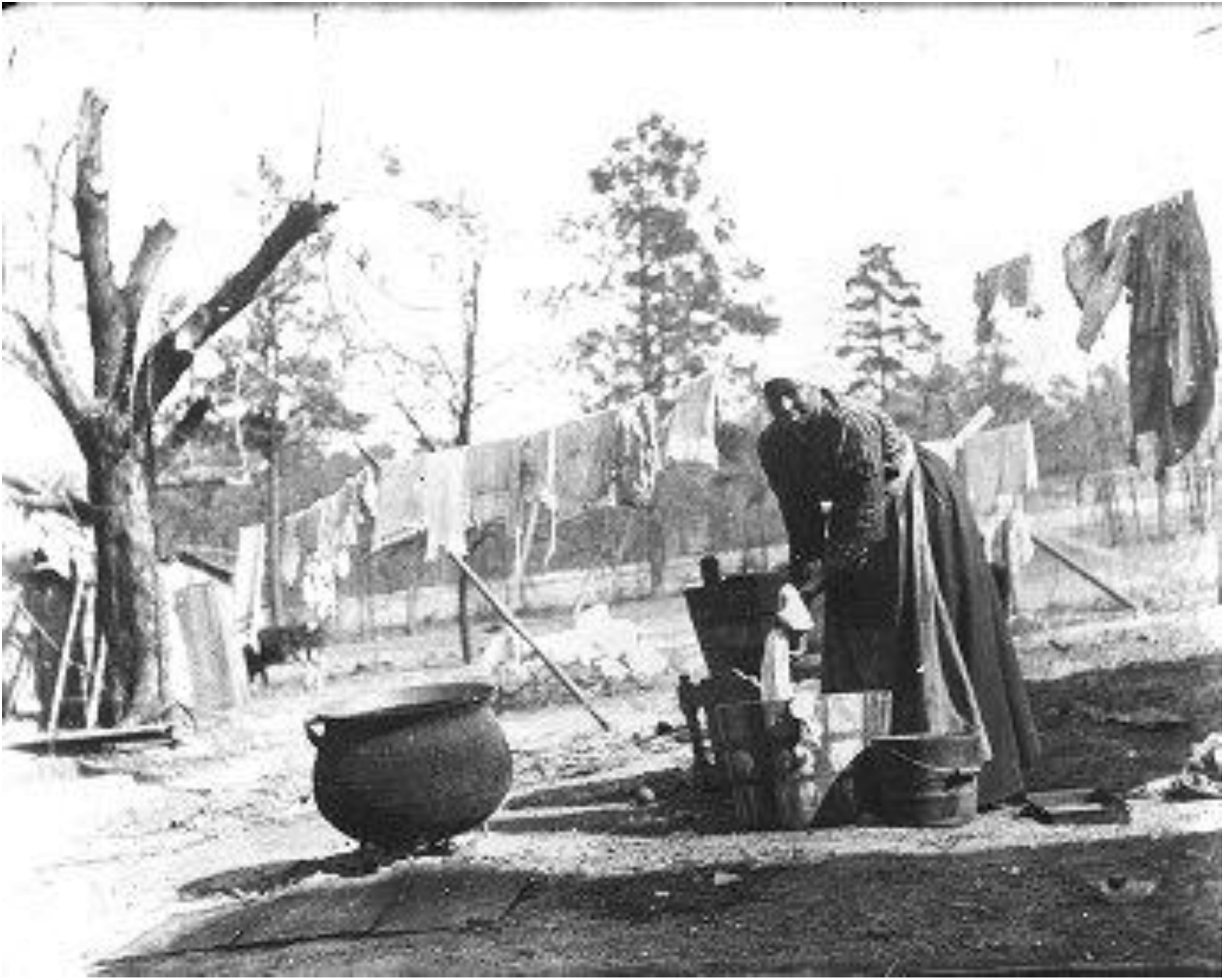

Reversible Quilt: Multiplicity in Analysis
Literature on Black quilting underscores that quilts, often dismissed as haphazard or decorative, are in fact socially and culturally encrypted systems (Davis, 1998) that preserve collective memory and communicate coded knowledge of survival, freedom, and joy. Through its practices, Black quilting refuses singularity, privileging instead a dialogic engagement between the collective and the individual, between overt and covert meanings, and between beauty and pain. This multi-layered, improvisational process models a womanist analytic stance that sees each story, fragment, or “scrap” as essential to the whole while also retaining its distinctiveness.
Thus, the reversible quilt becomes both method and metaphor for inquiry (Flannery, 2001); a womanist archival praxis that resists the flattening tendencies of traditional qualitative or historical analysis. In this sense, the reversible quilt embodies multiplicity—allowing for simultaneous readings from multiple analytic standpoints, and enhancing traditional frameworks (Toliver, 2024). This multiplicity privileges both cohesion and contradiction, and affirms that the beauty of Black life, memory, and meaning emerges precisely in the asymmetry of its construction.
The Thread of Goodness
The golden thread woven through every stage was goodness. Goodness framed research questions that sought not only to expose harm but to affirm life (Dillard & Dixson, 2006). It shaped analysis that highlighted joy, brilliance, and resilience alongside trauma. It guided writing practices that sought to repair and restore, rather than reproduce violence. Ultimately, goodness bound the quilt of this dissertation, transforming archival fragments into a testimony of Black women’s lives and livingness.
Womanist Archival Practice and Everyday Use: A Discussion
Alice Walker’s (1994) short story “Everyday Use” provides a powerful entry point for understanding the practical imperatives of a womanist archival praxis. The story centers a mother and her daughters, Maggie and Dee, whose contrasting relationships to family heirlooms—especially quilts—reveal competing understandings of heritage and identity. Dee, who renames herself “Wangero Leewanika Kemanjo,” seeks to display the quilts as cultural artifacts, while Maggie and her mother understand them as living objects imbued with the labor, love, and everyday use of their ancestors.
Walker’s narrative highlights the tension between performative displays of heritage and lived, relational practice. For womanist archival research, this distinction is vital. Like the quilts, archival fragments carry the spiritual and emotional labor of generations; they are meant to be handled, used, and engaged—not merely exhibited. A womanist archival praxis, then, requires the researcher to practice what the story teaches: that knowledge must be lived with rather than looked at. The researcher, like Maggie, becomes a caretaker and steward—one who preserves ancestral presence through active, ethical engagement with the materials of history.
Within this framework, the dissertation becomes analogous to Maggie’s care of the quilts. The principles of piecing, stitching, layering, and binding are not abstract metaphors but methodological actions shaping how research questions are framed, how archives are navigated, how data are interpreted, and how findings are shared. This “everyday use” approach grounds the (re)search for goodness in the daily, relational labor of research itself—collecting fragments, tracing connections, interpreting with care, and sharing knowledge in ways that repair, affirm, and sustain communities.
Arts-Based and Spiritual Practices as Methodological Imperatives
While qualitative research has long embracing quilting as a method (Ausband, 2006; Flannery, 2001), arts-based and spiritual practices have been less embraced methodologically in historical and archival research. As Hartman (2008) reminds us, the stories of enslaved and marginalized women survive only in pieces and fragments. To engage these fragments ethically requires imagination—what Hartman calls “critical fabulation”—a willingness to write within the gaps with care, creativity, and humility. In this sense, art and spirit converge as modes of endarkened knowing (Dillard, 2012), resisting Eurocentric demands for detached objectivity and embracing wholeness, relationality, and the affective dimensions of research.
This project, therefore, does not claim to invent something wholly new but rather gathers, extends, and honors the long-standing practices Black women have pieced together from what was already at hand. Like quilters who transform scraps into coverings of warmth and meaning, this praxis works with fragments, silences, and inherited wisdom to craft something enduring, ethical, and beautiful.
The (Re)search for Archival Goodness: Expanding the Methodological Horizon
The womanist archival praxis of the (re)search for goodness extends existing methodological conversations in several important ways. It first reimagines research as a sacred craft, positioning the process of inquiry as a theological and creative act of care. The work of quilting—often dismissed as domestic labor—becomes a model for scholarly rigor that centers love, imagination, and devotion. Second, this praxis distinguishes itself by centering goodness as its methodological telos. While many Black feminist and womanist methods focus on liberation, justice, or resistance, this approach foregrounds repair, joy, and love as equally vital dimensions of the pursuit of knowledge. Third, it bridges art, spirituality, and analysis, integrating creative expression and theological reflection into the heart of scholarly practice. Fourth, it reframes reflexivity as a reparative act, one that binds ethical responsibility across time, rather than a mere acknowledgment of positionality. Finally, it performs a womanist temporality in which past, present, and future intertwine—where ancestors, researcher, and community co-create knowledge in a cyclical process of return and renewal.
The ontological aim is not simply to recover lost knowledge but to restore spiritual, emotional, and communal wholeness through the very act of research. Goodness is treated as both knowledge and method. The researcher acts as quilter and caretaker, piecing together fragments and tending to archival wounds. This epistemic orientation frames research as restoration—a practice of ethical, aesthetic, and spiritual repair that honors the sacredness of Black women’s intellectual and embodied traditions.
Methodologically, this approach manifests as a quilted praxis. Each stage—piecing, stitching, layering, binding—serves as both methodological phase and ethical stance. It is multimodal and arts-based, integrating poetry, collage, journaling, and speculative storytelling. These creative practices are not embellishments but essential ways of knowing, embodying the spiritual and affective labor that womanist research demands. The archive itself is treated as fabric—fragmented yet stitched through love, imagination, and care—co-created with the researcher as a site of repair and revelation. In this sense, the Womanist Archival Praxis of the (re)search for Goodness does not merely interpret the past but tends to it—repairing historical ruptures and reweaving the moral fabric of research itself. It transforms scholarly inquiry into a spiritually grounded, love-infused practice of collective remembrance and renewal.
Tensions and Limitations
Despite its richness, this methodology carries tensions that must be navigated with care. Engaging in ancestral recovery entails interpretive risk; it demands humility to avoid projecting meaning where the archive remains purposefully silent. The line between speculation and evidence must be carefully maintained, balancing imaginative reconstruction with fidelity to historical integrity. Moreover, such a spiritually infused and arts-based approach may be met with skepticism in academic contexts that privilege empirical detachment from spirituality (Neal-Stanley, 2025). This method also requires deep emotional labor, sustained attention, and a willingness to slow down, making it both demanding and profoundly transformative.
Toward a Living Study of Goodness
The (re)search for archival goodness is a womanist–centered method to historical inquiry that gathers fragments, scraps, and remnants from diverse traditions and stitches them together into a methodological quilt. Like Black women quilters who make beauty and wholeness from what is available, this praxis works with silences, distortions, and fragments of the archive to re-member the intellectual, pedagogical, and spiritual lives of historical Black women. It combines the attentiveness, interpretive rigor, and political awareness modeled by Black women herstorians with explicit attention to spirit, relationality, and creative expression. Through arts-based practices such as narrative reconstruction, poetic interpretation, and visual mapping, womanist archival praxis cultivates a multidimensional engagement with archives, one that attends to affective, spiritual, and communal dimensions of Black women’s histories.
Womanist archival praxis holds in tension both the violence of what is missing and the creativity of what can be imagined. It approaches the archive critically and lovingly—refusing its claims to neutrality while recognizing its possibilities for recovery, reimagination, and (re)membering (Campt, 2017; Dillard, 2012). It calls for humility, rejecting extractionist approaches in favor of relational, affective, and spiritual engagement. It insists that archival work is not merely academic or intellectual labor but also a spiritual and artistic practice of care for those whom the archive has tried to erase. In this way, the violence and limits of the archive do not foreclose the recovery of Black women’s histories. Instead, they compel us to turn toward liberatory methods—arts-based, spirit-centered, and community-grounded—that more fully honor the survival, wholeness, and goodness that have always animated Black women’s lives.
Together, these patches form a quilt that does not seek perfection or seamlessness but coherence, care, and beauty. In the tradition of Black women quilters, who transform remnants into coverings of warmth and meaning, the (re)search for archival goodness pieces together fragmentary sources into life-affirming narratives. It is not a promise of completeness—no archive can yield that—but an ethical stitching that honors the wholeness, dignity, and survival of Black women across time.
Footnotes

Funding
The authors disclosed receipt of the following financial support for the research, authorship, and/or publication of this article: This research was generously supported by The Crossroads Project, Black Religious Histories, Communities, and Cultures Research Fellowship at Princeton University.
Declaration of Conflicting Interests
The authors declared no potential conflicts of interest with respect to the research, authorship, and/or publication of this article.