







Abstract
Multilingual qualitative research in the Democratic Republic of the Congo frequently depends on interpretation and translation across French and national or local languages, yet these processes are often reported as technical steps rather than methodological sites where meaning, power, and confidentiality are negotiated. This article presents an auditable Translation and Interpretation Workflow that documents how talk moves from interpreted interviews to translated transcripts and analytic claims. Using examples from Congolese qualitative projects, the article shows how translation choices alter coding, theme boundaries, and causal interpretation, especially when participants use indirect accusation, kinship terms, emotion idioms, legal administrative language, or stigma laden and politically sensitive expressions. Comparative analysis shows that literal, meaning based, culturally annotated, and protective strategies produce different analytic possibilities, with distinct tradeoffs for safety, feasibility, and interpretive precision. The workflow provides feasible documentation standards, including interpreter profiling, concept glossaries, translation memoing, bilingual verification on an audit subset, structured adjudication, and implementation templates for translation memos and adjudication notes. The article concludes by identifying criteria for evaluating successful translation workflows and by clarifying how the model can be adapted to other multilingual qualitative settings.
1. Introduction
Qualitative research in the Democratic Republic of the Congo routinely crosses language boundaries because everyday life, governance, and community authority circulate through French alongside national and local languages. A growing cross language methods literature shows that translation decisions are analytic decisions, because they determine what is preserved, what is softened, what is made legible to external audiences, and what is positioned as noise or ambiguity (Abfalter et al., 2021). For research in multilingual African settings, this matters because language is not only a medium of expression but also a marker of education, political affiliation, gendered respectability, rural or urban belonging, and exposure to institutions. When researchers move quickly from speech in Lingala, Kiswahili, Ciluba, Kikongo, or other local repertoires into French or English transcripts, the shift can quietly reframe kinship obligations, moral evaluations, and legal categories, producing findings that appear stable while depending on unreported interpretive labor.
International debates on qualitative rigor increasingly emphasize transparency, documentation, and the ability of readers to understand how interpretations were produced. Reporting standards for qualitative research ask authors to account for procedures that shape analytic trustworthiness, including decisions about data processing and representation (Levitt et al., 2018). Yet translation is still unevenly visible in methodological reporting. In health and social research, translation is often mentioned briefly in a methods paragraph, with little detail about interpreter roles, how disagreements were handled, what was done with culturally dense expressions, or how language choices affected coding. Work focused on translation reporting argues that this omission is not minor because readers cannot evaluate whether key concepts were stabilized through careful interpretive negotiation or through unexamined substitution (Yunus et al., 2022). More recent scholarship further questions the assumption that “good translation” means equivalence between source and target texts, arguing instead that validity depends on how researchers manage difference, uncertainty, and power within the translation process (Zhao et al., 2024). The practical challenge is therefore not to demand exhaustive bilingual archives from authors, but to encourage concise reporting of key translation decisions: which languages were used, who interpreted or translated, when translation occurred, how disagreements were resolved, whether bilingual verification was conducted, and how confidentiality risks were managed.
The Congolese sociolinguistic landscape intensifies these concerns because French often indexes institutional authority, while national and local languages may carry everyday ethics, emotional force, or locally authorized forms of naming harm and responsibility. Lingala, for example, functions as a supranational language with political histories and shifting status across regions and institutions, shaping who is heard and how claims are framed (Bokamba, 2019). Language hierarchies also shape research teams, since interpreters and translators are rarely neutral conduits. Evidence from Congolese research capacity collaborations, even when focused on education and training, illustrates how searching for a “common language” changes participation and power in knowledge production, with downstream effects on what becomes discussable and who can claim expertise (Horwood et al., 2021). This is the methodological problem that motivates the present manuscript: multilingual qualitative research in the DRC needs procedures that make translation and interpretation auditable sites of meaning making rather than invisible steps between interview and theme.
This article addresses that need by introducing a Transparent Translation and Interpretation Workflow, designed for multilingual qualitative research in the DRC and similar settings where language is intertwined with power and confidentiality. The workflow is proposed as a flexible, risk sensitive guide rather than a rigid universal standard; its components can be scaled according to topic sensitivity, linguistic complexity, team capacity, and confidentiality risk. The workflow is built to be replicable, not because qualitative interpretation should mimic quantitative reproducibility, but because multilingual processing adds an additional layer where meaning can shift without notice. Guidance on qualitative audit procedures underscores that transparency improves credibility when it clarifies how decisions were made, how disagreements were handled, and what documentation exists for external appraisal (de Kleijn & Van Leeuwen, 2018). The proposed workflow therefore treats translation choices as traceable analytic moves through structured memoing, dual language coding checkpoints, and explicit adjudication practices. To support implementation, the article also includes worked examples of meaning shifts and practical documentation tools, including translation memo and adjudication note templates.
The workflow also foregrounds ethics, since translation can expose sensitive information and can change what is identifiable in small communities. Qualitative ethics reviews emphasize that dilemmas often emerge during fieldwork and analysis rather than only at consent, making it essential to design procedures that anticipate risk during transcription, translation, and storage (Taquette & Borges da Matta Souza, 2022). The need for such a workflow is especially acute in contexts shaped by surveillance concerns, politicized speech, and community level reputational risk. Work on networked civic engagement in sub–Saharan Africa includes examples from eastern DR Congo that highlight how participants and facilitators rely on controlled communicative spaces and careful boundary management to protect safety and sustain voice (Toumaras, 2025a). In multilingual interviewing, interpretation can widen or narrow those boundaries, for instance when an interpreter chooses a more explicit target language phrase that increases identifiability, or when culturally recognized indirect speech is rendered as direct accusation. Ethical translation therefore requires more than accuracy in wording. It requires procedures that account for who is exposed by particular renderings, what social relationships are invoked by specific kinship terms, and how confidentiality can be compromised through seemingly minor lexical choices.
The article proceeds by first grounding translation and interpretation as methodological and ethical work, then presenting the workflow from interpreter positioning to adjudication and reporting. It then demonstrates how specific translation choices can alter codes, theme boundaries, and causal accounts, before considering how the workflow may be adapted to other multilingual qualitative contexts.
2. Conceptual and Methodological Grounds
In applied fields, scholars have shown that translation decisions are routinely underreported, leaving readers unable to evaluate how meaning was produced and how analytic conclusions were reached (Schumann et al., 2025). In humanitarian borderlands that include the Democratic Republic of the Congo, for example, qualitative interviewing often requires movement across several languages and registers, and these shifts are tied to power and accountability in ways that shape what becomes narratable and what remains unsaid (Toumaras, 2025b). For this reason, the methodological issue is not only whether translation is accurate, but whether the research account makes visible the social conditions under which translation becomes possible, risky, selective, or constrained.
A decision-oriented conceptualisation provides a concrete starting point for methodological grounding because it obliges research teams to make translation choices explicit, to justify them, and to treat them as revisable. Abfalter et al. (2021) propose a systematic framework that requires researchers to specify why translation is needed, when translation occurs across the study timeline, what materials are translated, who translates, how translation is carried out, where translation work is socially located, and by what means it is resourced. This approach is useful in multilingual Congolese research because translation is rarely a single step that happens after data collection. Because translation occurs through people, methodological grounding must treat interpreters and translators as co producers of data and analysis rather than as neutral instruments. Narrative accounts of working with interpreters show that they manage interactional dynamics, calibrate emotional intensity, repair misunderstandings, and decide when to explain culturally embedded terms or when to keep phrasing close to the participant for later interpretation (Bergen, 2018). Interpreter identity and positionality therefore become analytic conditions, not background characteristics. In DRC fieldwork, an interpreter’s gender, age, education, urban or rural affiliation, ethnicity, religious identity, institutional ties, or perceived closeness to local authority may affect what participants disclose, soften, avoid, or translate into safer registers. A participant may speak differently to an interpreter perceived as a community insider than to one associated with an NGO, state office, church, customary authority, or university. These positional effects should be documented reflexively, while also protecting interpreters from being made identifiable or vulnerable through the audit trail.
Translation becomes even more consequential when the research topic is sensitive, stigmatized, or linked to risk. Ho et al. (2019) demonstrate that translation of sensitive qualitative data is inseparable from analytic decisions because the translator must decide how to render taboo or politically charged material without increasing harm, while also preserving conceptual nuance needed for analysis. In addition, recent work has argued for an ethics of inclusivity and care in cross language research, emphasizing that translation is relational labor that should be recognized, supported, and integrated into the analytic team rather than outsourced as invisible service work (Mueller & Baniya, 2024). This care extends to interpreters as well as participants, since interpreters may carry emotional burdens, face pressure from local actors, or become exposed when they mediate politically sensitive speech. A workflow that records interpreter decisions must therefore distinguish between methodological transparency and unsafe disclosure.
Ethical grounding is inseparable from methodological grounding because language mediation changes the confidentiality landscape and redistributes vulnerability. A critical review of ethical dilemmas in qualitative research emphasises that consent and protection must be understood as ongoing practices that respond to context specific risks rather than as standardised form based compliance (Taquette & Borges da Matta Souza, 2022). Ethical practice requires explicit negotiation of interpreter roles, confidentiality expectations, and safe handling of notes and recordings. It also requires attention to the interpreter’s own safety, because interpreters can face pressure from local authorities or community members who want information. Mueller and Baniya (2024) argue that inclusive translation practice must account for how language mediation can either widen participation or create new exclusions, which is relevant to Congolese contexts where language choice may index schooling, urban status, or affiliation. Accordingly, confidentiality in multilingual research is not achieved only by removing names. It also requires attention to recognisable speech styles, kinship chains, place references, rare events, and locally specific terms that may identify participants or interpreters even after conventional anonymisation.
This conceptual and methodological grounding supports a transparency oriented view of rigor that remains feasible even when primary data cannot be fully shared. Calls for better reporting of translation practices emphasise that readers need to know who translated, how decisions were made, and where meaning uncertainty remains, because these features affect the defensibility of claims and the possibility of methodological learning across studies (Schumann et al., 2025). Transparency here does not require releasing identifiable transcripts. It requires producing an auditable record of translation decisions that links the multilingual chain from speech to transcript to code to claim. Erhard et al. (2021) propose openness, reflexivity, and pragmatism as guiding principles for cross language qualitative research, arguing that rigor is strengthened when researchers openly describe constraints, document decision points, and adopt practical strategies that preserve meaning while acknowledging limits. The workflow developed here follows this pragmatic logic: it is not a universal standard applied identically across studies, but a flexible guide for deciding which translation decisions require documentation, verification, adjudication, or protective withholding.
3. From Speech to Claims: An Auditable Workflow and Demonstration Design
The transparent translation and interpretation workflow is designed to make multilingual qualitative research auditable from first contact with participants through to analytic claims reported in English or French. Methods scholarship on cross language work repeatedly shows that meaning shifts are produced at identifiable decision points, yet those decisions are rarely documented in publications with enough detail for readers to assess credibility (Abfalter et al., 2021; Yunus et al., 2022). Recent field specific commentary has also emphasized that translation often has an iceberg quality, with substantial interpretive labor remaining below the surface of published analyses (Schumann et al., 2025). This workflow responds by treating translation and interpretation as part of data generation and analysis rather than a technical transfer, and it centers validity as a matter of making visible how equivalence, ambiguity, and difference are handled, rather than claiming that equivalence is always achievable (Zhao et al., 2024). The output is a documentation package that includes interpreter profiles, a concept glossary, interpretation and translation memos, bilingual coding artifacts for a defined subset, and a disagreement resolution log that records how contested meanings were adjudicated and by whom (Abfalter et al., 2021; Yunus et al., 2022). To keep the workflow practical, each stage is linked to a demonstrative translation trajectory: a source expression, an interpretation decision, a documentation artifact, and the analytic consequence of that decision. Appendix A provides these stage-by-stage examples, including sample memo entries, adjudication notes, and de identified excerpt matrices.
The workflow begins with interpreter recruitment and positioning as a methodological choice rather than staffing logistics. Studies of interpreter mediated qualitative interviews show that interpreters actively shape the interaction through choices about pronouns, politeness, repair, and the handling of taboo or politically risky language, which can shift what becomes sayable and recordable (Bergen, 2018; Egilsson et al., 2022). In the DRC, where community ties, gender norms, and local authority structures can strongly condition disclosure, the workflow uses a structured interpreter profile to document language repertoire, community and kinship ties to likely participants, prior work for institutions that may influence perceived neutrality, and any constraints related to security and political risk. This emphasis aligns with calls to treat translation labor as ethical and relational work, including attention to emotional labor, care, and the possibility that the interpreter is placed in a difficult position between participant safety and research demands (Mueller & Baniya, 2024). The interpreter profile is then paired with a short training session that standardizes the interview stance and sets expectations for confidentiality and note taking, acknowledging that standardized practices must still be negotiated in context (Bergen, 2018; Egilsson et al., 2022). For example, the profile is not used only to list languages spoken; it helps analysts later interpret whether a participant’s shift into French legal vocabulary, deferential address, or indirect accusation may have been shaped by the interpreter’s perceived institutional or community position.
Before fieldwork, the workflow requires concept glossary building because many terms central to social science inquiry in the DRC carry layered legal, moral, and relational meanings across French and national languages. The glossary is built collaboratively among the core research team and interpreters, starting from the interview guide and the study’s analytic interests. It records candidate translations, local variants, and short usage notes that describe when a term is avoided, softened, or intensified in ordinary speech. This step is grounded in guidance that translation timing and objects of translation should be explicitly planned because early decisions about how to render key concepts can shape what is later coded as evidence (Santos et al., 2015). It also responds to the argument that translation decisions are omnipresent in qualitative research and should be made explicit through systematic questioning about what is translated, by whom, for which audience, and with what consequences for meaning (Abfalter et al., 2021). In practice, the glossary in DRC research often needs entries for morally loaded categories, kinship and authority terms, and locally specific descriptions of coercion and consent, because direct lexical matches can be misleading or can erase culturally anchored distinctions. In the demonstration materials, glossary entries are treated as analytic safeguards: when one publication language term such as consent, family, authority, or land right covers several source language meanings, the glossary prevents premature merging of distinct social relations into a single code.
During data generation, the workflow specifies a live interpretation protocol that prioritizes accountability to the participant’s voice while recognizing constraints of safety and social norms. Research on interpreter mediated interviewing highlights that first person interpretation can help preserve speaker position, reduce interpretive distancing, and make it easier to identify when the interpreter is adding clarification or summarizing (Bergen, 2018). Immediately after each interview, the interpreter and interviewer conduct a short debrief that produces field notes focused on idioms, culturally specific references, and moments where the interpreter judged a literal rendering to be misleading, reflecting calls to recognize the interpreter’s influence and to plan for it rather than pretending it can be removed (Egilsson et al., 2022). The protocol therefore records not only what was translated, but also when the interpreter paused, softened, clarified, preserved ambiguity, or withheld identifiable detail for safety. These brief notes become evidence for later analysis rather than informal memory.
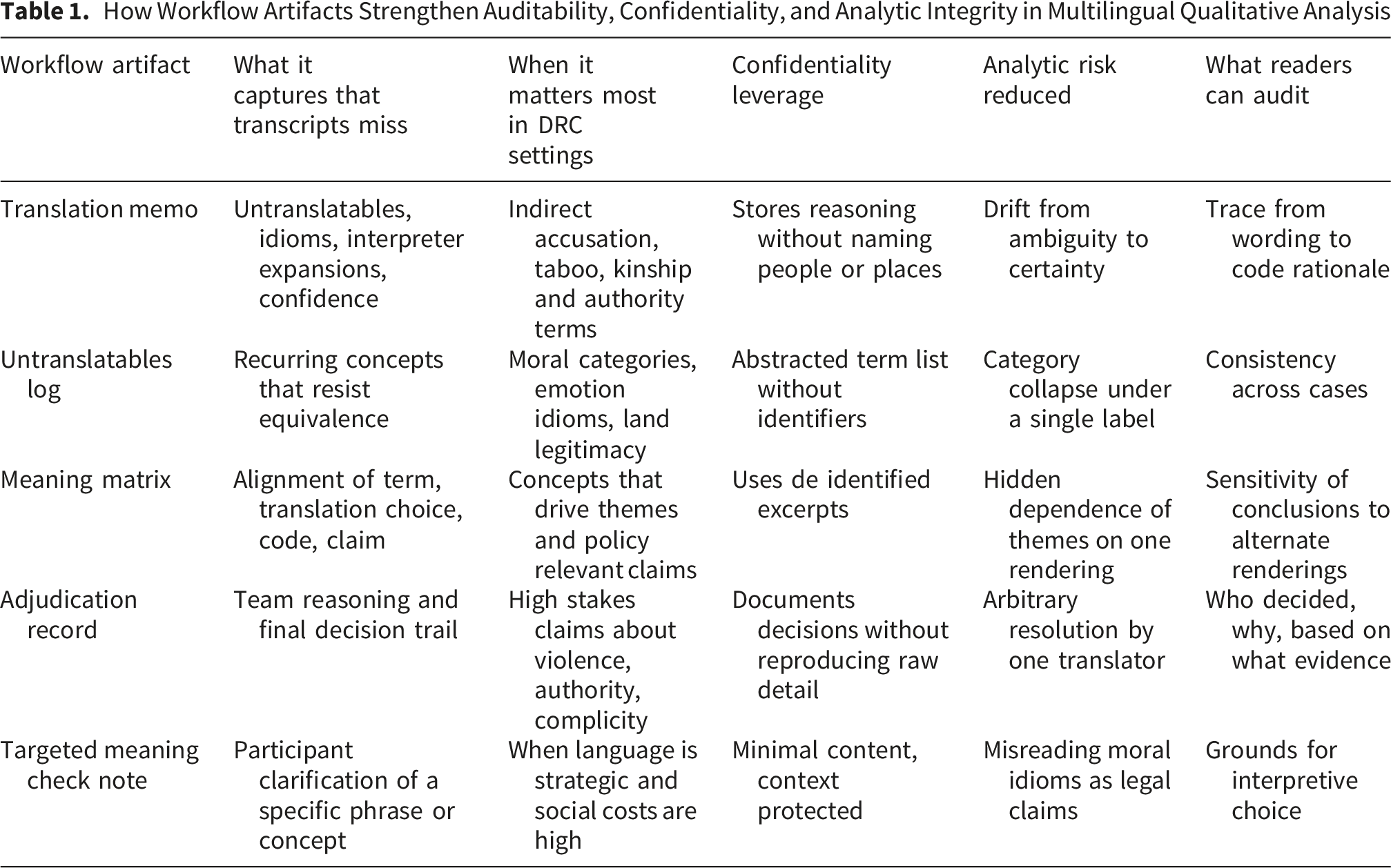
The next stage is translation memoing during transcript production. Instead of producing only a clean French or English transcript, the workflow creates a transcript record that preserves a traceable path from original speech to the analytic text. The translation memo is attached to each transcript and flags untranslatable words, idioms, and culturally specific concepts, with short explanations of possible readings and the rationale for the chosen rendering. This directly addresses evidence that translation processes are often underreported in qualitative health and social research, despite their clear implications for trustworthiness (Yunus et al., 2022). It also aligns with the view that validity discussions should extend beyond simple equivalence claims and should document uncertainty, contestation, and interpretive plurality as normal features of multilingual qualitative inquiry (Zhao et al., 2024). To strengthen auditability, the workflow links memo entries to time stamps in the audio file and to the interpreter’s debrief notes when available, allowing later analysts to revisit contested segments. The overall documentation logic follows guidance on audit procedures that emphasize transparent reporting of methodological decisions and the relationships among people involved in producing the dataset (de Kleijn & Van Leeuwen, 2018). Appendix B provides a concise translation memo template with fields for source term, literal rendering, working translation, alternative meanings, confidentiality risk, strategy chosen, and rationale.
Analysis proceeds through a dual language coding strategy that is designed for feasible use in resource constrained settings while still producing defensible claims. Full bilingual coding of all materials is rarely practical, but selective bilingual coding can surface systematic meaning shifts and can help teams decide which concepts require deeper linguistic attention. The workflow therefore defines an audit subset of interviews for bilingual coding, selected to represent key languages, sites, and participant groups, and it codes this subset in both the original language and the publication language. For each focal concept, the team produces a meaning matrix that aligns original terms, translation choices, memo rationales, and resulting code applications, making it possible to see how translation decisions propagate into thematic patterns. This approach treats thematic analysis as interpretive work that benefits from explicit decision trails, which is consistent with guidance on producing auditable analytic processes (Nowell et al., 2017) and with cautions about quality practice in thematic analysis that emphasize coherence between analytic claims and the procedures used to generate them (Braun & Clarke, 2021). It also reflects the argument that translation validity should be judged through transparent reasoning about interpretive choices rather than through an assumption that one correct equivalent exists (Zhao et al., 2024). Because resources are limited, the workflow treats audit subset coding as the recommended minimum for high stakes multilingual studies, while recognizing that full bilingual coding may be justified only when language difference is central to the research question or when claims depend heavily on culturally dense terms.
Disagreement resolution is then formalized because multilingual teams often discover that the same segment supports different analytic claims depending on how key terms are rendered. The workflow distinguishes disagreements about lexical meaning, disagreements about pragmatic force such as sarcasm or politeness, and disagreements about social positioning such as whether a phrase signals deference, fear, or accusation. It resolves these disagreements through structured adjudication meetings that include the interviewer, interpreter, and at least one additional bilingual team member when feasible, with outcomes recorded in a log that links back to the translation memo. When the disagreement concerns participant intended meaning rather than linguistic form, the workflow supports targeted participant meaning checking for a small number of high stakes segments, conducted in a way that does not reveal sensitive content to third parties and that respects risks in small communities. This emphasis reflects methodological writing that treats translation labor as ethically consequential and calls for practices that foreground care, safety, and the distribution of interpretive authority (Egilsson et al., 2022; Mueller & Baniya, 2024). The workflow also aligns with reporting standards that encourage explicit description of analytic procedures and decision making so that readers can evaluate credibility (Levitt et al., 2018). Appendix C provides an adjudication note template that records the disputed phrase, competing interpretations, evidence considered, final decision, remaining uncertainty, and publication handling.
The demonstration design reported in this research uses two existing qualitative projects as demonstration datasets to test and illustrate the workflow under realistic DRC conditions. The intent is not to claim representativeness, but to show how the workflow performs across different language configurations and topic sensitivities. The first dataset is positioned as a higher sensitivity case that involves interviews in at least one national language plus French on a topic where stigma, fear of retaliation, or moral judgment is likely to shape disclosure. The second dataset is positioned as a governance or livelihoods case that involves dense legal and kinship vocabulary, where translation choices about authority, land claims, and community belonging can shift the interpretation of agency and legitimacy. In each dataset, the unit of demonstration is a translation trajectory that includes the original audio, interpreter debrief notes, the first written transcript in the interview language, the translated transcript, the translation memo, and the coded analytic outputs. Selecting a manageable audit subset for bilingual coding follows an information power logic, where the subset size is guided by the specificity of the sample, the quality of dialogue, and the analytic aims rather than by a fixed numeric threshold (Malterud et al., 2016). This demonstration analysis finally responds to published concerns that translation processes are often invisible in final manuscripts by making the documentation artifacts part of the methods reporting itself (Yunus et al., 2022) and by using a structured audit logic that clarifies how the research team managed transparency, confidentiality, and interpretive authority (de Kleijn & Van Leeuwen, 2018). The supplementary appendices therefore carry the detailed demonstration burden, while the main text focuses on the logic of the workflow and the analytic lessons drawn from it. This keeps the article concise while allowing readers to inspect how translation choices moved from speech, to memo, to code, to claim.
4. Protocol
4.1. Interpreter Positioning and Concept Work as Upstream Controls on Meaning Shift
Interpreter positioning and concept preparation shaped the entire meaning chain long before the first transcript existed. In both demonstration projects, the most consequential shifts did not begin at the moment of written translation. They began at recruitment and calibration, when interpreters brought their own social location, safety concerns, and communicative norms into the interview space, and when the team decided which concepts would be treated as stable anchors across languages. The interpreter profile tool surfaced that language competence was the least contentious dimension. The more fragile dimensions were community embeddedness, perceived political alignment, and gendered legitimacy to ask about particular topics. When an interpreter was seen locally as tied to customary authority, participants tended to narrate land and leadership issues in a legitimizing register, relying on terms that framed authority as natural and morally grounded. When an interpreter was perceived as aligned with administrative structures, participants shifted toward French loanwords and quasi legal phrasing, often compressing story based accounts into claims about documents, rights, and procedures. The workflow made this visible by requiring interpreters to record short reflexive notes after each interview, and by linking these notes to later translation memos.
The pre field glossary functioned as a negotiating space where these positional dynamics became actionable. The team initially approached the glossary as a list of equivalents, but early interviews forced a shift toward concept descriptions that tracked moral force, not only denotative meaning. For example, a term used for local authority could be rendered as chief, customary leader, or land guardian in French or English. Each option carried different assumptions about legitimacy and coercion. During glossary workshops, interpreters often resisted a single translation because they anticipated how a word would be heard by outsiders, especially in conflict affected settings where categories like militia, community defense, and youth group can map onto legal risk. The glossary therefore evolved into a living record of contested meanings, capturing when a term indexed kinship hierarchy, when it implied spiritual sanction, and when it was used as a euphemism for coercive power. The key analytic insight was that glossary building did not reduce ambiguity. It redistributed ambiguity into documented choices, which later allowed the team to trace how a theme was stabilized around one rendering rather than another. Appendix A provides de identified examples of glossary entries for emotion, kinship, authority, legal, and stigma related terms, showing how alternate renderings changed coding decisions.
Calibration interviews made the interaction between interpreter positioning and the glossary especially clear. When two interpreters rendered the same short narrative, differences clustered around agency, accountability, and intensity. One interpreter preserved first person voice and left ambiguity intact, producing translations that kept uncertain pronouns and indirect accusation. Another interpreter clarified relationships and motives, often converting ambiguity into explicit statements that sounded more evidentiary in French. In the workflow, both renderings were not treated as errors to correct but as alternate interpretive pathways that could plausibly lead to different coding. The team used these calibration differences to revise the live interpretation protocol, adding a requirement that clarifications be signaled as clarifications and recorded in a brief note. This step directly addressed interpreter positionality: the team asked not only whether a rendering was linguistically defensible, but whether the interpreter’s gender, institutional association, community embeddedness, or perceived authority had shaped what the participant made sayable.
As fieldwork progressed, the glossary and protocol co evolved through iterative updates triggered by translation memos. Memos tended to accumulate around the same concepts, revealing which domains were most vulnerable to meaning shift. Kinship terms were a persistent source because they were often used strategically to claim rights, obligations, or protection, and they did not map cleanly onto French family categories. Emotion words were another source, especially those that combine feeling with moral evaluation. When a participant used a phrase that literally referenced the heart but pragmatically communicated endurance, resentment, or moral injury, a flat translation as sadness or anger collapsed important distinctions. The workflow treated these memo clusters as analytic signals. Instead of waiting until coding to notice that an entire theme relied on a fragile term, the team revised the glossary entry, added contextual notes, and flagged segments for dual language review. This interaction between memoing and glossary maintenance created a feedback loop where early translation uncertainty guided later analytic attention.
These upstream controls also shaped what counted as credible evidence during coding. In the dual language audit subset, the same conceptual code could look stable in the publication language while being unstable in the source language. A code labeled consent, for example, appeared coherent in French across multiple interviews, yet the underlying terms in the source languages varied between expressions of permission, endurance, family negotiation, and fear of consequence. Without the glossary notes and memos, those variations would have been treated as stylistic differences rather than substantively distinct forms of agreement. The meaning matrix made the interaction explicit by aligning each coded segment with the original term, the chosen translation, and the memo rationale. Analysts then had to decide whether the code represented a single phenomenon with local variants or multiple phenomena mistakenly merged by a convenient publication language label. In practice, this led to a pattern where some themes were split into sub themes anchored in source language distinctions, while other themes were retained but reframed with careful language that acknowledged variation.
4.2. Interpreted Interviewing as a Site of Safety, Voice, and Evidence Production
The live interpretation protocol became most consequential in moments when participants navigated fear, stigma, and contested authority. In both projects, these moments clustered around naming, blame, and the social costs of being understood too clearly. The protocol’s insistence on first person rendering did more than preserve narrative style. It altered the interactional alignment in the room. When interpretation shifted into third person, participants often turned their gaze and responses toward the interpreter as if the interpreter were the principal listener, which subtly moved authority away from the participant’s own framing. When the interpreter spoke in first person, participants more often continued their story in a continuous line, and the interviewer could follow shifts in certainty, hesitation, and emphasis as part of the data rather than as noise. This mattered because uncertainty carried meaning. In several interviews, participants avoided direct accusation through indirect speech, not because they lacked information, but because the act of accusation itself was risky. Rendering indirect speech into a direct allegation changed the moral and political position of the speaker. The protocol’s requirement that clarifying expansions be signaled created a boundary between participant meaning and interpreter inference, which later helped the team preserve indirectness as an analytic object rather than smoothing it into certainty.
Taboo and euphemism exposed another layer of interaction between the protocol and the data. Participants frequently used everyday expressions that functioned as protective veils, especially for sexual violence, humiliations, and collaboration with armed groups. If the interpreter converted these expressions into explicit biomedical or legal terms, the transcript gained surface clarity but lost the social practice of concealment that shaped how harm was narrated. If the interpreter remained literal, the transcript preserved speech form but risked analytic misclassification, where violence could be coded as a vague misfortune. The protocol’s ladder for handling taboo terms redirected this dilemma into documented choices. Interpreters learned to preserve the euphemism in the main translation while noting, in a short interpretation note, the conventional meaning of the phrase in local usage. This approach created two simultaneous records. The transcript retained the participant’s protective language, and the note retained a culturally informed reading that could guide analysis. The result was that concealment and disclosure were not treated as binary, but as a patterned set of communicative strategies that varied with audience, setting, and perceived risk.
The most visible impact of the protocol emerged in how it structured moments of pause. Interpreters initially hesitated to interrupt participants for clarification, especially when elders spoke or when the topic implied wrongdoing by powerful people. The protocol normalized short clarification prompts and required the team to record when a prompt was used. Over time, these prompts became a diagnostic tool. They revealed which concepts were unstable in real time and which meanings were being negotiated on the spot. In one land dispute interview, a participant said, “The land is with our people, but he carries the paper.” The interpreter paused to ask whether “our people” referred to a clan lineage, a village council, or a family household. The participant replied, “Not the house. The blood that stays here.” That short exchange shifted the analysis of ownership from household possession to lineage belonging, and it also showed how people used layered categories to avoid direct confrontation with administrative documents. Without the pause, the transcript would have presented a smooth sentence that concealed a contested category. Additional de identified examples of emotion, kinship, and legal administrative shifts are provided in Appendix A to avoid overextending the main text.
Post interview debrief notes also operated as a bridge between ethics and evidence. Interpreters often used debrief time to explain why they softened a phrase or omitted a name. Those decisions were rarely about convenience. They were shaped by confidentiality and immediate safety. In several cases, participants referred to “the one who commands” or “the people who pass at night” rather than naming individuals or groups. When interpreters recognized a reference that could identify a person, they sometimes chose to keep it vague in translation, especially in small communities where a detail could expose the participant. The debrief record allowed the team to understand the tradeoff without forcing disclosure into the transcript itself. In small or politically sensitive communities, the protocol also required removal or generalisation of place markers, rare event sequences, kinship chains, and role descriptions that could make participants or interpreters recognisable. Raw identifying notes were kept separate from shareable analytic memos, and participant meaning checking was avoided when recontact could increase exposure.
4.3. Memoing, Bilingual Verification, and Adjudication as Downstream Controls
Once interviews moved from spoken interaction into text, the most persistent threat to credibility was not simple mistranslation but analytic drift, the gradual reshaping of a participant’s account as it passes through translation, summarization, coding, and theme writing. The workflow treated drift as predictable, especially in the DRC where participants often speak through indirectness, proverbs, euphemism, and kinship coded references. Translation memos functioned as a barrier against drift because they forced translators and interpreters to name what could not be carried across languages without loss, and to record what they did about it. The memos did not aim to resolve ambiguity. They aimed to keep ambiguity visible long enough for analysts to decide whether it was linguistically incidental, culturally patterned, ethically protective, or analytically central. Appendix B provides the translation memo template used to record source phrase, literal rendering, working translation, alternative meanings, confidentiality risk, chosen strategy, and rationale.
Disagreement resolution was where the workflow most clearly exposed the interaction between language, power, and inference. Adjudication meetings repeatedly surfaced that disagreements were rarely about vocabulary alone. They were often about what the vocabulary allowed the participant to do socially. When an interpreter rendered a veiled accusation into explicit blame, another team member would ask whether explicitness was the participant’s intention or the interpreter’s repair for an outsider audience. A literal translation could be read as social stigma. An interpretive translation could be read as sexual assault. The adjudicated outcome preserved the idiom in the transcript, coded the segment as harm expressed through indirect speech, and flagged it for meaning checking only if it could be done without exposing the participant. The adjudication log therefore recorded the disputed phrase, competing interpretations, evidence considered, final decision, residual uncertainty, and whether the excerpt could be quoted, paraphrased, or withheld. Appendix C provides a sample adjudication note.
Participant meaning checking, used sparingly, acted as another barrier against drift when the analytic stakes were high and the risk was manageable. The workflow treated meaning checking as targeted clarification of a concept, not a demand that participants validate themes. The relationship between meaning checking and adjudication was important. Meaning checking was not used to settle every disagreement. It was used when the team could not decide whether the contested meaning was a linguistic ambiguity or a culturally patterned moral claim. When the risk of recontact was high, the workflow privileged bilingual team adjudication and protective paraphrase over participant follow up. This prevented the pursuit of analytic certainty from creating new confidentiality risks.
How Workflow Artifacts Strengthen Auditability, Confidentiality, and Analytic Integrity in Multilingual Qualitative Analysis
5. Implications
5.1. Demonstration Results: Where Meaning Shifts Occur and why
The demonstration material shows that meaning shifts are rarely random translation noise. They cluster around social domains where speakers in the Democratic Republic of the Congo manage risk, status, and belonging through language choice. In a multilingual ecology where French is often associated with institutions and bureaucracy while Lingala, Kiswahili, Kikongo, and Tshiluba anchor everyday sociality, participants routinely use language to position themselves in relation to authority and community norms (Bokamba, 2019). When research encounters move across these linguistic registers, translation becomes an intervention into those positions rather than a neutral transfer of content. This is visible in interpreter mediated interviews when a participant switches codes to signal caution, irony, or solidarity, and the translated transcript resolves that switch into a single stable register. The result is that the transcript can present participants as more compliant, more legally fluent, or more emotionally neutral than they were in the recorded interaction, especially when the translation is produced for an imagined external audience rather than for local sense making (Rolland, 2023; Svensson, 2024).
The most frequent meaning shifts in the demonstration arise around emotion and evaluation terms because these terms carry culturally patterned expectations about what can be said directly, to whom, and in what voice. Emotion words in many Congolese settings are often embedded in relational scenes rather than stated as inner states, and the move into French frequently invites psychologized labels that feel recognizably academic but reframe the speaker’s stance. A phrase that functions locally as a socially calibrated signal of restraint can become, in translation, a statement of fear or trauma, which then pulls analysis toward clinical or victim centered frames. In the audit subset, this changed coding from an individual emotion code to a relational or moral injury code when the source expression carried endurance, resentment, or restrained accusation rather than only sadness. This pattern aligns with work showing that translation validity cannot be reduced to lexical equivalence, because differences between source and target language formulations often carry epistemic content about how experience is organized and narrated (Zhao et al., 2024). It also fits evidence that translation timing matters: early translation into the publication language can lock an analytic pathway before the team has learned how participants use terms in context, especially when emotion vocabulary is among the first targets for thematic coding (Santos et al., 2015).
A second concentration point is legal and administrative categories, including terms tied to land, authority, documentation, marriage, and consent. In the demonstration, the movement from local language terms into French often creates an illusion of categorical precision. Local expressions that index negotiated authority or customary legitimacy become translated as formal roles with standardized powers, and references to informal dispute settlement become rendered in the language of courts or statutory rights. This shift is methodologically consequential because it changes what counts as an explanatory factor. Themes may then privilege state institutions and formal law as the organizing context, even when the participant’s account is centered on kin obligations, customary land tenure, or community enforcement. For example, where a publication language code such as consent appeared coherent, bilingual verification separated permission, family negotiation, endurance, and fear of consequence, requiring the team to split the original code rather than treat all segments as one phenomenon. Abfalter et al.’s (2021) systematic framework is helpful here because it treats translation decisions as present across the whole research process, including how categories are stabilized for analysis and publication.
Kinship and moral status terms produce a different kind of shift: a flattening of relational complexity. Words for kin and affinity in Congolese languages frequently encode obligations, hierarchy, and moral expectations that do not map neatly onto French kin labels. When “brother” becomes a simple sibling term, the transcript loses whether the relationship implies patronage, age seniority, clan affiliation, or a political alliance. This is not only a semantic loss but an interpretive loss about social structure. Conversation analytic work on interpreter mediated encounters shows that meaning shifts also emerge in the interactional sequence itself, because interpreters can reorder, summarize, or repair talk in ways that make the conversation proceed smoothly while altering what becomes hearable to the researcher (Kalocsányiová & Shatnawi, 2021). The implication is that kinship terms should not be treated as background descriptors; in the workflow they become possible analytic evidence for obligation, authority, protection, or coercion.
Stigma, taboo, and politically sensitive topics show the most ethically charged shifts. In small communities, interpreted interviewing intensifies the problem that anonymity is not only about removing names but also about controlling recognizability through speech style, place markers, and locally specific terms. Studies of interpreters in qualitative research highlight how interpreters influence power dynamics and can unintentionally dominate or redirect talk, especially when the topic is sensitive and when the interpreter feels responsible for protecting participants or themselves (Egilsson et al., 2022; Turhan & Bernard, 2022). The demonstration suggests that taboo management is a central mechanism of meaning shift: participants use euphemism, narrative distancing, or third person formulations to speak safely, while translation often replaces these strategies with direct naming. That directness can inflate perceived severity or certainty, and it can also raise risk if transcripts circulate within research teams. Ethical reviews of qualitative practice emphasize that dilemmas are often situational and emerge midstream, requiring documentation and continuous consent practices rather than one time procedural compliance (Taquette & Borges da Matta Souza, 2022). The theoretical implication is that translation choices are themselves ethical events because they change what is disclosed, how directly, and with what downstream consequences.
5.2. Comparative Analysis: How Translation Strategies Change Analytic Conclusions
The demonstration’s comparative logic shows that translation strategy is an analytic decision that reshapes what counts as evidence, what seems salient, and what is treated as an explanation. In cross language qualitative studies, researchers often discuss translation as a step that follows data collection, yet published methodological work argues that translation decisions are present at every stage, from interview interaction to excerpt selection, and that these decisions should be explicit because they condition claims (Abfalter et al., 2021; Yunus et al., 2022). The Congolese multilingual context sharpens this point because language choice signals institutional alignment, community belonging, and risk management, so a translation that smooths code switching, euphemism, or honorific forms can inadvertently relocate the speaker’s stance. When analysis later treats the translated text as a direct proxy for experience, thematic conclusions can tilt toward the categories that travel most easily into the publication language, rather than toward the categories that organized meaning in the source language.
A strategy that prioritizes close, literal rendering protects against over interpretation but can also redirect analysis toward the wrong phenomena if analysts are not equipped to read idiom, pragmatics, and local indexical meanings. Methodological discussions of cross language interviewing show that meaning is co constructed in the interpreted encounter, and that interactional repairs and summarizing moves are especially likely when the talk is sensitive or socially delicate (Bergen, 2018; Kalocsányiová & Shatnawi, 2021). A literal translation of an indirect accusation may preserve the participant’s protective speech form, yet it can also lead coders to treat the segment as uncertainty or lack of knowledge. The analytic consequence is not simply under coding; it is a shift in causal interpretation. Narratives can become stories of confusion, rumor, or misinformation rather than stories of strategic silence under constraint. In the DRC demonstration, literal translation tended to enlarge themes about ambiguity and interpersonal tension because the transcript foregrounded what was left unsaid, while the social purpose of leaving it unsaid was less visible without accompanying memoing.
A meaning based strategy, by contrast, produces a transcript that is easier to code and to cite, but it increases the risk that the publication language will supply categories that reframe the participant’s moral and political world. Work focused on sensitive qualitative data translation warns that “clarifying” translations often convert socially situated talk into standardized statements that travel well across audiences, which can unintentionally intensify disclosure and alter the relationship between what was said and what can safely be written (Ho et al., 2019; Turhan & Bernard, 2022). In the DRC demonstration, meaning based translations frequently pulled kinship moral claims into individualized psychological states and pulled customary governance into legal administrative categories. This changes conclusions in a specific way: themes become more legible to policy and legal discourse, but less able to account for how obligation, reciprocity, and locally authorized procedures shape action. The analytic frame can then privilege institutional explanations even when participants oriented to social sanction, lineage obligation, or public witnessing as the primary mechanisms that made events happen.
Ethically protective translation introduces another comparative dimension. In small communities and conflict affected settings, confidentiality can require deliberate vagueness, removal of identifying relational markers, or avoidance of direct naming, and those protections can change the apparent prevalence and texture of phenomena. Scholarship that frames translation through care highlights that translators and interpreters do not only transmit meaning; they manage emotional labor, exposure, and responsibility in ways that shape what becomes representable as data (Mueller & Baniya, 2024). The emerging discussion on cross language qualitative work in globally diverse research fields adds that English dominance and the pressure to publish can further push translation “below the waterline,” encouraging minimal disclosure about how translation shaped findings (Lingard & Klasen, 2025; Schumann et al., 2025). For DRC research, this means that a strategy optimized for safety can lead to conservative thematic claims, while a strategy optimized for clarity can increase analytic reach but also increase risk and overstate certainty. The workflow therefore uses a simple decision logic: literal rendering is preferred when speech form, hesitation, euphemism, or indirectness is analytically important; meaning based rendering is preferred when a literal version would mislead readers; culturally annotated rendering is preferred when both wording and social meaning matter; and protective rendering is required when direct translation increases identifiability or risk. Appendix E provides the strategy decision table used to apply this logic across ambiguous cases.
5.3. Human Interpretation, Automated Language Tools, and Adaptation to Other Contexts
The workflow also has implications for the growing use of machine translation and automated language tools in multilingual research. Automated tools may support low risk tasks such as initial orientation, indexing, vocabulary review, or comparison of non-sensitive administrative text, but they cannot be treated as neutral substitutes for human interpretation when data include idioms, stigma, taboo, political risk, kinship obligations, or indirect accusation. The practical problem is that automated outputs often appear fluent while concealing uncertainty, whereas human interpreters can explain why a term was softened, preserved, annotated, or withheld.
Recent scholarship illustrates the broader technologization of language work, including metaverse based immersive learning, automated vocabulary profiling, and machine learning models for predicting language performance (Sameephet et al., 2025; Wardat & Akour, 2025). In this article, their relevance is therefore limited and specific: they help situate translation work within a wider digital language environment, while reinforcing the need for human governed audit trails when multilingual qualitative evidence carries social, political, or confidentiality risk. If automated translation is used, the workflow requires human review of high stakes excerpts, documentation of machine assisted steps, and explicit memoing when automated fluency masks cultural or pragmatic uncertainty. Automation may assist the workflow, but it should not determine the final rendering of culturally dense or ethically sensitive data.
Although the workflow is grounded in DR Congo, its logic can be adapted to other multilingual contexts where language indexes power, safety, institutional access, or social belonging. These may include migrant and refugee research, Indigenous language research, humanitarian settings, multilingual health studies, education research, and projects where English or French is the publication language but not the language of lived experience. The transferable element is not a fixed checklist, but a sequence of questions: who mediates language, what meanings are likely to shift, which excerpts carry analytic or ethical weight, what documentation is feasible, and what can be made transparent without exposing participants or interpreters.
Adaptation requires recalibrating the workflow rather than importing it unchanged. In some settings, interpreter ethnicity or migration status may be most consequential; in others, caste, race, religion, colonial language hierarchy, professional status, or Indigenous sovereignty may matter more. Similarly, the audit subset for bilingual coding should reflect the local language ecology and the claims being made. A low-risk education study may need a small glossary and limited memoing, while a conflict, health, or stigma related study may require more extensive adjudication and protective paraphrase. The contribution of the DRC case is therefore methodological rather than only regional: it shows how multilingual qualitative researchers can make translation decisions inspectable while still respecting the limits imposed by confidentiality, safety, and unequal language power.
6. Final Outcomes
This research positions translation and interpretation as core analytic work rather than a logistical step, and it shows how a transparent translation and interpretation workflow can protect the validity of qualitative claims in multilingual settings such as DR Congo. A central contribution is that credibility becomes inspectable. The manuscript aligns the workflow with a documentation logic familiar in qualitative quality assurance, where analytic decisions are traceable and open to interrogation rather than presented as researcher intuition (de Kleijn & Van Leeuwen, 2018). It also responds to reporting expectations that emphasize transparency about procedures, roles, and decision points, while adapting them to the realities of multilingual qualitative inquiry where the units of analysis are routinely reshaped by interpretive mediation (Levitt et al., 2018; Yunus et al., 2022). The practical implication is that readers can evaluate not only whether findings are plausible, but also which translation choices stabilized particular interpretations and which unresolved ambiguities were carried forward as analytic tensions rather than flattened into equivalence (Zhao et al., 2024).
A successful translation workflow should meet several minimum criteria. Readers should be able to identify who interpreted or translated, when translation occurred, which languages and registers were involved, how culturally dense terms were documented, and how contested meanings were resolved. High stakes excerpts should have a visible decision trail linking source expression, translation choice, memo rationale, code, and claim. Bilingual verification should be conducted on a justified audit subset when full bilingual coding is not feasible. Confidentiality decisions should also be visible without exposing participants, interpreters, or communities. The goal is not perfect equivalence, but accountable interpretation: a process in which uncertainty is documented, ethically managed, and analytically considered.
However, limits remain. The workflow was demonstrated in a bounded set of projects and languages, and it cannot guarantee that all meaning shifts are captured, especially when insecurity constrains recording, participant follow up, or extended bilingual coding. The approach is also resource intensive, and the political economy of research often pressures teams to compress translation time and reduce interpreter involvement to meet donor timelines. These constraints are not peripheral; they are ethical dilemmas of method that must be named and managed rather than hidden (Taquette & Borges da Matta Souza, 2022). Future research should therefore test the workflow across additional Congolese languages, regions, and topic domains, and it should evaluate which components produce the greatest gains in analytic integrity under real budget and security constraints. Comparative studies can also examine how timing of translation shapes interpretation, for example whether early translation narrows analytic sensitivity to local categories or whether late translation limits collaborative sense making across multilingual teams (Santos Jr. et al., 2015).
A forward looking agenda must also address emerging translation technologies. Machine translation and related tools are increasingly used in qualitative pipelines, yet recent methodological work cautions that these tools can conceal meaning work beneath an appearance of fluency and speed, widening the gap between local speech and published claims unless human interpretive governance remains central (Lingard & Klasen, 2025; Schumann et al., 2025). The workflow can provide that governance by specifying where automation is acceptable, where human interpretation is required, and how uncertainty is documented rather than edited away. For multilingual African contexts, the policy and scientific payoff is a more trustworthy evidence base, one in which language is treated as a substantive part of method and ethics, and where findings remain accountable to the meanings people actually make in the languages they live. Beyond DR Congo, the workflow can be adapted to other multilingual settings by recalibrating its core questions: who mediates language, which meanings are likely to shift, what risks attach to direct translation, what documentation is feasible, and what level of transparency is safe.
Supplemental Material
Supplemental material - Meaning Across Languages: Demonstrating an Auditable Translation and Interpretation Workflow for Multilingual Qualitative Research in DR Congo
Supplemental material for Meaning Across Languages: Demonstrating an Auditable Translation and Interpretation Workflow for Multilingual Qualitative Research in DR Congo by Simon Kiluba, Prince Muyumba in International Journal of Qualitative Methods
Footnotes

Funding
The authors received no financial support for the research, authorship, and/or publication of this article.
Declaration of Conflicting Interests
The authors declared no potential conflicts of interest with respect to the research, authorship, and/or publication of this article.
Supplemental Material
Supplemental material for this article is available online.
References
Supplementary Material
Please find the following supplemental material available below.
For Open Access articles published under a Creative Commons License, all supplemental material carries the same license as the article it is associated with.
For non-Open Access articles published, all supplemental material carries a non-exclusive license, and permission requests for re-use of supplemental material or any part of supplemental material shall be sent directly to the copyright owner as specified in the copyright notice associated with the article.
