






Abstract
Despite increasing analytical sophistication, empirical research in organization studies continues to suffer from fragile inference, uneven theoretical accumulation, and contested credibility. This paper seeks to explain why these problems persist by shifting attention from authors’ methodological choices to the evaluative dynamics of peer review. Adopting a conceptual and theory-analytic approach, the paper theorizes peer review as an inferential gatekeeping system. Drawing on research design, theory evaluation, and philosophy-of-science literatures, this study develops an analytical framework to examine how evaluative routines shape what constitutes empirical rigor during the review process. The analysis identifies five recurring reviewer blind spots: inferential scope inflation, temporal under-specification, construct substitution for mechanisms, level-of-analysis slippage, and generalization by convention, which remain largely invisible once surface indicators of rigor (e.g., statistical sophistication, model fit, robustness checks) are satisfied. These blind spots systematically weaken inferential coherence while allowing analytically polished studies to pass review. By conceptualizing rigor as a review-mediated outcome rather than solely an authorial attribute, the paper explains why empirically rigorous studies often fail to cumulate theoretically. It advances a diagnostic framework for inferential review that reorients evaluative attention toward design-level inferential capacity without privileging specific methods or increasing reviewer burden. The paper offers a novel, system-level explanation for persistent weaknesses in empirical credibility by theorizing peer review as an evaluative system that can filter, legitimate, and amplify inferential fragility. It provides actionable diagnostic guidance to reviewers and editors, thereby strengthening the foundations of cumulative, credible organizational research.
Keywords
1. Introduction
Over the past two decades, empirical research in organization studies has undergone a marked escalation in analytical sophistication, data availability, and reporting standards. Advanced econometric techniques, structural equation modeling, multilevel designs, large-scale archival datasets, and increasingly sophisticated qualitative and mixed-method approaches are now routine in leading journals. Yet this methodological advancement has not resolved enduring concerns about fragile inference, limited replicability, and weak cumulative knowledge. Instead, it has coincided with a growing disjunction between what is evaluated as rigorous during peer review and what is required for credible inference (Bollen, 1989; Shadish, 2002; Starbuck, 2016). This paper argues that the persistence of this disjunction reflects not inattentive or unskilled reviewers alone, but systematic blind spots embedded within broader institutional and evaluative structures that peer review subsequently filters, legitimates, and amplifies.
Existing discussions of rigor in organizational research have largely emphasized methodological competence, including estimator choice, robustness checks, model fit, transparency procedures, coding reliability, interpretive consistency, and methodological reflexivity (Aguinis et al., 2018; Bergh et al., 2017). These efforts have undoubtedly strengthened technical execution and reporting clarity. However, they rest on an implicit assumption: once visible methodological standards are satisfied, deeper inferential weaknesses will be detected and corrected during review. Accumulating evidence from replication failures, contradictory findings across similar studies, and persistent misalignment between theory and evidence challenges this assumption (Camerer et al., 2018; Goldfarb & King, 2016). The central problem, we contend, is not the absence of rigor signals but their overuse as proxies for inferential credibility (Rashid & Rasheed, 2026a).
This paper introduces the concept of reviewer blind spots, recurring zones of evaluative neglect in which inferential fragility remains undetected despite formal methodological compliance. Blind spots arise when reviewer attention is disproportionately allocated to analytical execution, novelty claims, or stylistic coherence, rather than to whether the inferential demands implied by theory are logically supported by the research design. Crucially, these blind spots are not idiosyncratic errors on the part of the reviewers. They are structural features of contemporary peer review, shaped by disciplinary norms, cognitive heuristics, and practical constraints on evaluative attention (Bazerman & Moore, 2012; Hirschauer, 2010).
We argue that reviewer blind spots cluster around five recurring domains of empirical evaluation. First, reviewers often underweight inferential scope alignment, approving broad theoretical claims derived from narrow or convenience samples so long as estimation appears technically sound. Second, temporal adequacy is weakly scrutinized, allowing static or minimally temporal designs to support claims about learning, adaptation, or change. Third, reviewers frequently accept construct substitution for mechanisms, whereby abstract or omnibus measures serve as substitutes for theorized generative processes without explicit validation of inferential equivalence. Fourth, the level-of-analysis consistency is insufficiently interrogated, allowing for cross-level claims without a clear aggregation logic or causal localization. Fifth, generalization logic is routinely conflated with statistical significance or sample size, rather than treated as a design-dependent inferential commitment (Rashid & Rasheed, 2026b; Cook et al., 2008; Tsang, 2014). Together, these blind spots constitute systematic evaluation gaps, not marginal oversights.
By redirecting analytical attention from author behavior to reviewer cognition and review system dynamics, this paper makes four key contributions. First, it reconceptualizes empirical rigor as a review-mediated outcome rather than a property residing solely in methods or authorial competence. Second, it develops a field-level typology of reviewer blind spots, inferential scope inflation, temporal under specification, construct substitution for mechanisms, level-of-analysis slippage, and generalization by convention, identifying the recurring zones of evaluative neglect through which inferential fragility persists even in analytically polished manuscripts. Third, it demonstrates that these blind spots carry predictable downstream consequences for theory accumulation, replication debates, and author incentive structures. Fourth, it advances a diagnostic framework for inferential review that reorients evaluative attention toward a small number of high-leverage inferential questions without advocating additional checklists, increasing reviewer burden, or privileging particular methods. The objective is not to weaken standards, but to realign evaluative attention with the foundations of causal and explanatory credibility.
This perspective is timely. As journals increasingly emphasize transparency, openness, and analytical sophistication, the principal risk is no longer methodological laxity, but misplaced confidence, the systematic acceptance of claims whose inferential architecture cannot sustain their theoretical reach. Addressing reviewer blind spots is therefore essential not only for improving individual publication decisions but for strengthening the cumulative development of empirical knowledge in organization research.
Importantly, the argument advanced in this paper is not restricted to quantitatively oriented research traditions. Reviewer blind spots can emerge across qualitative, quantitative, and mixed-method studies whenever visible signals of rigor substitute for explicit scrutiny of inferential alignment. In qualitative research, for example, richly detailed narratives, extensive coding structures, prolonged field engagement, or claims of reflexivity may similarly function as proxies for inferential adequacy, even when the relationship between empirical material, analytical interpretation, and theoretical claims remains underexamined. The core concern of this paper is therefore not methodological style, but the broader evaluative tendency to infer credibility from recognized signals of rigor without sufficiently interrogating whether the design can sustain the claims being advanced.
This paper does not argue that peer review is the sole origin of inferential fragility in organizational research. Many inferential weaknesses emerge earlier in graduate training, disciplinary incentives, publication pressures, methodological specialization, dominant theory fashions, and constraints imposed by available data and accepted research conventions. The central claim advanced here is narrower and more precise: peer review functions as a critical evaluative filter that selectively legitimates and amplifies particular forms of inferential fragility once visible signals of rigor are satisfied.
Reviewer Blind Spots, Visible Rigor Signals, Inferential Risks, and Diagnostic Interventions

2. Why Peer Review Systematically Misses Inferential Fragility
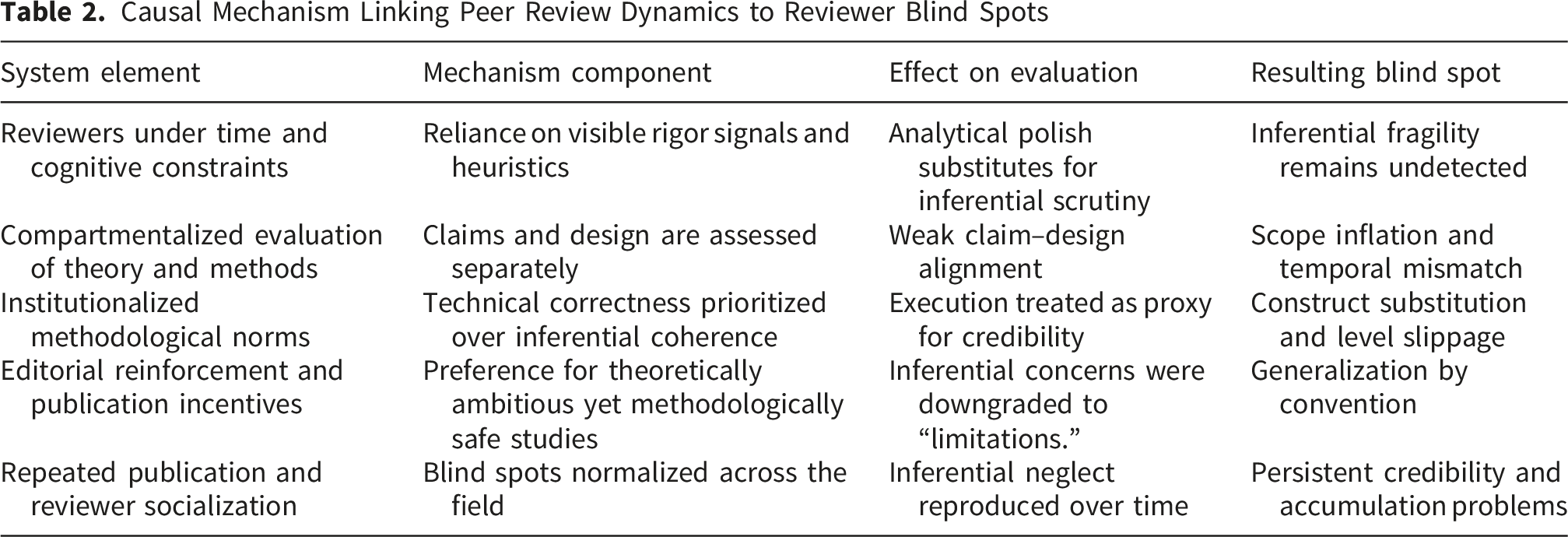
The persistence of inferential weaknesses in analytically sophisticated manuscripts raises a fundamental question: why do such weaknesses routinely pass peer review? Common explanations point to reviewer heterogeneity, time pressure, or uneven methodological expertise. While these factors shape review behavior, they do not explain the patterned and recurring nature of inferential fragility observed across journals, methods, and research domains. This section advances a more precise claim: although inferential fragility originates from broader institutional and disciplinary conditions, reviewer blind spots are systematically reinforced, filtered, and reproduced through the cognitive organization and normative stabilization of peer review, rendering certain inferential failures structurally difficult to detect rather than merely overlooked.
2.1. Rigor as a Signal Rather Than an Inferential Judgment
Peer review operates under conditions of bounded rationality. Reviewers face severe time constraints, increasing methodological specialization, and high cognitive load, all of which limit the feasibility of reconstructing a study’s full inferential logic (Hirschauer, 2010; Lee et al., 2013). Under these conditions, rigor is rarely evaluated through explicit inferential reasoning. Instead, it is inferred from visible proxies, advanced statistical techniques, large samples, extensive robustness checks, preregistration claims, and conformity to journal reporting norms (Aguinis et al., 2018; Bergh et al., 2017). These proxies serve as signals of competence, rather than guarantees of inferential validity (Rashid & Rasheed, 2026a). This dynamic is not confined to quantitatively oriented research traditions. Qualitative and interpretive research communities also rely on visible signals of rigor, including saturation, coding transparency, audit trails, triangulation, reflexivity statements, inter-coder agreement, and thick description. While these practices often strengthen empirical inquiry, they may also become proxies for deeper inferential evaluation when treated as sufficient indicators of credibility in themselves. For example, saturation does not by itself resolve case-selection logic, coding transparency does not necessarily establish interpretive warrant, triangulation does not automatically demonstrate causal mechanism, and thick description alone cannot justify broader analytic generalization. As in quantitative review, the core inferential issue is whether evaluative attention remains focused on whether the empirical design can sustain the theoretical and explanatory claims being advanced. Reviewer blind spots, therefore, emerge across methodological traditions whenever recognized signals of rigor substitute for explicit scrutiny of inferential coherence. The relevant issue is therefore not methodological orientation itself, but whether evaluative attention remains focused on the inferential relationship between evidence, design, and theoretical claims. Recent methodological scholarship in sociology and qualitative inquiry similarly emphasizes that inferential credibility depends not only on procedural transparency but also on the explicit articulation of how cases, observations, and analytical interpretations are connected to broader explanatory claims (Collins et al., 2024). These concerns parallel the argument advanced here: visible markers of rigor can strengthen methodological accountability while still leaving deeper inferential assumptions insufficiently examined.
Once such signals are satisfied, reviewer attention typically shifts toward contribution framing, novelty, or theoretical positioning. Inferential assumptions embedded in design choices, such as whether a cross-sectional survey can support claims about adaptation or whether firm-level indicators can stand in for network-level processes, are treated as secondary or implicitly resolved through analytical sophistication. As a result, inferential fragility is disproportionately concentrated in studies that are otherwise perceived as well executed. Importantly, this pattern does not reflect negligence on the part of the reviewers. It represents a rational adaptation to an evaluative environment in which methodological polish is strongly correlated with publication success and editorial approval. Over time, this dynamic institutionalizes a narrow conception of rigor that privileges execution over inference, making design-level misalignment less visible during review (Starbuck, 2016).
2.2. Decoupling Theoretical Ambition From Design Scrutiny
A second source of reviewer blind spots lies in the decoupling of theoretical ambition from inferential scrutiny of research design. Contemporary organizational research strongly rewards broad, integrative, and often dynamic theoretical claims, such as learning, resilience, adaptation, capability development, and institutional change. Yet peer review rarely enforces symmetry between the scope of these claims and the inferential capacity of the designs used to support them (Goldfarb & King, 2016; Tsang, 2014). In practice, theory sections are typically evaluated for originality and coherence, while methods sections are assessed for technical correctness. What is often missing is a systematic examination of whether the design can, even in principle, adjudicate the theory’s core claims. This compartmentalized evaluation enables dynamic theories to be paired with static designs, process explanations to be accompanied by variance-based tests, and multilevel arguments to be supported by single-level data, without triggering rejection, provided that each section meets its local evaluative standards (Bollen, 1989; Shadish, 2002). The result is a form of theoretical overreach by design omission. Although reviewers may acknowledge limitations post hoc, these concerns are frequently relegated to brief limitations sections rather than treated as fundamental inferential constraints. Over time, this practice normalizes a pattern in which theory travels farther than design can support, while remaining insulated from sustained evaluative challenge.
2.3. Heuristics, Not Errors: The Cognitive Roots of Blind Spots
Reviewer blind spots are further reinforced by shared cognitive heuristics about what constitutes a strong empirical contribution. Research on expert judgment reveals that under time pressure, evaluators tend to rely heavily on pattern recognition and mental shortcuts (Bazerman & Moore, 2012). In peer review, such heuristics include assumptions that large samples imply generalizability, longitudinal data imply dynamics, and sophisticated models imply causal insight. While these heuristics are often reasonable, they become problematic when they substitute for explicit inferential reasoning. For instance, a two-wave survey with a short time lag may be treated as “longitudinal,” even when it cannot capture change processes or rule out reverse causality. Similarly, the use of multilevel modeling may be considered sufficient evidence of cross-level theorizing, even when the aggregation logic or level-specific mechanisms remain underspecified. These practices do not reflect isolated reviewer mistakes; they are disciplinary conventions that are learned through repeated exposure to published work and reinforced through informal socialization among reviewers. As such, blind spots are reproduced across generations of scholars.
2.4. Editorial Reinforcement and the Stability of Blind Spots
Reviewer blind spots persist in part because they are editorially reinforced. Editors, like reviewers, operate under constraints and must adjudicate among competing evaluations, often privileging manuscripts that appear methodologically safe and theoretically ambitious. When inferential concerns are subtle, design-level, or difficult to articulate succinctly, they are less likely to outweigh visible markers of rigor and contribution (Hirschauer, 2010; Starbuck, 2016). Moreover, many inferential blind spots only become visible across bodies of work, through failed replications, contradictory findings, or theoretical stagnation, rather than within the evaluation of a single manuscript. Peer review is therefore structurally ill-suited to detect systemic inferential patterns, even as it remains effective at identifying local errors or omissions. These dynamics suggest that reviewer blind spots are not anomalies that can be corrected solely through improved training or stricter checklists. They are the predictable outcome of a review system that evaluates rigor through signals, compartmentalized judgments, and shared heuristics, rather than through explicit assessment of inferential coherence. The next section builds on this diagnosis by specifying where these blind spots most consistently occur, developing a systematic typology of evaluative neglect in the assessment of empirical rigor.
Causal Mechanism Linking Peer Review Dynamics to Reviewer Blind Spots
3. A Typology of Reviewer Blind Spots in Evaluating Empirical Rigor
Building on the diagnosis developed in Section 2, this section specifies where reviewer blind spots most consistently arise. Rather than treating missed inferential problems as isolated lapses, we develop a typology of reviewer blind spots, recurring domains in which evaluative attention predictably diverges from inferential requirements. The typology is diagnostic rather than accusatory. Although the blind spots are analytically related, each captures a distinct inferential failure operating at a different stage of claim formation, evaluation, or knowledge accumulation. It identifies structural patterns of neglect that persist even under conscientious review and high methodological competence, thereby clarifying how inferential fragility is reproduced through routine evaluative practices.
3.1. Inferential Scope Inflation
The first and most pervasive blind spot concerns inferential scope inflation: the approval of theoretical claims whose scope exceeds what the sampling frame and research design can logically support. Reviewers routinely assess whether samples are adequate in size and whether estimation procedures are statistically appropriate, yet they seldom interrogate whether the population implied by the theory aligns with the population actually observed (Cook et al., 2008; Shadish, 2002). As a result, studies based on convenience samples, single-country contexts, or narrowly defined industries are often permitted to make claims about organizations, firms, or markets in general. Comparable patterns also arise in qualitative research when richly contextualized case studies are treated as analytically representative without explicit justification of how case selection supports broader theoretical claims (Collins et al., 2024). This is not merely overgeneralization in discussion sections; it is an inferential error embedded in how claims are framed, tested, and evaluated. Inferential scope inflation specifically concerns a mismatch between the population implied by the theory and the population actually observed in the design. The problem emerges at the point of claim formation and evaluation, before broader questions of external transportability or cross-context generalization arise. Although reviewers may request more cautious language, they rarely require authors to realign the theoretical scope with the design commitments, effectively treating scope as a rhetorical rather than an inferential issue (Tsang, 2014). This blind spot persists because sample size and representativeness are more cognitively salient during review than the abstract population to which theoretical claims implicitly apply.
3.2. Temporal Underspecification
A second blind spot involves temporal underspecification, the acceptance of designs that are temporally incapable of supporting the dynamic claims advanced by theory. Organizational theories increasingly emphasize processes such as learning, adaptation, capability development, resilience, and institutional change, all of which unfold over time. Yet peer review routinely endorses cross-sectional or weakly longitudinal designs as adequate tests of such theories (Mitchell & James, 2001; Ployhart & Vandenberg, 2010). Reviewers often treat any temporal separation between measures as sufficient evidence of dynamics, without examining whether the design observes change, sequencing, or causal ordering. Consequently, temporal assumptions remain implicit, untested, and analytically unexamined. In qualitative research, similar issues emerge when retrospective narratives or episodic interview accounts are used to support process claims without direct observation of temporal sequencing or change dynamics. This blind spot is especially consequential because temporal misalignment directly undermines causal interpretation, even when extensive statistical controls are employed (Shadish, 2002). Its persistence reflects a broader tendency to treat time as a nuisance variable to be controlled, rather than as a core design dimension that requires explicit theoretical justification.
3.3. Construct Substitution for Mechanism
A third blind spot concerns the substitution of constructs for mechanisms, whereby broad or omnibus constructs are accepted as substitutes for theoretically specified generative processes. Reviewers typically focus on construct reliability, convergent validity, and model fit, but they rarely scrutinize whether the operationalized construct captures the mechanism invoked by the theory (Bollen, 1989; Edwards & Bagozzi, 2000). For example, abstract measures of capability, orientation, or culture are often used to test process theories without observing sensing, learning, reconfiguration, or interaction mechanisms. As long as such constructs behave statistically as expected, theoretical adequacy is inferred. Notably, constructs can legitimately function as evidence for mechanisms when they capture observable manifestations of the underlying generative process and when the inferential link between the construct and the mechanism is theoretically specified and empirically justified. Problems arise when constructs merely rename abstract processes, such as capability, learning, orientation, or culture, without providing empirical access to how those processes operate, unfold, or generate outcomes. The result is a proliferation of black-box explanations that appear rigorous but provide limited explanatory leverage (Goldfarb & King, 2016). An analogous problem arises in qualitative studies when extensive coding structures or thematic richness are treated as substitutes for demonstrating the underlying generative processes connecting empirical observations to theoretical explanations. This blind spot persists because construct validation procedures are well institutionalized in peer review, whereas criteria for evaluating mechanism observability remain poorly specified. Related concerns have also emerged in recent methodological discussions about “methodological black boxes,” particularly in qualitative and interdisciplinary research traditions where procedural sophistication may obscure rather than clarify the inferential pathways connecting empirical material to explanatory claims (Navarrete et al., 2026).
3.4. Level-of-Analysis Slippage
A fourth blind spot involves level-of-analysis slippage, the implicit movement between individual, team, firm, network, or institutional levels without explicit aggregation logic or cross-level theory. Reviewers commonly verify whether multilevel models are estimated correctly, yet they less frequently examine whether the theory specifies causal processes at the same level as the data. As a result, firm-level survey data may be used to explain ecosystem outcomes, or individual perceptions may be aggregated to represent organizational capabilities, without sufficient theoretical justification. Such moves are rarely treated as inferential violations. Instead, they are often accepted as pragmatic abstractions, particularly when supported by technically appropriate multilevel estimation. This blind spot reflects the growing tendency to treat multilevel modeling as a technical solution that substitutes for deeper scrutiny of where causality is presumed to reside.
3.5. Generalization by Convention
The fifth blind spot concerns generalization by convention, the tendency for findings to be treated as broadly transportable across settings, populations, or contexts after publication, once visible indicators of rigor, such as statistical significance, replication, contextual richness, or large samples, are satisfied. Rather than interrogating how and under what conditions findings should generalize, reviewers frequently treat generalizability as an achieved property once certain methodological thresholds are met (Cook et al., 2008; Tsang, 2014). This practice reinforces cumulative inconsistency. Whereas inferential scope inflation concerns whether a study’s claims exceed the population directly supported by its design, generalization by convention concerns how findings subsequently travel across contexts without explicit specification of boundary conditions, transportability assumptions, or contextual comparability. In qualitative traditions, thick description and contextual depth may similarly be interpreted as sufficient grounds for analytic transferability, even when the conditions under which findings should extend beyond the focal setting remain underspecified. Findings travel across contexts without explicit boundary conditions, producing apparent contradictions that are artifacts of unexamined generalization logic rather than substantive theoretical disagreement. The persistence of this blind spot reflects a tendency to view external validity as a post-publication concern or as beyond the evaluative scope of individual studies.
Figure 1 visualizes the evaluative asymmetry that underlies these blind spots. During peer review, attention concentrates on visible indicators of rigor, such as analytical sophistication, robustness checks, sample size, and reporting compliance, which function as signals of technical competence. Design-level inferential considerations, including scope alignment, temporal adequacy, mechanism observability, level consistency, and generalization logic, lie beyond a boundary of evaluative visibility that is rarely crossed explicitly. As a result, publication decisions are often made before the inferential architecture required to support theoretical claims is fully scrutinized. Zones of evaluative attention and neglect in peer review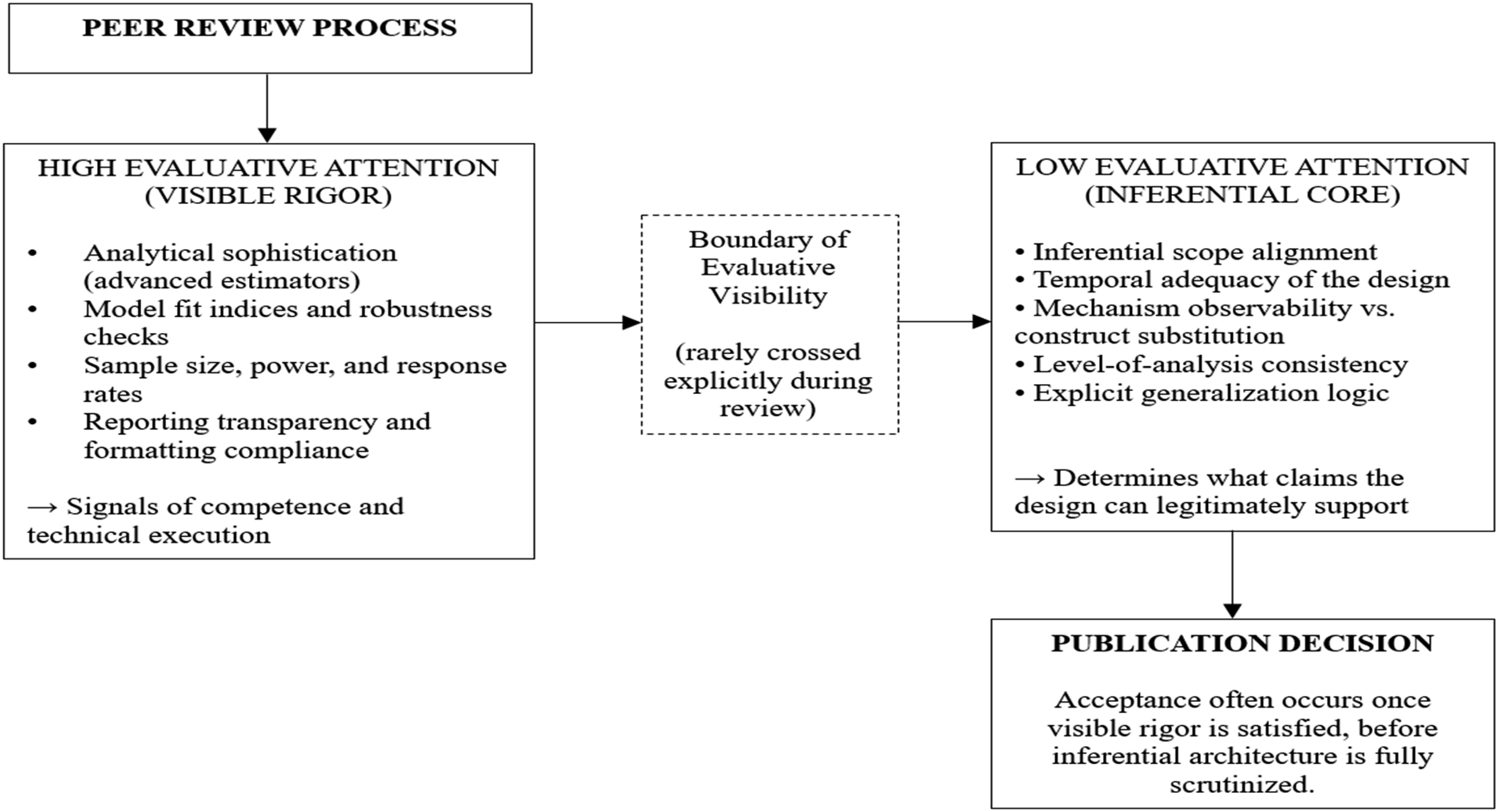
Having specified what reviewers systematically overlook, the next section examines how these blind spots influence publication outcomes and the accumulation of knowledge. Section 4 examines the downstream consequences of reviewer blind spots for theory development, empirical accumulation, and the credibility of organizational research.
4. Consequences of Reviewer Blind Spots for Theory Accumulation and Empirical Credibility
The reviewer’s blind spots identified in Section 3 do not merely affect individual publication decisions. They generate systematic, field-level consequences that shape how theories accumulate, how empirical findings are interpreted, and how credibility is assessed in organizational research. This section explicates these downstream effects, addressing a central editorial concern: why reviewer blind spots matter beyond isolated cases. We argue that blind spots reshape incentives for theorizing and empirical design, producing patterns of apparent rigor that ultimately undermine cumulative progress.
4.1. Apparent Progress and Latent Stagnation
When inferential fragility passes peer review, the literature can exhibit apparent progress without corresponding explanatory depth. New constructs proliferate, models become increasingly elaborate, and empirical results accumulate; yet, core mechanisms remain underspecified or inconsistent across studies. This pattern is often misdiagnosed as theoretical fragmentation or contextual contingency, when it is more accurately understood as inferential inconsistency generated by evaluative neglect (Goldfarb & King, 2016; Starbuck, 2016). Reviewer blind spots contribute to a literature in which studies are individually publishable but collectively incoherent. Because inferential scope inflation, temporal underspecification, and construct substitution are normalized during review, subsequent studies build on claims whose inferential foundations are unstable. Over time, scholars respond by introducing moderators, boundary conditions, or higher-order constructs, moves that increase complexity but rarely resolve underlying inferential misalignment (Davis, 2010; Tsang & Ellsaesser, 2011). The result is cumulative elaboration without cumulative clarification.
4.2. The Illusion of Replication Failure
A second consequence concerns the misinterpretation of replication outcomes. When findings fail to replicate across samples or contexts, the default explanation is often contextual variation or measurement error. However, many apparent replication failures stem from unacknowledged differences in inferential scope, temporal structure, or level of analysis that were never scrutinized during the initial review process (Camerer et al., 2018; Open Science Collaboration, 2015). Reviewer blind spots thus transform inferential ambiguity into post hoc debate. Because original studies rarely specify the precise conditions under which their claims should hold, replication attempts are evaluated against ambiguous or shifting standards. These dynamic fuels skepticism about empirical research while obscuring the role of peer review in allowing under-specified claims to enter the literature in the first place.
4.3. Incentive Distortion and Strategic Compliance
Reviewer blind spots also distort author incentives. As review norms signal that analytical sophistication and novelty are rewarded more reliably than inferential discipline, authors rationally allocate effort toward what reviewers are most likely to observe rather than toward what inference requires. This produces strategic compliance, characterized by meticulous reporting, extensive robustness checks, and polished theorizing, paired with research designs that are only weakly aligned with theoretical claims (Aguinis et al., 2018; Bergh et al., 2017). Over time, such incentives recalibrate the field’s understanding of rigor itself. Inferential alignment becomes a latent virtue, while visible complexity becomes a dominant currency. Importantly, this dynamic persists even among highly capable scholars and conscientious reviewers, reinforcing the stability of blind spots across journals, methods, and subfields.
4.4. Editorial Risk Aversion and Conservative Innovation
From an editorial perspective, reviewer blind spots can paradoxically increase risk aversion. Manuscripts that challenge dominant inferential practices or foreground design limitations may appear less rigorous than conventionally executed studies, even when their inferential logic is stronger. As a result, innovative designs that prioritize inferential clarity, such as narrowly scoped studies, process-tracing approaches, or design-based identification strategies, often face higher publication hurdles than analytically ornate but inferentially fragile work (Heckman, 2005; Shadish, 2002). This conservatism is not ideological; it is structural. Editors must adjudicate among competing manuscripts using reviewer input that is itself shaped by blind spots. Consequently, the review system may inadvertently privilege continuity in evaluative norms over improvement in inferential standards, further entrenching the dynamics that sustain inferential fragility. Having demonstrated that reviewer blind spots lead to systematic distortions in the accumulation of theory and empirical credibility, the analysis now turns to corrective mechanisms. Section 5 develops a diagnostic framework for inferential review that enables reviewers and editors to detect inferential fragility at the design level, without increasing evaluative burden or privileging particular methods.
5. A Diagnostic Framework for Inferential Review
A predictable editorial concern at this stage is whether identifying reviewer blind spots invites prescriptive overload, yet another set of checklists, standards, or methodological hierarchies imposed on already burdened reviewers. This section explicitly avoids that outcome. Instead, it advances a diagnostic framework for inferential review that reorients evaluative attention toward a small number of high-leverage inferential questions. The framework is method-agnostic, cognitively economical, and deliberately designed to operate within existing peer review practices rather than to reform them.
5.1. From Methodological Policing to Inferential Diagnostics
Conventional reviewer guidance implicitly emphasizes what might be described as methodological policing: verifying the choice of estimator, checking assumptions, assessing robustness, and ensuring complete reporting. These activities are necessary, but they operate downstream of a more fundamental question: whether the study’s inferential architecture is coherent. Inferential architecture refers to the alignment among (a) the causal and explanatory claims advanced by the theory, (b) the observational, temporal, and organizational structure of the research design, and (c) the conclusions drawn from empirical results (Bollen, 1989; Shadish, 2002). The diagnostic framework proposed here reframes peer review as an exercise in assessing inferential capacity. Rather than asking whether a study is well executed, reviewers are encouraged to ask a logically prior question: Does this design have the inferential capacity, even in principle, to adjudicate the claims being made? This question conditions the relevance of technical rigor. Analytical sophistication cannot compensate for misalignment between theoretical ambition and design capacity, and identifying such misalignment does not require reanalyzing data, imposing additional standards, or privileging particular methods.
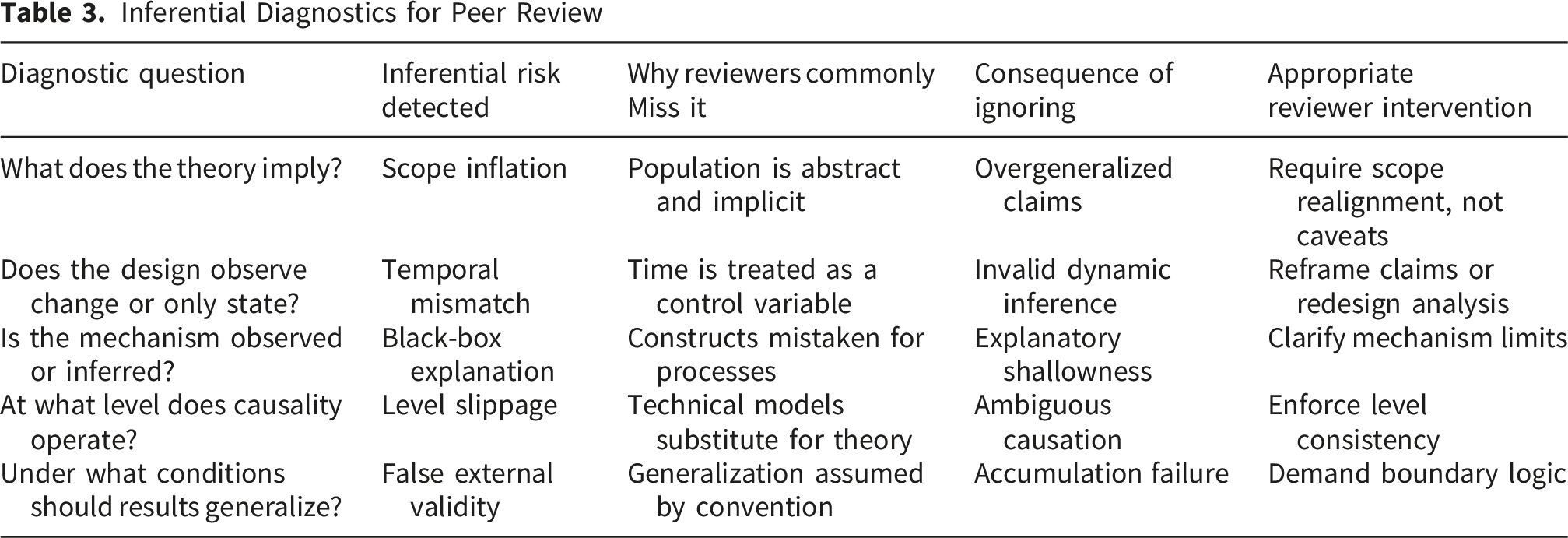
Inferential Diagnostics for Peer Review
5.2. Five Core Diagnostic Questions
The framework centers on five inferential diagnostics that map directly onto the blind spots identified earlier. Each diagnostic is intentionally phrased as a conditional reasoning test rather than a checklist item.
5.3. Why Diagnostics Work Under Review Constraints
A key strength of the diagnostic framework is that it aligns with how reviewers already reason under real review conditions. Reviewers routinely question whether claims are too strong, overstated, or insufficiently supported. The framework does not replace these intuitions; it disciplines them, anchoring evaluative judgment in explicit inferential logic rather than in stylistic impression or methodological signaling. Moreover, diagnostics reduce cognitive load rather than increase it. Instead of evaluating dozens of technical details in parallel, reviewers focus on a small number of inferential pivots that carry disproportionate consequences for credibility. By clarifying what a design can and cannot support, diagnostics streamline review effort while improving evaluative precision, directly addressing concerns about reviewer fatigue and overload (Hirschauer, 2010; Lee et al., 2013).
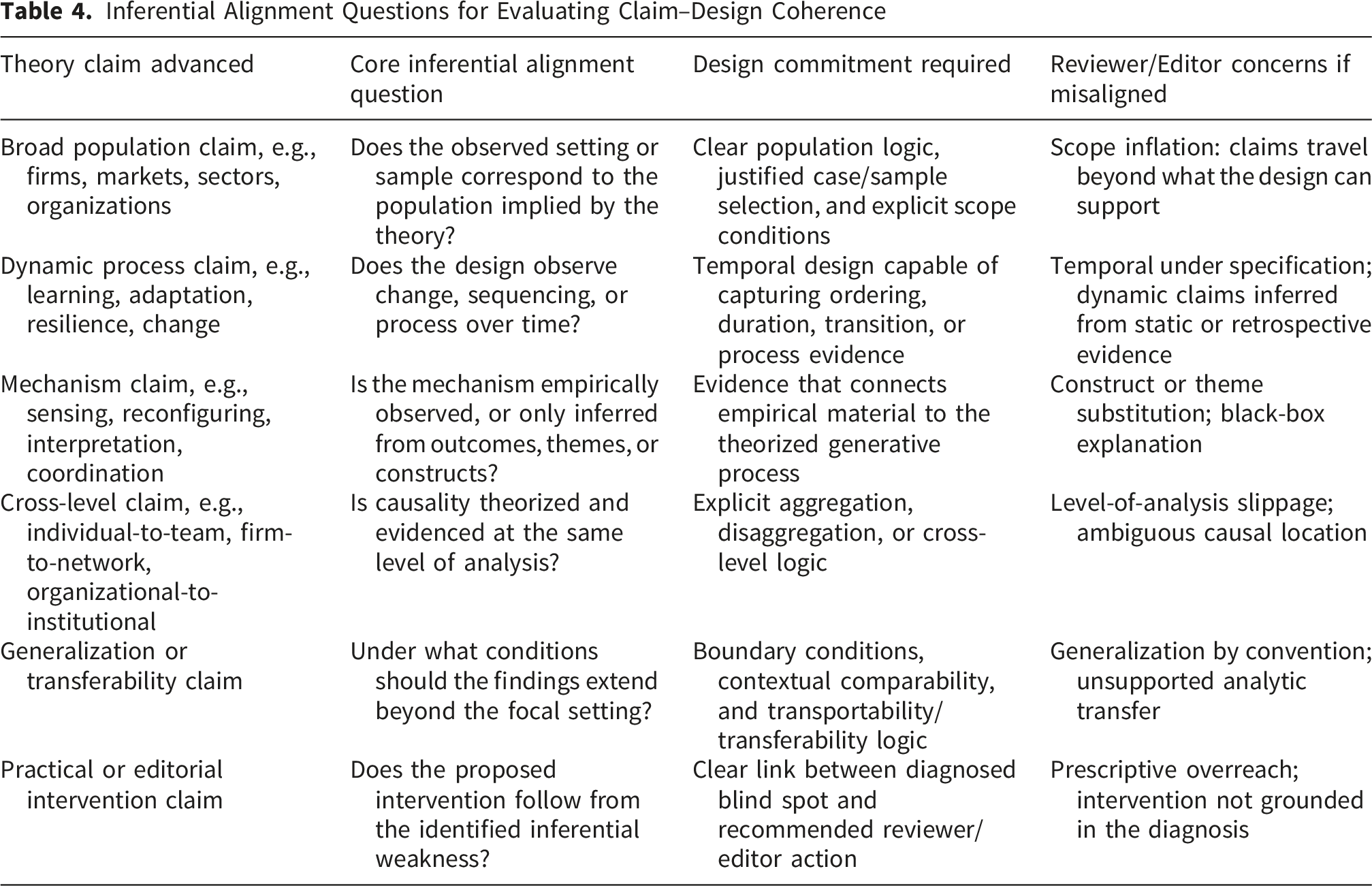
5.4. Anticipating and Addressing Editorial Critiques
Inferential Alignment Questions for Evaluating Claim–Design Coherence
6. Institutionalizing Inferential Review: Implications for Reviewers, Editors, and Journals
A recurring concern with critiques of peer review is that they are diagnostically insightful but institutionally inert. This section addresses that concern directly by showing how inferential review can be embedded within existing peer review practices, without adding formal rules, mandating new checklists, or privileging particular epistemologies. The core argument is straightforward: Reviewer blind spots persist not because the system lacks standards, but because inferential reasoning is weakly anchored in everyday evaluative routines. Correcting this imbalance does not require reforming peer review; it requires reweighting what already occurs.
6.1. Implications for Reviewers: Recalibrating Evaluative Attention
For reviewers, inferential review does not entail doing more work; it entails doing different work earlier in the evaluation process. Review reports typically devote substantial attention to the methodological execution and framing of contributions, while inferential coherence is addressed implicitly or deferred to the limitations section. The diagnostic framework developed in Section 5 provides reviewers with a principled way to surface inferential concerns before engaging in technical critique. Practically, this implies a change in the sequencing of reviews. Rather than beginning with estimation details or robustness checks, reviewers can first assess whether the study’s design has the inferential capacity to adjudicate its core claims. When inferential coherence fails at this level, analytical sophistication becomes secondary. This sequencing reduces the number of false-positive manuscripts that appear rigorous but rest on unsupportable claims and clarifies the basis of critical feedback (Shadish, 2002; Tsang, 2014). Importantly, inferential reviews also protect reviewers. By grounding critique in design–theory alignment rather than personal standards or stylistic preferences, reviewers can justify strong recommendations with transparent logic, reducing ambiguity and interpersonal friction in the review process (Hirschauer, 2010).
6.2. Implications for Editors: Managing Reviews, Not Just Manuscripts
Editors occupy a pivotal position in either reinforcing or correcting reviewer blind spots. When reviews focus narrowly on execution while overlooking inferential misalignment, editors often confront polarized recommendations that are difficult to reconcile. Inferential diagnostics offer editors a meta-evaluative lens for interpreting reviews, distinguishing between critiques that address inferential capacity and those that focus solely on surface rigor. Editors can institutionalize inferential review through light-touch practices that do not require policy changes. By encouraging reviewers to comment explicitly on inferential scope, temporal adequacy, or level alignment, editors can enhance the consideration of inferential issues within the decision-making process. Similarly, prioritizing inferential critiques when weighing conflicting reviews and requesting revisions that recalibrate claims to design capacity, rather than adding further robustness checks, helps distinguish between fixable execution issues and structural inferential limitations. Such practices improve decision consistency and reduce cycles of revision that add complexity without increasing credibility (Starbuck, 2016).
6.3. Implications for Journals: Shaping Norms Without Mandates
At the journal level, the framework has implications for how rigor is signaled, rewarded, and normalized. Many journals have successfully enhanced transparency by implementing reporting standards, data policies, and methodological guidance (Aguinis et al., 2018). Without parallel attention to inferential coherence, however, these initiatives risk reinforcing the very blind spots identified in this paper. Journals can shape inferential norms indirectly through what they publish and the values they promote. Publishing editorials and exemplars that model strong alignment between claims and design, valuing design transparency and calibrated claims alongside novelty, and legitimizing narrowly scoped but inferentially robust studies as high-quality contributions all signal what counts as rigor in practice. Importantly, none of these steps require formal enforcement. Norms in scholarly fields are shaped more by implicit expectations than by explicit rules, as they are influenced by repeated exposure to what is published and praised (Davis, 2010). By making inferential coherence visible and valued, journals can recalibrate reviewer heuristics over time.
6.4. Anticipating Resistance: Why Blind Spots Persist
A final concern is whether reviewer blind spots are so deeply entrenched that they resist change. The framework advanced here does not assume immediate transformation. Blind spots persist precisely because they are functional: they economize cognitive effort, stabilize expectations, and facilitate throughput in high-volume review systems (Bazerman & Moore, 2012; Lee et al., 2013). Functionality, however, does not imply optimality. As empirical research becomes more complex and theoretically ambitious, the costs of inferential neglect increase. The relevant question, therefore, is not whether blind spots can be eliminated, but whether they can be made visible enough to be managed. Inferential diagnostics provide such visibility without destabilizing the review system. The concluding section synthesizes the paper’s contributions, clarifies its boundary conditions, and articulates a forward-looking agenda for strengthening empirical credibility through inferentially informed peer review.
7. Conclusion: Making Inferential Rigor Visible Again
This paper addresses a central paradox in contemporary organization research: despite unprecedented analytical sophistication and increasingly formalized review standards, inferential fragility remains widespread and often invisible in peer-reviewed empirical work. We have argued that this paradox cannot be resolved solely through further methodological refinement. Instead, it reflects broader institutional and methodological pressures that are subsequently reinforced through systematic blind spots in how empirical rigor is evaluated during peer review.
7.1. Core Contributions
The paper makes four integrated contributions. First, it reconceptualizes empirical rigor as a review-mediated outcome, rather than as a property residing solely in methods or authorial competence. By shifting attention from what authors do wrong to what reviewers systematically miss, the paper reframes inferential weakness as an institutional phenomenon rather than an individual failure (Hirschauer, 2010; Starbuck, 2016). Second, it develops a field-level typology of reviewer blind spots, identifying recurring zones of evaluative neglect, inferential scope inflation, temporal underspecification, construct substitution for mechanisms, level-of-analysis slippage, and generalization by convention. This typology explains how inferentially weak claims can pass peer review even when studies are analytically polished and methodologically compliant. Third, the paper demonstrates that reviewer blind spots have predictable downstream consequences for the accumulation of theory, replication debates, and incentive structures. Apparent theoretical fragmentation, replication failure, and construct proliferation are shown to be symptoms of evaluative misalignment rather than inevitable features of complex social phenomena (Camerer et al., 2018; Goldfarb & King, 2016). Fourth, the paper presents a diagnostic framework for inferential review, designed to operate under real-world review constraints. Rather than adding checklists or privileging particular methods, the framework reweights evaluative attention toward a small number of high-leverage inferential questions that condition the credibility of empirical claims (Shadish, 2002; Tsang, 2014).
7.2. Boundary Conditions and Scope
This paper does not claim that inferential blind spots are unique to organizational research, nor that peer review is fundamentally broken. Peer review remains highly effective at identifying local errors, technical flaws, and violations of established norms. The argument advanced here is narrower and more precise: peer review is structurally ill-equipped to detect design-level inferential misalignment once visible signals of rigor are satisfied. Moreover, the framework does not eliminate judgment or disagreement. Inferential review necessarily involves reasoned interpretation about what claims a design can support. The contribution lies not in replacing judgment, but in disciplining it with explicit inferential logic, thereby making evaluative disagreement more transparent and productive.
7.3. Implications for the Future of Empirical Research
If inferential rigor continues to be weakly evaluated, the field risks deepening the very problems it seeks to address. Emphasizing analytical sophistication without parallel attention to inferential coherence is likely to exacerbate theory dilution, replication disputes, and concerns about empirical credibility (Rashid & Rasheed, 2026a). By contrast, making inferential architecture visible during peer review offers a path toward slower but more cumulative progress, in which fewer claims travel farther than designs can sustain, and disagreement reflects genuine theoretical alternatives rather than hidden inferential gaps. Importantly, this shift does not require radical reform. It requires a recalibration of evaluative attention, by reviewers who sequence their critiques differently, by editors who foreground inferential alignment in editorial decisions, and by journals that signal the value of claim–design coherence alongside novelty and technique.
What reviewers miss matters not because reviewers are inattentive, but because what is easiest to see has come to dominate what is necessary to infer. By naming and systematizing these blind spots, this paper seeks to make inferential rigor visible again, not as an abstract ideal, but as a practical evaluative commitment embedded in everyday peer review. Strengthening empirical credibility, we suggest, does not begin with better statistics. It begins with better inference, and with a review process willing to look past the surface of rigor to its foundations.
Footnotes

Ethical Considerations
This research did not involve human participants or animals. Therefore, no ethical review or approval from an Institutional Review Board (IRB) or an Institutional Animal Care and Use Committee (IACUC) was necessary.
Consent to Participate
No data collected; therefore, no voluntary participation was required.
Funding
The authors received no financial support for the research, authorship, and/or publication of this article.
Declaration of conflicting interests
The authors declare that there are no conflicts of interest associated with this research, its authorship, or its publication. All contributors have acted in an impartial manner, and no financial, personal, or professional relationships have influenced the outcomes or reporting of this study.
Data Availability Statement
No data used.