







Abstract
Several days after a failed assassination attempt on the life of the Russian Tsar on 2 April 1879, a new regime of ‘permission to exercise the right to purchase and carry weapons’ was introduced in St. Petersburg. Despite the fact that the first attempt on Alexander II's life occurred in 1866 (also in St. Petersburg), it took 13 years to make a radical departure from the previously unrestricted regime of access to arms in the capital of the Russian Empire. In this article, I analyse archival materials documenting how this new regime of weapons ownership was implemented. In particular, I am interested in the dimensions of locality and temporality in the practices by which imperial legislation introduced gun control in St. Petersburg and Warsaw, the Russian Empire's most cosmopolitan cities. The archival documents that I rely on show that the gun control regulations that were intended to be a repressive act of the authorities in reality unfolded as a process of negotiations and merciful exclusions. The intermediaries of the imperial legal order reacted to the international challenges that were posed by emergent revolutionary movements, including the negotiation of the permissible restriction of subjects’ rights. As a result, new practices of ‘public safety’ were implemented as exceptional measures – both locally and temporally. This article sheds light on the imperial legal regime of gun control as a practice of ‘exception’.
On 3 April 1866, a revolutionary named Dmitrii Karakozov tried to shoot Alexander II during the Russian Tsar's regular walk in a public Summer garden in St. Petersburg. Quite surprisingly, this attempt did not change the general permissive mode of access to firearms in St. Petersburg. The reason for this was that in the imaginary of authorities, revolutionary ideas were deemed separate from arms and were perceived to be much more dangerous. 2 In general, European political police of that time developed the idea that political crime was sponsored by foreign states. Moreover, it was aimed at weakening the political will of rival states and undermining their international ambitions. 3 Thus, the very nature of Karakozov's attack was perceived as somewhat irrelevant to the Russian context as it was understood to be inspired by the Western enemies of the Russian Empire who recently ‘pushed’ Polish insurgents into the 1863 Uprising. 4 The Russian political police, which was strengthened significantly after 1866, exerted much effort to underscore the Polish – in other words, foreign – origins of anti-government movement in the Russian empire until the very end of Romanov's rule. 5
This imaginary ‘foreign’ origin of political crime in Russia might explain why the experience of gun control, which was implemented in Warsaw during and after the 1863 Uprising, was not considered at all as an option for St. Petersburg in 1866 after Karakozov's assassination attempt. As the practices of martial law enforced in Poland in 1863, the disarming of rebels and the enforcement of gun control were meant to suppress massive Polish national liberation movement. In 1866, other measures of targeted surveillance and restrictions were introduced to the imperial capital. The police was strengthened and public activities (including literature, journalism and higher education) came under scrutiny, but the policy of unrestricted access to guns – everywhere, except the empire's borderlands – was not reconsidered.
13 years later, the situation radically changed. On 8 April 1879, new ‘obligatory rules’ on arms control were introduced in St. Petersburg after the second attempted regicide at Winter Palace, only a week after a terrorist Alexander Solovyev tried to shoot the emperor near his main residence. Forming a part of extraordinary measures of public safety, the new regime of gun control was introduced not only in the capital by a special Emperor's decree of 5 April 1879. 6 General-governors of St. Petersburg, Moscow, Odessa, Kiev, Kharkiv and Warsaw were given exceptional rights to enforce martial law in order to suppress political crime in the Empire. These regions had imperial residences of Russian monarchs (Moscow, Crimea, St. Petersburg) and/or had a significant rate of political crime already detected (Odessa, Kiev, Kharkiv and Warsaw in addition to both capitals). The exceptional rights that Tsar Alexander II granted to these general-governors, the most trusted generals of his army, enabled them to impose martial law measures such as the strengthening of the migration control, the introduction of military justice procedures in cases of suspected political crime, and the cracking down on the press for ‘challenging public safety’. 7
Gun control, however, was still not explicitly stipulated among these measures. It was introduced in spring 1879 by some of general-governors only in the cities where the Emperor's life could be threatened: St. Petersburg and its suburbs, the Crimean cities of Yalta and Simferopol, and the Ukrainian city of Kharkiv, a major transportation node on the way from St. Petersburg to Crimea. Interestingly, as publications in the local official newspapers demonstrate 8 , there was no uniformity as to how gun control was stipulated and enforced in all four cities.
This is a microhistory of gun control implementation in St. Petersburg in 1879. I namely will present the moment of change in access to arms as a particular imperial legal regime of a specific locality and a specific time. As a category of imperial administration word-wide 9 , this imperial program to spread ‘exceptional regime’ to new localities because of ‘exceptional timely necessity’, posed a challenge to the delicate balance of the ‘accommodative’ regime of Russian imperial rule.
For example, six months after the gun control regulation was implemented in the Russian capital, Grinberg, a merchant from St. Petersburg was allowed by the governor of Novgorod – a nearby city – to open a shop selling medications and pistols. 10 Since Novgorod is less than 200 kilometres from St. Petersburg, clients from the capital were able to avoid the new restrictions by shopping in Novgorod. The governor of Novgorod had consulted St. Petersburg's general-governor who was in charge of arms control in the capital to find out if permission to sell arms should be granted to Grinberg. St. Petersburg's general-governor assured his provincial colleague that there was no need for granting special permission, since the general permissive order of access to arms did not change. St. Petersburg was an exception to a general rule and the general rule did not have to be challenged unless under some urgent necessity. 11
In terms of safety, St. Petersburg's general-governor's reply raises many questions, all of which can be summed up into one: What was the imperial legal rationale of ‘exceptional’ gun control? On a more conceptual level, I wonder how we should conceptualize these ‘exceptional’ regimes of imperial legality not in colonies, but in metropolitan centres? Scholars of empires offer stimulating conceptualizations of ‘zones of legal exception’ situated in colonies. 12 In the case of gun control in the Russian empire, we can further develop the useful metaphor of ‘corridors of imperial control’ 13 and suggest that in 1879 the Emperor by his own will transformed some of these ‘corridors’ (i.e. where he was available in public space) into a sort of ‘closets’. In this ‘closed regime’, the Emperor declared that he was only responsible for maintaining his subjects’ right to life. 14 The implementation of martial law implied that order and justice had to be imposed in order to guarantee the imperial subjects’ right to bare life under conditions of war against political crime. 15 In the following sections, I will discuss how wide access to guns was radically limited in St. Petersburg as a practice of ‘exception’ and how the Russian subjects responded.
Armed subjects in the Russian empire
A noted authority of Enlightened legal education, William Blackstone in his Commentaries on the Laws of England, referred to the right to the private possession of arms as the fifth of the ‘auxiliary subordinate rights of the subject, which serve principally as barriers to protect and maintain inviolate the three great and primary rights, of personal security, personal liberty, and private property’. For Blackstone, the laws of England were derived from natural law. The Russian Empress Catherine the Great, who used Blackstone's work extensively as a source of inspiration in her reforms, never articulated her imperial rule in Enlightened terms of ‘natural rights’ of her subjects. 16 Instead, she used the broad term ‘the people's rights’. These imperial rights 17 were not articulated in terms of shared ‘human nature’. Instead, they were ‘assigned in collective ways to people as members of particular groups defined by ethnicity, status, confession, occupation, location, or other characteristics’. 18 Maintaining public order, collecting taxes or tribute and military recruitment was primary administrative concerns of imperial rule. The regime that accounted for pragmatic ‘accommodation’ of interests of local communities and imperial authorities, as Lauren Benton put it when discussing the Spanish rule in Latin America 19 , seems to be an adequate conceptualization of the administrative and legal practices of the Russian empire. 20 This principle of accommodation structured the broadly defined regulations concerning the civil population's ownership of weapons.
The basic practical assumption here was that maintaining order in the regions was the responsibility of regional administrators. Therefore, given the lack of funds to finance the rural police 21 , both central and local authorities opted for a permissive regime of access to weapons in order to ensure the personal safety of the Empire's subjects. Generally speaking, this attitude did not change throughout the imperial history. 22 The law segregated the empire's rural regions from its urban areas, where the police was in charge and free carriage of arms by subjects was limited.
The Ordinance ‘On prevention of and fight against offenses against person’ 23 was the only general law on the issue. 24 It stipulated that duelling was prohibited, while armed self-defence and defence of others were allowed. Carrying arms in cities and towns was generally prohibited but the fine was remarkably low – the equivalent of a soldier's daily pay. According to this general law, arms were accessible to everyone so that they could be equipped for armed self-defence or hunting regardless of social rank. The practical background of this permissive regime of arms’ ownership was twofold. In addition to clearly stipulated self-defence, safety concerns were cited as a legal reason to carry arms while travelling. In addition, all uses of arms for ‘neither dangerous nor reprehensible purposes’ (such as hunting) were allowed by law. 25
The implementation of martial law as a means of war against political crime implied that there was a revision of ‘normal’ imperial legal order. My analysis of official and unofficial media demonstrates that St. Petersburg as an imperial capital stood out among other cities where martial law was enacted. It was only in St. Petersburg Gazette where the decree on martial law was published with a title ‘Martial law’ (Voennoe polozhenie). It was followed by a lengthy explanation to the readers that this harsh measure was meant to fight back the evil elements of the Russian society. Moreover, honest citizens of all classes should not worry about the extra power given to military generals. 26 The official press in the other regions of the empire where the martial law was enforced did not bother to provide any specific titles and introductory commentaries. They did not even reprint the explanation from St. Petersburg official press. Neither was the essence of the martial law indicated, be it in a title or in other materials published in the press. A possible explanation for this could be that, with exception of Moscow, all the other cities belonged to territories that had been incorporated into the Russian empire via wars. Thus, switching to a specific legal regime promulgated by the imperial centre and in accordance to the imperial rule did not seem extraordinary and no extra explanations were provided. Furthermore, it was only in St. Petersburg official and unofficial press where various ‘western’ reactions on the enactment of martial law in Russia were discussed.
This specific position of St. Petersburg as the centre of imperial power where the war-like order was to be enforced might explain why, unlike Kharkiv and Crimean cities, the rules did not specify the deadline for the legalization of arms. Instead, the rules called for the ‘immediate’ implementation of the policy. In addition, the criteria for the eligibility for arms license were stipulated more clearly in Kharkiv and Crimean cities: One had to have a note from local police along with a written application containing the explanation for the purposes of the arms 27 Neither deadlines nor criteria were stipulated in the rules on gun control for the imperial capital. 28 Since such rules in the capital were quite open to interpretation, the office of the general-governor of St. Petersburg documented negotiations with residents on how their rights to trade and own arms were reconsidered. These documents demonstrate that a certain vision of the applicants’ subjecthood played a role both for authorities and residents.
The transformation of Russian subjecthood into citizenship was work in progress stimulated by the Great Reforms of Alexander II between 1860 and 1870s. The reforms led to an increase in the equalization of estates that was orchestrated with natural law discourse of rights and liberties as well as the capitalist realities of Russian urban life. These impulses for modernization affected universalizing changes in immigration policies and the treatment of foreigners, which, as Eric Lohr argues, pushed the Russian Empire to adopt conventions of ‘modern citizenship’. 29 However, as Burbank, Morrison, Glebov and Gerasimov demonstrate, repertoires of politics regarding the legal differentiation of the imperial subject continued to be exploited along with modernist discourses of equalization. 30
The global rise of political crime fostered the ‘modernist’ universalizing mode of citizenship worldwide. However, the case of gun control enforcement in St. Petersburg provides a more complex picture. Overlooked by scholars, the files of the archive of St. Petersburg general-governor consist of extremely valuable sources, which allow us, firstly, to look at how authorities collected statistics on the private ownership of arms and arms dealers in St. Petersburg and introduced some taxonomy into it. Secondly, the claims on ‘unfair’ implementation of new rules on firearms shed new light on how liberal discourse of the Russian press in 1860–1870s affected the language used by armed subjects and arms dealers to discuss both general rights and specific imperial privileges to address the difficulties posed by gun control.
Class-based Guns ownership as a guarantee of safety 31
Three days after Solovyev's assassination attempt, martial law was declared by temporary General-Governor of St-Petersburg Iosif Vladimirovich Gurko, who had been appointed on 5 April 1879. Another three days later, the new general-governor issued rules for arms control as part of the new regulations for public security in St. Petersburg. 32 These rules alerted the capital residents of dangerous objects and of people in charge of controlling these dangerous objects. These categories were based on the authorities’ previous experiences with dealing with the growth of anti-government propaganda in Russian cities throughout the 1860s. The rules stipulated that it was the responsibility of house owners and their groundskeepers (dvorniki) to keep the order of St. Petersburg's streets by watching for undocumented suspects in the neighbourhood, published or handwritten propaganda, as well as arms. According to the rules, house owners were obligated to pay and supervise the work of their groundskeepers, while the latter, in addition to cleaning, were to monitor the streets. The groundskeepers also had to assist the local police in any activity of surveillance and detention of suspects in the locality.
The second half of the regulation dealt with weapons. Here, a new measure was introduced: The right to possess arms had to be confirmed by special permission from the governor. Only those who had permission were allowed to purchase and keep arms and supplies for them in their homes. Owners of gun shops and weapons-manufacturing workshops were not allowed to sell arms to those who could not provide a permit for ownership of the weapons. Traders also had to register all their supplies and keep the books of the trade. They had to take away the permits from the buyers on purchase, so that the buyers would not abuse their right by buying weapons for others. This practice of buying for others was widespread, since there were few gun shops in the provinces.
Both weapon owners and shopkeepers had to report all the arms in their possession to the office of the St. Petersburg governor. This was very confusing because with the appointment of Gurko as temporary General-Governor in 1879, there were actually two Governors of St. Petersburg in charge: the newly appointed temporary general-governor and the civil governor. The official status of the temporary general-governor was higher because he had the right of ‘personal report’ to the Emperor. Furthermore, he was given exceptional legislative power to adopt new emergency measures – in terms of martial law – for the sake of public safety. Again, the importance of exceptional, temporary reactions was underlined by the very allocation of power between two major figures in St. Petersburg governance. The military temporary general-governor played a leading role in principal decision-making including changing the rules, while the civil governor was in charge of enforcement and supervision. This division of tasks resulted in close co-operation between the lawmaker – General-Governor of St. Petersburg Gurko – and Governor of St. Petersburg Lutovskii on what the new regulation was supposed to do. The newly appointed general-governor of Odessa, for instance, appointed a high-rank official that he brought to Odessa to be in charge of gun control in Yalta, the Emperor's main residence in Crimea.
According to the new rules, Governor Lutovskii was to issue gun permits. The rules stipulated that the owners of the arms had to register them and receive the permit. However, the conditions for gun permits to be issued were not specified in the rules, and the category ‘arms’ itself was also not defined. The rules of gun control introduced in Crimea and Kharkiv did not provide clear instructions either and they differed in terms. Nonetheless, one clear principle can be singled out in them: They adopted a class-related approach to granting permits for guns ownership. Arms owners would bring their weapons to the governor's office, or to the local police station if they resided in the suburbs of St. Petersburg. Their applications would be submitted along with personal information and the weapon itself. They could expect the decision in two weeks on whether or not they would be given the permit to own their arms.
Gurko ordered Governor Lutovskii to analyse the data regarding who had applied for arms permits, emphasizing that he was particularly interested in weapons ownership by members of the lower classes. 33 He specified that some rumours had reached him about the growth of guns ownership by the ‘insufficient classes’, namely ‘workers, craftsmen and other people, whose style of life and means of life cannot explain weapons ownership that deals with tastes and usual needs of sufficient classes’. 34 This worldwide class-oriented vision of arms ownership 35 was traditional in Russian society, which had ascribed arms to the hierarchically superior social groups: After the late 17th century, the right to ‘carry arms and firearms’ in towns had been a legal privilege of the high status, or ‘the senior people’. 36
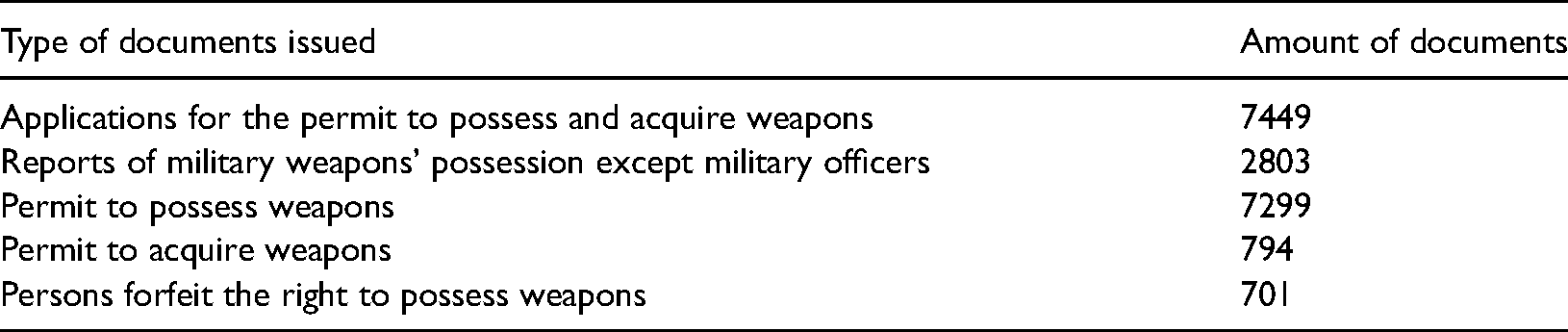
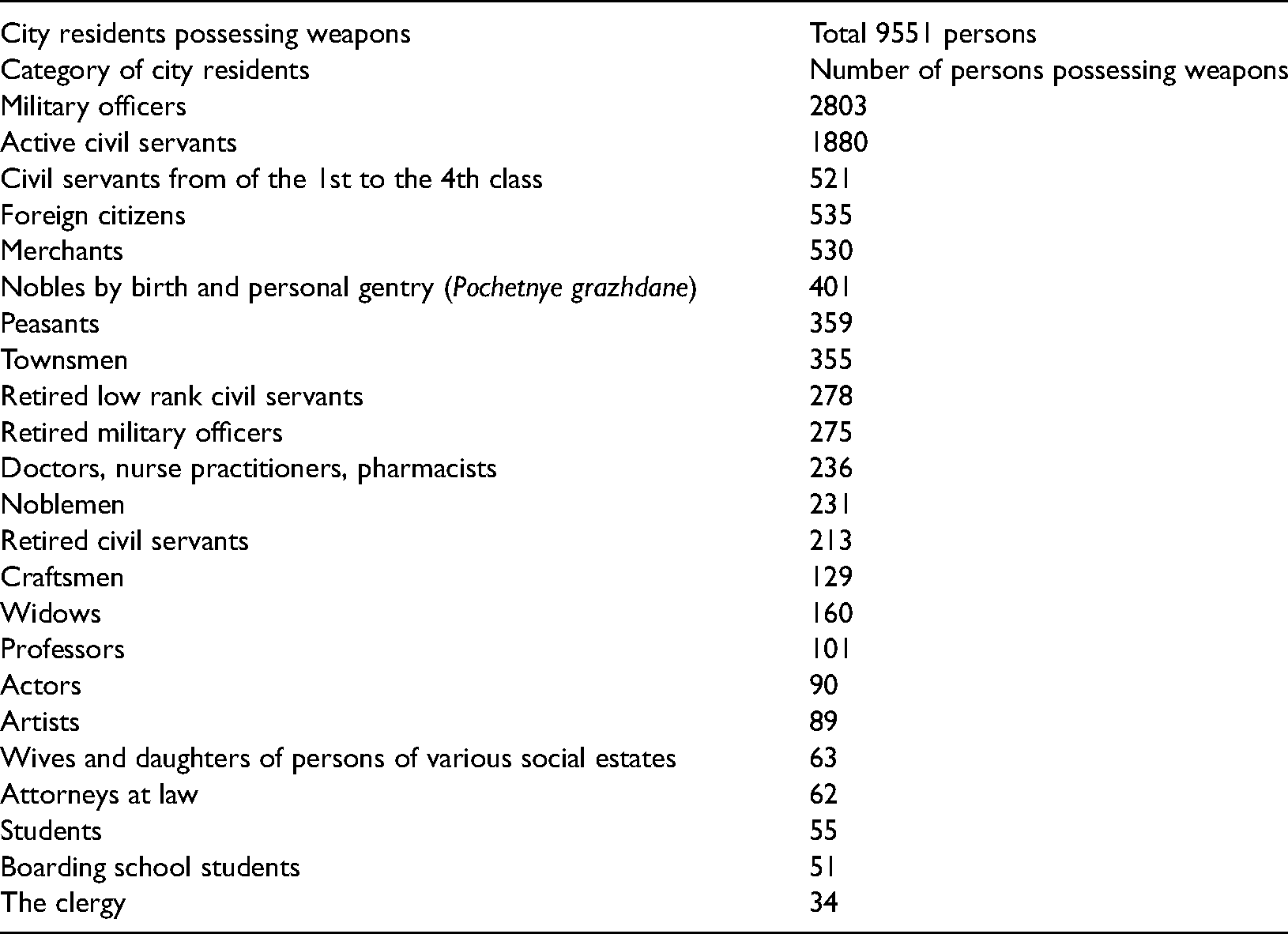
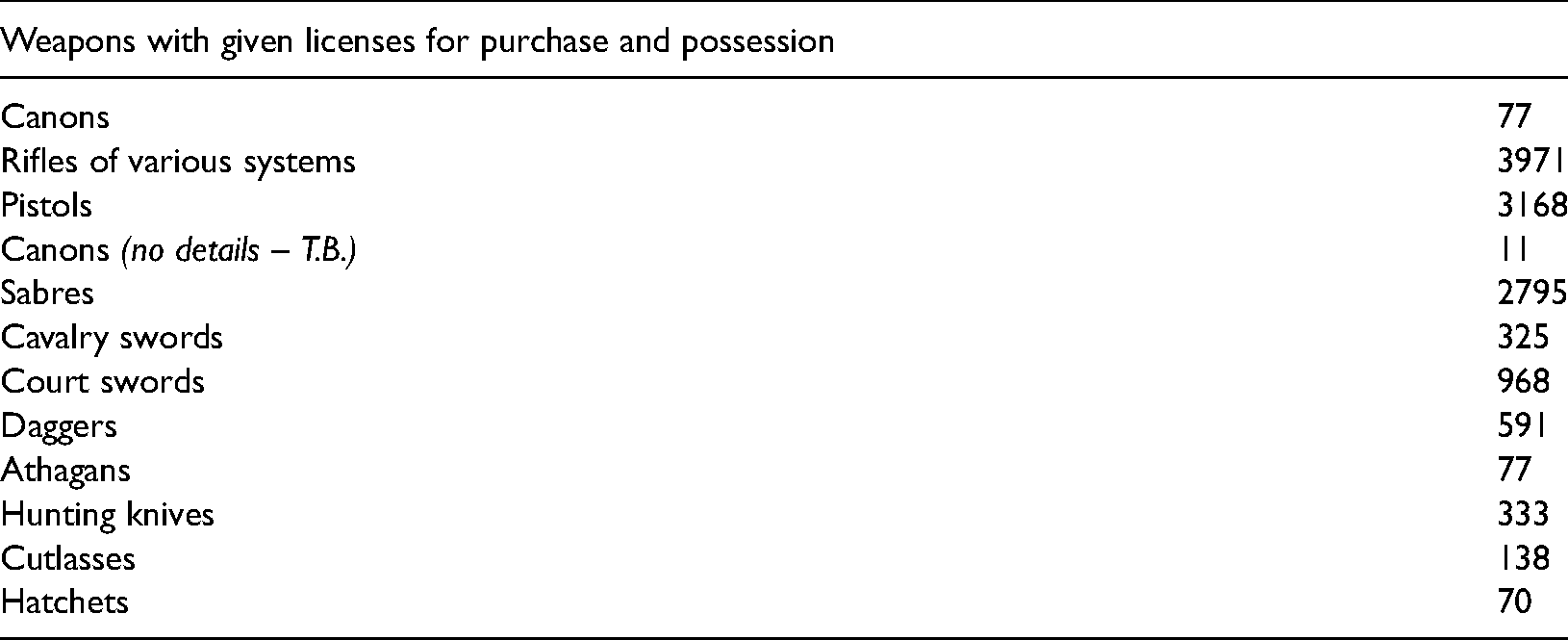
The statistics that the governor collected documented a very diverse dissemination of weapons among various social groups in St. Petersburg. Much to the general-governor's relief, the statistics confirmed that gun ownership was still mainly in the hands of the privileged classes. Out of 9551 weapons owners who applied for the permits, military officers stood out as the largest group of armed residents – 2803 persons. Retired military officers (275 weapons owners) were counted as a separate group. In general, service-related private weapons were owned by 3078 applicants (32.2%). The next largest group comprised civil servants – 1880 applicants (19.7%). Next, three groups of arms owners with almost equal numbers followed: the civil servants of the four highest ranks (521), foreign citizens (535) and merchants (530). Nobles by birth and hereditary gentry counted 401 arms owners. Right after them followed the peasants, who owned 359 arms (3.7%), which was only slightly more than townsmen – 355 (3.7%). This fact confirms what we have already seen in the regulations of guns: Arms were perceived as a means of defence, in particular for travelling in rural areas. Even the clergy of St. Petersburg declared 34 guns. Female gun owners included widows (160) as well as wives and daughters of persons of various ranks (63). Gun owners included boarding school students (51) and other students (55). Another 578 guns (6%) were owned by people of the ‘free professions’ – professors (101), actors (90) artists (89) attorneys at law (62) doctors, nurses and pharmacists (236). 37 (Please see Table A3 in the Appendix).
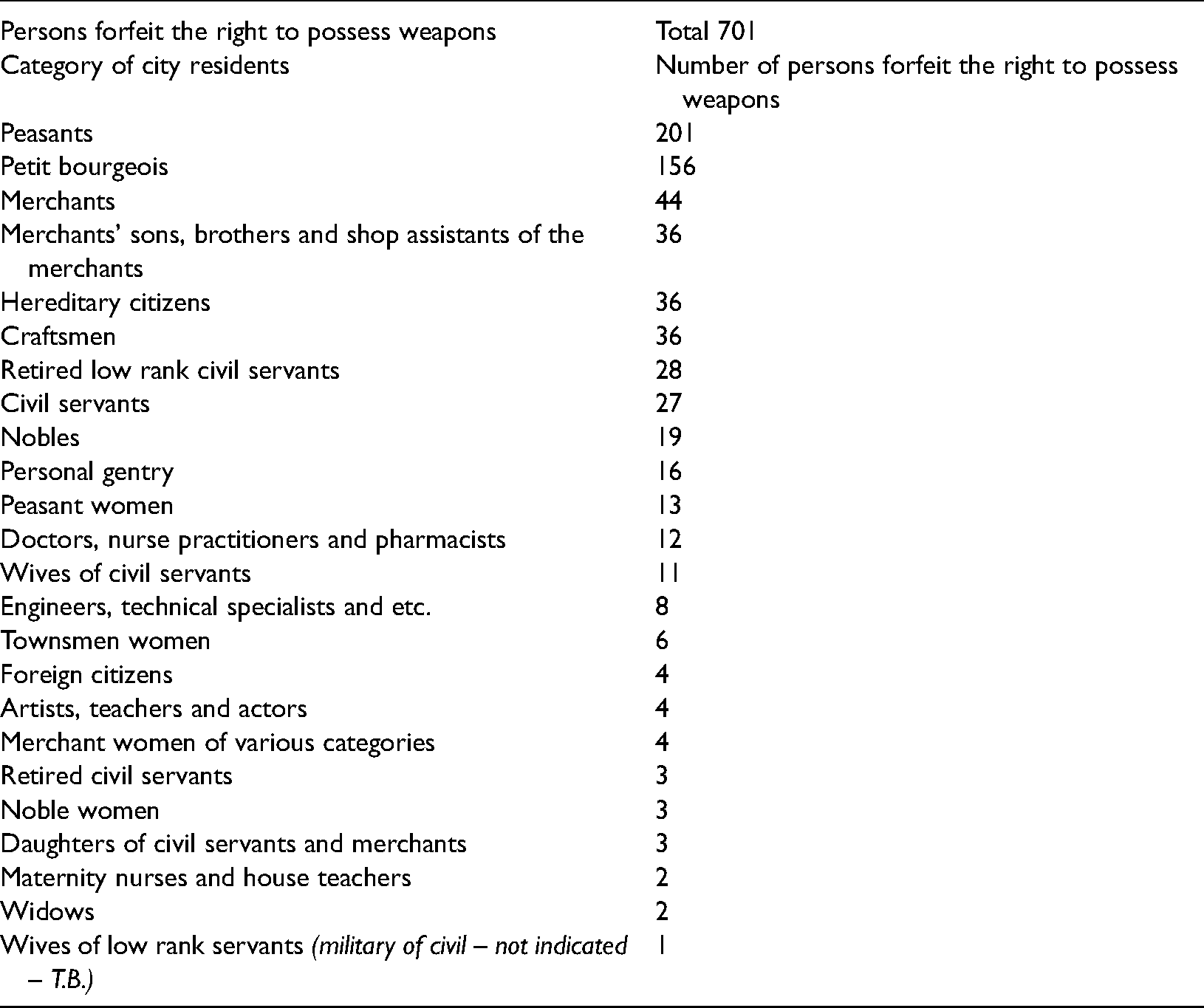
In conclusion of the statistical report, Governor Lutovskii confirmed that members of lower classes (the ‘insufficient classes’, in his words) did not own a significant number of arms. His definition of the ‘insufficient classes’ included peasants, townsmen, craftsmen and retired members of the lower ranks of state service. Still, altogether, 1125 peasants, townsmen, craftsmen and retired members of the lower ranks of state service applied for gun ownership permit. 391 applications from the members of lower classes were turned down and the applicants’ guns were taken from them. 38 The general-governor was relieved by these numbers and asked for a clear oversight of arms dealers and their reliability.
Privileged business as a form of gun control
The ban on the free sale of weapons shed light on two arms markets in the Russian Empire: artisanal weapons for the common folk and expensive weapons for the upper class. The first market of cheap weapons was sustained by craftsmen who produced hunting guns and bladed weapons for the people, as well as traders who sold them in all and any shops. This market was controlled by local administrations – the permits for the artisan masters were given on ad-hoc basis and supervised by police. The second market of high-quality weapons consisted of a network of special arms shops and workshops. They were the ones whose sales Gurko analysed. According to the data collected on his request, in June 1879, nine big arms dealers collectively possessed more guns than all private owners registered in St. Petersburg had in their possession. The dealers owned 60,734 weapons, while civilians declared 31,894 weapons and those in military service 6248 weapons. 39
These big arms dealers had particularly interested Gurko because the terrorists seeking to assassinate the Tsar and other high-rank officials in St. Petersburg preferred the technologically advanced pistols that were sold in elitist gun shops. 40 This elitist market was controlled by a very small group of specialists – dynasties of gunsmiths and wholesalers of foreign origin. As soon as new rules were officially announced on 18 April 1879, the arms dealers immediately tried to negotiate with the governor-general for a less harmful and more advantageous interpretation of the new rules. On the very day when the new rules were announced, four gunsmiths already appealed to Gurko with a petition. 41 The petitioners were merchants Vishnevsky, Léguin, Larderet and Gonneaud – the last two of them wrote their signatures in French. They reported that they immediately subordinated their trade to the new rules and asked about their ‘special and main occupation – repairing and remodelling weapons’. 42
In their petition, they requested to continue repairing and remodelling weapons in the workshops and asked about conditions under which they could now carry out orders. They emphasized their exceptional reliability: ‘The solidity of our firms recognized by government officials, and the desire to maintain a strong reputation in the future, can serve as a strong guarantee that we will not abuse the rights we have been given’. 43
There was also a moral argument included in the petition: ‘The termination of our work in workshops leads us to total devastation, because when we stop trading, capital is left in the goods, yet our business is to work [that is, to continue repairing and remodelling weapons in the workshops ]’. The suspension of activities in workshops would mean that ‘the livelihood of not only us, but also a significant number of masters, workers, employees and apprentices of our workshops and their families, ceases to exist’. 44 It seems that the gunsmiths indirectly wanted to distance themselves from the traders, stressing that their main activity was the production and repair of rifles, not the sale of short-barrelled pistols used by terrorists.
However, these merchants also participated in the trading of pistols. That is why they did not verbalise in their official petition their query about the sale of weapons by mail to buyers who did not reside in St. Petersburg: How should they continue the practice after the ban on free sale in St. Petersburg was introduced? We learn about this question from a cover letter that Gurko wrote to the governor when he forwarded the gunsmiths’ petition. 45 In the same letter, Gurko asked for information about the gunsmiths. He wondered if they had handed in the registers of weapons in their possession and if they were entitled to sell them at all. He also asked the governor ‘to pay attention to their personality and practices of their trade’. 46
This was a rather legitimate question given the gunsmiths’ international family names. Indeed, the arms workshops in the capital were in the hands of foreign nationals who passed on their knowledge to their children or apprentices also of foreign origin. 47 Russian masters from such workshops started their own businesses only at the beginning of the 20th century. As we saw with the petition of the four gunsmiths, three had French surnames – Gonneaud, Larderet and Léguin – and all of them were related to the French gunsmith Bertrand. His weapons with the Bertrand & Javalet logos are displayed today in the Hermitage museum. 48 Bertrand worked in St. Petersburg in the 1830s and passed his business to his disciple, also a French citizen, Jean-Marie Larderet. Larderet introduced his three sons to the business, and all of them made hunting weapons and ran gun shops. Another French national, Nicolas Gonneaud, seemed to have worked together with Larderet. The Austrian subject Wilhelm (Vassiliy) Léguin (born in 1821) had engaged in the arms business since 1844. He received a merchant's certificate in 1871 and opened a workshop. In 1875, he opened an arms shop. After his 1877 death, the business was continued by his widow, Emilia Léguin. Léguin's children had already been registered as Russian subjects, and from the 1880s onwards, they owned arms shops and workshops. Florian Wishnewski was an Austrian subject who opened his workshop and gun shop in St. Petersburg in 1828. His children were Swiss subjects and remained in business in the 19th century. The merchant's registers indicate that all the listed gunsmiths were Catholic.
In response to Gurko's enquiry about gunsmiths, Governor Lutovskii reported that nine merchants were allowed to hold and sell weapons: Edward Wenig, Wilhelm Seneca, Jean Larderet, Carl Minus, Emil Engelman, Max Fiedler, Emmanuel Goss, the widow of the merchant Emilie Léguin and the arms manufacturer Wishnewsky. All of them were ‘not known to be politically unreliable’. 49 It was especially mentioned that Wishnewsky, Léguin and Fiedler were invited to police interrogations as experts in 1878. Lutovskii does not mention it, but from the historical record, we know that they were involved in an investigation of a demonstration in the streets of St. Petersburg, during which members of the police had been shot. In such politically fraught circumstances, only ‘trusted’ people could have been called to act as witness experts. As for the merchant Gos, the governor specified that in 1878 Gos and Engelman applied for certificates of receipt of revolvers for the customs office – Gos 3000 pcs. and Engelman – 60 pcs. The order of 3000 revolvers was really a lot, especially in the year of 1878 when the crowd fired pistols at the police for the first time in Russian political history.
As for their petition, the gunsmiths were informed that it was still possible to send weapons to buyers who did not reside in St. Petersburg with no permit presented, so long as the shipping address was recorded in the shops’ books. The repair of weapons required an arms permit, and those in the military could show their permits signed by their superiors in order to purchase service weapons. Thus, the interests of the gunsmiths’ businesses were protected. Why? It seems that all of these gunsmiths earned the privilege of trading firearms as ‘cosmopolitan’ goods of luxury and progress precisely because of their own success in producing weapons. All four businessmen who approached Gurko had the prestigious status of ‘supplier of his Imperial Court’ or ‘manufacturer of his Imperial Court’. 50 This title was awarded not to the company, but to the master and was lost with his death. Its holder could use the image of the Russian court of arms in their commerce, for example, on the labels on the boxes and signages. Being a weighty guarantee of product quality, such a status could be earned through the responsible fulfillment of a number of conditions. The gunsmith had to supply his products to the Imperial Court for at least eight years without any complaints from customers and the shop had to take part in the manufactory exhibitions of ‘domestic works’ held in the Empire since 1845 at intervals of four years in Moscow, St. Petersburg and Warsaw.
Exceptional spaces, exceptional treatment
The fact that the exhibitions of ‘domestic productions’ were held not only in Moscow and St. Petersburg but also in Warsaw was not by chance. Unlike other western regions of the Russian Empire – the Grand Duchy of Lithuania and the Baltic provinces – , the Russian part of Poland was to some extent a showcase of Russian imperial rule for the ‘West’. The uprisings of 1830 and 1863, which were suppressed by the Russian troops, gave rise to a powerful criticism of the ‘uncivilized’ Russian autocracy in French and English newspapers. In response, it was important to demonstrate Russian achievements in the sphere of technical progress there in order to contrast them with the propaganda of the Western press about the backward and blood-thirsty Tsarist rule in the Russian part of Poland and in the Romanov Empire in general.
When revolutionaries first shot at the Tsar in 1866, Russian newspapers insisted on searching for a Polish revolutionary trail in St. Petersburg. It was believed that rebellious Poles were taking harmful ‘social ideas’ from the West to Russia. It is therefore not surprising that the experience of the suppression in Warsaw was taken into account in the fight against the revolutionary threat in the empire's capital. The most ‘modern’ cities in the Russian Empire – St. Petersburg and Warsaw – appeared to be the most infected with dangerous ideas. In 1879, Gurko introduced new rules on public safety in St. Petersburg, which was a part of what would be a ban on the free sale of weapons. As illustrated in his further correspondence regarding the new rules’ enforcement (this will be discussed in this section), Gurko saw the experience of the imperial authorities in the turbulent Warsaw as an example.
On 30 April, gunsmith Eduard (Gustav Edward) Wenig managed to be personally introduced to General-Governor Gurko. 51 Unlike the four previous petitioners – Wishnewsky, Gonnaud, Larderet and Léguin – Wenig was a Russian citizen and came from a very large and influential family of Baltic Germans from Revel (Tallinn). His eleven siblings kept positions of certain authority and wealth in St. Petersburg. For example, his brothers Bogdan, Peter and Karl were famous artists and stars of the Russian Academy of Arts. Another brother was the director of the Imperial Theatre Directorate.
Eduard Wenig brought a petition to Gurko on behalf of the four gunsmiths who had already petitioned the general-governor. His petition added an update: He added himself in the place of the Frenchman Gonnaud, who actually worked together with Larderet. In this new petition, the gunsmiths went much further than previously – they asked about a monopoly that the four gunsmiths could enjoy with the new rules on arms control. At the same time, while he handed his petition to Gurko, Wenig seems to have complained of a significant reduction in trade in such dramatic tones that Gurko, after talking to him, instructed his assistant Colonel Popov to go to Wenig's store to check the books about the trade turnover. Gurko ordered Popov to correlate the data on the sale of weapons a month before and after the introduction of the new rules on 8 April. Although Popov's report was not preserved in the archive, the difference was probably significant, since on 10 May 1879 Gurko sent an inquiry to the governor-general of Warsaw. Gurko asked his colleague whether the imperial administration had provided assistance to gunsmiths and shopkeepers during the temporary suspension of their trade during the Polish insurrection. And, if it did, Gurko wanted to know how much and through which authorities it was provided.
Two weeks later, on 24 May, the governor of Warsaw responded that despite requests from some of the local gunsmiths to compensate their losses due to the ban on trade, their requests were always rejected. However, by the time that Gurko received this comprehensive answer, he already had on his desk a detailed request from Wenig to provide material assistance to his business. This petition is a very interesting artefact because it intended to show convincingly that Wenig's reliable business, operating under capitalist laws – that is, based on the expansion of business on credit – was undermined by sudden state intervention. Wenig himself highlighted the conflict between his patriotic consciousness and the unrelenting pragmatics of capitalism: ‘Born in Russia and loving it with all my heart, I knew that this measure was necessary to preserve public order and the welfare of the state, thus I followed the rules in the most careful way. But at the same time, it is clear to me that I began to suffer great losses by not selling the goods borrowed on credit’.
Wenig wrote that some time ago, in January 1879, he moved the shop to a new, larger building, hoping to at least keep his profit. However, in the month and a half when the ban on the free sale of weapons was in effect, he received 7000 rubles less than his projected profit. Thus, the credit, which he acquired ‘not suddenly, but after many years of correct trade and the most accurate payments’ could no longer be paid – and it is precisely in spring, when the hunting season begins, that he always planned to pay off his bills of exchange: ‘The expenses on the maintenance of the shop and trade are due, including the monthly payment on bills of exchange up to 4500 rubles, and to cover them at the present time resources. Now I must see my business in ruins. It is irrevocable and unexpected that I have reached the point where everything that I have achieved with work and hardship is falling apart just in one month’.
Thus he appealed to Gurko's ‘fair view’ of the situation and insisted that ‘any government measure caused by the urgent necessity inevitably entails certain costs and individuals have always been compensated for losses caused by such measures’. On this basis, he asked Gurko to provide ‘his favourable assistance’ to obtain two subsidies: firstly, a subsidy to compensate the losses in the amount of 1000 rubles per month from the date of introduction of the new rules on arms trade, and, secondly, one-off subsidy of 15,000 rubles without interest with the obligation to return them within three years from the date of introduction of the new rules. In order to ensure the proper return of these 15,000 rubles, he offered his shop and a warehouse with goods as security. At the end of his petition, Wenig wrote that these measures would save his ‘strong business, which has always been the concern of the Ministry of Finance and the government in Russia in general’. He dramatically concluded that ‘the terms of the bills of exchange are coming, and I have no right to sell my goods in this completely desperate situation and beg for the prompt resolution of my present request’.
Despite the fact that, as it has become known from Warsaw, there was no precedent for government assistance to gunsmiths, Gurko turned to the Minister of Finance. On 26 May, he forwarded Wenig's petition to the Minister with the stamp ‘Confidential’ and provided it with his comments. 52 He certified that according to the information he received, Wenig's condition is critical due to the sudden decrease in the sale of his goods following the restriction of the right of possession and purchase of weapons, and Wenig might face bankruptcy for reasons beyond his control. Therefore, Gurko wrote, he considered it fair to provide Wenig with a benefit. However, to make sure that this aid could not serve as a precedent for other traders and manufacturers of weapons in the capital, he offered to assist Wenig without publicity.
Given that the Finance Minister prepared a resolution of the Wenig case, I will raise a question that may have puzzled the Minister as well: Why on earth would Wenig ask for exceptional assistance if other gunsmiths were silent? Perhaps, of course, there was a conspiracy between them, and the others were waiting for a precedent. However, it seems that Wenig was able to ask for such assistance because his position as a subject differed from the other big arms’ dealers. First, as I mentioned, he was a Russian subject who came from the imperial suburbs and was one of the sons of a music teacher from Revel, Gottlieb Friedrich (Bogdan Friedrichovich) Wenig, also a Russian subject. His brothers were prominent figures in the field of art, which was always subsidized by the imperial court, so the request may have been based on the experience of kinship of the court, which had often materialized. Governor-General Gurko's wife hosted a famous salon that gathered the artistic cream of society, to which the Wenig family belonged, so it is likely that Gurko experienced personal sympathy for this family.
Secondly, Wenig's shop may indeed have been the most harmed by the new rules because, according to rumours, terrorist Solovyov had taken his gun from Wenig's shop. As a matter of fact, his pistol was bought in the large Central Arms Depot owned by Wenig in Nevsky Avenue 10, the main street of the capital – the new big shop to which he had moved his trade, as he wrote in the petition to Gurko. It was another Baltic German, doctor Otto Weimar who, because of his sympathy for the revolutionaries, bought the pistol for Solovyev. 53 Doctor Weimar lived in the same building where Wenig's shop was located in Nevskii, and perhaps he knew gunsmith Wenig personally. The doctor was arrested very soon after terrorist Solovyov's assault.
Yet, all these facts may not have been taken into account at all as a special Chancellery for the Credit of the Ministry of Finance proceeded to prepare a negative response to Gurko's request to support Wenig. The major point was that a sound commercial enterprise fall into financial difficulty in a month and a half of trade interruptions. The clerks of the Ministry of Finance insisted that, contrary to Wenig's petition, these interruptions caused by new rules did not really stop the trade, but only limited it. Thus, while the provision of assistance to Wenig could be an example to others, the government could not in principle be obliged to ‘reward individuals for the losses they might incur as a result of the special rules established for a particular business’. 54
However, Gurko insisted on helping Wenig. On the margins of the refusal letter from the Ministry, he wrote that the emperor ‘should be informed of this case’. It seems that eventually Gurko and Wenig won – the assistance to Wenig was provided with the support of the emperor, as in 1880, Wenig opened another arms store with success, expanding the business also with a new cigar shop in the Nevskii prospect that was in the most expensive street of St. Petersburg. Thus, the Ministry of Finance's sound argument that the government could not be held responsible to arms dealers for their losses as a result of the new public security rules was defeated. The non-capitalist rationale that hardworking subjects and the caring patriarch Tsar together was used to increase the capitalist turnover. Continuing his strategy of being a loyal Russian subject, the originally Protestant Wenig, in line with a conservative turn of Russian autocracy after 1881, adopted Orthodoxy in 1893. Gustav Edward Wenig also changed his name again – Eduard Wenig now became Evgraf.
Justice for a lawful layman
An important feature of the new procedure for arms ownership introduced in St. Petersburg in 1879 was that permits were provided free of charge. The legislator was reluctant to punish the whole population for revolutionary excesses. Indeed, on the one hand, hunting was an integral part of people's life, while, on the other hand, self-defence was an essential right. 55
In this respect, the situation in St. Petersburg was different from that in Warsaw, where rebellious Poles had to pay dearly for their past mistakes. In 1864, after the Polish uprising was suppressed, the local Russian administration introduced a system of licenses for the possession of weapons for personal protection. These new rules on gun control were published in the first issue of the new Russian-language official newspaper Warsaw Diary on 1 October 1864. The article stipulated a change in the previous order of martial law that applied to all weapons and no one could keep them without special permission. From now on, ‘trustworthy residents’ could get one-year tickets for the possession of firearms for personal protection for a fee. This fee, it was emphasized, would go to the treasury of the Kingdom of Poland. This clarification may have been made because the fee was high – 6 rubles in silver for ‘permitted firearms, such as a hunting rifle, a revolver or a pair of pistols’. Annual tickets were to be issued by the Chiefs of the Main Military Departments at the place of the applicants’ permanent residence. The last point of the rules stressed that those who failed to pay the fee would lose their right to keep weapons. The rules also applied to all foreigners permanently residing in Poland. Six rubles a year was quite expensive in 1864. For comparison, Karakozov bought his pistol for 15 rubles in 1866. As the Siberian hunter Cherkasov wrote in his 1867 book, the cheapest low-quality artisanal rifle was five times cheaper – 3 rubles in silver. 56 The annual subscription fee for the daily newspaper Warsaw Diary in the post offices of the empire was 9 rubles 20 kopecks. Furthermore, as the Warsaw Diary noted on 2 October 1864, the carpenter's apprentice Alexander Jungmann received 12 rubles from the leaders of a radical organization for having assassinated a policeman. 57
Unlike Poles, the residents of St. Petersburg did not have to pay for arms permits, but maintaining the right to own weapons was not an easy task for people who did not belong to the privileged classes. This is evidenced by the long and difficult struggle waged by retired Under-Officer, doorman Makar Pavlov for his double-barrel gun. Pavlov's story, as he described it in his petition to Gurko 58 , was that of a misunderstanding between the law-abiding citizen and the formalistic police. Moreover, the degree of uncertainty that was involved in the very wording of new rules greatly affected the weaker party.
In his petition to Gurko, he acknowledged that he knew that weapons had to be legalised in St. Petersburg, but his rifle was stored in his wife's house in a nearby village. Having arrived there in June and learned that the rules on weapons were published in all the counties, he immediately presented his rifle to the 2nd section of Tsarskoselsk district, where it was accepted for storage and for which Pavlov was given a receipt. When Pavlov returned to retrieve his gun, the policeman said that he had missed the deadline for legalisation of the gun, and that his gun would be sold. In addition, Pavlov had to pay a fine.
‘In view of such an incomprehensible announcement and considering himself not guilty of anything’, Pavlov started to submit petitions and finally received a reply from the office of Governor Lutovskii. It stated that since Pavlov had not declared the gun in his possession in due time 59 , on the basis of the 4th section of the new rules, such a gun could be confiscated and could not be returned. Thus, as we see, having received an official refusal from Governor Lutovskii, who had previously reported to Gurko about the weapons taken from the lower classes to which Pavlov belonged, the doorman turned to Gurko himself. Firstly, Pavlov insisted that the weapons were illegally confiscated from him. He claimed that he complied with the new rules in a timely manner, that is, as soon as he arrived in the village and found out that the rules in force in the capital were extended to the counties of St. Petersburg region.
Secondly, he insisted that his rights were violated. According to the new rules, he underlined, ‘all persons who have weapons were obliged to declare them only, but these persons were not deprived of their property, especially since the law does not prohibit them from having any weapons in their homes’. Moreover, even though not guilty, Pavlov was now deprived of his property, ‘whereas in all fairness I not only believe, but I am even convinced that by the existing laws no one has the right to take away my property without guilt and the Court's [sic] judgment’. Pavlov critically emphasized that his property was confiscated without due procedure, since no court decision was made on his case. In conclusion, he ‘most humbly asked (General-Governor Gurko) to order whomever necessary to return Pavlov's own rifle for number 3870 that he presented in the 2nd police station of the Tsarskoye Selo district’, and by doing so to provide Pavlov ‘merciful and lawful satisfaction in his just petition’.
Unlike Wenig, Makar Pavlov insisted not only on the merciful but also on the lawful solution of his request. Pavlov's confidence that his law-abiding obedience had been misjudged by the law when his rifle was confiscated ‘without guilt and Court judgment’ 60 drew Gurko to his side. Gurko had it redirected to the governor, who, as we already know, had already refused Pavlov his right to receive the gun back. It seems that Governor Lutovskii stuck to the policy of restricting the low classes’ access to guns. He sent a reply to Gurko in which he insisted that the gun had been confiscated because Pavlov presented it after the deadline set in the rules. 61 He even appended to his letter to Governor-General Gurko the issue of the official newspaper in which the ‘Mandatory Rules of the Provisional Governor-General’ were published. In the rules, he highlighted with a blue pencil the line that specified the deadline for legalisation of arms as ‘immediate’. Since ‘immediate’ was quite open for interpretation, Gurko ordered in his comment on Lutovskii's response that if Pavlov did not raise any suspicion of political unreliability, he could have his gun returned to him with a permit to store it. The senior intermediary of the imperial legality therefore overruled the unfair decision, and the justice that Pavlov sought was served.
Thus, both petitions to the governor-general from the ‘victims’ of his new rules on gun control were satisfied. His own role as not only the lawmaker but also as an executive of gun control was actually also stipulated in the new rules. According to them, all penalties for failure to comply with the new rules on gun control were to be imposed by ‘administrative order’ on his approval. Those who did not have the right or obligation to keep or carry weapons by law or by special permit were subject to the confiscation of weapons, a fine of up to 500 rubles, and in case of failure to comply, arrest for up to five months. Makar Pavlov was actually wrong when he mentioned the court trial as a means of legal resolution of conflicts in this area. Political security had been taken away from court proceedings that were open to the public – the administrative procedure thus had to be applied.
Pavlov's petition clearly contained two key notions concerning the injustice of his rifle being taken from him – the lack of guilt on his part and the lack of trial. However, the rules themselves were formulated in such a way that it was up to the policeman, to whom the residents had to present their weapons, to decide whether they were filing an ‘immediate’ application for the arms permit. The policeman's decision on this seems to have been determined by the perceived potential danger of a given resident of St. Petersburg.
Foreign subjects, regardless of class, seemed to have more credibility than Russian representatives of the lower classes. For example, the governor Lutovskii, who was very reluctant to give the gun back to Pavlov, easily gave permission to the worker Joseph Prusch, an Austrian subject, – who had recently been employed at the Sestroretsk Arms Factory nearby St. Petersburg, – to make revolvers for sale in his apartment. 62 In Lutovskii's report to Gurko on this matter, he wrote that Prusch declared up to 25 revolvers of different sizes in his apartment (with no bullets), which he had received from abroad. At the customs office, Prusch presented the bill of lading, in which he announced that the purpose of his purchase of arms was to open a gun shop or his own workshop for the making and repairing of revolvers and shotguns. He promised not to sell or hand over the revolvers and shotguns of his own production to anyone without the permission of his superiors. Gurko also did not object to Prusch's gun storage and manufacture in his apartment. 63 It is possible that based on the rationale of the police, Prusch was the ideal bait for catching the revolutionaries amidst the workers and they expected to use him for this purpose in the future.
Due to the growth of the revolutionary movement, the opposition between the higher and lower classes became decisive in the question of government policy in the area of access to arms. In the opinion of the police, representatives of the lower classes – for example, those of retired lower ranks and subjects like Makar Pavlov, – did not have to be armed. This was indirectly pointed out by Governor-General Gurko himself when he asked the Governor Lutovsky for information on the number of weapons declared by the representatives of the lower classes whose ‘way of life and means did not imply the possession of weapons’. This class approach was also reflected in the number of fines for illegal possession of weapons. Proposals submitted for Gurko's approval to punish those guilty of illegal possession of weapons show that punishment was highly dependent on class. Peasants who were accused of having illegal guns among their household belongings received a higher fine than merchants who visited brothels with guns 64 , or the son of a merchant who threatened a cab driver on the street with a sabre. 65
Conclusion
The Terrorists’ hunt for the Emperor's life from 1866 up to his eventual assassination in 1881 highlighted the need to implement the ‘special security’ regime of public security and gun control in Russian cities of imperial residency. This regime constituted the imperial understanding of differentiated rights and obligations. The new rules of 1879 were applied particularly strictly against lower class arms dealers and owners, who were subject to the prejudice that it was inappropriate for them to have weapons in the city. However, as we saw from the example of doorman Makar Pavlov, his insistent demand to retrieve his unjustly confiscated shotgun as his legitimately owned property was satisfied, and his right to own the gun was confirmed.
Data on permits issued and refused, on June 1879, two months after new rules on arms control were adopted (TsGIA, F. 2073, R.1. F.15. L.53).
City residents possessing weapons (taxonomy of social groups) (TsGIA, F. 2073, R.1. F.15. L.53-54).
Taxonomy of representatives of social groups
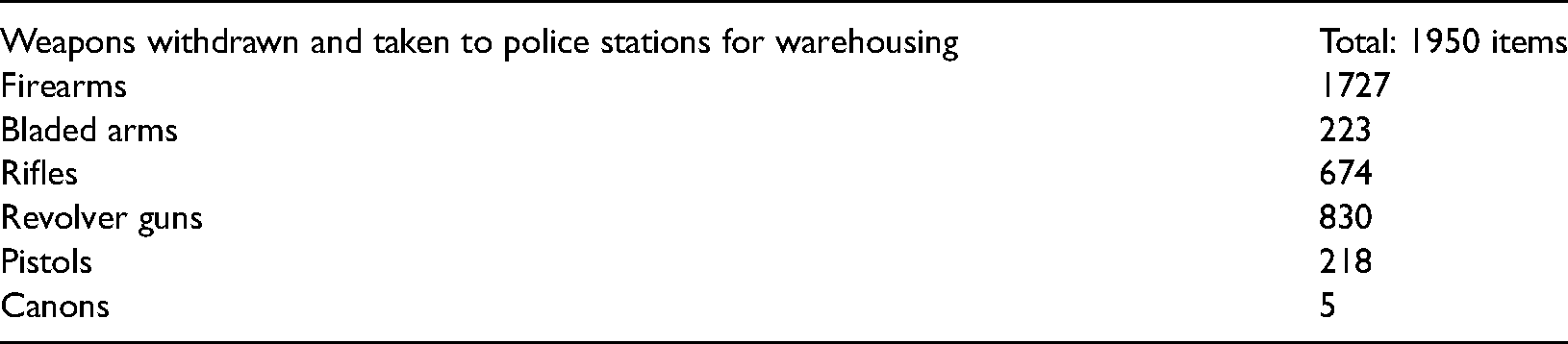
Taxonomy of confiscated weapons (TsGIA, F. 2073, R.1. F.15. L.58).
Taxonomy of legalised arms (TsGIA, F. 2073, R.1. F.15. L.59).
However, the revolutionary movement caused territorial restrictions on the exercise of the right to arms ownership. These restrictions worked in an imperial principle; however, there were exceptions to the general order, for instance, when the right of access to arms was not revoked but regulated in the regions where Emperor's life could be threatened – either in St. Petersburg or in Crimea. Even though gun control in such places was called ‘exceptional’ and was not planned to be implemented in other parts of the Russian Empire, this ‘exceptional’ character seems to be dubious. In reality, the extra measures of imperial security implemented in St. Petersburg relied on the experience of gun control that was implemented in the Russian part of Poland after the insurrections there. Thus, as archival documents show, the exceptional situation of the suppression of the rebellious imperial periphery was transferred to the core of the Russian Empire, its capital.
Another part of this story is that the Polish periphery was celebrated by the French and English press as being most developed in the political struggle for liberation from the Russian autocratic rule. To a certain extent, this could be said about St. Petersburg, where the most acculturated liberal and radical circles saw the autocracy as an outdated form of governance. Such impressions justified the exceptional actions against the internal enemies of autocracy. Still, since St. Petersburg was the centre of publicity in the empire, the general-governor was concerned about the fairness of the legitimization of the new measures. That is why he carefully considered petitions from subjects about arbitrary (in the case of Pavlov) or unfair (in Wenig's case) implementation of arms control measures.
Despite the growth of the revolutionary movement, other major cities only begun to regulate the sale and possession of weapons according to the St. Petersburg model on the eve of the 1905 revolution. As Gurko explained to the governor of Novgorod in 1879, governors could introduce arms control on their own initiative upon agreement of the central imperial administration in St. Petersburg. However, as the analysis of the archive material shows, the prohibitive regulation of arms sales and licensing of their possession caused a lot of controversies and additional work for both the governor's office and the police. 66 Thus, the governors did not opt for measures of exceptional gun control in their regions before the beginning of the 20th century when the revolutionary movement expanded radically. The refusal of the Russian imperial authorities to regulate access to arms despite the increase of political unrest shows that Russia had its own rationale when considering the need to ensure access to arms, despite the challenges of modernity.
As it was the case with empires everywhere, ‘protection talk’ was used to legitimize violence, which in turn (re)enforced imperial power. 67 With the spread of universalizing liberal discourse of rights in imperial Russia, the enforcement of martial law in some regions aimed to foster imperial power of the sovereign – the Russian emperor – to make and change laws, make exceptions from them, as well as to execute and pardon subjects. Still, Russian subjects successfully instrumentalized the different registers of rights protection – either modernist (i.e. through demanding fair trial, presumption of innocence and equality before the law), or traditionalist (mainly by asking for help and protection). 68 Why so? In line with Richard Wortman's findings about people's monarchy myth in late imperial Russia 69 , its principles also played a certain role in the merciful treatment of the conflicts that arose from the ‘unfair’ implementation of gun control. It seems that the discourse of ‘care’ and ‘protection’, which the Emperor and his officials had used to legitimize suppressions, also supported ‘care reasoning’ 70 that addressed the issues of particularity and difference in the implementation of the martial law in 1879. As a result, the permissive mode of access to arms in imperial Russia as a general rule was unchallenged even with the rise of revolutionary terror.
