






Abstract
This article examines the public use of archival documents that recorded crimes committed during the German occupation of Lithuania. The focus is on the mediation of archival documents originally produced by the Nazi German authorities in the documentary trial film, Why Stones Do Not Keep Silent, released in 1962. The first part discusses how the archives gained political importance in the Lithuanian Soviet Socialist Republic in the late 1950s and early 1960s. It shows how the history of World War II, Soviet war crimes prosecution and the (mis)use of archival documents were interrelated. The second part explores how Soviet Lithuanian documentary cinema was employed to mediate archival documents. The paper attempts to explain how, during the ‘second wave’ of Soviet justice in the 1960s, Nazi documents were instrumentalised to (re)shape historical narratives, construct enemy images and raise awareness of the history of the World War II. This study demonstrates that this archival material was mobilised to charge local Lithuanians with war crimes, while simultaneously reducing the creators of these documents – Nazi Germans – to an anonymous and voiceless occupying force that merely functioned as administrators and record-keepers of wartime atrocities.
Archives have been (mis)used as sites of knowledge and memory in both democratic and totalitarian regimes. They were often employed to enhance the dissemination of ideologised historical information, seeking to elevate or marginalise particular (hi)stories. 1 The political exploitation of archives has a long history in the Soviet Union. It was the October Revolution of 1917 that served as the catalyst for the most monumental changes in archive management in Russia. 2 The centralisation of the archival system enhanced by the Bolshevik leaders was guided by political and not historical aims, 3 as the documentary control was needed to legitimise and construct the new political regime. The archives were turned into ‘a site of power’, 4 associated ‘with ownership, control, and access to records’. 5 The Soviet annexation of foreign territories in the 1940s was also followed by the seizure and usurpation of local archives. For instance, after the forced inclusion of the Baltic States into the Soviet Union in the summer of 1940, the Soviet authorities issued special regulations that were intended to remodel the administration of the archives in accordance with Soviet legislation. 6 In 1944, when the Red Army troops entered Vilnius, one of the occupation regime's primary objectives was to gather and supervise archival records. Appropriating the archives and governing access to them meant controlling the past of the occupied territories and, therefore, was an issue of political priority. German historian Jan Plamper notes that ‘centralising the archives was crucial in the Soviet Union's self-understanding’ and represented ‘a common denominator of anti-capitalism’. 7
After the defeat of Nazi Germany, the Soviet Union used documents to establish its official narrative of the so-called ‘Great Patriotic War’, to mobilise Soviet citizens and to legitimise its political authority. As Schwartz and Cook, in their work on archives, records, and power, write, those who control the records also ‘wield power over the shape and direction of historical scholarship, collective memory, and national identity, over how we know ourselves as individuals, groups, and societies’. 8 German historian Walter Sperling, who has investigated the German trophy files in the aftermath of the war, notes that ‘the captured German files collected in Soviet archives became the dispositive of the Soviet state, a state-controlled resource for interpreting the past and the present’. 9 Therefore, during the Soviet era, German records remained interned in the state archives. Even after the collapse of the Soviet Union, as Patricia Kennedy Grimsted observes in her analysis of the pan-European displaced archives in the Russian Federation, captured German records and archival files from other countries remained ‘archival prisoners-of-war’. 10 The unwillingness to return these archival records remains ‘a symbol that the war is still not over’, as the historical documentation continues to be incorporated into the Russian State Military Archive. 11 These archives – which in fact belong to other European countries – serve as ‘symbols of victory’ celebrated in Russia in what many still refer to as the ‘Great Patriotic War’. 12 Their continued retention highlights how archival possession operates not merely as a legal or administrative matter, but as an enduring expression of political power.
The confiscation of archival materials was carried out by both Soviet authorities and Western Allied powers. German historian Astrid M. Eckert, in her book on the Western Allies and the return of German archives after World War II, shows how American and British troops in 1945 seized German government papers and archives, including the records of the German foreign ministry that were intended to expose Nazi foreign policy during the war. These documents were not only employed by the Allies in war crimes investigations, but also used for the writing of wartime history. 13 Eckert clarifies that ‘the seizure of the records was of profound importance for historical research’, and that they were used by British and American historians to present the official histories of the war. 14 Therefore, as she claims, ‘the Germans did not clamour for the return of the captured documents because possession of them would facilitate day-to-day governmental business, but rather because possession would erase a visible reminder of Germany's recent defeat and occupation’. 15
In the context of the Cold War, the Soviet government used archives not only for domestic purposes but also for international politics. Archives, particularly those containing documents related to the history of World War II, were weaponised in Soviet foreign policy, becoming part of the ‘psychological warfare’ on the ‘archival front’. 16 The official beginning of this ‘archival front’ in Soviet Lithuania dates to 1958. By the term ‘archival front’, this article refers to the systematic mobilisation of archival institutions, documents and professional practices as an ideological instrument in the broader Cold War struggle over historical interpretation and political legitimacy. In that year, following Soviet archival practices and legislation, the Central Committee of the Lithuanian Communist Party (LCP CC) adopted an act on the better use of archival documents and facts. 17 Historical documents had to be employed to educate citizens not only about the history of World War II but also to reshape the narrative of Lithuania's ‘bourgeois nationalist’ past. It is noteworthy that this document was issued on the same day as the act on measures to improve the protection of cultural monuments. 18 According to Lithuanian historian Zigmas Vitkus, this shows that ‘both material monuments and archival documents were treated as equally important tools that complement each other’. 19
The act on the better use of archival documents marked a renewed intensification of the Soviet approach to archival policy and signalled an explicit intention to use wartime historical documents for ideological ends. The Soviet Lithuanian authorities started to perceive archives as an important means of preserving historical consciousness and public memory, especially of World War II. The highest Soviet Lithuanian authorities, including those working within the Committee for State Security of the Lithuanian Soviet Socialist Republic (LSSR KGB) and the LCP CC, continually reshaped, reinterpreted and reinvented historical records. By restricting access to the archival records and choosing what information should be made public, they exercised an ‘enormous power over memory and identity’. 20 The documents, initially produced by the German occupational regime, were used in the 1960s in various forms of Soviet media, including documentary films. Therefore, this article aims to investigate how, in the 1960s, the Soviet Lithuanian authorities publicly mediated archival records that documented the crimes committed by the Nazi Germans and their local allies.
The focus of this work lies in the cinematic representation of archival documents. The paper, first, outlines how the archival work was intertwined with the (re)writing of the history of World War II and Soviet war crimes trials of the 1960s. What was the relationship between archives and politics during this period? How were the archives used to (re)shape the historical understanding of the war? Second, it examines the mediation of these records in the Soviet Lithuanian trial documentary film Kodėl akmenys netyli (Why Stones Do Not Keep Silent), 21 created in 1962. This documentary focused on the legal prosecution of the Lithuanian auxiliaries in 1962, who were convicted of participating in mass murder during the war. 22 The article seeks to explain how, in the 1960s, using archival records, the Soviet authorities strategically deployed the archival material and controlled the narrative of the so-called ‘Great Patriotic War’, in particular by creating public images of their domestic and foreign opponents. What forms of knowledge were generated about war criminals and their actions? What lasting effects resulted from the Soviet regime's public distribution of these archival materials?
Launching the ‘archival front’: Soviet justice and the Holocaust in the Cold War context
The two Soviet occupations of Lithuania in 1940 and 1944 started and ended with archival laws. 23 The Sovietisation of Lithuanian archives fulfilled two significant political functions. First, archives were used as an instrument of repression against the regime's enemies. The Soviet repressive institutions employed the archives to persecute, imprison or eliminate their opponents. Special departments of the state archives provided the Soviet security services with information used for the repression of the population. For instance, in 1946, Lithuanian archives under Soviet control received over 25,000 requests for information on individuals who had been members of various political organisations in the interwar period and were identified by the Soviet authorities as hostile to the new political regime. 24 Thus, as Lithuanian historians argue, ‘archives were an appendix to the repression system, and from Moscow to the periphery were subjugated to justify political repression’. 25
Second, by using archival documents for propaganda purposes, the Soviet regime exerted an enormous influence on the formation of the historical narrative of the war that had to be conveyed to both local and international audiences. The Soviet regime targeted both Western countries and members of the Lithuanian diaspora in the West, particularly in the United States. These exiles mostly consisted of those who fled Lithuania as the communist regime was established in the country after the war. They largely represented the middle and upper classes, including former members of the country's interwar political and cultural establishment. These emigrants possessed ‘a very strong feeling of duty and mission, both moral and civic, to do what was possible to retain the culture as well as to liberate the country’. 26 The Soviet authorities designated them as ‘enemies of the people’, and viewed their anti-Soviet actions as ‘weapons of hostile ideology’. 27
After Stalin's death, the political authorities further expanded their efforts to examine and politically exploit the archives of the republics occupied by the Soviet Union. The 20th Communist Party Congress in 1956 not only repudiated Stalinism, but also ‘exercised a profound influence on what may be called work on the historical front’. 28 As American historian Polly Jones argues, many of the changes after 1953 were linked not only to the attempt to ‘de-Stalinise’ the Soviet Union but also to reinvigorate and revitalise the socialist project, seeking ‘to emphasise the new regime's legitimacy’. 29 By more broadly examining the archives, history had to be publicly de-Stalinised and wartime memories and experiences had to be revisited through ideological filters. In this period, the Soviet authorities demonstrated an official state attempt to ‘employ’ the past and its archival records for political ends.
One of the most important functions of the Soviet archives was their publication activity, marked by the selective process of publishing and editing the collections of historical documents. In the 1960s, many publications and other forms of commemoration related to the ‘Great Patriotic War’ flourished. For instance, during these years, numerous new museums were opened not only in Soviet Lithuania but also in other parts of the Soviet Union. 30 Another important change in the Soviet memorialisation of the war during the Thaw was the return of civilian casualties to the narrative. In the 1960s, the regime permitted discussion of defeats and failures, concentration camps, and the tragic fates of individuals, often using historical records that were seized during the war. Lithuanian historian Vitkus affirms that such a new wave of memorialisation could be explained by the fact that, in this period, the regime, 20 years after the war, sought to influence a new generation that grew up in the Soviet Union, ‘a generation that had not experienced the war first-hand, i.e. a generation to which it was already possible to try to present and inculcate an ideologically purified image of the past’. 31
In the early 1960s, the Soviet archival system was reorganised. In 1961, the Lithuanian archives ceased to be supervised by the Office of the Ministry of the Interior of the Lithuanian SSR (former NKVD) and came under the control of the Central Committee of the Communist Party. 32 However, the archives of all the Soviet republics were subordinate to the Main Archival Administration of the Union of Soviet Socialist Republics (USSR). In the post-war years, ‘a strict system of classification’ of the archival collections was introduced, especially with regard to document collections on the period of German occupation. 33 Access to these archival collections was restricted to those individuals who had been commissioned by the state institutions to produce historical works and document collections favourable to the Soviet regime. In the late 1950s, the Soviet archives even proclaimed an opening to foreign scholars, officially seeking to normalise their international relations. Nevertheless, foreign scholars, whom the Soviet state designated as ‘bourgeois falsifiers’ of history, were granted only selective access to archival materials. 34 Historian Sheila Fitzpatrick remembers her archival research in Moscow in the 1960s: ‘Getting permission to do anything was a big problem in the Soviet Union, involving endless visits to bureaucrats who demanded ever more documents’. Yet, as she acknowledges, ‘archival permissions were the worst, except perhaps for permission to marry’. 35 Moreover, foreigners were never permitted to view the catalogues; it was the Soviet archivist who selected and ordered the material. 36
There are a few reasons that motivated the Soviet regime to focus particularly on the dissemination of archival records in Soviet Lithuania during the Thaw. Here, it is important to note that, in the late 1950s and early 1960s, the Soviet repressive institutions, including the LSSR KGB, began to change their approach to combating anti-Soviet dissent. After the end of the armed anti-Soviet resistance in Lithuania in 1953, new types of non-violent resistance emerged. According to the Lithuanian historian Kristina Burinskaitė, to lessen such acts of this new form of opposition in Soviet Lithuania, the LSSR KGB initiated methodological changes in its work and started ‘to participate actively in the formation of public opinion’. 37 Therefore, unsurprisingly, the archival records became a central means in this fight. The publication of document collections, as well as their public display in cinema, television and other media, often coordinated by the KGB, served both to authenticate the historical narrative of World War II and to serve as material evidence of wartime violence.
To consolidate their efforts in the dissemination of historical knowledge, the Editorial Office for the Publication of Archival Documents of the Lithuanian SSR Academy of Sciences (in Lithuanian: LSSR Mokslų akademijos Archyvinių dokumentų skelbimo redakcija) was founded in 1958. This group was led by former KGB investigator Boleslovas Baranauskas. It was tasked by the LCP CC with actively participating in the creation of the official state historical discourse on the wartime era using archival material. The publishing and editing of archival documents had to serve as the basis for this new historisation of the Soviet past. The German-American historian Fritz T. Epstein, who in the 1950s and 1960s curated Central European and Slavic collections at numerous American institutions, including the Library of Congress, asserted that in this period in the Soviet Union ‘the art of editing sources has been developed (…) into an auxiliary historical discipline’. 38
Nevertheless, it is important to emphasise that this tradition had already been established by the 1920s. Walter Sperling, in his research, reveals how in the 1920s leading Bolshevik historians ‘not only asserted their Marxist-Leninist interpretation of history, but also sought to prove it by publishing archival documents’, particularly in their flagship journal The Red Archive. 39 According to Sperling, to prove Lenin's theses on imperialism and capitalism, it seemed for Bolshevik historians that ‘it was enough to publish the documents, some from the tsarist archives, some from the German archives, which revealed the expansionist drive and antagonism of the European countries’. 40 The activities of the Editorial Office for the Publication of Archival Documents in Vilnius validated these established Soviet methods of document publication and editing. Not only did this group produce numerous document collections and other historical publications in Lithuanian and English on the history of World War II, but it also actively collected new historical material for the Soviet archives. 41
This ‘documentary turn’ in Soviet Lithuania in the late 1950s was also closely linked to the beginning of the ‘second wave’ of Soviet justice and the Khrushchev regime's attempt to find a new basis for self-legitimation after the years of Stalinist oppression. For instance, in 1953, the USSR returned some additional captured German records to Lithuania. 42 These records contained documents mostly originating from the Nazi occupation of Lithuania and relating to Lithuanian citizens, which had been collected by the police and secret services. 43 These returned document collections were intended to serve both the presentation of historical narratives about the German occupation to Soviet Lithuanian audiences and the prosecution of war criminals. Therefore, unsurprisingly, in the late 1950s, the Interrogation Division of the LSSR KGB was given the order to examine archival files of the cases related to the mass murder in Lithuania during the Nazi occupation. KGB officers were instructed to collect archival materials on unresolved wartime mass atrocities and to analyse records produced by the Extraordinary State Commission, which investigated Nazi crimes and their accomplices in the immediate post-war period. 44
In 1966, the deputy chairman of the LSSR KGB, colonel Vasilijus Konoplenko, demanded that KGB officers, including those from the interrogation department, ‘to expedite the investigation of materials from state special commissions on the crimes of German fascist invaders and their collaborators, as well as other archival documents, and to identify Nazi criminals who have not yet been exposed’. 45 This archival work marked the launch of the ‘second wave’ of Soviet justice in the LSSR and was of particular importance for establishing new cases of war crimes and publicly bringing accused war criminals to justice. Thus, archival records, first, had to be used as important evidentiary material during these legal proceedings; second, they had to be employed to inform the public about the Nazi occupation in Lithuania and the mass atrocities committed there by the Germans and their local collaborators. 46
On the one hand, these legal proceedings, due to the selective use of archival documents and the Soviet repressive legal system, were often characterised as examples of Soviet legal violence against its adversaries. They were conducted in a contentious legal and ideological atmosphere during the Cold War. The Soviet government also weaponised them against Western democracies and transformed them into a key component of the Cold War's ideological battle. 47 On the other hand, however, these trials also provided historical information about the mass atrocities that occurred during the war. The historian Alexander V. Prusin declares that: ‘The courtroom treatment of the Holocaust reflected the ambivalence of Soviet official attitudes towards the murder of Jews’, 48 because ‘the trials exposed the overwhelming tragedy of the Soviet Jews’. 49 First, by breaking two decades of silence, these lawsuits confronted the Soviet Lithuanian public with the extermination of the Lithuanian Jews. Jewish Holocaust survivors and other non-Jewish witnesses both openly recounted their experiences and memories throughout the pre-trial proceedings in these court cases. Second, the majority of the individuals prosecuted by the Soviet legal authorities ‘did indeed commit atrocities’ during the Nazi occupation, and ‘there was no need to falsify incriminating evidence against individual defendants’. 50
The public exposure of archival documents revealed the organisation of the Holocaust 51 in Lithuania and provided detailed descriptions of how these mass atrocities were carried out both in large Lithuanian towns and in the provinces. For instance, the Soviet document collections included such significant German documents as the report of SS-Brigadier General Walter Stahlecker, who reported on the killing of Jews in the Baltic countries and Belarus and whose report served as evidence during the Nuremberg trial. This archival material was first made available to the public in the mid-1960s and early 1970s through Lithuanian-language documentary collections on mass murder in Lithuania. 52 The published German documents were usually accompanied by interrogation protocols from both the immediate post-war years and the 1960s war crimes trials. All these historical records were maintained and supervised by the previously mentioned Editorial Office for the Publication of Archival Documents in Vilnius.
Mediating archival documents: The KGB and the construction of enemies on screen
On 16 December 1961, preparations for a broad media campaign were intended to accompany the trial against the members of the 12th Lithuanian Auxiliary Police Battalion and its commander, Antanas Impulevičius. Impulevičius left Lithuania in 1944 and moved to Germany; in 1949, he immigrated to the United States. In 1962, the Supreme Court of the Lithuanian SSR sentenced him to death in absentia; however, the United States rejected the Soviet request to extradite him. The broadcast of the trial on TV and radio, the preparation of a, portraying the acts of violence committed by the members of the battalion, and the publication of a series of press articles were included in the KGB operative plan.
53
Such additional operational procedures, which included visual means – exhibitions, films and television – were seen as carriers of symbolic retribution, aimed at achieving ‘quick justice’.
54
The KGB publicity campaign had to serve two purposes: first, to safeguard the ideological narrative on important historical issues, and second, to maintain heightened societal tensions. As the Lithuanian historian Darius Juodis explains: ‘By entering the public arena in this way, the KGB aimed, at least outwardly, to become closer to the masses and to partially mitigate or abolish the repressive image of the repressive institution of the Stalinist times’.
55
In 1960, Juozas Obukauskas, the Head of the Fourth Directorate of the LSSR KGB, illustrated the reasoning behind the KGB's publicity efforts in his report on the exposure of Lithuanian and other ‘bourgeois nationalists’ in the press and on the radio: Lithuanian bourgeois nationalists, both abroad and in the republic, are spreading all sorts of anti-Soviet information to try to prove that they also fought against the Nazis during the German fascist occupation. In order to expose such nationalist claims and reveal their collaboration with the occupiers and other criminal activities, we have published several articles on this subject in the republic's newspapers and magazines. […] The population welcomes all measures that expose and compromise these bourgeois nationalists and condemns their brutality. Nationalist elements, realising that they are losing ground when publicly exposed, sometimes react fiercely to the published articles.
56
By contrast, the documentary Why Stones Do Not Keep Silent centred on the pre-trial process of the legal prosecution against the Lithuanian auxiliaries. During the war, members of these battalions committed mass crimes in Lithuania and Belarus. The film review, which appeared in the Soviet Lithuanian press, asserts that this documentary ‘shows the viewer the cruelty not only of those degenerates who are currently in the docks or are about to be found guilty, but also of those who are currently still walking free’. 58 This series, including this documentary, was directed by the filmmaker Leonas Tautrimas. Tautrimas was one of the most productive cameramen in the chronicle industry, shooting over 700 stories for film magazines. He also had cinematic experience with historical subjects. For instance, at the beginning of his career, immediately after the end of the war, he participated in the creation of films dealing with the memory of World War II, as well as in the making of short documentaries commissioned by the Soviet Lithuanian communist authorities. 59
Preparatory work for these trial documentaries began in October 1958, when film director Tautrimas and the previously mentioned Boleslovas Baranauskas, head of the Editorial Office for the Publication of Archival Documents at the Lithuanian SSR Academy of Sciences, undertook a research visit to the Central Photo, Phono and Film Archive (today the Russian State Documentary Film and Photo Archive), commonly known as the Krasnogorsk Archive. During this visit, they collected archival film materials intended for use by the Lithuanian Film Studio. 60 This early collaboration illustrates the close coordination between archival institutions and filmmakers in sourcing visual as well as textual evidence for cinematic productions in the Soviet archives. In 1965, this trilogy was nominated for the Soviet Lithuanian State Prize in Literature and Arts for its contribution to Lithuanian documentary cinema. The commission, comprised representatives from the Art Council of the Lithuanian Film Studio, the Cinematography Committee of the LSSR, and the Film Workers' Union Board, declared: ‘In recent years, when the Federal Republic of Germany attempts “to legitimise” war criminals, these films are exceptionally relevant and meaningful’. 61
Notably, Lithuanian film historians often refer to this trilogy as an example of ideologised cinema, which used historical evidence and cinematic narrative for political ends rather than purely artistic expression. 62 For example, the Lithuanian film critic Živilė Pipinytė argues that such films manipulated the ‘documentary’ qualities of cinema, staged historical events, and employed voice-over narration to construct what she terms a ‘myth of imaginary reality’, thereby reinforcing ideological attitudes. 63 This critique highlights the ways in which cinematic form was used to blur the boundaries between documentation and propaganda. It is important to note that, despite adhering closely to communist propaganda frameworks, these films did not present a wholly fictional or entirely fabricated account of the World War. Rather, they drew upon real events, locations and individuals, selectively framing them to serve ideological purposes while maintaining a degree of factual grounding. Furthermore, these documentaries blended propagandistic documentary conventions with a poetic so-called auteur style that prevailed at that time in LSSR cinema. The early 1960s witnessed ‘a shift in the conception of documentary film’ in Soviet Lithuania. 64 During this period, documentary cinema assumed a threefold role: it was no longer limited to supporting the ideological programme or conforming to prescribed representations, but also functioned as a means of portraying reality through reportage and as a form of artistic expression in the shape of the authored documentary. 65
For instance, in the film Why Stones Do Not Keep Silent, imagery of nature (Figure 1) and a dramatic musical soundtrack were incorporated to convey the history of mass murder in a more emotionally charged mode. The film's musical score was composed by the Lithuanian composer and sound director Rimvydas Racevičius, who at that time served as head and chief conductor of the Lithuanian Radio and Television Light Music Orchestra. His contribution played a significant role in shaping the film's emotional tone. The visual and sensory aesthetic of this documentary film sought to evoke empathy and moral engagement from viewers while reinforcing the film's evidentiary claims. This shift was not unique to Soviet Lithuanian cinema but instead reflected a broader cinematic trend across the Soviet Union during the Thaw period, allowing filmmakers to explore new narrative forms and aesthetic strategies while remaining within the boundaries of acceptable political discourse. Film historian Josephine Woll claims that Soviet documentary films during the Thaw were of a twofold nature; they shaped a distinctive visual aesthetic that combined evidentiary authority with expressive, often lyrical, cinematic form. 66
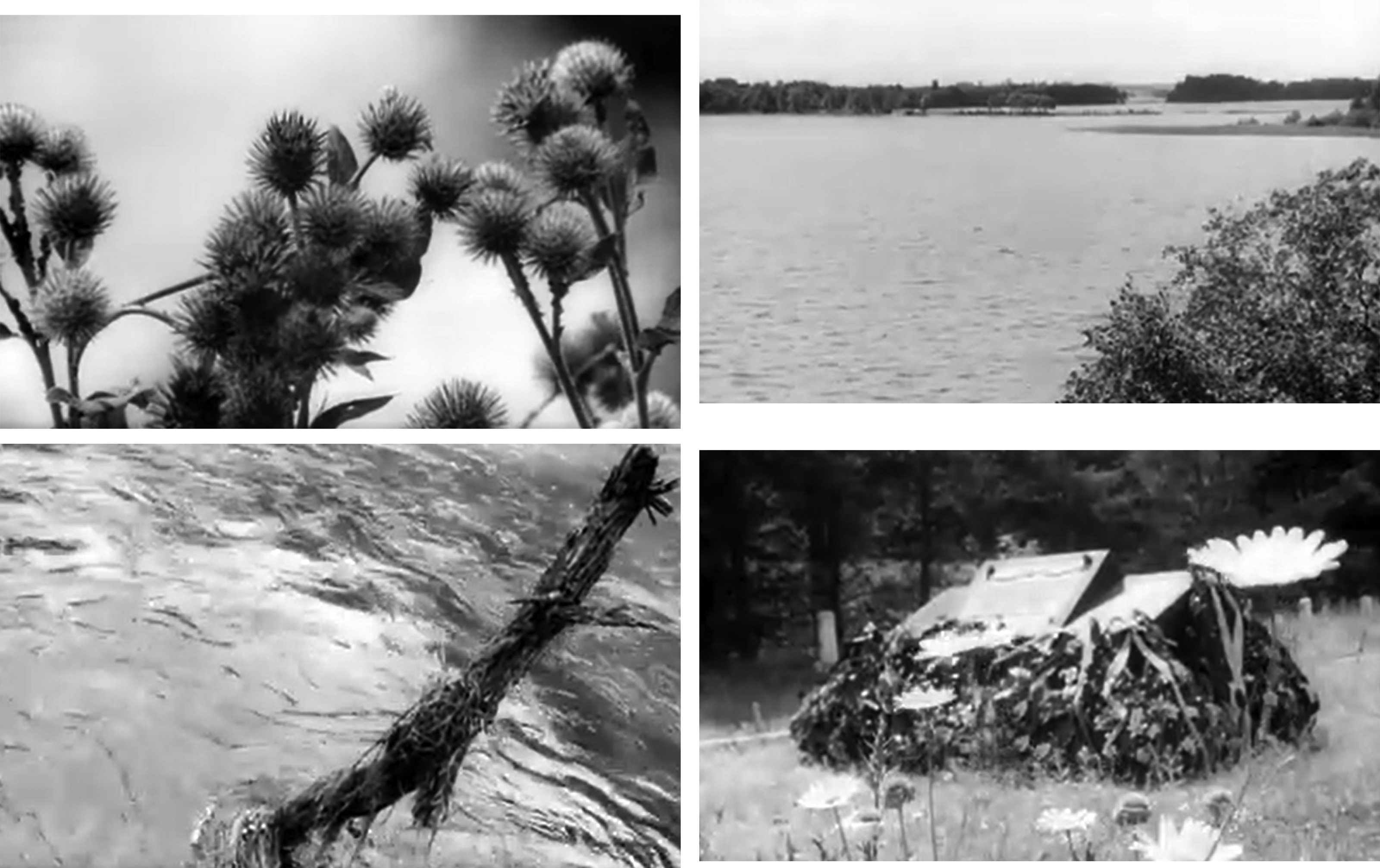
Natural scenery in screenshots from the documentary Why Stones Do Not Keep Silent, dir. Leonas Tautrimas (Lithuanian Film Studio, 1962).
Therefore, it can be argued that the use of documentary cinema during the war crimes trials was a well-thought-out strategy by the LSSR KGB. Various political regimes viewed trial documentaries on the post-war prosecution of war criminals as an essential tool for public education. Trials that could be easily turned into public spectacles were instrumental in educating people. Trial documentaries were used by both democratic and authoritarian regimes for propaganda, seeking to (re)shape historical awareness and (re)present ‘real events’ and ‘historical truth’. In her book on Soviet courts in the 1920s and 1930s, Julie A. Cassiday ascertains that the ‘combination of documentary film's heightened realism and the melodramatic unmasking of the hidden enemy’ transformed documentaries into one of the most significant forms of Stalinist propaganda during the show trials. 67 Similarly, in the case of the ‘second wave’ of Soviet justice, documentaries had to increase the involvement of Soviet society in the state's campaign of retributive justice and broaden the trial audience. Lithuanian historian Justas Stončius argues that cinema enabled the Soviet regime to pursue memory politics as well as to (re)present ‘an appropriate version of the Nazi occupation in Lithuania’. 68 Thus, how was the archival material incorporated into this documentary? What message was conveyed by the exposure of German documents to the public? What images of the enemy were created? And what were the legacies of such public exposure of archival records?
The documentary film Why Stones Do Not Keep Silent mostly focused on the pre-trial proceedings against the Lithuanian auxiliaries. The documentary gained significance by revealing the KGB's investigative methods and interrogations and by making previously undisclosed German legal documents accessible to the public. The French film scholar Irina Tcherneva, who has investigated Soviet Latvian documentaries on war crimes produced in the 1960s, ascertains that these films sought to authenticate legal accusations by combining visual evidence of violence, oral testimonies and captured German documentation. 69 As German media and cultural historian Judith Keilbach has shown in her research on archival records and documentary film, archival footage is employed not merely as evidentiary material but as a rhetorical device that persuades viewers of a narrative's historical credibility and functions as an ‘authenticity claim’. 70 Similarly, German film scholar Dagmar Brunow emphasises that the reuse of archival footage in documentary cinema ‘raises questions about the mediation of memory, its media specificity and the way memory travels, how it is adapted, translated and appropriated’. 71 Thus, this article likewise argues that the display of archival documents in documentary films does not simply transmit historical facts but actively shapes historical meaning and advances claims to truth through cinematic recontextualisation.
Therefore, it can be argued that the visualisation of German documents served two aims. First, it had to legitimise and authenticate the Soviet war crimes trials by demonstrating that war criminals were punished based on historical records produced by the German occupational regime in Lithuania. Second, KGB officials sought ‘to present their jobs as credibly and professionally as possible on screen’. 72 By presenting numerous archival documents, they attempted to demonstrate their thorough and systematic approach to investigating war crimes. According to historian Prusin's research on the Soviet war crimes trials, their publicity campaign had to function as ‘the rehabilitation of the security services, the reputation of which was severely damaged by its role in Stalinist terror’. 73
The LSSR KGB, which had a double function in Soviet Lithuanian cinema, played an important role in the production of such trial documentaries. Not only did the KGB monitor films that dealt with important historical issues, but it also observed the attitudes and behaviour of the directors. In the case of trial documentaries of this period, KGB officers, typically the chiefs or deputy chiefs of the LSSR KGB Investigation Division, served as film advisers. In the filmmaking of Why Stones Do Not Keep Silent, two senior KGB consultants were involved: Eduardas Kisminas, the chief of the LSSR KGB Investigation Division, and Vytautas Kažys, the division's chief investigator in charge of important assignments. Given their privileged access to restricted state archives, it is likely that they controlled which documents were selected and presented to the public in this documentary film.
German documents selected for inclusion in the documentary film were originally sourced from the Central State Archives of the Belarusian SSR, where the crimes were committed. They were among five German documents from the war crimes trial proceedings that presented the activities of the aforementioned police battalion, as well as their translations into Russian. These archival records, which were used as evidentiary material during the trial, portrayed the acts of violence committed by the battalion's members and the number of victims executed by this killing squad. At the beginning of October 1941, this battalion was transferred from Kaunas to Minsk. In October and November 1941, this unit actively participated in the execution of nearly 19,000 people in Minsk and other Belarusian towns.
It is likewise worth considering how this German-language archival document was integrated into the film in a way that would both resonate with and be accessible to a Lithuanian audience. The document that was exposed in the film (Figure 2) originally contained information on the deployment of the Twelfth Lithuanian Auxiliary Police Battalion to Minsk. However, the voice-over cited the content of other archival material from this legal case that contained the numbers of victims exterminated in Belarus by this unit. The German version of the document only briefly flashed on the screen, making it clear that the Lithuanian audience would not be able to comprehend and compare the document's content due to linguistic and time constraints. Thus, the filmmakers created a discrepancy between the visual and auditory information. The researcher of visual culture and film Natalija Arlauskaitė, in her book on photographs of the collapsed regimes in documentary film, claims that in archival cinema ‘the voice does not coincide with the image, creating a critical distance in various ways and filling it with specific content’. She further maintains that, in this way, ‘rewriting the archive involves its vocal deterritorialisation, transforming the subject's place and shifting the visual regime of the archive’. 74 Thus, voice-over narration and sound possess the capacity to reconfigure the meaning and authority of archival images. In this documentary, such an approach to archival documents demonstrates that the documents were employed in a highly instrumentalised manner, seeking to achieve the desired combination of visual and auditory effects. This form of presentation attempted to add emotional depth to the bureaucratic German document shown on the screen by presenting the victims of the accused local defendants. The archival records of this documentary film reveal that the filmmakers were expected not only to show archival documents on the activities of the Twelfth Lithuanian Auxiliary Police Battalion but also to film in Belarus:
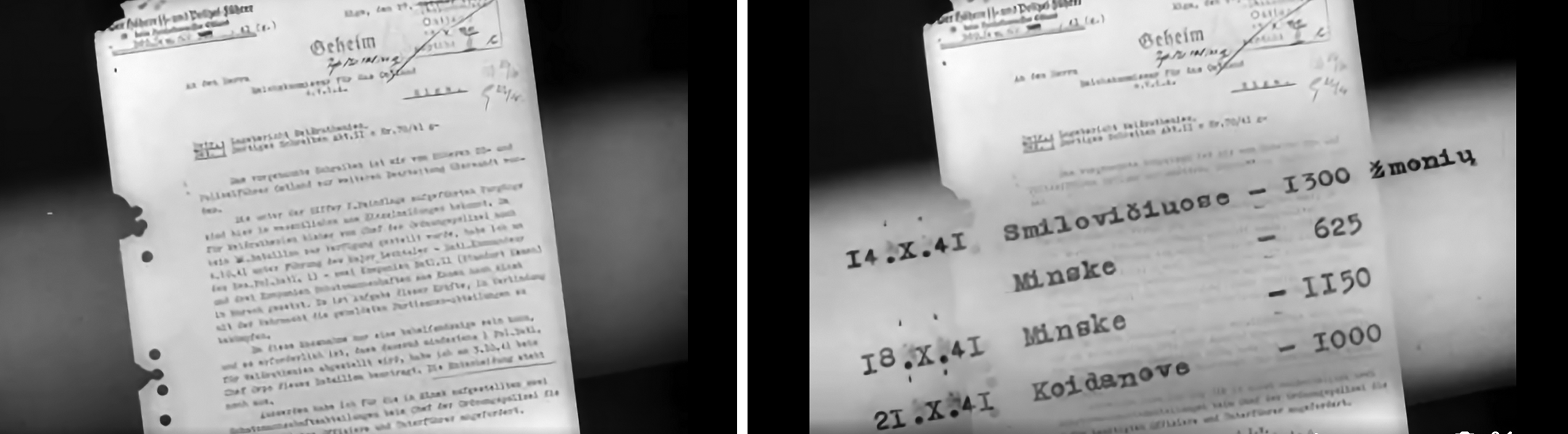
Screenshots from the documentary Why Stones Do Not Keep Silent, dir. Leonas Tautrimas (Lithuanian Film Studio, 1962).
The episode in Soviet Belarus should occupy a significant place in the film. How can we recreate the image of the battalion's atrocities from those years more clearly? We should ask the remaining executioners, now in the hands of the justice system, show the sites of the massacres and tell the people who live there now who they were. With the help of the film's creators, friendly meetings of Lithuanian farmers, and perhaps intellectuals, should be organised in those places in Belarus where people were massacred. Such a meeting should be warm, brotherly, and joyful. Perhaps wreaths could be laid in memory for those who died at the hands of the fascist executioners. 75
These scenes, although specified in the film's initial planning, were never filmed. The only evidence of the battalion's physical presence in Belarus was the interrogation scenes of the accused defendants, wartime photographs and the footage of archival material shown on screen. The public use of this archival record served not only to emotionalise viewers about the victims of the Nazi occupation regime but also to create the image of two categories of Soviet enemies: the Nazi Germans and their local Lithuanian collaborators. However, as will be discussed here, the Soviet legal authorities and the LSSR KGB investigators rarely mentioned specific German perpetrators, instead creating the impression that wartime atrocities were planned and carried out primarily by a segment of the local population. Even though the German documents provided evidence of the crimes of both the Nazi Germans and their accomplices, they were primarily used to identify local offenders.
For instance, Georg Jedicke, a commander of the Ordnungspolizei Ostland, who signed the document exposed in the documentary, was not mentioned in the film. Until 1947, he was detained in U.S. captivity as a prisoner of war and, after the war, was never brought to justice by the West German judicial system. Nevertheless, neither his character nor the absence of West German retribution against him is addressed in the film's storyline. Therefore, it is also difficult to understand why, at the height of the Cold War, the Soviet government publicly criticised Western countries for harbouring war criminals, particularly the West German judiciary, while simultaneously abandoning their own efforts to prosecute German war criminals legally. This contradiction in Soviet politics is also questioned by Anton Weiss-Wendt, who investigated the 1960s war crimes trials in Estonia: ‘If the Soviet authorities really intended to challenge the German judiciary, one would expect domestic trials to have paid particular attention to German perpetrators, as was the case back in the 1940s’. 76 Instead, the Germans were hardly ever mentioned in the war crimes trials of the 1960s, giving the impression that only the locals were responsible for the mass atrocities.
Thus, the German document, which the film voice-over denotes as the portrayal of ‘the pedantic German statistics’, 77 was screened, first and foremost, not to accuse the Nazi Germans but to incriminate local Lithuanian collaborators. The narrator of this documentary clarifies the role of Lithuanian collaborators: ‘They killed (…) hundreds and thousands, as confirmed by the documents left by the Hitlerites’. 78 This German archival record was inserted into the middle section of the documentary, where its central placement within the film's editing structure helped weave the narrative together and heighten dramatic tension. By presenting the archival document as authoritative proof that Lithuanian collaborators executed hundreds and thousands of innocent people, the film sought to persuade viewers of the narrative's historical credibility and to advance what Keilbach has described as an ‘authenticity claim’. In this way, through montage and sequencing, raw archival material was transformed into a cohesive and persuasive narrative designed to guide viewers’ interpretation of the historical events depicted.
Who were these local collaborators? The principal targets of the 1960s war crimes trials were several categories of local offenders: firstly, collaborators living in Soviet Lithuania; secondly, members of the exile community; and thirdly, the clergy of the Lithuanian Catholic Church, especially those who were active in the underground anti-Soviet resistance. However, due to their social and political activities, the émigrés were considered by the LSSR KGB to be a particularly important hostile group. 79 For example, during the trial process depicted in this documentary film, the figure of the previously mentioned Impulevičius, who lived in exile, as well as the emigrant community, were made the main culprits of the mass atrocities committed during the Nazi occupation. Nevertheless, contrary to claims made by the Lithuanian-American exile community, who criticised the ‘second wave’ of Soviet justice in Soviet Lithuania, the accusations against Impulevičius were neither invented nor forged. As Lithuanian-American historian Saulius Sužiedėlis discerns, most Lithuanian-Americans ‘simply saw him as a former officer of independent Lithuania. As unpleasant as it may be to admit, although there were not many such people, not all the facts about war criminals among the emigrants were invented’ by the LSSR KGB. 80
Despite the exposure of German documents, Nazi Germans, in contrast to Lithuanians, were only briefly featured in the documentary and were mainly depicted as a group of faceless occupying forces. Only Theodor Adrian von Renteln, General Commissioner of Generalbezirk Litauen, whose name was explicitly mentioned to the film's audience, represented an exception. Nevertheless, the film's narrator, even during the shots of Germans, spoke about the Lithuanians who, during the occupation, collaborated with the Nazi regime. By contrast, Lithuanian defendants were captured in close-up shots, filming their faces and facial expressions at close range (see Figure 3). Cassiday claims that the ‘frequency of such shots in profile constitutes the visual definition or cinematic mug shot of the accused men’. 81 She asserts that the offenders are portrayed in this manner ‘as illustrations of a single enemy type’, transforming them ‘into a single proto-enemy’. 82
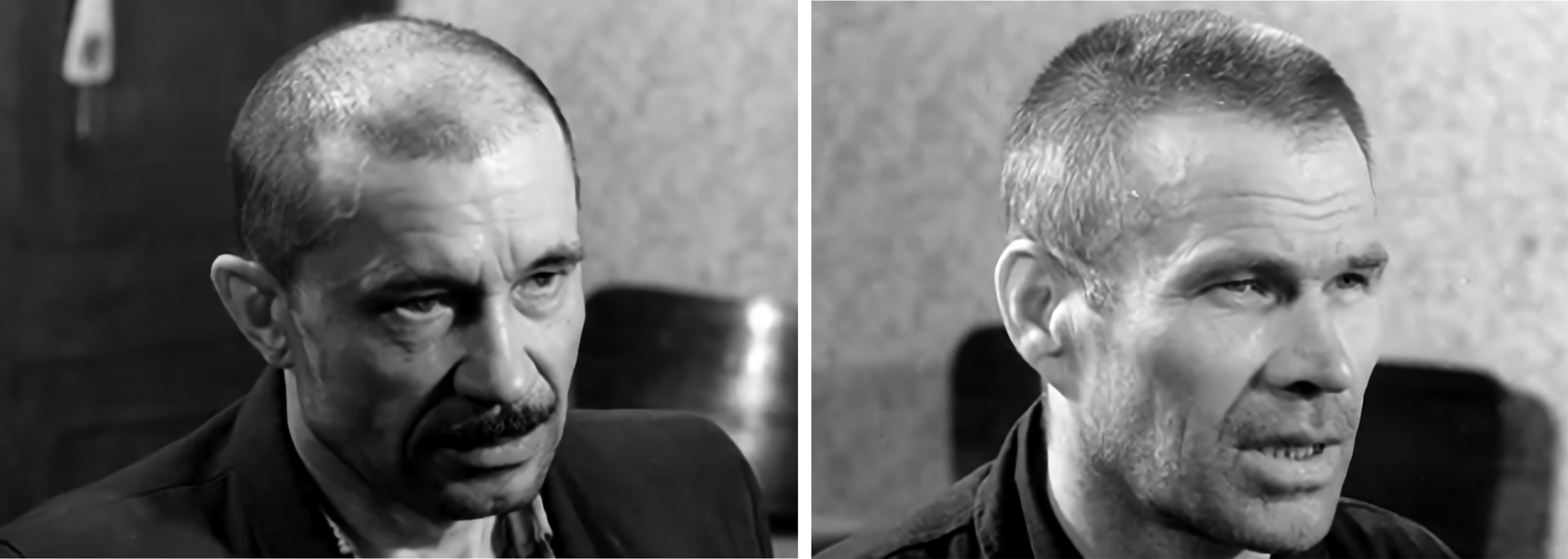
The camera shots of the interrogations of the accused local Lithuanians. Screenshots from the documentary Why Stones Do Not Keep Silent, dir. Leonas Tautrimas (Lithuanian Film Studio, 1962).
Moreover, the documentary, which was filmed with the synchronous camera, gave voice only to the accused Lithuanian defendants, leaving the Germans voiceless. It is worth noting that the use of the synchronous camera in Soviet Lithuanian cinema opened up new possibilities for depicting reality, ‘emphasising the principle of conversation as the main narrative axis of the film’. 83 Viewers could experience more than just the narrator's singular voice; the film captured authentic audio from trial participants, including the interrogations of the accused defendants. In 1964, Saulius Macaitis, a Lithuanian film critic, observed in his review of the sound techniques of this documentary film: ‘How new, unexpected and terrifying the confessions of the killers in the trial sound after these shots, how powerful the synchronous camera, so sparingly used by the filmmakers, becomes!’ 84 In this manner, he indicates the importance of hearing the voices of the accused defendants, who themselves testify about their criminal activities. As a result, the Lithuanian accused defendants were presented as a distinct group of war criminals with their own publicly spoken (hi)stories of mass atrocities, in contrast to the anonymous and mute group of German perpetrators.
What motivated the Soviet officials to minimise the role of Nazi Germans as adversaries and perpetrators, even while consistently presenting and using German documentation? There could have been several reasons for such an absence. First, as historian Greg Afinogenov, who investigated the construction of public memory about Nazi Germans in the Soviet Union, notes, the Nazis were nearly absent in Soviet war films, and when they appeared, they were usually portrayed ‘as shadowy figures in tanks or infantry helmets, more an elemental force than an ideologically specific enemy’. 85 Ukrainian historian Viktoriya Sukovata, who studied Soviet spy films, likewise ascertains that ‘the Soviet combat movies and the war melodramas de-personalised the Germans as symbols of the ontologically evil, faceless, and inhuman Nazis’. 86 Similarly, in this documentary, through the exposure of archival documents, Germans were presented as bureaucrats and meticulous record-keepers of the crimes committed by local auxiliaries, rather than as offenders or organisers of these criminal activities. Second, it could be asserted that these trials, even though they were used during the Cold War as an ideological means to attack Western countries for shielding war criminals, were nevertheless primarily designed for local audiences. Soviet Lithuanian society, especially anti-Soviet activists, had to be taught through these legal proceedings that nobody who opposed the regime could escape punishment.
Third, in the 1960s, the invisibility of Germans in Soviet Lithuania can be seen as a planned act of the numerous dissemination campaigns related to the history of World War II. It could even be argued that the Soviet regime sought to hide the traces of Germans, both from the archives, their burial sites as well as from most of the visual sources. In this manner, the regime edited and modified the content of archival records, in some cases resulting in the ideological exploitation of historical sources. For instance, already in the late 1940s, when Soviet camps for prisoners of war in Lithuania began to be closed, some documents ‘indicating burial sites, numbers and names of the deceased prisoners’ were ‘deliberately destroyed’ or taken by the Soviets to Moscow. 87 Moreover, in the 1950s and 1960s, Soviet authorities demolished the burial sites of the prisoners of war, including those of the German soldiers, who were viewed as ideological enemies of the regime. 88 According to Lithuanian historian Vytautas Tininis, who researched German and Axis prisoners of war in Lithuania in 1944–1949, there were around 3,000 German prisoners of war who lost their lives in Lithuania; however, ‘relatives of many of them never found out where they had been buried, because no signs were placed on any such graves’. 89 The most important archival documents recording the life and work of internees, including their exploitation, are stored in the State Archive of the Russian Federation and the Russian Military State Archive. 90 Thus, the Soviet authorities attempted to hide any traces of the suffering and death of Germans in POW camps that were unfavourable to the Soviet regime.
Finally, the Soviet censorship also regulated the visual representation of the Germans, even when shown publicly, their faces had to be depersonalised and rendered unrecognisable. For instance, in 1965, to commemorate the twentieth anniversary of the end of World War II, an album entitled Kovų keliais (On the Road to Battle) was published in Soviet Lithuania, which included photographs of German prisoners of war. However, the censors who were reviewing the album noted that ‘they could clearly make out the faces of the German prisoners’. 91 The editors became concerned about a possible scandal. In the earlier years, after the exchange of prisoners of war between Germany and the Soviet Union, the Soviets had kept some of the Germans in captivity and forced them to work on construction sites in Siberia. 92 The magazine that printed the photographs of those Germans reached Germany and one woman recognised her husband working in Siberia. Therefore, ‘the order was given to retouch the eyes of the prisoners to make them unrecognisable’. 93 The book artist of this publication, Rimantas Dichavičius, ‘used a brush and sulphuric acid to retouch the drums prepared for printing’ 94 transforming Germans into unidentifiable figures. Such erasure of German faces from the visual sources also became a ‘creative’ way of controlling their public representations in that period. Thus, as demonstrated in this documentary, the public display of archival documents effectively served as a visual replacement for the actual Nazi Germans.
It is noteworthy that the public exposure of archival documents had lasting and important consequences. The public and selective representation of documents through numerous publications, press and documentary films raised doubts about the credibility of this archival material. During the Cold War years, the Lithuanian-American exile community expressed significant scepticism over the authenticity of archival documents stored in Soviet Lithuanian archives. The public (mis)use and weaponisation of historical records for political purposes raised doubts about their authenticity. For instance, in the 1980s, when the Office of Special Investigations of the U.S. Justice Department took legal action against dozens of Lithuanians accused of being Nazi war criminals, the members of the diaspora claimed that the archival material from the Soviet Union, including German documents, used by the U.S. authorities in these cases was forged. The Lithuanian-American lawyer S. Paul Zumbakis, who defended some of the accused emigrants, criticised in his book the use of Soviet documentary evidence, as the Soviet authorities mostly provided copies of the original documents to the North American courts. 95 He even claimed that the Soviets ‘also captured an unusual amount of paper, forms and other necessary materials for the reproduction of authentic-appearing documents’. 96 He asserted, therefore, that the records produced by the Soviets ‘cast serious doubt on the evidentiary value and authenticity of the documentation’. 97 However, in this manner, the anti-Soviet members of the exile community questioned not only the credibility of archival documents stored in Soviet archives but also the crimes perpetrated by local Lithuanians during the German occupation period.
The selective use of archives for political aims and the construction of ideologically motivated historical accounts are particularly relevant in the present day, as materials documenting the German occupation are being weaponised for Russian propaganda purposes. 98 Russia's version of the history of the ‘Great Patriotic War’ is now being used to rationalise its aggression against Ukraine. The paper has shown how, in the late 1960s, the Soviet authorities rediscovered the potential of archival material for shaping the historical narrative and memory of World War II. The archival documents, particularly those produced by the German occupation regime, were perceived as crucial tools for both informing the public about wartime atrocities and projecting an image of the adversary. In the 1960s, during the ‘second wave’ of Soviet justice, these archival records were employed during the prosecution of war criminals and, at the same time, utilised in the production of knowledge on wartime atrocities. It was the LSSR KGB officers who turned themselves into the archivists of the historical records and had the power to reinterpret the archival collections as well as to select the material for their orchestrated dissemination campaigns, which were channelled through the press, historical publications, exhibitions and cinema. In this manner, the regime turned the archive into a certain ‘memory institution’ 99 that served the regime's political purposes.
The article sought to understand how German documents were utilised in Soviet Lithuanian documentary cinema during the 1960s and what purpose this dissemination of archival records served. It discussed how historical records were mobilised as sources intended to authenticate claims to historical truth. Their appearance in documentary cinema had to create a mark of authenticity, transforming the documents into historical evidence, even though their meaning was constructed through cinematic recontextualisation. These archival records were, first and foremost, employed to accuse local Lithuanian collaborators – and not the German offenders – of mass atrocities carried out during the war. The Germans not only remained in the shadow of local defendants, but their public representation was also carefully monitored by the Soviet censors. This portrayal of Nazi Germans aligned with Soviet filmmaking conventions that typically depicted them as anonymous and faceless adversaries. Local perpetrators, through various media, including documentary cinema, had to become publicly recognisable to all inhabitants of Soviet Lithuania as the main offenders of the atrocities committed during the World War II in Lithuania. Meanwhile, Germans were portrayed merely as unidentifiable bureaucrats, who documented the crimes of their local auxiliaries and produced an extensive archive of incriminating evidence.
Footnotes
Declaration of conflicting interests
The author declared no potential conflicts of interest with respect to the research, authorship, and/or publication of this article.
Funding
The author received no financial support for the research, authorship, and/or publication of this article.
