







Abstract
This study focuses on the unsteady flow, heat, and mass transfer behavior of a non-Newtonian second-grade fluid over an infinite vertical cylinder subjected to thermal and mass stratifications. The primary objective is to discuss, how the stratifications parameters, along with fluid elasticity and buoyancy effects, impact flow dynamics, temperature, and concentration distributions. To get the deep understanding of flow dynamics, the governing equations are reduced to the non-dimensional form with suitable non dimensional relations and the exact analytical solutions are derived using the Laplace transform method. The physical behavior of velocity, temperature, and concentration fields are discussed graphically by plotting some graphs using MATHCAD software. The Skin friction, Nusselt, and Sherwood numbers are also evaluated numerically against time for variations of second grade parameter and results are presented in the tabular form. Results reveal that both stratifications play an effect role to control the fluid velocity. Moreover stratifications have significant effect on the temperature and concentration distributions. A decreasing effect of grade fluid parameter over fluid velocity is also observed. Quantitatively, it was observed that the velocity decreases by approximately 35% as the thermal stratification parameter increases from 0.2 to 0.8. Similarly, a 25% reduction in concentration occurs.
Keywords
Introduction
Nonhomogenous viscous convective flow of an incompressible fluid along an infinite moving vertical cylinder, including heat and mass transfers is a common challenge in engineering and geophysical applications. The cooling systems for nuclear reactors, the underground electrical grid, and oceanography are all areas where these types of issues are applicable.
Rajagopal and Na investigated the natural convection of a homogeneous incompressible fluid of grade three between two infinitely parallel vertical plates. 1 Heat transmission and how non-Newtonian fluid behavior affects skin friction were investigated. In Fetecău and Fetecău, 2 the originality of some helical flows of a second-grade fluid between two infinite circular cylinders was described by Fetecau. The fluid was initially at rest, and the action of the cylinders created flow. The unique case of a flow in a circular cylinder was then taken into consideration. According to Erdoğan and Imrak, 3 stress on the fixed boundary at time zero for fluid flows caused by the impulsive movement of a boundary or two boundaries was infinite for a Newtonian fluid and finite for second-grade fluids. While the stress on the boundary was zero for a Newtonian fluid in an unsteady Poiseuille flow, it was not zero for other fluids. In Erdogan and Imrak, 4 some few properties of second-grade fluids with unsteady unidirectional flows were taken into consideration. A second-grade fluid required more time than a Newtonian fluid does to reach its asymptotic value. It was demonstrated that for flows initiated from rest by the sudden application of a constant pressure gradient, the initial stress on the stationary boundary for a Newtonian fluid was zero. Massoudi et al. 5 discussed the flow of a non-Newtonian fluid between two vertical parallel walls as a result of natural convection. According to Reynolds’ exponential law, it was assumed that fluid viscosity was a function of temperature. They analyzed the dimensionless velocity and temperature profiles’ dependency on various material characteristics using numerical solutions. The effects of free convection flow of a viscoelastic second-grade fluid down a vertical flat surface with varying heat flux were examined by Mustafa et al. 6 Using the proper transformations, the boundary-layer equations for the transport of momentum and energy were reduced to local non-similarity equations. The Laplace transform method was used to provide exact solutions for free convection flow of a second-grade fluid with ramping wall temperature by Haq et al. 7 Mohamad et al. 8 studied the unstable free convection flow of second-grade fluid in a vertical frame with ramping wall temperature. The governing equations were described in a rotating frame where the frame and fluid rotate simultaneously at the same angular speed. Yasir et al.9,10 considered the rate fluids flow over stretching cylinder and address the Soret-Dufour mechanism with the relaxation and retardation effect of time.
Several theoretical and experimental researchers have been drawn to the idea of heat convection in cylinders because of its vast range of applications in the coating of wires and spinning of polymer fibers. The constant boundary layer flow and heat transfer of a second grade through a horizontal cylinder were analyzed by Nadeem et al. 11 to find a similarity solution. The resulting coupled nonlinear ordinary differential equation system was solved using the homotopy analysis method under the necessary boundary conditions. In a vertical oscillating cylinder that was oscillating infinitely, the natural convection flow of second-grade fluid was examined by Javaid et al. 12 Integral transformation was used to calculate precise solutions for the temperature and velocity fields. Entropy generation for the unsteady flow of a second-grade fluid along a vertical cylinder that was uniformly heated was studied by Reddy et al. 13 It was assumed that fluid viscosity changed with temperature. Very time-dependent nonlinear coupled equations provided the mathematical framework for this issue, and an effective implicit unconditionally stable scheme was used to solve it. In References 14–21, the fluid interactions over the cylinder are extensively investigated. Yasir et al.21–23 discussed the cylindrical flows of rate type fluid with Cattaneo-Christov heat transfers and gyrotactic microorganisms.
In environments with stratification, many convection processes emerge. The best examples of stratification are environmental chambers and enclosed containers with heated walls. Furthermore, in the convection flows associated with the long-term, powerful sea power units when the sea environment is stratified. The importance of flows with thermal stratification can be seen in a variety of flexible flow structures, such as lake thermohydraulics, geothermal systems, condensation systems in power plants, volcanic flows, geological transport, etc. This phenomenon appears as a result of the temperature difference, which causes a change in the medium’s density. The situation in which stratification develops as a result of concentration disparities is another cause for concern. It is relevant to a variety of natural processes, including movement in the ocean where stratification occurs as a result of salinity variation. Different liquids may cause stratification when the thinner liquid is covered by a lighter one. Such flows are extensively used in industry, oceanography, and agriculture,24,25 because of the fact that the temperature difference varies from layer to layer. The work by Kandasamy and Khamis 26 presented MHD boundary layer flow and heat transfer toward an exponentially stretched sheet contained in a thermally stratified medium subject to suction. One of these models, a second-grade liquid, reflects the characteristics of double stratification. The References 27–38 contain relevant studies related to thermal and mass stratifications. Ahmed et al. 39 considered the bio-convection flow of Maxwell fluid to explain the Soret-Dufour effects in the energy transport mechanism. Yasir et al. 40 discussed the energy efficiency process in the light of rheological flow of Casson fluid over the cylinder.
Despite of the several research works on non-Newtonian fluid flows, particularly second-grade fluids over cylindrical geometries, there remains a lack of analytical studies including the both thermal and mass stratifications effect for the unsteady free convection flow over a moving infinite vertical cylinder. Most existing models address either thermal stratification alone or mass transfer independently neglecting the combined influence of stratifications. This inspires the need for this investigation. This work presents a novel analytical solutions of unsteady second-grade fluid flow over an infinitely long, vertically moving cylinder under the combined influence of thermal and mass stratification. By employing the Laplace transform technique with unity Prandtl and Schmidt numbers, the study derives closed-form solutions for velocity, temperature, and concentration profiles using modified Bessel functions.
The unsteady one-dimensional natural convective flow past an infinite moving vertical cylinder in the presence of thermal stratification was addressed analytically by Deka and Paul. 41 They conducted an analysis to look into temperature and mass stratifications across an infinite moving vertical cylinder, as well as the buoyancy effects of heat and mass transport. The flow was unsteady, incompressible, one-dimensional, and free. By using unit Prandtl and Schmidt values, the Laplace transform method was used to find solutions for velocity, temperature, and concentration. This study illustrates the flow of second-grade fluid passing on an infinitely moving cylinder while being subjected to thermal and mass stratifications. Modified Bessel functions of the first and second kind to determine the solution for velocity field, temperature, and concentration.
Problem formulation
Consider a fluid flowing across a vertical, infinitely long moving cylinder with radius
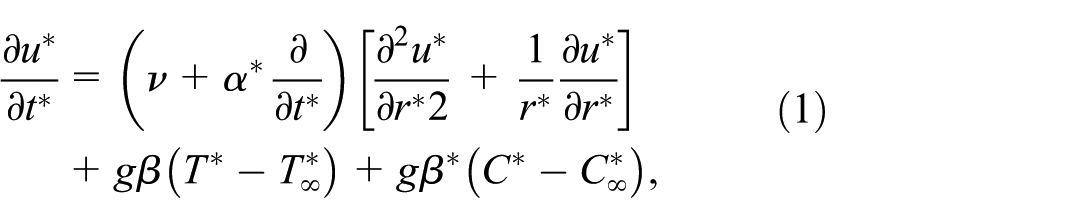


where
The following are the appropriate initial and boundary conditions.



The mathematical formulation of the problem is based on the following assumptions:
The flow is incompressible and unsteady.
A second-grade non-Newtonian fluid model is used to describe the rheological behavior of the fluid.
The Boussinesq approximation is invoked, allowing density variations to appear only in the buoyancy terms.
Thermal stratification and mass stratification are modeled linearly in the ambient temperature and concentration profiles.
The cylinder surface maintains constant perturbation temperature and concentration values.
Effects of viscous dissipation, thermal radiation, and chemical reactions are neglected.
The Joule’s heating is also ignored.
By addition of a few dimensionless variables and functions:
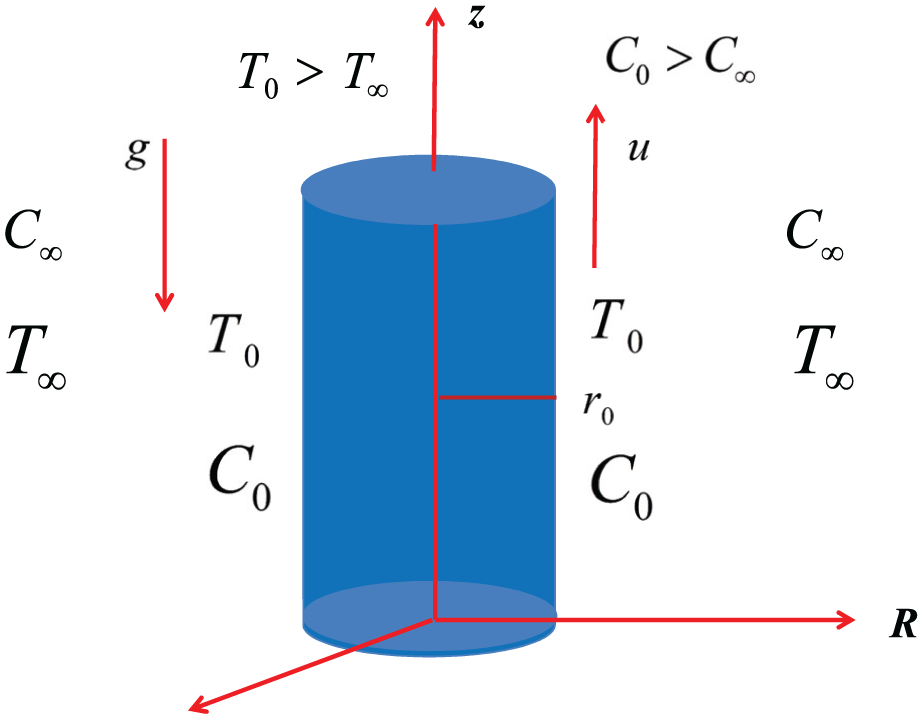
The coordinate system and physical model.
In dimensionless form, the governing partial differential equations appear as:
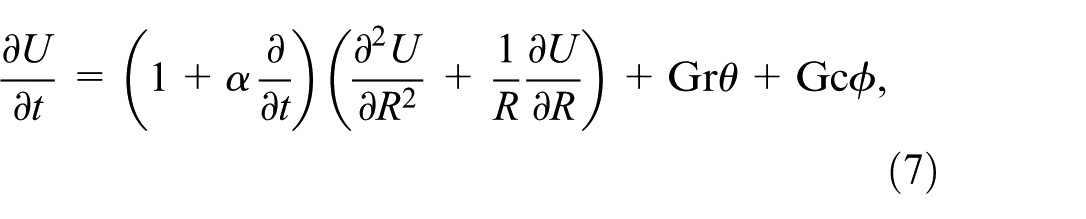


and the associated dimensionless initial and boundary conditions are as follows:



In this instance, Pr stands for the Prandtl number, R for the radial distance without dimensions, S stands for the parameter of thermal stratification without dimensions, U for the velocity without dimensions, Gr for the thermal Grashof number, and Gc for the mass Grashof number. Furthermore, the dimensionless mass stratification parameter is denoted by F, the non-dimensional time is denoted by t, the Sherwood number by Sc, the non-dimensional concentration by ϕ, and the non-dimensional temperature by θ.
Solution of problem
The governing nondimensional unsteady equations (7)–(9) subject to initial and boundary conditions given in equations (10)–(12) can be solved using the Laplace transform approach. Laplace transforms of equations (7)–(9) are obtained when initial conditions stated in equations (10)–(12) are used.



where p represents the Laplace transform parameter.
Solution for temperature and concentration
Equation (14) can be written as:

The solution for homogenous part of the above differential equation is:

For particular solution we assume
Substituting in equation (16), we obtained

where
Let
so

Likewise, the concentration relation can be found by solving equation (15) in the same approach as for temperature.

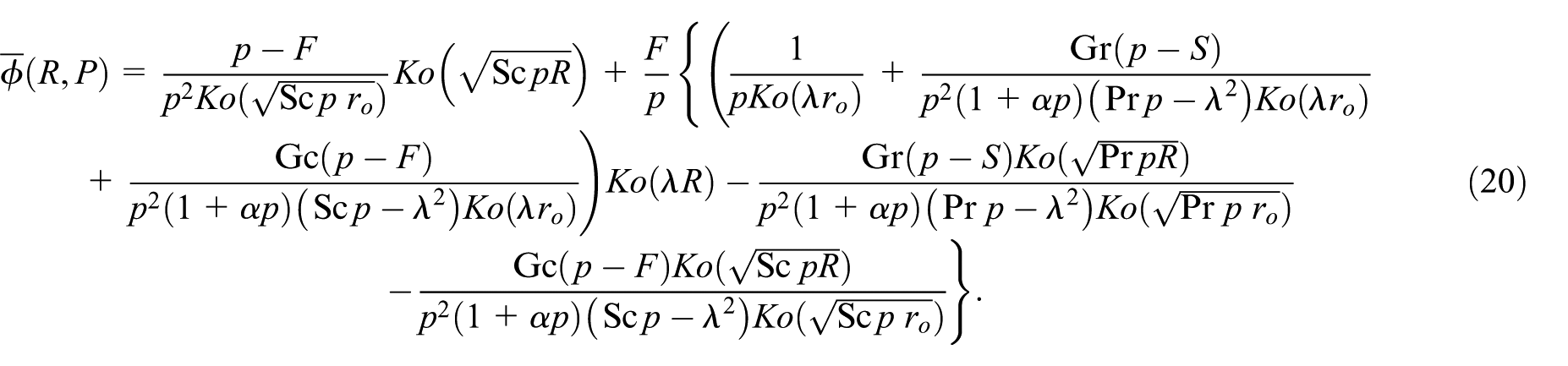
Equation (31) yields the following final form for temperature and concentration:
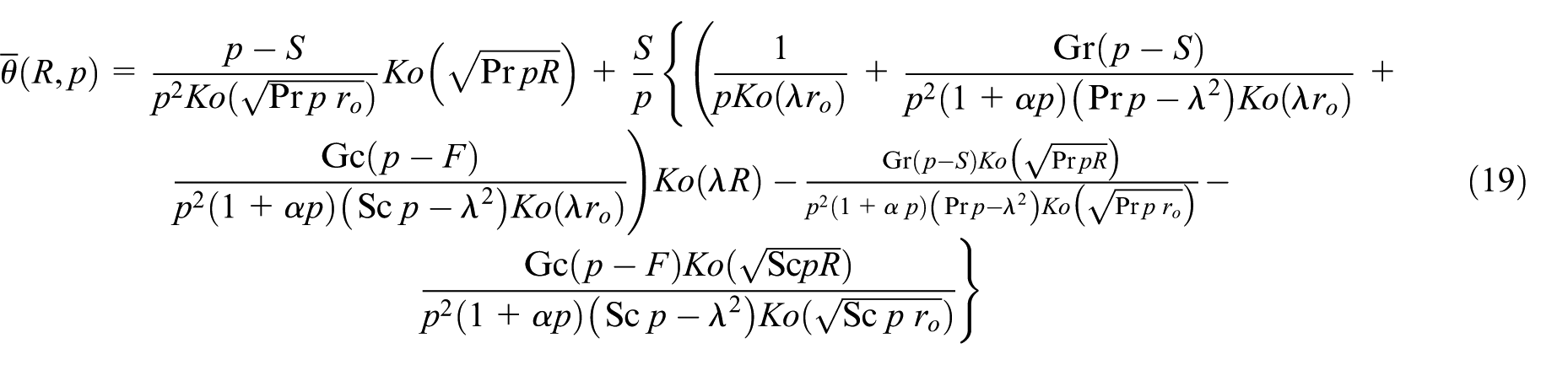
and
Solution for velocity
By using equations (17) and (18), equation (13) becomes as:
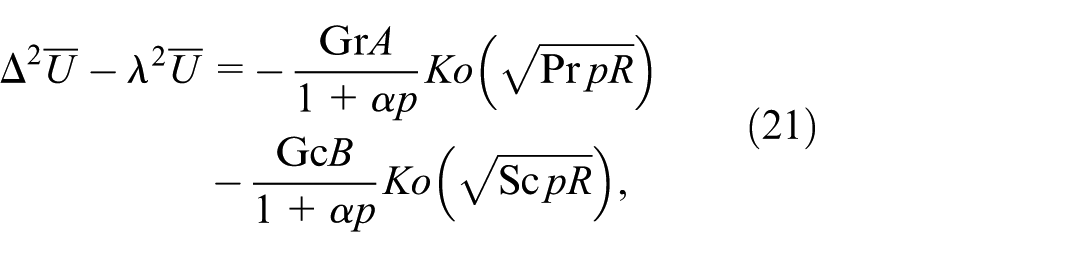
where

Complementary solution for homogenous part of equation (21) is:

For particular solution assume

by substituting in equation (21)
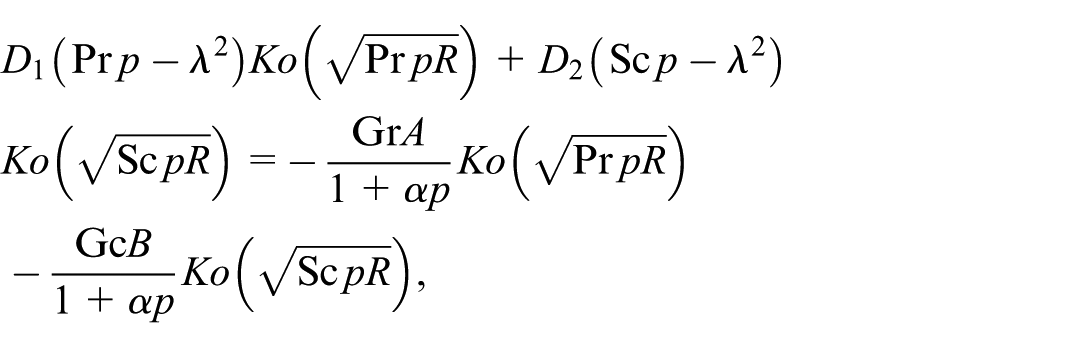
thus
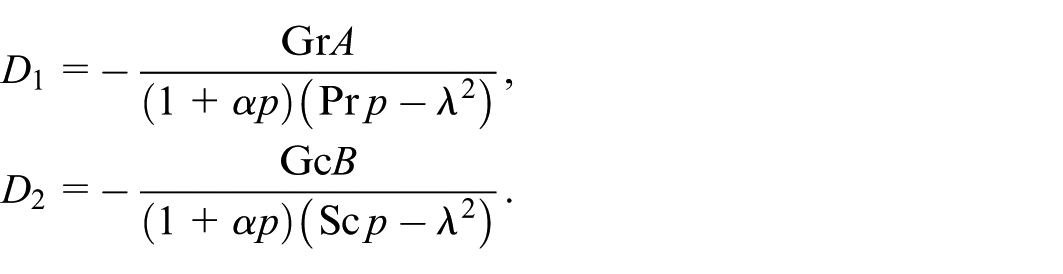
So
The Laplace transform of boundary conditions are as:

Equations (17), (18), and (24) are subjected to boundary conditions in order to determine the constants A, B, and C.



The following are the expressions of A, B, and C that are obtained by solving equations (26)–(28):



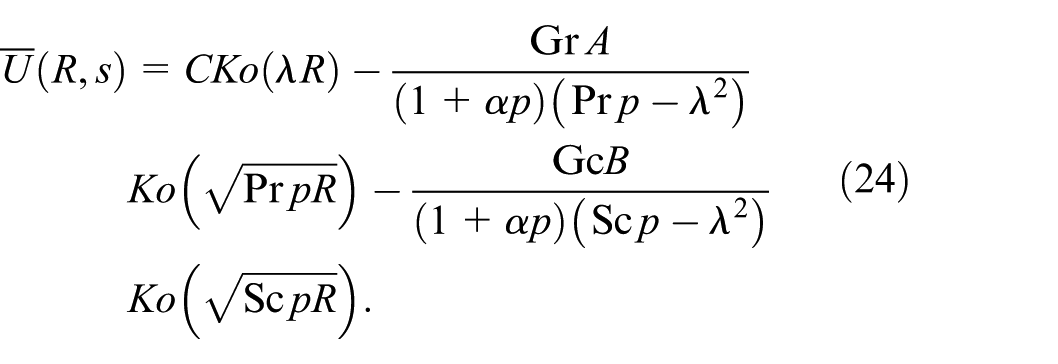
Equation (24) yields the final Laplace-space solution for velocity when the values of the constants A, B, and C are entered.

Skin friction
The velocity profile is used to calculate the dimensionless skin friction

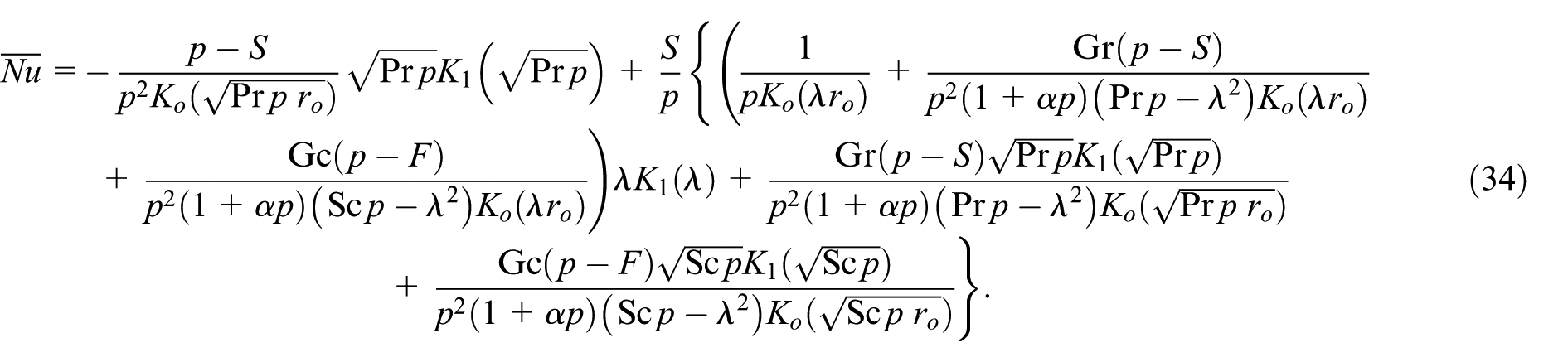
Nusselt number
The temperature profile is used to derive the dimensionless Nusselt number
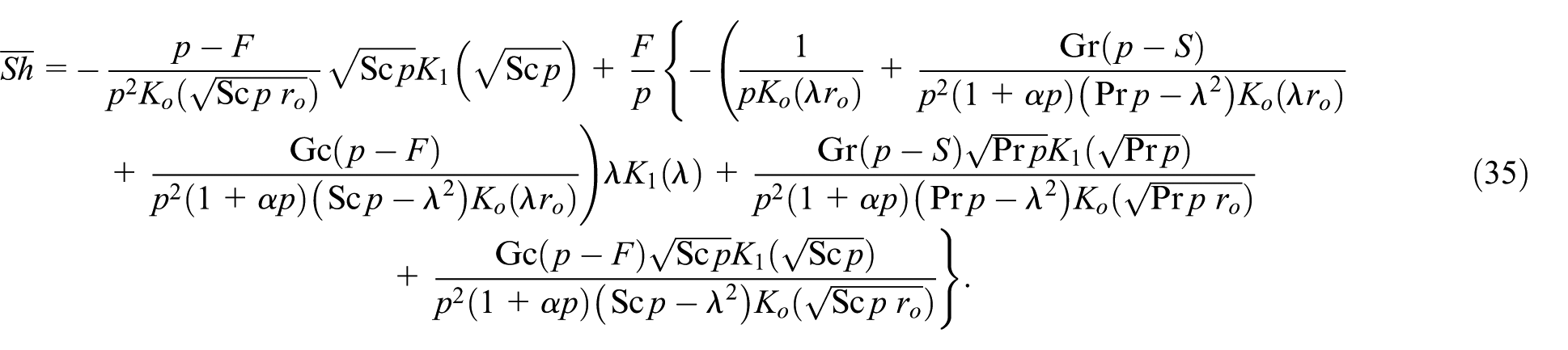
Sherwood number
From the concentration profile, the dimensionless Sherwood number
Some specifications
When thermal and mass stratification are present, the dimensionless velocity, temperature, and concentration result for a viscous fluid is obtained by setting
Now, by setting α= 0 to equations (7)–(9), the dimensionless governing equations for velocity, temperature, and concentration are obtained as



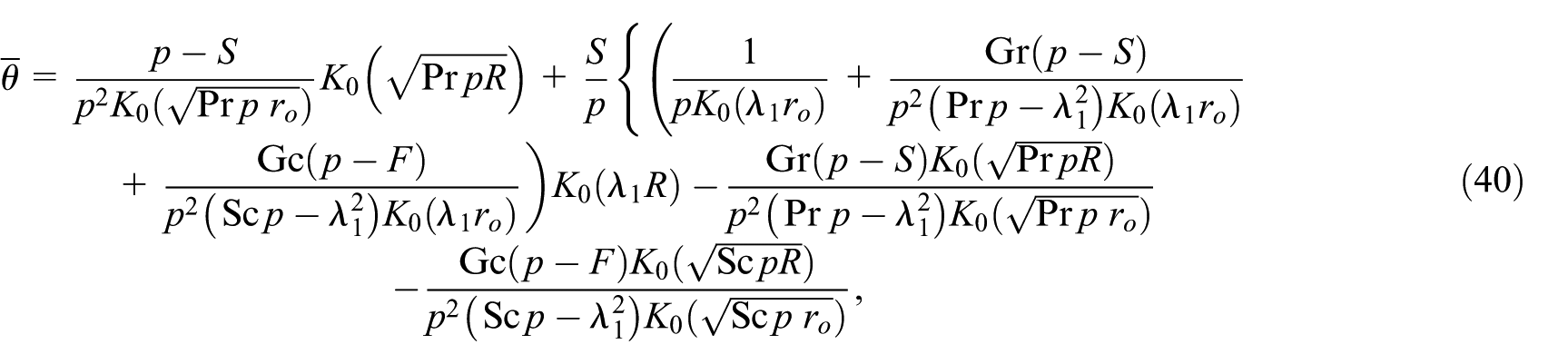
Equations (36)–(38) are solved by applying the Laplace transform method while taking the initial and boundary conditions (10)–(12) into account. Following are the formulae for profiles of velocity, temperature, and concentration for viscous flows:

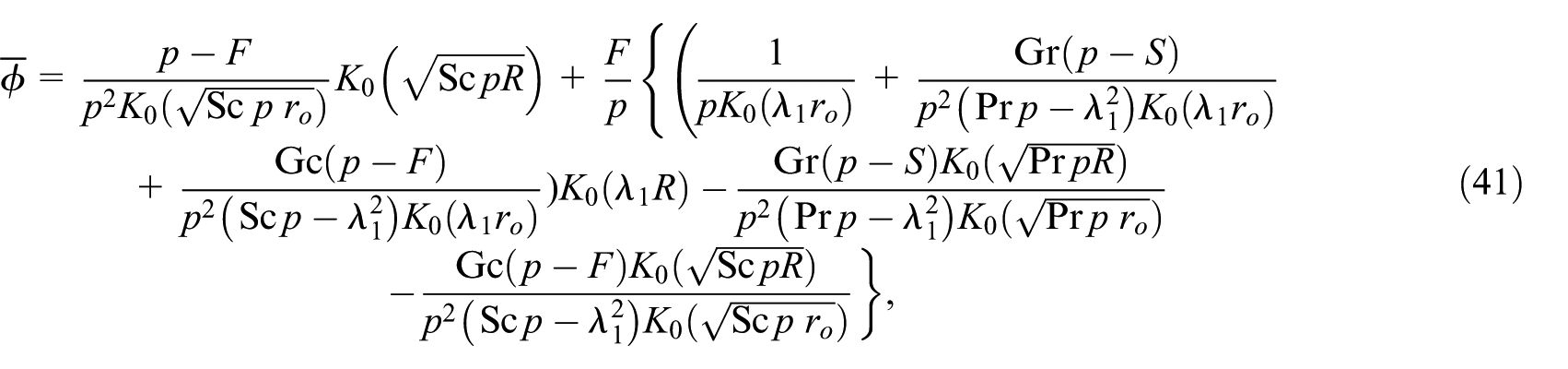
where

Case: 1 (S = 0, F = 0)
A comparison is made between the solutions for the fluid under thermal and mass stratifications and the classical situation, in which thermal and mass stratification are not present. The equivalent calculations are non-dimensionalized for the unstratified fluid (S = 0, F = 0) using the same set of non-dimensional quantities, yielding non-dimensional equations for the classical case in the following forms.
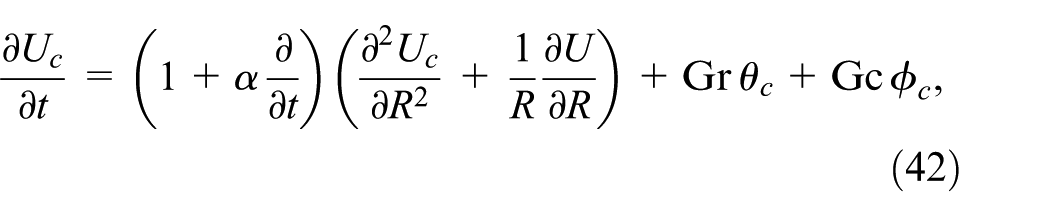


Using the same process as previously mentioned, the Laplace transform approach is used to solve equations (42)–(44) while taking the initial and boundary conditions (10)–(12) into account. For the classical situation, we derive the mathematical representations of the concentration


and

where

Results with discussion
The numerical computations of velocity, perturbation temperature and concentration, skin friction, Nusselt number, and Sherwood number are made for various physical parameters and given in the figures to provide a clear picture of the problem’s physical setting. Figure 2 illustrates how thermal Grashof number Gr affects the velocity profile. The proportion of buoyant to viscous forces operating on a fluid is known as the Grashof number. By raising Gr, viscous forces are reduced, and bouncy forces are dominated, which allows the fluid to flow with higher velocity. The similar effect mass Grashof number Gc over the fluid flow is also seen in the Figure 3. The effects of temperature and mass stratification are depicted in Figures 4 and 5 and it is seen that the profiles pattern of velocity in both Figures tend to falls for elevating values of thermal and mass stratifications. Increasing thermal and mass stratifications S and F lead to the less vertical mixing and momentum transport which creating resistive force to control the velocity of fluid. This resistive force reduces the natural convection and hence reduces fluid velocity, in both cases, buoyancy-driven and shear-driven flows.
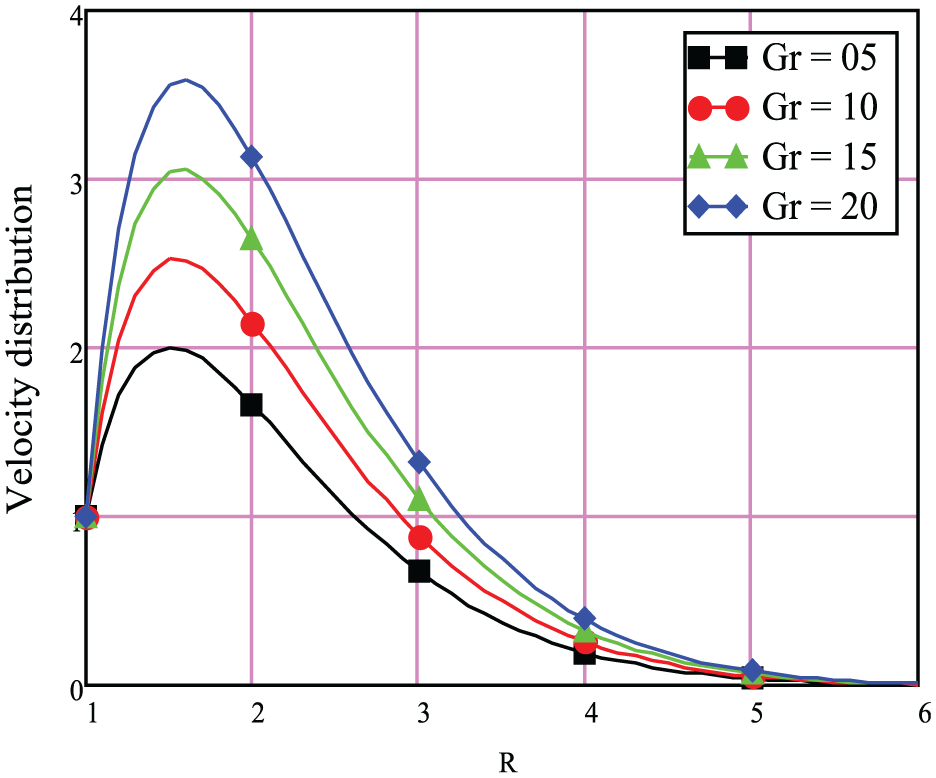
Velocity distribution due to thermal Grash of number Gr variation by fixing Gc = 5, S = 0.4, F = 0.2, α = 0.2, Pr = 7, Sc = 2, and t = 1.5.
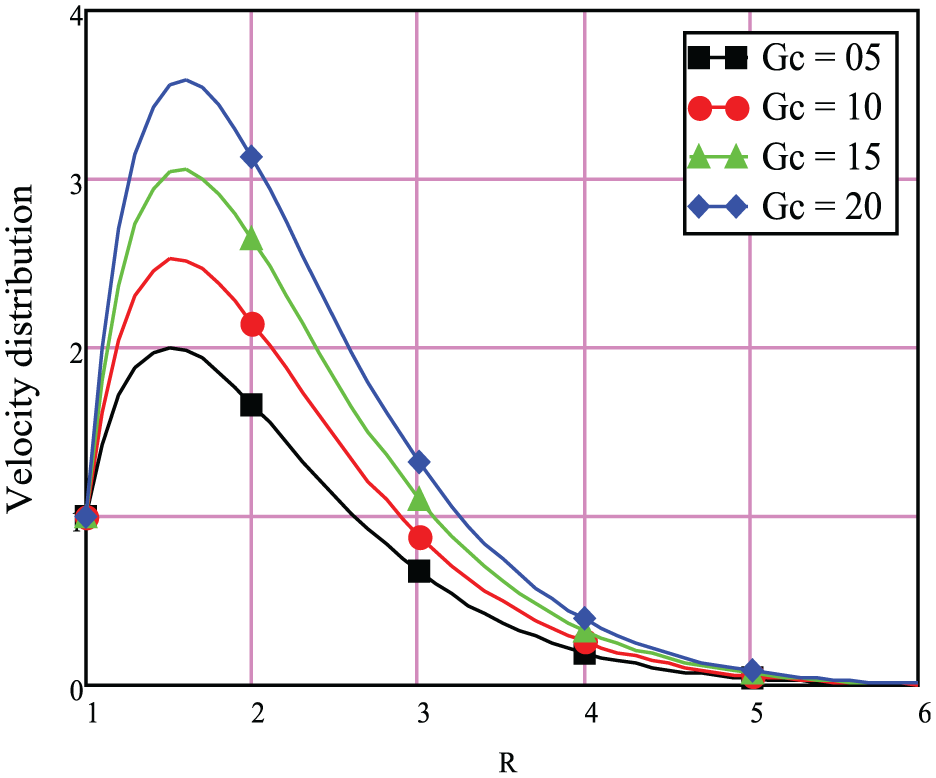
Velocity distribution due to mass Grashof number Gc variation by fixing Gr = 5, S = 0.4, F = 0.2, α = 0.1, Pr = 7, Sc = 2, and t = 1.2.
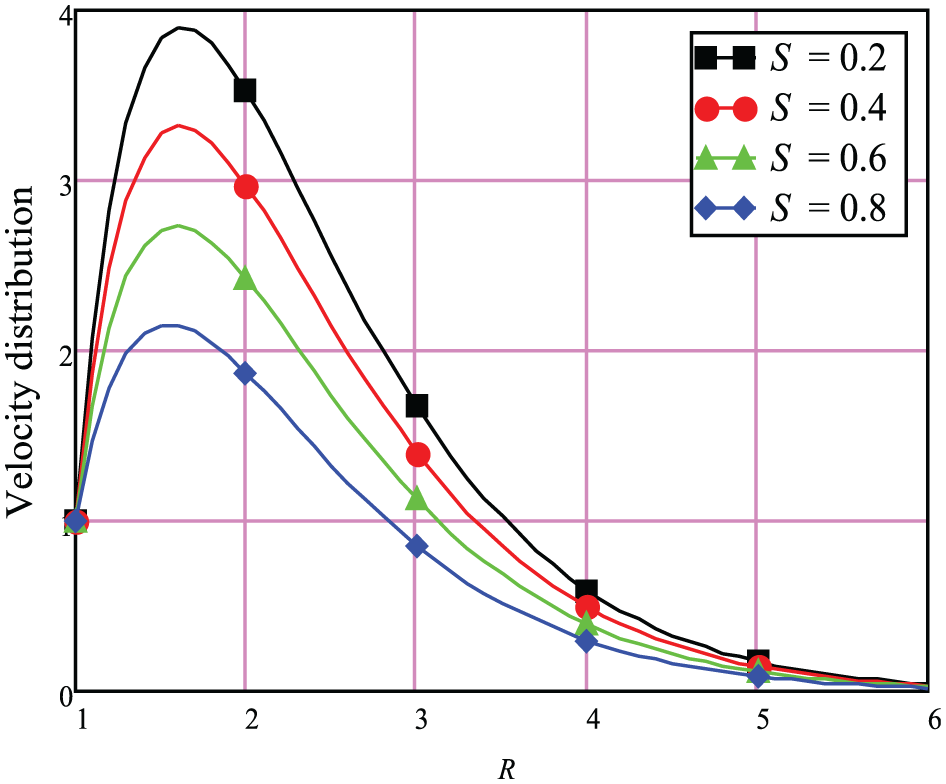
Velocity distribution due to S variation by fixing Gr = 5, Gc = 5, F = 0.4, α = 0.2, Pr = 3, Sc = 2, and t = 1.2.
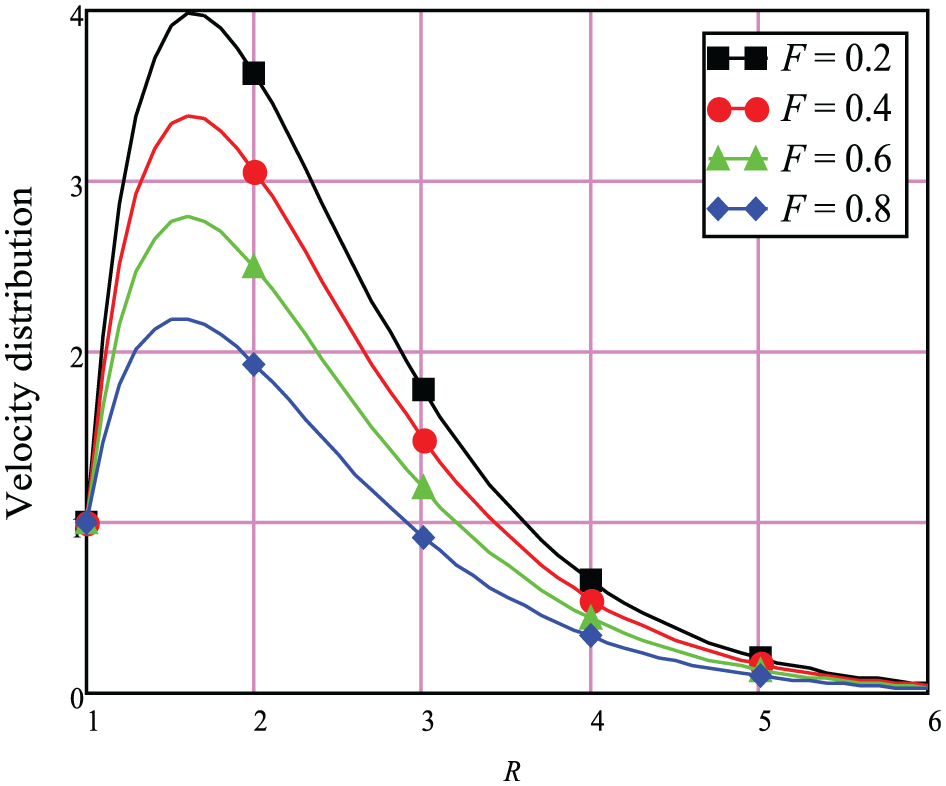
Velocity distribution due to F variation by fixing Gr = 5, Gc = 5, S = 0.4, α = 0.2, Pr = 4, Sc = 2, and t = 1.2.
In Figure 6, the effect of second grade fluid parameter α on the flow velocity is presented and velocity profiles drop down for increasing α. As α increases, the elastic forces within the fluid become stronger. So the higher second-grade parameter create internal resistance, which slows down the fluid flow.
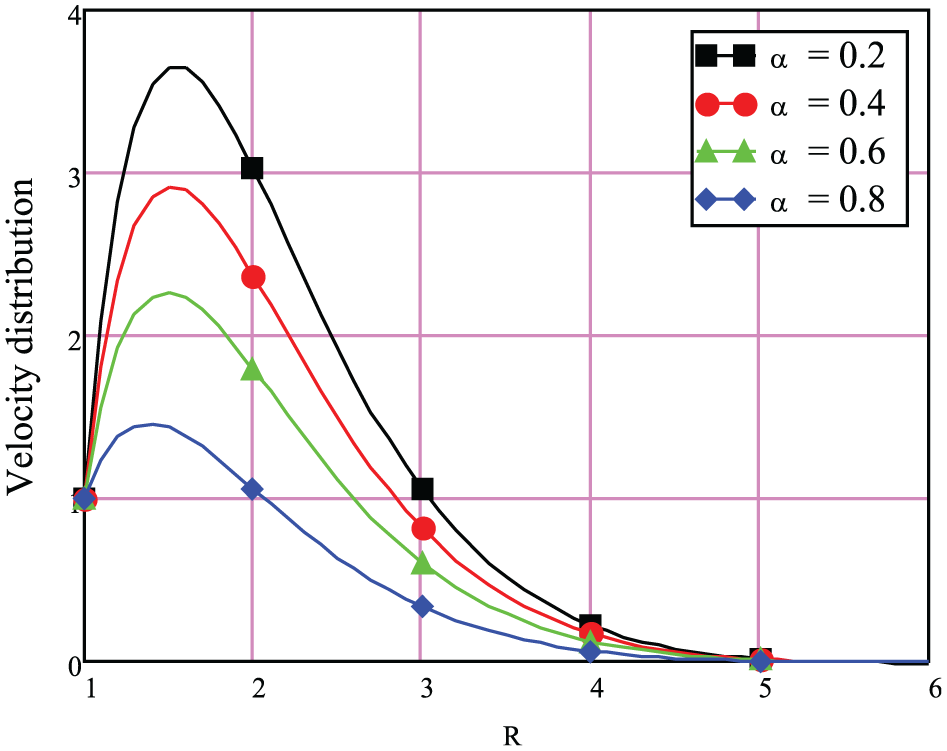
Velocity distribution due to α variation by fixing Gr = 5, Gc = 5, S = 0.2, F = 0.4, Pr = 7, Sc = 2, and t = 1.2.
The effects of Prandtl number Pr and Schmidt number Sc are highlighted in the Figures 7 and 8 respectively. The velocity field in a convective fluid flow is significantly influenced by both the Prandtl number Pr and the Schmidt number Sc, as these numbers characterize the relative diffusion rates of momentum, thermal energy, and mass transfer in flow domain. The higher values of Pr and Sc indicates that momentum diffusivity dominates over thermal diffusivity and mass diffusivity, resulting in a falls in the flow velocity and thicker velocity boundary layer for both increasing values of Pr and Sc.
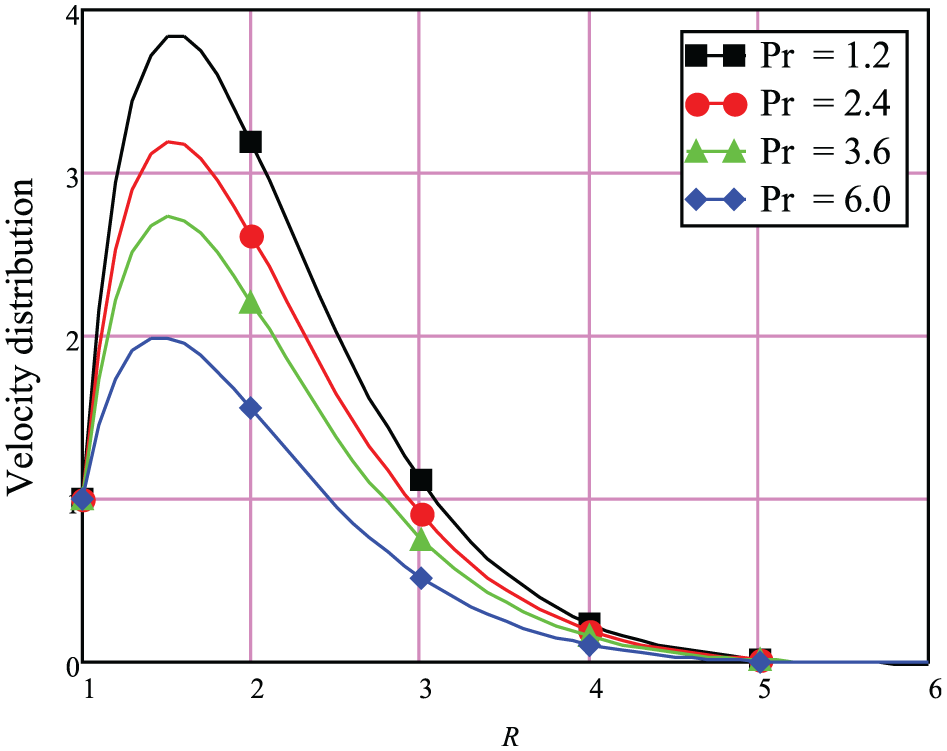
Velocity distribution due to Pr variation by fixing Gr = 5, Gc = 5, S = 0.2, F = 0.4, Sc = 2, α= .3, and t = 1.2.
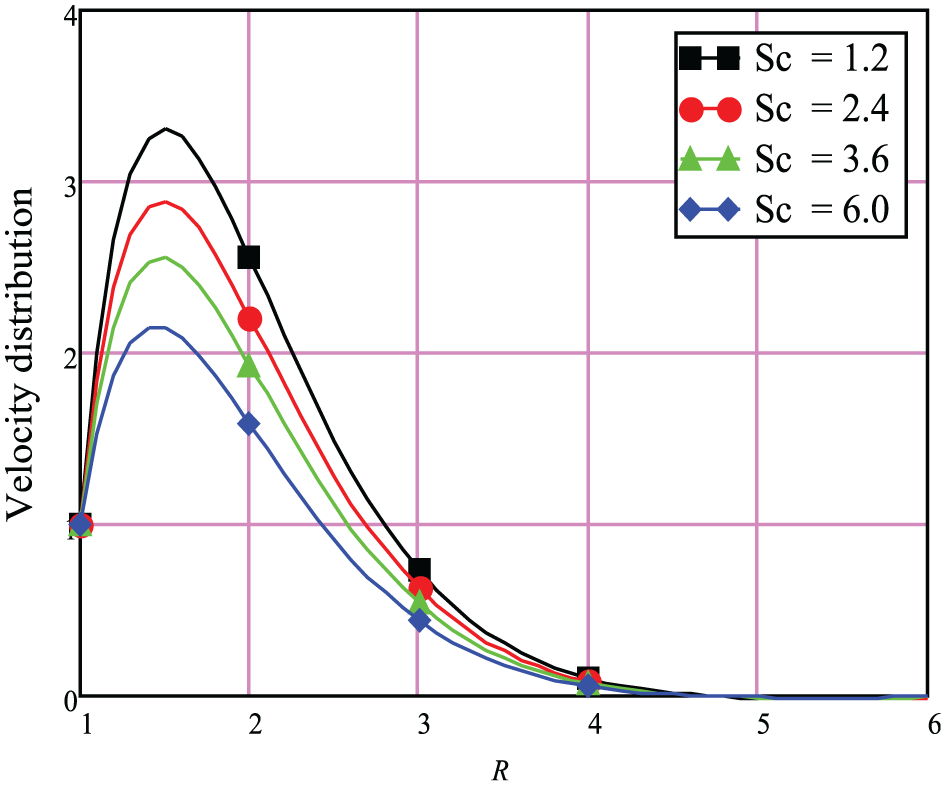
Velocity distribution due to Sc variation by fixing Gr = 5, Gc = 5, S = 0.2, F = 0.4, Pr = 4, α= .3, and t = 1.2.
In Figure 9 behavior of the temperature profiles under mass stratification is discussed and increasing trend is observed for increasing mass stratification. The presence of mass stratification in the flow region enhanced the solutal buoyancy and cross-diffusion effects gives the rise in the fluid temperature which lead to the elevating temperature distribution with in the fluid region. The effect of thermal stratification is depicted in the Figure 10 and temperature of fluid dropped down for increasing values of thermal stratification S. In the presence of thermal stratification in the flow domain, the heat trapped into respective layers of fluid and there is less heat transport due to convection. Consequently, local temperature of fluid reduces in flow regions, especially when heat is given from the boundary but thermal stratification resist to its vertical propagation. So for increasing values of S temperature falls.
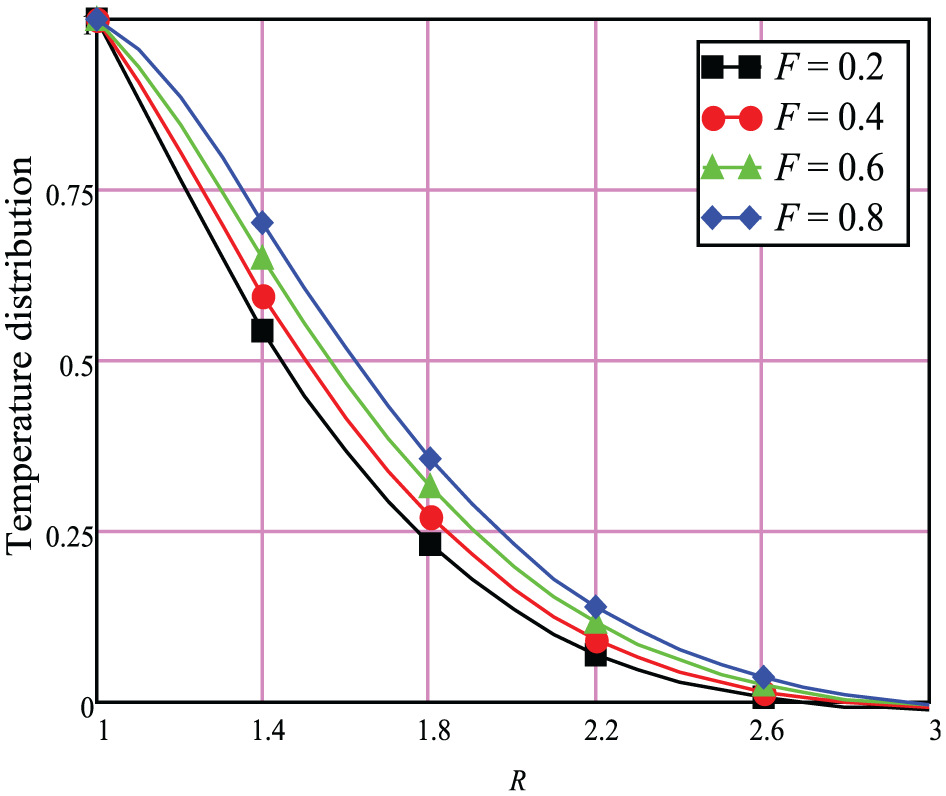
Temperature distribution due to F variation by fixing Gr = 5, Gc = 5, S = 0.4, α = 0.4, Pr = 4, Sc = 2, and t = 1.5.
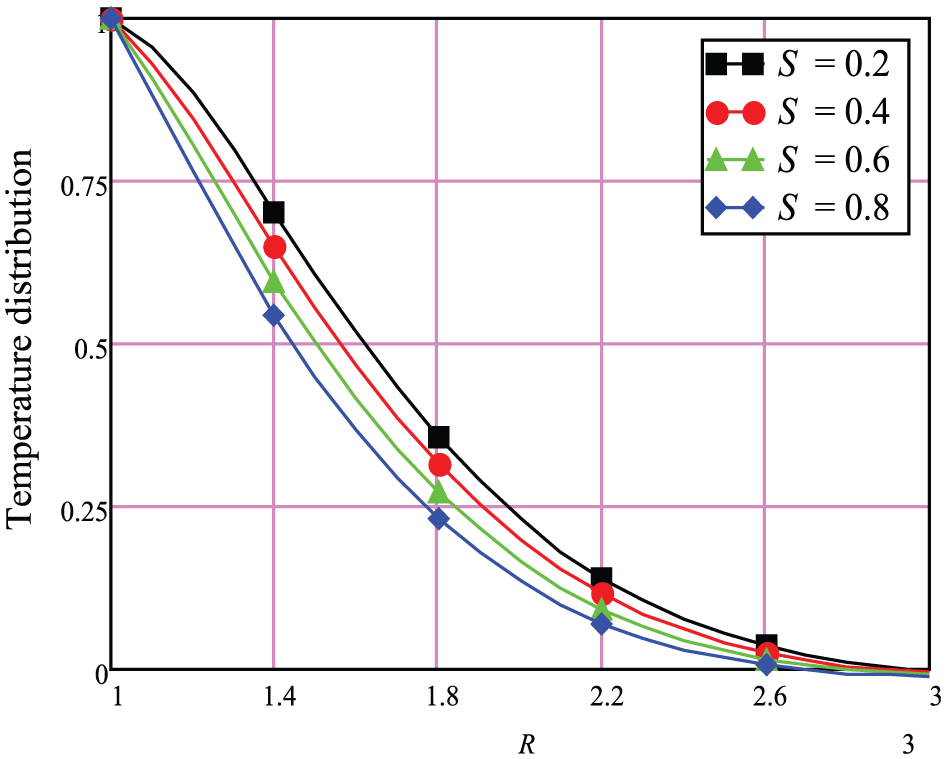
Temperature distribution due to S variation by fixing Gr = 5, Gc = 5, F = 0.4, α = 0.4, Pr = 7, Sc = 2, and t = 1.5.
The impact of the thermal and mass Grashoff numbers Gr and Gc on the temperature profile are shown in Figures 11 and 12 respectively. It demonstrates that temperature decreases as the values of Gr and Gc numbers are increased. As Gr and Gc are ratio of bouncy force to viscous force and higher values of Gr and Gc refers to stronger buoyant forces, which drive the fluid away from the boundary more quickly which lead to faster remove of the heat from the boundary. Consequently temperature falls in both increasing Grasshook numbers.
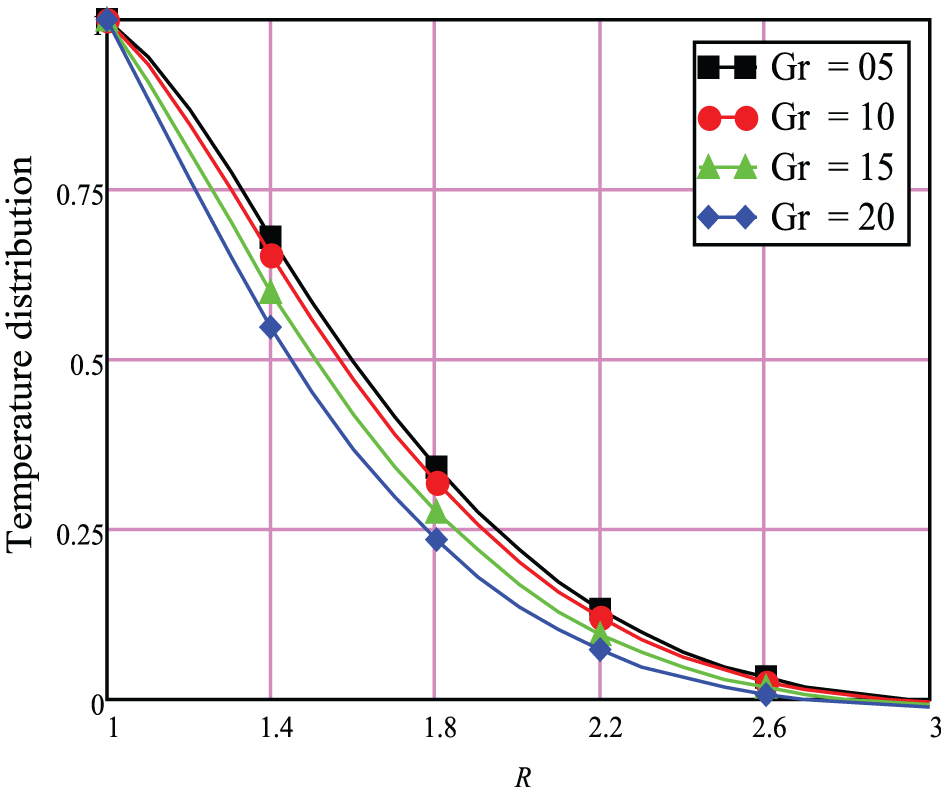
Temperature distribution due to Gr variation by fixing S = 0.5, Gc = 5, F = 0.6, α = 0.4, Pr = 7, Sc = 2, and t = 1.5.
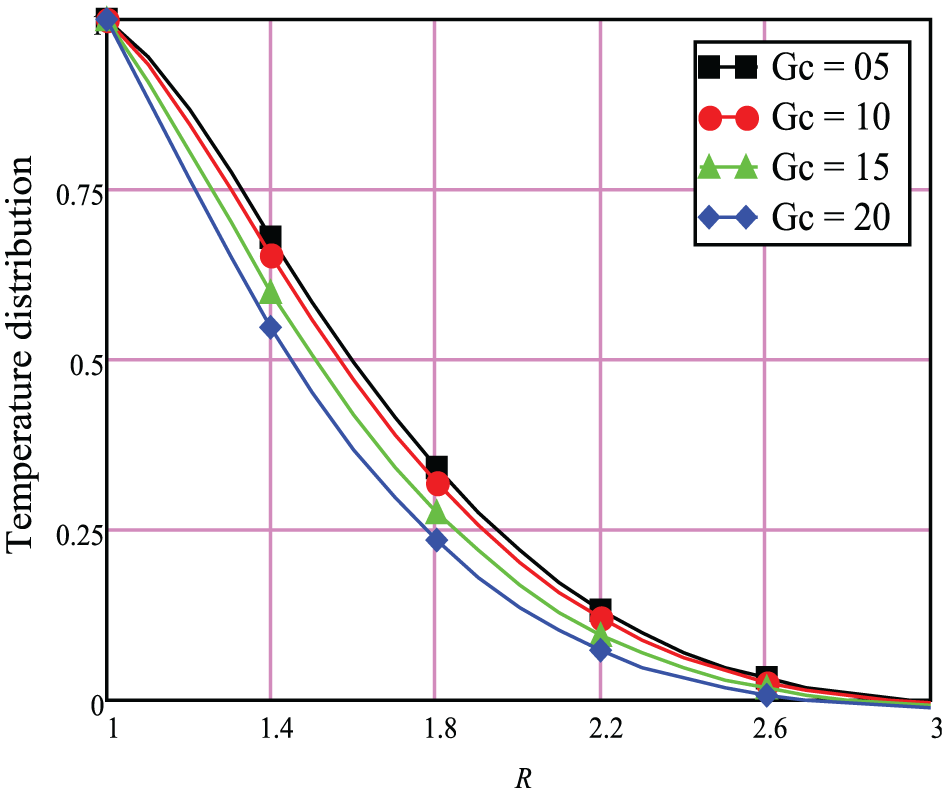
Temperature distribution due to Gc variation by fixing Gr = 5, S = 0.4, F = 0.6, α = 0.4, Pr = 7, Sc = 2, and t = 1.5.
In Figure 13 the effect of second grade fluid α on the temperature is discussed. It is seen that temperature rises with α. Higher α means the fluid retains deformation history (memory effects) significantly which improves the ability of fluid to store and transfer thermal energy, so an increase in temperature distribution across the boundary layer is occurred.
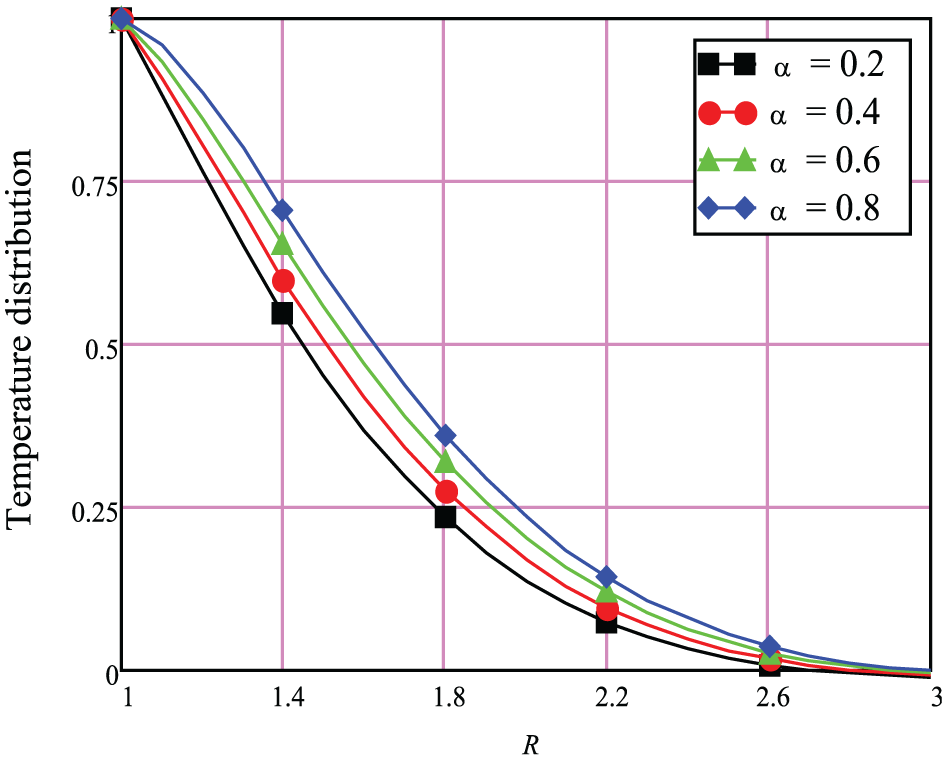
Temperature distribution due to α variation by fixing Gr = 5, S = 0.4, F = 0.6, Gc = 4, Pr = 4, Sc = 2, and t = 1.5.
Temperature field under the effects of Pr and Sc is discussed in the Figures 14 and 15. Higher Pr leads to lower thermal diffusivity, as the result, the fluid retains a steep temperature gradient near the wall, but heat does not penetrate far into the fluid. So, the overall temperature distribution shows a fall hence, temperature field decreases with increasing values of Pr as shown in the Figure 14. Moreover higher Sc means lower mass diffusivity so increasing Sc leads to weaker solutal convection and less heat carried away, so consequently temperature increases due to weaker fluid motion as shown in the Figure 15.
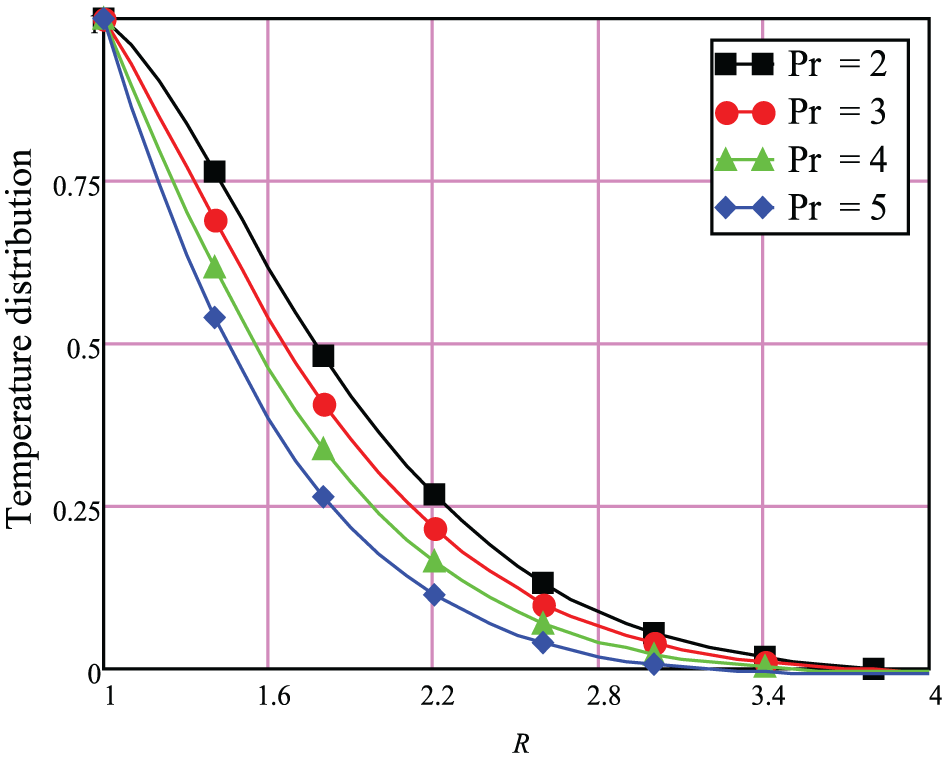
Temperature distribution due to Pr variation by fixing Gr = 5, S = 0.4, F = 0.6, α = 0.4, Sc = 2, and t = 1.5.
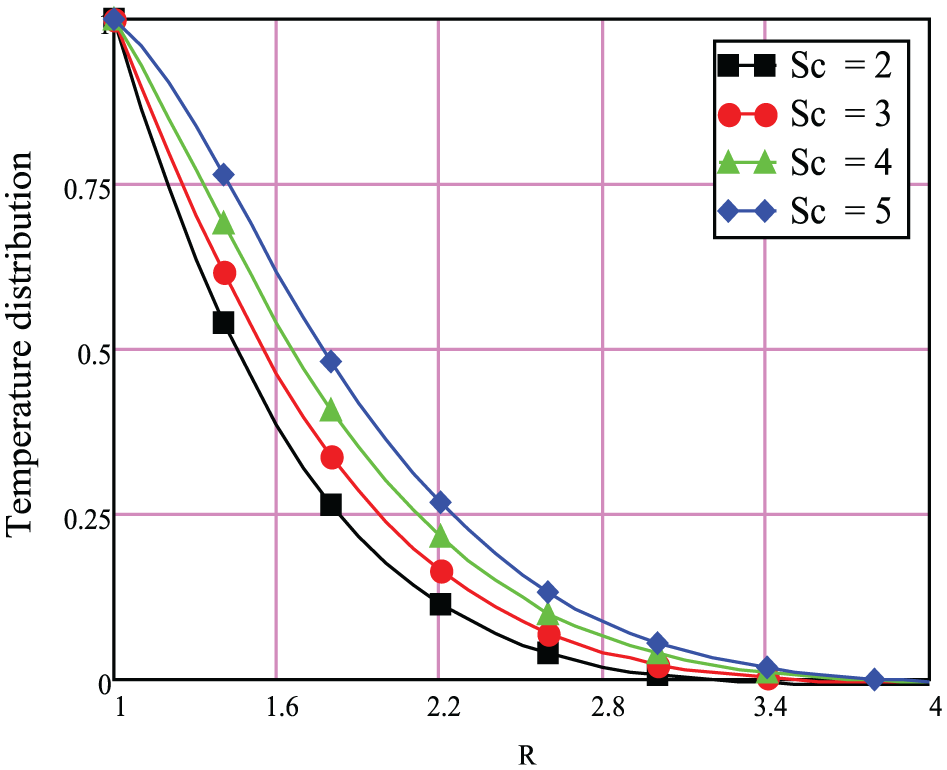
Temperature distribution due to Sc variation by fixing Gr = 5, Gc = 5, S = 0.4, F = 0.6, Pr = 4, Sc = 2, and t = 1.5.
The two stratifications have the same effects on species concentration as they do on temperature profiles, as illustrated in Figures 16 and 17. Due to the increasing mass stratification F, the concentration profiles falls. Mass stratification refers to a resistance in the vertical concentration mixing, making which make it difficult to move the solute from high to low concentration zones that is concentration falls with increasing values of stratification. On the other hand concentration level rises for increasing thermal stratification. Thermal stratification leads a temperature gradient in the vertical direction which gives a boot in the concentration level.
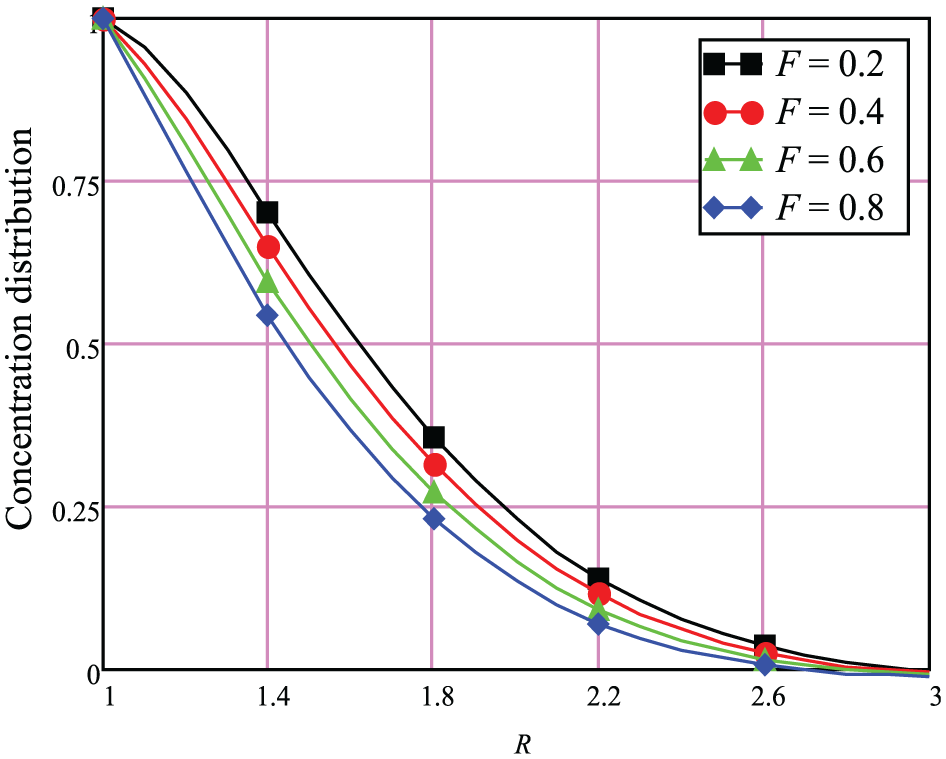
Concentration distribution due to F variation by fixing Gr = 5, Gc = 5, S = 0.4, α = 0.2, P r = 7, Sc = 2, and t = 1.2.
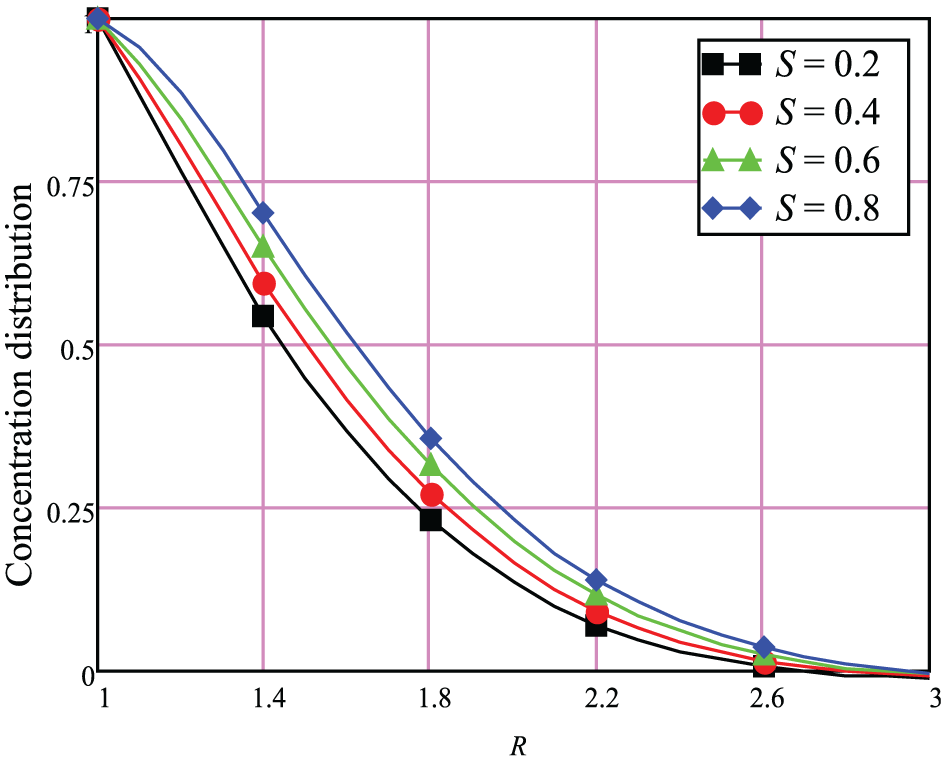
Concentration distribution due to S variation by fixing Gr = 5, Gc = 5, F = 0.2, α = 0.2, Pr = 7, Sc = 2, and t = 1.2.
Figures 18 and 19 show the concentration profiles behavior for variation of thermal and mass Grashof numbers Gr and Gc respectively. As Gr and Gc increase the bouncy forces become stronger which enhance fluid motion away from the boundary, causing more rapid transport of solute from the boundary and that is why the concentration level falls near boundary. Figure 20 is sketched to highlight the effect of second grade fluid parameter α on the concentration. As the values of second grade parameter increases, the elastic nature of the fluid becomes stronger. Therefore the increasing values of α refers to more elastic behavior of fluid, which reduces the resistance to solute diffusion. Thus, the concentration distribution becomes stronger as α increases.
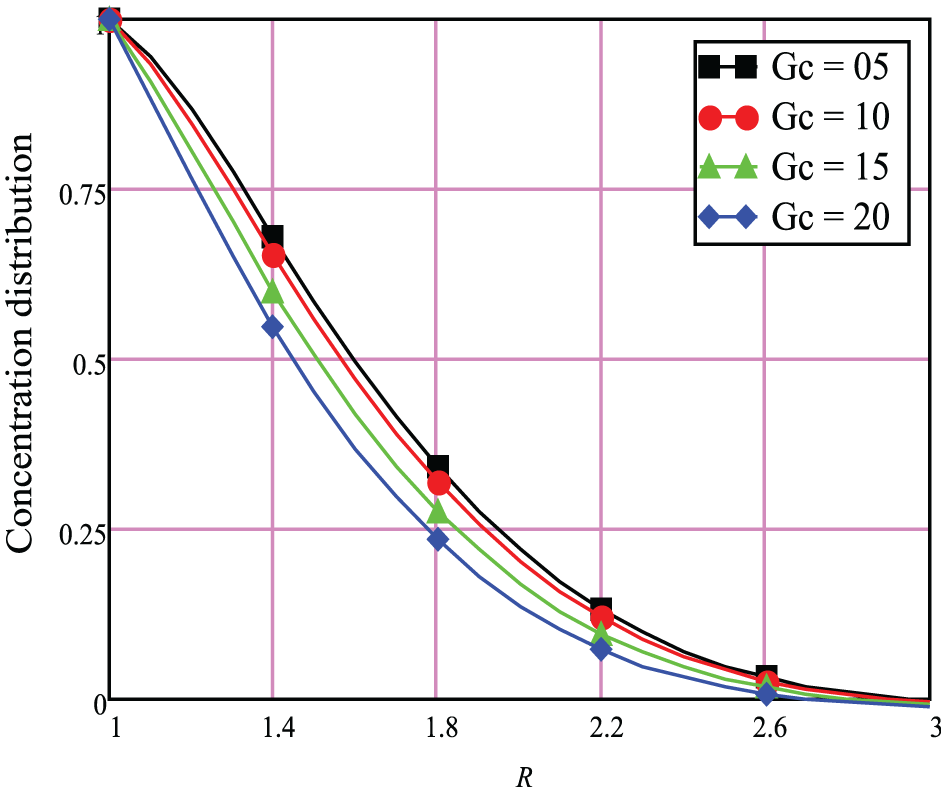
Concentration distribution due to Gc variation by fixing Gr = 5, S = 0.4, F = 0.2, α = 0.2, Pr = 7, Sc = 2, and t = 1.2.
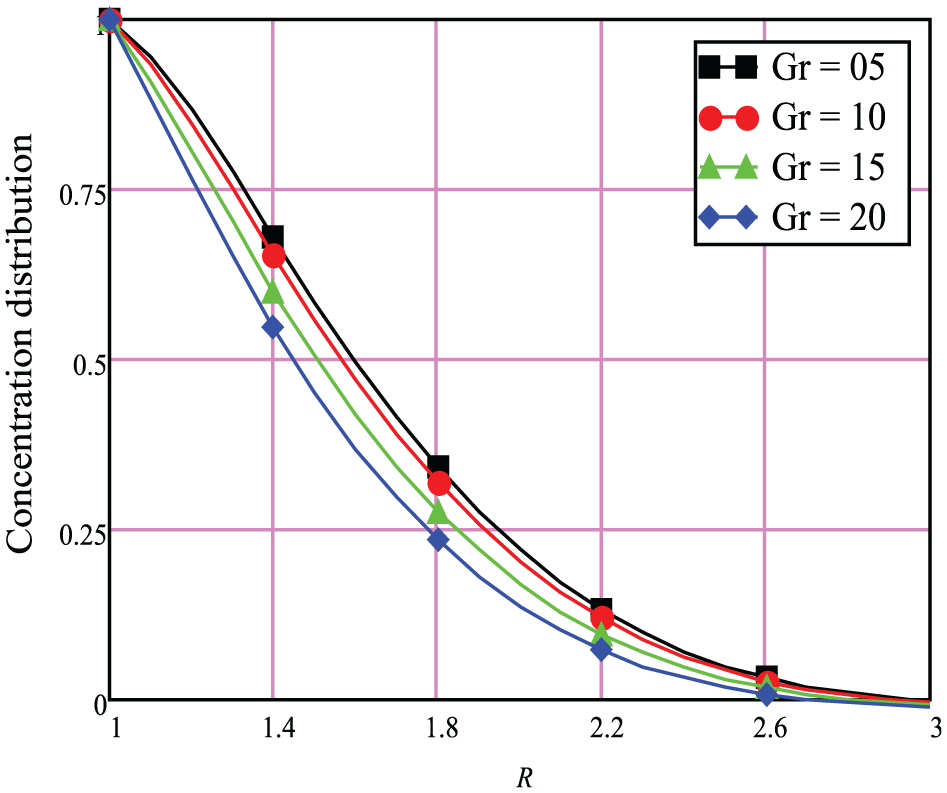
Concentration distribution due to Gr variation by fixing Gc = 5, S = 0.4, F = 0.2, α = 0.2, Pr = 7, Sc = 2, and t = 1.2.
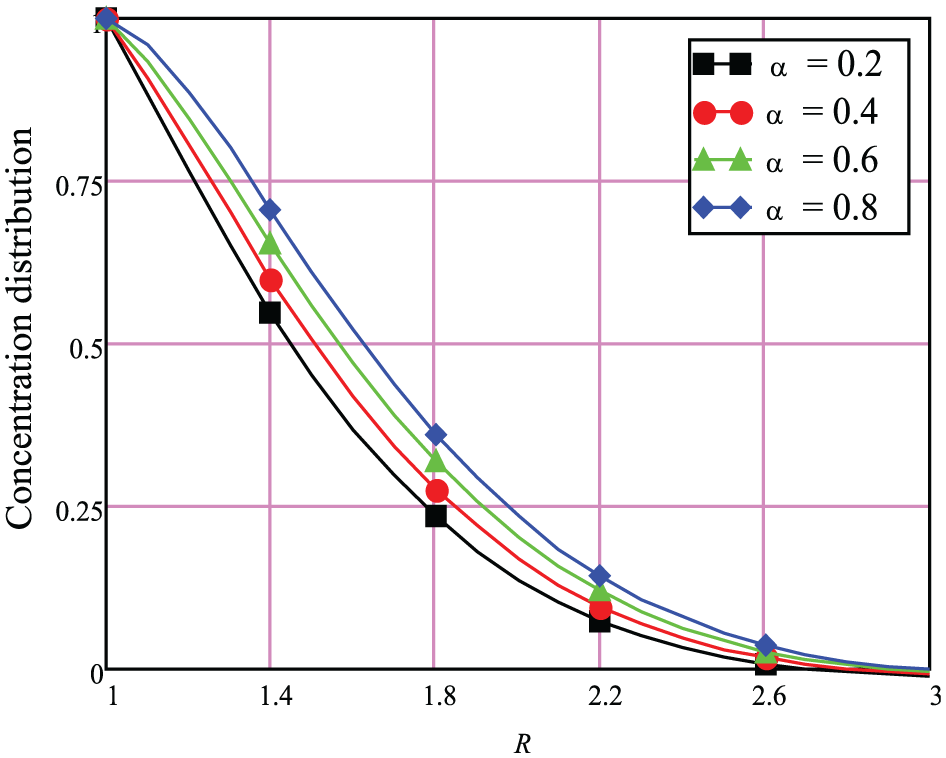
Concentration distribution due to α variation by fixing Gr = 5, Gc = 5, S = 0.4, F = 0.2, Pr = 7, Sc = 2, and t = 1.2.
The concentration field is discussed for the variations of Schmidt number Sc and Prandtl number Pr in the Figures 21 and 22. Concentration field is suppressed by the increasing values of Sc and rises for increasing values of Pr. Rising value of Sc implied lower mass diffusivity and weaker mass diffusion and thinner concentration boundary layer which leads to the overall lower concentration. A higher Pr refers to the lower temperature and slow velocity which leads to the higher concentration level near the wall.
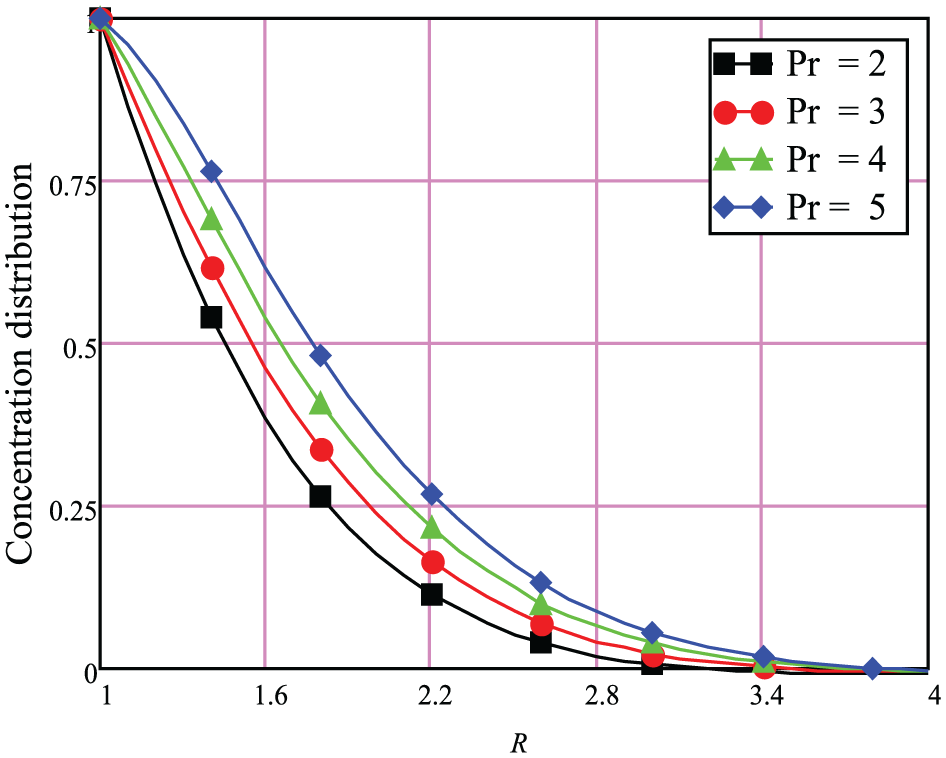
Concentration distribution due to Pr variation by fixing Gr = 5, Gc = 5, S = 0.4, F = 0.2, Sc = 2, and t = 1.2.
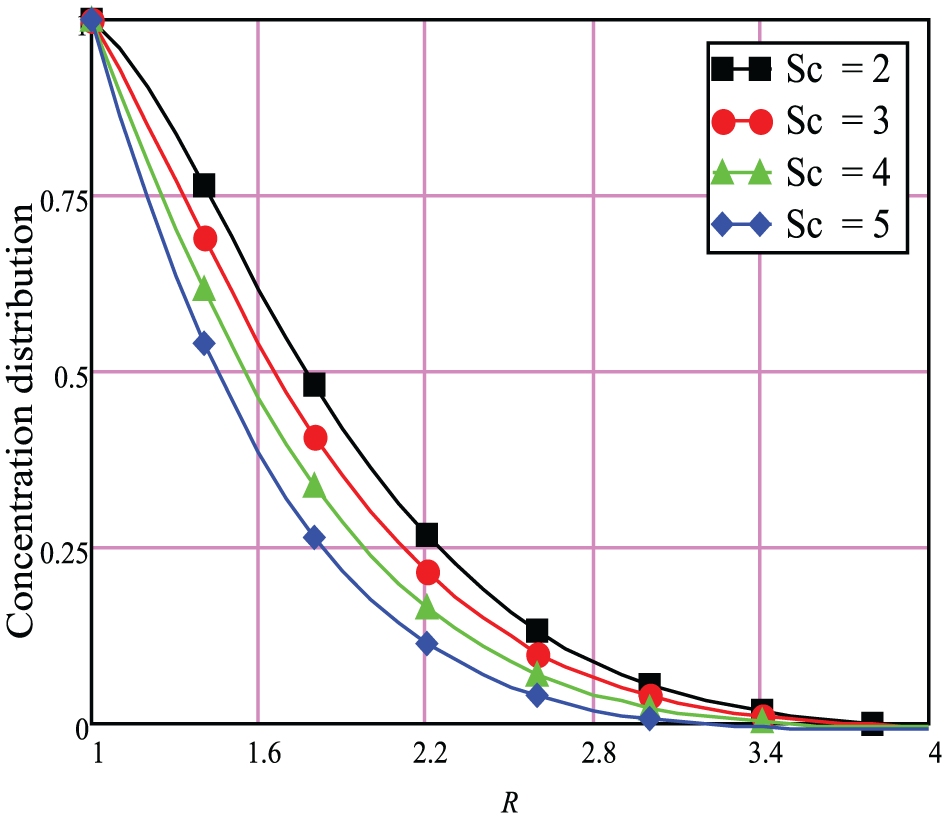
Concentration distribution due to Sc variation by fixing Gr = 5, Gc = 5, S = 0.4, F = 0.2, Pr = 7, Sc = 2, and t = 1.2.
Figure 23 shows the comparison between the present velocity
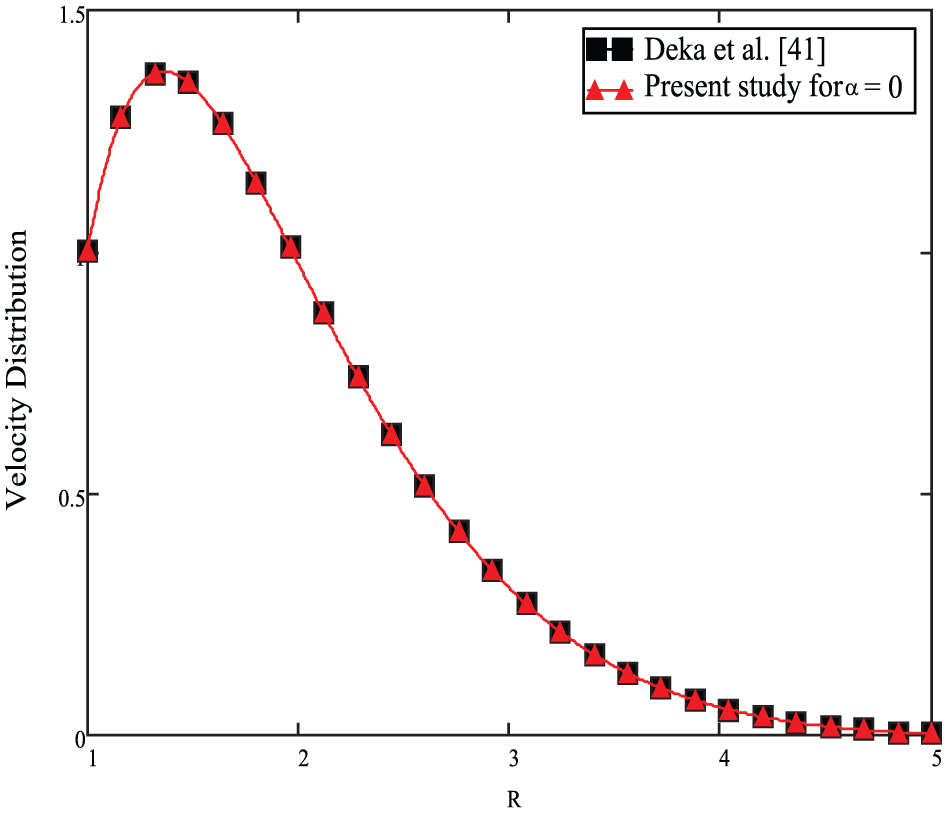
Comparison of the present velocity with the result obtained by Deka and Paul. 41
Table 1 presents the variation of the skin friction coefficient against time t for different values of the second-grade fluid parameter α. From the table it is observed that for a fixed value of α, the skin friction generally increases with increasing values of time. It indicates that as the flow evolves, the resistance offered by the fluid at the boundary of cylinder is enhanced significantly. Also by comparing the different values of α, it is clear that increasing value of α leads to the reduction in the values of skin friction at all time levels. Moreover, at earlier times the differences in skin friction between various α values are relatively small, but with the increasing time, this differences become more significant. Overall, the results show that both time and the second-grade parameter α has a significant effect for determining the skin friction behavior, time enhances the skin friction, while increasing values of α leads to reduction in skin friction.
Values of skin friction coefficient τ against t for different second grade parameter α.
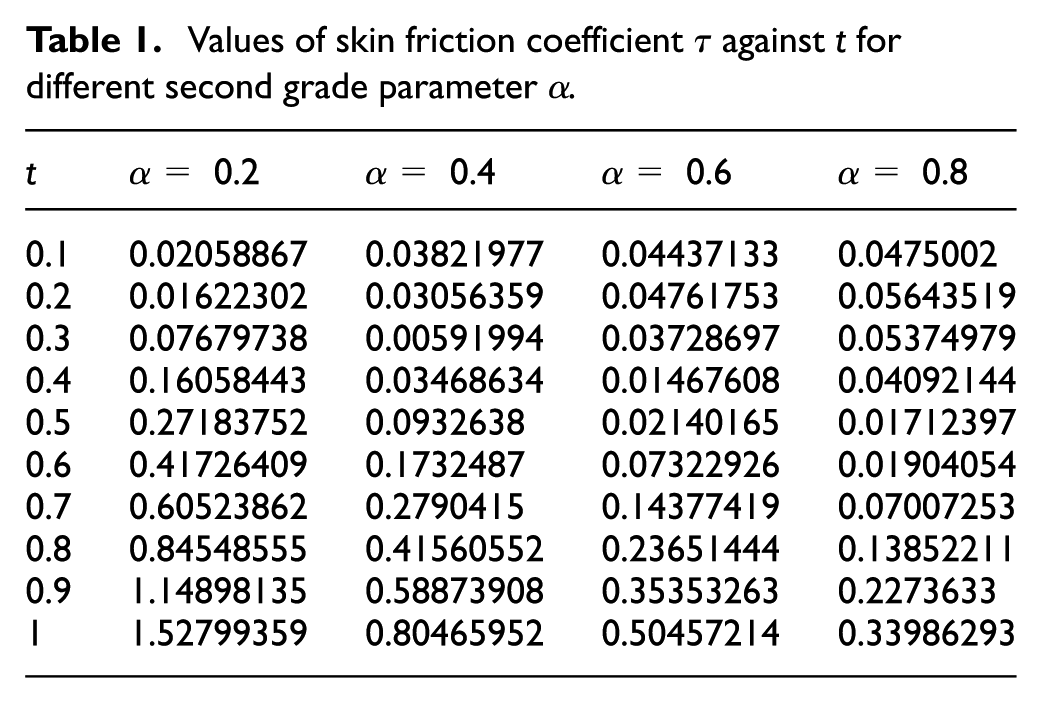
Table 2 presents the variation of the Nusselt number Nu against time t for different values of the second-grade fluid parameter α. It is cleared that, for a fixed α, the Nusselt number increases monotonically for elevation in time t. This trend refers the enhanced thermal transport at boundary of flow domain, which shows that rate of heat transfer is enhanced over time. Moreover, it is observed that for any fixed value of time t, the Nusselt number decreases as the second-grade parameter α increases. This inverse relationship reveals that stronger second-grade parameter α tend to reduce the convective heat transfer at the surface of cylinder. Finally the results indicate that time enhances the Nusselt number, while an increase in values of second-grade parameter α reduces the heat transfer at the boundary.
Nusselt number Nu against t for different values of second grade parameter α.

Table 3 presents the subjectivity of Sherwood number Sh against time t for different values of the second-grade parameter α. It is revealed that for a constant values of α, the Sherwood number increases as time increases. Mass transfer over time is enhanced, which is reflecting the natural variation of the concentration boundary layer with increasing t. It is also observed that a given time t, the Sherwood number decreases as the second-grade parameter α increases. This behavior refers to the stronger second-grade fluid effect leads to a suppress mass transfer rate. The results of Table 3 confirm that for increasing time, the Sherwood number enhances, which refers to significant mass transfer, whereas the increasing values of second-grade fluid parameter α reduces the rate of mass transfer over the cylinder surface.
Sherwood number Sh against t for different values of α.

Conclusion
We have conducted an analytical study of the mass transfer and transient heat from a heated infinite vertical cylinder in motion. By taking into account the mass and thermal stratifications that produce a related effect between the vertical velocity and the temperature and concentration, our research improves the thermodynamic energy and species concentration equation. Finally, Bessel functions are used to describe analytical results which are obtained by using the Laplace transform method. A summary of how various parameters influence fluid velocity, temperature, and concentration is presented below
The fluid velocity increases with an enhancement in the thermal Grashof number Gr and the mass Grashof number Gc, while it decreases with rising values of the thermal stratification parameter S, mass stratification parameter F, and the second-grade fluid parameter α.
The temperature distribution decreases as the values of F, Gr, and Gc increase. Notably, under strong thermal stratification (large F), the temperature profile are raised significantly. Additionally, an increase in α also leads to a rise in temperature, due to enhanced elastic properties of the second-grade fluid.
The concentration profile generally diminishes with increasing values of F, Gr, and Gc. However, in the presence of strong mass stratification (large S), the concentration can exhibit significant growth near the boundary. Furthermore, an increase in the second-grade fluid parameter (α) tends to raise the concentration distribution, Due to the enhanced elastic and memory effects within the fluid.
Both Prandtl number Pr and Scmidt number Sc influence the velocity significantly through their effects on the temperature and concentration field, which in affect fluid field. Increasing values of Pr and Sc tend to decrease the velocity field.
Increasing Pr leads lower temperature in the fluid bulk while increasing Sc leads to rising temperature.
Increasing Sc decreases mass diffusivity, leading to a thinner concentration boundary layer so reducing the diffusion of species into the fluid.
Therefore, concentration profiles decrease with increasing Sc, implying restricted species transfer away from the surface.
The skin friction increases significantly with time for all values of the second-grade parameter α. However, higher values of α lead to a slight suppression in the skin friction at larger times, reflecting the non-Newtonian fluid effects.
The Nusselt number grows with time, indicating enhanced heat transfer as the system evolves. An increase in the second-grade parameter α results in a decrease in the Nusselt number, showing that stronger non-Newtonian effects reduce thermal transport.
Similarly, the Sherwood number rises steadily with time, suggesting an improvement in mass transfer over time. Nevertheless, increasing α reduces the Sherwood number, highlighting a weakening in mass transport with stronger fluid elasticity.
Footnotes
Handling Editor: Aarthy Esakkiappan

Funding
The authors received no financial support for the research, authorship, and/or publication of this article.
Declaration of conflicting interests
The authors declared no potential conflicts of interest with respect to the research, authorship, and/or publication of this article.