






Abstract
Tšepong (“Place of Hope”) Clinic in Leribe, Lesotho, is the country's first publicly funded antiretroviral (ARV) clinic. Mountainous Lesotho (population 2.2 million) is a landlocked and impoverished country in southern Africa. About 30% of adult Basotho (the name given to the people of Lesotho) are HIV-infected — one of the highest prevalence rates globally.
The Ontario Hospital Association (OHA) and The Change Foundation established a team of health professionals that joined Tšepong clinic in December 2004. The Basotho staff and OHA team have treated over 1100 HIV-positive people and initiated over 350 on antiretrovirals.
A typical patient at Tšepong is a married woman in her early 30s weighing a meagre 40 kilograms. Her wasting is hidden under layers of clothing and a traditional Basotho blanket. She arrives by ox-driven cart or wheelbarrow, or on the back of a relative. She gasps from the Pneumocystis carinii which fills her lungs. Candida spills from her mouth.
Diagnostic capacity
Tšepong's diagnostic capacity is compromised by the absence of in-house X-rays, intermittent availability of laboratory tests, nonexistent phone line and, sporadically, lack of charting paper or soap. Treatment consists of five ARVs (the supply of which is tenuous) and a narrow range of antibiotics and oral antifungals (for which stock-outs are common).
AIDS treatment in Lesotho is complicated by widespread stigma and abject poverty. Concealment of ARVs in a shared one-room hut is impossible and patients are forced to reveal their status. Transportation costs for a single clinic visit, let alone repeated follow-ups, are prohibitive. The 10 Maloti (∼$2) charged for the full complement of drugs, including ARVs, is unaffordable for many in Lesotho, where the jobless rate exceeds 50%. Money spent on treatment means less for food, cooking fuel, and school fees. Non-adherence in Lesotho really means not enough cash.
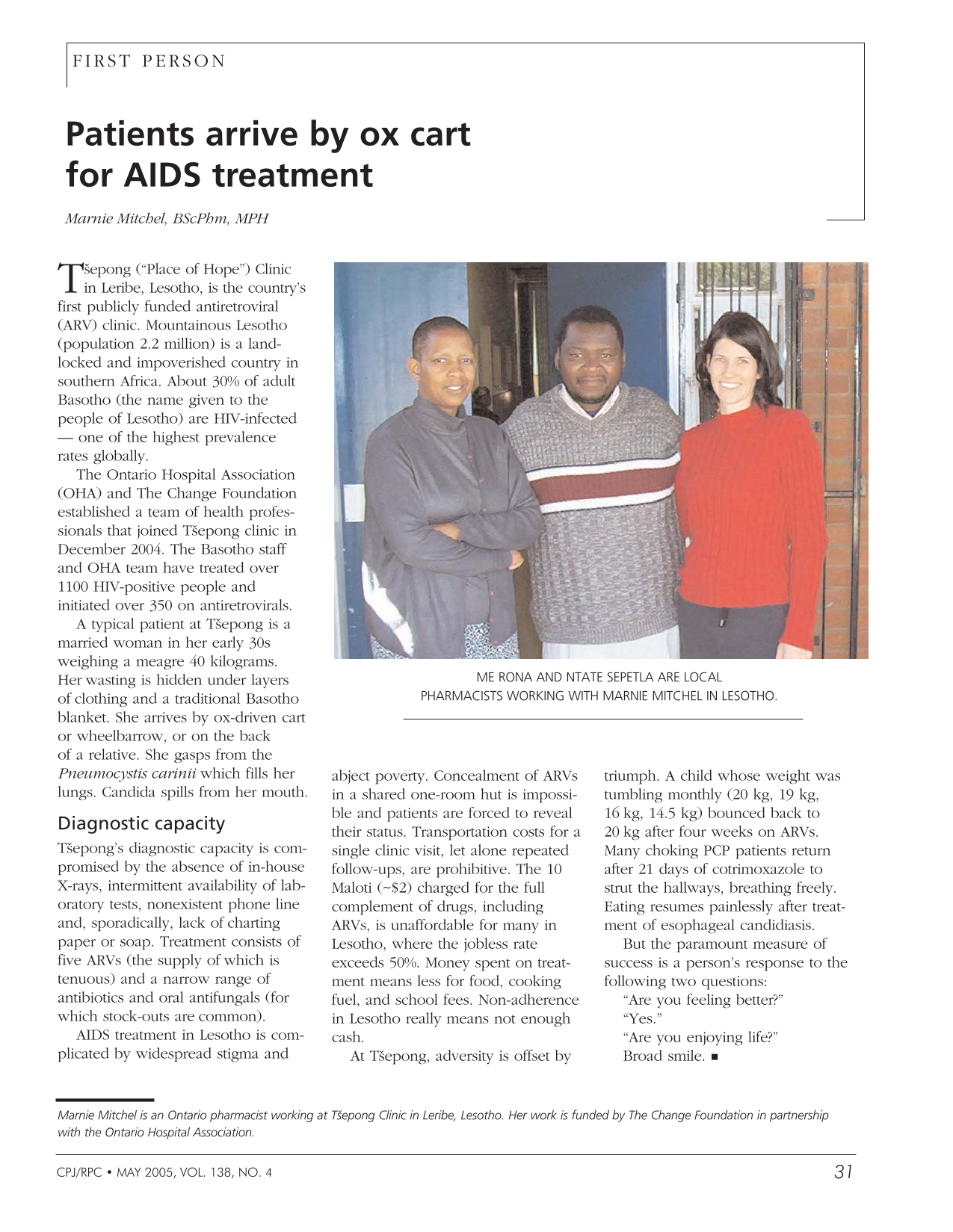
ME RONA AND NTATE SEPETLA ARE LOCAL PHARMACISTS WORKING WITH MARNIE MITCHEL IN LESOTHO.

At Tšepong, adversity is offset by triumph. A child whose weight was tumbling monthly (20 kg, 19 kg, 16 kg, 14.5 kg) bounced back to 20 kg after four weeks on ARVs. Many choking PCP patients return after 21 days of cotrimoxazole to strut the hallways, breathing freely. Eating resumes painlessly after treatment of esophageal candidiasis.
But the paramount measure of success is a person's response to the following two questions:
“Are you feeling better?”
“Yes.”
“Are you enjoying life?”
Broad smile.