






Abstract

Tailoring a hiring process to identify pharmacists suitable for different practice environments is a challenge, especially during a recognized pharmacist shortage. New types of opportunities for pharmacists further complicate the job market, making it imperative for employers and potential employees to ensure that the information each party requires is available to obtain a good match between the job applicant and position offered.
Key points
A description of the successful process used to hire 7 qualified pharmacists for the IMPACT research project is described.
The process used maintained transparency, equity, and credibility, and attracted a large number of excellent candidates.
Pharmacists had a variety of practice experience but all of them demonstrated diverse knowledge, skills and values identified for the position.
The trend towards family physician group practices, including the integration of other health professionals into the primary care practice site, is progressing rapidly as part of health care reform in Canada. Including pharmacists as integrated members of family physician group practices is a relatively recent opportunity compared to working in hospital practice, community practice, industry, or government. Integrating Family Medicine and Pharmacy to Advance Primary Care Therapeutics (IMPACT) is a large-scale demonstration project supported by the Ontario Primary Health Care Transition Fund that aims to improve drug therapy using a collaborative care model that integrates pharmacists into the primary health care team.
The IMPACT project required qualified pharmacists to work at 7 practice sites throughout Ontario for 1 year. Potential candidates had to meet the minimum competency for a pharmacist practicing in primary care, based on the standards in use by the Ontario College of Pharmacists, 1 the Faculty of Pharmacy at the University of Toronto, and the National Association of Pharmacy Regulatory Authorities. 2 Candidates also had to be willing to take on an innovative and extremely challenging role, be very flexible, work in an environment that had not previously incorporated a pharmacist, participate in rigorous evaluation, and adapt to the requirements of a constantly changing demonstration project. Tight timelines generated a situation whereby there were only 2 months from announcing the project to having the pharmacists start in their practice sites. Despite the challenges of short timelines and the need to find suitable candidates, a process was used that maintained transparency, equity, and credibility, and attracted a large number of excellent candidates.
A description of our process may be helpful to others seeking to incorporate a pharmacist or other health care professional into primary care practice.
Hiring process
We created a job description and an advertisement to distribute to potential markets where the best candidates were thought to be. We obtained consent and used the e-mail network of the following organizations: Ontario Pharmacists' Association (OPA), Ontario Branch — Canadian Society of Hospital Pharmacists (CSHP), and the Faculty of Pharmacy, University of Toronto. The messages featured a link to the IMPACT website, which contained additional information about the practice sites under consideration and more detailed project information. The positions were also advertised through participation in a job fair at the CSHP Professional Practice Conference and through direct contact with pharmacists who had expressed interest to the project team.
A structured process was developed that included application review, screening, and interviewing elements. An application package was sent to interested pharmacists. This included an introductory letter describing the project and the requirements for application. Applicants had to submit a curriculum vitae, a letter of no more than 4 pages describing how they felt they met the required competencies, and 2 references using a structured form. At least 1 reference was required from a health care provider other than a pharmacist. The form asked the references to use a scale to rate the candidate's interpersonal skills, critical thinking, the use of evidence-based medicine, independence, organizational skills, intellectual ability, and the quality of both written and verbal communication skills.
Our applicant screening process used a 4-member selection panel who individually completed a suitability assessment based on a rating system that assessed candidates' interpersonal skills, their experience working with other disciplines and pharmaceutical care, 3,4 and their potential to succeed. Each applicant was scored from 1 to 10 and special attributes were highlighted. The panel discussed applicants with inconsistent scores and interviews were set up with the candidates who had the highest consensus determined scores. Identified candidates were interviewed by at least 2 panel members using a structured format with standard questions. It covered the reason for application, description of knowledge and skills, methods of continuing competence, teamwork, and what they would like to do in the position. Interview results were discussed by the selection panel and a matching process was used to assign pharmacists to potential practice sites. Interviews were then conducted by a practice site designate to ensure suitability in some situations. Once all successful applicants were determined, a position was verbally offered and confirmed by a negotiated written contract. The pharmacists participated in a mandatory structured formative training program prior to starting at their practice sites.
Unsuccessful candidates were informed of the decision and, if they desired, kept on a mailing list for project status reports and for consideration in any related opportunities in the future.
Results of recruitment and hiring
One hundred applications were requested from the IMPACT office. IMPACT received 24 applications within the 3-week deadline. The selection committee conducted 13 interviews and the practice sites conducted 3 interviews. Seven pharmacists were hired. The past work experiences of pharmacists hired is described in Table 1.
Experience of pharmacists hired
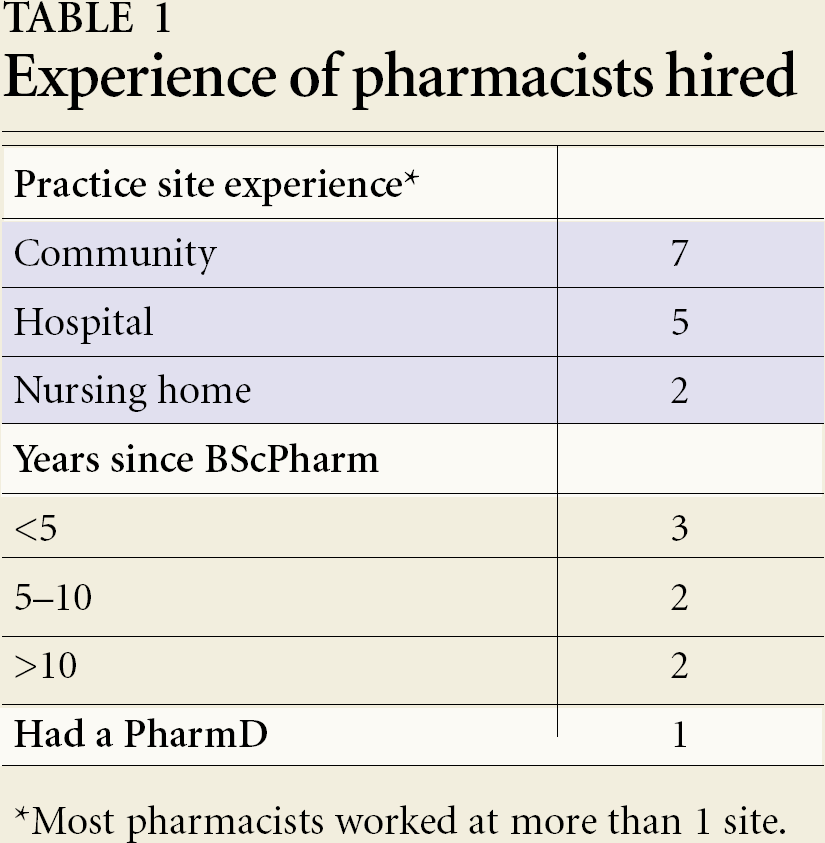
Most pharmacists worked at more than 1 site.
Discussion
The targeted advertising approach, the use of existing communication networks, and a creative advertisement highlighting the unique opportunities were all instrumental in attracting qualified pharmacists. To receive 100 requests for application packages within a 3-week period during a recognized pharmacist shortage demonstrates the quality of the pharmacist opportunity and the successful marketing of the project.
Points clés
Une description du processus fructueux utilisé pour embaucher sept pharmaciens qualifiés pour le projet de recherche IMPACT est fournie.
Le processus utilisé visait à assurer la transparence, l'équité et la crédibilité et a attiré un grand nombre d'excellents candidats.
Les pharmaciens avaient une expérience variée en matière de pratique, mais ils possédaient tous les connaissances, les compétences et les valeurs requises pour le poste.
The intensive, structured application process weaned out numerous pharmacists who were less committed to the unique opportunity. Those interviewed provided sufficient evidence that they met the general and pharmacist-specific competencies desired, such as:
The ability to communicate and collaborate with family physicians, specialists, community pharmacists, and nurses to resolve problems
The ability to conduct complete medication histories
Use of a consistent therapeutic thought process to accurately identify medication-related problems, generate care plans, and monitor patients according to the Hepler and Strand model of pharmaceutical care 3,4
The ability to provide written reports outlining actual or potential medication-related problems, the rationale for their existence, and recommended strategies for resolving or preventing them
An adequate knowledge base in the most common practice and therapeutic issues expected to be encountered by a primary care pharmacist
The ability to critically appraise primary literature
The ability to use key medical and pharmacy literature databases
The ability to prioritize, manage time effectively, and be flexible in a very active work environment
Basic computer skills related to word processing, spreadsheets, and PowerPoint
The structured reference form highlighted the issues we were most interested in. The personal letter written by the applicants provided insight into their type of practice and what their visions were for the position. Combined with the experience described in the curriculum vitae we felt we had a complete picture of the candidate.
Using a 4-member selection panel provided us with operational challenges but ensured transparency and equity for all candidates. The structured screening process and interview questions ensured that we fairly compared all candidates, since each interview was conducted by different members of the panel at different sites and sometimes used conference calls.
The pharmacists hired for the position had a variety of experience. The years in practice ranged significantly, demonstrating that their practice experience was more valuable than actual time employed as a pharmacist. Many of the pharmacists had practiced in more than 1 practice setting in their career, providing them with a breadth of experience to enable them to recognize the overall picture of primary care. Only 1 pharmacist had a Doctor of Pharmacy degree, recently completed, demonstrating that the degree was not essential to be considered qualified to perform the functions required.
Conclusion
This complex, interdisciplinary approach to hiring pharmacists was successful in hiring 7 pharmacists for 7 family practice sites. The pharmacists came with a variety of practice experience but all demonstrated the large set of diverse knowledge, skills, and values identified for the position. This process was completed in less than 2 months and during a recognized pharmacist shortage in Ontario. The structured process and the numerous tools developed can be applied to hiring pharmacists for primary care or hospital practice positions.
Footnotes
This paper is published on behalf of the IMPACT team members: Integrating family Medicine and Pharmacy to Advance primary Care Therapeutics. IMPACT was a large-scale demonstration project funded by the Ontario Ministry of Health and Long-Term Care (MOHLTC) through the Primary Health Care Transition Fund. The views expressed in this paper are the views of the authors and do not necessarily reflect those of the MOHLTC.
To view documents described in this article, go to