






Abstract

Collaboration has been a buzzword over the past few years. It's been talked about in health care circles and has entered the political world, enough so that the Primary Health Care Transition Fund had a national envelope dedicated to fostering collaboration among health care providers. If so many people are on the collaboration bandwagon, it must be a good thing, right?
I must admit, at the beginning of the Enhancing Interdisciplinary Collaboration in Primary Health Care (EICP) and Canadian Collaborative Mental Health Initiative (CCMHI) projects, I doubted that we would end up with documents that all the groups around the table would sign. It took a while for the steering committees of both groups to gel. Basically, we had to go through much the same process that front-line health care providers must before they can collaborate. We had to get to know each other, understand different perspectives, define our goals, find common ground, and finally, arrive at decisions we were all comfortable with.
It took a bit of time, but I was surprised at how quickly we began to collaborate. More than once, someone from another profession would step up to defend pharmacists. Or I would question whether something would be acceptable to psychologists, or any combination of one profession trying to understand another.
After a bit more time, suggestions were made that were acceptable to most people around the table. Those who objected were given the chance to explain their perspective and we worked to find a solution. In other words, we collaborated to reach a common goal.
When EICP first started, members of the Steering Committee were asked if they thought we would be able to reach agreement from all represented associations. Most of us were skeptical. We thought we'd have the majority of associations sign the Principles and Framework document, but not all. I remember attending a Leaders' Forum put on by the EICP initiative when it dawned on me that we were going to have sign-on from all 10 associations.
Collaboration definitions 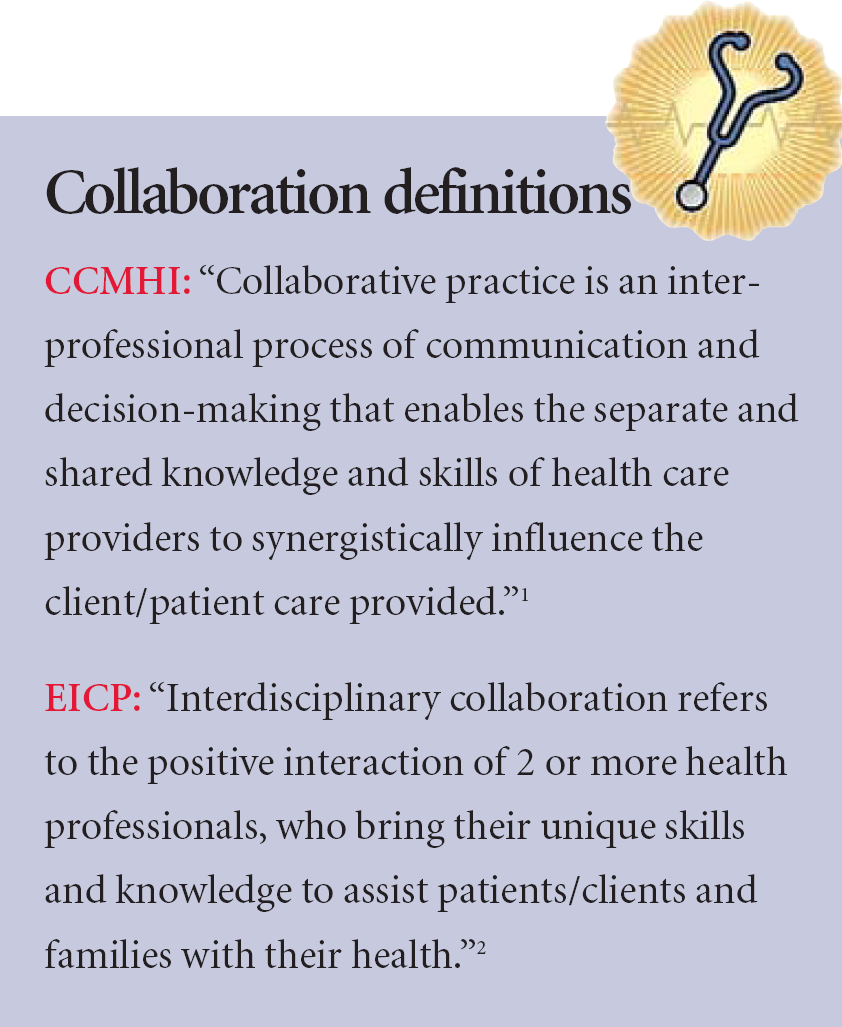
I've experienced collaboration firsthand in health care through various practice settings. Palliative care will always stand out as the area where collaboration was so obvious and essential, yet so unobtrusive. Like every other pharmacist in the country, I've experienced frustration from a lack of collaboration and the problems it causes for patients. Getting started on collaboration seems like a daunting task in most venues, but so important when you are faced with patients who cannot get what they need because of poor communication or a lack of teamwork.
Are the EICP and CCMHI documents the single solution to the collaboration problem? No, they aren't. What they are, however, is historic. The 2 projects have managed to get groups of both health care professionals and patients to agree. They agree on why collaboration needs to happen and what is needed to move it forward.
This supplement to the CPJ is your guide to the 2 projects. Use it as a starting point for attempts in collaboration. Use it to find some of the gems from the projects' toolkits and documents. Use it to provide better patient care.