






Abstract

Of the summit participants invited to complete the survey, 65 responded, for a response rate of 68%. Participants were asked to rank the 3 pharmacist practice activities that have the largest potential to impact patient health outcomes. Their responses are presented below (Table 1).
Practice activities that would have the largest potential to affect patient care
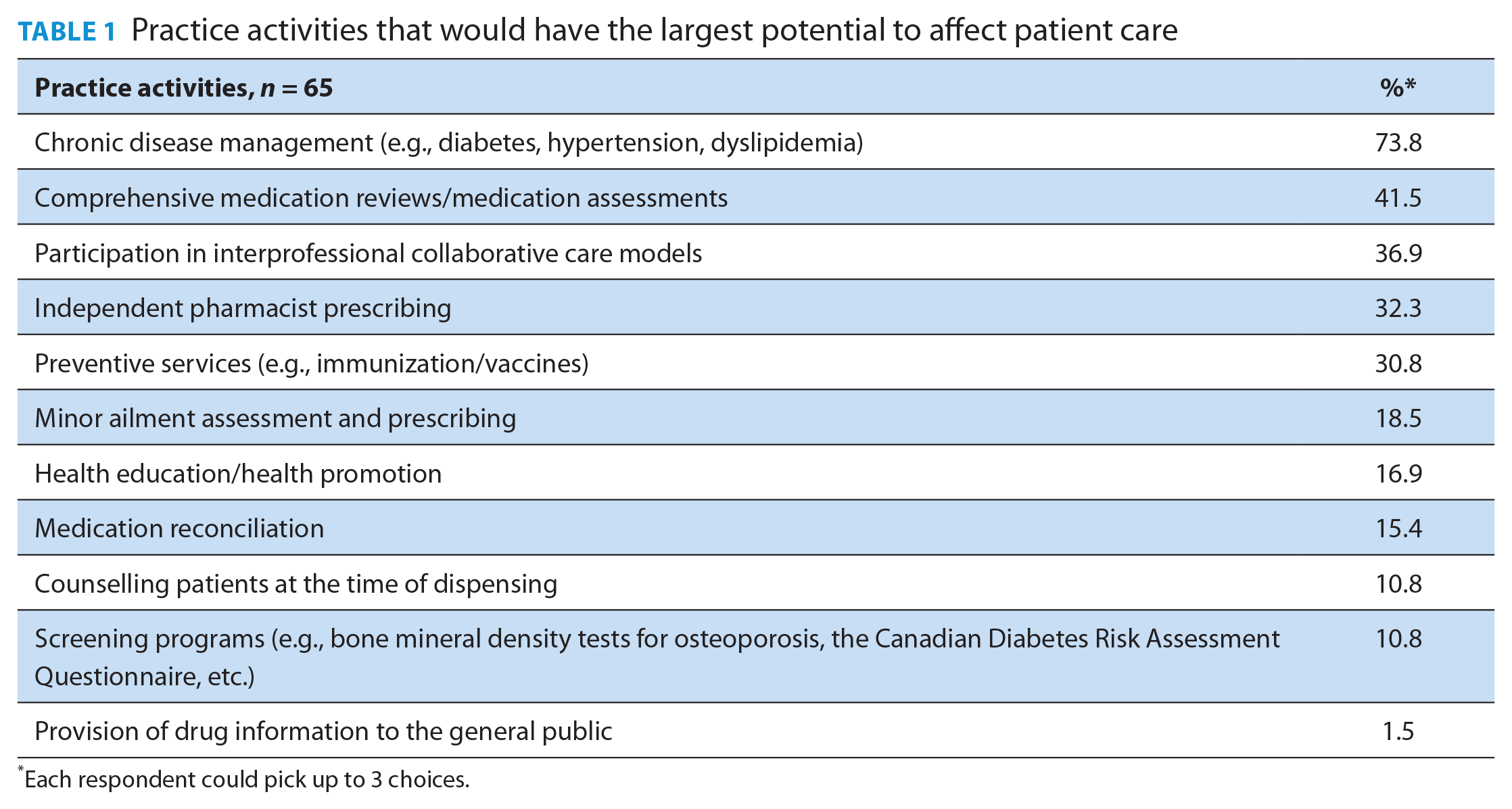
Each respondent could pick up to 3 choices.
Participants had an opportunity to provide additional comments in this section of the questionnaire, which helped to provide context to the quantitative results in Table 1.
Legislation needs to be changed so I can practise to the full extent of my knowledge and skill. There are hundreds of thousands of individuals without a family physician. These individuals could likely be well served by primary care pharmacists for many of the most common ailments. —Pharmacist respondent
Participants who classified themselves as a practising pharmacy professional were also asked about their personal satisfaction with their current work environment. Of the 65 participants who responded to the survey, 38 classified themselves as a practising pharmacy professional. Their responses are presented in Table 2.
Work satisfaction or stress felt by practising pharmacy professionals
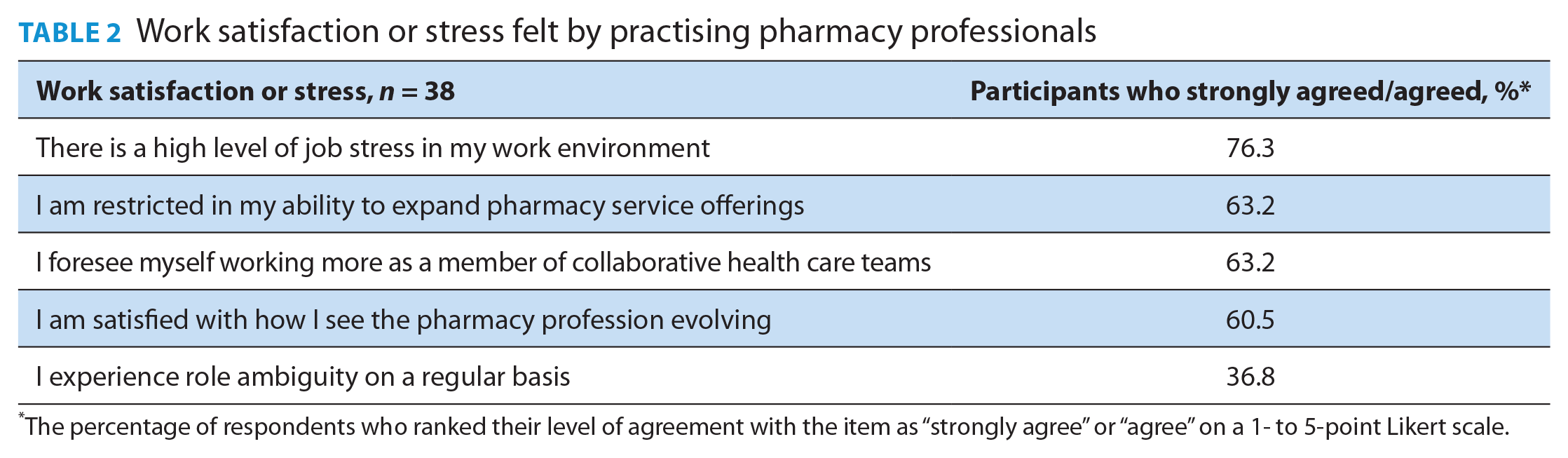
The percentage of respondents who ranked their level of agreement with the item as “strongly agree” or “agree” on a 1- to 5-point Likert scale.
Participants had an opportunity to provide additional comments in this section of the questionnaire, which helped to provide context to the quantitative results in Table 2.
We need to invest in proper technology to free pharmacists from clerical work and to document the impact they have on health care utilization. —Pharmacist respondent
Most participants felt that chronic disease state management would have the largest potential to affect patient health outcomes. However, many participants also experience a high level of job stress in their work environment and feel restricted in their ability to offer expanded pharmacy services. These survey results were further echoed at the Pharmacy Thought Leadership Summit meeting, when the participants met in person to discuss and debate these issues. All participants at the summit voted on 11 priority areas that would have the greatest impact on advancing the profession over the next 10 years. 2 The priorities that received the most votes were 1) technology and workplace environments and 2) payer/policy issues. The final article in this series goes into more depth on these priority areas. 3
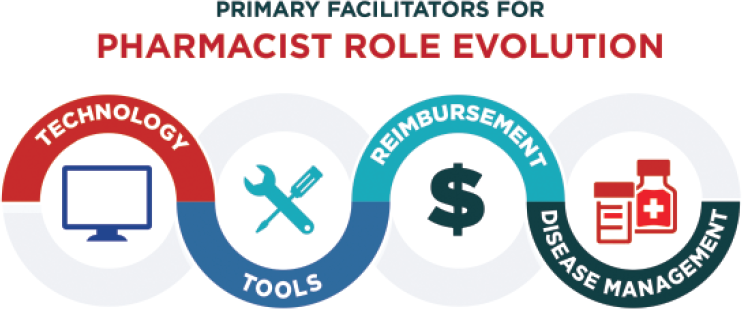
The findings of both the survey and discussions at the Pharmacy Thought Leadership Summit meeting suggest that technology and alternative payment and delivery models around chronic disease state management are the primary facilitators for pharmacist role evolution and practice change. Advancements in these areas would also enable the development of workplace environments that support innovative service models and ensure pharmacies remain a health care destination. ■
Editorial note
There is an old joke about how a statistician once drowned in a river that was–“on average”–6 inches deep. While survey data can be valuable, overreliance on them or any other single source of information for decision making can be problematic. This article highlights opinions of thought leaders regarding activities that have the largest potential to affect patient care and signposts the need for some deeper discussions with the profession about how pharmacy is and needs to evolve. General ideas related to chronic disease management or interprofessional care models are a necessary first step but insufficient to actually identify priorities and allow for the regulatory and practice changes needed to unleash the potential of pharmacists. This study provides us with an important first step, but only a first step, in launching a discussion across the profession to help us refine and articulate priorities that will guide our profession’s evolution.