






Abstract

In part 3 of this series, 2 we shared the results of what pharmacy technicians perceived to be the main indicators of professional satisfaction. This article reports the professional satisfaction responses from the 96 pharmacy professionals who were invited to attend the Summit meeting in Calgary (Table 1). Of the summit participants invited to complete the survey, 64 responded to this section of the questionnaire, for a response rate of 67%.
Indicators of professional satisfaction
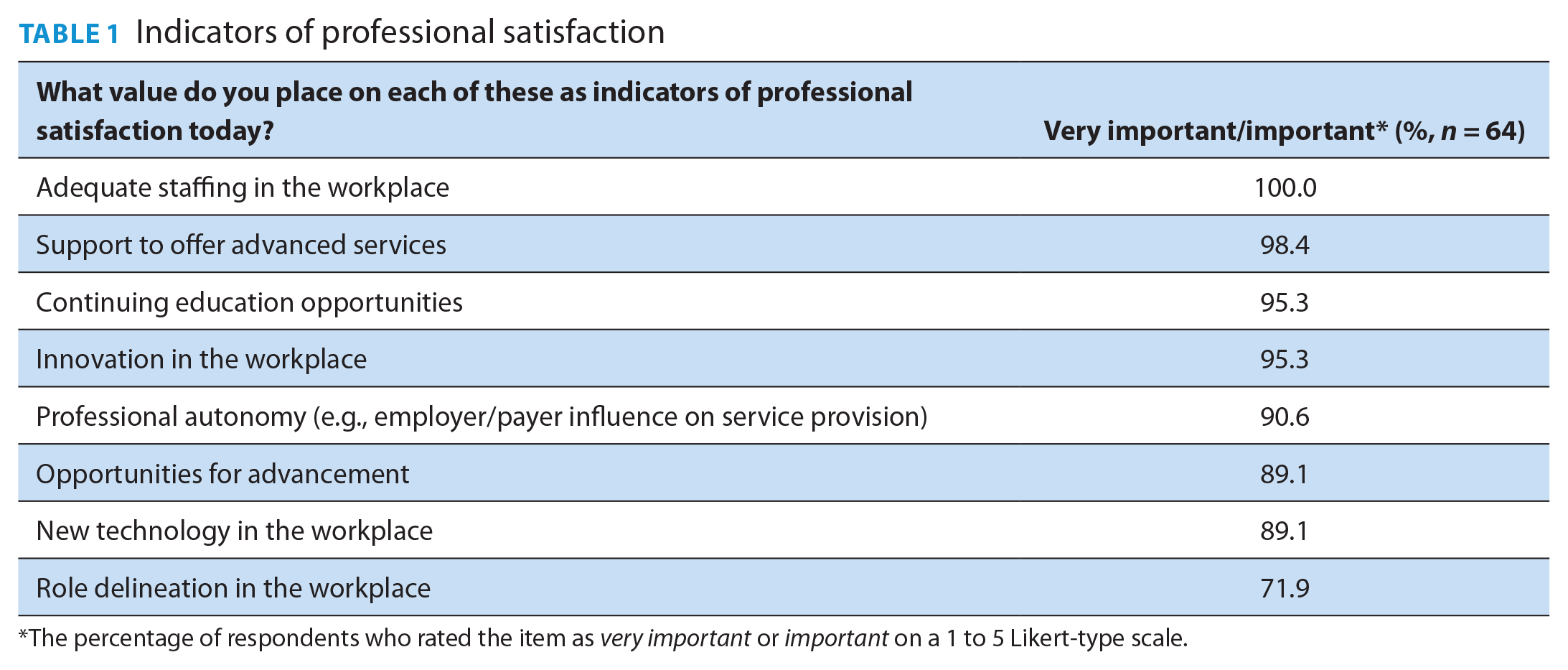
The percentage of respondents who rated the item as very important or important on a 1 to 5 Likert-type scale.
A majority of respondents felt that each of the 9 indicators of professional satisfaction was very important or important. Notably, all respondents agreed that “adequate staffing in the workplace” is very important or important. This echoes results from other questions in the survey about workplace barriers to the provision of patient care services.2-4 The second highest indicator of professional satisfaction was “support to offer advanced services.”
Previous research has observed a significant positive relationship between pharmacist job satisfaction and (1) perceived utilization of skills and (2) adequate staffing. 5 The authors of the study concluded, “one factor that may be contributing to dissatisfaction among pharmacists is their inability to use their skills while on the job.” 5 Some of the quotes provided by the respondents of this survey support these assertions.
Ability to find ways to expand scope in light of cost containment in the industry and pressures as the volume of scripts has expanded. New ways of handling script volume need to take hold and payment for services must also grow. —Pharmacist respondent
Collaborative practice models and expanded scopes of practice are seen as necessary for having a meaningful impact on patient care, and so [are] key to satisfaction. —Pharmacist respondent
Pharmacies need to be adequately staffed in order to offer advanced services.

The respondents were also asked for their input regarding the key priorities to advance the profession over the next decade (Table 2). A majority of respondents agreed that each of the 11 items presented to them in the survey question are very important or important, with “professional credentialing of specialization” having the least amount of support. Interestingly, 100% of respondents felt that “integration of expanded scope into daily practice” was very important or important; thus, it was deemed to be the top priority for the profession moving forward. Many of the written comments provided by the respondents supported this.
Key priorities to advance the profession over the next 10 years
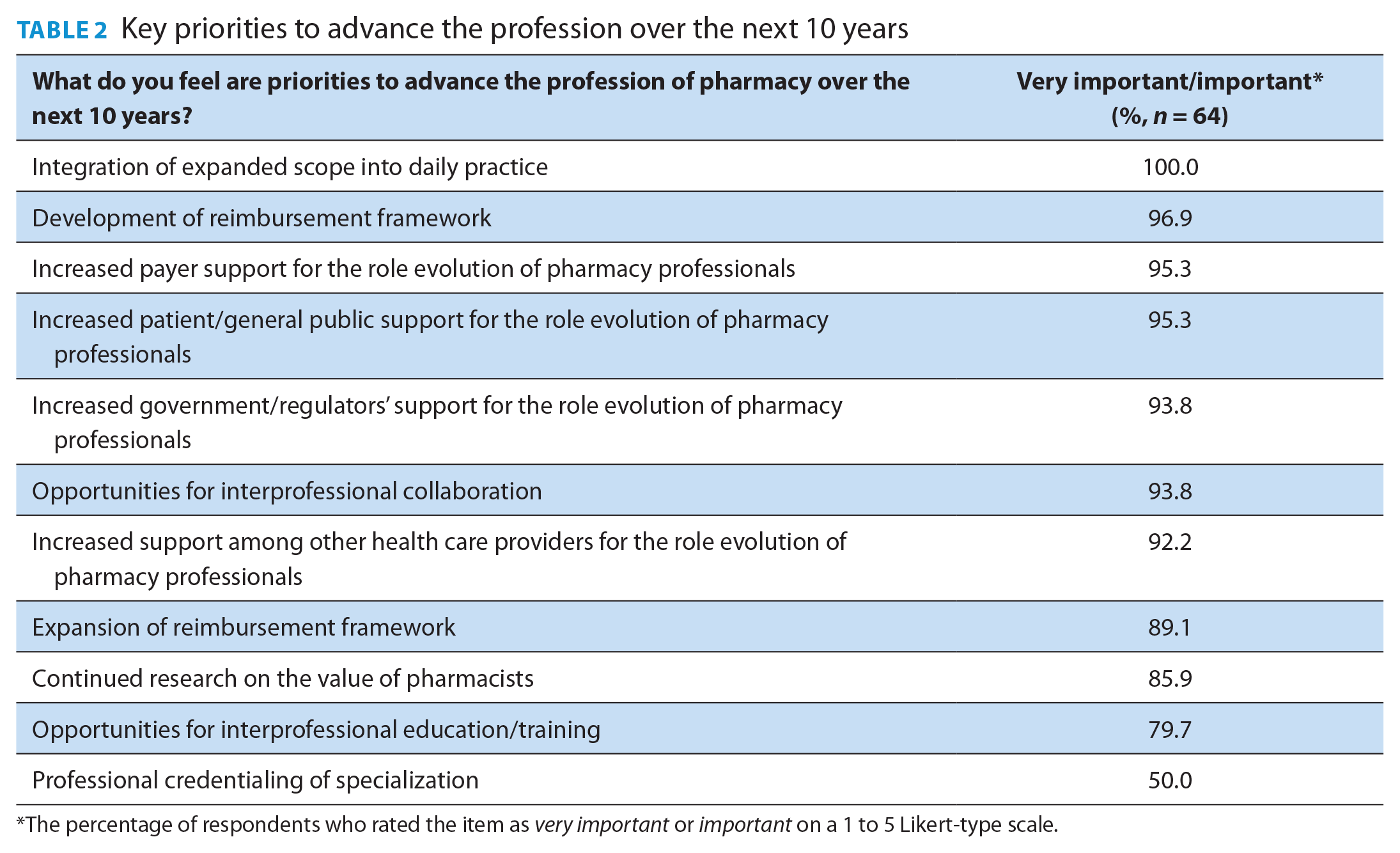
The percentage of respondents who rated the item as very important or important on a 1 to 5 Likert-type scale.
Participants had an opportunity to provide additional comments in this section of the questionnaire, which helped to provide context to the quantitative results in Tables 1 and 2.
Regulatory changes are needed to empower pharmacists to act as decision makers in the use of medications rather than simply carrying out the decisions of others (e.g., physician prescribers). The reimbursement model must support this by paying pharmacists to provide comprehensive medication management services rather than [being] medication providers. —Pharmacist respondent
Business needs to let professionals be professionals. Pharmacists need to be given autonomy so that they can make decisions and use appropriate resources so that care is focused on the patient, to improve outcomes. Currently, business seems satisfied with trying to minimize risk of harm and inserting the provision of services where the ROI [return on investment] is quick and evident. Patient health outcomes seem secondary. —Pharmacist respondent
In this fourth article in our series on the summit, we have shared the insights we have gathered from pharmacy professionals on the key influencers of their professional satisfaction and their priorities to advance the profession forward over the next decade. In our fifth and final article, coming in the next issue of CPJ, we will describe their future vision for the profession of pharmacy. 6 ■
Editorial note
Throughout this series of articles, the authors have carefully enumerated perspectives of diverse thought leaders across the profession. The data are rich and should alert us to the multiple opportunities to support pharmacists in managing change. Importantly, these authors have identified that no single organization or part of the profession can steer the change management process for the profession. Each arm of the profession—regulatory bodies, educational institutions, professional associations, employers and so forth—has a unique series of levers that they can potentially apply to shift incentives and advance practice, but no one arm of the profession can do it alone. A central question posed across this series of articles remains: how can we get these multiple parts of the profession to actually work together and align their activities in a positive and productive way?
—Zubin Austin
University of Toronto