






Abstract
Background:
Cluster-randomised trials often use some form of restricted randomisation, such as stratified- or covariate-constrained randomisation. Minimisation has the potential to balance on more covariates than blocked stratification and can be implemented sequentially unlike covariate-constrained randomisation. Yet, unlike stratification, minimisation has no inbuilt guard to maintain close to a 1:1 allocation. A departure from a 1:1 allocation can be unappealing in a setting with a small number of allocation units such as cluster randomisation which typically include about 30 clusters.
Methods:
Using simulation (10,000 per scenario), we evaluate the performance of a range of minimisation procedures on the likelihood of a 1:1 allocation of clusters (10–80 clusters) to treatment arms, along with its performance on covariate imbalance. The range of minimisation procedures includes varying: the proportion of clusters allocated to the least imbalanced arm (known as the stochastic element) – between 0.7 and 1, percentage of first clusters allocated completely at random (known as the bed-in period) – between 0% and 20% and adding ‘number of clusters allocated to each arm’ as a covariate in the minimisation algorithm. We additionally include a comparison of stratifying and then minimising within key strata (such as country within a multi country cluster trial) as a potential aid to increasing balance.
Results:
Minimisation is unlikely to result in an exact 1:1 allocation unless the stochastic element is set higher than 0.9. For example, with 20 clusters, 2 binary covariates and setting the stochastic element to 0.7: only 41% of the possible randomisations over the 10,000 simulations achieved a 1:1 allocation. While typical sizes of imbalance were small (a difference of two clusters per arm), allocations as extreme as of 10:10 were observed. Adding the ‘number of clusters’ into the minimisation algorithm reduces this risk slightly, but covariate imbalance increases slightly. Stratifying and then minimising within key strata improve balance within strata but increase imbalance across all clusters, both on the number of clusters and covariate imbalance.
Conclusion:
In cluster trials, where there are typically about 30 allocation units, when using minimisation, unless the stochastic element is set very high, there is a high risk of not achieving a 1:1 allocation, and a small but nonetheless real risk of an extreme departure from a 1:1 allocation. Stratification with minimisation within key strata (such as country) improves the balance within strata although compromises overall balance.
Background
It is common for parallel-arm cluster-randomised trials (CRTs) to include a small number of clusters.1,2 Randomising a small number of clusters increases the risk of chance imbalance on cluster-level covariates between intervention and control arms. Chance imbalance both undermines the internal validity of the study and might reduce the study power.3,4 Restricted randomisation methods, such as blocked stratified randomisation, reduce the risk of imbalance, and are commonly used in individually randomised trials.5–7 Blocked stratification not only induces balances across key covariates, but it also sets a limit on the maximum size of imbalance of number of units allocated to each arm. 8 Stratification is commonly used in CRTs.1,2,9 Yet, stratification breaks down when there are relatively more strata to observations to be randomised (i.e. clusters), and this means that it does not work well when there are multiple covariates with multiple levels and few randomisation units.10,11
An alternative form of restricted randomisation, covariate-constrained randomisation, which can potentially balance across many covariates has been proposed for CRTs.12–15 Covariate-constrained randomisation scores the balance of the covariates for all possible schemes in the randomisation space, and restricts the sampling space to those with the best balance from which one allocation is then chosen at random. Yet to implement covariate-constrained randomisation, it is necessary to have knowledge of all clusters at the time of randomisation, or at least in a few batches. 9 In practice, clusters are often recruited sequentially over time, and randomised when cluster participation has been ratified. This lends itself to a form of sequential randomisation, rather than a randomisation conducted at a single point in time.
Minimisation, originally proposed for use in individually randomised trials,16,17 can accommodate sequential randomisation, and is able to do so for more covariates than can be accommodated in stratification. 11 Minimisation can also be used to randomise clusters using cluster-level covariates. 18 Under this approach, when a new cluster is ready to be randomised, some measure of imbalance is calculated first assuming the cluster is allocated to intervention, and then supposing the cluster is allocated to the control. The cluster is allocated to the arm that leads to the least overall imbalance. Conventionally, to prevent complete determination of the next upcoming allocation, the allocation is made in part at random, with a weighting (referred to as a stochastic or random element) that gives a high probability of being allocated to the arm with least imbalance.19,20 Unlike stratification, minimisation has no inbuilt mechanism to limit the size of departures from a 1:1 allocation. 21
The performance of minimisation has been evaluated in individually randomised trials.20,22,23 These studies have investigated various properties of minimisation on balance and predictability of upcoming assignment. It is known, for example, that a higher stochastic element increases predictability but also increases balance, 23 adding in more covariates might reduce balance 22 and including centre as a minimisation variable increases predictability but reduces within centre imbalances. 20 Typical values for the stochastic element range from 0.7 (meaning a 70% chance of allocation to the least imbalanced arm) to 0.9 (meaning a 90% chance of allocation to the least imbalanced arm). Almost all evaluations of the performance of minimisation have considered a large number of randomisation units, but in those evaluations that have considered smaller sample sizes (∼100 randomisation units), it has been observed that low stochastic elements might not result in the desired level of balance. 23
While in principal, applying minimisation to CRTs should provide the same performance as in individually randomised trials, most evaluations of the performance of minimisation have focused on scenarios with more than 100 randomisation units; performance is known to depend on the number of units.20,22,23 Yet, CRTs include an average of only 30 randomisation units. 2 In trials with such a small number of allocation units, an imbalance in the number of units allocated to each arm (i.e. a departure from a 1:1 allocation) may be important: for example, it can undermine the face validity of the study, reduce study power and create logistical complications.
Because of the context of most cluster trials having a small number of randomisation units, we evaluate the performance of minimisation in the setting of a small number of units. Specifically, we consider the size of any imbalance in the covariates and number of clusters allocated to each arm, the implications of varying the stochastic element, and the use of minimisation in conjunction with stratification (as an aid to creating balance within key strata as well as across all clusters). As an aid to increasing the likelihood of a 1:1 allocation, we additionally consider if there is merit in including ‘the number of clusters allocated to each arm’ as a covariate in the minimisation algorithm.
Motivating case study
The E-MOTIVE study is an 80 cluster two-arm CRT to evaluate the effect of evidence-based interventions for the prevention of post-partum haemorrhage, set across four countries. 24 Randomisation will be performed sequentially over time to allow clusters to adopt different study start dates. There is a desire to restrict the randomisation to balance on (1) country, (2) the cluster size and (3) the cluster-level proportion of the primary outcome (measured in a baseline period). There are 12, 14, 14 and 42 clusters per country, and the two continuous cluster-level covariates are categorised into binary variables using medians.
We use a hypothetical example to illustrate implementation of minimisation. Suppose 23 clusters have already been randomised and the 24th cluster is to be allocated. The minimisation method that we consider is one of those proposed by Pocock and Simon, 17 known as the range method. 25 Table 1 shows the imbalance scores under both allocation to the intervention and control (for simplicity we illustrate with just two of the three covariates). In this example, the imbalance score is lower when the cluster is allocated to the control arm, and so the 24th cluster is allocated to the control arm (possibly with a stochastic element).
Hypothetical illustration of minimisation to allocate clusters to treatment arms.

The 24th cluster to be randomised is categorised as <median for both cluster-level covariates. The ‘imbalance scores’ are used within the minimisation algorithm; ‘covariate imbalance’ used to assess imbalance across arms as a performance measure (see section ‘Methods’).
Methods
We report a simulation-based evaluation of minimisation, and stratifying and then minimising (e.g. stratified first by country, then minimised within country). We consider a range of scenarios which are informed by the E-MOTIVE trial, but nonetheless are not atypical of cluster trials in general. We consider scenarios with 10, 20, 30 and 80 clusters in total. We include two binary cluster-level covariates (both with a 50:50 split). Some scenarios include an additional four-level categorical covariate with fixed numbers at each of the four levels (to emulate a key cluster-level characteristic such as country in E-MOTIVE). This was only considered for the 80 clusters scenario with number of clusters at each of the four levels set at: 10, 14, 14 and 42 (these were the number of clusters anticipated in each country at the planning stage of E-MOTIVE).
The data generation process consisted of generating cluster-level covariates for each cluster. Binary cluster-level covariates were generated by dichotomising uniform random variables at the median (to emulate dichotomisation of continuous cluster-level covariates at the median across clusters). The four-level categorical covariate (to emulate country) was generated by randomly sorting clusters and stratifying into the four groups as per the number of levels assigned to each group. After generation of cluster-level covariates, clusters were then randomly sorted (to emulate a sequential order of the clusters ready to be randomised). Clusters were then randomly assigned to the treatment or control arm on the basis of the randomisation method under evaluation (see below). For each simulation, the number assigned to each arm and a measure of covariate imbalance across treatment arms (see below) was saved. This process was repeated 10,000 times.
For minimisation, we use the Pocock and Simon range algorithm, considering four values for the stochastic element (0.7, 0.8, 0.9 and 0.99) – the last of which essentially represents a completely deterministic allocation. The first few allocations are allocated completely at random (we refer to this proportion allocated completely at random as the ‘bed-in period’).26,27 We consider a range of values for this ‘bed-in period’ (0%, 10% and 20%). Of some concern is the possibility that with only a small number of randomisation units, minimisation provides no clear guarantee that the number of clusters allocated to each arm will be similar. One strategy to reduce this risk is to include a covariate that represents the number of clusters assigned to treatment and control arm (in an attempt to balance on the covariates included in the minimisation but also on the number of clusters allocated to each arm) which we thus include in some scenarios (see Supplemental Table 1 for an illustration). For the method of stratification combined with minimisation, the clusters are independently randomised using minimisation in each of the four strata (defined by the four-level categorical covariate). Not every variation of the randomisation method is considered under every scenario.
We report the median, inter-quartile range and range of imbalance in the number of clusters and cluster-level covariates allocated to the two arms. The median and inter-quartile range represents the typical sorts of imbalance that might be expected, whereas the range represents what might happen at the extreme, albeit less commonly. These are calculated both within strata and across all clusters (for any scenarios which include the covariate representing strata/country) – so as to illustrate the size of imbalance that might be expected both across the entire study and within strata (e.g. country). In some scenarios, we also calculate the percentage of simulations for which there was an exact 1:1 balance in number of clusters allocated to each arm. We measure covariate imbalance as the sum of the difference between the treatment and control group at all levels for all covariates (see Table 1 for an illustration ‘covariate imbalance’).
All analyses were carried out in Stata 16 using the routine rct_minim to implement the minimisation. The seed used for data generation was set by creating a set of 9-digit random numbers. A different seed was used for each scenario and randomisation method. The seed for the random element within the minimisation software was the same used for the data generating mechanism.
Results
Table 2 illustrates the degree of imbalance, under minimisation, on the number of clusters allocated to control and intervention arms, and can be viewed as an evaluation of when a 1:1 allocation is achieved (scenarios limited to two binary cluster-level covariates). For example, for the scenario of 20 clusters, bed-in period 10% and stochastic element 0.7: only 41% of the possible randomisations achieve a perfect 1:1 allocation (i.e. allocation ratio of 10:10). Furthermore, there are some extreme allocations (Figure 1, range of allocations across 10,000 simulations), for example, an imbalance of 10 clusters occurred when randomising 20 clusters (i.e. an allocation of 10:10). Increasing the stochastic element reduces the risk of this imbalance: the chance of perfect balance increases to about 55% when the stochastic element increases to 0.8, to 73% when the stochastic element is 0.9 and is over 90% when the stochastic element is set at 0.99 (Table 2). There is little discernible impact of the size of the bed-in period (proportion of first clusters allocated completely at random) or number of clusters (Table 2 and Figure 1).
Imbalance between number of clusters in each arm when using minimisation, by stochastic element, bed-in period, number of clusters and whether a covariate for the number of clusters was used in the minimisation.

Table shows the percentage of simulations with perfect balance in the number of clusters allocated to intervention and control (10,000 simulations per scenario). The stochastic element is the probability clusters that are allocated to the least imbalanced arm. The ‘bed-in period’ is the percentage of the first clusters that are allocated at random. Scenarios all include two binary covariates (50/50 split).
Cov: covariate included in minimisation for number of clusters; No cov: no covariate for number of clusters include in the minimisation.

Imbalance between number of clusters in each arm when using minimisation, by stochastic element and number of clusters.
Figure 2 illustrates the impact of including the ‘number of clusters’ as a variable in the minimisation algorithm (again with two binary cluster-level covariates). This increases the likelihood of a 1:1 allocation slightly: for example, from about 41% to 51% in the scenario of 20 clusters and with a stochastic element of 0.7 (Table 2 and Figure 2). Although adding in ‘number of clusters’ made a more noticeable improvement in scenarios of 10 and 30 clusters (in these scenarios, there are 2 × 2 = 4 strata and neither 10 nor 30 are a multiple of 4). Patterns of covariate imbalance followed similar trends with the exception that when the number of covariates was included as a covariate in the minimisation – this sometimes increased the imbalance on other covariates (Figure 3). Of note, there is no clear increase in balance as number of clusters increases.
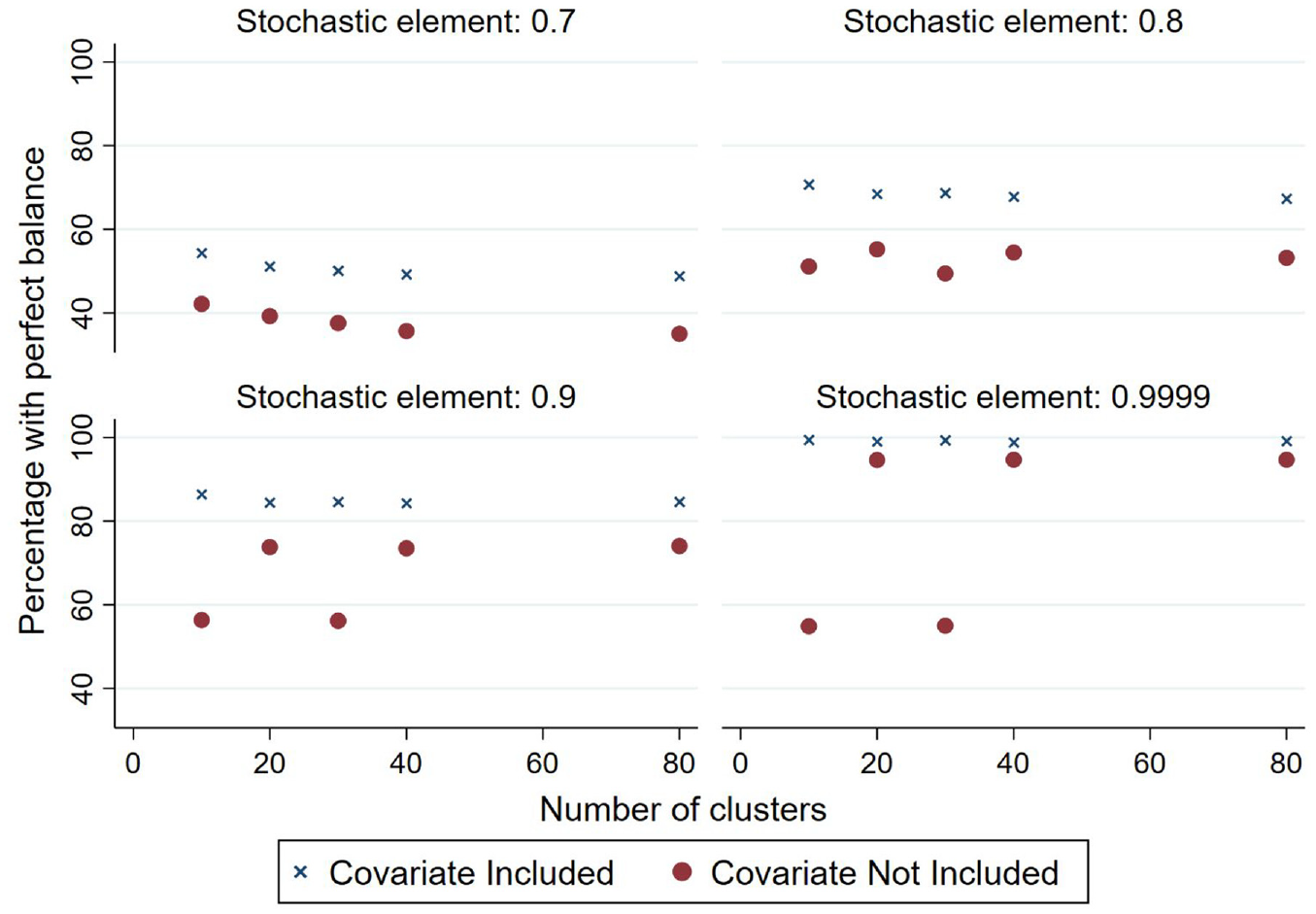
Imbalance between number of clusters in each arm when using minimisation, by stochastic element and whether or not a covariate for ‘number of clusters’ was included.
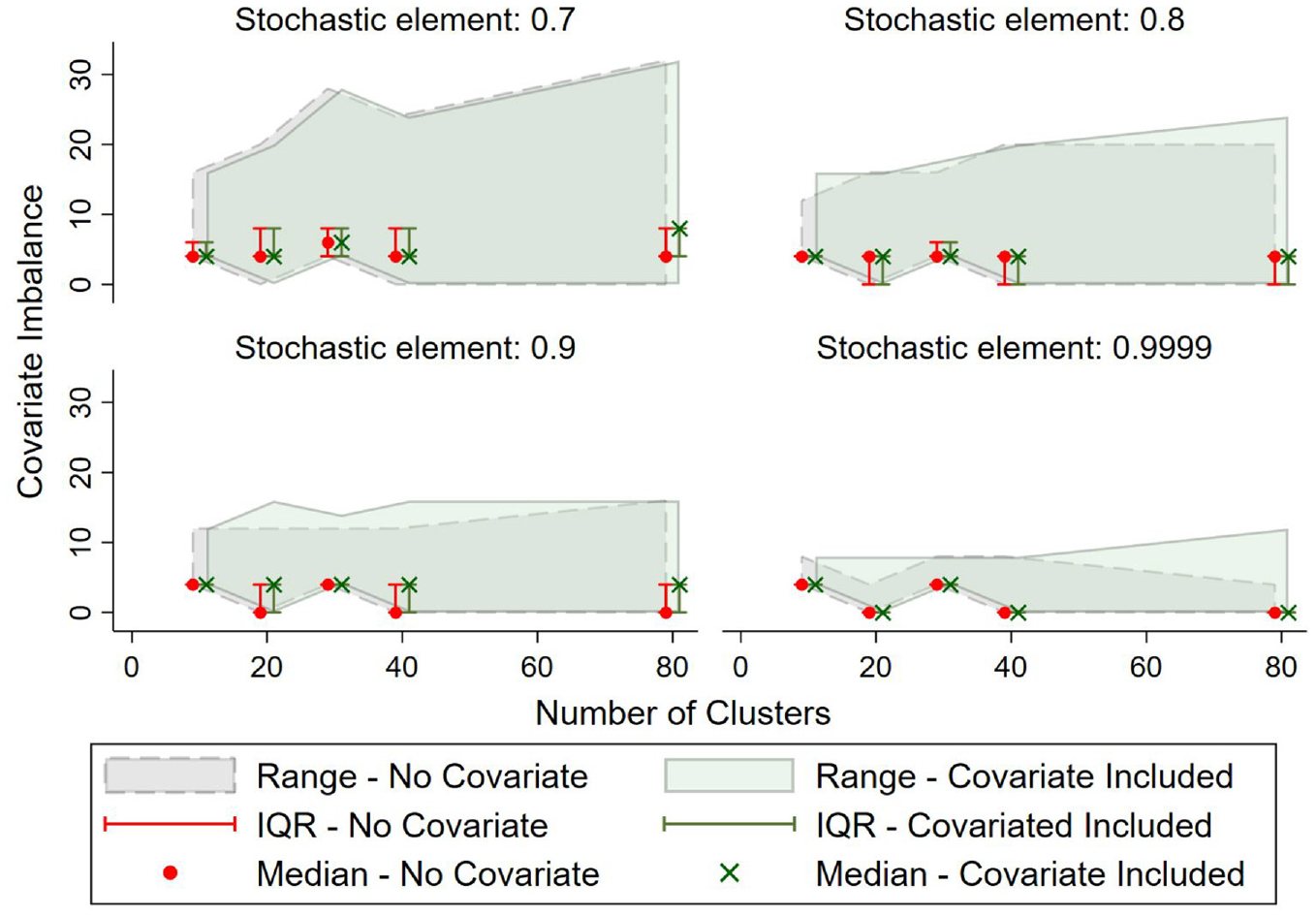
Covariate imbalance when using minimisation, by stochastic element and number of clusters.
Figure 4 (grey panels) illustrates the degree of imbalance within strata and across all clusters, when using minimisation (scenarios limited to eighty clusters, two binary covariates and one 4-level categorical covariate representing a key stratifying characteristic). This can be viewed as an illustration of balance within strata and across all clusters in a trial like E-MOTIVE. The imbalance across all clusters (both in terms of the likelihood of a 1:1 allocation and the imbalance across covariates) tends to be less compared to that which is observed within strata. Again, allocations become more balanced as the stochastic element is increased. Stratifying and then minimising within strata result in less imbalance (both number of covariates and covariate imbalance) within strata, but increase imbalance across all clusters (Figure 4, contrasting grey and green panels).

Covariate imbalance and imbalance between number of clusters in each arm within strata and overall when using minimisation, by stochastic element and whether or not a covariate for ‘number of clusters’ was included.
Discussion
CRTs typically have a much smaller number of randomisation units compared to individually randomised trials: the average number of clusters randomised in a sample of 100 cluster trials published in 2017 was 29. 2 The implementation of restricted randomisation procedures is thus desirable, not only to improve balance on cluster-level covariates but also to prevent randomisations to very unbalanced allocations which might substantially undermine the face validity of the trial and study power. 28 While covariate-constrained randomisation has received particular attention in recent years,12–15,28–30 minimisation is a potential alternative for settings where the allocation can be implemented sequentially over time. Implementation of minimisation in theory is not different to when used in individual randomisation; however, the typically small number of clusters means that best practice choices around such things as the size of the stochastic element and bed-in periods might be different.
We found that with a small number of clusters (up to 80 considered here), minimisation is unlikely to result in an exact 1:1 allocation of clusters to treatment arms, unless the stochastic element is set higher than 0.9. Including the ‘number of clusters’ as a covariate in the minimisation algorithm can improve this a little. The typical degree of imbalance is unlikely to be very large (maximum around 2 in 75% of scenarios considered), but nonetheless, minimisation runs a small risk of an extreme imbalance (allocations observed over 10,000 simulations). Stratification with minimisation within key strata (such as country) improves the balance within strata although compromises overall balance.
Research in context
Achieving a 1:1 allocation
An exact 1:1 allocation of randomisation units to study arms is never guaranteed. Because of this, many randomisation approaches incorporate blocking – to maximise the size of the imbalance across the study arms to be the chosen block size.5,8 While minimisation can help balance on key covariates, and thus has some intuitive appeal, as it does not include any inbuilt approach to prevent deviations from a 1:1 allocation. A 1:1 allocation of clusters or randomisation units across arms is desirable, for a multitude of reasons, including enhancing face validity, helping with logistical and planning issues as well as providing the most statistically efficient design. Depending on context such departures may or may not be problematic. For example, in cluster trials, imbalance in the numbers allocated to each arm could create logistical complexities, for example, if the funding bid had anticipated 10 clusters in the intervention arm, there might not be funds to allow for intervention roll out in 14 clusters. Departures from a 1:1 allocation also result in power loses, although because only allocation ratios greater than 1.5:1 are associated with significant power losses – the extent of these power losses are unlikely to be very large. 31
Predictability of allocations
We identified to retain a 1:1 balance the stochastic element has to be set very high, consistent with the findings of others. 23 However, the more deterministic an allocation procedure, the increased potential for predictability of upcoming allocations.20,32 For example, minimisation with stratification is also known to increase predictability of the allocation, 19 essentially a reflection that any attempt to increase balance of the algorithm will naturally increase predictability (as well as reduce overall balance). The Statistical Principles for Clinical Trials ICH Harmonised Tripartite Guideline recommends that any method of randomisation should not be deterministic and should include some random element. 33 Other ways of avoiding subversion of the randomisation procedure, such as recruitment and randomisation (of clusters) by someone independent to the trial, can help alleviate these concerns, and any removal of the stochastic element should only be undertaken with appropriate and transparent mitigation measures in place to prevent predictability of upcoming assignment. 34
The role of stratification
While it is already known that including centre as a minimisation variable reduces within centre imbalances, 20 the additional knowledge that stratification with minimisation performs slightly better than including strata as a minimisation variable (at balancing within strata) could help further reduce within stratum imbalance. However, we note that this increase in within strata balance comes at the cost of a reduction in balance across all randomisation units. We also see other trade-offs, for example, when adding the ‘number of clusters’ as a covariate in the minimisation algorithm, we see a reduction in balance across other covariates. We are not the first to observe these sorts of trade-offs, as others have observed –‘he who attempts to please everyone pleases no one’.11,22 Our findings here are aligned with some caution being needed before implementing minimisation. 35 Indeed, the simple approach of using random blocks within strata, and then sorting by a continuous covariate (e.g. cluster size) – to additionally balance on continuous variable might be a preferable approach. 36
Limitations
There are some important limitations to our findings, for example, we only included up to three categorical covariates, limited the maximum number of clusters to 80 and only considered the so-called range method for minimisation.16,17 We also categorised continuous covariates in the minimisation, yet this can be an important limitation of minimisation. 37 While other balance metrics sometimes used in minimisation can work with continuous covariates, these have yet to be widely implemented and, for example, are not a feature of Stata’s rct_min function. 38 Indeed, for situations where all of the clusters are identified at the start of the trial, covariate-constrained randomisation has been shown to have better performance compared to minimisation, perhaps in part because it does not typically require categorisation of continuous covariates.11,18,39 While there are numerous implementation software packages for covariate-constrained randomisation,40–42 there appear to be fewer for minimisation, although some centres maintain their own in-house randomisation systems.27,43
In the individually randomised setting, minimisation has been compared to stratification, identifying that for a small number of strata, they work similarly, but for more numbers of strata, minimisation works better.11,20 Indeed, minimisation and stratification can be viewed as identical procedures for the case of one binary-level covariate. As a rough rule of thumb, stratification is known to work with up to about half the number of strata to randomisation units. So, for example, with 8 clusters, stratification would work with up to about 2 binary covariates (4 strata); with 16 clusters, about 4 binary covariates (8 strata). In the E-MOTIVE study, there are 16 (=(1 × 4) × (2 × 2)) strata. So, by this rule, stratification should work well for E-MOTIVE (80 clusters). However, balance within key strata can be important, again for face validity, logistics and when subgroup analyses are planned. Thus, because of the importance of country, in E-MOTIVE, it was desirable to achieve balance within each country. The number of clusters available for randomisation within each country varied from 10 to 40 – with 10 being just above the minimum number needed to stratify on 4 strata (i.e. two binary cluster covariates). Thus, it is possible that in this particular study, stratification might have worked similarly to minimisation.
We have also not considered the question of analysis, but it has long been recognised that any restriction in the randomisation should be followed by an adjusted analysis so as to maintain nominal type-1 error rates.5,44–46 We have not considered whether minimisation provides improvements in power compared to simple randomisation, although others have shown there are power gains from other forms of restricted randomisation methods and this is also likely to hold for minimisation.28–30 Note, our findings suggest that some improvement on balance on the number of clusters allocated to treatment and control arms is achieved when the variable ‘number of clusters’ is included as a minimisation variable (albeit at the sacrifice in some loss of balance on other covariates). This is not a cluster-level covariate but rather a covariate that takes one value for all clusters in the treatment arm and another value for all clusters in the control arm – and so it is not amenable to adjustment at the time of analysis. The implications of including a variable in the minimisation and not subsequently adjusting for it have not been explored here.
Conclusion
When implementing a minimisation algorithm, an overall 1:1 allocation is unlikely to be realised unless the stochastic element is removed. Removal of the stochastic element will induce a predictability of upcoming assignments and should only be undertaken with mitigation measures. Thus, while minimisation improves imbalance on covariates, there is a risk of an imbalance in number of clusters allocated to each arm (which can be controlled with blocking in other randomisation procedures). Furthermore, while stratification and then minimising improve balance within strata, it runs the risk of increasing imbalance overall.
Supplemental Material
sj-docx-1-ctj-10.1177_17407745221149104 – Supplemental material for Minimisation for the design of parallel cluster-randomised trials: An evaluation of balance in cluster-level covariates and numbers of clusters allocated to each arm
Supplemental material, sj-docx-1-ctj-10.1177_17407745221149104 for Minimisation for the design of parallel cluster-randomised trials: An evaluation of balance in cluster-level covariates and numbers of clusters allocated to each arm by James Martin, Lee Middleton and Karla Hemming in Clinical Trials
Footnotes
Author contributions
K.H. led the development of the idea and wrote the paper. J.M. undertook simulations and produced tables and figures. L.M. is the E-MOTIVE senior statistician. All authors made an intellectual contribution to the development of the ideas and commented on draft versions of the paper.
Declaration of conflicting interests
The author(s) declared no potential conflicts of interest with respect to the research, authorship and/or publication of this article.
Funding
The author(s) disclosed receipt of the following financial support for the research, authorship and/or publication of this article: K.H. is funded by an NIHR Senior Research Fellowship SRF-2017-10-002. E-MOTIVE is a commissioned trial by the Bill & Melinda Gates Foundation. J.M. is partly funded by the Bill & Melinda Gates Foundation. This research was also partly funded by the UK NIHR Collaborations for Leadership in Applied Health Research and Care West Midlands initiative.

Supplemental material
Supplemental material for this article is available online.
References
Supplementary Material
Please find the following supplemental material available below.
For Open Access articles published under a Creative Commons License, all supplemental material carries the same license as the article it is associated with.
For non-Open Access articles published, all supplemental material carries a non-exclusive license, and permission requests for re-use of supplemental material or any part of supplemental material shall be sent directly to the copyright owner as specified in the copyright notice associated with the article.
