






Abstract
Myasthenia gravis is a neurological disease that causes poor quality of life. Mestinon® is the drug of choice. However, using the original medication may lead to high costs particularly in developing countries. We did a pilot study in previously diagnosed, stable generalized myasthenia gravis patients by switching Mestinon® to pyrimine 60, a generic form. After we enrolled 13 patients, 6 patients responded, 4 patients did not respond, and 4 patients had severe dry mouth and throat from pyrimine 60. Clinical characters, SF-36 scores, and composite scores in those who responded, did not response, and had side effects were compared. No patients had serious side effects or myasthenic crisis. In conclusion, pyrimine 60 may be as effective as mestinon® with minor side effects.
Introduction
Myasthenia gravis (MG) is one of the prevalent neurological diseases that have specific clinical characteristics. The frequent symptoms include proximal muscle weakness, ptosis, and double visions. The major characteristics are fatigue and fluctuation of symptoms, which can increase after a period of activity and can be relieved after resting. 1 Treatment is anticholinesterase medication2,3 and thymectomy when indicated.3,4 All patients must take anticholinesterase for improving motor weaknesses. Presently, anticholinesterase or pyridostigmine is mestinon®, which is imported and so expensive when compared to pyridostigmine that is manufactured in Thailand. On 27 June 2007, Thailand Food and Drug Administration has approved pyrimine 60, a local-made anticholinesterase. It is claimed to have similar pharmaceutical properties as the original mestinon® and has been used in over 100 hospitals in Thailand from which no reports have been made related to pyrimine 60's side effects. However, some patients do not respond to pyrimine 60, and hence, a concern among clinicians involved. We did a study to investigate the effectiveness of pyrimine 60 in clinical practice.
Methods
We did a pilot, prospective, open-labelled study in 13 MG patients at Neurology clinic, Srinagarind hospital, Khon Kaen University, Thailand. The diagnosis of MG made by clinical presentations plus any of these criteria including positive prostigmine test, positive repetitive nerve stimulation test, or clinically responses to pyridostigmine. We included generalized MG patients with stage II or III Osserman classification in established patients whose symptoms remained stable and received no dose adjustment of mestinon®. Patients with ocular MG, MG crisis, MG with hyperthyroid, or MG with pregnancy were excluded. All patients were given informed consent prior to the study participation and the study protocol was approved by the Human Research Ethics Committee, Khon Kaen University.
Pyrimine 60 prescription protocol
The patients will receive the same dose and frequency of pyrimine 60 instead of mestinon®. If clinical condition was worsening, mestinon® will be immediately replaced.
Assessment

Statistical analyses
We evaluated the response rate, MG composite with weighted scores, quality of life, and side effects of pyrimine 60 treatment by descriptive statistics. Clinical characters of those who responded, did not respond, and those who had side effects were also compared.
Results
After we enrolled 13 patients, 6 patients responded to pyrimine 60, 4 patients did not respond to pyrimine 60, and 4 patients had severe dry mouth and throat (one patient did not response to treatment and had dry mouth). Therefore, we stopped the study earlier due to patients' safety.
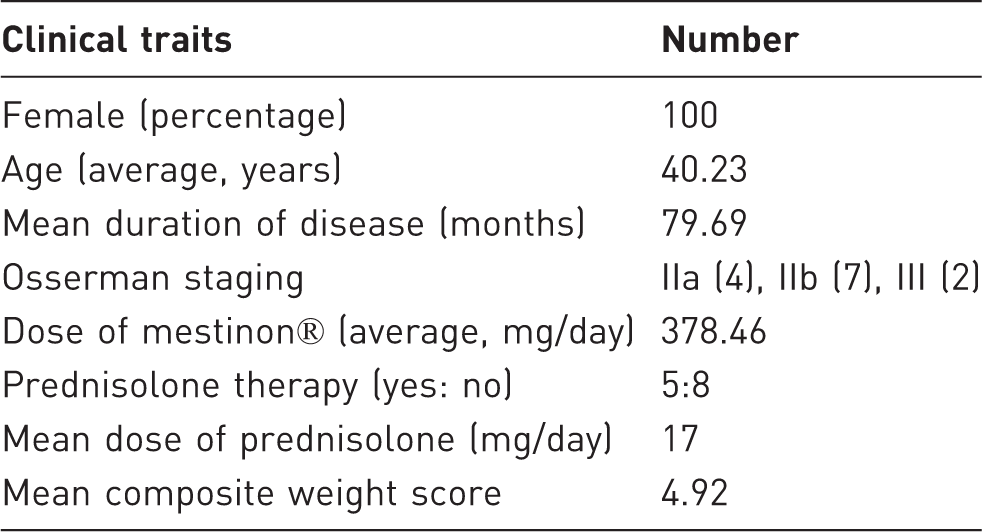
Basic information and clinical characteristics of the 13 myasthenia gravis (MG) patients
Quality of life of 13 myasthenia gravis (MG) patients

Clinical variables of patients who respond to, did not respond to and had side effect from pyrimine 60

One patient who had both side effect and did not respond; description of SF-36 is shown in Table 3.
All four patients who did not respond to pyrimine 60 showed more weakness after 4 days of treatment with pyrimine 60. They withdrew from the study and received mestinon®, weaknesses improved without myasthenic crisis during pyrimine 60 treatment.
Discussion
This is the first study that showed the efficacy of pyrimine 60 in MG patients. Of the 13 patients, 9 had no motor weaknesses after pyrimine 60 treatment (69.23%), but 3 of them experienced severe dry mouth and throat. The other four patients (30.77%) did not respond to the treatment. Considering the clinical characteristics of the patients who responded to pyrimine 60, they had an average duration of MG of 101 months, while those who did not respond to the treatment had MG only for 39 months. This finding may be very useful for further application in selecting pyridostigmine for the treatment of MG patients who had a stable long-term symptom, since the use of pyrimine 60 is promising.
The quality of life of MG patients in this study is similar to other studies on the patients' quality of life in Thailand. 7 Generally, MG patients had low quality of life values. In this study, the patients' quality of life became even worse when they were weaker, while their quality of life increased when the weakness improved.
Anticholinesterase normally causes more salivation. The severe dry mouth and throat from pyrimine 60 may be an effect of the side effect of the ineffective drug constituent, dicalciumphosphate. Mestinon® has no dicalciumphosphate and has never been reported to cause dryness of mouth or throat. Thus, if this element in pyrimine 60 is replaced by another ineffective element, the side effect of dry throat should be alleviated. Besides dryness of mouth and throat, there is no other serious side effect from pyrimine 60. It can be generally considered to be a safe medication.
Four patients did not respond to pyrimine 60 treatment. They developed weaknesses from the fourth day after taking pyrimine 60. There was fatigue during the study period but reported no other serious effects such as suffocation from food or water or respiratory failure. They became better after switching from pyrimine 60 to mestinon®.
The limitations of this study are (1) It was an open study in which bias could occur from the change of mestinon® to pyrimine 60. (2) There were only 13 patients participating and all of them were old patients. Thus, further studies should be conducted.
The use of pyrimine 60 can be recommended as follows:
Old MG patients whose conditions are stable and no adjustment of mestinon® dose for 2 months; pyrimine 60 can replace mestinon® with caution of non-responders in the first few days. New MG patients can use pyrimine 60 if the hospital has no supply of mestinon® or wish to reduce their expenses. If the patients do not respond to pyrimine 60 in the first few days, then mestinon® should be prescribed instead.
Conclusion
The response rate of pyrimine 60 is quite close to that of mestinon®, with minor side effects.
Footnotes
Conflict of interest
The authors declare that they have no competing interests.