






Abstract
Since 2006, there has been a dramatic increase in patent litigation filed between brand and generic pharmaceutical companies in the United States. The Federal Food, Drug, and Cosmetic Act (commonly referred to the Hatch Waxman Act) enables generic companies to apply to the FDA to enter the market before the brand product’s patents expire. In turn, the filing of an application permits the brand company to file patent infringement actions against the generic applicants. Known as “Paragraph IV” cases, these actions beg the question of which legal defenses generic companies use to defend the actions and to what degree these defenses are successful. Analyzing all Paragraph IV cases decided from 1 January 2009 to 31 December 2012, this paper identifies the case outcomes and analyzes the success of generic companies and their defenses.
Background
In 1984, the United States Congress passed major amendments to The Federal Food, Drug, and Cosmetic Act. Referred to as the Hatch Waxman Act, these amendments created a mechanism for generic companies to challenge the patents of branded pharmaceutical products and to potentially enter the market before the products’ patents expire.
To enter the pharmaceutical market, a brand company such as Pfizer or GlaxoSmithKline must apply for a New Drug Application with the U.S. Food and Drug Administration (FDA). 1 Once approved, the brand company will then list certain types of patents in the Orange Book. 2 The types of patents listed are composition of matter, formulations, and methods of use. Listed with the patents are their expiration dates and certain use codes.
In order to market a generic form of the brand product, a generic company such as Teva or Mylan files an Abbreviated New Drug Application (ANDA). 3 At the time of the ANDA filing, the generic applicant must certify against the patents listed in the Orange Book. 4 While there are four certification types, the last two are relevant here. A “Paragraph III” filing asks the FDA to approve of the generic product after that particular patent expires. A “Paragraph IV” filing asks the FDA to approve of the application as soon as possible as the ANDA filer believes that the patent is not infringed, invalid, or unenforceable. 5
With the Paragraph IV certification, the generic company is in effect challenging the patent(s) of the brand product. From this, the Hatch Waxman Act created a legal process to determine the outcome. 6 After FDA accepts the ANDA for filing, 7 the generic company notifies the brand company that it filed the ANDA. The ANDA filer’s notice to the brand company identifies which patent(s) received the Paragraph IV certification(s) and provides a basis as to why it believes the patent(s) is not infringed, invalid, or unenforceable.
The filing of an ANDA with a Paragraph IV certification is an act of infringement. 8 From this point, the brand can file a patent infringement action in the appropriate U.S. District Court within 45 days. 9 Once filed, the Paragraph IV patent case has begun, and the ANDA filer can assert several defenses to its infringement.
The research
Since 2003, the author has researched the universe of Paragraph IV patent cases. 10 The research criteria includes identifying each Paragraph IV patent case filed in a U.S. District Court and extracting the following data: product, product dosage form and strength, district court, case number, date filed, parties, litigated patents, 11 non-litigated Orange Book patents, and presiding judge. Each case is followed from the filing of the complaint to case completion whether through settlement, dismissal, or adjudication in the U.S. Court of Appeals for the Federal Circuit. 12 Each pending court docket is checked once a month, and each Complaint, Answer, District Court Opinion, Final Judgment, and Court of Appeals Opinion is reviewed. The research is ongoing.
The Paragraph IV market trends
A short review of Paragraph IV market trends will place the outcomes data and analysis in its proper context. Since 1 January 2000 to 31 December 2012, about 1800 Paragraph IV cases have been filed in a U.S. District Court and identified in the research. Some of these cases represent duplicate cases filed by plaintiffs (that is, filing the same case in two jurisdictions) to prevent jurisdictional challenges by defendants.
While 1800 cases is certainly a large number representing the universe of Paragraph IV Patent cases, what may be more telling are the annual trends. The graph below (Figure 1) shows the annual trends of Paragraph IV cases filed.
13
Number of Lawsuits involving ANDA’s with PIV Certifications.
The graph depicts the fact that the Paragraph IV Market has grown dramatically over the past 5 years. From the time period 2003–2006, each month saw roughly 7–8 Paragraph IV cases filed, but starting in 2007, the number of cases filed nearly doubled to 162 cases and continued to rise. In 2011, 242 Paragraph IV cases were filed, nearly triple the number from 2006.
While the reasons for this market observation are not overwhelmingly important here, there are a few reasons for the market growth worth mention. First, the number of cases is a function of the growing number of ANDA filers, especially from companies that are not based in the U.S. Second, many ANDA filers have viewed the U.S. market as financially attractive. Third, because the Paragraph IV mechanism is the quickest way to market—rather than waiting for patents to expire—many ANDA filers have accepted a Paragraph IV ANDA strategy as a primary revenue driver.
Case outcomes: 1 January 2009–31 December 2012
From the data demonstrating the dramatic increase in number of cases, one could draw a conclusion that generics tend to be successful in their patent challenges submitted via a Paragraph IV certification. After all, the more success generics have in these cases, the more likely generic companies will continue to submit Paragraph IV certifications.
Certainly, to test this conclusion, the outcomes over the past 4 years can be calculated and analyzed. However, if nothing else, the dramatic upswing in litigation activity begs the question of what defenses do generics typically raise in these cases and which defenses succeed.
In filing a Paragraph IV case, a brand company alleges that the generic ANDA filer has infringed its patents and that these patents are also valid and enforceable. Technically, while there is no generic product on the market, the filing of the ANDA is deemed an act of infringement allowing the brand company to have a cause of action.
After the suit is filed, a generic company defendant has several defenses available. First, non-infringement: the ANDA filer can demonstrate that its product does not infringe the brand product. 14 Obviously, because the generic company is making the same molecule as the brand product, infringement is often not defensible. In those cases, the parties will typically stipulate to infringement, and the generic will then rely on a second or third type of defense. However, in cases of highly technical formulations or modified release formulations (such as an extended release formulation), some generic formulations may not infringe the brand product as they establish the same bioequivalence as the brand but by different technical, non-infringing means.
Second, patent invalidity: a generic company can prove that the patent at issue is invalid. The statute provides for several types of these defenses. 15 An ANDA filer can show that the patent is invalid for obviousness, lack of enablement, failure to disclose best mode, indefiniteness, lack of utility, inoperability, anticipated by prior art, double-patenting, and lack of inventorship. 16 Of course, unlike a showing of non-infringement which is a finding specific to the particular generic product, if a generic company prevails on an invalidity defense, then the patent is held invalid for all ANDA filers.
Third, unenforceability: closer to an equity argument, a generic company can assert an unenforceability defense. This type of defense often falls into one category where a generic company asserts that through the brand company’s inequitable conduct before the U.S. Patent and Trademark Office, the court can render the patent valid, yet not enforceable. The hallmark of this type of defense is the occasion where the brand company withheld certain information from the patent examiner which may have narrowed the patent’s scope or rendered the invention un-patentable. A generic company must show specific intent on the part of the brand company to deceive the patent office, thus rendering this defense challenging to prove. 17
As one can imagine, there are plenty of cases tried on one defense such as obviousness. However, there are also many cases where the generic company asserts several separate defenses.
From the research, case outcomes from each district court can be identified in the dockets, recorded, and examined. Starting from 1 January 2009 and ending on 31 December 2012, each Paragraph IV case that ended with a final judgment entered in a district court was identified. Each court’s opinion was also examined which identified how each case concluded (either through summary judgment or a bench trial), which defenses were asserted, court analysis of each defense against the evidence and law, and the court’s ruling on each defense.
As for categorization, a brand company plaintiff would “win” a case if it prevailed on all defenses and the patent(s) was upheld as being infringed, valid and enforceable. This would also have the effect of requiring the generic ANDA filer to wait until all adjudicated patents expire before entering the market. A generic company/ANDA filer defendant would “win” a case if it prevailed on only one of the defenses asserted and the patent(s) was deemed to be not infringed, not valid, and/or unenforceable. 18
The last data analysis was considering legal defenses raised and adjudicated and how to count them. The methodology was to count the number of defenses raised for the entire case. As an illustration, say three ANDA filers were challenging two patents, and the court considered the three defenses the ANDA filers raised: obviousness, anticipation, and lack of written description. For this research, this would count as three defenses. This methodology simplifies things and mirrors court opinions as they consider the law as applied to all of the patents at issue. 19
Paragraph IV case outcomes (District Court) 1 January 2009–31 December 2012

Reading the table, 158 Paragraph IV cases were resolved in district courts during the time period. A majority of them (90 of them, or 57%) settled. In the remaining 68 cases, district courts rendered decisions, finding in favor of the brand 37 times and the generic 31 times.
As the table suggests, for all cases resolved, brands won 37 of them, or 23.4%. When removing the settled cases, brands won 37 of the 68 cases actually tried, or 56%. Conversely, generic companies won 46% of the cases tried. 20
Legal defenses
Of the 68 Paragraph IV cases that were tried and decided during the time period, a total of 208 legal defenses were raised and considered. Thirteen of the cases considered one defense while the balance of them considered more than one. The table in Appendix 1 lists defenses raised and considered with its outcome favorable to brand or generic.
Paragraph IV legal defenses by outcome U.S. District Courts—68 cases 1 January 2009–31 December 2012
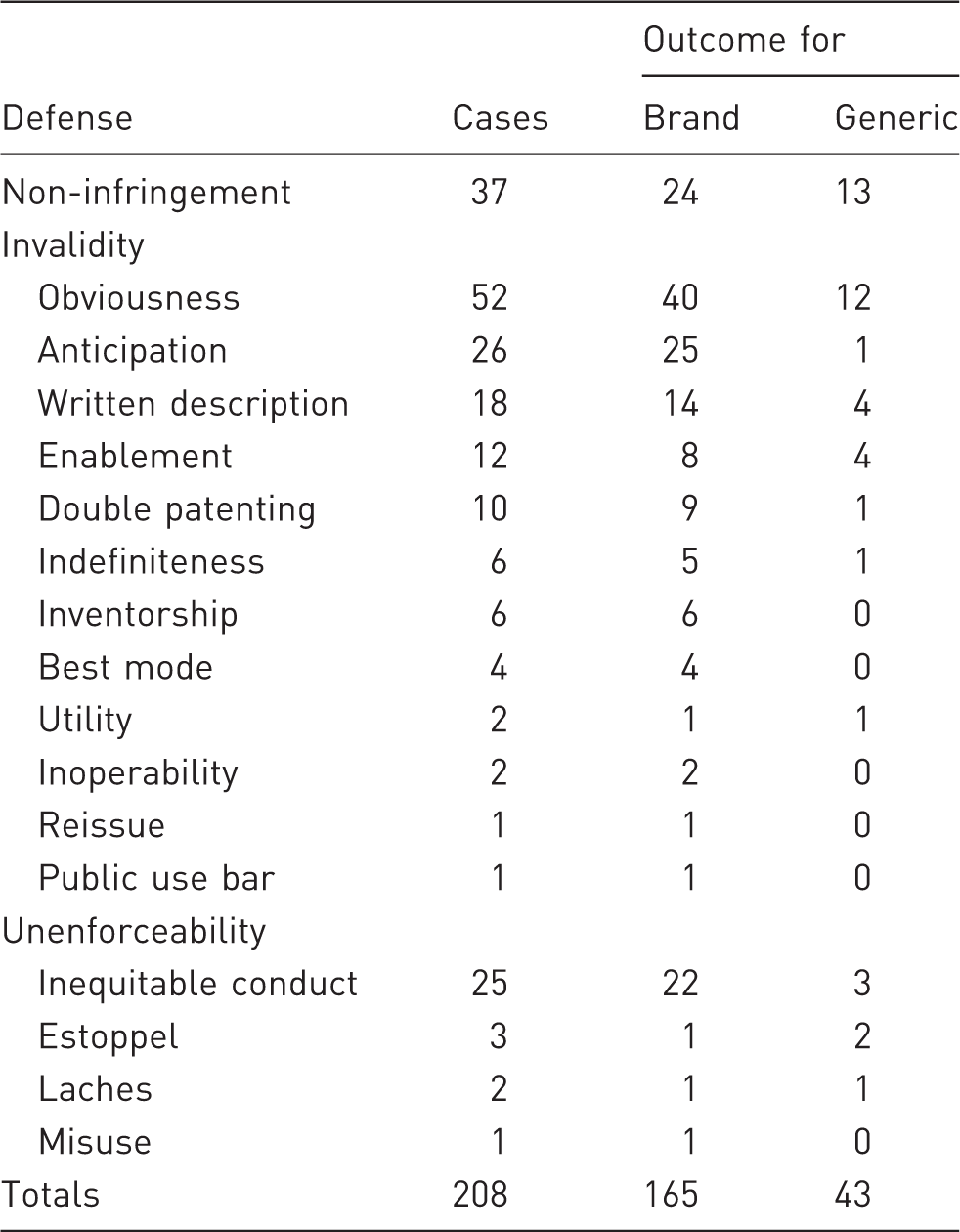
To review the table, it shows that non-infringement was a defense raised in 37 cases (about half of all cases.) We can presume that in the remaining number of cases 31 (68 total cases tried − 37 cases = 31 cases), the parties stipulated to infringement. Of those cases where infringement was an issue, brands won 24 of the defenses and generics won 13 of them. Likewise, in cases where the generic raised obviousness as a defense (52 of 68 cases), the generic company successfully prevailed on the defense 12 times yet failed 40 times.
From the outset, it is important to recognize that every case is different. Each case will have its own set of facts: from the structure of the chemical compound, its development and patent prosecution, and down to the ANDA product. Equally important is how well the facts get discerned through the discovery process—many of the original inventors, if still around, would have to remember facts from decades prior when the brand product was synthesized and developed.
Even with the recognition of the uniqueness of cases and how they are litigated, the table above is quite revealing of two observations. First, during the time frame, generics won about 46% of the cases decided and brands about 54%. So, one would expect, with some variance, that generics might win around 46% of the legal defenses they raise.
However, as the table above reveals, the data do not support this expectation. Of the 208 total defenses raised, generics have prevailed on only 43 of them, or 20% of all defenses. To illustrate, generics raised the anticipation defense in 26 cases and won only one time. For eight other invalidity defenses—double patenting, indefiniteness, inventorship, best mode, utility, inoperability, reissue, and public use bar—raised in 32 cases, generics were successful only three times using those defenses. Between anticipation and these eight others, generics won in only four of those cases with brands prevailing 54 out of the 58 times.
Second, there were 17 different defenses raised (infringement, obviousness, anticipation, etc). Of those, six of them were completely unsuccessful as generics lost every time those defenses were raised over the past 4 years (best mode, inventorship, etc). Of course, this is more than one third of the types of defenses raised.
These observations lead to two conclusions.
The strategy of raising all plausible defenses may not be optimal
While law students are often taught to lead with their best argument, putting forth any defense that has even a slight chance of success can be an appealing strategy to the practitioner. First, in a Paragraph IV case, all the generic defendant needs to do is prevail on one defense. So, it might seem logical to assert any plausible defense in the hopes that one works.
Second, winning a Paragraph IV case can mean hundreds of millions of dollars to the generic company. If the generic company is the first to file a Paragraph IV certification and ends up winning the case (if filed), then it is rewarded with 180 days of market exclusivity. 21 By pricing its product just under the brand product price, it will quickly take market share from the brand and enjoy the benefits of a price point much higher than when the second, third, and more generics reach the market. So, with much to be gained by victory, asserting every plausible defense might seem logical.
Third, there are many dynamics in any case such as how the facts are revealed in discovery, a client’s expectations, lawyer reputation, complex fact patterns and other strategic considerations that may encourage a practitioner to raise every possible defense. There are certainly occasions where even a highly competent patent litigator may not be certain as to which defense might succeed.
However, the data really do not support employing the strategy of raising every plausible defense. Synthesizing these data, in the 31 cases generics won, generics asserted only one defense in eight cases (see Table 3, Appendix 1). 22 These eight cases represent over 25% of the generic victories. Moreover, generics won an additional 14 cases where only one defense prevailed though the generic company raised more than one defense. These 22 cases represent 71% of the cases generics won.
While it is easy to review data in hindsight to identify “what worked,” it nonetheless demonstrates that Paragraph IV cases are usually decided in a generic’s favor on one defense alone. This in turn suggests that a more practical litigation strategy for a generic would be to focus on its best defense, maybe two.
Moreover, there are pitfalls with the raise-all-plausible-defenses strategy that can be quantified. Of the category of defenses—non-infringement, invalidity, and unenforceability—one by far is the most advantageous for the generic in the marketplace: non-infringement. If a generic’s ANDA product is found to be non-infringing, it can gain approval and enter the market.
In the meantime, because the ANDA’s particular formulation was found to be non-infringing, it means that the patents in question are still valid and enforceable to every other ANDA filer/generic company. So, the second generic must either demonstrate that its formulation is likewise non-infringing or that the patents are invalid or unenforceable. Failing this, a subsequent ANDA filer must wait for the patents to expire before entering the market.
This outcome can be extraordinarily beneficial to the non-infringing generic because it means it will be the only generic on the market. One notable case was that of Sporanox®(itraconazole) Capsules. In 2004, Eon Labs (now Sandoz) won its PIV case where the Court found that its product was non-infringing. 23 FDA approved the Sandoz generic product on 28 May 2004. 24 Sandoz was the only unbranded itraconozole product on the market for 8 years as Mylan received the second ANDA approval in July 2012. The peak brand sales for Sporanox was $655 million in 2004, thus providing a substantial revenue stream for Sandoz. 25
On the contrary, if a generic company prevails on an invalidity or unenforceability defense, the market is open for all ANDA filers. After all, if a patent is invalid for one, it is invalid for all.
So, employing all plausible defenses has a strategic pitfall. If a generic company asserts three defenses such as non-infringement, obviousness, and lack of enablement, and wins on all three, the market would be open for all ANDA filers. Clearly, if the ANDA filer asserted only the non-infringement defense, the market outcome would have been dramatically better for the ANDA filer like what happened to Sandoz with itraconazole. Again, while critiquing strategy using hindsight is easy, the point is nonetheless a valid one: throwing in every argument may lose some benefit to the ANDA filer even in victory.
Portfolio selection must also consider likelihood of legal success
The data from the Table 2 of Legal Defenses yield another consideration for portfolio management teams at generic companies. When portfolio managers consider a drug for an ANDA application, they must analyze a variety of factors. Of course, the company will have finite resources in terms of money, people, and time, so managers must choose products carefully to maximize the opportunity a candidate product may provide while also reducing the opportunity cost of foregoing other candidate products in the process.
Portfolio managers must consider several key business elements: (1) potential product sales (what will the brand product sales be and how many prescriptions written at time of generic launch); (2) price erosion curve (how many competitors will be present in the market when their product launches and how many will enter the market afterwards); and (3) portfolio mix (how well does the candidate product work with the other products in the portfolio in terms of manufacturing, distribution channels, marketing and sales).
There are technical and development factors to consider as well. Sourcing active pharmaceutical ingredient, creating bioequivalent formulations, and conducting studies are just a few technical considerations and hurdles to carry before choosing a candidate product and submitting an ANDA.
The last consideration in choosing a candidate drug for an ANDA with a Paragraph IV certification is arguably just as important—the legal analysis. Working with in-house or external patent counsel, the portfolio manager must collect legal data on the Orange Book patents listed on the candidate product in two different respects. First, an attorney must examine the Orange Book patents in terms of infringement vis-à-vis the candidate ANDA product. Here, technical knowledge may play a key role in determining whether the candidate ANDA product infringes a patent, and if not, the strength of the non-infringement argument.
As the data from the research suggest, almost half of the ANDA’s in cases that were tried did not raise the infringement defense. So, the legal analysis that took place strongly suggested that infringement was not defensible. However, of the cases tried, generic companies were successful 35% of the time raising the non-infringement defense (13 out of 37).
If the legal analysis suggests that the non-infringement defense is weak or non-existent, then the attorney must analyze the Orange Book patents relative to possible legal defenses of invalidity and unenforceability that may be available based on prior art (e.g. prior patents, applications, journal articles, scientific knowledge), actions and statements made during the patent prosecution process, and legal precedent.
While an attorney is trained to identify plausible defenses, the attorney often cannot quantify likelihood of success. However, the present research can provide some guidance in this regard which can assist a portfolio manager. For example, if the facts suggest that anticipation is the strongest defense a candidate product may have, the research data reveal that the legal defense has been successful only 1 out of 26 times in the past 4 years when the case was tried. Of course, the team can conclude that the situation is unique and justify moving forward with the candidate product. However, if the data suggest that the likelihood of succeeding on the defense is low, choosing the candidate product may indeed also have a low chance of success in Paragraph IV litigation as well as create an opportunity cost of foregoing another candidate product.
Not only does the research data provide an additional guidepost to enable an attorney and portfolio manager to assess likelihood of success of legal defenses but the data also suggest where legal counsel should focus. For example, the defenses of obviousness, written description, and enablement have a success rate of about 25%. These data suggest that the attorney should focus his or her time on determining whether these defenses are viable and if so, how strong of a case does the anticipated evidence allow. Focusing on the most successful defenses would be time better spent than simply identifying possible defenses, thus reducing time for legal analysis and make the product portfolio selection more efficient.
Conclusion
Without a doubt, Paragraph IV patent cases have increased in number over the past years with much at stake for both brand and generic companies. What is also clear is that more than one-third of the defenses used by generic companies have never been successful over the past 4 years and that generics win only 20% of all defenses raised. These data suggest that generic companies may be more successful in product selection, ANDA filing, and Paragraph IV litigation if they are more discerning with their analysis and selection of legal defenses.
Footnotes
Author biography
1
See 21 U.S.C. 355 et seq (Practitioners in the area will also refer to these sections as Section 505, referring to the enumeration of The Federal Food, Drug, and Cosmetic Act) and 21 C.F.R. 314.50 et seq.
2
The Orange Book is formally known as Approved Drug Products with Therapeutic Equivalence Evaluations. It can be found at FDA.gov.
3
See 21 U.S.C. 355(j) et seq and 21 C.F.R. 314.92 et seq.
4
21 U.S.C. 355(j)(2)(A)(vii).
5
In addition, an ANDA applicant can also submit a “Section viii” statement instead of a patent certification. A Section viii statement can be used for certain types of use patents that cover indications in the drug label. The Section viii statement allows a generic to “carve out” an indication in its label which indication is patent protected. However, the Section viii statement is not relevant to this discussion. 21 U.S.C. 355(j)(2)(A)(viii).
6
21 U.S.C. 355(j)(5)(A).
7
Accepting the ANDA is a preliminary review and usually takes about two months. Final product approval will be done much later (often years later).
8
35 U.S.C. 271(e)(2)(a).
9
Technically, as patent infringement has taken place, the brand company can sue at anytime, but the statute provides a benefit to the brand if it sues the ANDA filer within 45 days of receiving the notice. If timely filed, the statute prevents the FDA from approving the ANDA (and thus keeping the generic product off the market) for 30 months (or sooner only if the generic wins the district court case before 30 months has expired.) 21 U.S.C. 355(j)(5)(A). There are occasions when the brand company will sue beyond 45 days or not sue at all.
10
The inclusion criteria start date begins on 1 November 2003 with every active product. “Active” product means that there was a pending Paragraph IV case on that day and the product was not offered in generic form in the U.S. As such, there are many cases filed in 2000–2002 that are included in the research as these cases were pending on November 1, 2003.
11
While an overwhelming majority of cases litigate solely over patents listed in the Orange Book, there are a few cases where the brand company plaintiff includes a patent that is not listed in the Orange Book such as a process patent. These non-Orange Book patents are included in the database as well.
12
The U.S. Court of Appeals for the Federal Circuit in Washington, DC is a specialty court of appeals that has exclusive appellate jurisdiction over Paragraph IV cases. Just about every case adjudicated in a district court is appealed. There has been one recent case that was adjudicated in the U.S. Supreme Court on a peripheral issue and another on the current Supreme Court docket regarding settlements of these cases.
13
The data on the graph represent 1633 cases filed. The graph does not include the duplicate cases filed or other actions filed simply for procedural reasons such as an inter-jurisdictional case transfer which brings the total number of Paragraph IV cases to about 1800.
14
A technical note is instructive. As mentioned above, the filing of the ANDA is deemed an act of infringement. From this, the ANDA filer can raise an affirmative defense of non-infringement. At this point, courts usually place the burden of proving infringement on the Brand Company/Inventor/Plaintiff which, of course, can be refuted by the evidence the ANDA filer defendant presents. See, for example, Alza v. Mylan, Court of Appeals for the Federal Circuit, #06-1019 (decided 6 September 2006).
15
The legal defenses are imbedded within Title 35 (Part II) of the U.S. Code, primarily sections 101, 102, and 103. For example, if an invention must be “new and useful” and “non-obvious” to be patented, one can show that the patent was obvious or lacked utility. Sometimes through an inverse reading of the statute, courts have recognized several defenses.
16
On 16 September 2011, the Leahy-Smith America Invents Act (“AIA”) was enacted into law (Public Law 112-29). The AIA amended 35 USC § 282 and no longer allows a defendant to invalidate a patent using the “best mode” defense. Of course, as this defense was valid during the study period, it is mentioned throughout this paper.
17
Over the past decade, the inequitable conduct defense has evolved in its standards of proof. Concluding that courts had made the standards of proof too low to establish the defense, the Court of Appeals for the Federal Circuit established a “specific intent” proof standard in Therasense, Inc. v. Becton, Dickinson, and Company, Court of Appeals for the Federal Circuit, 08-1511 decided 25 May 2011 (page 24) (also referenced as 649 F.3d 1276 (Fed. Cir. 2011)). Of course, as the new standard was established in May 2011, the study period covered cases using the older, lower standards. For prior discussions on equitable defenses, see for example
18
In addition, for purposes of counting cases, each lead case is counted as the single case. For example, say the brand company filed three Paragraph IV cases in one jurisdiction, and the lead case was adjudicated. Though the decision might be recorded as a final judgment in the later cases, it would count as one. If a brand company filed two cases in two jurisdictions, both court decisions would be counted. So, in effect, a “case outcome” means a single judicial decision and is only counted once.
19
The alternative method of counting was not used. In the illustration, arguably, one could count them as three ANDA defendants times three defenses raised times two patents yields a count of 18 defenses raised. That is, each defendant is raising three defenses against each of the two patents. This method would really not enable further insight.
20
Of course, the district court is not the final court to consider the legal issues as the cases typically move up to the Court of Appeals for the Federal Circuit. For this research, the Court of Appeals results were not included for two reasons. First, of the 68 cases completed at the district court, about 27 of them are still pending at the Court of Appeals. Second, the Court of Appeals affirms 75% of Paragraph IV cases, thus not changing the result. Of the 25% to be reversed or reconsidered, there is no discernable correlation as to which side wins (e.g. brands and generics win about half of the appeals reversed) so the results really do not change significantly.
21
21 U.S.C. 355(j)(5)(A)(iv).
22
Ironically, the only time the anticipation defense worked out of 26 tries was the time it was used as the primary defense with obviousness as a subset argument.
23
Janssen Pharmaceuticals v. Eon Labs, New York Eastern District Court 1:2001cv02322 as affirmed on appeal at the U.S. Court of Appeals for the Federal Circuit, 04-1539.
24
See Drugs@fda (itraconazole entry) at FDA.gov.
25
Sporanox sales data from Steven Niles, “Company of the Year: Johnson & Johnson,” Med Ad News, September 2005.