






Abstract
US Legal and Regulatory Update
Compiled and written by Greenblum & Bernstein PLC
A US intellectual property law firm which provides a full range of services in IP-related matters across all industries, including the biotech and pharmaceutical industries, including:
Inter partes Review (IPR) and Post Grant Review (PGR)
Abbreviated new drug applications (ANDAs) and Notice Letters
Patent and trademark litigation
Patent drafting and prosecution
Patent infringement and validity opinions
Patent reexamination proceedings and interferences
New drug strategies
Market entry strategies
Joint venture strategies
and Licensing
This section is intended to be a synopsis of recent developments and is not intended to be exhaustive. If any issue is referred to in this section is to be relied upon, specific advice should be sought. Please contact the Editor:
Paul A Braier
Greenblum & Bernstein, P.L.C.
1950 Roland Clarke Place
Reston, VA 20191
USA
Tel: +1 703 716 1191
Fax: +1 703 716 1180
Email:
8399514 Update: IPRs Involving Biotech and Pharmaceutical Patents
Partner, Greenblum & Bernstein, P.L.C.
Since the provisions of the America Invents Act (AIA) providing for inter partes review (IPR) and post grant review (PGR) proceedings became effective on 12 September 2012, the number of AIA petitions filed against Bio/Pharma patents (technology center 1600) has been steadily increasing. This article presents statistics about such proceedings and provides an update concerning the multiple IPR proceedings initiated by the Coalition for Affordable Drugs.
IPR statistics related to bio/pharma patents
From 12 September 2012 through fiscal year 2013 (ending 30 September 2016), 45 petitions related to Bio/Pharma patents were filed at the Patent Trial and Appeals Board (PTAB). In fiscal year 2014, the number of petitions filed relating to Bio/Pharma patents increased to 92, which accounted for ∼6% of the total number of petitions filed that year (92/1489). Of those 92 petitions, one petition was for a PGR. 1 The following year (fiscal year 2015), 167 petitions challenging Bio/Pharma patents were filed, which accounted for ∼9% of the total number of petitions filed that year (167/1897). Of those 167 petitions, again only one PGR petition was filed.
In fiscal year 2016 (through 30 September 2016), a total of 1683 petitions were filed, 212 of which challenged Bio/Pharma patents. This accounted for ∼13% of the total number of petitions filed that year. The number of PGR petitions filed increased to 6. Data regarding the petitions filed fiscal years 2014–2016 are available from the USPTO’s web page (reproduced below).
Data current as of: 9/30/2016 Source: USPTO, Patent Trial and Appeal Board Statistics.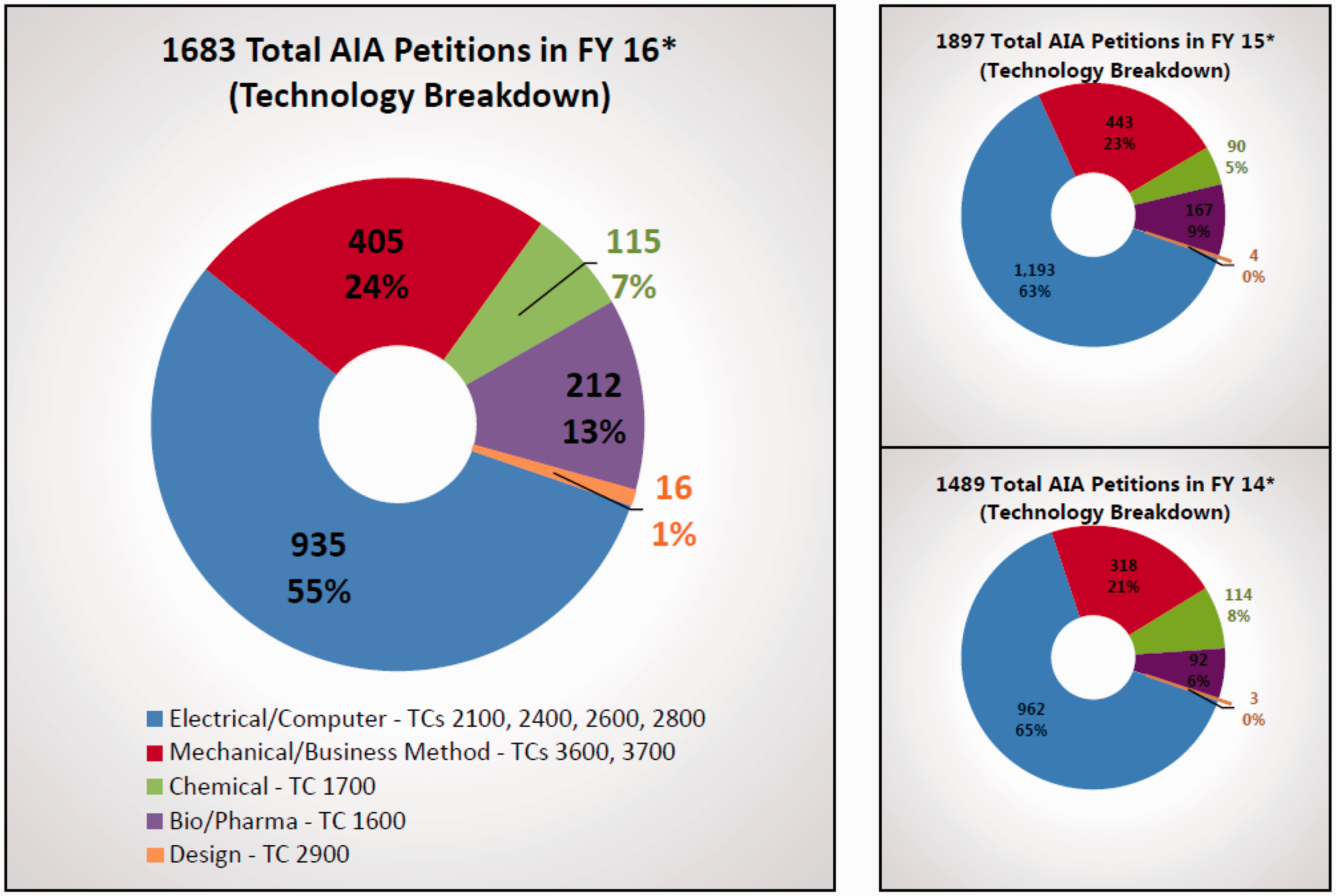
In fiscal year 2016, the institution rate of AIA proceedings challenging Bio/Pharma patents was approximately 61%. For those instituted proceedings which went through trial (did not settle or otherwise were dismissed), the PTAB found 40% of the claims unpatentable and 32% of the claims patentable. Additionally, 8% of the claims were either cancelled or disclaimed by the patent owner. As to the other 20% of the claims, the trial was either dismissed or settled prior to a Final Written Decision.
Although the number of IPR and PGR petitions filed and the number of proceedings instituted each year has been increasing, a recent change in the procedural rules governing IPR proceedings may strengthen the patent owner’s ability to rebut the invalidity assertions raised in an IPR petition. As of 2 May 2016, a patent owner is permitted to submit expert testimony in support of a preliminary response in an IPR. The new rules further provide that genuine issues of material fact raised by the patent owner’s expert testimony are to be viewed in the light most favorable to the petitioner when determining whether to institute the proceeding. Under the new rule, if genuine issues of material fact need to be resolved, the PTAB has discretion to allow limited discovery and a petitioner’s reply prior to institution. Expert testimony submitted in support of a preliminary response in biotech/pharma cases may be effective to rebut unpatentability assertions based on obviousness, especially where the specific art is unpredictable. It is too early to tell the impact of this rule change, but it would not be surprising if the institution rate of IPR and PGR proceeding relating to Bio/Pharma patents decreases in the future as patent owners submit expert testimony in support of their preliminary responses.
The coalition for affordable drugs
The Coalition for Affordable Drugs (CFAD) is a company formed by J Kyle Bass and Erich Spangenberg which has challenged the validity of many pharmaceutical patents by filing IPR petitions. As of 31 October 2016, CFAD and Kyle Bass have filed a total of 33 IPR petitions. The challenged patents cover an assortment of drugs. The table below identifies the IPR case number, the challenged patent (patent number and title), the patent owner, the product, the date the petition was filed, and the status:
Of the 33 IPR petitions filed, 15 of the IPRs were terminated and 18 have been instituted. Of the 18 instituted proceedings, 7 have been completed. A Final Written Decision in each of the seven IPR proceedings was issued by the PTAB in October 2016. The results of the seen completed IPR proceedings are as follows:
In IPR2015-00988 filed by CFAD, the PTAB instituted IPR review of claims 1–4 of U.S. Patent No. 6,773,720 based on a single ground of obviousness under 35 U.S.C. § 103(a). After all papers had been submitted and an oral hearing, the PTAB issued its Final Written Decision on 5 October 2016 in which it held that the Petitioner has not shown by a preponderance of the evidence that claims 1–4 of the patent are unpatentable. This is the first Final Written Decision issued in an IPR proceeding brought by CFAD and is instructive because it highlights the importance of establishing a motivation to combine the teachings of the prior art to render claims obvious.
In IPR2015-00990 filed by CFAD, the PTAB instituted IPR review of claims 46−52 and 61−75 of U.S. Patent No. 7,056,886 (the ‘886 patent) based on four grounds of obviousness under 35 U.S.C. § 103(a). In its Final Written Decision issued on 21 October 2016, the PTAB concluded that the Petitioner had shown by a preponderance of the evidence that claims 46−52 and 61−75 of the ‘886 patent were unpatentable.
In IPR2015-01093, CFAD again challenged claim of the ‘886 patent. The PTAB instituted IPR review of claims 1−27, 31−40, and 44−45 based on four grounds of obviousness under 35 U.S.C. § 103(a). In its Final Written Decision issued on 21 October 2016, the PTAB concluded that the Petitioner had shown by a preponderance of the evidence that claims 1−27, 31−40, and 44−45 of the ‘886 patent were unpatentable.
In IPR2015-01092 filed by CFAD, the PTAB instituted IPR review of claims 1–10 of U.S. Patent No. 6,045,501. Trial was instituted on a single ground of obviousness 35 U.S.C. § 103(a). In its Final Written Decision issued on 26 October 2016, the PTAB concluded that the Petitioner had shown by a preponderance of the evidence that claims 1–10 were unpatentable under 35 U.S.C. § 103.
In IPR2015-01096 filed by CFAD, the PTAB instituted IPR review of claims 1–32 of U.S. Patent No. 6,315,720. Trial was instituted on a single ground of obviousness 35 U.S.C. § 103(a). In its Final Written Decision issued on 26 October 2016, the PTAB concluded that the Petitioner had shown by a preponderance of the evidence that claims 1–32 were unpatentable under 35 U.S.C. § 103. Additionally, the claims of the ‘720 patent were challenged in two related IPR proceedings filed by CFAD, IPR2015-01102 and IPR2015-01103. In both IPR2015-01102 and IPR2015-01103, claims 1–32 of U.S. Patent No. 6,315,720 were challenged and trial was instituted on a single ground of obviousness 35 U.S.C. § 103(a), albeit differ grounds in each of the three IPR proceedings. As in IPR2015-01096, the PTAB in both IPR2015-01102 and IPR2015-01103 concluded that the Petitioner had shown by a preponderance of the evidence that claims 1–32 were unpatentable under 35 U.S.C. § 103. Decisions dated 26 October 2016.
Of the 34 IPR petitions filed by CFAD and J Kyle Bass, 19 have been instituted, corresponding to a ∼56% institution rate. Of those instituted proceedings, seven IPR proceedings so far have proceeded through trial and Final Written Decision have been entered. Of those seven completed proceedings, CFAD established unpatentablility of the challenged claims in six of the proceedings. Accordingly, where trial has been instituted, CFAD has enjoyed a success rate of ∼86%. Because all of these Final Written Decisions were entered in October 2016, it will be a while until the appeals to the Federal Circuit are completed.

TNF: tumor necrosis factor. Data current as of 31 October 2016.