







Abstract
The Japanese pharmaceutical market is known for having a relatively low market penetration of generic medicines. However, the velocity of generic penetration varies among medicines. Looking at current sales and share of off-patent branded medicines and generic medicines in Japanese pharmaceutical market, our main aim is to identify the factors associated with sales reductions of off-patent medicines and price competition caused by generic entry in the Japanese pharmaceutical market. We showed as one result that an increase in the number of generic maker entries significantly increases both price competition and sales reductions of off-patent branded medicines. As a second factor of note, we found that being subject to “NHI Drug Price Premium for Promoting the Creation of New Drugs and the Elimination of Off-label Use” before generic entry is related to maintaining sales of off-patent branded medicines after generic entry. The importance of generic medicines is increasing in association with the hypertrophy of health care expenditures in Japan. Efficient polices and corporate strategies reflecting market principles are strongly needed. Detailed results of this study on what determines whether sales and prices of off-patent medicines significantly decrease after generic entry in the Japanese pharmaceutical market should be useful for this purpose.
Keywords
Introduction
Everywhere in the world, the price of a generic medicine is typically lower than that of the original off-patent medicine. Therefore, the need for generic medicines is rising in association with the hypertrophy of health care expenditures in many countries. However, the Japanese pharmaceutical market is known for having a relatively low market penetration of generic medicines.1,2 Therefore, sales of off-patent medicines have a considerable impact on the revenue of pharmaceutical companies operating in Japan. Furthermore, the Japanese pharmaceutical market, which was the third largest in the world in 2015, is known for strong government intervention.3,4 Therefore, we consider that understanding the market principles of the impact of generics in the Japanese pharmaceutical market is beneficial not only for Japanese companies and the government but also for the global pharmaceutical companies doing business in Japan. Several studies have clarified the market principles involved in the entry and survival of generics for a market. The main such studies are classified into three categories: generic entry, quantitative share, and price competition. For several countries, the determinants of generic entry have been shown to be mainly related to differences in market potentials and the properties of the targeted diseases.5,6 For the Japanese pharmaceutical market, Iizuka identified the factors associated with generic entry by using micro prescription data of generic medicines launched during 2004–2006, specifically the following: market size, ATC classification, and differences of sales amount between categories of medical institution such as hospitals, clinics, and pharmacies. 3 For Japan, quantitative market share has been shown to be mainly related to patient attributes and the price difference between the off-patent medicine and the generic versions. 7 Several policies have recently been enacted to promote the use of generic medicines in Japan. For instance, the government grants an additional medical fee if the generics share within an institution is sufficiently large. Price competition has been shown to be mainly related to the specific competitors and policies of the country.8–10 Generic entry causes an increase in the price of off-patent medicines in the USA.11,12 It means that off-patent medicines do not enter into price competition. However, it has been unclear whether or not off-patent medicines enter into price competition in Japan. The mechanism of price competition is quite different in Japan. Drug prices in the USA are determined mainly by the pharmaceutical companies, whereas they are set mainly by the government in Japan. Furthermore, in Japan, pharmaceutical wholesalers are free to negotiate delivery prices under the official drug price with medical institutions. Therefore, price competition occurs only in the negotiation between pharmaceutical wholesalers and medical institution in Japan, which is a completely different mechanism than in other countries.
Even though previous studies identified several generic market principles, continuous study of the generic market is needed because the environment surrounding the off-patent pharmaceutical market has been changing drastically year to year.13–15 Furthermore, the impact of generic entry on the off-patent branded medicine is as yet relatively unexplored. It has been reported that the sales of original medicines significantly decrease with generic entry in the USA, but not in Japan, the UK, or Germany. 16 Hudson also found that the speed with which the original brand loses revenue is directly proportional to both the size of the market and the price of the original brand prior to generic entry. 16 However, the effects of the number of the generic entries and the medical properties on sales reduction and price competition remain unclear. Specifically, it is unclear what determines whether sales and prices of off-patent medicines significantly decrease after generic entry.
For this study, we calculated the current shares of off-patent branded medicines in the Japanese pharmaceutical market among the top 500 in sales for 2015. Then the generic entry mechanism was analyzed by using relatively recent (2010–2014) generic entry data, and the impact of generic entry on sales reductions of off-patent branded medicines and price competition in the Japanese pharmaceutical market were investigated. As mentioned above, official drug prices are determined by the government in Japan, whereas delivery prices under the official drug price are freely determined between pharmaceutical wholesalers and medical institutions. Therefore, we use the price divergence between the official price and the delivery price as an indicator of the degree of price competition. Additionally, we also investigated the share of off-patent branded medicines versus generic medicines five years after the first generic entry.
Methods
Data
Annual sales of medicines are obtained from QuintilesIMS (IMS-Base JPM). 4 The use of IMS data is common in many studies of the pharmaceutical market. Data of each drug include, for example, the administration path and timing of the generic entry, from the Japanese Central Social Insurance Medical Council. 17 We also used the Anatomical Therapeutic Chemical (ATC) classification system, a pharmaceutical coding system operated by the World Health Organization. 18 Only the first level of the ATC code was used in the present study. This level indicates the main anatomical group and consists of one letter, as follows: “A,” alimentary tract and metabolism; “B,” blood and blood-forming organs; “C,” cardiovascular system; “D,” dermatologicals; “G,” genitourinary system and sex hormones; “H,” systemic hormonal preparations, excluding sex hormones and insulins; “J,” anti-infectives for systemic use; “K,” hospital solutions; “L,” antineoplastic and immune-modulating agents; “M,” musculoskeletal system; “N,” nervous system; “P,” parasitology; “R,” respiratory system; “S,” sensory organs; “T,” diagnostic agents; and “V,” various.
In this study, we conducted four statistical analyses: generic entry determinants, sales after generic entry, price competition after generic entry, and share versus generics five years after generic entry. For the analysis of generic entry determinants, off-patent medicines whose generic versions first launched between 2010 and 2014 are targeted (n = 83). Within these 83 medicines, those whose annual sales are ranked among the top 500 at least once from 2010 to 2014 are selected (n = 47) in order to determine what factors are associated with the sales decrease rate of off-patent branded medicines. In order to analyze reductions in the price divergence rate, off-patent medicines whose generic version first launched between 2010 and 2013 are targeted (n = 75). All off-patent medicines for which generic versions remained on the market for more than five years since the first launch of a generic version were targeted (n = 404) for the analysis to identify which factors are associated with the share of off-patent branded medicines versus their generic versions five years after the first generic entry.
Measures
Analysis of generic entry determinants
A linear regression analysis was conducted to identify the factors associated with the number of generic entries. The explanatory variables were selected on the basis of the conceptual model: Market size, 2015; top-sales rank, 0–50 = 10, 51–100 = 9, 451–500 = 1, and 500 and over = 0; ATC classification (dummy variable); Authorized Generic Medicine (dummy variable) and three administrating-path dummy variables, Injection Medicine, Internal Medicine, and External Medicine.
Analysis of sales after generic entry
A linear regression analysis was conducted to identify the factors associated with sales decreases in off-patent medicines after generic entry. The independent variable was the sales decrease rate, which was defined as the sum of monthly sales from month 7 to month 12 divided by the sum of monthly sales from month −12 to month −7, where month 0 is the month of the first generic entry. The explanatory variables were selected on the basis of the conceptual model: Number of generic makers at the first launch of generic medicines (First entry of GE makers), Increase in the number of generic makers at the first drug price revision after the first launch of a generic medicine (Additional entry of GE makers), Reduction of “NHI Drug Price Premium for Promoting the Creation of New Drugs and the Elimination of Off-label Use” (Reduction of Promoting Premium) (dummy variable), ATC classification (dummy variable), Authorized generic medicine (dummy variable), Injection Medicine, Internal Medicine, and External Medicine (dummy variable). The “NHI Drug Price Premium for Promoting the Creation of New Drugs and the Elimination of Off-label Use” is a price addition within the Japanese NHI drug pricing system.19–21 This price addition is targeted at medicines whose price divergence rates (ratio of delivery price to official price) are lower than average (across all medicines). The medicines for which such a price addition are received are targeted for a special price reduction by the government in the drug price revision after the first generic medicine enters the market. Therefore, the reduction of “NHI Drug Price Premium for Promoting the Creation of New Drugs and the Elimination of Off-label Use” is an indicator of a low price divergence rate before the generic entry.
Analysis of price after generic entry
Price divergences rates are estimated from the drug price revision rate (ratio of revised price to prior price in the drug price revision). A linear regression analysis was conducted to identify the factors associated with the reduction in the price divergence rate. The independent variable was the reduction of the price divergence rate calculated according to the following formula: (price divergence rate in the second drug price revision following the first generic entry) − (price divergence rate in the drug price revision immediately before the first generic entry).
We used the second drug price revision after the first generic entry because the first drug price revision includes a special price reduction, which makes it impossible to calculate the price divergence rate at that time. The same explanatory variables as in the analysis of the sales decrease rate were selected. The price divergence rate in the drug price revision immediately before the first generic entry (Price divergence rate before GE launch) was added to the explanatory variables. The data on delivery price were not available, but the drug price revision was based on the price divergence rate, and therefore the price divergence rate can be estimated from the price reduction rate in the drug price revision.
Analysis of share versus generics 5 years after generic entry
An ordered logit analysis was conducted to identify the factors associated with the share of an off-patent branded medicine versus the share of generics five years after the first generic entry. The independent variable is a categorical indicator of the Z2 price reduction policy: 2.0% (share of generics is under 30%, n = 118), 1.75% (share of generics is under 50%, n = 128), 1.5% (share of generics is under 70%, n = 64), and 0% (other, n = 94) price reductions are categorized as 4, 3, 2, and 1, respectively. The explanatory variables were selected on the basis of the conceptual model: Number of generic makers, ATC classification (dummy variable), and administrating path of the medicine (dummy variable). The Z2 policy is introduced to facilitate usage of generic medicines and to reduce national health care expenditures on off-patent branded medicines in Japan. This policy targets medicines for which generic medicines have been available on the market for more than five years and reduces the price of an off-patent medicine according to the share of the generic medicines. Therefore, these price reductions can be used to estimate the share of each off-patent branded medicine (versus the generic medicines).
Statistical analysis
A chi-square test was conducted to examine the distribution of off-patent branded medicines among the top 500 sales in the Japanese pharmaceutical market in 2015. We include explanatory variables based on p-value < 0.05 for all linear regression analyses. Explanatory variables used in the ordered logit model are included based on p-value < 0.10. These statistical analyses were performed with IBM SPSS Statistics for Windows version 23.0.
Results
Current distribution of generic and on- and off-patent branded medicines in the Japanese pharmaceutical market in the top 500 sales in 2015
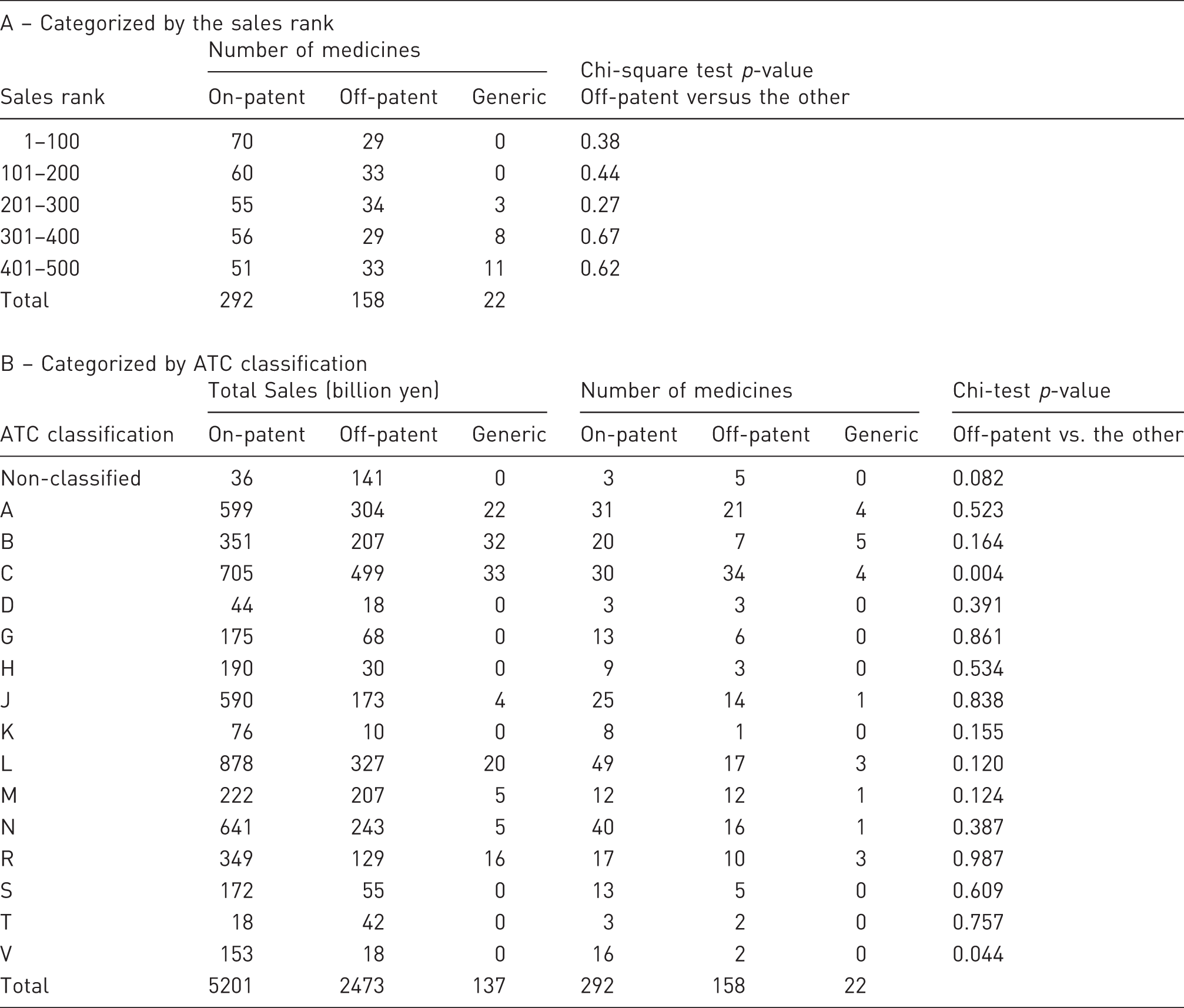
Note: Chi-square test is conducted for the number of off-patent branded medicines. Only NHI-listed medicines are included in the top 500 sales. Total sales are annual sales of drugs by ATC classification.
Multi-linear regression analysis of the factors associated with the number of generic entries
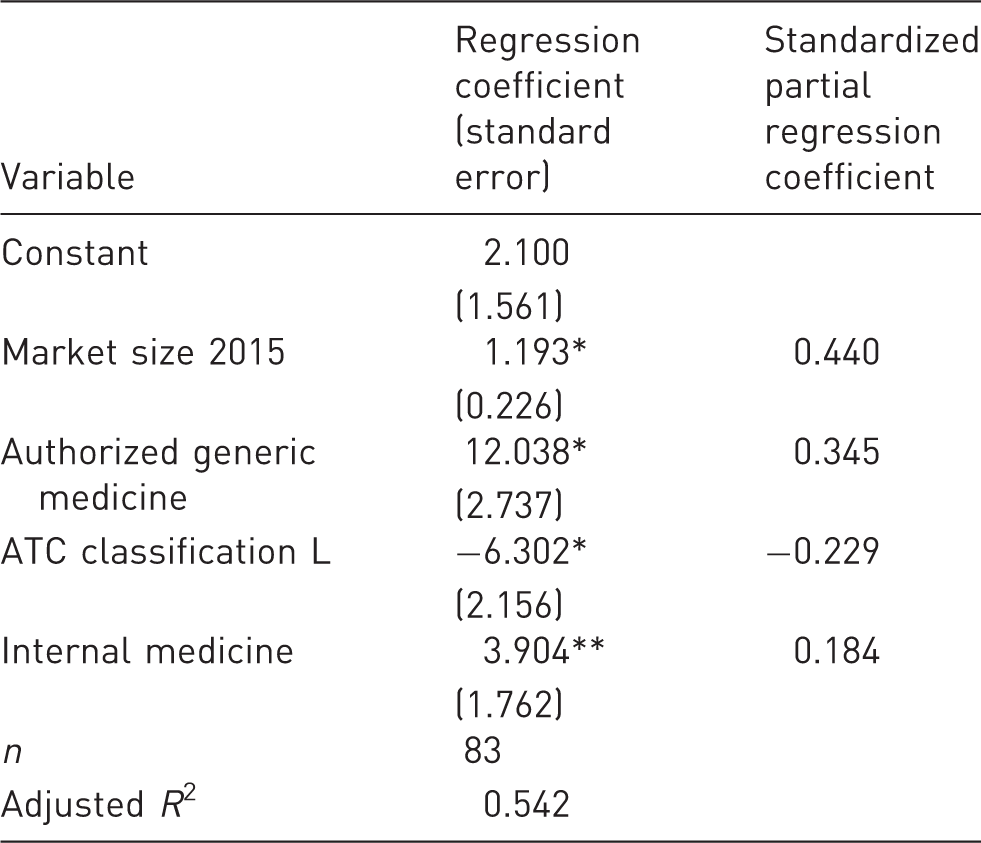
p < 0.01.
p < 0.05.
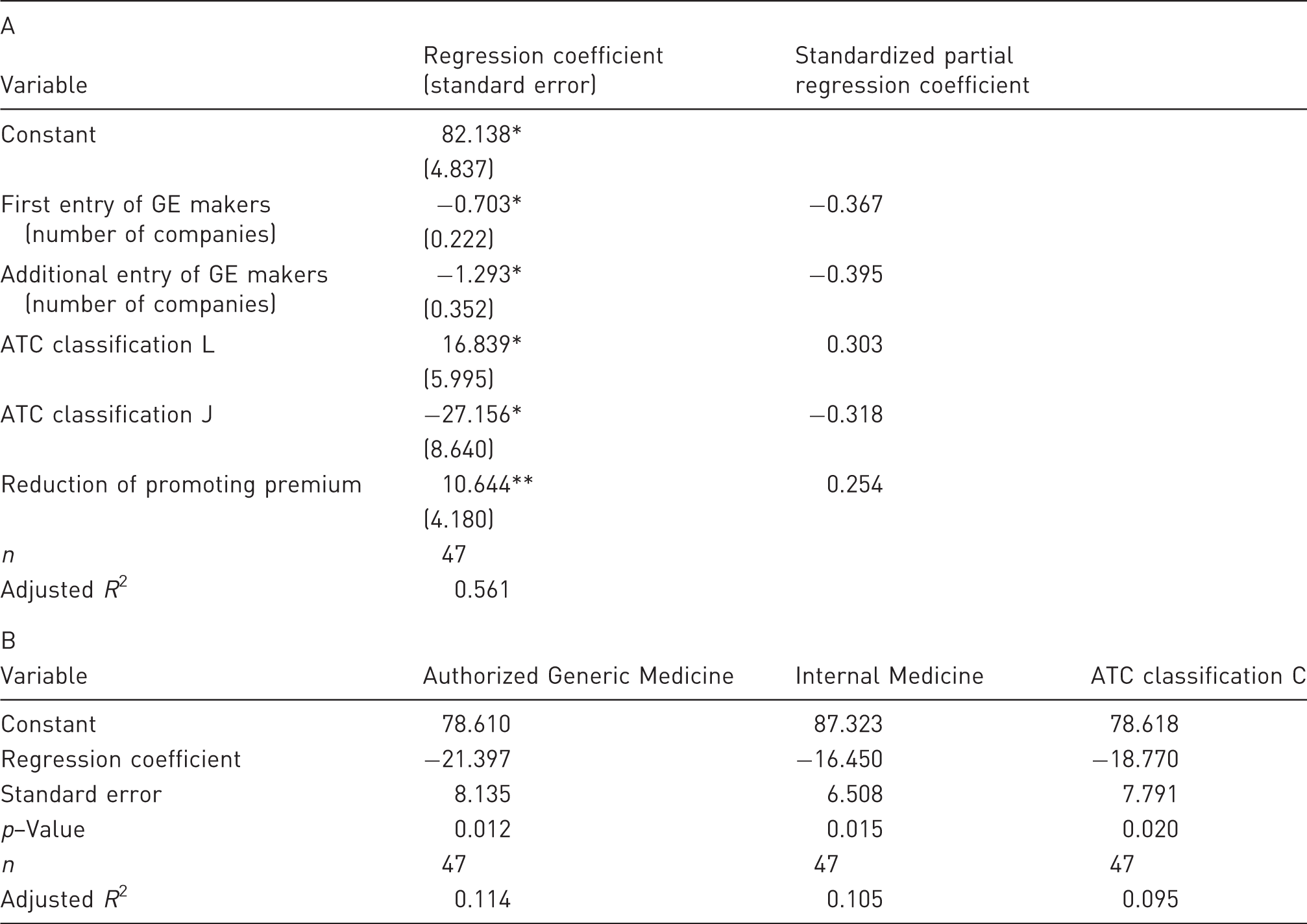
The sales trends of off-patent medicines before and after the first generic entry are shown in Figure 1. Monthly sales of off-patent branded medicines are shown as two line graphs: high-competition market (number of generic makers is 10 or more) and low-competition market (number of generic makers is under 10). The factors associated with the sales’ decrease rates of off-patent medicines are analyzed and the results are shown in Table 3. The results of our multi-linear regression analysis are as follows: generic medicine makers at the first launch of generic medicines (first entry of GE makers), increase in the number of generic makers at the first drug price revision after the first launch of a generic medicine (additional entry of GE makers), and ATC classification J (anti-infectives for systemic use) showed statistically significant negative correlation with maintenance of sales of off-patent branded medicines. On the other hand, Reduction of Promoting premium, and ATC classification L (antineoplastic and immune-modulating agents) showed statistically significant positive correlation with the maintenance of sales of off-patent branded medicines. Furthermore, Authorized Generic Medicine, Internal medicine, and ATC classification C (cardiovascular system) showed statistically significant negative correlation with the maintenance of sales of off-patent branded medicines only in simple linear regression analyses.
Monthly sales trends of off-patent branded medicines before and after the first generic entry. Error bars indicate standard error. Linear regression analysis of the factors associated with the sales decrease rates of off-patent branded medicines Note: Multi-linear regression analysis is shown in A. Simple linear regression analyses are also shown in B. for the variables which do not show statistical significance in the multi-linear regression analysis. p < 0.01. p < 0.05.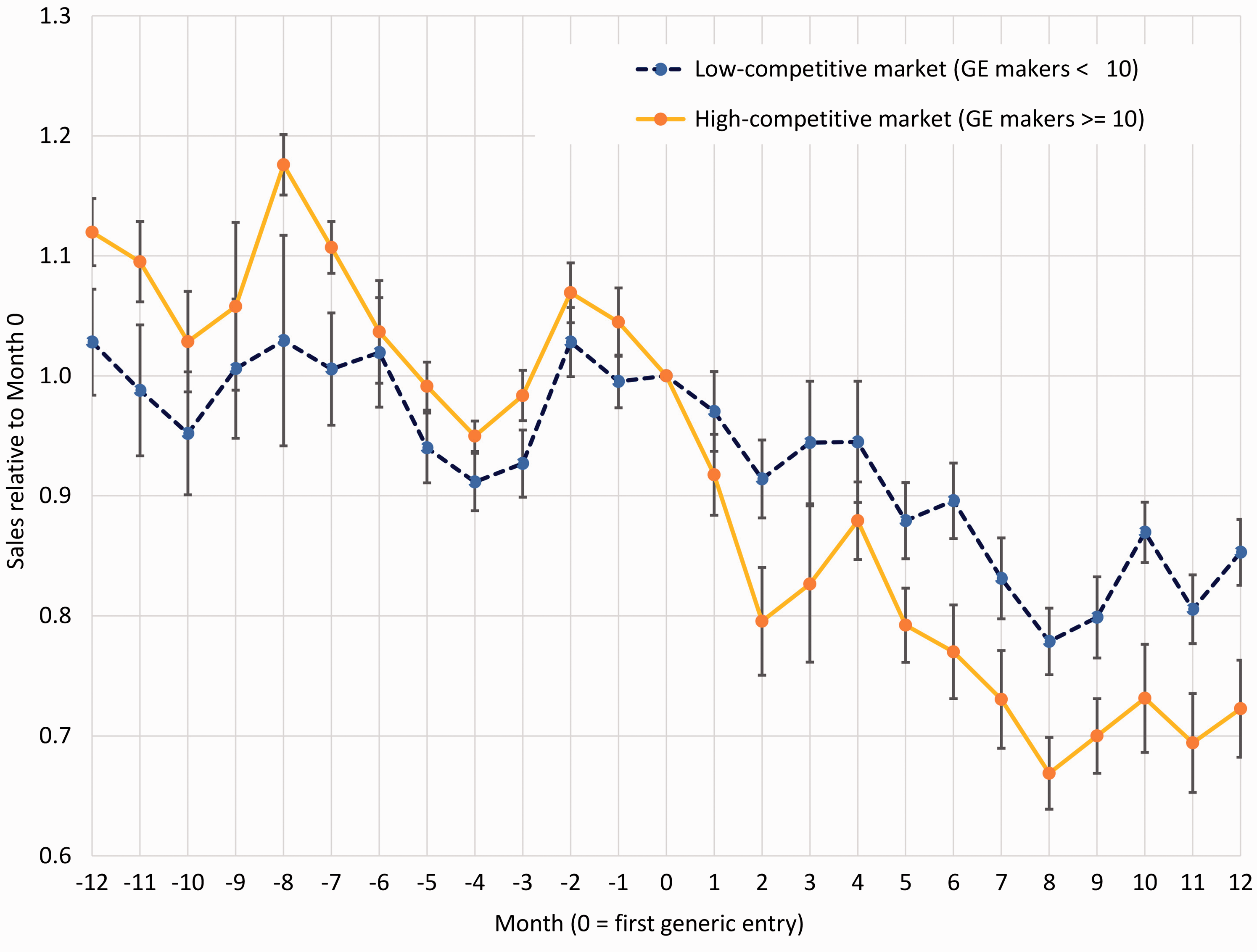
Multi-linear regression analysis of the factors associated with the reduction in the price divergence rate
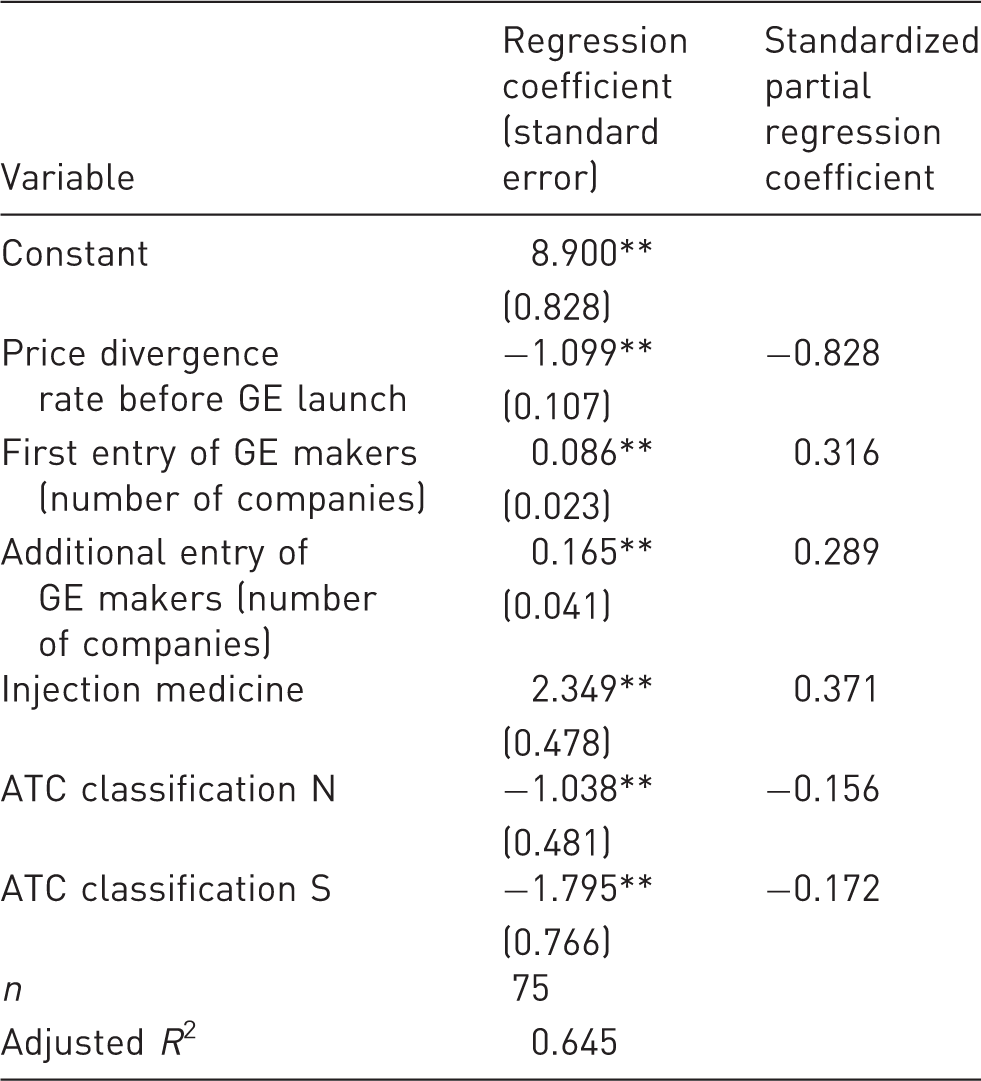
p < 0.01.
Ordered logit analysis of the factors associated with share of an off-patent branded medicine 5 years after first generic entry
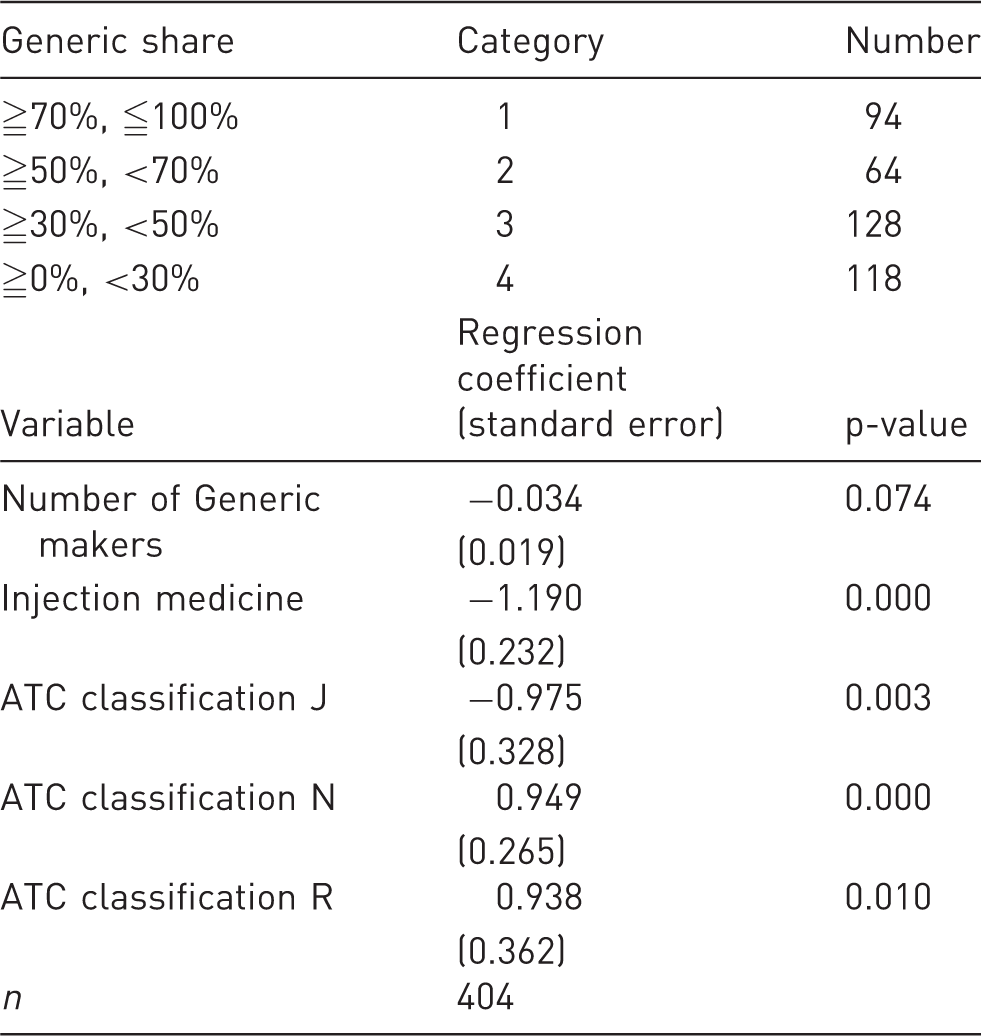
Note: The independent variable is a categorical variable of Z2 price reduction policy: 2.0% (share of generics <30%, n = 118), 1.75% (share of generics <50%, n = 128), 1.5% (share of generics <70%, n = 64), and 0% (others, n = 94) price reductions are categorized as 4, 3, 2, and 1, respectively.
Discussion
The Japanese pharmaceutical market is known for having a relatively low market penetration of generic medicines. We showed that the share of off-patent branded medicines in the Japanese pharmaceutical market among the top 500 sales medicines was about 30% in 2015. Because there have been dramatic changes surrounding the generic pharmaceutical market, we investigated the factors associated with the number of generic entries. Market size and ATC classification L showed significant correlation with generic entry in our analysis of the generic medicines that first appeared between 2010 and 2014, supporting Iizuka’s findings. In addition, we revealed that Authorized Generic Medicine also showed significant correlation with generic entry. Authorized Generic Medicine means that the generic medicine is produced with the permission of the off-patent branded medicine maker. There are few authorized medicines in Japan currently. Our results indicated that such a strategy is taken in competitive markets including many generic medicines. We demonstrated that sales of most off-patent branded medicines are not dramatically depressed by the launch of generic versions, and a few medicines see no change in sales in the Japanese pharmaceutical market. Therefore, we examined the sales trends before and after the first generic entry and analyzed what factors of the off-patent branded medicines are associated with sales trends after generic entry. Our analyses showed that the number of generic makers was significantly correlated with sales reductions of off-patent branded medicines. A greater number of generic makers increase the promotion of generic medicines and facilitate price competition in the setting of delivery prices, thereby reducing sales of off-patent branded medicines. Reduction of Promoting Premium was also significantly correlated with sales reductions of off-patent branded medicines. Reduction of Promoting Premium indicates that the price divergence rate is lower than the average rate of drugs before the first launch of their generic versions. It has been reported that a low price divergence rate is strongly correlated with high competitiveness in the market. 22 Therefore, the drugs which are highly competitive with other original medicines maintain their sales relatively well even after the launch of generic versions. With regards to our investigation of the impact of the launch of generic medicines on price competition with the corresponding off-patent branded medicines, as stated previously, since official drug prices are set by the government in Japan whereas lower delivery prices are freely determined between pharmaceutical wholesalers and medical institutions, the entry of generic medicines is likely to increase the delivery price reduction of off-patent branded medicines. This hypothesis was supported by the results of our analyses. Specifically, we could show that an increase in the number of generic makers is significantly correlated with the reduction of the price divergence rates of off-patent branded medicines. Both sales reduction and delivery price reduction of off-patent branded medicine are strongly correlated with the number of generic medicine makers. Looking at the shares of the generic medicines five years after first generic entry for the off-patent branded medicine, we found that a larger number of generic makers tended to be associated with a larger share of the generic medicines. About 60% of generic medicines that have been on the market for more than five years had not gained better than 50% shares versus the off-patent branded medicines in the Japanese pharmaceutical market. These results suggest that it is difficult to increase the share of generic medicines in this market without specific policies. Currently, Japanese government enacted several policies to enhance generic use, i.e. reducing prices of off-patent drugs, setting incentives for hospitals to select generic medicines and for pharmacists to recommend generic medicines to patients, and so on. These policies should be validated whether or not the policy enhances generic use effectively. Generic medicines are considered useful tools for reducing the hypertrophy of healthcare expenditures in most developed countries. Furthermore, most pharmaceutical companies take into account total sales over the product life cycle, including after the entry of generics, when deciding their investments in drug development. Therefore, to understand the current impact of the launch of generic medicines on the sales of off-patent branded medicines, it might be necessary to establish a method for properly estimating sales of off-patent medicines and enact appropriate policies.
Conclusions
There remains room in the Japanese pharmaceutical market for more use of generic medicines. Pharmaceutical expenditures that could be curtailed by replacing branded medicines with generic medicines are estimated to exceed 1000 billion yen. Our findings suggest that the sales of most off-patent branded medicines are not dramatically depressed by the launch of generic medicines in the Japanese pharmaceutical market. As one factor is shown to have a relatively strong impact on the sales of off-patent branded medicines, an increase in the number of generic medicine makers would accelerate sales decreases and price reductions of off-patent branded medicines. The importance of generic medicines is increasing in association with the hypertrophy of health care expenditures in Japan. Efficient polices and corporate strategies reflecting market principles are strongly needed. The results of this study, which identified what determines whether sales and prices of off-patent medicines significantly decrease after generic entry in the Japanese pharmaceutical market, should be useful for this purpose.
Footnotes
Acknowledgements
The authors wish to thank Ryotaro Uemura and the anonymous reviewers for comments on earlier version of this paper. The authors also wish to thank Paul Greiner for the English language review.
Declaration of conflicting interests
The author(s) declared no potential conflicts of interest with respect to the research, authorship, and/or publication of this article.
Funding
The author(s) received no financial support for the research, authorship, and/or publication of this article.