







Abstract
In Sandoz Ltd & Hexal AG v G.D. Searle LLC & Janssen Sciences Ireland UC [2017] EWHC 987 (Pat), the UK High Court held that an active ingredient in a pharmaceutical product that was claimed only by reference to a Markush formula and not expressly referred to in the patent was “protected” by a basic patent for the purposes of obtaining a patent term extension under the European Union Supplementary Protection Certificate Regulations. This decision will be welcomed by practitioners in adding some clarity to the interpretation of previous decisions of the Court of Justice of the European Union relating to the definition of what is protected by a basic patent in this extremely commercially important and fast-moving area of jurisprudence. The implication of this decision is discussed further in this report.
Keywords
Background
The Patent
G.D. Searle LLC (“Searle”) was the proprietor of the UK component of European Patent number 0810209 (“the Patent”) and Janssen Sciences Ireland UC (“Janssen”) was the exclusive licensee. The Patent was titled “Alpha- and beta-amino acid hydroxyethylamino sulfonamides useful as retroviral protease inhibitors.” The Patent was filed on 24 August 1993 and claimed a priority date of 25 August 1992. The term of the Patent expired on 23 August 2013. The Patent was extended to 23 February 2019 by virtue of a supplementary protection certificate (SPC) for darunavir.
The Patent describes the utility of a range of sulfonamide containing hydroxyethylamines in inhibiting retroviral proteases, which would be useful in the treatment of retroviral infections, such as human immunodeficiency virus (HIV) infections. The mechanism of action of such compounds is to bind to and inhibit the retroviral protease enzyme which plays a key role in the formation of other proteins which form essential components in the natural replication machinery of the retrovirus, thereby inhibiting retroviral replication.
The Patent claimed a group of compounds described with reference to what is known as a Markush formula. In patent law, a Markush formula is usually used in relation to chemical compounds. A Markush formula is a method of formulating a claim directed to a group of similarly acting compounds which share a common structural element, but differ in their defined substituents at particular chemical locations on the molecule. This approach allows a patentee to claim a very large number of chemical alternatives in a simple manner, rather than having to list each individual compound being claimed.
One compound that was contained within the Markush formula in the Patent was darunavir. Darunavir was marketed under the brand name Prezista, for the treatment of HIV infections.
Supplementary protection certificates
In order to place a medicinal product on the market, the product will usually be subject to lengthy and expensive pre-clinical and clinical trials, which often take years to conduct, before the product will obtain a marketing authorization enabling the product to be placed on the market. During this period of development, the effective patent term of the product is being reduced, with the net effect that by the time most products receive a marketing authorization there has been a significant erosion of the normal patent term.
In recognition of this and to promote the research and development of new medicines, the EU has created the Supplementary Protection Certificate Regulations (“SPC Regulations”).
1
Providing that the specified criteria are satisfied, a SPC will be granted, extending the basic patent for up to five years. The criteria in Article 3 of the SPC Regulations are as follows:
the product is protected by a basic patent in force; a valid marketing authorization to place the product on the market as a medicinal product; the product has not already been the subject of a SPC; the marketing authorization in (b) is the first authorization to place the product on the market as a medicinal product in the EU.
The legal context
Janssen obtained a marketing authorization for darunavir in the treatment of HIV. A SPC was granted for the Patent, based on the darunavir marketing authorization. Sandoz Ltd (Sandoz) and Hexal AG (Hexal) both challenged the validity of the darunavir SPC on the basis that, the product, darunavir, was not protected by a basic patent. Article 1(c) of the SPC Regulations 2 define a basic patent is one which protects a product as such, a process to obtain a product or an application of a product.
Claim 1 of the Patent claims a compound represented by Formula (1).
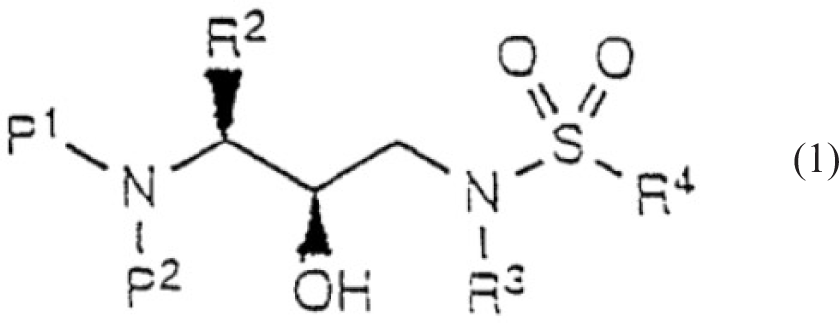
Furthermore, the substituent groups P1, P2, R2, R3 and R4 in equation (1) can themselves be one of the large number of variables defined in the Patent. The evidence at the trial was that the Markush formula represented by claim 1 of the Patent was too wide to precisely calculate the number of actual compounds it encompassed, but was estimated to be somewhere between 7 × 10135 and 1 × 10337 compounds.
The Patent did not refer to darunavir by name. Moreover, none of the compounds exemplified in the Patent corresponded to darunavir. The Patent did not expressly disclosure darunavir. Darunavir was encompassed within the Markush formula in claim 1. The issue before the Court was therefore a compound that was only identified within a Markush formula and not otherwise expressly identified in a patent protected by a basic patent, pursuant to the SPC Regulations.
Previous case law of the Court of Justice of the European Union (CJEU) has stated that in order for a compound to be protected it must be “specified” 3 or “identified” 4 in the claims of the Patent. The subsequent case of Lilly 5 has stated that it is not necessary for the compound to be expressly identified in the claims, it is sufficient if the compound is covered by a functional description which relates specifically to the product. It is worth noting that the claims in Lilly were directed towards a product which was a monoclonal antibody with activity against the neutrokine-α-peptide, rather than a Markush formula. Although this is not a Markush formula, conceivably the claim could encompass a large number of individual peptides which exhibited activity against the neutrokine-α-peptide.
The tests emanating from the CJEU jurisprudence have been criticized as lacking clarity and their application has been considered by national courts. In Teva v Gilead, 6 the UK Court proposed a reformulation of the CJEU test in determining when a product is protected by a basic patent. In order to be protected by a basic patent, for the purposes of the SPC Regulations, a product must fall (i) within the extent of protection provided by the claims of the underlying patent and (ii) the active pharmaceutical ingredient in the product embodies the invention advance (or the technical contribution) in the Patent. It is worth noting that it is not sufficient, for the purposes of the SPC Regulations, to demonstrate that a product is protected by a basic patent, merely if dealing with that product would infringe the Patent.
Legal application and analysis
Turning to the CJEU case law, applying the Lilly jurisprudence, it was not a bar to obtaining a SPC simply because the claims encompassed several compounds. Furthermore, it was sufficient for the claims to identify the product with reference to a structural formula which “relate, implicitly but necessarily and specifically to the active ingredient.” 7 Applying these criteria, the Court in this case held that it would be sufficient for the claim to identify the active ingredient in the product by reference to a Markush formula. In the premises, darunavir is protected by the basic patent, for the purposes of the SPC Regulations.
That was not the end of the matter; as the Court then went on to consider its previous proposed alternative formulation of the test in Gilead, described above. Having already satisfied the first limb of this formulation, the Court asked what was the inventive advance embodied in the Patent. In this case, it was the identification of chemical compounds which would be useful in the inhibition of retroviral proteases. On that basis, darunavir did indeed embody the inventive advance in the Patent.
Therefore, using both the CJEU test and the proposed alternative test put forward in previous UK decisions, the conclusion is the same, that darunavir is indeed protected by a basic patent and the SPC was validly granted for the product.
However, it was of note that Sandoz and Hexal decided not to attack the validity of the Patent, as opposed to the validity of the SPC. It appeared that the underlying basis of Sandoz and Hexal’s objection was that the breadth of the claims in the Patent was excessively broad, given the enormous number of compounds which fell within the scope of the claims. If Sandoz and Hexal’s contentions were accepted, it would mean that national intellectual property offices, which administer the grant of SPCs, would be required to conduct an analysis of patent claims in order to determine whether the active ingredient in the product was individually named or depicted in the claims of the basic patent. Such actions would run contrary to the overriding rationale behind the SPC system, which should be a simple, easily administered and transparent system.
From a practical perspective, a case restricted to a narrow challenge to the validity of the SPC is likely to represent a much more cost-effective means to clear the path to market for a generic entry, if successful. However, it should be borne in mind that such claims do not provide a means to launch a veiled attack on the underlying patent and in the instance case begs the question as to whether the basic patent would have been susceptible to an attack on inventive step, on the basis that not all of the compounds in the claimed series possessed the desired technical effect. 8 This provides a salutary reminder that even when the basic patent has expired and only the SPC protects the product, it may still be necessary to put the validity of the underlying patent in issue to ensure that the path to market is cleared.
It remains to be seen, what traction the alternative test proposed by the UK Court in Gilead receives in courts outside the UK who may also be considering the question of what is protected by a basic patent. This is so particularly in light of the current uncertainty surrounding the impact of the UK’s decision to leave the EU, given that the rights conferred by the SPC Regulations emanate from EU, not domestic UK law.
Declaration of conflicting interests
The author(s) declared no potential conflicts of interest with respect to the research, authorship, and/or publication of this article.
Funding
The author(s) received no financial support for the research, authorship, and/or publication of this article.