







Abstract
Advertisements are essential for sustaining growth and economic development in a world for all kinds of industries. Drug development is a protracted process and a risky business. For new product entry in the market, advertising has a noteworthy positive impact. But some pharmaceutical products advertising specially branded products is controversial and doubtful to advertisement regulations. Advertising is an important asset for any industry to reach new consumers with faith in existing consumers forms over a decade. As per the regulatory perspective in pharmaceutical advertising which is much more than advertising in the serious sense of words itself. The different county has a different legislative framework for protects consumer and company rights. Administrative bodies and lawmakers limit the possibilities of advertising for better achievements. This study emphasizes the regulatory outline of pharmaceutical advertisements in India, USA and Australia.
Keywords
Introduction
The pharmaceutical business is one of the exceptionally managed enterprises, with numerous regulations, standards and guidelines implemented by the administration to secure the wellbeing and prosperity of general society. Advertising is a type of informative initiation. 1 Advertisement as a commercial speech globally restricted under a certain limit for protecting consumers' rights.2,3 Advertising of pharmaceutical products through the media is the primary ambition to earn maximum profit. Advertisements in the market include healthcare supplements, medical devices, pharmaceutical brands, medical device medicine, hygiene products, non-prescription medicine and others. Advertisements are a platform for representation of symbols of quality, processor, quantity, method of use others data, place and price for any product or service which control or scrutiny by regulations for the prohibition of illegal use of advertising. Most of the pharmaceutical companies has their own set of codes or principles for the advertisements of medicinal products. Pharmaceutical promotional activity jointly controls and regulated by the government, industry and NGOs.4,5 Unapproved use of an approved medicinal product is known as ‘off-label’ use. ‘Off-label’ promotion is illegal in most countries. Regulatory control of pharmaceutical advertisements is very tricky and problematic. 6
India
Indian consumers are being constantly exposed to advertisements for prescription as well as non-prescription via television, internet, social media & other forms of media. knowledge about pharmaceuticals products obtained from various sources that are followed by the literate and illiterate person without consulting a pharmacist or physician which leads to self-medication practice. Celebrities and other famous spokespersons hire by the pharmaceutical advertiser for promotional products.7,8 Currently in India, there is no focal constitutional agency for uniform regulations in the advertising business.9,10 Pharmaceutical advertisements and promotion activities are regulated under the Drug and Cosmetic Act (1940), DMR (Objectionable Advertisements) Act, 1954 and CP Act,2019. The goal of the DMR Act was to restricted claims of witches, faith healers and voodoo experts or other professionals from influencing individuals. In India advertising allowed only for OTC and Ayurveda drugs. however, it does not legally recognize a list of OTC drugs. Ayurveda products advertisement are common in India because pre-approval for advertisement is not needed. No regulation specifies the minimum essential information requirements for an advertisement.11,12 ASCI is a non-statutory body that completely directed and controlled the Indian advertising market. ASCI monitors and regulates advertisement for consumer interest voluntarily.13,14
United States of America
Control on advertising and promotional activities is under the USFDA domain with the collaboration of the FTC which ensures the advertisement must be genuine and not misleading with ensuring data of benefits and hazards information to patients. On infringements of advertising laws FDA and FTC issue warning letters and product recall penalties to manufacturers. Suitable standards for pharmaceutical marketing and advancement in the United States set by the PhMRA, which is the IFPMA accredited voluntary organization.15,16
DTCA advertising is a moderately new zone of pharmaceutical products and services promotion which is legalized only in New Zealand and USA. 17 By the mid-1980s, pharmaceutical companies used to give information about prescription drugs (Rx) only to healthcare professionals. No legislation has ever prohibited DTC advertising. In 1981 first print DTC advertisements were run for the Pneumovax® vaccine by Merck. DTCA for pharmaceuticals was legalized in 1997. FDA is responsible for ensuring DTC advertising. 18 ,19 This authority ensuring that ads should as per 21 CFR 202. 20 Supervision of prescription drug advertising by OPDP to ensure that advertisements are under FDA's enactment and also scrutiny advertising to healthcare professionals in various ways like an audio conference, mailing, meeting and all other sources.15,21
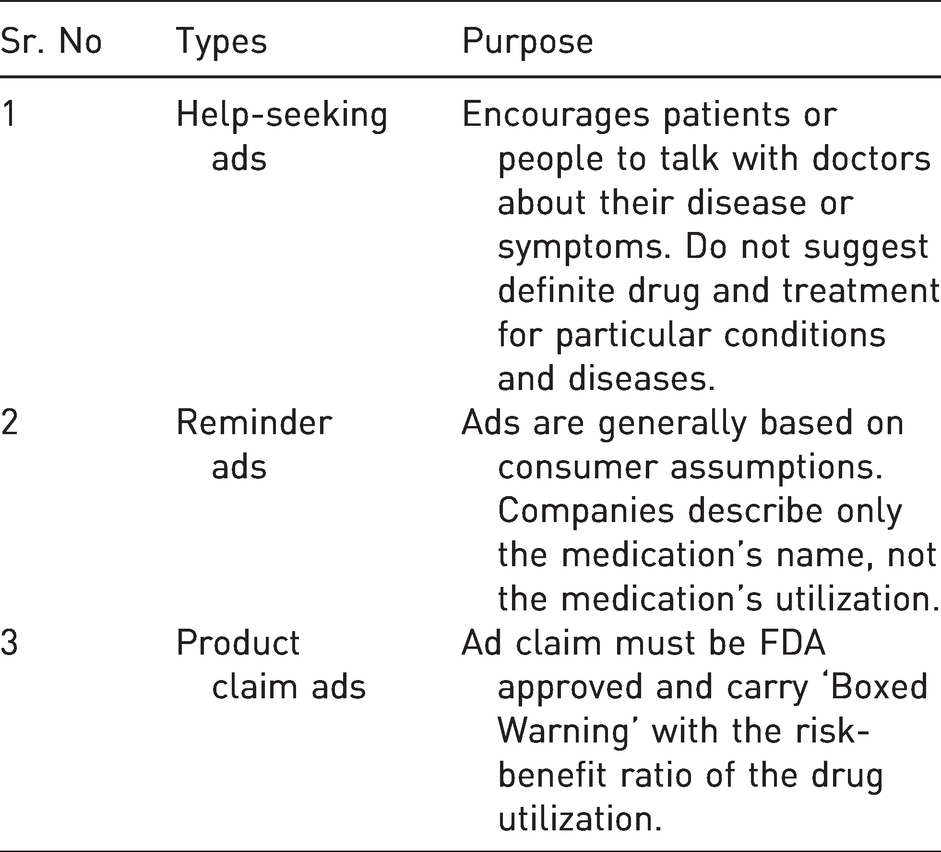
Advertising and marketing campaigns of prescribing products are classified into three types which are described in Table 1.
Types of DTC Ads. 22
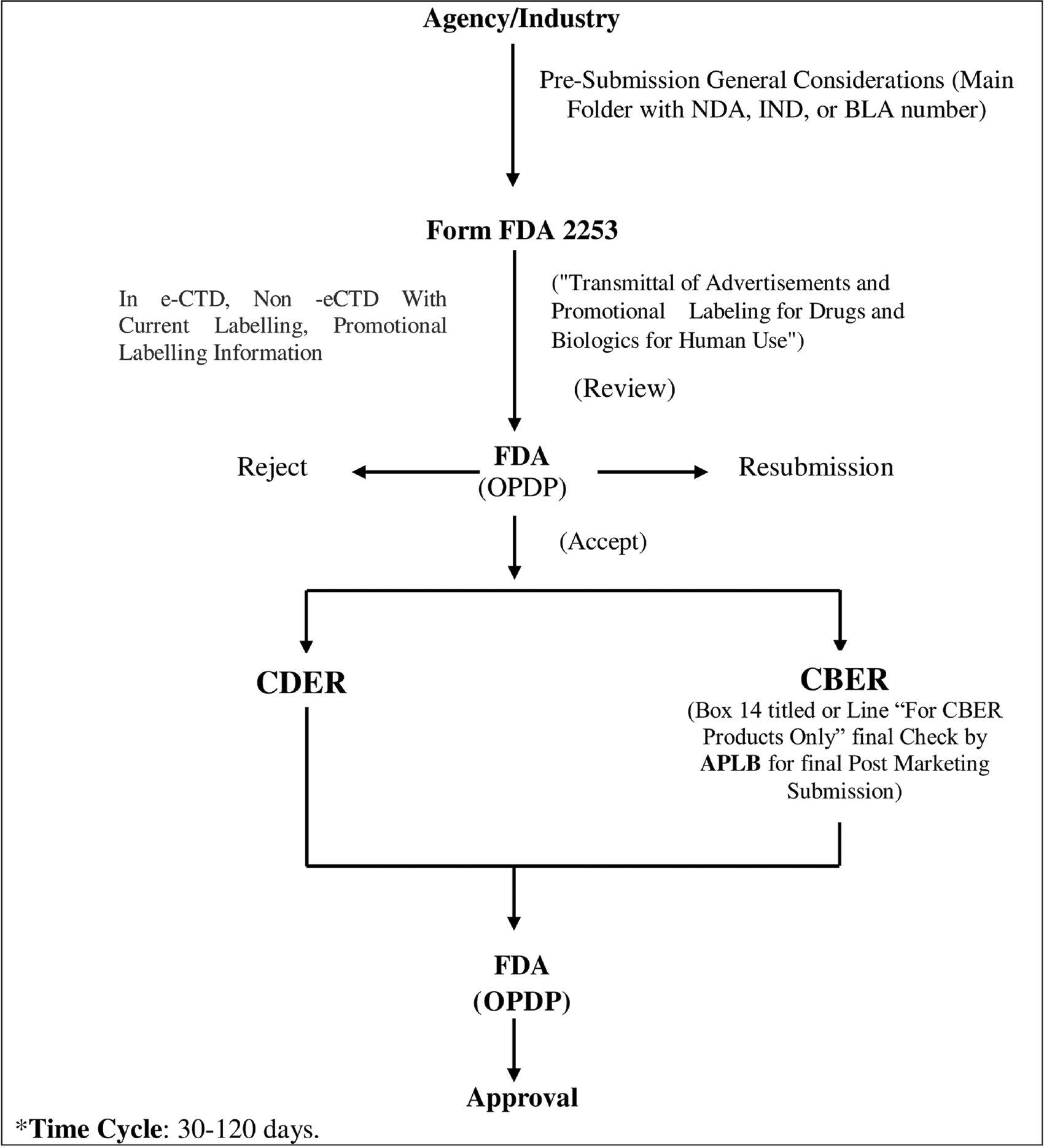
Advertising approval process in the USA
Promotional and labeling approval is mandatory for prescription products in the USA. Surveillance of pharmaceutical advertising is important for protecting consumers and better information for health care professionals. OPDP reviews prescription drug advertising and labeling to ensure the information is correct and not deceptive or misleading. Agencies should back up their advertising claims with verified solid evidence.23,24
The Bad Ad Program is regulated by the OPDP in the CDRH by FDA in 2010. 25 The main goal of the Bad ad Program is to increase awareness about false and misleading advertising to health care professionals and reports about advertising and labeling materials. 26
Approval process of promotional labeling and prescription product advertisements is shown in Figure 1.
Australia
In Australia pharmaceutical products like patient diagnostics, medical devices or drugs described as “Therapeutic Goods” which means products for human use for healthcare purposes. Pharmaceutical advertising devotedly under the regulatory framework in Australia. 32 Therapeutics advertising on any media platform about all kinds of products and services (Prescription and non-prescription) or packaging which creates a false impression on consumers is illegal as per the Australian laws. Therapeutic Goods Act,1989 is administered by the TGA which has the legal power to pre-market, post-market monitoring and withdraw advertisements approval. Section 42DL of TG Act,1989 prohibits illegal, biological and prescription product advertisements in Australian territory. 33
Advertising approval process in Australia
Advertising of medicinal products allowed for medical device, complementary and non-prescription medicines in digital and print media. But prior approval required for advertising of complementary and non-prescription medicines was mandatory in Australia before July 2020. Exclusive data is required for prior approval of therapeutics products in different forms of media. Prior approval by TGA is an essential form of advertising of therapeutics goods use in serious defects, diseases and conditions which is known as restricted representation.34–36
Advertisement approval is a combination of self-regulation and national legislation. Two associations are responsible for advertisement approval of healthcare products in Australia are CHC: Complementary Healthcare Council, ASMI: Australian Self-Medication Industry.
Off-label promotion and advertising activities of therapeutic goods and services are restricted in the ACT.33,37–39
Medicinal product advertising approval process is shown in Figure 2.
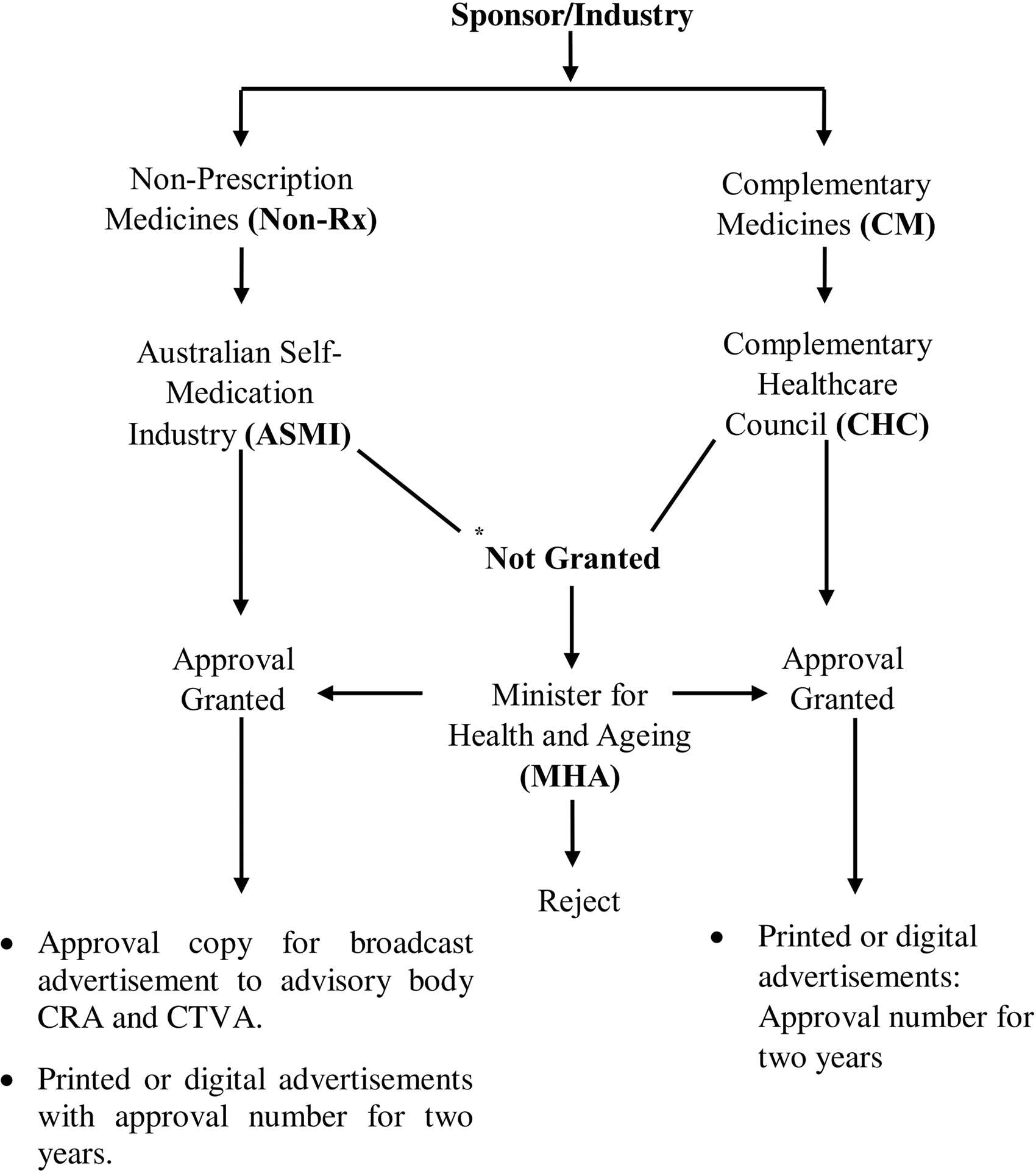
Flowchart of Non-Prescription and Complimentary products advertisement approval process in Australia before 30th June 2020.37–40 Note: Parliament of Australia has amended TG Act,1989 according to which the prior approval process for therapeutics goods is not needed from 1st July 2020 and approval number display is also not required for advertised approved before 30th June 2020 and advertisement approval number and exclusive data is mandatory for restricted representation.36,40
Comparison
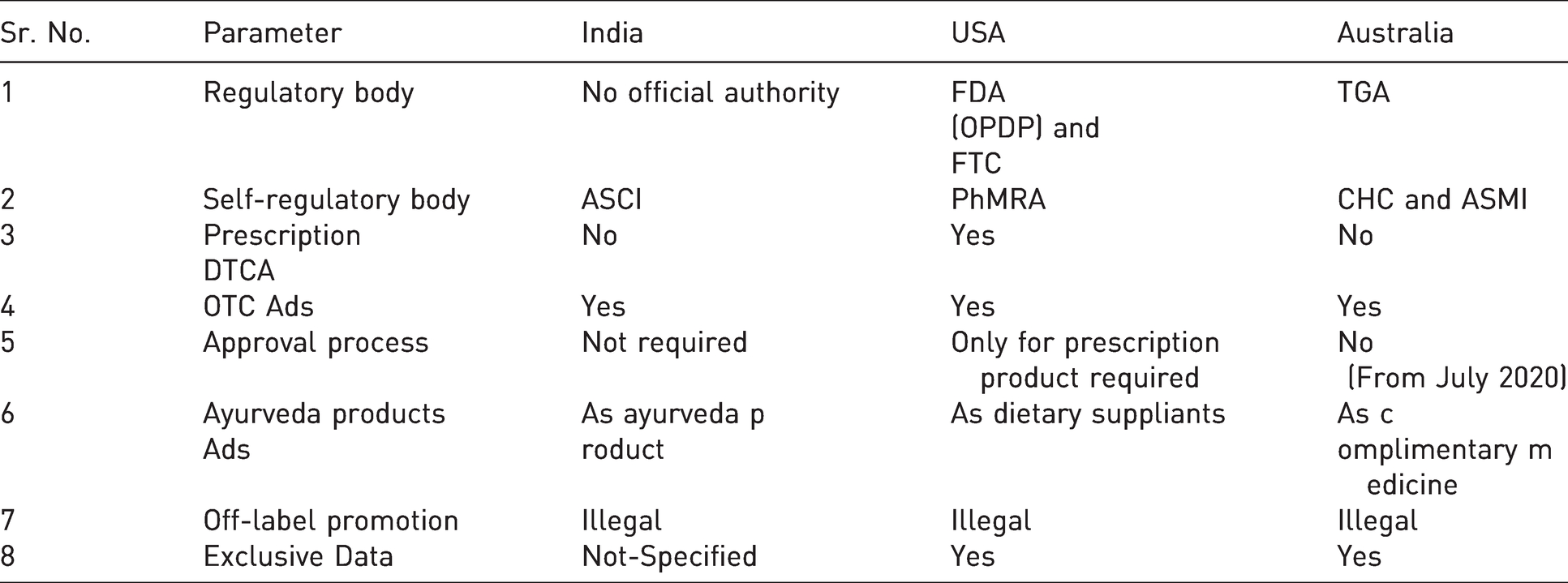
Pharmaceutical product advertising is unique and challenging as compared to other Industry-Specific advertisements due to a combination of complex regulatory and ethical issues. Based on the findings of the study and assessment the pharmaceutical advertisement regulatory framework of India, USA and Australia comparison is summarized in Table 2.
A Comparison of pharmaceutical advertisements regulatory framework in India, USA and Australia.
Conclusion
Each country has its own specific rules and regulations to address the advertising of pharmaceutical products and services. Indian scenario of advertising regulation seems very bleak as compared to those of USA and Australia. In India, Urgent needs to establish central regulatory authority for control and supervision on the industry-specific advertisement. USA advertising legalizations are strict and different as compare to other developed countries due to DTCA. Promotional and labeling approval is mandatory for prescription products. However, DTCA is still controversial because it indirectly encourages irrational medical use and pricing pressure. The pharmaceutical advertising approval process was strict process for OTC and complementary products before 30th June 2020 in Australia. CHC and ASMI have stopped reviewing the advertisement approval process.
The government agencies should identify and promotes health campaigns regarding drug information services. Through mass media and advertisement, uncontrolled information about prescriptions or Over the counter medications should with easy accessibility in range with clarity of quality in data under controlled surveillance. Policymakers should focus on online advertisement regulation for consumer privacy and security.
List of abbreviations
ACT: Australian Capital Territory
APLB: Advertising and Promotional Labeling Branch
ASCI The Advertising Standards Council of India
ASMI: Australian Self-Medication Industry
BLA: Biologics License Application
CBER: Center for Biologics Evaluation and Research
CDER: Center for Drug Evaluation and Research
CDRH: Center for Drug Evaluation and Research
CFR: Code of Federal Regulation
CHC: Complementary Healthcare Council
CP: Consumer Protection Act
CRA: Commercial Radio Australia Limited
CTD: Common Technical Document
CTVA: Commercial Television Australia
DMR: Drugs and Magic Remedies
DTCA: Direct to Consumer Advertising
e-CTD: electronic Common Technical Document
FDA: Food and Drug Administration
FTC: Federal Trade Commission
IFPM: International Federation of Pharmaceutical Manufacturers and Associations
IND: Investigational New Drug
NDA: New Drug Application
NGO: Non-Governmental Organization
OPDP: Office of Prescription Drug Promotion
OTC: Over the Counter
PhMRA: Pharmaceutical Research and Manufacturers of America
TGA: Therapeutic Goods Administration
USA: United States of America
USFDA United States Food and Drug Administration
Footnotes
Acknowledgments
The authors are thankful to the Department of Pharmaceutical Sciences and MDU Library which provided the relevant data for the review article.
Declaration of conflicting interests
The author(s) declared no potential conflicts of interest with respect to the research, authorship, and/or publication of this article.
Funding
The author(s) received no financial support for the research, authorship, and/or publication of this article.
