







Abstract
The aim of this study is to assess the level of knowledge, perception, and experiences of the Sulaimani population in KRI, Iraq. A descriptive and cross-sectional survey was performed with 389 participants (283 male, 106 female) in the city of Sulaimani. The main method of collecting data was done through a questionnaire which was made up of two sections; firstly assessing the demographic characteristics of the sample population, and secondly assessing their knowledge towards generic medicines and their perceptions of generic medicine usage and purchasing intention. The Cronbach’s alpha coefficient was 0.726 which is considered as an acceptable value to measure internal consistency of the sampled population. As a result, this study showed that the sampled population did not have sufficient knowledge about generic medicines and would therefore also not be considering replacing branded medicines with the generics. This is mostly related to poor awareness of generic medicines and lack of publicity or awareness campaigns surrounding generic medicines. This study recommends that authorities invest in publicizing the use of generics and implement public awareness campaigns.
Introduction
Expenditure in health care in Iraq has constantly changed over the years. According to the World Bank, the Iraqi government’s expenditure on health care has significantly increased from 2.7% GDP in 2002 to 8.4% by 2010. 1 However, in 2014, the government spent 5.5%, and this has steadily declined in 2019 with only 4.5%, an estimate of 5 billion US dollars, of Iraqi GDP being spent on healthcare and its facilities.2,3 This clearly illustrates that the government’s expenditure over the last 10 years has decreases significantly, however, the cost is still considerably high. One of the factors that could be contributing to the high cost in medicine is because the Iraqi government has not invested enough and utilizing generic medicine as a strategy to lower the expenditure of medicine and health in general. 4 To understand the high cost one would need to understand the basic structure of the Iraqi healthy system. According to Shabila et al., 5 the Iraqi healthy is predominately hospital orientated and capital intensive. Thus, it severely economically drained because of its high dependence on imports of medical equipment, medicine, and at time even staff, and this includes also generic medicine but at a minimum. The further break it down, the health care system consist of private and public sectors. Currently the public (government) sector covers about 75% of all heath facilities and often services are inexpensive for the Iraqi public. On the other hand, the private sector represents about 25% of services and equipment in the healthy industry. Per Iraqi constitution, all citizens of Iraqi are entitled to receive free health care and that the government is sole provider for these services.4,6 Unfortunately, the public health care services are at a constant decline in terms of quality, equipment, medicine, and staff due to constant wars, sanctions, the rise of ISIS, political instability, corruption and the substantial economic and fiscal crisis that often have major impact on how general services function.2,7 This has increase the public to be more depend on private sectors’ services and products that are often costly however have constant availability of products and services. 5
There is very limited publication on the Iraqi health care system and subsequently the Kurdistan Region of Iraq (KRI), and the lack of internal documentation about the health status both at national to an individual level. At a national level, data and publication of population behavior and attitudes of the Iraq and the KRI are even less explored regarding their healthy practices, therefore, further investigation is needed in order to identify crucial economic trends. At a more individualist level, it is noted that even patients themselves have limited knowledge and that health professions are often reluctant to impart adequate knowledge, because of time constraints that come from a heavily overwhelmed health system. 8 This then manifests in a general lack of trust towards the medical fields. Therefore the wider population of the KRI have inadequate and negative perceptions towards health services, perhaps towards generic medicines also. Despite the fact that government does not have clear policies, this research is aimed to analyze the other side of the medallion, which is the society’s perceptions and knowledge towards generic medicines.
The rest of the paper will provide an overview of the literature on use of the generic medicines in Middle East (Section 2), then methodology, an analysis and results of the survey on knowledge, perceptions and experiences with population of Sulaimani city in the KRI, (Section 3 and Section 4 respectively), and final chapter will discuss the results and conclude with some recommendations.
Use of generic medicines in the Middle East
According to the World Health Organization (WHO), within the world population as much as 30% of people are not able to access medicines due to prohibitive costs of pharmaceutical products. In developing nations, the figure stands as much at 50%, and often governments are faced with various challenging factors to solve the lack of access to proper medicine in short terms,9–11 which in turn has a direct impact in increasing public expenditure on healthcare. 12
Generic medicines are often considered essential and have a crucial place in both developed and developing countries as an essential part of their healthcare systems. Therefore, generic medicines take on an important role in reducing healthcare expenditure where generics can range from 20% to 90% less costly than their branded counterparts,10,12–17 which of course is essential in driving the cost down of essential medicines within the health care sector. According to Mathew 18 and El-Jardali et al. 11 generic medicine are often encouraged by numerous governments and policies advocating for their use in healthcare system are often at the forefront in encouraging and ensuring that the production and availability of generic medicine are sold at affordable prices based on the populations’ economic context. Consequently, generics are an alternative to branded counterparts in various countries, such as the United States of America (USA), United Kingdom, Germany, United Arab Emirates (UAE), Cambodia, Malaysia, Brazil, Iran, and many others. For example in 1984, after the Hatch-Waxman Act was passed, generic medicines made up 19% of prescriptions in the USA, whereas today, as of 2018, this has jumped to more than 75%.15,19–21 Haque 18 has illustrated some examples from various countries, for example, eight of South and Midwest Brazilian cities where generic prescription amounts to 86.1%, whereas in the United Arab Emirates around 100% of generic prescriptions are administered in four hospitals, and around 99.8% in Cambodia. Furthermore, Iran is a strong competitor in locally manufacturing up to 90% of its own vaccines and drugs of which the majority are generic. 22 Another example is that UK most prescriptions (more than 83% of prescriptions) in general practices (GPs) were written generic medicines.10,23,24
The Middle East and North Africa (the MENA) a region provides major growth opportunities as well as some challenges for generics. This is due to the continuously growing population, increasing government expenditure in the healthy sector, a sturdy pricing environment, and an evolving healthy insurance industry as well as low cost production and manufacturing. Though generic medicine can enjoy such favorable variables, there are often challenges that can contribute to these medicines being access. To mention a few, the lack of brand promotion, low quality perception, product prejudice by patients and physicians, fragmented regulatory procedures, and slow policies to allow generic substitution can often put these medicine at a disadvantage.25,26
Those challenges identified were supported by 12 They explained why society would have lower quality perceptions towards generics and linked that with poor awareness and knowledge. Furthermore, lack of awareness and ill-informed education on the bioequivalence and safety of generic medicines have significantly impacted the complexity and irregular development of generic medicine usage and have influenced the preferences amongst the population which has contributed to the lower quality perceptions and bias of the generics in society. 12 In Iraq, specifically Sulaimani’s population, Uctu 25 mentioned that there is lower quality perceptions towards locally produced generic medicines within society and recommended government action for supporting locally produced medicines to change these perceptions.
Methodology
The objective
The objective of this study is to evaluate the population’s knowledge, perceptions and experiences towards generic medicines use in Sulaimani City.
Study design and participants
Questionnaire was adapted, with the permission’s of the authors, from de Lira et al. 6 and translated from English to Kurdish to assist the ability of the sample population to respond to the questionnaire. Some of the questions were modified, adjusted and in some cases removed to remain relevant to the sampled population. A descriptive and cross-sectional survey was carried out from April to July 2020. The Covid-19 pandemic and associated lockdowns in the city, limited the researcher’s data collection. As a result, data collection was completed in July 2020. The key method of data collection was done through a questionnaire which was distributed by volunteers. For the ethical clearance, Institutional Review Board (IRB) at the American University of Iraq-Sulaimani approved the content of the questions.
Data collection and instrument
A 36-item questionnaire was adapted to assess demographic context, the knowledge, perceptions and experiences of the population towards generic medicines and were distributed to 389 people at various areas in the city of Sulaimani. Volunteers were recruited to distribute the questionnaire via direct contact with the population in public spaces, such as bazaar, parks, streets and malls. Due to the Covid-19 pandemic curfews and lockdowns, a small portion of the data (40 participants) were collected through phone calls or distributions to the volunteers’ relatives, friends or family members. b Data collection were limited to the following areas in the city: City Center (n = 177), Family Mall (n = 80), Hawar Shar (n = 50), Qularysi (n = 29), Bakrajo Taza (n = 21), Twa-Malik (n = 10), Malkandi (n = 6), Aqari (n = 5), Ashti (n = 5), Nali (n = 2), Ali Naji (n = 1), Baxtiyari (n = 1), ChwarBax (n = 1) and Kani Kurda (n = 1).
The questionnaire was contained two sections: The populations’ demographic characteristics and, Questioning their knowledge regarding generic medicine, the general perception of generic medicine usage, and purchasing intentions.
The Cronbach’s alpha coefficient was used to measure the questionnaire’s reliability to internal consistency and the questionnaire had a consistency of 0.726, and thus considered acceptable and reliable.
Data analysis
The collected data was analyzed by utilizing the statistical package for social science (IBM SPSS Version 25.0). Descriptive statistics were used to analyze findings. Furthermore, research conducted comparison analysis to test differences in the perceptions of generic medicines usage between respondents of the Sulaimani population as well as similar research done by researchers in other countries.
Results
Populations’ demographic profiles
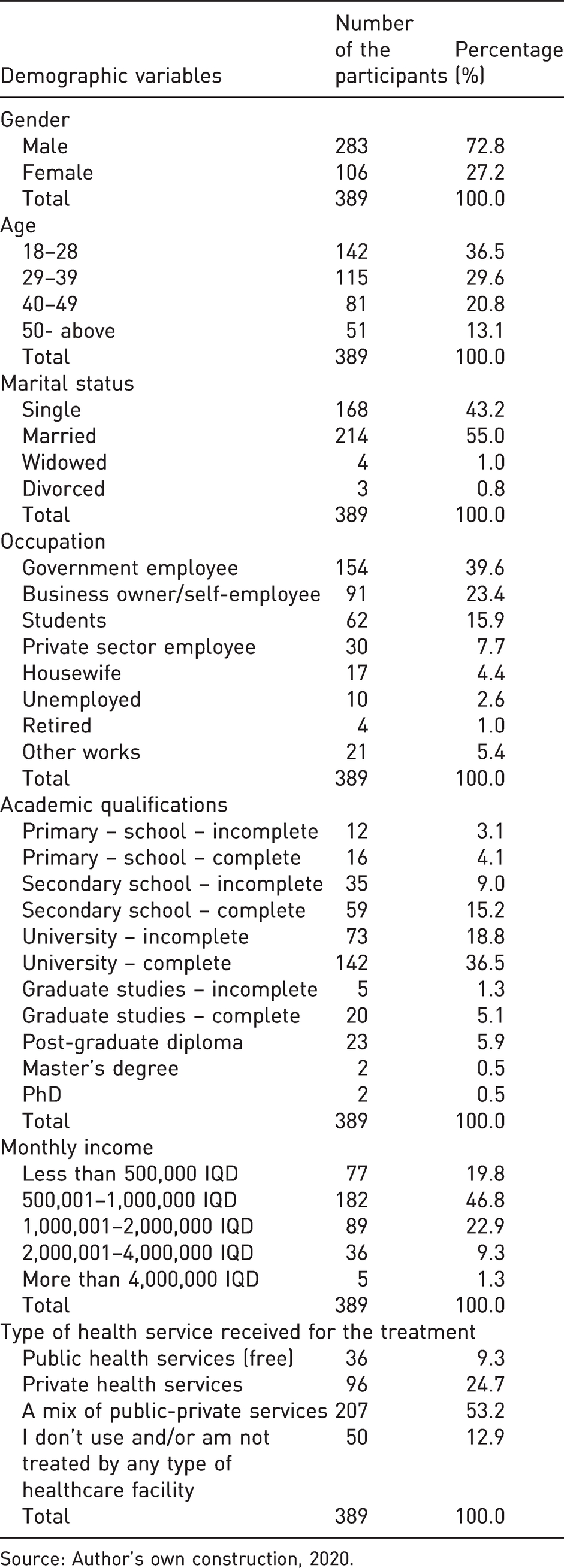
Research surveyed 389 participants in Sulaimani and 72.8% participants were male and 27.2% were female. 86.9% participants’ age was below 50 years old. Most participants were married (55%) whereas 42.3% participants were single. Almost 40% of them have worked or were currently working for government, 23.4% of the participants ran their own businesses and 15.9% participants were still students. From the participants, most of them held a university degree (36.5%). 66.6% participants’ income was less than 1,000,001 IQD (813 USD c ) and 53.2% used both public and private health services (Table 1).
Demographic analysis of the participants (n = 389).
Source: Author’s own construction, 2020.
Populations’ knowledge towards generic medicines
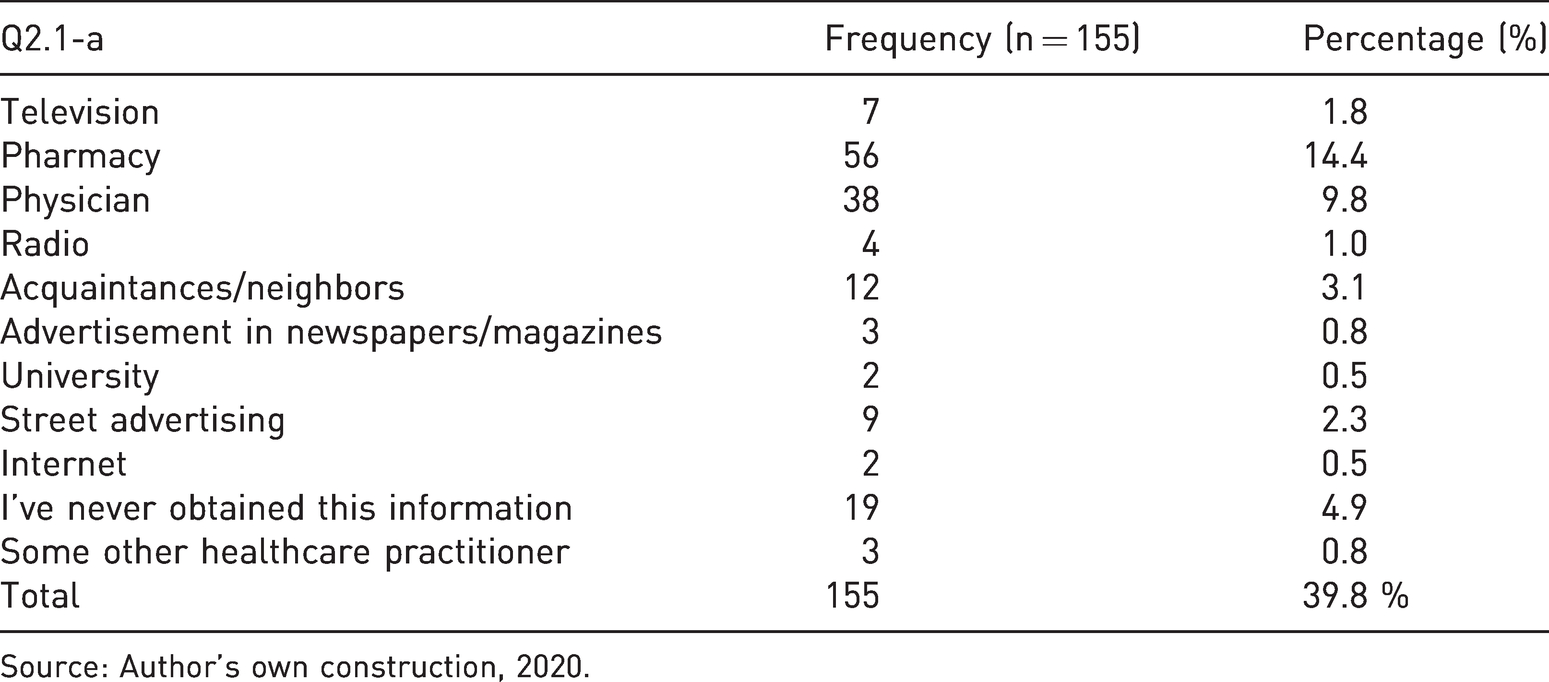
In relation to the knowledge level surrounding generic medicines, among the respondents, 234 (60.2%) never heard of generic medicines, whereas 155 (39.8%) respondents were aware of them. Of the 155 respondents that were aware of generic medicine, 56 (14.4%) respondents obtained information on generics medicines from their pharmacy, whilst 38 (9.8%) of them from their physicians (Table 2).
Places information gathered about the generic medicines.
Source: Author’s own construction, 2020.
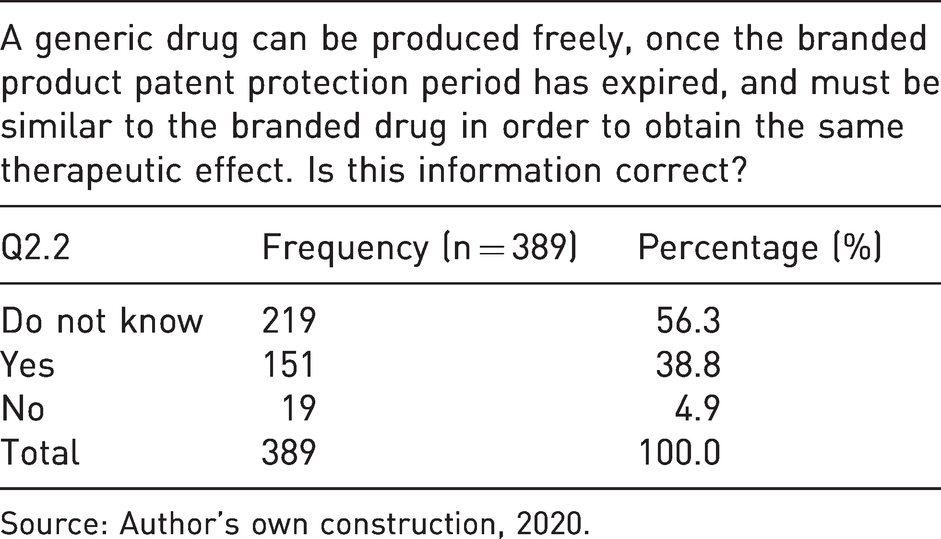
When investigating the existing knowledge of generic medicine, 219 (56.3%) of the responded had no knowledge regarding the definition of what generic medicines are. 151 (38.8%) of responded were able to give the accurate definition of generic medicines. 19 (4.9%) respondents did not define it correctly (Table 3).
Definition of the generic medicines.
Source: Author’s own construction, 2020.
Populations’ perceptions and experiences towards generic medicines
Regarding finding generic medicines in pharmacies, 230 (59.1%) participants mentioned that they could find generic medicines, whereas 159 (40.9%) said that they do not know. From the respondents, 363 (93.3%) mentioned that their medical use was often short term and not for chronic illnesses. Only 26 (6.7%) answered as yes to the question. For the one who use continuous medication, only 6 (1.5%) participants said that the medication was generic, 11 (2.8%) participants said it was not generic and 9 (2.3%) respondents said they do not know.
With regard to know the place respondents buy the medications, 294 (75.6%) participants mentioned that they buy from pharmacy/drugstore (paid), 81 (20.8%) respondents buy from pharmacy/government healthcare unit (free) and 14 (3.6%) respondents do not purchase or take medications. Of 389,304 (78.1%) respondents visit the pharmacy/drugstore/government healthcare units, only when they get sick.
Regarding the characteristics of the generic medicines, 186 (47.8) respondents stated that they trust the efficacy and 203 (52.2%) respondents believed that they are not confident about the efficacy of the generics. Comparing to the branded medicines, 208 (53.5%) respondents believe that generic medicine had less efficacy than their brand counterparts. 98 (25.2%) participants mentioned that they do not know. We were curious to know what do they think about the quality, and 222 (57.1%) respondents stated that they viewed generic medicine as lower quality than the branded medicines. 105 (27.0%) respondents mentioned that they do not know. For the safety, 180 (46.3%) respondents believed that generic medicines less safe than the branded medicines. 130 (33.4%) respondents said they do not know.
Of 389 participants, only 56 (14.4%) participants can identify that a generic medicine by the substance that it contains, 160 (41.1%) respondents cannot identify and 173 (44.5%) respondents do not know.
With regard to prescribing medications by physicians, 56 (14.4%) participants noted that their physicians never prescribed generics, only 18 (4.6%) participants stated that their physicians always prescribed generic medicines. 133 (34.2%) respondents said that they did not know whether or not they were prescribed generic medicines or not.
Among all the respondents, 211 (54.2%) respondents believe that the price of the generic medicines was less, 15 (3.9%) respondents stated that generic medicines were priced more than the branded medicines. 52 (13.4%) respondents believe it is the same as branded medicines. 111 (28.5%) respondents stated that they did not know about pricing between generic or non-generic medicine.
When asked, whether they would choose generic medicine over banded medicine or not, 130 (33.4%) respondents answered they would and 259 (66.6%) respondents stated that they would not choose. However, 296 (76.1%) respondents mentioned that they would switch to generic medicines if their illness was not severe (like cold, fever etc.) and 93 (23.9%) respondents answered no to the question. When asked if the physician prescribed a branded and the pharmacist offered a cheaper generic medicine, whether they would switch or not, 286 (73.5%) respondents said they won’t whereas 103 (26.5%) respondents confirmed they would switch to generic medicines. When asked if the physician prescribed a branded and the pharmacist offered a generic medicine for the same price whether they would switch or not, and 359 (92.3%) respondents confirmed they would not, whereas 30 (7.7%) respondents noted they would switch to generic medicines. Finally when asked if the physician prescribed a branded and the pharmacist offered an expensive generic medicine, whether they would switch or not, and 370 (95.1%) respondents mentioned they won’t whereas 19 (4.9%) respondents stated they would switch to generic medicines.
Among the respondents, only 54 (13.9%) respondents believed that a generic medicine had the same substance as a branded medicine. 261 (67.1%) respondents stated that they did not know this. Finally, 159 (40.9%) respondents believed that generic medicines are currently not well publicized in Sulaimani, and overall in KRI, and 93 (23.9%) respondents felt that generic medicines were well-publicized. 137 (35.2%) respondents said that they did not know.
Discussion and conclusion
The research’s aim was to examine the perceptions, experiences and knowledge of the Sulaimani population about generic medicines. The results of the study showed that only 155 (39.8%) respondents out of the 389 participants, had already heard about the generic medicines and the majority of the surveyed population (60.2%) 234 of the 389 never heard about generic medicines. This finding is not consistent with the results studied in other countries and clearly shows that Sulaimani population’s knowledge and awareness about generic medicines is lacking or still at its infancy. De Lira et al. 6 demonstrated that 99.6% (277 of the 278 respondents) of the studied population had already heard about the generic medicines in Brazil. Furthermore, authors showed another example which was conducted for the population of Auckland in New Zealand by Babar et al., 27 and noted that 51% respondents had heard about the generic medicines. 12 On the other hand, recently studied the population of the Klang Valley in Malaysia and found that 57.7% respondents, 128 of 222 participants, had a good knowledge of generic medicines whereas 42.3% respondents, 95 of 222 participants, had poor knowledge about the generic medicines. Kulikovska et al. 28 conducted a research in Latvia and reported that 72.3% respondents, 727 of the 1005 participants, were aware of the generic medicines and 22.5%, 226 of the 1005 participants, were not informed about the generic medicines.
Regarding to the definition of the generic medicines, 219 (56.3%) respondents did not know the definition. Only 151 (38.8%) respondents defined generic medicines correctly, and 19 (4.9%) respondents could not define it correctly. This result is very low and shows that population is not aware of the definition of generic medicines. On the other hand, de Lira et al. 6 reported that 48.6% respondents in Brazil defined the generic medicines correctly.
With regard to the characteristics of the generic medicines, 186 (47.8) respondents mentioned that they trust the efficacy of generic medicines. This result is significantly different than the research conducted by de Lira et al. 6 in Brazil where most (79.1%) respondents believed in generic medicines’ efficacy. Comparing to the branded medicines, 208 (53.5%) respondents believe that the effect of the generic is less than the branded medicines and 222 (57.1%) respondents stated that generic medicines has less quality than the branded medicines whereas 105 (27.0%) respondents mentioned that they do not know. 180 (46.3%) respondents believed that generic medicines less safe than the branded medicines whereas 130 (33.4%) respondents said they do not know.
In this study, with regard to switching from the branded medicines to the generic medicines, 259 (66.6%) respondents stated that they would not choose a generic over a branded medicine. However, 296 (76.1%) respondents stated that they would only switch to generic medicines if the disease was not serious (like cold, fever etc.). Interestingly, 286 (73.5%) respondents would not switch to a branded generic if the physician prescribed a branded and the pharmacist offered a cheaper generic medicine. Moreover, 359 (92.3%) respondents said they won’t switch if the physician prescribed a branded and the pharmacist offered a generic medicine for the same price. Finally 370 (95.1%) respondents said they won’t switch if the physician prescribed a branded and the pharmacist offered an expensive generic medicine.
This results support the arguments that in Sulaimani city population has negative perceptions towards the generic medicines which was also mentioned by Uctu 25 and Karadaghi and Willott 17 for overall healthcare services, possibly including the generic medicines.
In regards to publicity of generic medicines, among the respondents, 159 (40.9%) respondents believed that generic medicines are not well publicized in Sulaimani and in KRI and 137 (35.2%) respondents said that they do not know. Only 93 (23.9%) respondents felt that generic medicines were well-publicized. This result is in line with findings by Uctu. 25 He held an interview with the local generic manufacturing company in Sulaimani and confirmed that there is less publicity regarding the generic medicines.
Overall study showed that there is a lack of awareness, knowledge towards generic medicines amongst the Sulaimani population. This conclusion is in line with the research conducted by Thomas and Vitry 29 for the Malaysian and significantly different than de Lira et al. 6 for the Brazilian and Kulikovska et al. 19 for the Latvian consumers where they confirmed that the studied population has sufficient knowledge towards generic medicines.
Around 50% population in less-developed countries has difficulties to access to the essential medicines. Yet, generic medicines have not necessarily been used as one of the strategies to lower health expenditure and to access to essential medicines. For this reason, therefore, generic medicines could be seen as alternative medicines in many countries including in Iraq. The findings of this study proved that there is also an ongoing perception that generic medicine are of a low quality. To change these perceptions, government should take an action and create policies and a conducive environment where generic medicines and their use are more widely publicized and the population is able to make more informed about their use.
Footnotes
Declaration of conflicting interests
The author(s) declared no potential conflicts of interest with respect to the research, authorship, and/or publication of this article.
Funding
The author(s) received no financial support for the research, authorship, and/or publication of this article.
