







Abstract
This article seeks to establish a new research agenda on distributed leadership by linking early childhood and school leadership research. It begins with a discussion of how distributed leadership is conceptualized, including a discussion of the main features and meanings of distributed leadership as defined by key scholars who have maintained a sustained interest in this topic. It explores theoretical bases underpinning leadership research that have adopted a distributed leadership framework in general and within early childhood education organizations in particular. By critiquing the application of learning derived from school-based research within early childhood settings, this article aims to engage readers across different education sectors to collaborate in reconceptualizing distributed leadership in the future.
Introduction
Much of the literature on distributed leadership to date focuses on school-based leadership (see for example, Camburn et al., 2003; Firestone and Martinez, 2007; Leithwood et al., 2007; MacBeath, 2005; Spillane et al., 2007). In contemporary theorizing, distributed leadership can be traced to the work of those such as Gronn (2002a, 2002b), Harris (2009), Leithwood et al. (2009), Mayrowetz (2008) and Spillane (2006). By examining the broader context of school-based leadership, the definition and meaning of distributed leadership is explored from a conceptual perspective. This discussion is then extended to early childhood leadership literature where discussions on distributed leadership are currently being affirmed (Fasoli et al., 2007; Siraj-Blatchford and Manni, 2007).
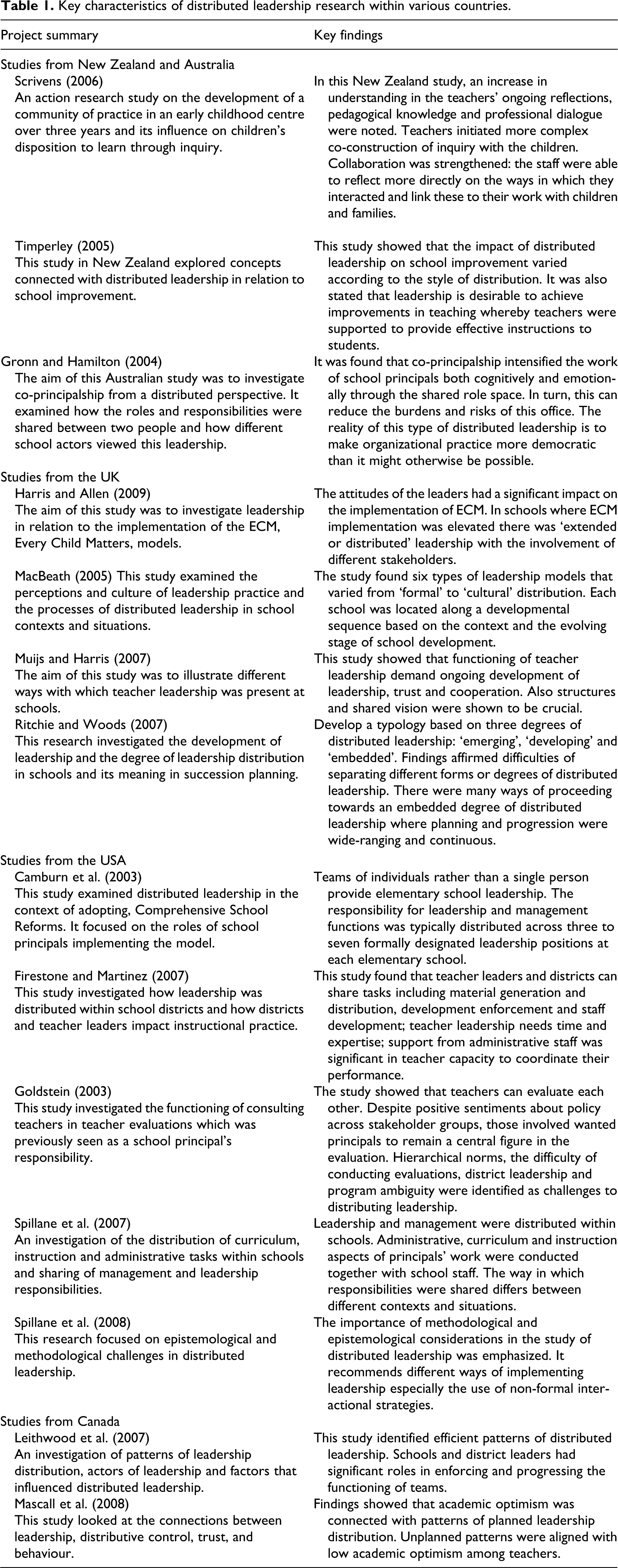
By analysing the application of previous research, this article aims to establish the groundwork to develop a new distributed leadership research agenda that can bring together scholars from diverse education sectors. As such, this article critiques the relevance and significance of school-based distributed leadership within early childhood contexts, including an analysis of implementation challenges that flow on from applying theory into practice. This discussion draws on relevant research undertaken in a range of countries, especially Canada, the UK and USA, involving the work of key scholars such as Keith Leithwood, Alma Harris and James Spillane, respectively. Specific papers by these scholars and others, selected for analysis are presented in Table 1. This analysis is important because a discussion incorporating early childhood and school education leadership literature has not been published previously. By stimulating discussions between scholars interested in exploring distributed leadership across different education sectors, it will be possible to assess the veracity of applying distributed leadership in similar but different educational organizations.
Key characteristics of distributed leadership research within various countries.
Ways of Defining Distributed Leadership
In reviewing appropriate leadership literature it was clear that distributed leadership research is relatively young, emerging as a focus of research during the late 1990s, and is primarily concerned with the study of school-based leaders. Likewise, although Ebbeck and Waniganayake (2003) introduced the concept of distributive leadership, and others such as Aubrey (2007) and Scrivens (2006) have endorsed its exploration within early childhood settings, published papers in this sector of education are sparse and difficult to locate. Nonetheless, the burgeoning literature on distributed leadership being operationalized within schools in Canada, Europe and the USA in particular (see Table 1) warrants independent analysis, so that its relevance in early childhood settings may be critiqued in meaningful ways.
The literature review on distributed leadership undertaken in preparing this article affirms the assessment of those such as Harris (2007), Hartley (2007), Lakomski (2008) and Mayrowetz (2008) about the absence of clarity and consistency in defining leadership through a distributed lens. These authors refer to a range of leadership models built by using a variety of variables, but are concerned about the limited opportunities to debate and discuss findings, which in turn may have stunted advancements in promoting understanding and clarity necessary to implement distributed leadership effectively.
The conceptual confusion or ambiguity in defining distributed leadership has also given rise to a diverse nomenclature being used in the literature, such as democratic leadership (Woods, 2004) and shared leadership (Pearce and Conger, 2003). These terms are frequently used interchangeably and uncritically. Hartley (2007: 202) describes this situation as ‘conceptual elasticity’ reflective of what Lakomski (2008: 160) describes as a case of ‘horses for courses’. Such criticism from esteemed leadership scholars can in turn thwart theorizing, especially if the goal is to seek consistency or advancements based on commonalities or similarities. For example, ‘distributed leadership’ and ‘shared leadership’ are often used in the same paper as if they were equal, with the authors providing no definition or explanation on what is meant by each concept (Hammersley-Fletcher and Brundrett, 2008; Lindahl, 2008). The use of these concepts interchangeably creates confusion in operationalizing definitions in practice and raises difficulties in interpretation when considering implications of findings based on research studies.
In defining distributed leadership and shared leadership there is also no consensus or common understanding about any associations or structural connectivities between these two concepts. For instance, Fletcher and Käufer (2003) describe the nature of shared leadership processes as ‘distributed and interdependent’ (p. 22). This reflects the move away from conceptualizing leadership as an individual attribute to a collective achievement based on teamwork. Fletcher and Käufer (2003), however, do not clarify the difference between distributive leadership and shared leadership. This confusion is also reflected in Leithwood and Mascall’s (2008) attempt to find clarity in discussing the functions and practices of ‘collective leadership’ (p. 530) where they refer to distributed leadership as a general category to include terms such as ‘distributed’, ‘shared’ and ‘dispersed’. The rationale for this discussion is presented in terms of the benefits that can be achieved through collective action.
Some scholars, such as Harris (2009), connect the two properties, ‘interdependence’ and ‘emergence’ with distributed leadership. However, it has been difficult to establish a strong connection between these two elements in the practice of leadership in school contexts. Much of the research reviewed for this article suggests that the successful achievement of distributed leadership is determined by the interactive influences of multiple members within an organization. Distributed leadership is however, not just about the sharing of tasks in an organization, but is also used to explain deeper levels of interaction between members working through shared goals. Recognition of this complexity is not unique to distributed leadership (Gronn, 2002b; Harris, 2009) and is found in the work of scholars who write about shared leadership (Cox et al., 2003; Fletcher and Käufer, 2003).
Furthermore, distinctions are made across distributed leadership and collaboration or teamwork. ‘Distributed leadership results from the activity, that it is a product of a conjoint activity such as network learning communities, study groups, inquiry partnerships, and not a simply another label for that activity’ (Harris, 2004: 15). According to Spillane (2005: 149) however, ‘shared leadership’, ‘team leadership’ and ‘democratic leadership’ are not synonyms for distributed leadership. The slippery nature of defining distributed leadership is acknowledged by Spillane (2006: 94) when he explains that the term distributed leadership is in itself ‘a set of diagnostic and design tools’ that can be used to examine ways of experiencing or practicing leadership. The phenomenon under study and how it is perceived will change with the focus or lens being used. As such, according to Spillane (2006) a distributed leadership framework is merely another ‘analytical tool’ for the study of leadership (p. 6).
Moreover, teams do not necessarily have authority or leadership and teamwork does not necessarily involve distributed leadership perspectives because teams can function hierarchically and be directed in non-democratic ways. According to Spillane et al. (2004: 11) leadership is best understood as a practice ‘distributed over leaders, followers, and the school’s situation or contexts’. On the other hand, according to Cox et al. (2003: 53) shared leadership is seen as ‘the condition in which teams collectively exert influence’. Accordingly, they emphasize the centrality of teams as a strong indicator of shared leadership, where ‘collaborative, emergent process of group interaction in which members engage in peer leadership while working together’ (pp. 52–53). In contrast, scholars who focus on distributed leadership, tend to adopt a more macroscopic view of organizations where leadership functions are structurally more detached and therefore notions of interdependence are emphasized.
Within distributed leadership literature, the emphasis is on leadership practice rather than on leadership roles and ‘it is the nature and quality of leadership practice that matters’ (Harris and Spillane, 2008: 33). According to Woods (2004: 6), ‘although leadership may be distributed, it does not necessarily imply an absence of hierarchy. This is evident from the fact that distributed leadership may comprise teams, informal work groups, committees and so on, operating within a hierarchical organization.’ Leithwood and Mascall (2008) define distributed leadership as illustrating everyday ways of sharing tasks in organizations and thereby minimizing the possibility of mistakes made through leadership decisions being made by individuals acting alone. Instead of task partition for actors in different positions it means interactions between members of the organization (Timperley, 2005). As such, Spillane et al. (2001: 25) refer to leaders who work towards a shared goal through ‘separate, but interdependent work’.
Spillane et al. (2004: 9) discuss distributed leadership practice as being ‘stretched over’ the whole school social and community contexts. Leadership for instruction involves multiple personnel, consisting of those who held either formal leadership positions and/or informal leadership responsibilities. Spillane et al. (2001), Spillane et al. (2004) and Harris and Spillane (2008) base their leadership thinking on activity theory and theories of distributed cognition based on the work of those such as Hutchins (1995), Leont’ev (1981), Rogoff (1990) and Vygotsky (1978) where material and cultural artefacts form identifiable elements of the socio-cultural context. This approach emphasizes the meaning of situations and contexts of leadership suggesting that leadership activity is distributed over various facets of the situation, including tools, language and organizational structures. Gronn (2000: 318) also associates his view of distributed leadership with activity theory (see Engeström, 1999), conceptualizing it ‘as a part of a model of jointly performed and tool-mediated activity’. Interestingly, although the majority of papers included in this literature review cite the work of Gronn and Spillane and colleagues, few others have embraced activity theory (Mayrowetz, 2008).
Distributed leadership approaches are often described as being in opposition or competing with leadership perspectives that focus on person-based leadership and with static organizational positions being ‘leaders’ and ‘followers’ based on individualistic leadership models (Gronn, 2000, 2002a; Mayrowetz, 2008; Timperley, 2005; Woods and Gronn, 2009). Several researchers also suggest that leadership in schools is more likely to be distributed (Gronn, 1999; Spillane et al., 2004; Timperley, 2005). Distributed leadership does not demand a change in prevailing leadership structures. Persons holding leadership positions become as monitors of distributed leadership (Harris, 2008). In addition, school leaders’ role can vary between different contexts. Distributed leadership does not mean that every staff person has leadership roles (Spillane, 2007).
Distributed leadership is significant when considering leading educational organizations (Timperley, 2005). In theoretical reviews of distributed leadership, concepts of effectiveness and school improvement are aligned with instructional leadership (Mayrowetz, 2008). Furthermore, in dealing with the conceptual underpinning of distributive leadership, Woods and Gronn (2009) connect organizational capacity with initiative and sustainable change. Moreover, Woods et al. (2004: 444) emphasized that ‘the degree of control and autonomy is a major variable in distributed leadership’. Gronn (2008) and Hartley (2009) both also stated that the meaning of power is not considered enough in distributed leadership studies. Likewise, Maxcy and Nguyen (2006) raised the question of whose power to influence is enhanced through the distribution of leadership.
However, distributed leadership is not generally thought of as a normative concept or an ideal model. Instead of modelling leadership, distributed leadership scholars usually examine the different ways in which leadership is distributed observing relations between actors and situations and how these relations can be investigated. It lacks advocacy or normative goals (Firestone and Martinez, 2007; Harris, 2007; Mayrowetz, 2008; Spillane et al., 2004, Timperley, 2005; Woods and Gronn, 2009). However, Mayrowetz et al. (2007) provide a theoretical framework that can be used in research for studying distributed leadership.
Robinson (2008: 251) also suggests that ‘if distributed leadership research is to make stronger links with student outcomes, it needs to be informed by a normative theory that is grounded in our knowledge of the conditions that teachers require to improve teaching and learning’. Following this perspective one can continue that in early childhood education, leadership distribution has to be focused and organized in ways which support pedagogical functions and processes. This is based on the belief that within early childhood settings, knowledge and learning should guide leadership practice and distribution of organizational roles (Ebbeck and Waniganayake, 2003).
Key Adaptations of Distributed Leadership in Research
Although empirical research on distributed leadership is increasing, this knowledge base is relatively young and narrow in scope. Further research is necessary especially about the functioning of distributed leadership and its effectiveness within education (see Harris, 2007; Hartley, 2007; Leithwood and Mascall, 2008; Woods and Gronn, 2009).
Table 1 highlights some of the key distributed leadership research within school leadership and early childhood literature. Similar to Woods et al. (2004) these publications were selected for inclusion here by visual scanning and evaluation of published research. This selection was based on four main principles. First, the publication had a clear focus on distributed leadership in practice. Previously published reviews of distributed leadership have used a broader focus for gathering relevant publications for analysis. For example, Bennett et al. (2003) and Woods et al. (2004), in their literature reviews used a variety of overlapping keywords which were closely associated with distributed leadership including delegated leadership, democratic leadership and dispersed leadership. Leadership studies of non-educational settings such as ‘a pygmy community in the Cameroon rainforest’ (Bennett et al., 2003: 24) were also included in these reviews. Table 1 however, contains distributed leadership studies based on educational organizations only.
Second, scholars interested in distributed leadership have consistently cited the publications included in Table 1 and were therefore considered as important for inclusion in this analysis. Third, only publications that explained the research methods used and provided information about the analysis of research findings were selected for inclusion in Table 1. In contrast to publications such as the report by Bennett et al. (2003), Table 1 contains only peer-reviewed journal articles reporting on primary research. The only publication that does not fit these selection criteria but has been included in Table 1 is Scrivens (2006). This article was presented at an international research conference and has been included in this analysis because of its uniqueness as the only publicly documented distributed leadership study undertaken in an early childhood setting.
The 14 articles included in Table 1 are categorized under the country where the studies were undertaken and provides a project summary and key findings. The overall analysis of these publications was directed in terms of their relevance for early childhood education.
Overall, the publications included in Table 1 reflect key characteristics of distributed leadership research. First, distributed leadership research is relatively young with most research being published during the current decade as reflected in the examples included in Table 1. Australia and New Zealand, who were pioneers in researching early childhood leadership, have been slow to publish papers based on distributed leadership research. As reflected in Table 1, this research is located mainly in the United Kingdom and the United States, although there is an increasing interest in Canada as well as Australia and New Zealand. Common questions investigated in these studies included the degree, patterns or forms of distributed leadership; the actors or stakeholders of distributed leadership; factors that influenced distribution and the impacts of distributed leadership. Most studies used a mixed methodology consisting of some combination of interviews, observations, document analysis, journals, case studies and questionnaires. Scrivens (2006) was unique in that she used video recordings and digital still images of staff–child interactions in her case study. Participants included in these studies were variable, consisting of a mix of stakeholders, who may or may not occupy leadership positions, including office staff, district administrators, consultants, parents as well as students.
Findings across the studies included in Table 1 suggest that distributed leadership has positive impacts on teachers, leaders and on education itself. These conditions suggest that to be effective, distributed leadership has to be well managed, goal oriented, planned and developed continuously. In linking distributed leadership with the core purposes of learning and teaching, these studies also suggest that the involvement of all organizational levels and support from different stakeholders is essential. Based on these findings, two types of questions can be identified in designing distributed leadership research in early childhood education. First, questions concerned with stakeholders of distributed leadership such as who is responsible for planning and implementing the distribution of leadership functions, and what processes are used in selecting leaders. Second, questions that focus on leadership outcomes such as what impact did leadership distribution have on the organization and its stakeholders and how is overall leadership performance and effectiveness of distribution assessed. To date within early childhood education organizations, exactly who performs what leadership tasks is unclear. Answers to these questions may significantly influence the organization of early childhood practice and leadership theorizing.
Absence of research focusing on the specialization of organizational tasks and functions could be one reason for the lack of clarity in the discussions on distributed leadership research. For some time now, early childhood researchers have focused on the separation of responsibilities according to administration, management and leadership functions (see Aubrey, 2007; Ebbeck and Waniganayake, 2003; Rodd, 2006). These discussions can be helpful in organizing the dimensions of leaders’ work in terms of task distribution and responsibility sharing. However, the extent to which the early childhood sector has adopted an evidence-based approach to allocating everyday work in early childhood settings is difficult to evaluate. It would be accurate to state that instead of achieving conceptual clarity, discussions about contemporary practice have raised new questions, particularly in relation to connections between leadership and pedagogy (Andrews, 2009).
Within school leadership literature it is also difficult to ascertain clarity between administration, management and leadership functions through available research evidence. Writing under the banner of shared leadership, Lindahl (2008) for example, supports the need to retain the focus on leadership work instead of administration. By alerting to the need to be cautious against defaults that ‘being a manager does not automatically entail being a leader’ (Gronn and Hamilton, 2004: 4) or that only managers lead, Gronn (2000: 318) has also suggested that ‘a distributed view of tasks and activities implies the existence of a new form of the division of labor at the heart of organizational work’. Likewise, too often within early childhood settings, accidental leaders are appointed to management positions simply by virtue of allocating the top job of being the childcare centre director to the most highly qualified person employed, regardless of their leadership attributes, experience and capacity to lead (Ebbeck and Waniganayake, 2003; Hayden, 1996; Rodd, 2006).
Systematic collation and evaluation of research on distributed leadership is also stifled by information presented through public access. For example, Spillane and associates have published findings from a longitudinal study of distributed leadership in numerous publications (for example, Spillane, 2005, 2006; Spillane et al., 2001). Spillane’s study was aimed at making the ‘black box’ of leadership practice more transparent through in-depth analysis of everyday practice. In the Distributed Leadership Study website (http://www.sesp.northwestern.edu/dls, Spillane, n.d.), it is described as ‘a collection of projects’ aimed at examining ‘leadership practice in urban k-12 schools’, and more than 40 papers including journal articles, books and dissertations are listed. Much of this literature however, fell outside the scope of the brief to find primary research on distributed leadership based on the selection criteria described earlier, and two specific studies linked with Spillane and associates were identified for inclusion in Table 1.
As the work of Spillane et al. (2008) has shown, the settings and methods used to collect data are fundamental when designing distributed leadership research. This issue was first raised by the Australian psychologist, C.A. Gibb (1954), who introduced leadership as a distributed phenomenon. According to Gronn (2002a: 423) in leadership research the leader has long been the ‘unit of analysis’. However, most distributed leadership research focuses on leadership in teacher–teacher or teacher–middle leader aspects. Woods et al. (2004) criticizes the narrow focus of distributed leadership studies based mainly on teachers. As Table 1 shows however, those such as Leithwood et al. (2007) have investigated the role of administrative leaders who are employed within schools as well as district offices. Inclusion of parents by those such as Gronn and Hamilton (2004) also demonstrate the expanding stakeholder perspectives in distributive leadership research.
Challenges of Applying Distributed Leadership within Early Childhood Contexts
Within early childhood education, leadership research has been dominated by a focus on the study of relationships between leaders and followers (see Aubrey, 2007; Ebbeck and Waniganayake, 2003; Hard, 2004; Rodd, 2006). By adopting a micro-lens on leadership phenomenon, early childhood researchers have investigated the actions and/or attributes of leaders themselves (for example, see Hayden, 1996; Hujala and Puroila, 1998; Jorde-Bloom, 1992, 1995; Rodd, 1996, 1997, 2006; Vander Ven, 2000). The investigation of the functions and roles of educational leaders has also been a consistent theme of early childhood dissertations in Australia (for example, Boardman, 1999; Nupponen, 2005; Stamopoulos, 1995, 2001).
Cognizant of the impact of social-cultural contexts on leadership performance, in more recent research conducted in Finland by those such as Hujala and Heikka (2009) as well as Nivala and Hujala (2002), early childhood leadership is studied in more holistic ways. Originating in the United Kingdom, there is now an increasing interest in exploring leadership within integrated child and family services that involve collaborative work between professionals from multidisciplinary heritages including early childhood education, health and welfare (see Aubrey, 2007; Siraj-Blatchford and Manni, 2007; Whalley, 2006). This research also highlights the importance of taking into account stakeholder diversity within the early childhood sector when exploring leadership matters. Negotiating the relevance and priority accorded to the specific professional heritages can be challenging when implementing distributed leadership and requires urgent investigation as early childhood organizations embrace integrated service delivery models as seen in Australia (Colmer, 2008) and in the UK (Aubrey, 2007; Whalley, 2006).
Currently, early childhood theorizing about distributed leadership is evolving. In separating the roles and responsibilities of early childhood leaders against the workplace operational dimensions of administration, management and leadership, it has become necessary to rethink how early childhood leadership is researched and reconceptualized. According to Waniganayake (2000), distributed leadership provides one of the possibilities of achieving organizational cohesion through the integration of these three applied orientations under a single conceptual framework. It is suggested that there can be more than one person/actor involved in leading by learning, based on their knowledge-based expertise. Distributed leadership relies on building relationships through the validation of professional expertise and empowerment of people and diversity, and thereby creating a culture of learning. In practising distributed leadership, it is essential to understand the meaning of expertise and its relevance in the way that leadership tasks are defined and distributed. Overall, although leadership theory in early childhood education draws on the meaning of collaboration for quality provision, the use of distributed leadership theory and research applications in everyday practice is rare.
As indicated earlier, discussions about distributed leadership began appearing in early childhood literature only recently (Aubrey, 2007; Ebbeck and Waniganayake, 2003; Fasoli et al., 2007; Muijs et al., 2004; Rodd, 2006). The aim of this article is to review distributed leadership literature to find ways of using this knowledge within early childhood contexts because of the growing interests of early childhood scholars and practitioners in exploring innovative ways of addressing leadership challenges in this sector.
Identification of the key actors or stakeholders of distributed leadership emerged through the analysis of previous studies as one of the main challenges for future research. Determination of the main actors or stakeholders of leadership is fundamental in establishing distributed leadership. In Finland, the national early childhood curriculum states the importance of co-operation with other services (STAKES, 2003). In Australia, likewise, partnerships are defined as broad ranging and often include parents and support professionals working with children with disabilities (Australian Government, 2009). In the Finnish national curriculum, key actors are considered as conditional, ‘depending on the child’s needs, early childhood may also include other support services, such as rehabilitation guidance, therapy and/or special education for children. . . and attention is paid to the co-ordination of the services’ (STAKES, 2003: 32). This ‘conditionality’ challenges early childhood educators to organize leadership work by allocating key people to perform leadership functions and co-ordinate this work according to changing demands in everyday practice.
Conclusion
In this article, we set out to generate a new research agenda on distributed leadership by linking early childhood and school leadership research. As early childhood scholars, we are keen to assess the benefits of enacting distributed leadership within early childhood education so as to increase the capacity for organizational change and enhance learning for all involved in these settings. The literature reviewed indicated that distributed leadership approaches can assist in the implementation of leadership responsibilities by bringing about better interconnection, consistency and coherence in service delivery among diverse stakeholders. It was also noted that in Finland and in Australia, there are significant policy changes impacting on the curriculum and pedagogy of early childhood education due to the launching of national curriculum frameworks in each country (see STAKES, 2003 and Australian Government, 2009, respectively). These policy reformulations have signalled the need to enhance leadership capacity within early childhood education organizations and explore effective leadership strategies to enable the enactment of complex policy changes.
In conclusion, three key lessons learnt from this analysis are highlighted. First, conceptual clarity must be respected in terms of applying distributed leadership models to early childhood education to ensure that the difficulties encountered by school leadership scholars are minimized or eliminated. This process can be enhanced through collaboration between scholars involved in leadership research within early childhood and school contexts.
Second, it is essential to consider the uniqueness of the organizational contexts of where the research is being carried out. As such we note the diversity of early childhood organizations, in their structure and governance, incorporating a variety of programs such as preschools/kindergartens, childcare centres, before and after school programs, playgroups and home-based programs. This diversity is also reflected in the personnel employed in these organizations, with a mix of qualifications including education, health and welfare backgrounds. As such, when undertaking research, the unit of analysis may vary, including leaders on vertical as well as horizontal dimensions of the organization and depending on the leadership tasks at hand or the particular focus of the study.
Third, the focus of distributed leadership research is not on a single actor but is influenced through the intersection of diverse stakeholders, situations and structures. The importance of developing closer connections with families and communities highlighted in early childhood organizations reflect the necessity to explore collaborative ways of enacting leadership within contemporary educational settings. Accordingly, the theoretical roots of distributed leadership based on cognitive science, could inform future leadership studies undertaken within both school and early childhood education organizations.