






Abstract
This concept article discusses the importance of developing psychic income as an administrative strategy to enhance the context of school environments and to curb high teacher turnover. The hope is to promote further debate and research in order to establish the extent to which psychic income influences retention rates in hard-to-staff schools. Psychic income refers to the satisfaction and benefits derived from intangibles that have non-monetary value in the workplace. We argue that principals have little control over teachers’ salaries, but have significant influence in developing psychic income thresholds that can curb high teacher turnover in struggling schools. Discussed are strategies that principals can use to build psychic income for their schools, realizing that success and sustainability of the strategies are dependent on leadership style and tenure of the principal. Through engaged leadership strategies, principals have the capacity to promote psychic income in order to build satisfying school environments.
Introduction
Research shows that teacher quality is a significant factor in determining student achievement (Berry, 2005; Boyd et al., 2006, Darling-Hammond, 2010). The problem is that less satisfying work environments found in most hard-to-staff schools fail to attract experienced and qualified teachers (Amrein-Beardsley, 2007). The failure to provide satisfying environments or psychic income often leads to high staff turnover (O’Connell, 2001). This concept article introduces school administrators to a variety of ideas for building psychic income that have the potential for encouraging teachers to work in a hard-to-staff school regardless of low salaries and other less-than-optimal conditions. Special emphasis will be given to the role that principals play by tapping into their leadership skills to develop relational trust and build psychic income benefits for their organizations.
Theoretical foundation of psychic income
The term psychic income has its roots in the field of economics (Hatt, 1950; Kelman, 1979; Lawn, 2003; O’Connell, 2001; Ross and Mirosky, 1996; Strober, 1987; Thurow, 1978). According to Thurow (1978), the work place generates two types of income, that is, tangible benefits such as money income and related benefits and intangible benefits or psychic income such as recognition and support. American workers, particularly knowledge workers, seek more than a paycheck from their work place (O’Connell, 2001). In other words, besides the money, people also take jobs based on the unmeasured and invisible rewards of the job, or forfeit money income for these invisible rewards (Houston and Wilson, 2002).
Several scholars define psychic income in a number of ways that range from ‘utility satisfaction’ (Lawn, 2003: 111), happiness (Kelman, 1979), personal enjoyment (Gimeno et al., 1997) and producer’s (employee) welfare (Thurow, 1981), to subjective, unseen and unquantifiable utilities that explain motivation for job selection (Ross and Mirosky, 1996). Thus, the decision by workers to choose lower paying jobs, in favor of maximizing the subjective utilities that follow the job, reflects an economic theory known as compensating differentials (Ross and Mirosky, 1996).Typically, compensating differentials are the pecuniary (for example, extra wages for overtime) and non-pecuniary benefits (for example, flexible schedules, recognition of contributions and achievement, and so on) offered to employees in order to offset the desirability or undesirability of a job.
The benefits of psychic income are immeasurable, invisible and subjective in nature and have ‘sentimental value’ as well as ‘irreplaceable commodity’ (Schlesinger, 1986: 131). Some people may find the money more appealing while others place more value on psychological well-being, control and/or relationships. Benefits may include power, friends, fame, work schedules, collegial relationships with co-workers, leadership, quality of collaboration and satisfaction based on teamwork (Thurow, 1981).
There are disparities in the enjoyment of psychic income from person to person and from organization to organization (Kelman, 1979). While psychic income tends to be enjoyed more by an elder workforce, a younger workforce prefers immediate monetary rewards rather than the intangibles (O’Connell, 2001). There are also gender differentials of enjoyment as women tend to seek psychic income qualities more than men and men tend to seek more economic value. A study by Ross and Mirosky (1996) revealed that men demand more money to offset the negatives associated with the job, while women seek more interpersonal rewards, that is, recognition and thanks from others. These interpersonal qualities have a non-monetary value. Of critical importance is that ‘recognition from others for the quality of one’s work is highly subjectively rewarding’ (Ross and Mirosky, 1996: 238).
These disparities in levels of psychic income influence decisions of both men and women to remain in an organization or to exit and look for alternative employment (Gimeno et al., 1997). Minimal opportunities exist for workers to be highly productive when working in an organization where they are unhappy, unsafe, stressed, depressed, unappreciated, powerless, helpless, controlled, miserable and/or where they feel the job is unfulfilling. Both Gladwell (2000) and Fullan (2003) emphasize the importance of context in job satisfaction. They claim that the social context (environment), including intangible benefits (or psychic income as referenced in this paper), significantly impacts employee behavior. Gladwell (2000: 150) states, ‘the power of context is an environmental argument’.
Muller and Opp (1986: 485) identified two kinds of psychic income that are based on ‘expected benefits of conforming to behavioral expectations of important others, and expected social affiliation rewards’. Following Muller and Opp’s definition, arguably, a person may find gratification in working well with others and through group cohesion and solidarity. Social affiliation develops through new friendships, learning new skills that increase craft competence from others, and group pride gained from a job well done. As an example, retaining the best and brightest in the Silicon Valley translates to conforming to casual dress and creating intellectually engaging work environments (O’Connell, 2001) because the employees believe work is life and, therefore, work must be fun. A relaxed work environment provides the psychic income needed for a positive and rewarding social context. Psychic income translates to the extrinsic job characteristics that employers provide or ‘a consumption good that the employee happens to buy from the employer’ (Thurow, 1981: 185).
Workers analyse the private return of remaining at the job by looking at all the tangible and intangible rewards of the job (Ross and Mirosky, 1996). During stable economic environments, many organizations have the capacity to provide significant monetary rewards and benefits, while employees have more options in seeking more satisfying work situations that meet their intrinsic needs. Consequently, corporations and schools may still face high staff and teacher turnover. In contrast, unstable economic environments tend to be marked by too many applicants for fewer positions. The challenge is no longer to find workers, but to recruit and retain the best ones who fit in the organizational culture, who are willing to work in less than optimal conditions, and who are committed to remaining. These new recruits should bring exceptional, critical skills sets vital for organizational survival. As O’Connell (2001: 7) claimed, ‘turnover is costly, more expensive still are workers who have quit, but have yet to leave’.
O’Connell (2001) suggested that allowing employees the option of setting their own work schedule to meet their individual preferences and personal needs (when feasible) increases worker performance and commitment. The popularity of telecommuting and telework is an effort to give employees flexible time and increasing productivity that is otherwise lost during long train/car commutes. Companies make savings, as they do not have to worry about office space and/or flying people to destinations to conduct business. Ideally, leaders should strive to identify staff or subordinate interdependent preferences, and, where possible, provide options that provide non-monetary benefits within the work environment. Some of these may be as simple as support from supervisors and co-workers, as well as recognition for the quality of work and appreciation of effort.
In summary, psychic income can be compared to the emotional bank account described in Covey's (2004) Seven Habits of Highly Effective People. Covey uses the metaphor
Rationale for building psychic income in schools
Viability of psychic income in schools
According to DeMarco (1947: 218), ‘In education, satisfaction can be gained from psychic income’. To corroborate DeMarco’s work, a study conducted almost 40 years later by Lortie (1986) in Dade County, Florida showed 70 percent of teachers ranked psychic rewards above all other job satisfaction variables. Furthermore, O’Connell (2001) postulated that rewarding employees with psychic income pays long-term dividends for organizations. This suggests that school leaders have to deliberately create psychic income thresholds as a tool to curb high teacher turn over in hard-to-staff schools.
As stated earlier, psychic income is a model adopted from the business world. Although some scholars dismiss psychic income as a failed business model, others stress its positive impact. Thurow (1980) dismisses psychic income as a market failure as he claims it has no effect where there is equilibrium in the job market. Refuting Thurow’s position, Katz and Syrquin (1982: 628) state, ‘the existence of job-related psychic income, does not, per se, cause market failure’. As an example, psychic income has been largely applied and successful with big businesses in the Silicon Valley (O’Connell, 2001).
In education, psychic income and/or its characteristics have been discussed in different semantics: parallel leadership (Crowther et al., 2009), relational trust (Bryk and Schneider, 2002; Fullan, 2003) and heartbeat of leadership (Sergiovanni, 2005). Our intent is to promote the concept of psychic income as a strategic tool in school administration, one that could be given attention, embraced and included in the repertoire of the principalship. Of interest to us is Fullan’s (2003) and Bryk and Schneider’s (2002) focus on relational trust. Bryk and Schneider (2002: xiv) suggest that ‘the quality of social relations in diverse institutional contexts make a difference in how they function’. They (2002: xiv) also clarify that, ‘schools are networks of sustained relationships. The social exchanges that occur and how participants infuse them with meaning are central to a school’s functioning’. We reframe the discussion on relational trust to focus on the principal’s ability to build satisfying school environments for teachers. By capitalizing on the intangibles in the work environment such as flexible work schedules and supportive leadership, principals in hard-to-staff schools may be more successful in attracting and keeping experienced teachers.
Hard-to-staff schools
Hard-to-staff schools are typically low-income urban schools and rural schools that tend to have a majority of inexperienced and unqualified teachers (Amrein-Beardsley, 2007). These schools are often characterized by: ‘high-poverty students, low test scores, high teacher turnover, and unusually large numbers of teachers who are inexperienced, provisionally certified, or teaching out of field’ (Lashway, 2003: 1). In essence, these schools tend to be chronically low performing as measured by standardized tests. Furthermore, hard-to-staff schools have large numbers of culturally, linguistically, socially, and racially diverse students representing minority populations within the community, limited English proficiency and low-income families (Amrein-Beardsley, 2007; Berry, 2005; Humphrey et al., 2005).
In addition, most hard-to-staff schools have very high turnover rate among teachers, administrators and students (Humphrey et al., 2005). The high turnover rate may be caused by working conditions and the burden of scrutiny overly exercised in today’s era of accountability. Humphrey et al. (2005: 6) added, ‘Those who teach in low-performing schools are neither lauded nor applauded for the challenges they have assumed.’ Conditions in hard-to-staff schools undermine effective teaching (Berry, 2010) as teachers are often handed scripted curriculums geared to improve student achievement (Amrein-Beardsley, 2007). Considering that teachers at low-performing schools are under pressure to perform and to adhere to the prescribed curriculum, they often share a lack of collective commitment to student achievement. Furthermore, there are teachers and students who carry with them the stigma associated with failure and who may suffer from learned helplessness that comes with the culture of low expectations often evident in low-performing schools (Humphrey et al., 2005). In other words, the context of the school environment is less than energizing and positive.
Although the quality of teachers makes a significant difference in student achievement (Stronge, 2002), sadly, expert teachers tend to gravitate towards schools that are well resourced, have smaller teacher to student ratios, have fewer students from low income families, fewer minorities and fewer numbers of students with limited English proficiency (Berry, 2005). Amrein-Beardsley (2007) claimed that among expert teachers, only 15 percent teach in hard-to-staff schools, while Humphrey’s et al. (2005) study revealed that only 19 percent of national board certified teachers work in schools that rank in the bottom third. Expert teachers are those who have state licensure in their area of academic training and/or maybe national board certified teachers and meet the highly qualified requirement of the No Child Left Behind Act 2001. The implication is that teachers in hard-to-staff schools are there because they either genuinely love their jobs or because they cannot find a position in a better school. The latter group could be physically present in the schools, but not sharing a commitment to improving student achievement.
Regrettably, students in hard-to-staff schools are often deprived of an enriching learning experience when expert teachers, repelled by difficult working conditions, prefer to teach in high-performing schools. Expert teachers are usually accomplished in their practice because they have content knowledge of their subject and know how to teach to a variety of student learning styles. Ideally, such teachers should benefit students in hard-to-staff schools that need them most (Darling-Hammond, 2010). If critical psychic income thresholds are sufficiently present in these schools, perhaps expert teachers may choose to stay, or experienced teachers can be recruited. Examples of psychic income thresholds include: support from the principal, flexible work schedules that meet individual teacher needs, collegial relationships and engaging collaboration.
Berry (2005: 291) observed that although salary incentives are necessary, they are ‘not sufficient, to recruit and retain accomplished teachers for hard-to-staff schools’. He points to the creation of climates that are conducive for professional learning communities as one of the cornerstones of retaining teachers. Creating such climates requires principal leadership that fosters empowerment, experimentation with new ideas of instruction, and attention to the needs of teachers. Studies that link high student achievement with the high quality of teachers not only suggest the importance of retaining high quality teachers (Byrk and Schneider, 2002; Darling-Hammond, 2010), but reveal that the differences in teacher effectiveness often account for an entire year or more of student learning (Hanushek and Rivkin (2003). In other words, the principal must address the social context of the school environment in order to incorporate elements of psychic income that will attract and support highly qualified and accomplished teachers who, in turn, will significantly impact student achievement and motivation.
The concept of relational trust offers a significant tool for the development of psychic income within the hard-to-staff school environment (context). Bryk and Schneider (2002) found that schools with strong levels of relational trust among: students and teachers, parents and teachers, teachers and teachers, and/or principals and teachers are more likely to improve academically than schools with low levels of relational trust. Furthermore, those schools without relational trust show little promise of academic gain. Fullan (2003: 43) identifies four dimensions of relational trust: ‘respect, competence, personal regard for others, and integrity’. When the school principal demonstrates these, they tend ‘to characterize the culture of the school and the community’ (Fullan, 2003: 43). The development of relational trust builds a culture of deep change and commitment, which reflects the moral purpose and engagement of teachers and students in their work together (Bryk and Schneider, 2002; Fullan, 2003). In turn, the outcome of these changes reflects psychic income: intangible benefits that influence an individual to stay or leave their work environment. These benefits not only make a difference for teachers, but they significantly impact students as well. Effective, experienced teachers, able to demonstrate caring and nurturing attributes and who remain over the course of time, are those most likely to make a significant difference in the achievement of lower performing students (Stronge, 2002).
Retaining quality staff
Recruiting and retaining high quality staff should be a priority for school principals because, ‘… among all school resources, well prepared, expert, experienced, teachers are among the most important determinants of student achievement’ (Darling-Hammond, 2010: 16). Such a caliber of teachers is a treasure that ought to be supported and retained in the school system (Berry et al. 2007; Ingersoll, 2001). Furthermore, teacher turnover is expensive as the cost of chronic replacement of teachers undermines long-term school improvement and stability (Berry, 2010; Darling-Hammond, 2010). Sadly, most principals have no control over salaries and external politics, but they can influence desirable teacher turnover rates and positive working environments by developing psychic income — a state of having satisfaction derived from intangible and invisible benefits other than monetary value. These benefits gratify emotional and psychological needs.
For any school administrator, building an encouraging climate is critical to maintaining a positive work environment and creating psychic income for teachers (Owens and Valesky, 2007). It becomes imperative for school principals to invest in the development of psychic income benefits in order to boost teacher morale. As a study indicated, ‘… the quality of the principal is the most significant factor expert teachers would consider before taking a position in a hard-to-staff school’ (Amrein-Beardsley, 2007: 42). Darling-Hammond (2010) cited teacher recruitment and attrition in hard-to-staff areas as being influenced by the quality of administrative support among other factors. Principals must create environments that not only attract good teachers to the organization, but that support and guide teachers in their work with students (Bryk and Schneider, 2002; Fullan, 2003) and develops relational trust among constituents. The following discussion includes a framework that can help school leaders in the development of psychic income for their schools.
Leadership framework for psychic income
There are leadership qualities in school administration that can be viewed as the embodiment of psychic income. Called the communal qualities: caring, collaboration, cooperation, empowerment, inspiring others and relationship-building fit well with Kouzes and Posner’s (2002) practices of exemplary leadership, Fullan’s (2003) discussion on relational trust, and Bryk and Schneider’s (2002) focus on relational trust and social context in school settings. In particular, this article focuses on: (1) five qualities that school principals should practice to build psychic income benefits: competence, caring, collaboration, shared leadership, and empowerment (CCCSLE) as shown in Figure 1; and (2) how each quality relates to the building of psychic income in administration.
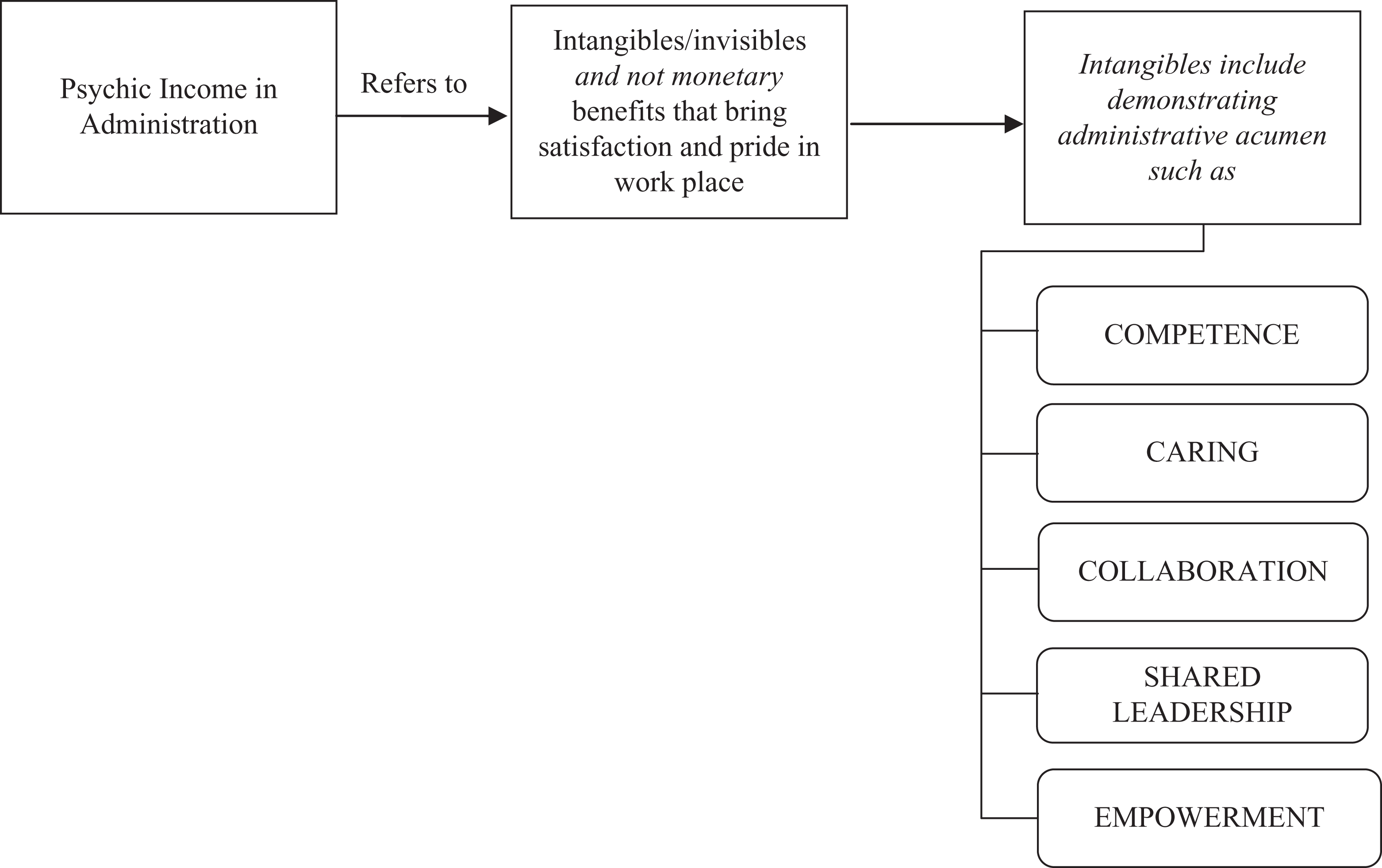
Conceptual framework of building psychic income in administration.
Competence
All principals have to prove their competency on the job to their constituencies by demonstrating craft and literacy competence of school administration. Principals must know how to lead people, manage budgets and resources, resolve conflicts, communicate with different stakeholders, make decisions and carry out other critical functions. It is the principal’s role to develop a mission, create a shared vision, and formulate school goals and plans that are understood by all stakeholders. Leaders are required to produce positive results; there are no gender considerations for this requirement (Kouzes and Posner, 2002).
Caring leaders
Society has traditionally delegated the work of caring to women (Miller, 1987). However, principals who possess this quality work hard at fostering relationships and activities that promote the growth of teachers. This leadership style is characterized by working with others to create positive working environments that foster rather than stifle growth. The principals are active listeners and give special attention to the concerns of teachers. Caring principals are primarily concerned with giving enough support to teachers and derive satisfaction in seeing teachers expand their competencies and knowledge bases. As caring principals, they invest in activities geared to the development of teachers. They measure organizational success by calibrating teachers’ success — if there is growth within teachers, then the principal is succeeding; if there is no growth, then, the principal is failing (Crowther et al., 2009). Failure is mitigated primarily through nurturing each individual with the conviction that individual growth will translate into the growth of the group.
Collaboration
Effective principals engage in collaborative leadership by seeking consensus, consulting teachers, and bringing everyone on board to carry out tasks that are major and non-routine. They value inclusiveness and the participation of everybody and favor contributive, consensual decision-making (Kouzes and Posner, 2002). They create a culture of discipline that is purposeful and reflective of moral purpose. In doing so, they transform the culture of the school to one that is productive and fulfilling (Fullan, 2003). This approach allows principals to work with teachers on an individual level to bring out the best in each teacher. Collaborative principals do not assume that they are the custodian of all knowledge but will consult others in the decision-making process to promote a sense of ownership among teachers.
Shared leadership
Shared leadership, through consultation with others, particularly teachers, fosters self worth and a sense of value, particularly, if teacher contributions prove to be successful (Crowther et al., 2009). Teachers want to work in schools where they feel valued and know their contributions are meaningful. Success is measured by the extent to which principals suspend their own ego and work with others to build relational trust, create opportunities for all to grow, and work through and with others to achieve school goals.
Empowerment
Empowerment provides a powerful element for building psychic income in schools. According to Schaef (1985), leaders facilitate and enable others to make a contribution while they simultaneously make their own. If teachers expand their skills, competences and knowledge, they channel the growth towards the attainment of school goals. Empowerment increases individual and group efficacy. Efficacy in turn fosters confidence, autonomy, innovativeness and experimentation of ideas. Empowerment ushers in synergy that benefits both the organization and the individual. Principals who empower teachers make connections that are enduring and that help teachers to contribute effectively to their schools.
Integrating psychic income with Fullan’s framework
The leadership framework developed by Fullan (2001) relates easily to the development of psychic income. The framework incorporates five key concepts: moral purpose; understanding change; relationship building; knowledge creation and sharing; and coherence making. These five concepts are nurtured and supported with the hope, enthusiasm and energy exhibited by the leader. They also reflect components that support the development of psychic income within the work/teaching environment. According to Fullan (2001: 8), ‘leaders who are steeped in the five core capacities by definition evince and generate long-term commitment in those with whom they work … they mobilize more and more people to become willing to tackle tough problems’. As early as the 1940s, social scientists such as Maslow (Owens, 1991) and others began studying the impact of environment on employee satisfaction and production. Although, the impact of environment is discussed in leadership literature over the past 60 or more years, today’s reality in the workplace implies that more needs to happen. Fullan (2001: 10) states:
If leadership does not become more attractive, doable, and exciting, public and private institutions will deteriorate. If the experience of rank-and-file members of the organization does not improve, there will not be a pool of potential leaders to cultivate … Good leaders foster good leadership at other levels.
Relationship between leadership styles and psychic income
We believe that the leadership concepts described by Fullan (2001) require elements of psychic income to avoid organizational deterioration. Building psychic income encompasses various leadership styles and the organizational culture that is created. Transformational, transactional and laissez-faire leadership styles are incorporated into this discussion as they have a more ubiquitous adoption by school principals (Crowther et al., 2009; Owens and Valesky, 2007). The extent to which these leadership styles are applied by principals is dependent upon the context of the school and the professional maturity of teachers.
Transformational leadership manifests in several dimensions (Eagly, 2007, Northouse, 2007). The first is idealized influence that is demonstrated by two components: (1) the leader motivates and inculcates a sense of pride among people such that they feel proud to be associated with the organization and the leader; and (2) the leader passionately communicates the values, moral purpose and the importance of the organizational importance. The second dimension is motivation. The leader exudes excitement, positive energy and passion for the organization and its future. In the third dimension — intellectual stimulation, the leader allows people to experiment and innovate in order to bring new approaches to problem solving and better ways of completing tasks in the organization. The fourth and final dimension, individualized consideration, involves the preoccupation of the leader with fostering growth of subordinates. Applied to school leadership, transformative principals mentor, coach, teach, train, and give a special ear to the needs of the individual, thereby developing the capacity of the individual as well as the school. Certainly, the above aspects fit well with Fullan’s (2001) leadership framework, particularly in the areas of coherence making, relationship building and moral purpose. The principal harmonizes individual and organizational goals for the betterment of the organization through collaborative decision making (Lortie, 1986).
Transactional leadership, unlike transformational leadership, focuses on exchange relationships between leaders and subordinates. In implementing transactional leadership, leaders are guided by the principle of management by exception where they initiate two options (Eagly, 2007). The first option is the active mode where the leader rewards good behavior for satisfactory performance and punishes followers who fail to meet expected standards. The second is the passive mode where the leader waits and only steps in when problems become more severe. In schools, transactional principals celebrate achievements and reward teachers for jobs well done by making special recognition at principal teacher meetings, announcements in newsletters, writing a handwritten letter to individual teachers, and other forms of recognizing teacher contributions. In areas where teachers are lacking, transactional principals may withhold teacher privileges until the teacher job performance is satisfactory.
The third style of leadership, laissez-faire, is reflected in situations where the leader is not involved at all, particularly, during critical junctures of an organization’s life. The leader leaves the running of the organization to individuals and individual units (Northouse, 2007). This style works well with workers, in this case, teachers who are professionally mature, have honed their skills and are trusted to execute their duties unsupervised. Without the ongoing support of the principal, however, there is the danger of a disconnect between the principal and teachers that could have a negative influence on the sustainability of psychic income that has been developed.
Implications of psychic income for school administration
Principals should tap into their leadership style and the special qualities or attributes they bring to administration. These attributes include being kind, caring, supportive, sensitive, gentle, nurturing, intuitive, friendly, warm, cooperative, trustworthy and collaborative, just to name a few. By capitalizing on these qualities to build psychic income, school principals provide a critical ingredient that could reap enormous dividends for hard-to-staff schools. Bryk and Schneider (2002: 123) describe these qualities as supports for social learning − a critical component for developing ‘school-based professional community’. Research shows that organizations that offer more psychic income have fewer people exiting for alternative employment (Gimeno et al., 1997). Furthermore, ‘the connection of relational trust to the operations of a school-based professional community is highly salient. In essence, trust functions as the social glue necessary for this form of work to coalesce and be maintained’ (Bryk and Schneider, 2002: 123).
Celebrate communal qualities
Communal qualities are included in the five practices of exemplary leadership identified by Kouzes and Posner (2002). They are (1) modeling the way, (2) inspiring a shared vision, (3) challenging the process, (4) enabling others and (5) encouraging the heart. In the work place, subordinates are attracted to inspiring leaders who are role models, who give challenging and meaningful tasks, who empower others, and who are cheerleaders of their staff. Such are the qualities that teachers look for in schools. Principals could attract and retain teachers by tapping into these qualities that most workers look for in an organization. When faced with the choice to leave or stay, teachers are more likely to choose to stay because of the positive working conditions and a sense of worth championed by the principal.
Build a positive school culture
Since there appears to be a positive correlation between high levels of psychic income and the diminished probability of teachers exiting for alternative employment (Gimeno et al., 1997; O’Connell, 2001), principals should intentionally provide opportunities that build positive climates for psychic income. These activities may include: brokered or preferred mentoring sessions; building teams for specific tasks and giving autonomy to teams; exercising distributive leadership where those with expertise on certain tasks can share; and leading others to achieve the same capacity in order to enhance growth for self and the organization. If possible, scheduling that caters to individual teacher needs may be organized so that colleagues have schedules that conflict less with their personal lives. Above all, the principal must be the greatest cheerleader by doing small things such as praising teachers for their contributions and celebrating so that those paddling and waddling with change and the vision of the school are encouraged and supported, thereby curbing unnecessary and damaging teacher turnover.
Exercise caution
Adopting psychic income as a long-term strategy for curbing high teacher turnover rates may be problematic for the following reasons. To some principals it may sound utopian and may never be considered or experimented upon. Thurow (1981) argued that its application is largely depended on the demand for it by workers. For the development of psychic income to be successful, the principal has to champion the cause. Some principals potentially lack the capacity and interest to focus on psychic income; and others may trivialize it, and never allow it to become a priority in their administrative repertoire. Sustainability of psychic income is dependent on the leadership style and tenure of a principal in a school. There is no guarantee that once a principal transfers or resigns, the incoming principal will adopt psychic income as a strategy, or will adopt it with the same interest and intensity as the previous principal. More often than not, a new principal brings a new leadership style. Psychic income works only if there is relational trust among teachers and the principal. Trust is something that can be built and worked on, but can crumble when players change: in this case, when teachers or principals transfer, resign or are fired. Notwithstanding, principals do have the capacity to develop positive work schedules, build collegial relationships with teachers, engage in leadership that fits the school context, and improve the quality of collaboration and satisfaction based on teamwork and recognition of teachers’ efforts and successes. We propose that if there is a systematic approach that is institutionalized by superintendents and school boards, there can be sustainability and minimization of negative effects of change, even if principals leave.
Conclusion
Retaining and keeping effective teachers is a perennial problem for hard-to-staff schools. These schools chronically suffer from high teacher-turn over and poor student achievement. The challenge for school principals is to retain effective, experienced, expert and highly qualified teachers who are committed to working in these schools despite challenging and, sometimes, difficult working conditions. To do so requires leadership that fosters collaboration, experimentation, empowerment, openness, mutual respect and relational trust, among other factors. This paper emphasizes how school leaders can build psychic income: the invisible intangibles that generate satisfaction in an organization. Principals, per se, do not control teachers’ salaries, but they can influence working conditions in the school by engaging certain qualities. These qualities include: being competent, caring, nurturing, sensitive, collaborative, empowering and so on, and are considered as critical in building the psychic income that moves schools forward. They are qualities that the average person looks for when looking for an ideal workplace. Do the leaders care? Will they value my work and contributions? Is there harmony in the work place?
Since educators spend most of their time at work, they need to get up every morning looking forward to going to work because of a positive and encouraging work environment provided by non-monetary work benefits. An effective principal can surely address these concerns by engaging in psychic income practices. However, the sustainability of using psychic income as a long-term strategy to curb teacher turnover, largely depends on the leadership style and tenure of the principal. Relational trust between teachers and the principal is a key ingredient for psychic income to work.