







Abstract
This article reports the findings of a small-scale investigation into the perspectives of Chinese school leaders (school principals and deputy principals) on their leadership learning opportunities. The research draws on key policy documents and semi-structured interviews within a phenomenographic framework based on a cluster sample of ten school leaders located in Fuqing municipality, Fujian. Three overarching ‘categories of description’ emerge from the data: perspectives on formal learning, informal learning and the influences of systemic-contextual factors. The findings indicate that while there has been both an increase in investment and significant developments in school leadership training and continuing professional development, provision has been top-down and primarily focused on raising awareness of educational policy and reform. The study gives voice to the perceived learning needs of the school leaders themselves, arguing that these need to be addressed by policymakers if improvements in the quality of education are to be achieved in line with government expectations.
Keywords
Introduction
The significance of leadership to school effectiveness and school improvement is now widely recognized (Waters et al., 2003; Wong, 2005; Leithwood and Jantzi, 2006; Bryk et al., 2010), with a corresponding growth of international interest in school leader training and continuing professional development (CPD) (Lumby et al., 2008; Bush, 2011). China has invested heavily in pre-service training of aspiring principals and the in-service training of serving principals, but it is far from clear how effective such formal provision has been in promoting authentic leadership learning, or to what extent it has been applied in practice to achieve school improvement.
The research study was based on a number of a priori assumptions about authentic leadership learning and its practical application arising from a comprehensive review of international adult (especially professional) learning theory. Three closely interrelated paradigms emerge to provide a basis for a systematic evaluation of leadership learning needs and provision in China, but it must be emphasized that their translation to non-Western contexts is in its infancy.
The first paradigm comprises the closely related experiential and situated learning models, which emphasize the importance of learning through ‘doing’. Learning therefore takes place through a process of concrete experience, reflection on observation and active experimentation (Kolb, 1984). Brown et al. (1989) see this learning process as ‘situated cognition’ and ‘cognitive apprenticeship’ stimulated through social interaction and the progressive enhancement of performance in applying knowledge to solving problems in the work context. The emphasis on social learning relates closely to the concept of ‘legitimate peripheral participation’ as a means of exploiting situated cognition through engagement in ‘communities of practice’ (Lave and Wenger, 1991; Wenger, 1998). Situated learning is promoted through observation, coaching, scaffolding, modelling, action learning sets and opportunities for reflection on practice. Active members of professional networks and communities of practice are thus able to work collaboratively in finding shared solutions to common problems (Pickering et al., 2007).
The second paradigm is what might be broadly termed the opportunity for ‘expansive learning’. It is ‘expansive’ in being learner-centred, allowing for autonomy and self-determination according to individual needs and interests. It makes a sharp contrast to the more restricted and tightly regulated ‘defensive learning’ undertaken in compliance with authority and regulation; for example, in successfully completing mandatory courses that may or may not satisfy individual learning or professional needs. Holzkamp (1993) emphasizes opportunities for expansive learning through ‘action potency’: the acquisition of strategies and options for action in response to problems encountered in carrying out one’s normal work activities. In ‘activity theory’ (Engeström, 1987, 2001), expansive learning is seen primarily as a collective activity closely affiliated to the idea of communities of practice in acquiring mastery over shared problems. Thus, from a workplace perspective, expansive learning requires an integration of both personal and organizational development (Fuller and Unwin, 2004), a crucial consideration in considering the extent to which professional learning impacts on leadership practice and school improvement.
The third paradigm focuses on learning for critical and scholarly reflection (Brookfield, 1987): the need to develop the critical thinking of school leaders, not only through reflection on their own actions (Schön, 1987) in order to become better leaders, but also to reflect critically on the wider institutional and policy contexts in which they must exercise leadership responsibility. Such learning requires both a grasp of theory and its application through praxis. From a critical and ethical perspective, effective school leaders champion the cause of their schools and protect their stakeholders against unfairness or injustice, endeavouring to ensure that accountability to the higher authority of policymakers is reciprocated. This requires professional learning that cultivates critical and reflective thinking to help identify and question unfounded assumptions, challenge inequity in the wider educational and social context, and imagine and explain alternative strategies that will overcome obstacles to further organizational improvement.
Against this backdrop of leadership learning theory, the article reports and evaluates the findings of a small-scale study of the perceptions of school leaders of their leadership learning, based on a sample of school principals and deputy principals working in 15–18 senior middle schools (gaozhong) and 12–18 complete middle schools (wanzhong). The sample was located in Fuqing municipal authority, Fujian province, in south-east China, geographically, linguistically, culturally and economically, one of China’s most diverse regions.
In contextualizing the research investigation, the article first critically assesses recent evidence on the impact of professional training and development on leadership learning in China. This is followed by an outline of the research methods, a presentation of the key research findings and a discussion of the significance of these findings to a wider understanding of leadership learning theory. A concluding section reflects on the limitations of the investigation and makes a number of suggestions for further research.
The Chinese Context
In the wake of the Compulsory Education Law 1985 and the introduction of the ‘principal responsibility system’, whereby school principals were entrusted with more direct responsibility for school-based management (Lin, 1993: 79–81), the Chinese government introduced three significant changes to school leadership training under the State Education Commission (SEC, 1989, 1991), firmly established by 1999 under the Ministry of Education (MOE, 1999). Differentiated provision between pre-service courses for aspiring principals (fu xiaozhang) and newly appointed or novice school principals (xin xiaozhang), and for serving principals (zaizhi xiaozhang) a minimum of 240 hours in-service development training (CPD) over a five-year cycle. Localized programme delivery by provincial governments within a prescribed centralized framework of set syllabuses and instructional guidelines. A greater participation of prestigious ‘normal’ universities in the provision of advanced training programmes for elite or ‘backbone’ principals (gugan xiaozhang).
School leadership training has been further prioritized with the introduction of a New National Curriculum to improve educational quality (suzhi jiaoyu) through more progressive student-centred approaches to teaching and learning, and, as part of a wider programme of social reform to achieve ‘balanced development’ (junheng fazhan), to provide greater equality of opportunity for disadvantaged groups, including poor, ethnic minority and migrant children (Zhu and Lin, 2011) and children with special educational needs (Law and Pan, 2008). Therefore, ‘China needs a new generation of school leaders who are visionary strategists, have both the courage and capability to transform the system and mobilize all stakeholders, to help teachers so they can help themselves’ (Huang and Wiseman, 2011: 144). The importance of an effective programme of school leadership training and development to equip school leaders with the skills to meet these new challenges cannot be underestimated.
There is evidence of more progressive and innovative approaches to programme delivery, including the involvement of nationally distinguished school principals (ming xiaozhang), the use of workshops, opportunities for networking and visits to successful schools. However, there is a shortage of programmatic research on leadership preparation and programme evaluation (Murphy and Vriesenga, 2006) and therefore very limited evidence of the impact of such training on leadership learning and its application; what Huang and Wiseman (2011: 128) describe as ‘the pathway between preparation and practice’.
In spite of developments, at least three serious problems have been reported. First, the mode of delivery of the training has been essentially top-down and highly controlled through a series of regulations from the MOE, including prescribed topics of training, a stipulated number of hours of training for each topic, and lists of recommended textbooks and training manuals (MOE, 1999, 2001, 2002, 2007, 2008). From a government perspective, the primary purpose of the training has been to raise awareness of legislation and reforms in order to ensure their effective implementation. This has resulted in uneven coverage, with insufficient focus on curriculum leadership, teacher professional development, school–community relations and the application of information technology (Su et al., 2000). There has also been an absence of leadership issues related to diversity, poverty, ethnicity, special educational needs and social justice (Huang and Wiseman, 2011: 136). Second, the content of the training has focused on knowledge transmission rather than developing strategic, critical thinking and problem-solving skills (Feng, 2005; Huang and Wiseman, 2011: 137), so that ‘principals are receivers to be stuffed rather than active learners’ (Chen, 2008). Third, training has been unevenly distributed geographically and on grounds of status, seniority and political and/or social connections (Jing and Hu, 2007: 21; Qian, 2008). Inequality of access to training is particularly problematic in the remote and economically underdeveloped regions (Militello and Berger (2010).
However, the educational policy context is dynamic and rapidly changing, while programme delivery varies considerably from region to region. From the perspectives of a sample school leaders in Fujian province, our research uncovers new evidence by assessing the extent to which pre-service and in-service training meet perceived needs by having a positive impact both on both leadership learning and its practical application. The study was exploratory and limited in scale, but the findings add to a growing corpus of local and context-rich literature in this crucially important and neglected area of research.
Research Design and Methods
The exploratory study was underpinned by three key research questions (RQs): What opportunities for school leadership learning are currently available in the province of Fujian? To what extent are these opportunities meeting the perceived learning needs of school leaders? How might opportunities for leadership learning be enhanced?
Answering RQ1 involved a preliminary analysis of key official documents and an interview with an education official with specific responsibility for local school leadership training. Two provincial documents covering the 9th, 10th and 11th five-year plans provided a long-term developmental perspective of school principal training from 1996 to 2010 (FPG, 2006, FPEG, 2008). These were supplemented by two further documents published by the Fuqing Municipal Government (FMG): a report on local reform in general with references to education (FMG, 2007) and a specific evaluation of educational provision within the municipality (FMG, 2008). This was followed by interviews with 10 school leaders based on a phenomenographic framework – a collective analysis of individual experiences with an emphasis on relationships: between the phenomenon in question and the actors, and between the actors themselves in the social construction of knowledge and meaning (Åkerlind, 2005; Åkerlind et al., 2005).
As a key aim of phenomenographic enquiry is to elicit and interpret both commonality and variation within the target population (Åkerlind, 2005), the interviewees were selected on the basis of ‘purposive maximum variation sampling’ (McMillan and Schumacher, 2006) as a means of gaining as wide a representation of perspectives as possible from a relatively small cluster sample in Fuqing municipality. The dimensions of variation in respect to both participants and the schools in which they work are summarized in Table 1. In total there are nineteen public middle schools in Fuqing which provide post-compulsory education beyond the age of 15: mostly ‘complete’ middle schools (wanzhong), combining junior middle and senior middle school provision (12–18), and a small number of senior middle schools (gaozhong) (15–18) (FMG, 2008). The sample of 10 schools therefore represents just over half the total, including a cross-section of eight ‘ordinary’ schools (pugao) and two ‘key’ schools (zhongdian). The schools are diverse in terms of academic reputation; location, including city, the city suburbs and rural townships; and variation in student intake, size, campus space and the quality of educational facilities (Table 1).
Informant and Institutional Profiles
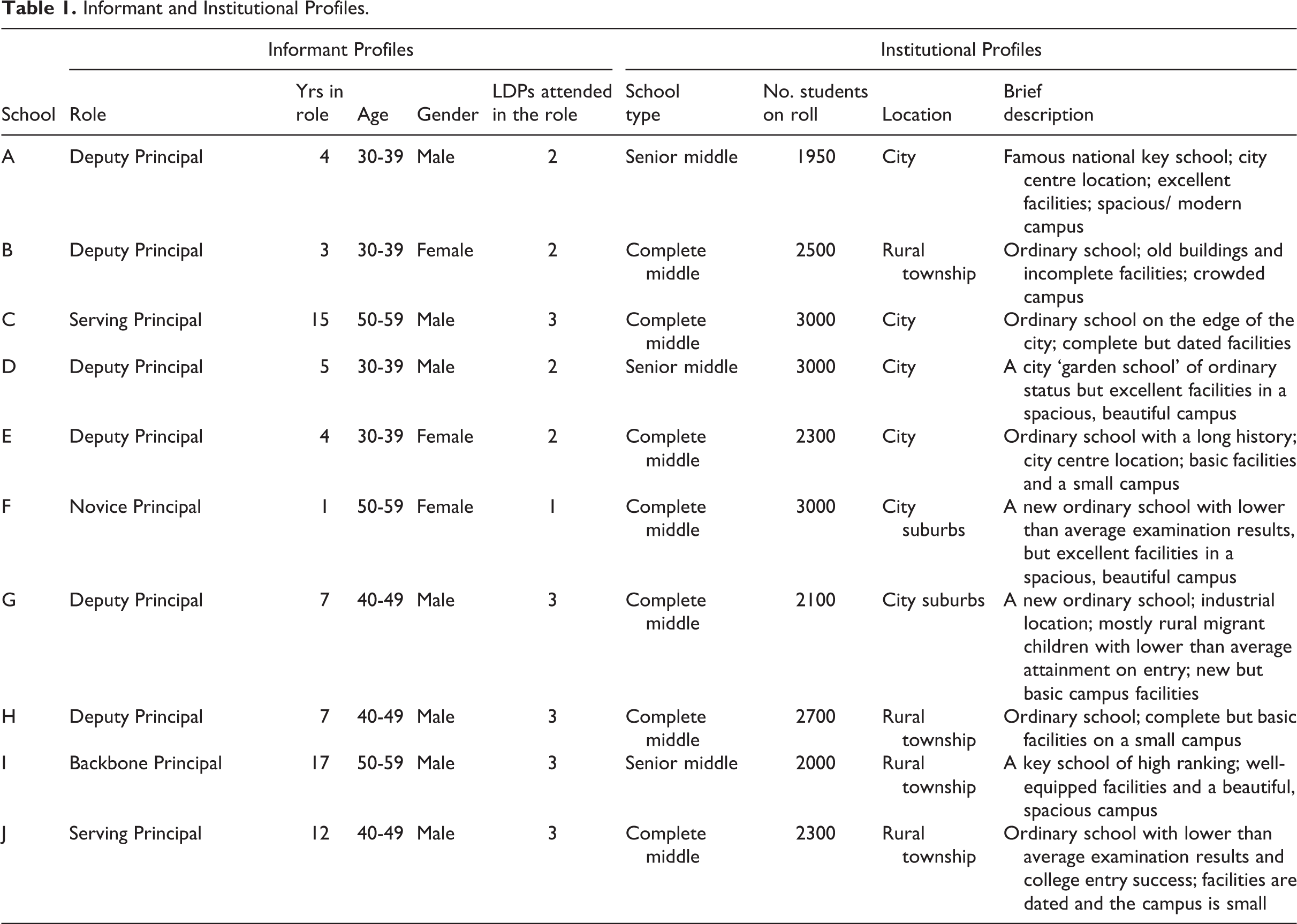
Maximum variation sampling also applied to the sample of interviewees, dimensions of variation covering gender, age, status, experience and the number of leadership development programmes (LDPs) attended in their current leadership roles. Participants included six deputy principals (fu xiaogang), able to comment on the most recent pre-service training provision, and three categories of school principal able to comment on in-service development programmes: a novice principal (xin xiaogang), with only one year’s experience, two serving principals (zaizhi xiaogang) each with 12 years’ experience, and a backbone principal (gugan xiaogang) with 17 years’ experience of headship (Table 1).
The interviews were conducted during two one-day visits to each school, allowing time also to carry out informal observations to supplement context-specific information from school documents. An open-ended but focused interviewing technique was adopted using four semi-structured questions closely aligned to the three research questions. What pre-service and in-service opportunities have you experienced in support of your current school leadership role? (RQ1) What learning experiences, if any, have left a deep and positive impression in developing your leadership capacity and in meeting your perceived needs as a school leader? (RQ2) What experiences, if any, have limited your opportunity for leadership learning and/or its practical application in your school? (RQ2) In your opinion, how could opportunities for leadership learning be enhanced? (RQ3)
The interview process was sufficiently flexible to obtain as much information as possible as a basis for a collective analysis. Responses were probed in depth (Kelly, 2002) to clarify, engage and empathize with informants’ conceptions, intentions and conscious decisions relating to their leadership learning experiences. The interviews were recorded and transcribed with the consent of the informants.
Steps were taken to enhance the validity of the research findings. First, the transcripts were translated from Chinese into English, prioritizing ‘functional’ over ‘literal’ equivalence to ensure greater accuracy of interpretation (de Vaus, 2008: 261). Second, the principles of phenomenographic data analysis (Marton (1981, 1986) were followed in assigning codes to emerging themes to make systematic comparisons of respondents’ accounts. The process was iterative, examining and re-examining the data to ensure that the final configurations faithfully represented informants’ experiences, in order to establish content validity and final ‘categories of description’ (Marton, 1986: 43; Kelly, 2002). Respondent validation (Silverman, 2001: 236) was further enhanced by inviting informants to comment on the accuracy of our interpretations prior to publication (Kvale, 1995; Cope, 2004).
Reliability, in the sense of consistency in the assignment of instances to ‘categories of description’, was achieved through the use of ‘low-inference descriptors’ (Seale, 1999; Silverman, 2001), including verbatim accounts of the interviewees with illustrative quotations to allow transparency of interpretation. The two investigators first carried out an independent analysis of the data. This was followed by reliability checks by comparing the independent coding, categorization and data analysis, to achieve equivalence of meaning between the use of Chinese and English, and consistency and agreement in interpretation.
The research ethical guidelines of the lead author’s organization were followed. Permission to carry out the research on the basis of informed consent was first obtained from the local education officer and the participating school leaders. The names of the participants and their institutions were anonymized and confidentiality assured.
Research Findings
Opportunities for Leadership Learning (RQ1)
Two ‘categories of description’ emerged from the evidence. The first was opportunities for formal learning through pre-service and in-service training courses of a kind that tends to be institutionalized, bureaucratic, driven by a curricular agenda and formally recognized though the award of qualifications (Merriam et al., 2007: 29). The second was opportunities for informal learning taking place independently of instructor-led programmes. This has been variously described in the literature as the self-directed, intentional, conscious learning of the ‘reflective practitioner’ (Schön, 1987) and the ‘extended professional’ (Hoyle, 1974). It can be an incidental, epiphenomenal or accidental by-product of more formal learning (Marsick and Watkins, 1990), as well as a ‘situated’ social process (Lave and Wenger, 1991), embedded in ‘communities of practice’ (Wenger, 1998), which facilitate learning from working alongside colleagues through informal professional networks.
Formal learning provision was extensively reported in the documentary evidence and emerged as a key ‘category of description’ from the interview data, the 10 interviewees having attended between one and three leadership development programmes (LDPs) in their current posts (Table 1). Three key subcategories of formal learning emerged: learning through theory; learning through practice; and the learning implications of a centrally controlled training agenda.
The four official documentary sources and the interviews described a pattern of school leadership training and development in Fujian consistent with the national framework. Compliance with a succession of five-year plans had focused on the needs of trainees at different career stages in school leadership. The training had also become more systematic and innovative in attempting to integrate learning from educational leadership theory and practice. Trainees therefore typically underwent a month’s initial theoretical training, focused on political and educational philosophy, educational reform and school administration and management. This was followed by two months of personal study and reflection, leading to an assignment based on the application of leadership and management principles to a real issue or challenge in trainees’ own work contexts. Participants were also provided with the opportunity to visit famous key schools in order to learn from best practice, followed by a written report reflecting on the experience.
As might be expected these official accounts were unquestionably upbeat about the progress made in school leadership training, but they also drew attention to major challenges that still need to be addressed. Significant among these was the relative neglect of in-service, as opposed to pre-service, training explained on account of a need to comply with the central government regulation, that school principals who had not successfully completed their pre-service training within a specified time period would not be allowed to remain in post. This relative neglect of in-service training was consistent with evidence from an earlier study by Yang (2006), who found that in Fujian only 167 of approximately 1900 middle school principals had received any such training. An urban–rural disparity was also acknowledged: of the 60 school principals from Fuqing who had undertaken advanced training, 48 (80 per cent) were from urban schools (FMG, 2007).
Informal learning was not reported in the documentary evidence, but emerged from the interview data. Two broad inextricably linked subcategories of informal learning were identified: personal self-directed learning and situated social learning through participation in professional communities of practice.
Self-directed learning was articulated through a combination of knowledge acquisition, particularly in preparation for school leadership, and reflection on personal leadership experience after becoming a school principal. Deputy Principal B commented: ‘I prepared for my position. For self-learning, I read books about leadership, such as how to do well in the role of deputy principal.’ Deputy Principal A also drew attention to the value of prior work experience: ‘Before being appointed, I was the Secretary of the Youth League Committee. I gained valuable experience in a leadership capacity and improved my organizational and communication skills.’ Experiential learning as an informal process also took place through trial and error. Deputy Principal E, for instance, reflected on her conversations with students and her concern that they had no opportunity to voice their opinions about the school or their teachers: So I created a mail box open to all students to get their comments on school management and teaching. As a staff, we discuss students’ suggestions and criticisms, reply to them and change anything that is unsatisfactory on the basis of the feedback. We have used the evidence to help in the evaluation of teacher performance. This was potentially risky, but we have found that the system motivates teachers as well as students.
Informants also highlighted opportunities for situated social learning through participation in professional communities of practice. Such communities were seen as informal leadership support networks, both within and between schools. There was a temporal dimension to such learning, senior colleagues recounting how they had been inspired by role models in the early stages of their teaching careers: ‘I learned much from my colleagues and former leaders, who gave me practical suggestions when I met difficulties’ (Deputy Principal E).
Meeting Perceived Learning Needs (RQ2)
In meeting learning needs, informants identified three key categories of influence: formal learning provision through official training programmes, opportunities for informal learning, and the impact of wider systemic-contextual factors. Each can be assessed in turn.
In respect to formal learning, all 10 respondents agreed that there was an emphasis on theory in course provision. Comments generally indicated a perceived failure of theory to meet learning needs. Deputy Principal H expressed his personal dissatisfaction in saying, ‘A disadvantage is that the content of the training is too theoretical and the methods of training monotonous’, while Deputy Principal D commented on its limited value: I discussed some training programmes with my classmates. Most of us think that the training is too theoretical, offering too little in terms of skills or knowledge related to our practice.
Deputy Principal E added: Their courses have good ideas but poor applicability. Some experts or scholars from academic institutions have no sense of the real world of school leadership practice.
However, there was also recognition that theory can provide a foundation for understanding, especially when integrated with more practical, skills-based training through praxis. Principal F, sceptical of the way theory was currently being applied in school leadership training, was not critical of theory per se when appropriately applied: I had worked in teacher training institutions for about twenty years. I also edited a textbook on training, so I had accumulated educational theory which, when combined with experience, helped me a lot before I became a school principal.
Deputy Principal B commented that she had benefited significantly from reading books about leadership in preparation for her position as a deputy, while Deputy Principal G also emphasized ‘the importance and value of combining theory with practice’.
All respondents were very positive about the benefits of formal training based on school-based practice. Three key elements were identified as being particularly beneficial: school visits, the involvement of experienced and highly successful school principals in the training programmes, and workshops based on school case studies and problem-solving tasks. The opportunity to visit outstanding schools was seen as a means of learning best practice at first hand. Deputy Principal D noted the significance of such visits on observing the leadership styles of outstanding principals, and how such observations had helped to shape his own philosophy and approach to leadership: I visited some elite secondary schools in Fujian province. I gradually realized that the leadership and management philosophy has a direct influence on the atmosphere of the school…The characteristics of the school reflect the personality and values of the principal…These experiences told me that the style of leadership is very important to the school and have inspired me to develop myself as an effective leader.
Other respondents made reference to how visits to elite schools provided an opportunity for networking, the sharing of ideas (Deputy Principal A) and resources (Principal C). However, they were not always successful. In the words of Principal I: I will say that I have visited many schools both within and outside of Fujian province, but most of the visits were ineffective. First, the time is too short: the visit is usually conducted in a day, and we cannot learn anything in depth in a day. Second, the attitudes of the schools visited are often not very good; they are more interested in showing off their own achievements than in helping us to improve our own schools.
The contribution of experienced principals to formal training programmes was enthusiastically welcomed, because they have first-hand knowledge of school contexts, understand the needs of practising school leaders and are in a position to share a wealth of practical experience. Deputy Principal A recounted how ‘sessions given by experienced principals inspired me’, while Deputy Principal B said that ‘tutors who were former principals make sense of the reality of headship, understand what practitioners actually need and can be a source of inspiration’. Likewise, the involvement of leading principals in training programmes was linked to the benefits of learning activities based on school case studies and problem-solving workshops. In the words of Deputy Principal H: Case study is a good method to analyse problems. It is very helpful for illustrating how to conduct leadership and management in a better way. Training which included case study inspired me to carry out some new ideas in the management of my own school.
While interviewees agreed that significant improvements had taken place, they were critical of the centrally controlled training agenda. Principal J acknowledged the inevitability of raising policy awareness, but pointed out that it fell short of meeting the wider needs of school leaders: The advantages of leadership development programmes are to master the national curriculum policies and to realize the direction of education reform, but this is not enough to improve school leadership and management practice, and the training time is too short.
A minority of respondents were more direct in their criticism, suggesting that government interests were put before those of school leaders: The aims of school principal development programmes pay more attention to serving the Party’s need, while neglecting school leaders’ practical needs and their professional development.
Another suggested that a reluctance to be openly transparent meant that courses ‘usually only report what is good, while concealing what is unpleasant or problematic – a situation that is unhealthy for the development of school leaders and their influence on education’, a problem reflected in the perceived inadequacy of training course evaluation: Course evaluations are usually simply a matter of filling in a form to say whether we have found the training useful. Of course, it is difficult to say until we have had an opportunity to put some of the ideas into practice. And this is where there is a problem, because it is difficult to see how much of what we learn can have a real impact on school improvement.
In turning to the second category of influence, the importance of informal learning in contributing to professional growth and development was emphasized by all the informants, an observation consistent with previous research findings (Zhang and Brundrett, 2010).
In the words of Deputy Principal G: There is a Confucian slogan for education: he who excels in study can follow an administrative career. It is similar in the education cadre promotion system: she or he who excels in teaching can follow an administrative career … but this logic does not necessarily follow. Leaders therefore normally develop themselves more through practice and gaining experience on the job than from development programmes. It takes time for those principals who are good at teaching but not managing.
With more than 12 years’ experience as a principal, Principal J emphasized the value of experience in being able to analyse and solve problems: In China, the school is a small community, and as a principal you must learn to deal with practical issues as and when they arise. In my experience, if you encounter problems in practice you will learn more. You will need to consider the whole situation when you confront a problem, so your leadership capacity will be improved as you consciously build a capability to analyse and solve problems. Learning is lifelong; an ongoing process.
Deputy Principal H alluded to the importance of combining direct experience of working with people with key management principles in becoming a good team leader: First, the leader should have a deep understanding of the team members, to know what they are good or not good at so they can be allocated to an appropriate role…Then enterprise management can be used to make plans, set aims and motivate team members…A leader should care about what teachers need, especially when they are in a difficult situation. In a word, traditional Chinese culture should combine with modern management principles to lead a school to success.
Learning through networks of professional communities of practice was perceived as particularly helpful in providing mutual peer support and exchanging ideas on good practice and problem solving. Deputy Principal D, for example, discussed the importance of networking through school principal forums to maintain momentum and continuity because of the infrequency of formal training programmes. Developing personal leadership skills in social networking beyond the confines of professional communities was also seen as crucial for pragmatic reasons. In the words of Principal J: The capacity to participate effectively in social networking is very important for school principals. In their relation to higher authorities, they need to gain more financial and material resources, as well as more good teachers if they are to improve education quality. School principals also need to use their networking skills to gain help from non-government sectors to remedy the inadequate level of government funding.
These views were endorsed by Principal C, anxious to develop his own networking and interpersonal skills: There is a sentence that says that relationships are productivity in China. Although I have been a school principal for quite a long time, I still have difficulty in dealing with people and my interpersonal skills need to be improved. However, this kind of skill seemingly cannot be improved by formal training; it requires ongoing practice and developing the power of understanding.
Finally, system-wide influences, as determined by the educational policy framework, have potential to facilitate, or conversely constrain, leadership learning. In the opinion of most respondents opportunities for system-wide formal training provision to help facilitate informal learning were not exploited. There was also a common perception that the broader educational reform framework acted as a constraint, rather than a facilitator, on leadership learning and its practical application. Two factors emerged as particularly significant: the impact of the national curriculum reforms (systemic) and the impact of educational inequality (contextual).
Although well-intentioned, the reforms were seen as problematic and difficult to implement. One major difficulty identified was the perceived lack of alignment of the curricular reforms with an examination system which had remained largely unchanged, resulting in additional pressure on students, teachers and school leaders. In the words of Deputy Principal A: ‘We can only quicken the pace of the teaching and teach in a simple and pointless way.’ Attention was drawn to the frequency of the curriculum changes, lack of stability and much extra work: ‘Usually when we have just adapted to the new curriculum it changes again resulting in confusion for teachers and students’ (Deputy Principal B). Deputy Principal E also drew attention to the lack of alignment between the curricular requirements of the junior middle and senior middle phases, concluding: ‘We have no solution to the situation; teachers and students need to do lots of extra work to remedy the inadequacies of the reform.’
Training offered no solution to these problems. Informants were particularly sceptical of the neglect of instructional and curriculum leadership in formal training programmes. One commented that unpleasant or contentious issues were deliberately avoided. Another said that school principals had ‘unlimited responsibility but limited authority’ and were unable to influence either the direction of the reforms or the nature of their training. Yet another said the same of the ‘experts’, who likewise have ‘no influence over either educational reform or the scope and direction of the programmes’.
Educational inequality was the second major constraining factor, likewise an issue conspicuously absent from training programmes. The variation in the responses of informants reflected differences in their school contexts and circumstances. Rural schools were seen as particularly disadvantaged, with fewer opportunities for training and fewer resources with which to implement the reforms. Curricular leadership in such schools was seen as particularly challenging. In the words Principal J: Our material resources are inadequate for some courses such as information technology…Rural schools have low-level facilities, less well qualified teachers and lower grade students. Teachers are working under intense pressure…School principals have to take responsibility but without the necessary personnel or material resources. It is hard to carry out the work.
The financial difficulties facing rural schools were exacerbated by an unanticipated cash flow problem resulting from the ‘two exemptions, one subsidy’ reform (Zhang, 2008: 19), which from 2006 extended the right of exemption from tuition and miscellaneous school fees, along with a subsidy towards school boarding costs in remote areas, to all families. While welcomed in principle, in the words of Deputy Principal B: Payment to the school from the county authority lags behind, especially in rural schools. This situation has brought difficulties. We have no solution; only to notify the finance department that the allowance has not come and to be kept waiting until it arrives.
Another context-specific challenge was the impact of migration, the children of migrant workers remaining socially disadvantaged despite government efforts to remove barriers to basic welfare and educational entitlements (Zhu and Lin, 2011). Consequently, many migrant children are low achievers with limited social capital, as in the case of the student profile in School G (see Table 1). Overseas migration of parents from Fujian, to supplement family income, accounts for 28 per cent of the total Chinese emigrant population (Morooka and Liang, 2009), resulting in many ‘left-behind’ children. While there is evidence that increases in migrant family income have had a positive impact on higher school enrolment rates (Liang and Chen, 2007; Morooka and Liang, 2009), the overall effects of parental absenteeism on the psychological wellbeing of the children and home-school collaboration have not been researched, and according to School Principal C have had negative consequences: The ‘left-behind’ students are mostly weak, with a poor level of academic performance because of a lack of home-school cooperation and parent-teacher collaboration. These students have certainly brought some problems and significant challenges for school management.
Overall, systemic-contextual factors were perceived as negative, limiting the application of leadership learning to meeting some of the most serious challenges facing schools. The potential for formal learning programmes to facilitate informal learning was largely unrealized. The incoherence of various reform programmes not only created additional problems for school leaders but were largely ignored in the training schedules. Furthermore, differences in context created problems of inequality in both school resources and opportunities for training. Additonally, while leadership training had diversified in accordance with different stages of career development, it had not diversified in response differences in school context: Principals from different regions and different types of schools, with different students and school conditions, including different levels of educational expenditure, all attend the same courses. It is not sound. (Deputy Principal G)
Enhancing Leadership Learning (RQ3)
The interviewees made a number of explicit recommendations for enhancing the quality of formal pre-service and in-service training to meet their leadership learning needs more effectively. They argued for more in-service training to keep up with the pace of reform and frequent policy changes. In the words of Principal C: I have only been able to attend three leadership development programmes in the past fifteen years as a school principal. It is not enough. Because educational policies change every one or two years, the government needs to provide relevant training for school principals to understand the new policies and changes.
There was also a plea for improving the quality of the provision, especially in making the theoretical element more directly relevant. Principal F, for instance, suggested that the trainers should develop theories on the basis of more school-based research: Our principal training includes two main components, education policies and theory, and management theory and skills, but they lack sufficient depth to have an impact on practice – just like a dragonfly skimming over the surface of the water! This does not satisfy local or school-based requirements … ‘Experts’ should visit schools to understand the real situation at the grass-roots level, make pointed suggestions for schools and develop their theory accordingly. Trainers’ training needs also need strengthening!
While the more practical elements of training provision, such as school visits, were broadly welcomed in principle, informants regretted that in practice they often fell short of expectations. Deputy Principal E, for example, elaborated on the ineffectiveness of short visits, with recommendations for a more meaningful learning experience: School visits are too short. I think the best way is to work in elite schools for a period of time: to be an Assistant Principal or a member of the leadership group, and therefore be able to participate in their school management; or a principal could be allocated to each trainee as a coach who can lead us by the hand through the problems and difficulties that beset us.
Principal C made a similar suggestion in recommending the opportunity of ‘working in a particularly excellent school [for] a term or an academic year, so we can study how the principal actually works’.
Informants expressed a need for more specific training according to school type as well as opportunities for more individualized learning; for example, through coaching and mentoring. One principal felt left behind by the pace of modern technology: ‘Because of my age, I feel I am a bit out of step with the times; IT skills will be necessary for me!’ A deputy principal, conversely, had unfulfilled ambitions to extend her professional horizons by being able ‘to study in a high-level academic institution, such as Beijing Normal University or East China University’, while the novice principal made a plea for the kind of personalized help and support necessary to building self-confidence: To be frank, because I did not have any experience of being a school principal, I was under a lot of stress at the beginning. Sometimes I could not meet the physical demands; I felt exhausted. I am not confident about my leadership capacity. As a female leader I may be more careful and prudent, but I am not decisive enough.
The school leaders also recognized the interconnected and overlapping nature of formal and informal learning, and the potential for formal learning structures to facilitate greater opportunities for informal learning. In the words of Deputy Principal D: Due to the limited amount of time for formal training, a school leader forum is useful for us. My classmates organized an informal forum to discuss hot issues, but did not keep on. Therefore, in my opinion, if local government officials were to organize a school leader forum it would work.
Indeed, informants regretted a number of missed opportunities for formal learning systems to facilitate informal learning. The failure to assist school leaders to establish, and above all, sustain informal networks was one example. Another was the failure to establish an ‘internment’ system to enable school leaders to spend more time seconded to a highly successful elite school and benefit from first-hand experience.
In addition to explicit recommendations, interviewees alluded to a number of implicitly desired changes, especially in addressing the constraints of systemic-contextual factors, such as: inequalities of access to training provision; an overemphasis on policy implementation at the expense of school-based management; and the omission of contentious but crucially important issues related to funding, examination assessment and instructional leadership in the implementation of the curriculum reforms. It is therefore imperative that policymakers heed the concerns of practitioners in targeting support for leadership learning where it is most needed.
Discussion
The findings reveal a disparity between Chinese school leaders’ perceived leadership learning needs and the quality of pre-service and in-service provision. The perceived needs are consistent with what should be provided from the perspectives of learning theory and international evidence of best practice. Opportunities for experiential learning and participation in professional networks and communities of practice were greatly valued; for instance, in benefiting from the input of successful school leaders, in being able to visit successful schools and in engaging in group problem-solving activities. Value was also placed on informal learning through professional networks. The clear articulation of personal needs and learning priorities emphasized the importance of self-determination and school leader participation in decisions about the form and direction of leadership training. This was a need consistent with the principles of expansive learning and evidence of best international practice, including: linking learning to school contexts and real problems; substantially involving trained and experienced principals in programme delivery and as mentors and critical friends; ensuring flexibility to meet diverse needs; providing multiple opportunities for sharing, reflecting, cohort bonding and networking to promote ongoing collaboration; recognizing and respecting the existing skills, values and knowledge of school leaders; and applying systems of meaningful evaluation (Walker and Dimmock, 2006).
Although provision was moving towards meeting school leaders’ needs in offering differentiated training according to experience, along with some opportunity for experiential learning (for example, through school visits and problem-solving workshops), it was falling short of expectations. School visits and observations of limited duration were seen as no substitute for the ‘situated cognition’ or ‘legitimate peripheral participation’ that would be possible through internships in successful schools. Arguably more serious was the perceived lack of opportunity for either expansive learning or critical reflection, which appeared possible only through personal, self-directed learning. Training agendas were tightly regulated from the centre with neither trainers nor participants having any say in the content or direction of the training – a situation more consistent with ‘defensive’ rather than ‘expansive’ learning – while contentious issues, in antithesis to the principles of critical engagement, were absent from training agendas. Consequently, informants were sceptical of the impact of formal training on either authentic leadership learning or its impact on school improvement.
There can be no doubt that school leadership training in China has developed significantly over the past three decades, but a key message conveyed by the informants was frustration with a training agenda biased towards policy awareness and policy implementation. They saw their own needs and priorities largely marginalized. In general, informants emphasized the need to enhance skills both in developing the professional capabilities of teachers and in managing external relations in support of their schools. Effective leadership learning therefore requires more attention to mentoring and peer support, along with bespoke programmes to address leadership strategies and priorities according to school context. Given the magnitude of the challenge in delivering on both the educational quality and equality reform agendas, school principals require learning opportunities to enable them to become transformational leaders with critical insight, strategic vision and the ability to engage and energize stakeholders in pursuit of achieving that vision.
Conclusion
While insights from the sample of informants resonate with what we know from learning theory and international best practice, there is need for caution before universalizing theoretical claims, especially given the unique political and cultural context of China. Similarly, while international collaboration has the potential to enhance the quality of leadership learning, for instance, in assisting areas where access to training is currently limited, and in providing opportunities for overseas visits and international networking to extend the learning horizons of Chinese school leaders (Krajewski, 2006; Wang, 2007), there is need for caution in adopting Western-based practices not necessarily suited to the Chinese educational context (Zhang, 2011). Chen (2008) has rightly drawn attention to an unthinking importation of ‘foreign vocabularies’, now ‘widely used in policy papers and research’, but with insufficient reflection on their precise meaning or significance to Chinese school leadership.
To further enrich our understanding future research could take account of local cultural and contingent factors, with a focus on the adaptation of international best practice to meet local needs and priorities. Given the size and diversity of China more research is required to assess the differential learning needs of school leaders in diverse socio-economic and cultural contexts, and how training opportunities can be best tailored to satisfy those needs.
On the basis of a small localized sample, evidence from this study cannot be generalized in any conventional sense, not that this was ever intended. But from the perspective of transferability or naturalistic generalization (Stake and Turnbull, 1982), readers may be able to empathize with our informants and identify parallels which resonate with their own leadership learning experiences. More importantly, the study has voiced the perspectives of school leaders themselves, whose insights shed new light on current opportunities and constraints in leadership learning and how the constraints might be addressed by policymakers.