







Abstract
Since the implementation of the Pre-primary Education Voucher Scheme (PEVS) in 2007, its built-in quality assurance mechanism has brought about subtle changes in the work relationship between kindergarten (KG) principals and teachers. The increasing demand for accountability and the call for improvement in the quality of pre-school education are altering the conventional practice of school management, which had been strongly affected by Chinese cultural values. In the meantime, the collaboration and teachers’ participation in making decisions in KGs, which are emphasized in the quality assurance mechanism of the PEVS, are influencing the leadership styles of KG principals in managing their staff. This article presents the findings on Hong Kong KG teachers’ perceptions of their principals’ leadership practices in the context of such managerial changes.
The context of managerial changes in Hong Kong schools
Schools in Hong Kong have inevitably been influenced by traditional Chinese cultural values, although Hong Kong was ruled by the British for more than 150 years. Individualism gives way to collectivism in a traditional Chinese society: individuals act according to collective expectations and in line with the hierarchical relationships in a family and organization (Fei, 1947). According to Hofstede (2001), there is a large power distance between people of different ranks in a Chinese society. It was therefore expected by both principals and teachers that a type of strong, almost autocratic, leadership was to be practised by principals in Hong Kong schools. Teachers’ involvement in school management tended to be hierarchically bounded, and school principals had almost absolute authority over staff selection and promotion. If principals did not display strong leadership, they were regarded as having neglected their leadership role (Walker, 2004). In discussing teacher education and empowerment, Lo (2002) also suggests that Hong Kong schools should be understood in the context of hierarchy. Thus, we can understand why ‘little emperors with dictatorial powers’ was used as a metaphor to describe the Hong Kong school principals in the School Management Initiative (SMI), a policy paper released in 1991 by the Education and Manpower Bureau (EMB) and Education Department (ED) of the Hong Kong Government 1 on setting the framework for quality in local schools.
The publication of the SMI in 1991 was a milestone in the reform of educational management in Hong Kong schools. It aimed to improve the efficiency of educational provision and to provide quality education in schools; and it identified and examined problems in the systems of school management and funding. After interviewing a large number of principals, members of the school sponsoring bodies and officers of the Education Department, the following recommendations on school leadership were made in the SMI (EMB and ED, 1991: 37–41): The role and responsibilities of the principal should be set out in a Principal’s Manual. School management frameworks should allow for participation in decision making by all concerned parties including principal and teachers. Each school in the public sector should produce an annual school plan to guide its activities during the year. Each school should prepare an annual school profile covering its activities in the previous year and detailing school performance in a number of key areas.
Six years later, the Education Commission (EC) formulated recommendations on enhancing the quality of the school system in its Report No. 7 (EC, 1997). The major concern of this report was to facilitate schools in striving for improvement in their performance. The EC suggested that, in addition to building a quality culture, a quality assurance mechanism should be developed in the public school sector. This mechanism was to be composed of both internal quality assurance to be achieved through school self-evaluation and external quality assurance to be conducted by the Education Department. The EC’s Report No. 7 also recommended that the Hong Kong Government should devolve its administrative and financial authority to schools and encourage school-based reforms. All public sector schools were required to put school-based management into practice by the year 2000. The Advisory Committee on School-based Management, which was appointed by the Education Department in December 1998, reiterated that schools should be given greater autonomy in the delivery of education and deployment of resources, and principals should not act just as custodians of their schools but play a more prominent role as professional leaders and chief administrators (ACSBM, 2000). In order to work together with teachers and parents, and be responsible to them for their schools’ performance, principals need to undergo a paradigm shift in their leadership in the context of school-based management. They have to move from the traditional concentration on maintenance and hierarchy to change, collegiality, teamwork, improvement and effectiveness (Task Group on Training and Development of School Heads of ED, 1999). To help principals change their mindsets in managing their schools, new principal training programmes were designed to equip them with the necessary knowledge, skills and attitudes to: increase understanding of the critical role of a principal in the development and maintenance of effective schools; improve skills in strategic planning and implementation processes; and shape a personal vision for leadership and continuous professional development.
According to the Education Department’s guidelines for principals’ continuing professional development (CPD) – which aim at empowering principals to become effective and professional leaders and administrators of schools – principals need to develop values, knowledge, skills and attributes in six core areas of leadership 2 (Education Department, 2002).
School-based management and the requirement for principals to undergo continuing professional development allow schools greater flexibility in resource utilization, and principals have to adjust their role and practices in leading their schools. However, the school-based management and continuing professional development required by the Education Department are mainly for publicly funded schools. Early childhood educational settings, for example kindergartens, which are privately owned and operated, are theoretically immune to these policies. However, following the global developments in early childhood education and the education reforms in Hong Kong, the quality of pre-primary education became a concern for the Hong Kong community and government. The Pre-primary Education Voucher Scheme (PEVS), which was implemented in 2007–2008, aims mainly at ensuring that all Hong Kong children can receive affordable and quality pre-primary education through direct fee subsidies provided to parents with young children attending kindergartens. Non-profit-making kindergartens can join the scheme and obtain financial support from the government for upgrading the qualifications of serving teachers and principals. Serving KG principals are required to complete the Principalship Certification Course 3 by the end of the school year 2012–2013; and from the school year 2009–2010, newly appointed KG principals have had to complete the course before taking up the posts. In the meantime, a quality assurance mechanism for kindergartens was put in place in the school year 2007–2008. PEVS kindergartens are required to compile two documents annually – a School Report and an Annual School Plan – for school development and accountability purposes. The School Report should include a self-evaluation of the kindergarten’s performance and the annual School Plan should provide details about the strategic planning for school improvement in the coming school year. The kindergartens’ self-evaluation is to be validated in the form of a Quality Review by the Education Bureau (EDB) from the end of the school year 2011–2012. Thus, the education reforms and general awareness of the quality of Hong Kong’s school education have called for increased accountability and improvement in Hong Kong’s pre-primary education.
Aims of the survey
Although decentralization and teacher empowerment were encouraged after the implementation of a school-based management policy, principals were still in a very strong position in making decisions in schools. Schools in Hong Kong were still perceived to be practising a bureaucratic style of management, and teachers’ involvement in school management tended to be hierarchically bounded because of influences from Chinese culture. Principals of primary and secondary schools in Hong Kong seemed to be more sensitively aware of the structure of their schools than were their Western counterparts (Lam, 2002). As revealed in the 2000–2001 OECD Programme for International Student Assessment (PISA) data, principals were still the primary decision-makers in the Hong Kong educational system, even though Hong Kong had a more decentralized system at school level than had Japan and Korea (Ho, 2006).
Research findings on principals’ leadership in Hong Kong schools have suggested that shared leadership is difficult given the deep leadership structures in many schools. Teachers’ involvement in school decisions is not structurally obvious (Kwan and Walker, 2009; Walker, 2004; Walker and Ko, 2011). A study of the principals’ and teachers’ perceptions of school-based management in Hong Kong primary schools also revealed that not many teachers could state explicitly the mission and policy of their schools (Yau and Cheng, 2011). In early childhood settings, Ho (2009) found that the leadership process in kindergartens took a highly centralized form, although there was delegation of some tasks and responsibilities. KG principals played a leading role in every aspect of the operation of the school, and were almost the sole source of inspiration for school improvement; and KG teachers rarely took the initiative to be involved in school decision-making. Although there have been some studies on the leadership practices in Hong Kong kindergartens, they have focused mainly on KG teachers’ participation in curriculum and pedagogical development (Ho, 2009, 2010a, 2010b). Research which examines the leadership styles of Hong Kong KG principals is still limited.
With the implementation of the PEVS, the Quality Review has served as a vehicle for fostering improvement and development in kindergartens. Quality Review Reports have revealed that many kindergartens have adopted the skills of strategic planning, such as SWOT analysis, prioritization of the schools’ major concerns, and periodic review and revision of objectives in formulating their School Reports and Annual School Plans (EDB, 2010). Thus, changes in the hierarchical relationship between principals and teachers in kindergartens are expected as a result of the enhanced teachers’ collaboration and participation in school decision-making. This study, which uses a quantitative approach, aims to identify the leadership styles of Hong Kong KG principals in the context of managerial changes in schools.
Leadership style refers to how a leader plays a role in leading his/her followers – that is, the style of behaviour adopted by the leader. It is determined by the motivational system of the leader, i.e. the underlying needs structure that motivates behaviour in interpersonal situations (Hoy and Miskel, 2008). Different styles of leadership can be identified according to the leader’s behaviour, i.e. how he/she makes decisions, reacts, and interacts with and treats other people. The behaviour of leaders is affected by their philosophy, experience, traits and personality (Gibson et al., 2012; Guthrie and Schuermann, 2012). There are various behavioural theories of leadership, varying from focusing on task to focusing on people, and from leader-dominating to subordinate-involving in decision-making processes (Gibson et al., 2012; Hoy and Miskel, 2008; Martin and Fellenz, 2010; Owens and Valesky, 2011).
The leadership styles into which the KG principals are categorized in this study are: transactional leadership, transformational leadership and distributed leadership. These three styles of leadership reflect different ways of motivating the teachers and different degrees of centralization/decentralization of authority in schools. In this respect, transactional leadership and distributed leadership can be regarded as the two end-points of a spectrum: transactional leadership can be viewed as a style with the least decentralized control in school management; distributed leadership involves a relatively high degree of decentralization; and transformational leadership lies somewhere between them. Transactional leadership is characterized by the leader’s ability to bring about compliance from group members upon request through exercising the power of rewarding and giving recognition to staff members (Bass, 1985; Blau, 1964). Transformational leaders, on the other hand, do not exert their influence on others through a reward and recognition system but instead by socializing their subordinates. Staff members are motivated through the sharing of values and ideas, creating shared visions and enhancement of their self-efficacy (Bass and Riggio, 2006; Den Hartog et al., 1999; Leithwood and Jantzi, 2006). Distributed leadership has been advocated in recent decades because of an increasing demand for teacher participation in school management and growing concern about the quality of school education. Distributed leadership is characterized mainly by empowerment and the leader’s ability to facilitate the participation of staff members (Harris, 2002). Distributed leadership practices recognize that there are multiple leaders and that leadership activities are widely shared within an organization. As Harris and Spillane (2008: 32) comment: It implies a social distribution of leadership where the leadership function is stretched over the work of a number of individuals where the leadership task is accomplished through the interaction of multiple leaders.
Distributed leadership in school management therefore implies that the responsibilities of leadership are extended beyond principals, and teacher participation in school management is valued.
These three types of leadership style are adopted in this study because all kindergartens in Hong Kong are privately run so that KG principals enjoy greater flexibility in using their funds than do public sector primary and secondary schools. KG principals are more able to exercise rewarding power to motivate their teachers. However, on the other hand, with the implementation of the Quality Review, which promotes collaboration among teachers and teachers’ participation in school decision-making, more devolution in kindergartens is expected. Moreover, principals’ knowledge, skills and competence in leading their staff will have been enhanced as a result of qualification upgrading and continuous professional development. They will probably move from the exercise of reward power to some other ways of leading and motivating their teachers.
Methodology, instrument and data set
A questionnaire survey was adopted to explore the KG teachers’ perception of their principals’ leadership practices. In analysing leadership style in schools, it is necessary to understand how school leaders define, present and carry out micro-tasks such as day-to-day work, motivating followers and building school visions, and to explore how they interact with others in the process (Spillane et al., 2001). Therefore, the styles adopted by leaders can be identified by looking into their leadership behaviour – that is, the characteristics of how they motivate their subordinates and interact with other people in managing their organizations. The questionnaire consisted of 69 items about the various features of how leaders execute their micro-tasks in line with the three types of leadership, and used a six-point Likert scale with 1 denoting that the respondent strongly disagrees and 6 strongly agrees with the description of his/her principal. The items were tested in a pilot survey in which 72 kindergarten teachers were involved. The questionnaire was then streamlined and refined to one consisting of 15 items measuring the teachers’ perceptions of their principals’ leadership practices in three significant aspects, namely: ‘giving reward and recognition to teachers’; ‘practising role modelling and communicating shared vision among teachers’; and ‘empowerment and facilitating the involvement of different leaders in school tasks’. These three aspects are the key features of transactional leadership, transformational leadership and distributed leadership, respectively. Each of these three leadership practices was measured by five items. The items in the questionnaire adopted for this survey were as shown in Table 1. KG teachers pursuing a Diploma in Early Childhood Education programme at the Open University of Hong Kong were invited to take part in the survey in 2011, and 284 completed questionnaires were received.
Questionnaire items.
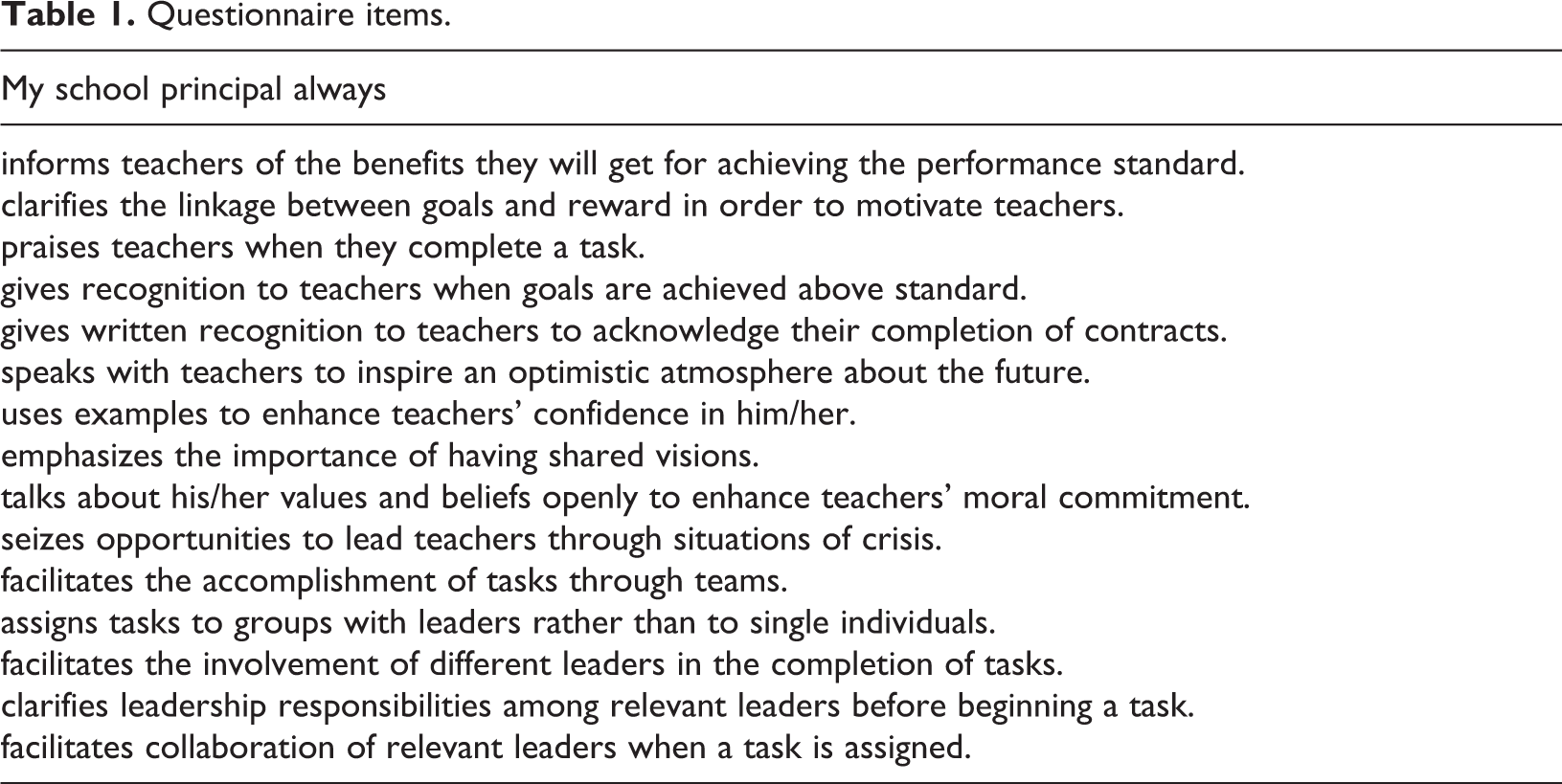
Correlation analysis was used to validate the internal consistency of the items for each leadership practice. Cronbach’s α for the items about Reward and recognition, Role modelling and shared vision and Empowerment and participation were .875, .890 and .809, respectively, as shown in Table 2. This reveals that the items developed for the questionnaire were highly internally consistent in measuring the respective leadership practices.
Cronbach’s α, mean and standard deviation values.

Results of the survey
The mean values of the teachers’ perceptions of their principals’ leadership practice were obtained by averaging the ratings on the corresponding items. Fifteen respondents who had answers missing in their questionnaires were excluded in the following chi-square and ANOVA tests. Table 3 indicates the frequencies of the leadership features which had the highest mean values in rating the items with respect to the three types of leadership practice. Thirty-two of the 269 teachers involved gave the same highest rating to two types of leadership practice, and 16 of them gave the same highest rating to all the three types of leadership practice.
Frequencies of KG principal leadership practices.
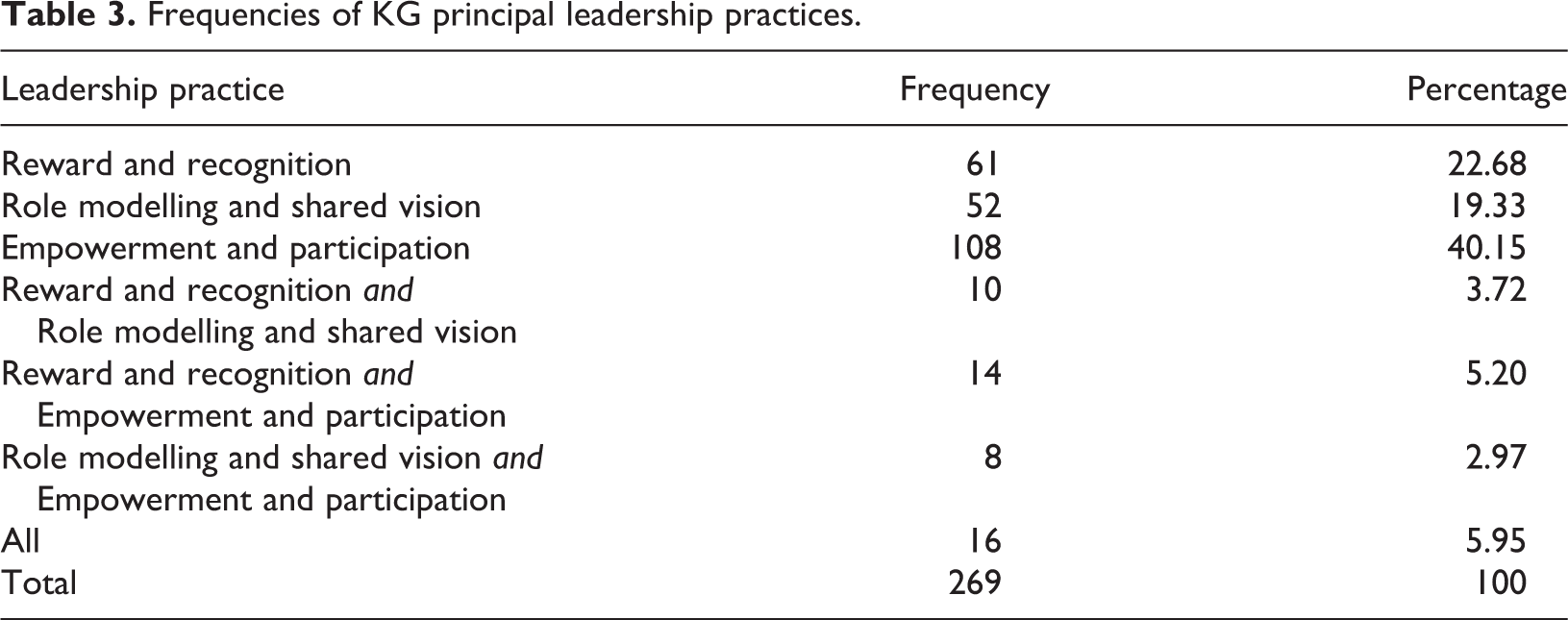
Empowerment and participation had the highest frequency among the three types of leadership practices, accounting for 40.15 percent of the respondents. To see if the number of KG teachers with different perceptions of their principals’ leadership style differed from what would be expected if each style had an equal number, a chi-square test was carried out for the 221 respondents who gave the highest average rating to only one of the three leadership practices. As can be seen in Table 4, the results were significant as the probability is smaller than .05.
Chi-square test.

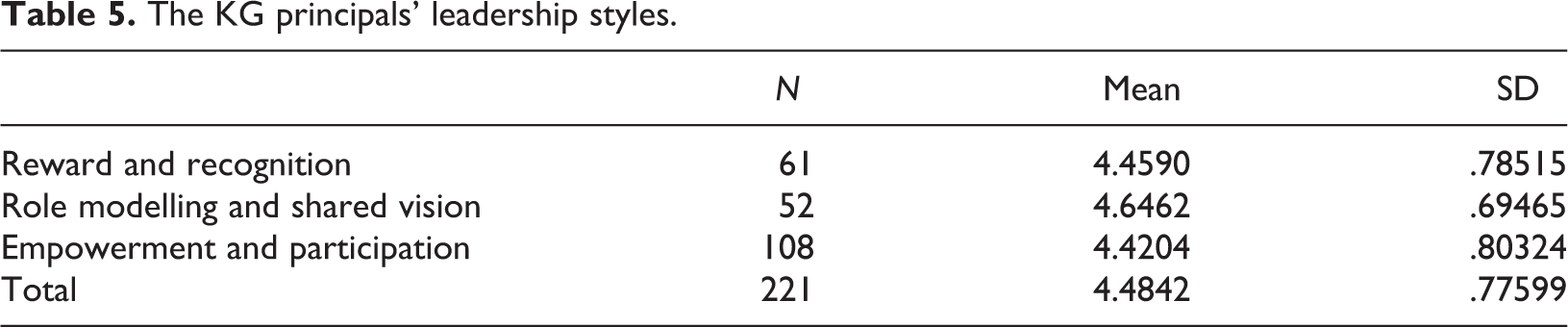
The mean values and standard deviations of the 221 KG teachers’ perceptions of their principals’ leadership styles are listed in Table 5. Role modelling and shared vision had the highest overall mean rating among the three leadership styles.
The KG principals’ leadership styles.
Because the various types of leadership practices are not mutually exclusive in motivating people to get things done and no single leadership practice is applicable to all situations, the leadership style used in one situation should not constrain the styles used in other situations (Gibson et al., 2012). Therefore, KG principals may adopt a mix of them for achieving both the students’ learning outcomes and organizational outcomes, although they may have one dominant style. A Pearson correlation and ANOVA analysis were then conducted to find out if there was any correlation in the adoption of leadership practices by the KG principals, and if there were any significant differences in the KG teachers’ perceptions of their principals’ leadership practices. The results of the analysis are given in Tables 6 and 7.
Pearson correlation matrix for the three types of leadership practice.
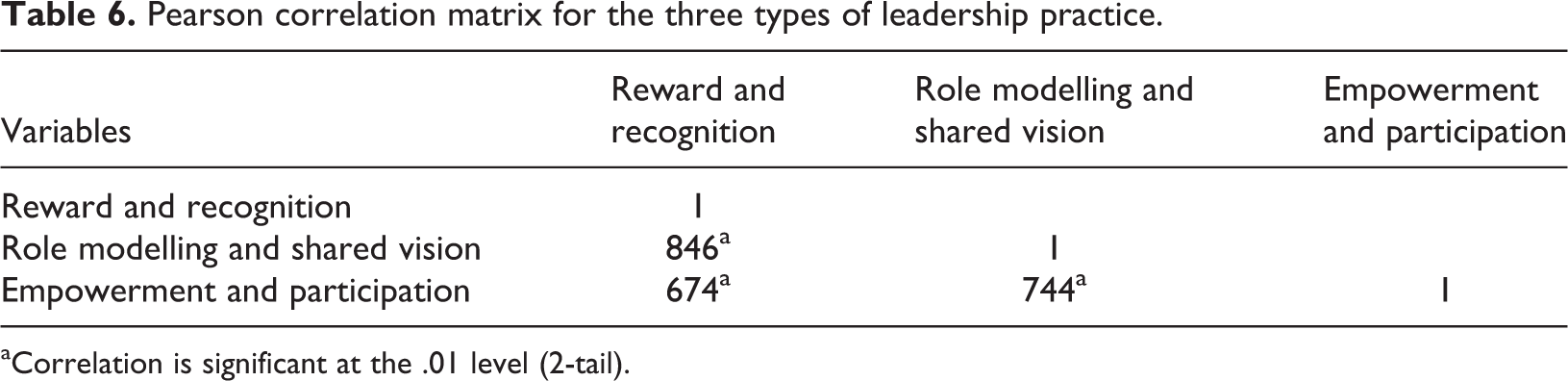
aCorrelation is significant at the .01 level (2-tail).
ANOVA analysis of teachers’ perceptions of their principals’ leadership practice.

Findings and discussion
This study shows that the three types of leadership practices adopted by the Hong Kong KG principals are closely correlated to one another as the correlation coefficients are all significant at the .01 level. This may reflect the fact that these principals try their best by all means to get things done: they do not rely solely on exercising their reward power, even though they enjoy much more flexibility in doing so. The chi-square test also reveals that the majority of KG teachers gave the highest mean rating to Empowerment and participation in their perceptions of their principals’ leadership. However, this does not imply that the KG principals have changed from transactional leadership to distributed leadership in managing their schools as the ANOVA analysis showed no significant difference in the mean values of the respondents’ perceptions of their principals’ leadership practices. Also, 48 respondents gave the same highest mean rating of their principals to more than one type of leadership style. Nevertheless, this survey shows a scenario about the management practices of KG principals which is different from that in Ho’s 2006 study, where the process of exercising school leadership in kindergartens took a highly centralized form, although there was delegation of some tasks and responsibilities (Ho, 2010a). This study reveals that most of the KG teachers perceived their principals as tending more to practising Empowerment and participation, and Reward and recognition and Role modelling and shared vision were also used in managing their schools.
KG teachers in this survey perceived that not only do their principals exercise their reward power but, to a certain extent, also motivate their teachers through the sharing of values and ideas, create shared visions, assign tasks to groups instead of single individuals, and facilitate the involvement and cooperation of various group leaders in completing a task. This change in the style for leading kindergartens may have been caused by the implementation of the PEVS, which has brought about changes in the mindsets of both KG principals and teachers about teachers’ participation in school decision-making and management. KG principals have become more aware of the value of having shared visions, enhancing teachers’ self-efficacy, and promoting teacher collaboration and team-working in managing their schools; and KG teachers have recognized the benefits of taking up a more active role in school affairs. The fact that kindergartens are small and have simple organizational structures may be one of the reasons for facilitating teacher participation in their daily affairs. Also, the PEVS and the Quality Review which advocate team-working in schools and teacher involvement in school management may have become a catalyst for changes in the paradigm for managing kindergartens.
Implications and limitations
If the change in KG principals’ leadership practice indicated in this survey is the result of the PEVS, the Education Bureau should continue the PEVS and Quality Reviews – despite the complaints from many KG teachers that these measures have created extra paperwork for them – because transformational leadership has been found to have a strong impact on teachers’ motivation and commitment and a positive effect students’ achievement (Leithwood and Jantzi, 2000, 2006; Yu et al., 2002), and sustainable distributed leadership can be regarded as a viable solution to teacher alienation and the building of both individual and organizational capacity (Kennedy-Plant, 2009). When leadership functions involve the work of a number of individuals among whom there is spontaneous collaboration, professional autonomy can be reinforced and job satisfaction enhanced. Teachers will also be more accountable for the quality of learning and teaching if they can take a more active role in curriculum and pedagogical decision-making (Ho, 2010b). Through sharing the responsibility for decision-making and school performance, positive interactions among teachers, and principals’ facilitation and support, schools’ capacity for dealing with changes will also be promoted.
However, as convenience sampling is used in this survey, the results obtained can hardly be used to generalize a full picture of the leadership styles of Hong Kong kindergarten principals – there may be teachers working in the same school who have different perceptions of their principals’ leadership practices. This problem cannot be dealt with properly here as the KG teachers were not asked to provide the names of the kindergartens in which they worked. Therefore, although this survey found that the majority of the respondents considered their principals to be practising Empowerment and participation in managing their schools, it would be worthwhile to conduct a more comprehensive survey to gain a clearer and fuller picture of the leadership practices of Hong Kong KG principals. Also, studies on the causes of any changes in KG principals’ practice, and the extent to which each cause contributes to such changes, are called for.