







Abstract
The purpose of this study of school improvement planning in the southeastern USA was to establish the current view of the process through the eyes of the district superintendents. The answers to the questions were consistently mixed. Generally, the presence of school improvement planning is prevalent in the large majority of districts. However, the data indicate a lack of fidelity to the process between superintendents’ beliefs regarding the process and how they perceive those tasked with development and implementation of the process. Given that school improvement planning is an internationally accepted process, the findings have implications not just for the USA but for international audiences as well. The authors make two recommendations: (1) significant further research into the effects of the process on student learning, and (2) continued research into the reasons for the lack of congruency indicated here between district expectations and school development and implementation.
Introduction
In some form the ubiquitous school improvement plan (SIP) is found in every state in the USA (Dunaway, 2012). School improvement/reform efforts are by no means limited to the USA. Hallinger and Heck (2010: 95) wrote of the expansive nature of school reform and of the broader implications for district- or system-wide efforts:
Over the past 50 years, scholars in Europe, North America and the Asia Pacific have sought to understand if and how leadership contributes to school improvement and more specifically to student learning. This research generally supports the conclusion that leadership contributes to learning through the development of a set of structural and sociocultural processes that define the school’s capacity for academic improvement.
The Business Model Foundation
Typically, the process is built around a model of continuous improvement often attributed to the work of W. Edwards Deming as he led the reviving of the Japanese industry after the Second World World (The W. Edwards Deming Institute, 2010). Langley et al. (2009) describe organizational improvement as being built upon five key concepts consistent with the work of Deming and many others, and consistent with school improvement planning models.
The organization must know and understand why it needs to improve (the problem).
The organization must implement a solution-focused process that will result in improvement.
The proposed solution should be tested before large-scale implementation.
The improvement process must include a feedback loop to provide a picture to show whether or not the improvement is happening.
The organizational leadership must determine when and how to institute the solution on a permanent and large scale.
This process is often viewed as a cycle with definite roots in the original Deming or Shewhart Cycle, more popularly known as the Plan Do Check Act (PDCA) Cycle (Arveson, 1998). The PDCA cycle has four steps that an organization follows in response to a problem in quality with the expectation that the solution will be implemented on a small scale before being implemented throughout the organization. The cycle is: (1) plan the solution to the problem – identify the problem and its root causes; (2) do – implement the solution on a small scale for a limited amount of time; (3) check – assess the results to see if they were successful or need revising; and (4) act – implement the pilot throughout the organization. The cycle is repeated as often as problems in quality arise.
The School-based Evolution of the Improvement Model
Dunaway (2007) put the improvement process in the form of an equation shown in Figure 1.
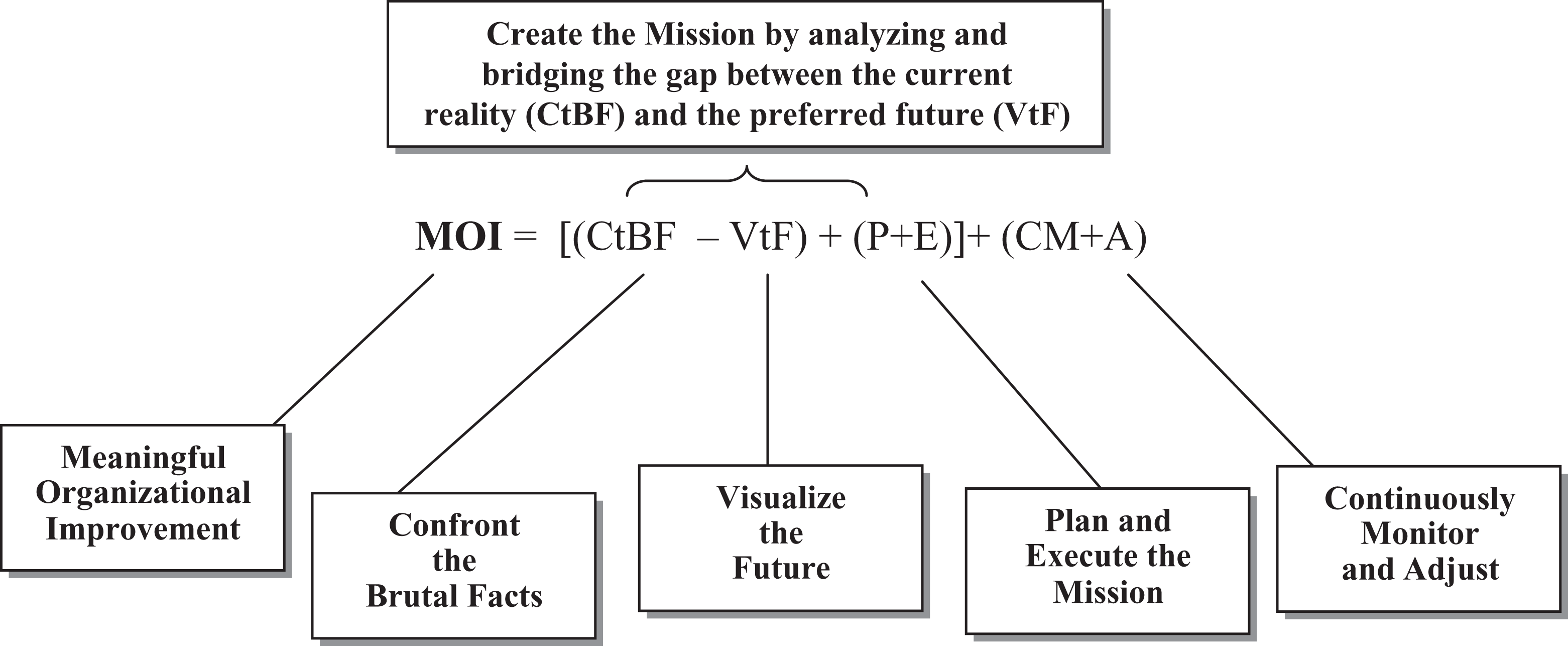
Formula for meaningful organizational improvement (Dunaway, 2007).
The formula shows the complexity of improvement, illustrates how the elements interact with each other, and emphasizes that organizations can engage in purposeful improvement rather than just completing a process. In this version, as opposed to the PDCA cycle, vision and mission are clearly delineated as integral components of the process of organizational improvement.
That the standardization of the improvement process is ingrained in the fabric and expectations of schools and districts is nowhere better illustrated than in North Carolina, where the expectations of the school improvement process are found in legislative mandate (N.C. Gen.Stat. §115C 105.27a), and the expectations of school principals (now called school executives in North Carolina) are spelled out in performance standards specifically tailored to organizational improvement (North Carolina Standards for School Executives, 2006: 1):
No longer are school leaders just maintaining the status quo by managing complex operations, but, just like their colleagues in business, they must be able to create schools as organizations that can learn and change quickly if they are to improve performance. Best practices support (National Staff Development Council, 2001), and districts and schools are recognizing, that a continuous improvement model of strategic planning is critical to achieving the learning for all expectations (Knoff, 2007). That schools employ a defined school improvement process is a very widely held and embraced expectation (Dunaway, 2012).
As a part of the accepted best practices of SIPs is that SIPs are typically required to be submitted to the district and approved by the board of education before the plans can be formally implemented. According to Dunaway (2012), this time-driven and formal acceptance process often devolves into a hoop-jumping exercise. He concluded:
Simply, teachers and principals perceive the purpose, value, commitment to the process, and impact on the profession and student performance in profoundly incongruent ways … One can logically conclude that the process … is so flawed in its understanding and application by its users as to be useless if not counter-productive.
In a review of the literature of SIPs in the USA, Dunaway (2012) found:
Only three empirical research studies describing SIP effectiveness were discovered. One study, in Tennessee in 1994, found that the school improvement plan, at the one elementary school studied, noted increased involvement, collaboration, group openness and trust – all items being targeted in the school’s improvement plan. A second, in Georgia in 1997, followed the achievement of a cohort of high school students as related to the school improvement plan. Finally, a 2002 study in Europe focused on the school improvement plan process and its relationship with effectiveness in several countries.
These unintended consequences caused us to look more closely at the role of the superintendent in the school improvement process and to look at how the superintendent’s leadership relates to the perceived status and value of the process. The broad vision-driven of the superintendent is one that connects and communicates community expectations to the school organization, but equally as important is the much more specific mission-driven role. As the mission-focused leader, the superintendent brings consistency of expectations, resources (including his or her leadership), and accountability to the school unit. Equally, the mission-driven superintendent includes providing a frequent, consistent and ongoing focus to improvement efforts and the schools which compose the district. Our question here is not to determine if SIPs are successful, and why or why not, but to better understand the connections between district leadership and school improvement planning. Only until this picture of relationships is clear, can the ‘why or why not’ of successful SIPs be addressed.
On an international level others are also looking at the relationship of school improvement and the role of the larger educational governing body. Hallinger and Heck (2010: 94), in defining their study, wrote:
In the current context of global education reform, however, recent inquiries have focused on identifying how teams of school leaders contribute to school improvement and student learning … [This] research [study] extends this finding, however, by offering empirical support for a more refined conception that casts leadership for student learning as a process of mutual influence in which school capacity both shapes and is shaped by the school’s collective leadership.
In 2006 the Mid-continent Research for Education and Learning conducted a meta-analysis of the research on the effect of the superintendent’s leadership on achievement and published the book, School District Leadership That Works: The Effect Of Superintendent Leadership On Student Achievement (Waters and Marzano, 2006). Their findings from 27 studies and 2817 districts included five statistically significant correlations (p < 0.05) to district-level activities:
the goal-setting process;
non-negotiable goals for achievement and instruction;
board alignment with and support of district goals;
monitoring the goals for achievement and instruction;
use of resources to support the goals for achievement and instruction. (Waters and Marzano, 2006: 7)
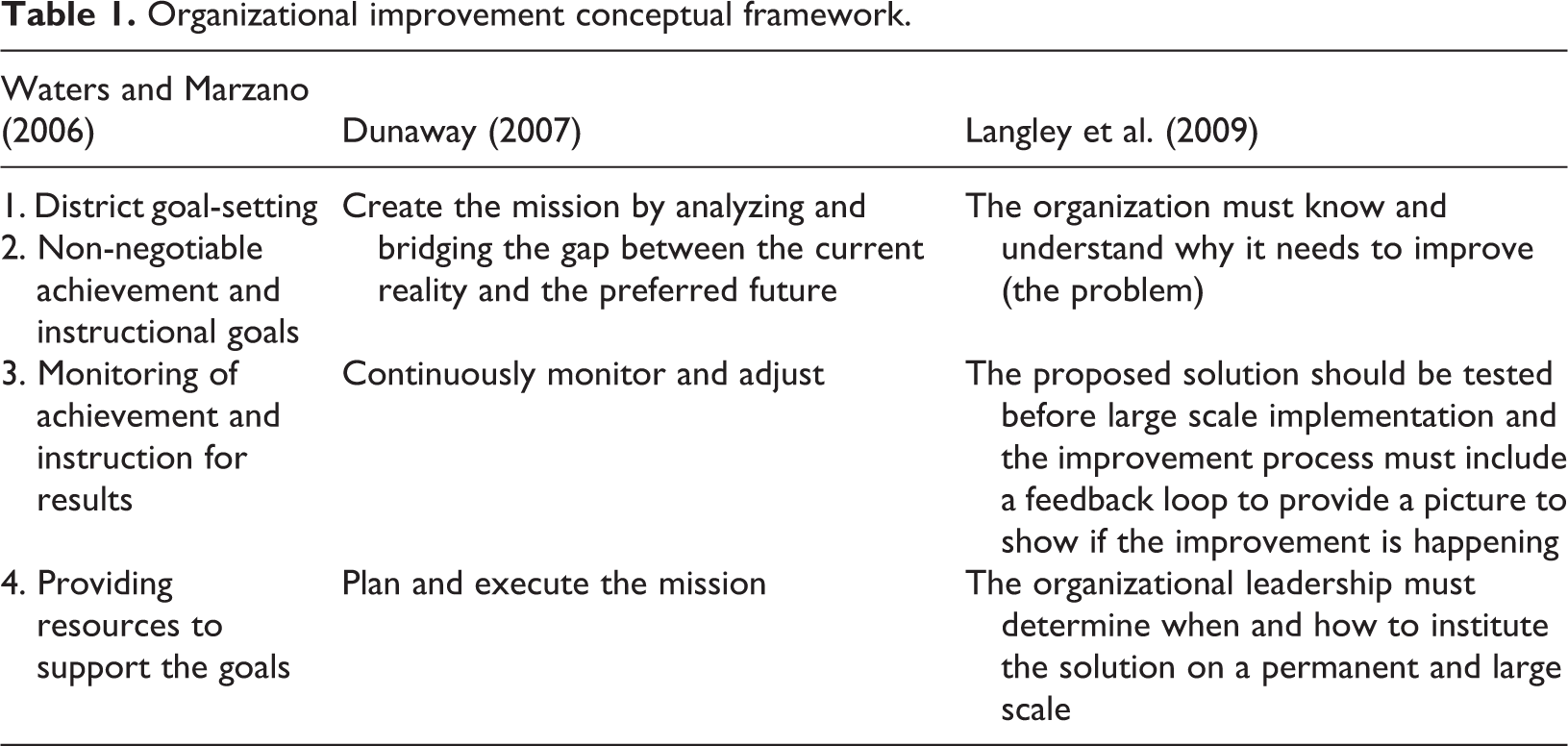
Within the organizational improvement conceptual framework presented earlier, findings 1, 2, 4 and 5 relate directly to school improvement planning processes. Specifically, that relationship can be demonstrated in Table 1.
Organizational improvement conceptual framework.
Research Questions
Clearly, leadership from the district can have a direct and positive impact on academic improvement at the school site. Our four research questions sought to establish a current understanding of the perceptions of the process through the eyes of the superintendents in the southeastern USA. Our questions for this study were: (1) What is the status of SIP practices in school districts as reported by southeastern US public school superintendents? (2) What were the superintendents’ perceptions of the fidelity of school personnel to district expectations? (3) What were the superintendents’ perceptions of fidelity to organizational/school improvement best practices? (4) What were the superintendents’ perceptions of the presence and importance of effective schools benchmark practices on the SIP?
Method
Participants
Two hundred and thirty-two superintendents in six southeastern states in the USA responded to the surveys online. Six participants did not finish the survey, and their information was not included in the sample. The sample consisted of 226 superintendents: 76% (n = 171) were male and 24% (n = 54) were female. One person did not report gender. These superintendents were predominantly (93%) Caucasian (n = 210) with 6% (n = 14) African American, 1% (n = 2) Hispanic or Other. Sixty percent (n = 136) of participants had doctorate degrees, 24% (n = 54) had educational specialist degrees, 16% (n = 35) had master’s degrees, and one person had a bachelor’s degree.
Instrument
School Improvement Process Questionnaire
This is a 22-item questionnaire developed by the authors. Superintendents were asked to report their perceptions of the school improvement process in their school districts. All but one of the items asked the participants to choose the best out of 3, 4 or 5 choices given, but the last item allowed them to choose all that apply. The content validity of the items was established through a focus group by asking experts in educational leadership who had dozens of years’ experience serving as superintendents and currently as professors in educational leadership programs. Each of these experts read the items and made changes individually and then offered suggestions for deletion, addition or revision. Since the items are not on a Likert-scale, the number of choices was left free (ranging from 3 to 7), to include all possible scenarios based upon the expertise of the experts.
Data Analytical Procedure
Frequencies and percentages of participant responses to each item of the survey were generated with SPSS18.0. The percentage of responses for each category of the item was also reported to answer each of the research questions. As for open-ended questions, thematic analysis was employed to identify common themes of the responses.
Results
Research Question 1: Status of School Improvement Planning in Districts
The status questions fell into two subcategories: (1) What were the actual district practices and parameters regarding school improvement? (2) What were the superintendents’
An overwhelming majority of superintendents (92%) reported that SIP progress and/or results were reported quarterly (34.8), at semester (13.3%), at the end of the year (33.0%) or not reported at all (5.8%). Eight percent of respondents added write-in comments which were at odds with the above results. Of these respondents, eight superintendents indicated that results were typically discussed monthly at district principals’ meetings. Two employed district monitoring teams that regularly visited schools. Four indicated that results were assessed electronically on an ongoing basis through data mining, and five indicated that results were discussed during midyear and summative evaluations. The picture regarding frequent and routine reporting of progress is really no better when the written comments are added. Actually, it becomes more negative except for the two districts that used monitoring teams, but only if one assumes the monitoring was formative and assistive in nature.
When asked how results are reported, superintendents were able to choose from a range of options and could select all that applied. A very large majority (74.8%) indicated that results were reported at administrative team meetings, and almost as many (63.8%) said the results were presented to the boards of education. Interestingly, only 41.7% indicated that the results were actually presented to the superintendent in writing. Disappointingly, less than one-half (46.8%) reported that the progress/results of school improvement planning were reported to the public. Another 7.8% provided written explanation, but these were related to public dissemination of information and are, therefore, discussed immediately below.
Eighty-four respondents or 36.7% chose not to respond to the question about reporting to the public indicating that they did not routinely report SIP progress/results to the public. For those responders who reported progress to the public, district and school webpages were the method of choice. Almost 70% indicated results could be found on the district webpage and another 45.9% indicated they could be found on the school webpage. Almost 64% indicated results were reported through the news media. When the 15.5% of respondents providing written comments were aggregated, three people indicated that their districts held special public meetings or forums to present the results, but seven people indicated that public reporting was mainly done through board meetings. Finally, newsletters from schools or districts or annual school report cards were the reporting mechanism.
Research Question Two: The Fidelity of School Personnel to District Expectations
When asked to indicate their perceptions of how the people involved viewed the process, the results were mixed. While large numbers (70%) indicated the process was valuable and taken seriously by most people, significantly, 30% indicated that the process resulted in little improvement or was simply a process required by the district. Barely one-half believed that teachers sensed the process had a significant impact on student learning and that less than 50% of staff members were motivated by SIP goals. Larger numbers saw positive views by administrators, which is likely related to the closeness of the administrators to the seat of power in the district.
Finally, when superintendents were asked to indicate their personal views of the process and the levels of their personal involvement, results are again mixed with almost 80% indicating that the SIP has a positive effect on learning, but less than 50% specifying that the process is inherently motivating for staff members, and barely 50% who believe it is taken seriously by teachers. Dismally, 14% report that they believe the process is demotivating for those involved. When asked to report their personal involvement in the SIP process, less than 50% reported direct involvement in the process in their districts. The highest rated selection (53%) was that they emphasize the process at the beginning of the year. A large number delegate (49%) the responsibility to central office staff that make regular reports. However, 33% indicated that they delegate supervision to central office staff without the requirement of regular reports.
Research Question 3: Fidelity to Organizational/School Improvement Best Practices
We selected six areas of superintendent perceptions of SIP process in their districts indicative of the presence of organizational improvement best practices in the districts: (1) staff input; (2) parental input; (3) implementation practices; (4) monitoring and reporting; (5) discussion of progress with faculties; (6) discussion of progress with the public.
The largest response (53.6%) indicated that staff input came from members of the school improvement or the building leadership team. The second largest response (32.9%) indicated that faculty input came from faculty members serving as members of subcommittees supplying information to the school improvement team. Finally, a substantial number of superintendents (13.5%) indicated that faculty input was limited to that supplied by faculty upon review of the plan before the final draft. Almost two-thirds of superintendents indicated the school improvement team developed the plan with significant participation from the faculty. However, this is largely tempered by the fact that more than one-third of the superintendents indicated that the plan was developed by the principal (26.4%) or with limited faculty input to the school improvement team (6.3%).
It is research proven that effective schools have high levels of parent engagement, an accepted best practice of school improvement, and just common sense that since the schools belong to the public, the public, in the form of parents, should have a direct role to play in improving them. Of all the best practices appraised, the view of superintendents for involving parents is the most disappointing. Almost 60% of the respondents indicated that parents have limited involvement in the development of the SIP.
Like input, broad-based responsibility for implementation is congruent with positive results. The results of the views of superintendents about implementation practices indicate that most plans (62%) are implemented by the improvement team or principal with significant faculty responsibility. However, a significant number (19%) of superintendents indicated that the principal alone was responsible for implementation, and another significant number (18%) indicated that the plan was delegated by the principal with limited faculty responsibility or implemented by the improvement team with limited faculty responsibility.
Monitoring and adjusting improvement efforts are one of the accepted organizational best practices for improvement. Very typically, SIPs are monitored and adjusted infrequently. Substantiating this view, 48% of respondents indicated that SIP goals are measured several times during the year and adjusted based on monitoring results. Interestingly, 40% of superintendents indicated that results were monitored but no adjustments were expected, and 12% indicated that SIP were seldom monitored or not at all.
When superintendents were asked to the best of their knowledge how often progress on SIP goals was routinely discussed with school staffs, only 19% responded that progress was discussed at each staff meeting. Almost 40% responded that progress was discussed either quarterly (35%) or yearly (3.1%). Nearly one-third left the decision to the principals, which means for this group that frequent monitoring of progress toward improvement goals was not a priority.
While the following results are reported in more detail under Research Question 1, we also chose to include them here as an indicator of fidelity to the process. Eighty-four people or 36.7% indicated by the lack of a response to this query that they did not routinely report SIP progress/results to the public. For the 63.3% who reported progress to the public, district and school webpages were the medium of choice (70%). Three responders indicated that their districts held special public meetings or forums to present the results, and seven people indicated reporting was done through board meetings.
Research Question 4: School Effectiveness Practices Found on SIPs
One multi-option question was designed around the research-proven effective schools benchmark practices and gave the responders 10 defined choices from which they could select any number, and an 11th option to write in other views routinely found in their district’s plans. These responses are grouped in six categories for analysis of results. The individual options are shown in italics under each of the six categories: (1) beliefs, vision and mission; (2) frequent monitoring of student achievement; (3) instructional and curriculum leadership; (4) student engagement in learning; (5) parent engagement in school improvement; and (6) high expectations for student learning. Each of these categories is discussed below.
Assessing school culture for agreement with the school and vision (vision and mission correlate) received 65.8% agreement. Four additional questions further explored beliefs/values and vision/mission in more depth. Respondents were asked about the use of beliefs/values and mission/vision in their districts and their personal views of the value of these best practices of organizational improvement. When the effective schools correlate choice of safe and orderly was assessed, school safety received an expected majority of responses at 65%. However, when one looks at the next choice, analysis of school routines and/or the use of time as a variables of student learning, which is also a best practice under the safe and orderly correlate, less than 40% of respondents indicated it was typically found on SIPs.
The frequent monitoring correlate contained two possible responses, frequent monitoring of student achievement data beyond standardized assessments and improvement of standardized assessment scores. These two particular items received the most frequently selected responses of all the 11 options. Ninety-three percent selected improvement of standardized assessment scores, and almost an equal number (87%) said that frequent monitoring extended beyond standardized assessments.
The researchers chose to look at the instructional leadership through the lens of curriculum leadership. Certainly this could have been looked at in other ways; however, more traditional forms of instructional leadership do not lend themselves to the SIP process. More than 62% of respondents indicated that both vertical curriculum alignment (between grades) and horizontal alignment (within grades) were considered on their schools’ SIPs.
School effectiveness research has shown that student engagement in learning, as opposed to time on task (the student engagement correlate), can have significant power to improve learning outcomes for children and the improvement of schools. Of respondents 51% selected this option as typically found on their districts’ SIPs.
For almost 40 years, effective schooling research has consistently shown the power of parents to positively affect learning and improve schools. However, only 40% of superintendents indicated that parent engagement in student learning as opposed to parent involvement/attendance at school events was routinely found in SIP goals.
The final specified choice, high staff expectations for student learning regardless of student background, received a significant level of support at 76.4%, although that almost 25% of respondents did not routinely find high expectations for learning on the SIP must be viewed negatively in today’s high stakes education arena.
Discussion
Status of SIP Practices
As expected, the SIP was required by a large majority of states or districts, again supporting its status as a best educational practice. If there was a surprise here it was that almost one-third of the superintendents indicated that no standardized improvement plan was required. However, this should not automatically be viewed as negative if a framework is provided within which schools can develop their own unique improvement plans.
Perceptions of Schools’ Fidelity to District Expectations
Perhaps by looking at the superintendents’ perceptions of how they believe school staffs see the SIP process, we can gain insights into the perceptions of the fidelity of schools to district expectations. We asked superintendents to indicate their perceptions of how most teaching faculty members saw the SIP process. The results as shown in Table 2 can only be described as dismal.
SIP fidelity findings.
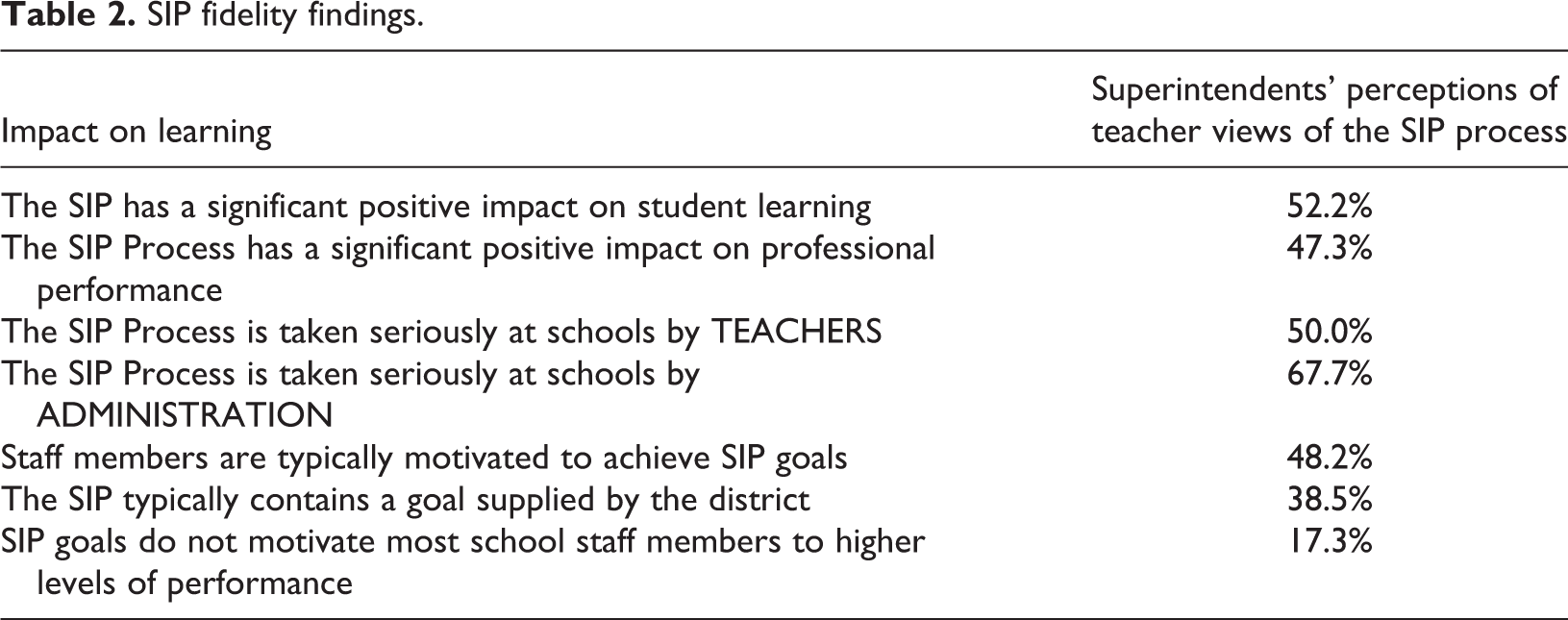
It may not be possible for us to make direct connections between superintendents’ perceptions and positive results. However, from our data indicating less than enthusiastic personal views of the process, we can conclude that the process does not consistently receive the most positive response from the superintendents’ offices. This certainly cannot but have a negative impact on the fidelity of the process at the school level.
The lack of fidelity was found as well in how schools report results to districts and to the public. Basically, if one were to take any other organization, public, private, product- or service-oriented that is intent on improving its processes, services and products, one would be hard pressed to find an organization that at best reports results of its improvement efforts only every four months. The picture was equally dismal in the area of reporting to the public. One must note that except for the very few superintendents who held public meetings or forums, all the reporting on the progress of school improvement plans was passive – parents and community members had to know where and how to access it, if they could access the results at all.
School performance has for some time been under attack from all angles. While sunshine statutes do not come into play here except at the board level, clearly the spirit of those laws – to conduct the public’s business in the light of sunshine – is really not present in how progress/results of school improvement efforts are relayed to the public.
Fidelity to Organizational/School Improvement Best Practices
Every best practice has a set of accepted foundational processes that define it. With this assumption in mind, we turn to the final research question – the issue of presence of accepted school improvement practices as indicated by the superintendents’ perceptions of those practices in their districts.
While results indicated the presence of elements of the six chosen indicators of organizational improvement (staff input, parental input, implementation practices, monitoring and reporting, discussion of progress with faculties, and discussion of progress with the public), their presence was less than substantial individually or collectively. Staff input into the plan was typically indirect. Parental input was, for practical purposes, ignored. Though counterintuitive, the implementation of the plan was with limited faculty responsibility. Plans were discussed with faculties infrequently, and were monitored and adjusted only intermittently, if at all, during the improvement cycle. Finally, consistent with the perception of parental involvement, reporting of results to the public was typically through passive means such as school or district webpages rather than through planned forums promoting transparency and seeking outside input (and energy) into a typically static environment.
There is no small insignificance in this data. We must conclude that even an accepted best practice cannot cause improvement when there is little faithfulness to its accepted processes.
Presence of Effective Schools Benchmark Practices Found on SIPs
The effective schools benchmark practices as expressed as correlates were first described from research conducted by Brookover and Lezotte (1977). The presence of these practices was consistently found in schools where achievement was demonstrated by over 90% of students, regardless of background, consistently over a three-year period. The practices are not synonymous with the SIP, but their presence is an indicator of the plans’ connections to research-proven strategies.
First, superintendents’ responses to questions aimed at beliefs/values and mission/vision yielded positive results, indicating support for revisiting both in order to set the cultural norms for school improvement plans before beginning the actual process – a positive development.
Second, the responses that indicated strong support for safety as a focus of school improvement were expected. However, we sought as well to look at the critical aspect of school routines and the use of time as a variable of learning since this factor is fundamentally under the direct control of schools. That this aspect of orderliness was largely ignored in superintendents’ responses raises significant concerns. Likely this is a result of the unintended consequences of standardized testing. Far too often schools place low emphasis on using time as a variable of learning since the emphasis on standardized testing tends to be all-consuming of both time and willingness to challenge time-oriented system-in-place.
Third, in looking at frequent monitoring we sought to determine if the focus was on standardized assessments and/or if monitoring was done beyond the standardized tests. While almost all superintendents selected improvement of standardized assessment scores was no real surprise, that almost an equal number (87%) said that frequent monitoring extending beyond standardized assessments as an SIP goal was very pleasant revelation. One might hypothesize that this is a result of the emphasis on professional learning communities in many districts as a counterbalance to the consequences of standardized testing.
Fourth, vertical and horizontal alignment were chosen as assessed factors of instructional leadership because they are largely controlled by schools and are affected by principal- and teacher-leadership. Horizontal alignment is always within the purview of schools’ staffs, but even when vertical curriculum is defined by the state or district, it is still the school that has the control of assuring that the implemented curriculum between grades in the school and in grades feeding to and from the school is seamlessly aligned and functioning as intended. Larry Lezotte (2002) wrote of the role of curriculum alignment in a learning centered school:
Students must be given the opportunity to learn what they need to know to do well on the assessments. To assure learning for all, schools and teachers need to refocus the school from a ‘teacher-centered system’ to a ‘learning-centered system.’ Teachers must stop talking about what curriculum they have to cover and start talking about the curriculum that students-all students-must learn. Creating learning-centered classrooms is simple, it's essential … but it's not easy.
Fifth, grabbing and hanging onto students’ attention long enough to authentically engage them in learning is, at all levels of K–12 schooling, an ongoing competition, and one that schools too often seem to be losing. Therefore, it was particularly disappointing to find that barely one-half of superintendents indicated that student engagement in learning was an item typically found on SIPs, even though this, too, is an area of schooling controlled at the school level.
Sixth, ‘[p]arent involvement in education is widely recognized as important, yet it remains weak in many communities’ (Warren et al., 2009). Therefore, given the historical distance between parents and schools and especially school districts, it was not really surprising that only 40% of superintendents indicated that parent engagement (authentic involvement) was a goal on their schools’ SIPs. However, it was disturbing. In loco parentis, the long held and often cited legal doctrine of acting in place of the parent, seems to continue to define the connection between parents and schools in legalistic rather than partnership terms. Perhaps it is simply easier to blame parents than to engage them. Whatever the reason, there still remains an emotional distance between parents and schools which borders on, if not crosses, the line of contempt. At a time when more and more is expected of an archaic educational system-in-place, schools can ill afford to ignore a possible resource and a certain stakeholder in the improvement of our schools. To do so will likely increase events such as took place in the spring of 2011 in North Carolina where the state legislature approved legislation to significantly increase the number of charter schools and their funding. Conceivably, this is a reaction of some of the legislators and/or their constituents to the same kind of attitude that was demonstrated in this data.
Finally, on the encouraging side, one of the most positive responses to the survey regarding effective schooling practices was that more than three-fourths of superintendents responded that high expectations for students were found on their schools’ SIPs. But, we must ask, why was there the presence of high expectations in large numbers, but not corresponding high numbers for student or parental engagement? There clearly appears to be a conundrum as these three areas are, by their nature, connected to each other. Even though we do not have the answer to that question at present, it is, nonetheless, worth noting that it is very unlikely that schools will have sustained levels of improvement over all populations of learners if they emphasize high expectations but fail to provide for equally important high levels of students engaged directly in their own learning and parents actively engaged in the learning of their children.
Conclusion
The Future of the SIP
The SIP is, indeed, geographically pervasive, but is it effective? At this stage in the SIP’s life-cycle as a best practice, districts seem simply to be satisfied that the process is being carried out consistently and efficiently, if not effectively, across all schools in the districts.
Given its pervasiveness, clearly K–12 education as a profession accepts at least deductively that school improvement planning works to improve student learning. And reasonably, why would it work across other professions, but not in education? However without research directed specifically to find out, we just do not empirically know. Therefore, we are left to ponder whether or not the hours and hours spent in completing district-designed templates, and in often less than energetic implementation, are simply wasted hours that could have been used more productively in other ways that would improve learning such as professional development. Unfortunately, professional development, for its acceptance as a best practice, has its own set of hoops and issues which frequently make it less than useful. Finally, the lack of congruency between superintendents’ own beliefs toward the process and their perceptions of the beliefs of those expected to carry out the process are cause for concern. Those who are tasked with implementation will inevitably adjust their own perception of the validity and reliability of the process to be consistent with their superintendents.
One might also speculate on the knowledge and use of organizational planning best practices as a potential fundamental flaw of the current process. Clearly hoop-jumping is the antithesis of good planning and, in fact, causes poor planning. But, does poor knowledge of best practices cause hoop-jumping as well?
Recommendations
There has been little research that asks the question, ‘Do SIPs improve teaching and learning?’ Simple question. Few direct answers. Fernandez (2009: 6) writes, ‘A search for the published literature on the impact of planning on performance produces few results.’ However, in his study of the relationship of school improvement planning and student achievement in the Clark County, Nevada school district, Fernandez (2009: 1) concluded, ‘Even when controlling for a variety of factors, there is a strong and consistent association between the quality of school planning and overall student performance in math and reading.’ If school improvement planning is to endure as a best practice and reach its hoped-for potential to improve schools and learning for children, the profession must know empirically if it works. Toward this end the profession needs to be able to concretely define two critical areas.
First, process fidelity must be clearly defined in ways and methods that eliminate the hoop jumping which seems inherent in all bureaucratic-controlled processes. This is best accomplished by setting general process guidelines that assure that all schools in the district focus on a minimum of non-negotiable criteria. Perhaps a classroom example is appropriate. It is not necessary for each teacher in a school to use the same lesson-plan template to produce quality lesson planning. The wise principal sets certain non-negotiable criteria, such as daily objectives in behavioral terms, engaging activities directly congruent with the objectives, and assessments aligned with the objectives and activities. If these expectations are always present, it should not matter whether the teacher keeps those plans on a computer, in a spiral notebook, or in a manila folder. When the principal goes to review the plans, the things most important to learning are the same regardless of format. Must every school’s SIP plan look the same? We think not. Flexibility of design allows for greater fidelity of implementation.
Second, production-fidelity – the knowing if the implemented improvement strategies actually improved teaching and learning – must be present in design and implementation. Did the plan produce improved teaching and learning in measurable terms? That is the simple question. When this question can be answered routinely and definitively, the future of the SIP will be assured.