







Abstract
This study examines the degree to which senior executive members of a school’s decision-making team (senior management team and board of directors) are aligned on fundamental principles of school strategy. Our study is based on a conceptual framework of strategic leadership as it applies in an Australian independent school context. We also examine the differences between the senior management team and board of directors based on top management team (TMT) tenure heterogeneity, and how these differences account for TMT associations with school strategy. Implications for research and practice complete the study. The terms top management team, senior management team, and senior leadership team are used interchangeably in this article.
Strategic Leadership and Alignment
Strategic Leadership
The research on school strategy development and implementation has increased considerably both theoretically and empirically over the last decade. This current study continues to develop our understanding of school strategy development and implementation (execution) by examining the degree to which senior executive members of a school’s decision-making team (that is, school principal, senior management team and board of directors) are aligned on fundamental principles of school strategy. Our study is based on a conceptual framework of strategic leadership as it applies in an Australian independent school context.
The role of strategy is to assist organizations in translating vision, mission and values into action. Identifying the vision, mission and values of an organization helps establish the identity of that organization and the business in which it operates (Kaplan and Norton, 2008). In today’s dynamic social, political and economic environments, leaders are expected to become strategy experts and strategic leadership is increasingly important to organizational performance and survival (Crossan and Berdrov, 2003; Zahra and George, 2002). Personally and organizationally, strategic decisions and relationships are becoming more complex and, in this context, the need for clear and consistent strategy execution has become more pronounced (Kaplan and Norton, 2000, 2008). Hambrick and Pettigrew (2001) note that strategic leadership focuses on executive work not only as a relational activity but as a strategic and symbolic activity, a view consistent with the recent work by Eacott (2011: 36) on school principals: ‘to understand strategic leadership it is important to engage with issues of power, reality construction, symbolic order, actor networks and language games’. Therefore, strategic leadership is defined as how the top management team influences the strategic direction of the organization; that is, how top management teams create meaning and purpose for the organization (Boal and Hooijberg, 2001; Crossan, Vera and Nanjad, 2008; Finkelstein and Hambrick, 1996; House and Aditya, 1997; Lovas and Ghoshal, 2000). As Montgomery (2012: 2) states, ‘defining what an organization will be, and why and to whom that will matter, is at the heart of the leader’s role.’
In a school setting, strategy formulation and execution is often the result of a specific leadership team rather than individuals (Davies and Davies, 2004: 29). In this context, strategic school leaders are strategically orientated; translate strategy into action; align people and organizations; determine effective strategic intervention points; and develop strategic competencies (Davies and Davies, 2004: 30). A form of translating strategy into operational terms is through strategy maps and the balanced scorecard (Kaplan and Norton, 2000, 2008), which have been shown to facilitate strategy execution in school settings (Sarros and Sarros, 2007, 2011a, 2011b). Given the dynamic nature of the global marketplace, Sarros and Sarros (2011a: 256) assert that ‘strategic leadership [now] requires complex sense-making and evaluation of uncertainty . . . [through] strong and positive work relationships’. The alignment of the senior management team through core values, beliefs, sense of meaning and strategy maps, and its distillation through all organizational levels, is a key driver of strategic leadership and change.
Alignment
We use the term alignment to connote the degree of consensus or agreement on strategic imperatives among members of the top leadership team. O’Reilly et al. (2010: 111) claim that ‘it is not the effectiveness of a leader in isolation that affects organizational performance, but the alignment of leaders across hierarchical levels that is associated with the successful implementation of a strategic change’. It is in the context of strategic leadership that this study was undertaken. Consensus in the top leadership team on strategy also helps in its execution (Dess, 1987; Hrebiniak and Snow, 1982). O’Reilly et al. (2010: 105) assert that ‘alignment or misalignment of leaders across hierarchical levels may enhance or detract from the successful implementation of a strategic initiative’. In other words, critical to the execution of organization strategy is that the senior management team first agrees on the strategic intent of the organization before its distillation to other levels of the organization.
The definition of alignment used in this article is fundamentally different from the concept of alignment as applied in human resource and operations management research. In that context, alignment is defined as the degree to which the design, strategy and culture of an organization cooperate to achieve the same desired goals (Semler, 1997). Our study is delimited to an examination of agreement on strategy imperatives only, and not on the associated design and culture domains. We also focus at the micro level of agreement among senior leaders rather than the macro level of organizational agreement on issues of strategic importance. This micro perspective defines alignment as ‘the difficult challenge of bringing together both individuals’ and organizational perspectives to work in a focused way to achieve agreed objectives’ (Davies, 2004: 14).
This view is consistent with the notion proposed by Davies and Davies (2004: 32) who identify the strategic leader’s capacity to align people and the school to a future organizational state or position by encouraging commitment through shared values and the creation of meaning (Boal and Hooijberg, 2001; Davies and Davies, 2006: 130). Davies and Davies (2004: 33, 36) initially identified alignment as an organizational ability of strategic leaders that helps influence the culture of the organization. Davies and Davies’ (2006: 135) recent case studies of 23 schools in the UK have produced a model of strategic leadership that promotes alignment as a component of strategic processes. This model of alignment retains the essential ingredients of developing a common understanding and language for the school through the sharing of values, beliefs and future scenarios (Davies and Davies, 2006: 136), also referred to as strategic intent. Accordingly, the degree to which Boards and the Senior Management Teams of schools are aligned on matters of strategy is an indicator of how well these two levels of management function as a collective body, encourage the motivation and commitment of team members, and allow the accomplishment of school goals (Jackson et al., 2003; Land, 2002).
Our intention is to more completely operationalize the concept of strategic alignment among a school’s senior leadership team rather than examine the impact of this alignment on quantifiable outcomes such as performance or organizational innovation. Elenkov et al. (2005: 667) assert that upper echelons theory, from which strategic leadership research has emerged, has only examined strategic leadership behaviour through the use of demographic proxies and inferred strategic leadership behaviours. Accordingly, we more directly explore the concept of strategic leadership and of strategic alignment among the senior leadership team in a school setting.
Top Management Team and Board Demographics
Elenkov et al. (2005) identify top management team (TMT) tenure heterogeneity as a measure of team diversity. The greater the variation in the length of tenure of team members, the greater the impact of the team on leadership decision processes and outcomes. TMT heterogeneity has been associated with the interpersonal dynamics of strategic management (Jackson, 1992) and corporate strategic change (Hambrick and Mason, 1984; Wiersema and Bantel, 1992). Elenkov et al. (2005: 670) assert that diversity in the TMT means that the team ‘collectively view the world in very different ways and that this leads to diversity of behaviors’. Pitcher and Smith (2001) found that more heterogeneous TMTs have more cognitive diversity in their teams. Elenkov et al.’s (2005: 679) study of 1095 top managers in six countries (USA, UK, Germany, Austria, Russia, Ukraine) found that strategic leaders of heterogeneous TMTs are more effective in influencing innovation when they employ vision development and intellectual stimulation in their leadership repertoire. Given that much of the research on TMTs focuses on their role in large entrepreneurial firms in relation to growth and productivity (Daily, McDougall, Covin, and Dalton, 2002), it seems appropriate that the relevance of TMTs in other organizational sectors be examined and analysed. Similarly, the majority of research on boards of directors has focused on large, traditional organizations compared to schools or non-profit organizations (Dalton et al., 1998; Ranft and O’Neill, 2001). That research takes the independence of board directors and board size as predictors of company performance.
Given that much of the research on TMTs and Boards of Directors has focused on private, large scale firms, in this study we instead examine and analyse the roles of the TMT and Board in the development and execution of strategy, as these roles are manifested in a large independent school that operates on both educational and business principles.
This research is timely, given the tensions between school boards and principals as they negotiate the dual responsibilities of leading an educational institution whose main purpose is to produce students who are productive and responsible members of society, while also abiding by and implementing sound business practices. These practices require Australian independent schools to be separately incorporated as not-for-profit companies limited by guarantee (McCormick et al., 2006: 429). Sometimes school tensions become public property, as in the case of a nationally recognized and respected independent girls’ school in Melbourne where the principal and the board of directors took legal action against each other over their respective roles and jurisdictions (Dunckley and Mitchell, 2012). In this case, the board had difficulty in rationalizing its business principles to satisfy the educational protocols and imperatives of operating a large school. As a result, the line between the principal’s role and the board as policy and strategy adviser became blurred. According to a chair of a large independent girls’ school in Sydney, ‘while corporate skills are useful in running a school board, the process is very different to running a company . . . [I]t’s not really a business, it’s the education of young people, and you do need to manage that in a way that we wouldn’t necessarily operate in a corporate role’ (Dunckley and Mitchell, 2012: 49).
Method
Context and Sample
The school (FGS) in this study is one of Melbourne’s largest private girls’ schools in an affluent bay-side suburb (detailed information on the school is provided in Sarros and Sarros, 2007). Australia has three sectors of secondary schooling: government (public), independent (private), and the Catholic School sector. In 2011, government (public) schools comprised 71%, Catholic schools 18%, and independent schools 11% of all schools in Australia (n = 9435) (ABS, 2011). In Victoria, Australia, where this study was conducted, all three sectors are accountable to the Victorian Institute of Teaching for their policy and program protocols. Government schools are administered by the school principal and council, which comprises members of the parent community. Independent schools are governed by the board of directors (BOD) and the senior management team (SMT). The BOD comprises members of the parent community, and invited senior members of industry and government or non-profit enterprises, many of who wield some degree of influence in their respective professions. Additional members of the BOD are the school principal and their nominees (if required). The SMT consists of the principal, deputy principal(s), head(s) of campus, director of curriculum, director of communication, and the business manager. Catholic schools are administered by the principal, a school council and the Catholic Education Office.
At FGS, the BOD consists of 11 members, nine males and two females. The school principal is an ex-officio member of the BOD. BOD member tenure ranges from 1 year to 10 years, with a mean of 3.36 years and a standard deviation of 3.32. The school principal is the chair of the SMT, which comprises eight members: five females and three males. Tenure on the SMT ranges from two years to eight years, with a mean of 6.63 years and a standard deviation of 2.56.
Instruments
The Alignment on Strategy Questionnaire (ASQ) used in this study was developed in three stages as a result of consultation among the school principal, SMT and chair of the BOD. First, the principal consulted with an independent researcher to identify a list of operational and strategic issues of importance, concern or in need of further investigation to FGS. Second, these issues were reviewed and subsequently revised by the principal and members of the SMT. Third, the revised issues were then discussed with the Chair of the BOD, who made final additions and revisions prior to the inclusion of the issues in the ASQ. The instrument was then distributed to all SMT members and directors of the BOD.
Each item in the ASQ forms part of the balanced scorecard evaluation of the school’s strategy and was reported in a recent study of the school’s execution of strategy (Sarros and Sarros, 2011b). Questions in the ASQ examine the extent to which specific strategy indicators are important to respondents on a five-point Likert scale where 1 = not at all, 2 = minimally, 3 = moderately, 4 = considerably and 5 = very much/completely. Three items of strategy are first presented: vision, mission and values. These items were aggregated into a unitary strategy measure and registered a strong Cronbach alpha of 0.76. The remainder of the ASQ consists of: balanced scorecard intent, purpose, execution (3 items); infrastructure and master plan (12 items); school size (4 items); relationships with partner school (one item); marketing strategy (4 items); alumni (one item); foundation (facility for generating external revenue streams) (2 items); roles/responsibilities of Board and senior management (2 items); and meetings (one item). Where possible, other items were aggregated into unitary measures as follows: balanced score card (α = 0.86), infrastructure (α = 0.67) and marketing (α = 0.78).
The strategy execution framework or balanced score card, as used in this article, was developed over a 15-year period by Kaplan and Norton (1992, 1993, 1996, 2000, 2008) and is promoted as a method of assisting organizations to design, execute and manage their business strategy. The framework comprises six stages: developing the strategy, translating the strategy into operational terms, aligning the organization and operational planning, monitoring and learning, and testing and adaptation.
Analyses
In this case study of one school’s senior leaders, data were analysed through simple t-tests and correlations. The rWG index of agreement (Cohen et al., 2001; James et al., 1993; Lüdtke and Robitzsch, 2009) was used as an indicator of inter-rater agreement for each team of senior leaders, namely the SMT and BOD. This index is calculated by comparing an observed group variance with an expected random variance. Importantly, group size has no effect on the expected value of rWG. Additionally, because the sample size was relatively small, we relaxed the level of statistical significance to the 0.10 level (90% level of confidence). This less stringent level of confidence is appropriate to avoid the increased risk of a type 2 error (‘false negatives’) in a small sample and where the analyses are exploratory in nature (Cohen, 1988).
Findings
Descriptive Data
Table 1 provides the descriptive statistics and correlations for all variables.
Correlations, Means, Standard Deviations of Key Variables.

Note: N = 18;
As shown in Table 1, the largest correlations were among the importance of the targets projected for growing the school’s enrolments on its three campuses (r = 0.85, p < 0.01; r = 0.94, p < 0.01). These projections are consistent with and very strongly related to the school’s master plan as represented in eleven elements of infrastructure (buildings and grounds) (r = 0.90, p < 0.01). This correlation is important because it validates that the components of school structure are recognized by the SMT and BOD as helping the school achieve its master plan of providing the best possible educational experience for its students.
The key indicators of strategy are all inter-correlated (vision and mission, r = 0.63, p < 0.01; vision and values, r = 0.60, p < 0.01; values and mission, r = 0.50, p < 0.05), supporting the possibility of a unitary measure of strategy comprising these essential elements. The strongest correlation between this unitary (overall) strategy measure is with values (r = 0.89, p < 0.01) and vision (r = 0.87, p < 0.01). Overall strategy is also positively related to the demarcation of the roles and responsibilities of the board and the SMT (r = 0.77, p < 0.01). That is, the clearer this demarcation, the better placed it is for strategy development and execution to occur. Senior management and board strategy meetings are perceived to assist in the delivery of the school’s vision (r = 0.55, p < 0.05) and are strongly aligned with the unitary strategy measure (r = 0.73, p < 0.01).
The balanced score card delivers mixed results. While it is seen as being considerably to very important to school strategy (mean = 4.06, SD = 0.74), it is only significantly related to tenure (r = 0.58, p < 0.01) and projected school size for the SH campus (elementary school campus associated with the senior school FGS campus) (r = 0.41, p < 0.1). Of some interest is the negative correlation between the balanced scorecard and the foundation target (r = −0.41, p < 0.1), indicating that the strategy execution tool of the balanced scorecard is not seen as necessarily achieving external revenue targets. The importance of the role of the director of alumni is positively related to values (r = 0.44, p < 0.1), infrastructure (r = 0.41, p < 0.1), and marketing (r = 0.44, p < 0.1). The importance of the foundation strategy in the achievement of its aims is positively associated with infrastructure (r = 0.81, p < 0.01), and the master plan (r = 0.80, p < 0.01), as well as school values (r = 0.66, p < 0.05) and the role of the director of alumni (r = 0.60, p < 0.01).
Tenure of office holders is an important indicator of uniformity and may contribute to performance outcomes (Elenkov et al., 2005). The extent to which the SMT and BOD are uniform in their length of experience in senior management can be expressed as a measure of Top Management Team Tenure Heterogeneity (TMTTH). TMTTH was measured using Finkelstein and Hambrick’s (1996) formula:

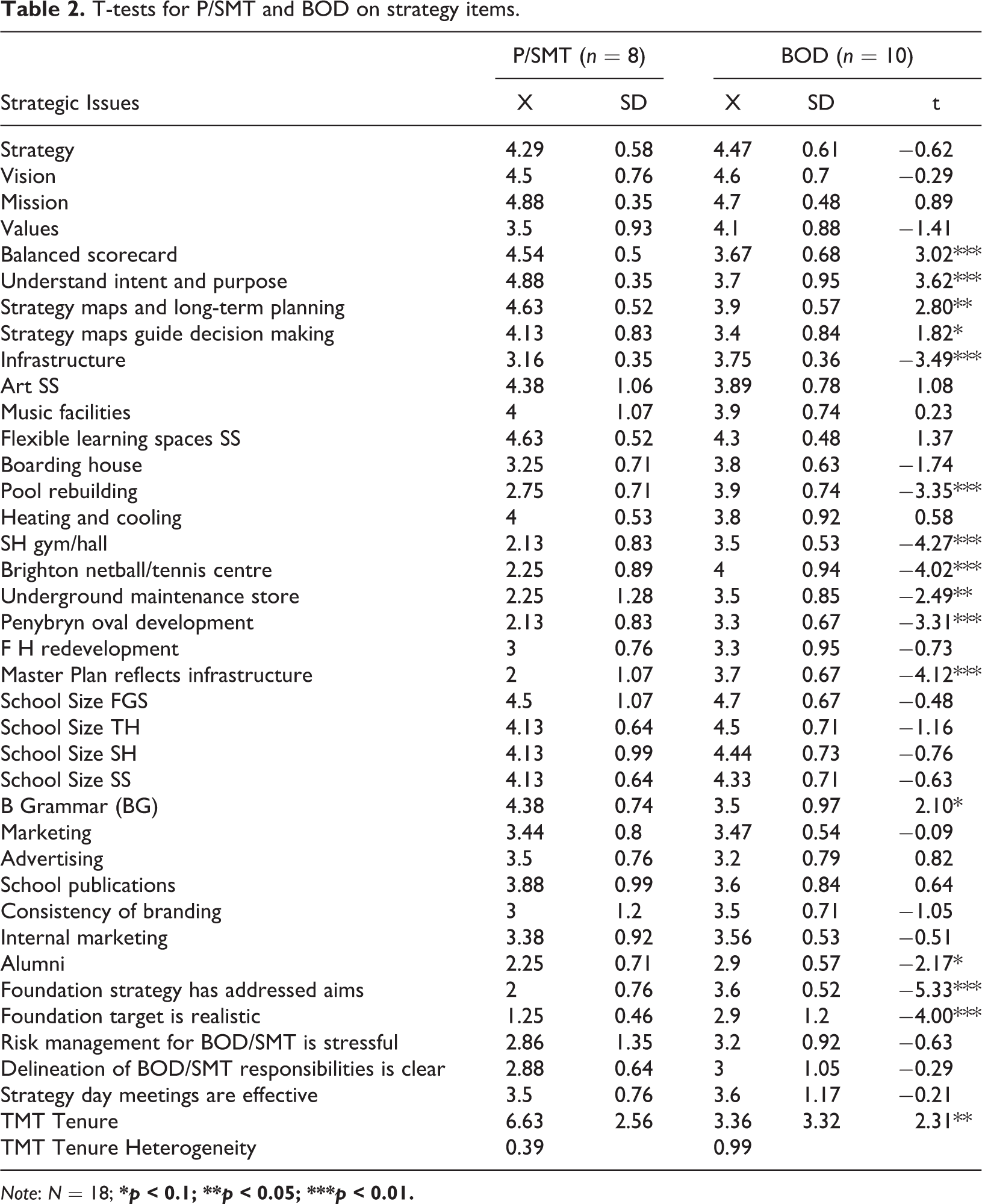
In our study, the means and standard deviations for the SMT (mean = 6.63, SD = 2.56) and BOD (mean = 3.36, SD = 3.32) were statistically significantly different to each other (t = 2.31, p < 0.05, Table 2) and resulted in TMT tenure coefficients of heterogeneity (TMTTH) of 0.39 and 0.99, respectively. The larger the TMTTH coefficient, the greater the dispersion of tenure among respondents. Therefore, the BOD were more dispersed in tenure compared with a more stable cohort of tenure among members of the SMT. These findings are important, as they could help explain some of the significant correlations between tenure and aspects of school strategy as shown in Table 1.
T-tests for P/SMT and BOD on strategy items.
Note: N = 18;
As shown in Table 1, tenure is positively related to mission (r = 0.44, p < 0.01), which indicates that the longer time spent in senior office by the SMT is also associated with firmer convictions in the mission of the school, which is to prepare students with an outstanding education now and as preparation for their future. Tenure is also positively related to the balanced score card (r = 0.58, p < 0.05), confirming that perceptions of the importance of this element of strategy execution are associated with SMT experience. This finding is confirmed by the very strong level of agreement (rWG = 0.93) for members of the SMT and principal on the balanced score card (Table 3). Tenure is negatively associated with the school’s external revenue raising body, the Foundation, on two aspects: the extent to which respondents agree that the Foundation has addressed the strategic aims of the school (r = −0.42, p < 0.1) and the extent to which the target of raising US$20 million by 2020 is realistic (r = −0.48, p < 0.05). These correlations suggest that the longer the tenure at a senior management role in the school, the less respondents are convinced that the Foundation is achieving its goals and/or fulfilling its strategic mission.
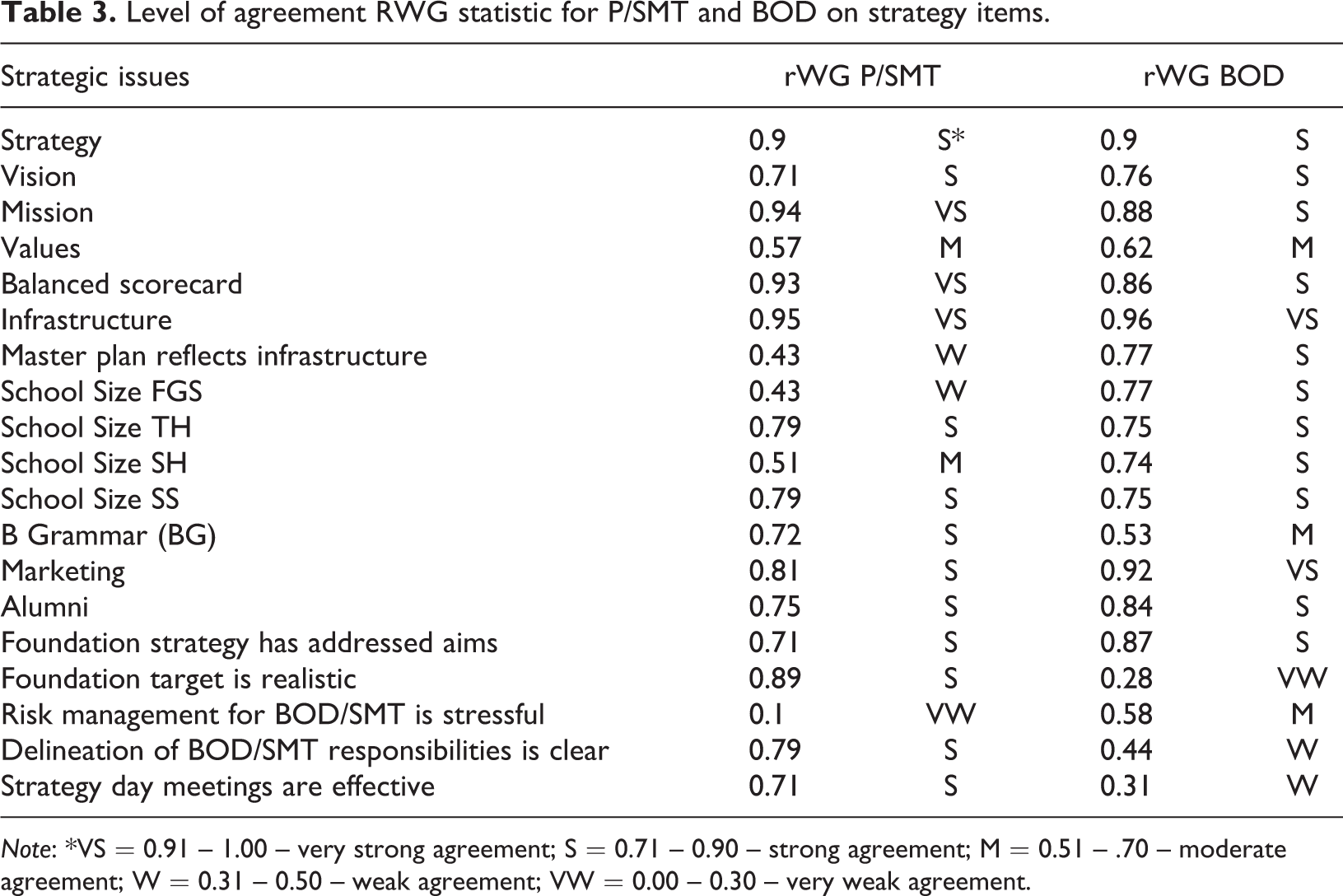
Level of agreement RWG statistic for P/SMT and BOD on strategy items.
Note: *VS = 0.91 – 1.00 – very strong agreement; S = 0.71 – 0.90 – strong agreement; M = 0.51 – .70 – moderate agreement; W = 0.31 – 0.50 – weak agreement; VW = 0.00 – 0.30 – very weak agreement.
As shown in Table 1, the reliability level for strategy (α = 0.76) indicates that in this study, strategy is a reliable indicator of its three constituent elements, namely vision, mission and values. The best reliability is for the balanced scorecard (α = 0.86), which suggests that the components of intent and purpose, and strategy maps related to long-term planning and decision-making, are reliable indicators of the balanced scorecard as a tool of strategy execution.
Comparative Data
Table 2 shows the comparisons in mean scores recorded by the SMT and BOD on each of the items of strategy as measured by the ASQ, and as an indication of alignment between the SMT and the BOD.
As the data reveal, both the SMT and BOD agreed on the strategic vision, mission and values of the school (none of the t-test results registered statistically significant differences). This unanimity across groups on school strategy however is not replicated when we examine the importance of the balanced score card as a tool for strategy execution. As Table 2 shows, the SMT recorded statistically significant higher scores on all aspects of the balanced scorecard than did the BOD, with the t-test results showing differences at the p < 0.01 level of significance. In other words, the balanced scorecard is more important to the SMT as a tool of strategy articulation and execution than it is for the BOD. This finding is consistent with tenure being significantly related to the balanced scorecard (r = 0.58, p < 0.05, Table 1) where SMT members have been in their positions of seniority longer on average than have BOD members.
In comparison, the findings on infrastructure are reversed, with the BOD registering significantly higher scores on the infrastructure components of pool rebuilding (t = −3.35, p < 0.01), the Sandringham House gym and hall development (t = −4.27, p < 0.01), the Brighton Netball and Tennis Centre (t = −4.02, p < 0.01), the underground maintenance store (t = −2.49, p < 0.01), and the Penybryn Oval development (t = −3.31, p < 0.01). In each case, the BOD believed these infrastructure developments were more important to the school’s master plan than did the SMT (t = −4.12, p < 0.01). These results may be the result of more long-term perspectives by the BOD compared with the SMT, who are more concerned with more immediate and concrete educational issues and their relevance to students and the parent community.
This notion of educational imperatives driving SMT decision making and strategic thinking instead of infrastructure development may also explain why the SMT recorded a statistically significant higher score on FGS’s relationship with its partner school, BG, compared with the BOD (t = 2.10, p < 0.1). Apparently this relationship between the two schools is more important to the SMT than it is for the BOD. In comparison, the BOD believe the Director of Alumni addresses the strategic aims of the school more than does the SMT (t = −2.17, p < 0.1). Similarly, the BOD believe that the external fund-raising committee, known as the Foundation, is addressing the strategic aims of the school and has a realistic target for fund raising into the year 2020. In comparison, the SMT is less convinced in the capacity of the Foundation to deliver on these aspects of its role (t = −5.33, p < 0.01, and t = −4.00, p < 0.01 respectively).
Level of agreement
The previous section has compared SMT and BOD responses on strategy issues. In this section we discuss the level of agreement or consensus among members of each team. This helps us to understand the internal alignment between members of the SMT and BOD. A simple mean or average score may conceal considerable diversity among the opinions of a group. Accordingly, we use a statistic called ‘rWG’, which is a commonly used measure of inter-rater agreement. Higher rWG values indicate greater levels of agreement among members of a group. When all members of a group are in perfect agreement on a specific issue, rWG is equal to 1. In contrast, when group members lack total agreement, the value of rWG is zero (rWG has a meaningful range from 0 signifying complete lack of agreement, to 1 signifying complete agreement). Following LeBreton and Senter (2008), the common cut offs for rWG are: .00 to .30 – Very weak agreement; .31 to .50 – Weak agreement; .51 to .70 – Moderate agreement; .71 to .90 – Strong agreement; .91 to 1.00 – Very strong agreement.
Overall, there was strong to very strong agreement (mean rWG = .71 to >.91; 74% of cases) among members of the SMT on the strategic issues (Table 3). Very strong agreement (rWG >.90) was found among the SMT members in mission, use of the balanced scorecard and infrastructure. Interestingly, despite the overall strong agreement for overall strategy, only moderate agreement was found specifically for values. Much weaker agreement among SMT members was found for the master plan reflecting infrastructure, school size projections and risk management for BOD and the SMT as a stressful activity.
There was also on average strong to very strong agreement (mean rWG = .71 to >.91; 68% of cases) among the BOD on the importance of the strategic issues. Very strong agreement (rWG > .90) was found among the BOD members on infrastructure and marketing. Much weaker agreement among BOD members was found in the areas of the effectiveness of strategy day meetings, the degree to which the Foundation target is realistic, and the degree to which the delineation of BOD and SMT responsibilities is clear.
Interestingly, despite the finding (reported above and in Table 2) that the BOD believes, on average, that the school has a realistic target for fund raising into the year 2020 more so than the SMT, there is in fact a very low level of agreement on this within the board itself, and strong consensus in the SMT that the target is only minimally realistic.
Discussion
Our results indicate that school leadership is an executive function that has important strategic and educational imperatives. In particular, the articulation and execution of school strategy that satisfies educational, business and public agenda is increasingly a differentiator of school identity and outcomes (Davies and Davies, 2004; Eacott, 2011). In the context of the independent school sector, the degree of alignment between the SMT and BOD is essential to successful strategy execution. This imperative is replicated across various industry sectors (Dess, 1987; O’Reilly et al., 2010). However, alignment in schools may be difficult to achieve, when we consider that senior management and board members often have different work experiences and expectations which may at times be incompatible with school cultures. Accordingly, our intention was to examine and analyse the extent of alignment in one independent school. The findings could help establish a framework for further research and development of this topic, which has significant performance and strategic implications for schools and their constituencies.
An important finding of our study was that strategy was firmly identified both as a unitary construct with a respectable level of reliability (α = 0.76) and as a collection of three essential elements: vision, mission and values. Surprisingly, strategy was not significantly correlated with the Balanced Scorecard (BSC), which is a mechanism of strategy execution. One possibility for this result is that the BSC is not yet firmly operational as intended. The latter explanation has some veracity, as Table 2 indicates significant differences between the SMT and BOD on all dimensions of the BSC, while the rWG values for both sets of respondents also show strong to very strong internal agreement on this component of strategy (Table 3). That is, both the SMT and BOD agree internally in their responses to the BSC (SMT = 0.93; BOD = 0.86), but disagree with each other on the merits of the scorecard. These results indicate that for strategy to be executed successfully, it first needs to be fully understood and agreed to by all parties responsible for its articulation and execution (Crossan et al., 2008; Davies and Davies, 2004). In this specific school context, the results suggest that the BOD could benefit from further education on the purpose and practice of the BSC as a tool of strategy execution. The findings confirm the dynamic differences in attitudes between corporate members of the BOD and educators who comprise the SMT, a difference prominent in many independent schools in Australia (Dunckley and Mitchell, 2012). However, we should consider that alignment on all issues at all times might not be important or desirable. For instance, the lack of alignment by the SMT and the BOD may indicate that the strategic initiative of the BSC is a poorly conceptualized idea that needs further articulation. In this case, dissent may be an important alternative to agreement.
Strategy execution may also be associated with tenure. In particular, TMT tenure is related to the extent to which the SMT and BOD in this school believe specific initiatives are essential to school strategy. Specifically, the longer the tenure in a position of seniority, the more important is the school mission and the BSC to overall strategy development, and less important are infrastructure developments to strategy execution (see Table 1). These findings suggest that the SMT is more focused on getting the strategy correct, and the BSC is one mechanism by which this mission may be achieved. In comparison, the BOD is more focused on the cosmetic factors that help improve the appearance and public profile of the school, but that may not necessarily add value and substance to the quality and expertise of teachers and the educational success and experience of the students. These differences indicate a tension between the operational duties of the SMT as it develops and executes school strategy, and the long-term objectives of the BOD to make the school the best resourced and visibly prominent school in the region. McCormick et al. (2006) and Bush and Gamage (2001) assert that when school boards become increasingly involved in the operational management of the school, the leadership and decision making processes of the principal and the SMT are compromised. McCormick et al. (2006: 432) claim that the chair of the School Board should assist in strategy formulation and execution, ‘without becoming directly involved in operational management of the school’.
On the basis of these findings, we would expect that TMTTH might be a valid proxy for agreement (or lack thereof) between the SMT and BOD on strategic issues. In this study, we found TMTTH was stronger for the BOD (.99) than for the SMT (.39), which suggests, on the basis of past studies, that the greater variety in experience by the BOD would translate to less agreement on key issues and greater leadership impact of the SMT (Elenkov et al., 2005). Instead, we found that regardless of the level of TMTTH, the level of internal agreement in both the SMT and BOD determined the degree to which there was alignment between these two groups on critical issues of strategy. As shown in Table 3, there are strong to very strong rWG coefficients for both sets of respondents on the BSC and infrastructure. The SMT, which had a low TMTTH coefficient (0.39) and therefore is relatively homogeneous in its tenure, rated the importance of the BSC to issues of strategy significantly higher and at a very high level of agreement (rWG = 0.93) than did the BOD, who also was internally strongly consistent in its ratings on this construct (rWG = 0.86). Similar results relate to infrastructure, where the very strong levels of agreement for both the SMT and the BOD on this element of strategy may explain the significant differences between the groups (Table 2) rather than the level of TMTTH. Our findings indicate that internal agreement may occur regardless of low or high levels of TMTTH. The question we now need to address is what causes higher levels of internal agreement in groups if their TMTTH is low or high. It may be that working in a stable group over time has benefits that may compensate for the initial unanimity of heterogeneous groups that are still excited by their new positions of responsibility. Research indicates that team or group cohesion is a significant predictor of group performance (Hackman, 1990; Jensen and Zajac, 2004; Jung and Sosik, 2002; Sivasubramaniam et al., 2002; Westphal and Zajac’s, 1995). It follows that the greater the unanimity in decision making in SMTs in schools (that is, lower the level of heterogeneity), the more likely the school strategy will reflect this uniformity (McCormick et al., 2006) and enhance its execution.
Limitations and Recommendations
This study of strategy alignment could be improved on a number of fronts. First, because this is a cross-sectional study of one school at one point in time, the findings only apply to that specific situation, regardless of how relevant they may be to other school systems and cultures. Additionally, because the sample for the study has altered since the collection and analyses of data (the principal has retired from her post and now chairs a disciplinary committee for a government body responsible for the registration and professional conduct of all teachers in the state; some board members have taken up other appointments in industry and as a result have been replaced with new members), it would be impossible to collect new data in an effort to enhance the reliability and validity of the study. Therefore, future research is recommended which may include an instrument in addition to the ASQ to improve the validity (hence ‘trustworthiness’) and reliability of the study. A social desirability scale similar to Crowne and Marlowe’s (1960) may be suitable for this purpose. This addition of data independent to the perceptions of respondents on strategic alignment may also help increase the depth of understanding of alignment or lack of alignment between the BOD and SMT. Further, qualitative data in the form of interviews with the sample on issues of importance raised through the analyses of the quantitative data may help clarify issues of concern, and promote further interest in on-going investigation of this important topic.
In closing, we believe that an area of concern and therefore opportunity relates to the sometimes ambiguous roles and responsibilities of the BOD compared with those of the SMT. This role ambiguity is an area of on-going tension in the leadership and management of large independent schools in Australia, and requires possible leadership development workshops and related activities to help educate the parties on their roles, associated duties and accountabilities. In some cases, BODs appear unsure about where their role ends before it infringes on the operational duties of the principal and SMT. Such ambiguity may lead to tension and misunderstanding during Board meetings and in subsequent interactions with the SMT. Accordingly, further exploration of alignment as a key facet of strategy articulation and execution in schools is warranted and encouraged.