







Abstract
This study analyses the collaboration between principals within four Flemish school federations (voluntary collaborative networks between either primary or secondary schools). Interview data from principals were analysed using a micropolitical perspective. A central idea in micropolitical theory is that organization members’ actions (and sense-making) are largely driven by their interests. As such this perspective allows to understand how principals’ interests influence how collaborations within federations work out in practice. In three federations, we found an alignment of principals’ interests that stimulated a collaborative dynamic, which eventually contributed to improvement of the federation. Moreover, it also enhanced principals’ professional development. In the fourth case, however, such dynamics were absent due to a conflict of interests between the federation and one member school. Because one school felt the federation threatened its educational identity and mission, it almost completely withdrew from the federation. Thus, we conclude that principals’ balancing of interests plays an important role in the development of collaborative relationships and practices within school federations.
Research Interest
As a consequence of increased government pressure on schools to develop their own local policies and as a result of processes of enlargement of scale, school organizations have increased in size and complexity over the last two decades. In many countries schools are stimulated (often legally enforced) to develop their own local policies on several domains (for example, human resources management, educational provision, student counselling and mentoring) (Kelchtermans, 2004). As a result, schools govern themselves within the limits set by the government (Kelchtermans, 2007). In order to better cope with the increasing demands, many countries saw the birth of school networks, groups, federations and so on, where several schools join forces in one or another form of structural collaboration (Hadfield and Chapman, 2009; OECD, 2003). This goes together with a shift in emphasis on improvement efforts from individual schools to collaborative entities, such as networks, federations and groups (Chapman and Salokangas, 2012).
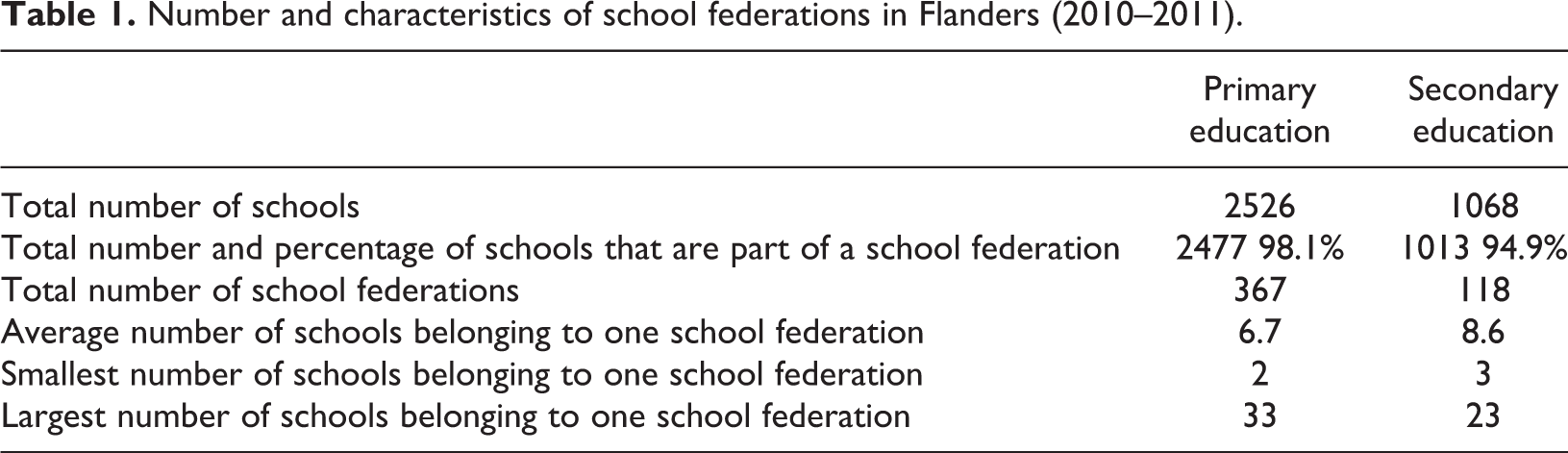
As a consequence, school organizations are becoming bigger and more complex. In Flanders this is most clearly manifested in the phenomenon of ‘school federations’ in primary and secondary education. The Flemish government provides incentives to encourage geographically proximate schools to engage in structural collaboration through the establishment of school federations. As a result, today, most primary and secondary schools belong to a federation. Table 1 provides an overview of the number of school federations and schools belonging to them in primary and secondary education (school year 2010–2011).
Number and characteristics of school federations in Flanders (2010–2011).
Both experience and research provide evidence for the assumption that these changes deeply affect the leadership and management of school organizations (Atkinson et al., 2007; Busher and Hodgkinson, 1995; Chapman and Hadfield, 2010; Chapman and Salokangas, 2012; Hadfield and Chapman, 2009; Sliwka, 2003). The installation of school federations implies that an additional level in the organization and its leadership is introduced, new leadership roles and positions are created and existing ones change. An example is the so-called ‘inter-school management’ or the team of school leaders and supporting staff that becomes responsible for leading and managing an educational organization that encompasses several schools (Bemelen et al., 2004). In this study, we therefore want to explore the actual collaboration of the principals within school federations.
Conceptual Framework
School Federations
School-to-school networks, school groups, federations, chains and so on, are upcoming in many countries (OECD, 2003). The terms used to refer to them are often used interchangeably (Chapman and Salokangas, 2012). Moreover, the precise meaning of a term often varies in different countries and educational systems. In Flanders a school federation is an organization or a group of organizations (schools as well as boarding schools and pupil support centres) that provides educational services within a particular geographical area (Decree of 14 July 1998 regarding secondary education, 1998). A school federation is a voluntary collaborative structure between schools within a region. Schools are free to choose whether they want to join a federation or not. However, they are stimulated to do so by the Flemish government, since school federations receive extra financial resources (a staffing budget, based on the total number of pupils of the school federation) to develop ‘a dynamic process of organization and policy culture’ (Decree regarding Education XV, 2005).
Within these collaborative federations, schools remain entities of their own, while at the same time also creating an extra layer of governance and even an new ‘overarching’ organization (enlargement of scale). This way, a school federation can be considered as an organization in its own right. Each school federation is governed by an autonomous governing body, composed of representatives from the school boards of each school. This governing body appoints the board of principals, which is composed of the principals of the schools and chaired by a coordinating principal. The board of principals takes on the responsibility of leading and managing the federation. The coordinating principal often is or used to be a principal of one of the member schools. School federations can decide to use a part of their staffing budget to release the coordinating principal from school or classroom duties so that they can have part or fulltime availability for the job. However, even when the coordinating principal is fully released, he or she has no extra decision-making powers compared to the other principals. Thus, the coordinating principal is not hierarchically superior, but a ‘primus inter pares’ or a ‘king among kings’ (Berdrow, 2010).
Within these structures of governance and leadership some decision-making powers are delegated to the ‘inter-school’ level of the federation. When school federations want to receive the extra resources from the government they at least have to delegate the following issues to the inter-school level: pupil orientation and support; the hiring, management and evaluation of staff; and the composition of the local education program. Schools are free to go beyond this and delegate more decision-making powers to the federation.
The international research literature, but also, for example, the Flemish government, hold high expectations towards these school federations. Some studies indeed find positive outcomes from schools working together or joining within networks, federations and so. For example, federations offer opportunities for sharing staff and other resources, for developing joint professional development and curriculum development, knowledge creation and information sharing (Atkinson et al., 2007; Chapman and Hadfield, 2010; Chapman et al., 2010; Coleman, 2012; Hadfield and Chapman, 2009; OECD, 2003). However, the development of collaborative relationships and -sometimes of inter-school governing and leadership bodies, also come with a lot of challenges, especially for principals. Examples of these challenges are: developing a shared vision and ownership, resolving disputes and competition (while retaining the potentially positive elements of challenge and difference in opinion), and balancing between collaboration within a federation and maintaining the autonomy of the school. In order to understand these dynamics and challenges we will draw on micropolitical theory.
Micropolitical Theory
Micropolitical theory (Ball, 1987; Blase, 1991) relates to symbolic interactionism and sense-making theory (Weick, 1995). Sense-making theorists have described how actors construct meaning or make sense of situations and act based on this sense-making. Social actors interpret the situations they find themselves in and this interpretation will influence their further actions.
Micropolitical theory's central claim is that organization members’ actions (and sense-making) are largely driven by their interests (Altrichter and Salzgeber, 2000; Ball, 1987, 1994; Blase, 1991, 1998; Blase and Anderson, 1995; Greenfield, 1991; Hoyle, 1982; Kelchtermans, 2007; Malen, 1994). These interests can be similar or shared, but may also be divers and even conflicting between certain (groups of) individuals. Organization members will also use their sources of power and influence in order to further their interests. In the case of different interests, this is likely to result in conflict. Yet, in the case of common interests it may contribute to new or intensified cooperation.
As such, micropolitical theory explicitly draws attention to ‘those strategies by which individuals and groups in organizational contexts seek to use their resources of power and influence to further their interests’ (Hoyle, 1982: 88). Based on an overview of studies on micropolitics, both in schools and in other organizations, Blase (1991: 11) has developed the following working definition of micropolitics: Micropolitics refers to the use of formal and informal power by individuals and groups to achieve their goals in organizations. In large part, political actions result from perceived differences between individuals and groups, coupled with the motivation to use power to influence and/or protect. Although such actions are consciously motivated, any action, consciously or unconsciously motivated, may have political ‘significance’ in a given situation. Both cooperative and conflictive actions and processes are part of the realm of micropolitics. Moreover, macro and micropolitical factors frequently interact.
In former research we have linked micropolitics in schools to the notion of ‘working conditions’ (Kelchtermans, 2007; Kelchtermans and Ballet, 2002). Staff members of schools always have partly individual, partly shared ideas about which working conditions they consider to be desirable or necessary in order for them to properly do their job. As such, these working conditions act as professional interests: when they are absent, threatened or lost, teachers and school leaders will engage in micropolitical actions to establish, safeguard or restore them. Thus, based on the ideas actors have about necessary and desirable working conditions, interests arise and manifest themselves as issues that call for action. This way, an interest agenda arises: a group of interests that, at a certain moment in time and within a particular situation, call for micropolitical action.
We have identified and described five categories of micropolitical interests of teachers (and/or school leaders): self-interests, material interests, organizational interests, cultural-ideological interests, and social-professional interests (Kelchtermans, 2007; Kelchtermans and Ballet, 2002). Material interests relate to the availability of and access to study materials, financial and other resources, infrastructure and time. Organizational interests concern procedures, roles, positions and formal tasks. Cultural-ideological interests have to do with the less or more explicit norms, values and ideas that are acknowledged within the organization as legitimate and binding elements of the school culture. This category also includes the processes and interactions that lead towards the definition of these cultural elements, since they are subject to ongoing negotiation (Altrichter and Salzgeber, 2000; Ball, 1994). Social-professional interests relate to the quality of the interpersonal relationships within and around the school organization, such as the quality of the relations between teachers and the relationship between the school and the local community. Self-interests, finally, relate to people’s professional self-understanding as a teacher or principal (for example, self-esteem, job motivation, task perception).
In our analysis of the collaboration between principals in school federations the micropolitical perspective is highly relevant because of its focus on the interests of organization members (which can explain why they act the way they do). The differences in interests, goals and values between principals as well as their influence on the thinking and acting of these members, have been often ignored in research on school leadership. Administration theory has largely underestimated the plurality of individual differences in values, ideologies, goals and interests in educational organizations and the processes of power, influence and conflict that are related to these differences (Blase, 1991; Hoyle, 1982). Traditional theories of school organization and leadership have failed to capture adequately the complicated and dynamic nature of school life. Leadership theories, in particular, are limited in their sensitivity to the daily dynamics of social influence in schools.…Consequently, descriptions and theories about schools do not address the realities of school life as school people experience it. (Blase, 1991: 1)
Moreover, micropolitical theory helps to understand the possible simultaneous existence of different (sub)cultures in organizations: the goals and interests of individuals and groups within organizations may differ, conflict and/or result in the absence of a shared culture (Hargreaves, 1994; Kelchtermans, 2006; Stoll, 2000). This is also very relevant with regard to school federations, since these are composed of schools with their own specific culture and/or subcultures.
To sum up, we will use the micropolitical perspective as the conceptual lens to analyse the relationships and collaborations between principals in school federations, since these actual practices are likely to be shaped by the agendas of interests and goals of the people involved, as well as the political strategies they use to achieve these goals. Our research questions are: Which interests do principals hold with regard to the inter-school level? And how do these influence collaborations between principals and schools within school federations?
Methodology
Studies from a micropolitical perspective often use qualitative-interpretative research methods, aimed at providing detailed and in-depth descriptions of contexts, people, interactions and behavior (Ball, 1987; Bryman, 2008; Kvale, 1996; Merriam, 1998; Patton, 1987). Such rich descriptions of the entity or case that is being studied (Geertz, 1993), can be used to develop conceptual categories (theory) or to test and challenge theoretical assumptions.
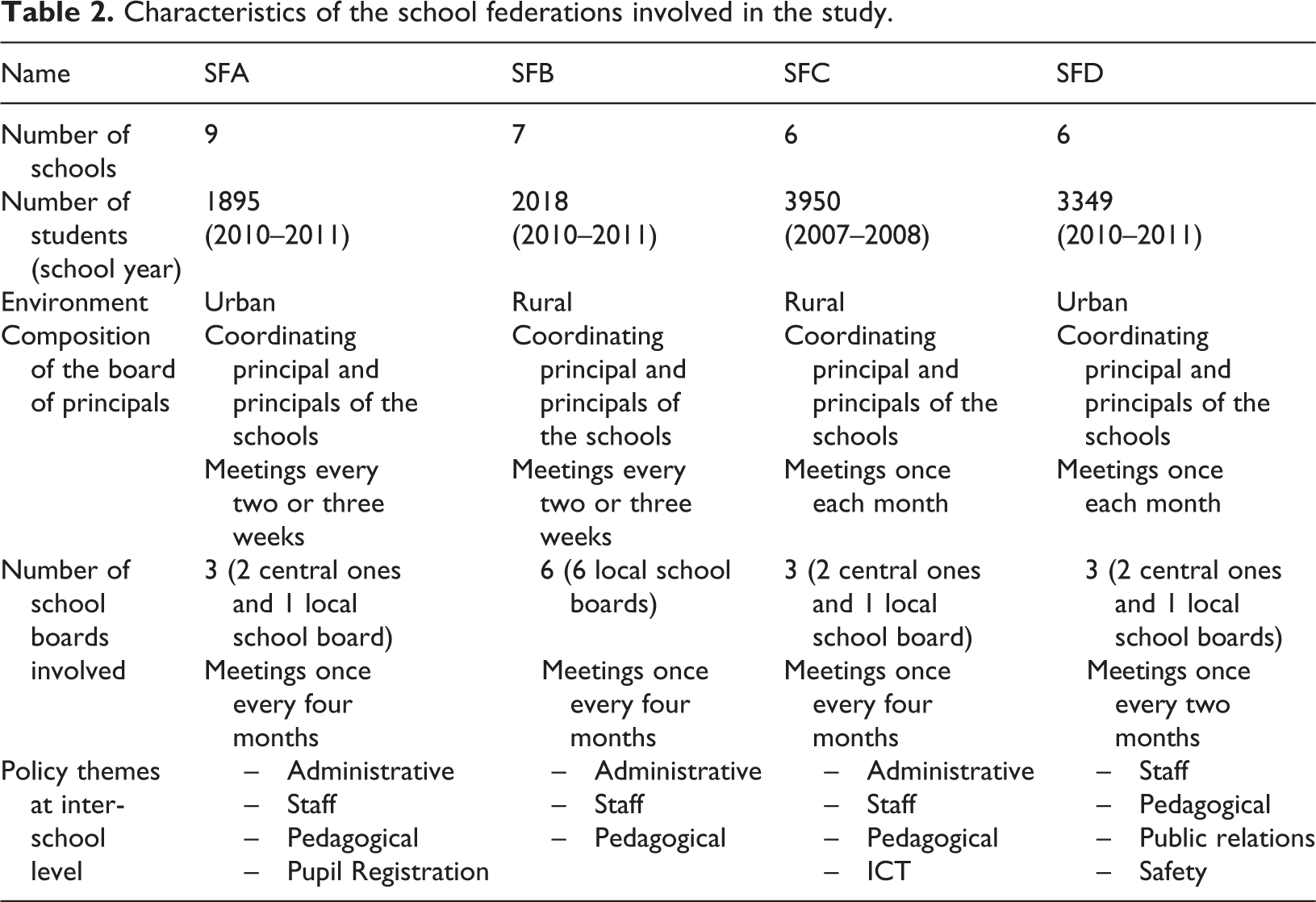
We constructed qualitative case studies (Bryman, 2008; Merriam, 1998; Miles and Huberman, 1994; Stake, 2000; Yin, 1994) of four school federations in Flanders (two federations offering primary and two offering secondary education). ‘A qualitative case study is an intensive, holistic description and analysis of a bounded phenomenon such as a program, an institution, a person, a process or a social unit’ (Merriam, 1998: 19). We selected four school federations that would allow us to answer our research questions (purposive sampling) (Bryman, 2008; Merriam, 1998; Stake, 2000). Thus, we did not intend to compose a representative sample. We did however consciously choose to include federations from both primary and secondary education. We also opted for federations with an average size (6 up to 9 schools). Given our research interest, the most important criterion for the selection of cases was a sufficient number of leadership practices enacted at the inter-school level. We therefore selected school federations, where not only the legally imposed duties were taken up at the inter-school level, but also other issues of local policy. We also knew that the board of principals met on a regular basis (at least once a month) and that the coordinating principal was released from classroom and school duties (in SFB the coordinating principal is released only for 50%, to allow for the hiring of a part-time additional administrator for the level of the federation). Table 2 provides an overview of the school federations and some characteristics, such as the number of schools, number of students, geographical area, composition of the board of principals, the number of school boards involved and the policy themes.
Characteristics of the school federations involved in the study.
During the school year 2009–2010 we interviewed the members of the boards of principals of each federation (a total of 4 coordinating principals and 23 principals). The semi-structured interviews consisted of questions that were the same for each respondent (based on the interview guide) and questions that changed, depending on the respondent and the situation (for example, questions for clarification, questions for more examples). Examples of interview topics are the foundation and organization of the school federation, the relationships and collaboration between principals, the experiences and beliefs of principals and the policy agenda of the school federation.
Prior to the interviews, the respondents were asked to fill out a questionnaire. Apart from identification information (such as age, teaching experience, education), the questionnaire also contained three open-ended questions. 1 The questionnaire thus operated as an ‘advance organizer’ that prepared respondents for the topics of the interview, while at the same time providing a first set of relevant data for the researcher. During the interview the answers on the questionnaire were explored in more detail.
Finally, we analysed a number of documents, such as the mission statements and websites of the schools and federations and agendas and reports of meetings of the boards of principals.
The data were analysed interpretatively in two steps, using the within-case and the cross-case analysis (Merriam, 1998; Miles and Huberman, 1994; Silverman, 2001; Yin, 1994). The within-case analysis took each respondent as the unit of analysis. Each interview was recorded and transcribed. The transcripts were coded with descriptive codes (summarizing the content of text fragments) as well as analytical codes (based on the conceptual framework). The coding scheme was designed starting from the conceptual framework and was extended and modified based on the interview data. Transcript fragments with the same codes were grouped and analysed. This way we constructed a case of each respondent, with the same text structure, based on the most frequently occurring codes, such as ‘cultural-ideological interests’, ‘structure of the school federation’, ‘school interests versus federation interests’ and ‘culture’. These texts (individual case reports) were then compared to construct cases of each federation (the first cross-case analysis). This way, systematic similarities and differences between the respondents could be identified. Therefore we used the technique of continuing comparative analysis, namely a cycle of repeated reading, interpreting and controlling of the data set (transcripts, conceptual framework and the individual case reports) during which the data were continuously compared with one another in an on-going process of interpretation.
In a final step, the cases of the school federations were compared in order to come up with an over-arching answer to the research questions (the second cross-case analysis). The purpose was ‘to see processes and outcomes across many cases, to understand how they are qualified by local conditions and thus develop more sophisticated descriptions and more powerful explanations’ (Miles and Huberman, 1994: 172). We present the results of this final analysis in the remainder of the text.
Results
The comparison of cases showed significant similarities between school federation B, C and D (SFB, SFC and SFD) as compared to school federation A (SFA). In the first three cases the school federation allowed the principals (and boards) of the schools involved to safeguard and accomplish the needs and interests of ‘their’ school. Within SFB, SFC and SFD the interests of the different schools within the federation were aligned. This triggered a collaborative dynamic within the federations that fostered ‘federal improvement’ (Chapman and Salokangas, 2012); a dynamic that each school could benefit from. Moreover, the federation also served as a platform for support and professional development for the principals themselves.
In SFA, on the contrary, the federation was considered as a threat for the cultural identity and mission of the school. Thus, there was an opposition between the interests of the member schools (that is, one school versus the others). Because of this the federation could not serve as a platform for federal improvement, nor as one that stimulated the professional development of the principals involved. Instead, the federation only served as a formal structure in order to receive extra resources from the government.
Federations B, C and D: Alignment of Interests Enabling Federal Improvement and Professional Development of Principals
The data show that principals’ collaboration within federations primarily aims at safeguarding or promoting the interests of ‘their own’ school. This finding is in line with ethnographic studies that portray principals as ‘threshold guardians’, protecting their schools (Willower, 1991; Wolcott, 1973). It also corroborates one of the most prominent results of micropolitical studies: organization members’ actions are largely driven by their interests (Ball, 1987; Blase, 1991). Within school federations these are not merely ‘personal’ interests of the individual principals, but also ‘school interests’. These can be divided into four categories: material, organizational, cultural-ideological and social-professional school interests.
Material school interests involve acquiring additional (financial) resources and saving time and money. The latter can be achieved through bundling their resources. For example, by collectively placing their orders (software, tables, paper) they can get a better price. For example, we need tables … So we [the federation] asked a supplier to make an offer and we got a huge discount. (Bea, SFB) If I have to name one thing as the best feature of our school federation, it would be our central administration office.… So everything that has to do with staff, with human resources is taken care of by one person, for the whole school federation. So that is a major decrease in workload for myself and my secretary. (Ben, coordinating principal) This way, we have more time to take care of the educational issues: the children, the teachers, the parents. (Babs)
Further, principals’ collaboration also aims at forcing into line the rules and procedures for the teaching staff, since an increasing number of teachers are appointed in two or more schools of the same federation (for example, rules concerning the possibility for staff members to work from home, job evaluations and the minimum hours teachers have to teach as part of a fulltime job). For instance, when we do classroom visits as part of the evaluation: how are we going to do this within the entire school federation? … This has become an important issue, because teachers no longer work in just one school, but often in several schools, or they may work in one school for now and in another one next year. (Bert, SFB) One of the things we do within the school federation is sharing what we do in our schools with each other, for instance we tell each other everything about our investments in school infrastructure, because this is a very complicated matter.… So now, because principals have to tell their colleagues everything within the school federation, they also start doing this within their own school. So there is an evolution towards more openness, participation, sharing, notifying each other in the schools. It is becoming part of the culture. (Chris, coordinating principal, SFC)
Finally, the school federation enables safeguarding the social-professional needs of school staff, that is, teachers (social-professional school interests): developing close professional relationships with colleagues, so that they can share their experiences and problems, and come up with improvements and answers together. The federations stimulate professional development of staff members by organizing in-service training opportunities aiming at sharing knowledge and expertise among the teaching staff of the entire federation. Teachers and supporting staff of the different schools meet, visit each other's schools and classrooms, share information and attend workshops together. Another example is inter-school meetings of teachers who teach the same subjects. Especially teachers who have no or few subject colleagues within their school (for example, geography, biology, chemistry teachers) were keen to seize this opportunity to meet with subject colleagues, as members of the same organizational unit (federation). For example, the history teachers of SFC organized a peer meeting to share experiences and ideas on teaching historical terminology, as this was an issue they all struggled with. The alignment of teachers’ needs and interests, explains why they are willing to devote time and energy to attend and engage in such additional meetings (Ball, 1987; Blase, 1991). History, for example, last week we had a meeting with all of the history teachers of the entire school federation … It had to do with language issues, working with historical terminology … because the students didn't grasp that terminology. (Chris, coordinating principal, SGC)
Of course, this federal improvement doesn't come without challenges, since sometimes alignment of interests is absent. According to micropolitical theory, these conflicts of interest are likely to trigger micropolitical actions of the different parties involved, in order to safeguard their own interests (Ball, 1987; Blase, 1991). In SFB, SFC and SFD, however, conflicts of interests were dealt with in ways that allowed the federal structure to operate, show its effectiveness and eventually contribute to strengthen the federal level. An example is SFC, where some principals (temporarily) sacrificed one interest in favour of one or more others. The principals of three schools allowed the principal of the fourth school to use more financial resources than it would normally get, based on the number of students enrolled. … we get more resources, a lot more, than what we would rightfully get, based on the student numbers … so we would normally get 10% of the resources of the school federation, but we actually get 20%. They [the other principals] say: you need it more than we do … we know that it is a tough situation for you. (Christophe, SFC)
The dynamic within the federation not only enables federal improvement. It also enhances principal's professional development and well-being. Put differently, the federation serves as an organization that can safeguard some of the individual social-professional interests of principals. These interests relate to the structural position of principals within their schools. Kelchtermans et al. (2011) describe the position of school principals as one that implies a struggle between loneliness and belonging. The formal position of the principal is – especially in primary schools – a structurally lonely one, since there are no other organization members that share the same position. This often causes principals to experience a structural loneliness and a desire to belong to or be part of a group of colleagues. The school federation provides a solution for this structural issue, because principals become part of a group of equals, for example, all the principals of the member schools in the federation. Put differently, because of the school federations, principals can – at least to some extent – satisfy their need for belonging. Some of the principals refer to this as the biggest benefit of the school federation.
On the one hand, principals are pleased to be able to contact colleagues to ask questions, gather information and tackle problems together. When you have a problem and you think ‘Maybe I'm not the only one having this problem’, you can consult each other and help each other out. (Dirk, SFD) Professionally, it allows you to develop. You feel more powerful, stronger … In the earlier days, I used to sit alone at my desk … and everything would pile up and weigh on my shoulders. And now I think we gain strength from being able to talk to each other. And one colleague already has developed something, and another has already thought about this, and so on. (Anne, SFA) … you can consult each other, use each other's professional abilities and experience. [When we wanted to develop an in-service training policy] we asked our colleagues for advice. So in a way, we consulted ‘the school federation’ … What do we need to include in such a policy? What do these policies look like in other schools? (Dora, SFD) Yes, especially someone who listens to you. It is very important, because as a principal, you're often on your own.… So it is very convenient that you can count on others now. (Bert, SFB) Also the emotions. It is very important to be able to share them.… So on a professional level I have people who support me when something is going on. Sticking together through the good times and the bad ones. Yeah, that's a really good thing actually. (Bieke, SFB). Being a principal is kind of a lonesome job. And now we have some kind of back-up group. You can lean on others.… When something is going on you can share your story and people listen. I highly value that. (Babs, SFB) It is kind of a replacement of the collegial bond you had as a teacher. Now we also have it as principals. You're no longer stuck alone on an island. As a beginning principal it is very nice to get support, to have colleagues as a back-up.… So when I had to develop a local policy on kids with special needs and I wondered: what are the legal requirements? I just called a colleague from another school and this one move gave me all the information I needed. (Bart, SFB) I can lean on them.… So that kind of support is very important to me … also the emotional support … It is a school with some problems, to say the least … And then you really need that kind of support.
The principals of SFB, SFC and SFD were prepared to be open towards each other and – in that sense – endure the vulnerability (Kelchtermans et al., 2010). They indicate that this is sometimes a tricky endeavor, especially when the information they have to share might contribute to a negative image of themselves or their schools. Christine (SFC) illustrates this in relation to the sharing of evaluation reports from the inspectorate. We are open toward each other … Also when the inspectorate visited the schools … And this isn't always easy, because some people or schools get a lot of criticism. So it isn't nice to have to share it when it is a negative report. Trust, I think it is very important … If you don't trust each other, you won't be willing to put everything out in the open. (Anja, SFA)
Federation A: a Conflict of Interests Preventing Federal Improvement and Professional Development
So far we have described the development of collaborative practices within SFB, SFC and SFD. Based on these cases, as well as that of SFA, we conclude that principals seem to balance different interests when they collaborate with others within federations. They assess which school interests can be safeguarded or are threatened by ‘inter-school’ initiatives. When principals think that certain initiatives may help them to safeguard particular school interests, they engage in collaborations and develop leadership practices at the inter-school level. Examples from SFB, SFC and SFD are obtaining resources (material), collectively developing rules and procedures (organizational), improving public relations (cultural-ideological), and organizing in-service training together (social-professional) (see above). In these cases there is congruence between the school interests and what we call ‘the inter-school interest’ or interest of the federation: retaining and improving the inter-school collaboration within the federation. This interest is primarily important for the coordinating principals, since their job recognition depends on a successful inter-school collaboration. Principals sometimes also put effort into safeguarding this interest, in particular when it allows them to achieve organizational goals and obtain acknowledgement as professionals.
SFA, however, showed a different picture. The possible consequences of inter-school collaboration for the school caused principals to resist and refuse this cooperation. In this case, the interest of the federation and the interests of one school in particular proved to be incompatible and irreconcilable. The principal and school board of one school (‘The Apple’) were not prepared to develop and subscribe to an educational mission statement at the level of the federation, which would have to be implemented by all member schools. The principals and the board absolutely wanted to safeguard the educational mission and specific identity of The Apple and considered an inter-school pedagogical mission as a threat to that purpose. We keep the educational issues out of the collaboration, because it would be problematic for us … because the other schools don't share our vision and mission. And we don't think that we should adjust our vision and mission so that we would become closer aligned … There are more similarities than differences, but the differences are there for a reason, they have been deliberately chosen and we are not willing to abandon them. (André, principal of The Apple) So we work at two different paces. The principals of the Apple only join us a few times to meet the legal requirements. No more than that. (Anna, coordinating principal, SFA)
Ball (1994) also states that ‘battles’ that revolve around the stable order and existing definition of a school are different from those that revolve around resources or time. These battles are of a more profound nature, touch the heart of the school and cannot simply be resolved by an exchange or redistribution of resources. Therefore, Ball (1994) distinguishes a vertical and a lateral dimension of micropolitics. The lateral dimension refers to ‘competition over resources and rewards’, while the vertical one refers to ‘struggles over control of organizational form and policy … what is to count as education and what kind of organizational control is to prevail’ (Ball, 1994: 3823).
Conclusion and Discussion
We conclude that the interests of principals at the inter-school level primarily relate to ‘their’ school. Material school interests are obtaining additional resources and saving time and money. Organizational school interests involve controlling the human resources management (hiring and retention of staff). Thus, our results support and exemplify the central claim in micropolitical theory that organization members’ actions are to be understood as driven by their interests. With regard to school federations, these interests do not only relate to the principals as individuals, but also to their schools. Cultural-ideological school interests are safeguarding and promoting the educational project and identity of the school. Social-professional school interests include stimulating collaborative relations between teachers, both within and across schools.
Balancing these different school interests shapes principals’ (micropolitical) actions and helps to explain how and why inter-school collaborative practices take place the way they do. Principals act based on an assessment of the interests that are threatened and/or accomplished through initiatives at the inter-school level. When they believe that the federation can contribute to the achievement of particular interests, they will engage in developing inter-school policies and practices. However, when they consider the federation level to be a threat to their interests, they will minimize their commitment or even withdraw from the federation. Cultural-ideological interests (especially safeguarding the identity of the school) appear to be of crucial importance. When these interests are threatened, principals will almost certainly withdraw from the ‘inter-school’ organization and the conditions for federal improvement are lost.
Our research results show that in cases of absence of serious conflicts between interests, school federations can effectively act as a structure that supports schools and their development. Collaboration within federations allows schools to achieve goals that they would not be able to on their own. Furthermore, if federal improvement takes place, all the member schools benefit. Chapman and Salokangas (2012) describe a shift from individual school improvement towards federal improvement with regard to school federations in the UK. Most of the six characteristics of federal improvement, described by these authors, apply to three of the school federations of our study. Centralized co-ordination of some functions by a central body to provide administrative support, strategic direction, challenge and support to schools across the federation (for example, the role of the coordinating principals and/or central administrator in SFB, SFC and SFD). Benefits from administrative economies of scale (for example, central administration office in SFB, collective purchase policy for the whole federation in SFB, SFC and SFD). The development of federation-wide initiatives for continuing professional development (for example, in-service training for the entire staff of the federation in SFB, SFC and SFD). The support of succession planning and career management (for example, the synchronization of rules and procedures for staff and the collaboration on staff hiring in SFB, SFC and SFD). In-house tailored support for ‘struggling’ and lower-performing schools, departments and individuals across the federation (for example, support for beginning principals and teachers in SFB, SFC and SFD). Commitment to promoting the brand of the federation (for example, PR-policy of SFD).
Moreover, the school federation is a source of support for principals. Principals feel that they belong to a groups of peers, are able to consult each other and share their (emotional) experiences. Given the increasing difficulties to find and retain principals (see for example, Howley et al., 2005), this is a very important conclusion.
Our study obviously also has its limitations and further research is needed to corroborate the findings and gain more in-depth understandings. An example is research on the role of school boards. In our study, we have only included the role of school boards when they were mentioned by the principals. It would be interesting to study to what extent the interests of large school boards (organizing high numbers of schools all over Flanders) are threatened by the idea of regional school federations. The case of SFA, for example, supports the hypothesis that the demands of school boards with a strict ideological educational project prevent schools under their authority to truly engage in collaborative structures that go beyond the borders of the board membership (for example, to include schools with a different educational mission or identity). A related question is how schools, principals and school boards can truly collaborate and trust each other, when they still have to compete for students (since the resources they receive depend on the number of students enrolled).
Our study is based on interviews with (coordinating) principals. The data involve only reported practices. The question therefore remains what actually happens when principals interact and make decisions together. If we assume that principals interact and negotiate about the meaning of issues at the inter-school level (Coburn, 2006; Dewulf, 2005; Dumay, 2009), it would be interesting to study the actual conversations between principals at the inter-school level. This could give us more insight into the actual processes of negotiation, communication and use of micropolitical strategies. This way, it would enable us to gain a more in-depth understanding in how leadership practices take place within school networks and eventually contribute to the development of leadership as it is enacted in actual organizational practices.