







Abstract
Purpose:
Using Activity Theory as an interpretive lens to examine the distribution of leadership, this paper shares a case study on how leadership for an ICT project was distributed in a Singapore school.
Method:
The case study involved observations of 49 meetings and 34 interviews of leaders and the teachers who were involved in the ICT project.
Findings:
Applying the lens of third-generation Activity Theory helped to reveal two main interrelated activity systems, and the leadership actions performed by senior and middle management. The two activity systems comprised the school and the ICT project. The focus in Activity Theory on the social–cultural perspective highlighted the role played by social norms in mediating the leadership activity.
Implications for future research:
The conclusion focuses on the understanding of distributed leadership as analysed through the lens of Activity Theory and suggests future research directions. Activity Theory enables research on distributed leadership to identify and examine interrelated activity systems that various leaders are involved in, and how these impact the leadership provided.
Background
Singapore’s first Information Communication Technology (ICT) Masterplan for Education was launched by the Ministry of Education (MOE) in 1997, with the second Masterplan (MP2) launched in 2002 (Ministry of Education, 2006b). All 20,000 Singapore teachers had access to individual notebooks; the student–computer ratio was approximately five to one; all classes were equipped with broadband access; and every school had at least one Technology Assistant (Ministry of Education, 2004a). Under the first Masterplan, all teachers were provided with 30 to 50 hours of subject-related ICT training, while under MP2, schools could send their teachers to workshops offered by the ministry (Ministry of Education, 2004b).
The main thinking behind the Masterplans was that ICT could be used to engage students in active learning (involving higher order thinking skills and the construction of knowledge), resonating with Jonassen’s concept of students using ICT as a mindtool to support learning (Jonassen, 1999a; Jonassen, 1999b) and with what the literature refers to broadly as Type II as opposed to Type I use of technology (Maddux and Johnson, 2005). Type II use of ICT occurs when students, in the process of using ICT, need to apply higher order thinking and have opportunities to be creative. This is contrasted with Type I use where students’ involvement in learning is relatively passive and students have little interaction with the ICT tool, except to respond to drill-like questions.
After the Masterplans had been in place for about a decade, the Ministry’s official review of MP2, conducted in 2005, found that although a high proportion of teachers (93%) reported having used ICT in 2004, the usage involved mainly productivity tools for preparing and delivering lessons, and students’ use of ICT to master skills or search for information (Ministry of Education, 2005).
Although the context which motivated this study was local, the problem extends beyond Singapore. Cuban (2001), in his pivotal book entitled Oversold and Underused Computers in the Classroom, observed that when teachers adopted technology, the way they used the technology ‘typically maintain[s] rather than alter existing classroom practices’ (p. 71). Similarly, Gibson (2005) noted the abundance of examples in Australia in which the presence of up-to-date technologies had not led to a change in the traditional model of teaching and learning, while Kozma and Anderson (2002) observed that in most of the 28 countries involved in an international study, only a small number of schools and teachers were using technology to change their pedagogical practices.
In providing funding, pedagogy and subject-based training, technical support, and accessibility to technology, the two Masterplans had removed many common barriers to technology use, as highlighted in the literature (Anderson and Dexter, 2005; Baylor and Ritchie, 2002; Brown and Rojan, 2002; Divaharan, 2007). The essential question was what was required to help more teachers move from using technology to simply deliver information to using technology to support students’ active learning (involving higher order thinking skills and the construction of knowledge).
One plausible answer lies in the role of leaders, as suggested by an Organisation for Economic Co-operation and Development (OECD) study conducted from 2000 to 2001, which involved Singapore and 22 other countries (Venezky and Davis, 2002). The main objective of that study was to understand how ICT was used to support educational innovations, generally involving constructivist ways of learning, and to examine factors which impacted the diffusion of ICT. Considering that the focus of that study was not on the role played by leadership, it was revealing that the authors concluded that rapid diffusion of innovative ICT use ‘rarely occur[s], however, without adept school leadership’ (Venezky and Davis, 2002: 24).
This finding, from a large scale international research involving 94 diverse case studies, that leadership was critical in the diffusion of ICT which supported educational innovations, is supported by the general literature on leadership and educational reforms (Busher and Harris, 1999; Sammons et al., 1995), as well as by literature which examines organisational factors which impact the implementation of ICT in schools (Flanagan and Jacobsen, 2003; Kincaid and Feldner, 2002; Murphy and Gunter, 1997).
However, one question remained. What leadership actions are needed to support ICT reform in schools? Even though the literature outlines in broad strokes the leadership required for ICT implementation in schools, it does not indicate the details of specific leadership practices (Flanagan and Jacobsen, 2003; Martinez, 2002), or how such leadership is distributed (Anderson and Dexter, 2005). Although Venezky and Davis (2002) highlighted the importance of leadership, they did not go into details on the leadership practices required, or who else besides the Principal should provide this leadership.
The intent of the present study was to examine a school in the process of implementing an ICT reform, focusing on the leadership actions performed. Since the literature suggests that leadership is critical in influencing the way teachers use ICT, it is important to study the enactment of leadership and how that leadership is distributed. The essential research question was: ‘How is distributed leadership practised in a school reform involving the use of ICT for instruction?’ The main theoretical lens which was adopted was distributed leadership (Spillane et al., 2004), while the analytical lens used was Activity Theory.
Purpose of paper
This paper proposes that there is merit in using Activity Theory to understand the construct of distributed leadership. Distributed leadership, as defined by Spillane and Gronn, allegedly drew upon socio-cultural activity theory (Gronn, 2000; Spillane et al., 2001, 2004). However, in actual practice, empirical studies on distributed leadership have to date rarely utilised Activity Theory as an interpretive lens to analyse the concept of distributed leadership (Harris, 2005; Hartley, 2010; Mayrowetz, 2008).
Instead, Spillane used a simplified version of Activity Theory to propose that leadership practice is constituted in the interactions of school leaders, followers and situations, as illustrated in Figure 1 (Spillane et al., 2001, 2004).
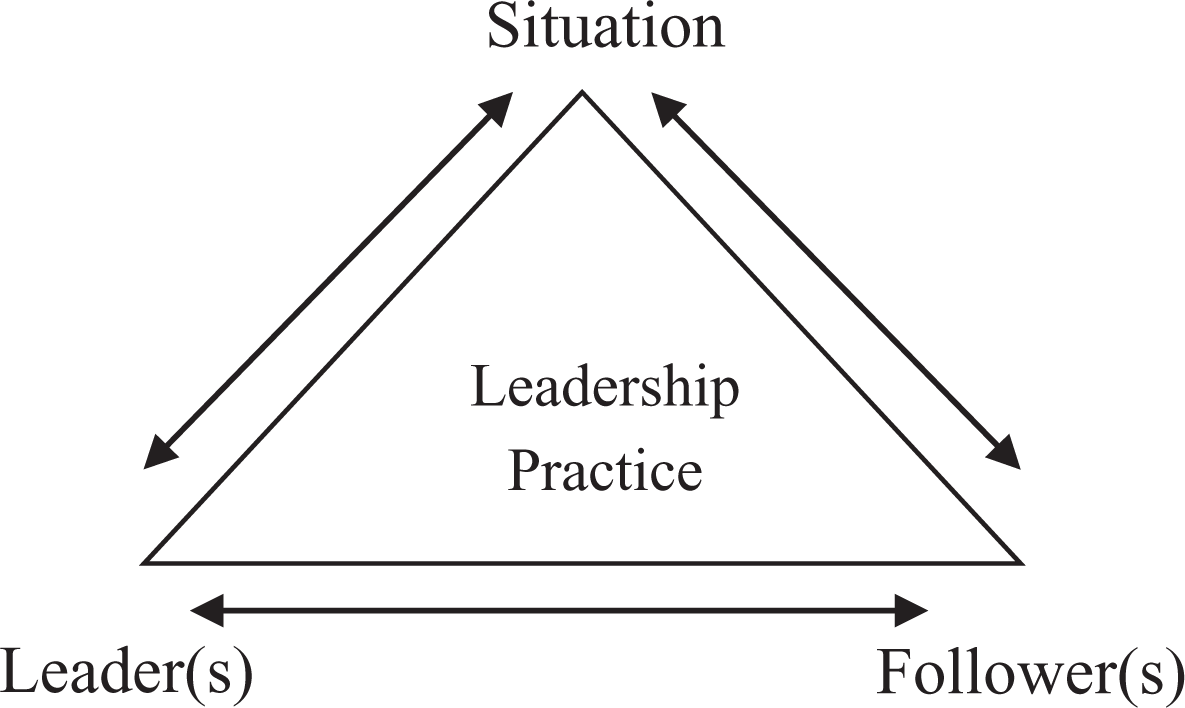
Distributed leadership as represented by Spillane, Halverson and Diamond (2004).
Unfortunately, in reducing the complex social–cultural context in which the leadership activity takes place to the broad concept of ‘situation’, distributed leadership as a construct did not provide sufficient guidance on what to focus on within the situation. This paper proposes that Activity Theory is useful as an interpretive lens for distributed leadership in enabling a more nuanced understanding of ‘situation’ through its consideration of tools, rules/norms, and the community.
In addition, Activity Theory embraces the concept of division of labour which arguably is aligned to distributed leadership’s concept of multiple leaders with different leadership roles, and includes an outcome, which could be aligned to the definition of leadership as being purpose driven. As the activity being analysed in this paper is the leadership activity, the subject in consideration is the leader(s), while the object is the particular aspect of the follower(s) which the leader aims to influence in order to achieve a specific outcome; in our case study, the object is the desired change in the teachers’ use of ICT.
Overlaying Activity Theory on the construct of distributed leadership enabled the researchers to identify two interacting activity systems at the organisation and process levels (school and ICT project), and the leadership actions performed by senior and middle management. The focus in Activity Theory on the social–cultural perspective also highlighted the mediating role played by social norms in the leadership activity.
In the following sections, literature related to Activity Theory is reviewed and its relationship to distributed leadership is discussed. This is followed by a description of the methodology applied, particularly with respect to the use of Activity Theory as an interpretive lens. Findings support the original intention of a more nuanced understanding of how leadership is distributed amongst multiple groups of people. The paper concludes by reiterating the potential of using Activity Theory as a lens to study distributed leadership, particularly to illuminate the social–cultural context within which the leadership activity is performed.
Literature review
Activity Theory’s position that the activity is the fundamental unit of analysis resonates with distributed leadership which views the unit of analysis not as individual leaders but as leadership activity, which is distributed over multiple leaders, followers and the situation (Spillane, 2005).
Three generations of activity theory in brief
In Activity Theory, human actions are meaningfully understood only within the context of an activity system (which includes the subject whose motivation is to transform an object into an outcome), which can be either material or intangible in nature (Barab et al., 2002; Engeström, 1999). The first generation of Activity Theory drew heavily on Vygotsky’s concept of mediation to emphasise that the relationship between subject and object is mediated by cultural artifacts (Engeström, 2001), as illustrated in figure 2.
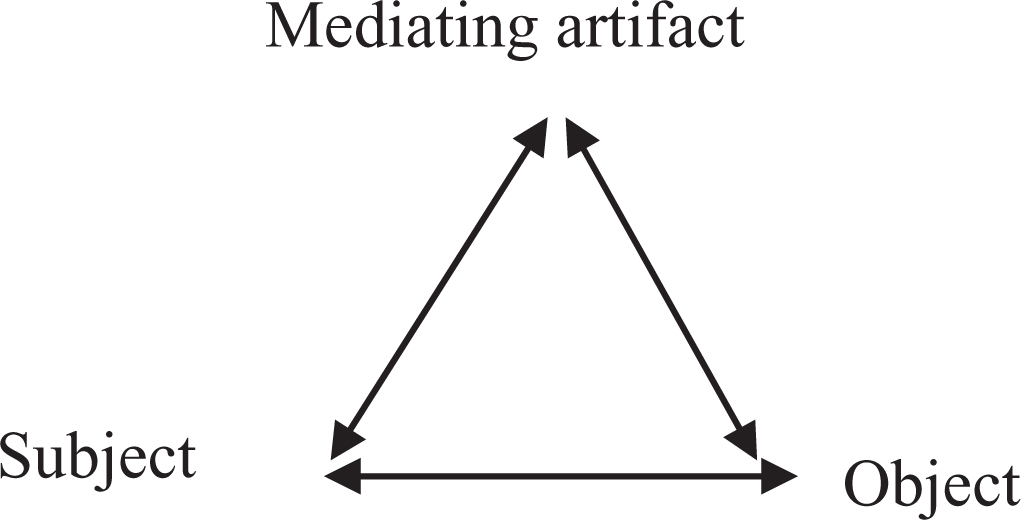
Vygotsky’s model of the mediated act as cited in Engeström, 2001.
In the second generation, Activity Theory goes beyond the consideration of individual actions to the consideration of activities within a social, historical context (Barab et al., 2004; Collis and Margaryan, 2004; Engeström, 2004; Issroff and Scanlon, 2002). Thus, the relations between subject and object are not direct, but are mediated by various components of the activity system, namely the community, tools, rules and division of labour (Yamagata-Lynch, 2001).
In Activity Theory, the unit of analysis is the social, collective activity itself, situated within a community-based context (Collis and Margaryan, 2004; Jonassen, 2000). The subject is the individual or groups of individuals involved in the activity who are motivated to transform an object into an outcome, and whose point of view is adopted in the analysis of the activity system (Marken, 2006; Roth and Tobin, 2002). The object is the objective or problem space that motivated the subject to participate in the activity (Roth and Tobin, 2002; Yamagata-Lynch, 2003). For example, in a study conducted by Yamagata-Lynch (2003), teachers (subjects) who participated in a technology-related professional development programme entitled TICKIT were motivated to design ICT projects for their students (object).
The social relationship between subject and object is mediated by tools, including material and psychological artifacts, such as sign and language systems, as well as by rules, and division of labour (Barab et al., 2002). Rules, which can be explicit or implicit, include norms, policies or conventions of the community which can both constrain and enable actions and interactions within the activity system (Kelceoglu, 2006; Marken, 2006). Community refers to a community of actors who share a common object (Hung and Chen, 2002; Ryder, 2007). Division of labour refers to both the division of tasks and the status relations between actors (Daniels, 2004). It considers how tasks are divided horizontally among community members of similar status, such as amongst teachers, or vertically amongst community members with differences in power and status, such as amongst teachers and Heads of Department (Nelson and Kim, 2001). In the context of a study of leadership, the division of labour may refer to the leadership actions and interactions of multiple levels of leaders within the organisational structure.
The components of activity systems are not static, stable components which exist in isolation from each other. Fundamentally, the interaction between subject and object is not a direct interaction; instead the interaction between subject and object is mediated by tools, the community, rules or division of labour (Barab et al., 2002). For instance, in the activity system described by Yamagata-Lynch (2003), the teachers’ development of their ICT projects was mediated by rules which included their schools’ expectations and the expectations of the TICKIT programme, tools which included ideas shared by other TICKIT participants who were part of the TICKIT community, as well as their partnership with Indiana University lecturers (division of labour).
Figure 3 is an illustration of the mediational structure of an activity system (second generation), which shows the possible interactions amongst the various components
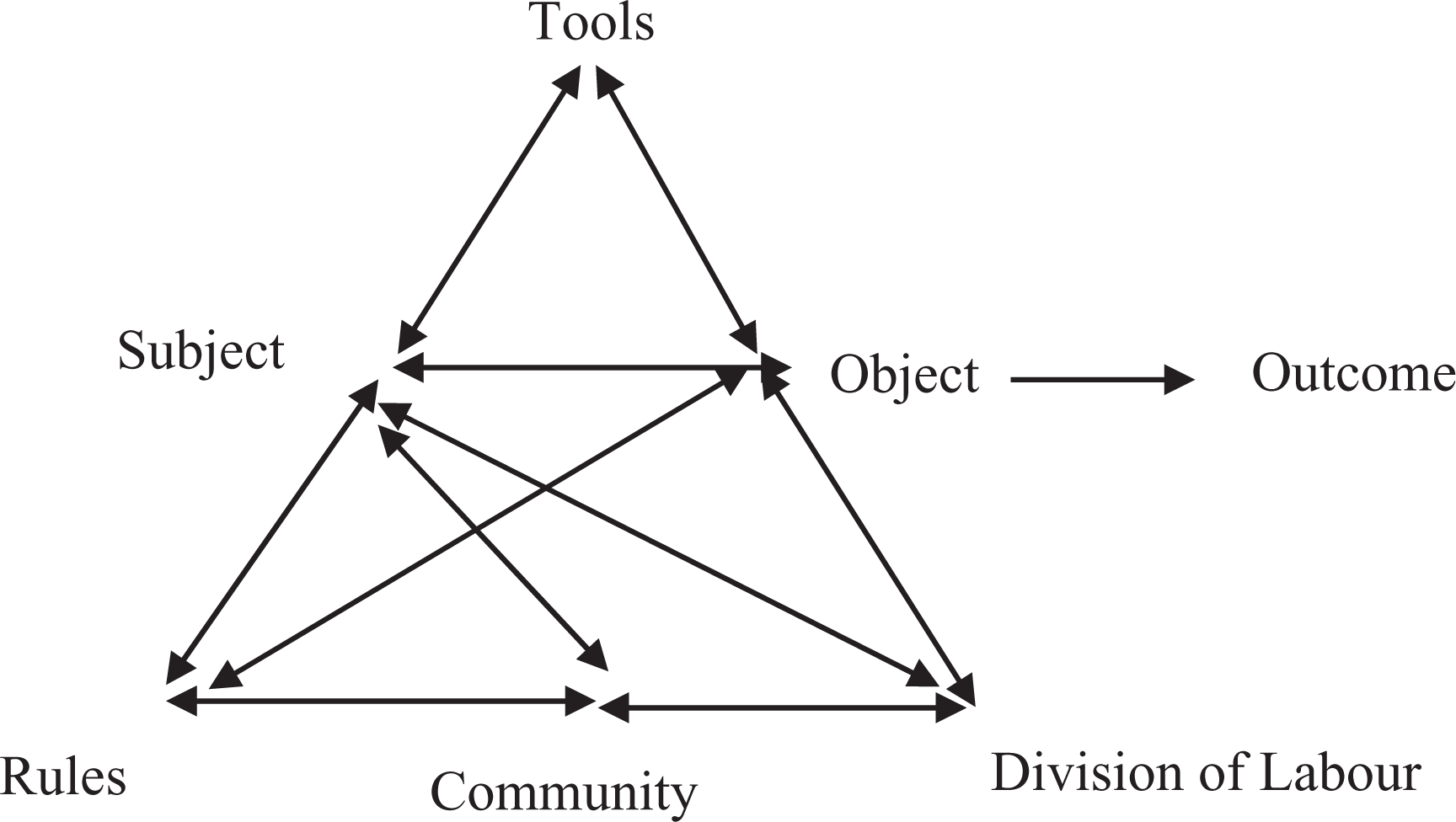
Model of Activity Theory in Engeström (1999) – second-generation.
In the third generation concept of Activity Theory, it is suggested that the minimal model comprises two interacting activity systems, which could consist of macro and micro level clusters of activity. The two or more interacting activity systems have a partially shared object (Engeström, 2001; Yamazumi, 2008). In a special issue in the Journal of Educational Change in 2008, five papers demonstrate the potential of Activity Theory as a resource to study educational change within a school (Engeström, 2008). In one of the papers, Yamazumi (2008) investigates how two main activity systems, involving a university and local elementary schools, interact and collaborate with the shared object of creating an after-school learning activity for the children, one that would bridge the gap between elementary school activities and the practices of everyday life by involving outside communities and organisations.
Relationship between activity theory and distributed leadership
According to Bennett et al. (2003), what distinguishes distributed leadership from similar conceptions of leadership, such as shared leadership, is that it emerges from the interactions of a network of individuals, from conjoint as opposed to individual agency. Therefore, what distinguishes distributed leadership is its concept of leadership as a dynamic and collectively performed activity (Gronn, 2002a; Spillane et al., 2004). Based on such a concept of leadership, the unit of analysis is the leadership activity (Spillane, 2005).
Although distributed leadership is positioned as having its theoretical roots in Activity Theory, it is not a direct mapping. Spillane did not adopt Engeström’s entire object-orientated activity system, choosing instead to adopt a simpler model comprising leaders, followers and situation (Hartley, 2009). While Spillane did not adopt Engeström’s activity system in its entirety, he acknowledged situation as involving various facets, including tools or designed artifacts, language and organisation structure and norms (Spillane, 2006; Spillane et al., 2004), which correspond to the tools and rules components of Activity Theory. Parallel to the concept of tools and rules mediating the various components in the activity system, the situation in distributed leadership impacts and is impacted by the leadership activity which emerges. Certainly, the language used to describe distributed leadership is reminiscent of language used in the literature on Activity Theory: ‘Leaders do not work directly on the world; their actions in and on the world are mediated by artifacts, tools and structures of various sort’ (Spillane et al., 2001: 26).
When it comes to analysing distributed leadership in a case study context, where the change concerned is larger in scope and the activity system is more complex in nature, potentially comprising more than one interacting activity system, we suggest that there is merit in using Activity Theory in conjunction with distributed leadership.
Methodology
The basis of distributed leadership is the leadership activity itself and the interactions amongst leaders, followers and the situation. To enable an in-depth analysis of the leadership activity and interactions involved, this study adopted a naturalistic inquiry approach (Creswell, 2005; Lincoln and Guba, 1985) involving the case study of a school in the process of implementing a project using ICT for instruction. The study encompassed the preparation and implementation time-frame of the ICT project, which spanned 16 months from August 2006 to November 2007.
The essential research question was: ‘How is distributed leadership practised in a school reform involving the use of ICT for instruction?’ This question was broken down into three sub- questions: What were the leadership actions enacted? Who enacted these leadership actions? What pattern, if any, is there in the distribution of leadership?
Based on the distributed leadership perspective, leadership is best understood through examining the execution of leadership actions and the ‘theories-in-use’ of the practitioner (Argyris and Schön, 1974, as cited in Spillane et al., 2004). From a methodology perspective, this translates into the need to observe leadership in action, and to interview leaders for their explanations and interpretations of the actions observed.
To observe leadership in action, the case study involved observations of 49 meetings, and analysis of over 150 emails. Identified leaders were interviewed at least twice during the course of the study. As followers are an integral part of leadership practice (Gronn, 2003; Southworth, 2002; Spillane et al., 2003), the case study involved interviewing followers between one to three times for their perceptions of leadership provided, and its impact. There were a total of 34 semi-structured interviews of leaders and of followers. Gunter (2001) notes that in a study of leadership, interviewing both leaders and followers enables the ‘interplay between what is said is done and what is experienced as being done’ (p. 59).
In the case study of Greenville Elementary (pseudo-name), the ‘timetabled’ meetings were a rich platform at which many leadership actions were performed, including highlighting the theory behind an ICT use (what leaders say) and demonstration of ICT resources (what leaders do). All the 49 meetings were audiotaped and field notes, involving a mix of description of actions observed and researcher reflections (Creswell, 2005), were taken. Besides taking field notes of the interactions and actions which occurred, these field notes also contained notes on relevant artifacts created or used by leaders, including 14 lesson plans and various ICT resources created or selected to help students learn.
Data analysis
An inductive approach (Patton, 2002) to coding leadership actions was adopted. In coding leadership actions, a deliberate effort was made to use gerunds (verbs ending with ‘ing’) as advised by Charmaz (2006) to minimise the temptation to impose existing leadership functions onto the data. Examples of themes generated this way included ‘aligning with the department or school’ (code 1), ‘planning ahead for sustainability and scalability’ (code 13), and ‘creating time’ (code 5). The significance of emerging themes was determined based on relevance to research questions, and partly based on frequency of mention during interviews or occurrence during meetings or email correspondence. For example, ‘modelling’ (code 21) was mentioned or observed 73 times across 30 different data sources, suggesting it was a pervasive leadership action which was also alluded to by the participants during their interviews.
Data analysis through the lens of Activity Theory
The second generation of Activity Theory was originally adopted as an interpretive lens to unpack the ‘situation’ in which the leadership activity took place. However, as the data was explored more deeply, it was realised that the third generation was more appropriate to illustrate the two main activity systems involved. Table 1 illustrates this study's interpretation of Activity Theory as a lens in analysing the context of this case study, and how this interpretation was aligned to the distributed leadership perspective.
Use of Activity Theory as a lens in alignment to distributed leadership (DL).
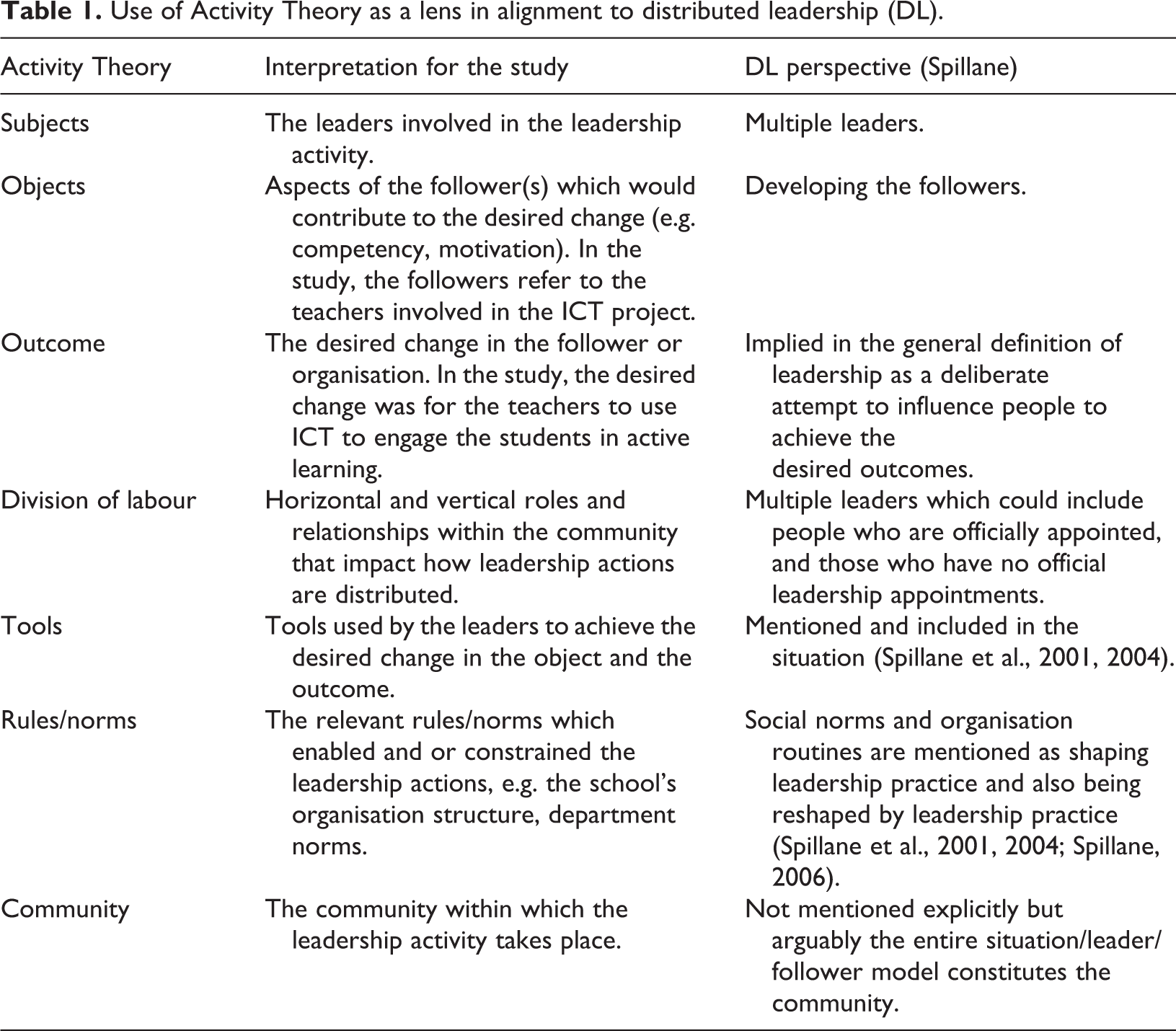
In brief, the construct of Activity Theory emphasises how context is an integral part of influence and meaning making. Distributed leadership emphasises how leadership influence is held between individuals and aspects of the situation and thus views the leadership activity as ‘stretched over’ both human actors and aspects of the situation they are in (Spillane et al., 2004: 16). In using Activity Theory as the analytical lens, the concept of ‘situation’ in Distributed Leadership was broken down to include the following: Tools that an individual uses to enact practices of work, such as lesson plans; The rules of the organisation that individuals abide by in their work, such as the school’s stated strategic thrusts; Norms of the community that dictate how individuals relate to each other in work and how work is organised/accounted for, such as Heads being recognised as officially higher in the organisation hierarchy than a Senior Teacher, as well as the organisation structure of the subject department.
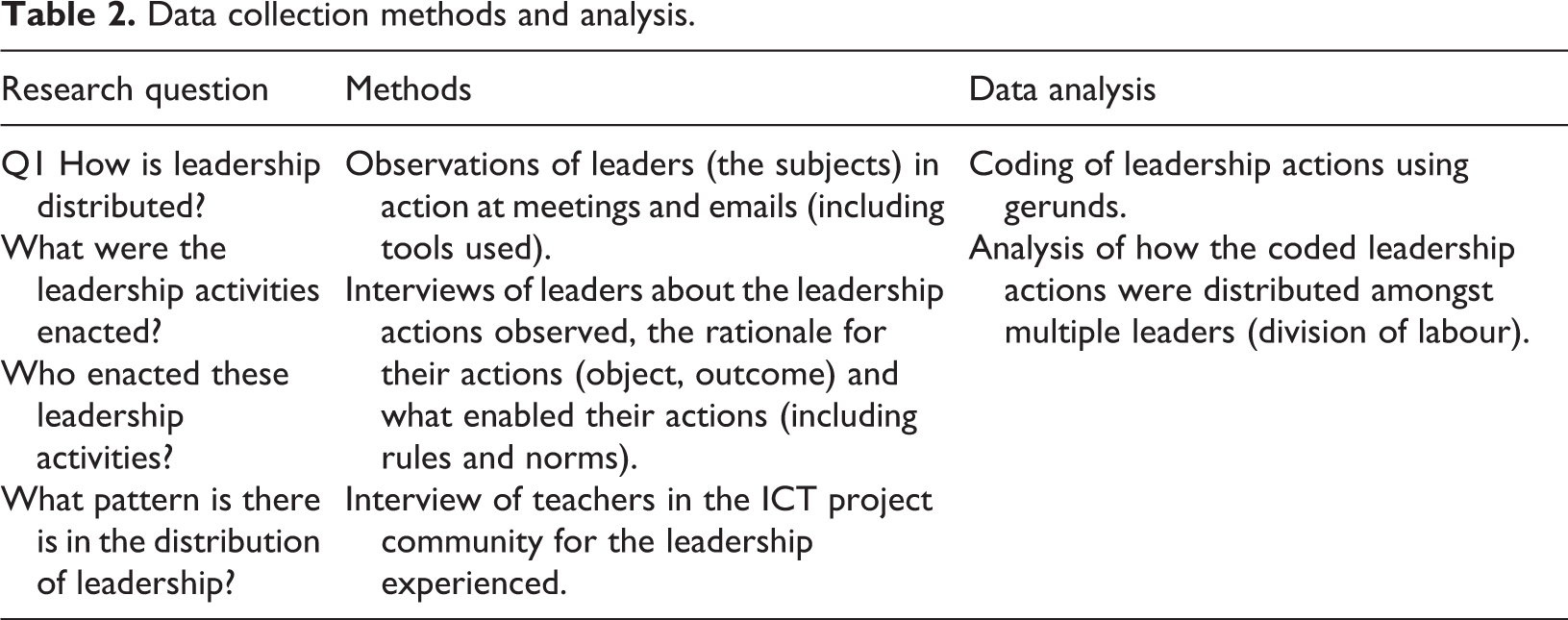
These components of ‘situation’ were used to guide analysis of the division of labour amongst the various leaders involved in the ICT project, and how the different components impacted the leadership practices. Table 2 summarises the main data collection methods and analysis approach based on the research question, and incorporating the Activity Theory components.
Data collection methods and analysis.
Validity and reliability in qualitative research
In qualitative research, unlike in quantitative research, it is acknowledged that there are multiple, ever evolving realities, and that what the researcher presents is ultimately his or her unique interpretation and construction of these realities (Merriam, 2002). However, there are strategies researchers can employ to increase the validity (or credibility) and reliability (or dependability) of a qualitative study.
One essential strategy is triangulation. In this study, three types of triangulation as proposed by Denzin were employed: multiple investigators; multiple sources of data; and multiple methods (Denzin, 1978 as cited in Lincoln and Guba, 1985). There were three researchers involved in designing the interview questions, collecting the data, conducting the interviews or observations, and checking emerging theoretical ideas with one another, thus minimising the danger of idiosyncratic interpretations based on one researcher’s lens and values (Lincoln and Guba, 1985). To ensure multiple sources of data and multiple methods, the actions and views of both leaders and followers were examined, through observations, interviews and analysis of relevant artifacts.
Brief description of school
In this section, a brief description of the school is provided to provide the context, together with the official leadership hierarchy in Greenville Elementary, as well as the main leaders involved in the Lead ICT project.
At the Senior Management (SM) level, Greenville Elementary had two Vice-Principals (VPs) from 2005–2006. Middle Management (MM) in the school included the Heads of Departments (HOD), Level Heads, and Level Managers. The title ‘Level Head’ needs to be clarified as it is misleading. As opposed to the Level Manager who is in charge of all the core subjects for one grade level, the Level Head is officially the second-in-command for a subject, just below the HOD, across all the grade levels. The main Level Head involved in the ICT project was Sarah, LH/Science, who was simultaneously the Level Manager for the Primary 4 level, which was the level at which the ICT project was first implemented. Besides the various Heads, Greenville Elementary also had a number of Senior Teachers (ST), one of whom, Cassie, was the person officially appointed by the Principal to be in charge of the ICT project. The post of Senior Teacher was relatively new, and was created by the Ministry of Education as part of a parallel teaching track to the traditional leadership track of HOD, Vice Principal and Principal (Ministry of Education, 2007).
Figure 4 indicates the hierarchical structure of the school to illustrate the difference in rank of the various positions. The Level Manager position is indicated in parentheses as unlike the other roles, the Level Manager position in 2008 was an internal school appointment while the other roles were official positions recognised by the Ministry of Education. Although Senior Teachers reported to the Vice Principals, similar to the various Heads, the position of ST was considered to be lower in the organisation hierarchy compared to the role of a Level Head. Figure 4 attempts to represent this difference in status. All the names mentioned are pseudo-names to protect the identity of the research participants.
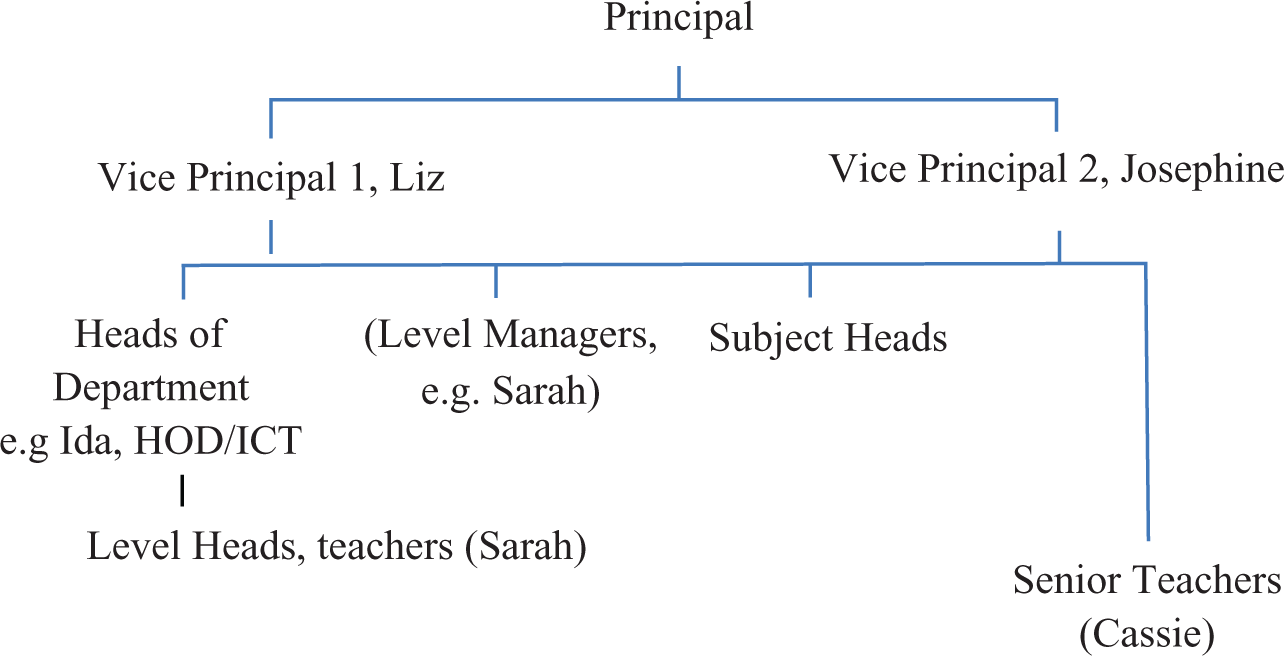
Hierarchical organisational structure in Greenville Elementary.
In 2006, the Lead ICT scheme was introduced by the Ministry of Education. Lead stands for Leading Experimentation and Development in ICT. The aim of the scheme was to support schools which were ready to achieve a higher level of ICT use by providing funding and other support from ETD. The Principal applied for the scheme and the decision at that time was to begin with the Primary 4 level and with the Mathematics subject, with Cassie appointed to be in charge of the project.
Findings and discussions
How is distributed leadership practised in a school reform involving the use of ICT for instruction? The use of Activity Theory revealed two interrelated activity systems promoting the use of ICT, and the division of labour between senior and middle management.
Leadership for the ICT Project as distributed across two activity systems
The two main activity systems identified were the Lead ICT project activity system at the Primary 4 teachers’ level and the overall ICT implementation activity system at the school level.
The existence of the two activity systems was revealed mainly through the discourse by Senior Management or Middle Management, at interviews or during the ICT project meetings. To Senior Management, the Lead ICT reform was more than a one-off project or limited to the Primary 4 teachers. Lead ICT was perceived ‘as a springboard for our other use of ICT in teaching and learning’ (Liz, Vice Principal, second interview, researcher’s emphasis), a ‘prototype’ for the school’s longer-term outcome of using ICT to ‘bring about greater engagement to the children’, in support of the school’s strategic thrusts of enabling teachers to engage students (Liz, first interview). At the same time, Middle Management realised that the Lead ICT reform activity system was ‘not just one initiative’, it was ‘supported by the whole school’ (Ida, HOD/ICT, 9 November meeting).
As Liz (Vice-Principal), stressed at the 22 October meeting: ‘so we’re not thinking just in terms of one level [the Primary 4 teachers] only, we’re thinking about the whole school’. She reinforced this message at the Middle Management meeting on 30 October 2007, ‘to me lead ICT is really a springboard, a springboard to move even further and deeper into using ICT’. In fact, right from the very beginning of the Lead ICT project, as early as at the 19 August 2006 meeting, Liz was already planning for the project to be scaled up in the near future, and this message was communicated to the teacher leaders and middle management, as revealed by Ida, HOD/ICT, in her first interview: Cassie is also trying out to get another set of tablets, so that’s for the next group of teachers because my VP [Liz] said, ‘LEAD, LEAD, then where does it go?’ You know,…like we want to know that it’s not just for these 2 years, it’s actually for the future, so we’re also looking into may be two more levels.
There was thus evidence that senior management strategically planned to use the intended outcome of the ICT project activity system, an increase in the primary 4 teachers’ capacity to develop engaging ICT lessons, as a tool (as a benchmark and in terms of manpower deployment) in the larger school activity system to achieve the broader object of developing all Greenville Elementary teachers to become competent to develop and conduct ICT lessons. The ICT project and school activity systems were also interrelated in that they shared a common longer-term outcome, encapsulated in the school’s strategic thrusts of enabling teachers and engaging students (refer to Figure 5).
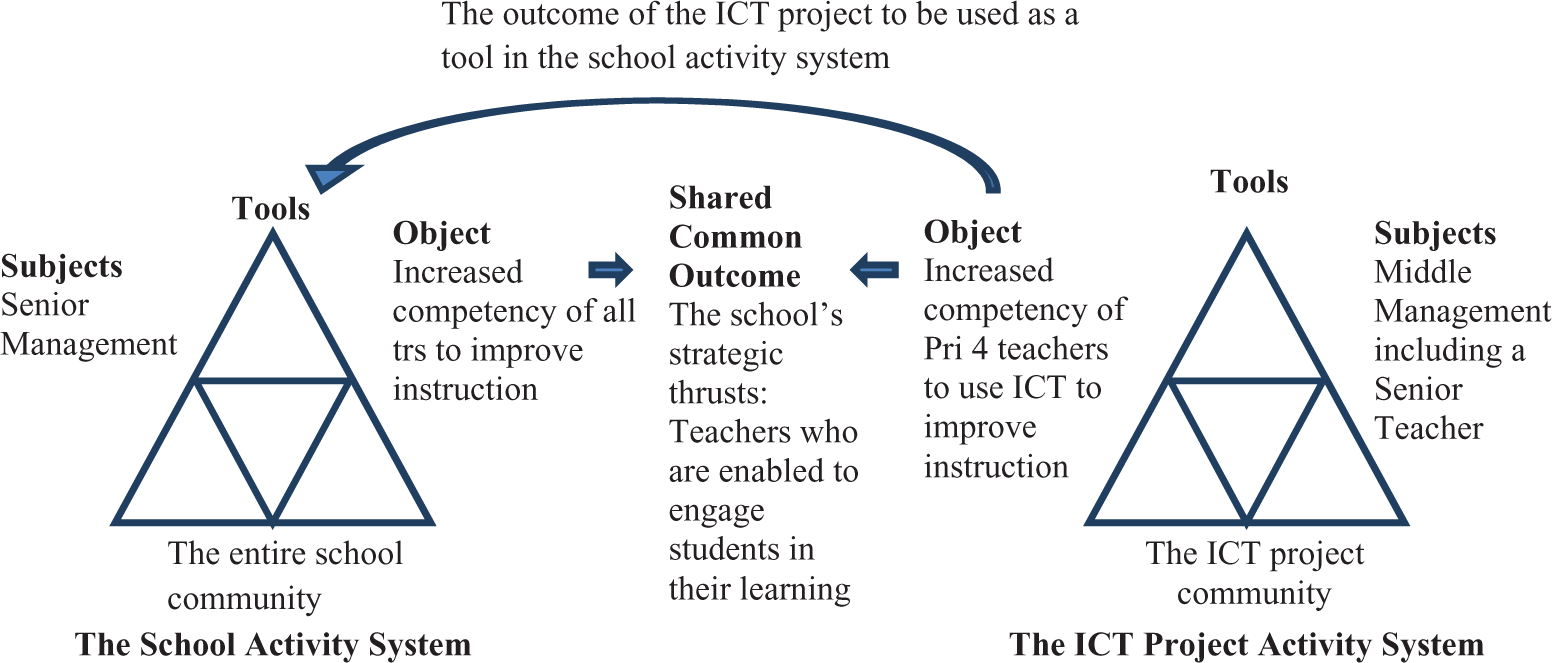
Activity systems at school and ICT project levels: a shared outcome.
The identification of the two interacting Activity Systems shed light on the leadership played by the different levels of leaders in each system, as well as how the leaders supported one another to achieve the shared outcome, which will be discussed in the next finding.
Leadership as distributed between senior and middle management
Distributed leadership raises the issue of how various people performed different leadership actions, which in the field of Activity Theory corresponds to the division of labour. The use of Activity Theory assisted in the analysis of the leadership actions performed through analysis of the main tools used by Senior Management (SM) and Middle Management (MM). While both SM and MM performed a range of leadership actions, SM focused mainly on setting the general direction for ICT use and strategically deploying the appropriate middle managers, while MM focused on coaching and supporting the teachers to use ICT to teach specific lessons.
Leadership by Senior Management
Senior Management provided the direction for ICT use in the school. Emerging strongly from the talk of SM was that the use of ICT should be aligned to the school’s strategic thrusts of enabling teachers and engaging students (the shared outcome in Figure 5). Even when the school’s strategic thrusts were not explicitly mentioned, they were obliquely referred to: ICT is always mentioned as a tool, yeah, the thrust of the school is the big things, like the big chunks, like the students’ learning, engaged learning, and how do we enable our teachers…?. So ICT doesn’t come up as a specific thrust,…, you see. We kind of like put it as part of the strategies. (Josephine, VP, first interview). Actually, [the school’s vision for technology was] to engage children, with interactive work, you know. Yah. And also through engagement, there will be passion for learning…. (Ms Wong, P, first interview).
Clearly, linking the use of ICT to the school’s strategic thrusts of enabling teachers and enhancing learning was an important consideration for senior management. There were several indications that this philosophy trickled down to the middle managers, who spoke the same language: At the end of the day, learning and teaching becomes more, err, powerful. Or learning becomes better for the children and everybody will be engaged on the task. So more or less we are looking at technology to support our pedagogy…basically to improve teaching, and to get children engaged. (Cassie, 15 September meeting, researcher’s emphasis). But where the teachers are concerned, the teachers need to be able to have the pedagogy as well as be prepared to teach the children…. To me I think that’s what the basic thing leads to. Enabling our teachers and engaging our students. (Ida, HOD/ICT, first interview, researcher’s emphasis).
Beyond setting the direction for ICT use, Senior Management strategically harnessed the organisation structures which they had influence over, particularly the temporal arrangements of the work day and manpower deployment, as ‘tools’ to provide Cassie and Sarah with both the time (three hours each week during normal curriculum hours) and the authority to exercise the latter’s leadership activity of coaching the Primary 4 teachers.
It was a strategic decision by Senior Management to appoint Cassie as the person officially ‘in charge’ (Dean, teacher, second interview) of the ICT project although the school had a Head of Department who was in charge of ICT, Ida. Josephine, one of the two Vice Principals, shared that the Principal had applied for the Lead ICT project because the latter felt that ‘Cassie could head it because Cassie had already started something [using ICT as a mindtool], you see, and…maybe this Lead IT project will help her take it further’ (first interview). Cassie was selected as she had the expertise to lead the ICT project while Ida, though officially Head of ICT, was ‘not entirely into the ICT part’ and ‘may not be very familiar with the ICT’ (Josephine, VP, first and second interviews).
Another essential deployment decision by Senior Management was giving Sarah the new and internally appointed role of Level Manager for the Primary 4 teachers, which gave her the authority to involve all the Primary 4 teachers in the development of ICT lesson plans, regardless of the subject department which they reported to. In addition, the deployment of Sarah to the ICT project when she returned from a course in May 2007 was itself a strategic decision. As Level Head of Science who ‘might be our [next] HOD/Science’ (Principal, second interview), Sarah was perceived as being in a more authoritative position than Cassie to promote the use of ICT for Science, moving beyond just Mathematics.
In the literature, time is often mentioned as a barrier to teachers’ use of ICT, including the time for teachers to meet and discuss their ICT lessons (Anderson and Dexter, 2005; Brown and Rojan, 2002). Yet, there is little detail in the literature about how leaders resolve this issue of lack of time for technology integration.
In Singapore schools, the Principal is given the discretion to hire additional people, such as adjunct teachers (retired teachers). Exercising this discretion, the Principal of Greenville Elementary tapped her extensive social network to employ the school’s full entitlement of ten adjunct teachers to teach non-examination subjects like Health Education, so as to free up curriculum time during which teachers from the same level could meet – what the Ministry refers to as timetabled time.
Senior Management created three hours of timetabled time each week for the Primary 4 teachers. Although the Ministry had introduced the concept of timetabled time, in reality, due to difficulty in hiring retired teachers, many schools faced difficulty in providing such time. In such a context, the provision of three hours of timetabled time per week was a luxury. There is evidence that this extra time was perceived by both Principal and Vice-Principal as critical, and as a strategic move: We just want to give them time to explore. Help them to see that it [use of ICT] is important,…if you need time, we’ll give you the time. (Liz, VP, first interview). Freed up, for a group of teachers so that they can meet as a level to discuss issues, share problems that they face, those who need help, shout out, and they can put into their agenda for the following week or to see how they can help each other. (Ms Wong, P, first interview).
Leadership by Middle Management
The middle managers, Sarah and Cassie, provided leadership mainly through coaching the teachers to develop ICT lessons, making suggestions and giving feedback on the ICT lessons developed, and by modelling ICT lesson plans and lessons. Much of this coaching and modelling was done during the timetabled time created by Senior Management.
In the literature, modelling is defined as leading by example, demonstrating best practices and desired behaviour or values and beliefs (Elmore, 2000; Hallinger, 2005; Murphy, 2005; Sheppard, 1996). During the timetabled meetings, the essential leadership action observed was the modelling of both the product and process of crafting an ICT lesson. Many of the teachers acknowledged the impact of the modelling, particularly by Cassie: Sarah (Level Head/Science): I see Mathematics, I see a role model, Cassie. (first interview, in explaining why she stepped up the pace of integrating ICT into Science lessons) Lai Ling (primary 4 teacher): But we need to see somebody. (6 July, on Cassie’s offer to provide a role model for an ICT lesson).
Modelling the lesson product
Cassie started the first meeting in 2007 with the Primary 4 teachers on 3 January by going through five ICT lessons (products) which she had created for the teachers ‘to set a certain standard’ (second interview), to ‘have some direction’ (third interview) with regard to the desired approach to using ICT. Since Type II use of ICT was new to the teachers, Cassie felt that she needed to provide models of desired ICT use. That she had put in so much effort to 'start the ball rolling’ did not go unnoticed by the teachers, with Dean commenting that Cassie 'start[ed] the lessons so much so that we also feel that we cannot leave her to do everything on her own’ (second interview) and Azman noting the following: She will be the one who starts, and the rest of us, either we support, we follow or we are amazed, then we feel ‘pai seh’ [embarrassed], eh, how can this be!” [laughed] So in a way, motivates us, eh, what are you doing, wake up! [laughed] (first interview).
Therefore, one direct impact of Cassie’s modelling of ICT lessons was the teachers signing up to develop ICT lessons for selected Mathematics topics.
Similarly, after she returned from her middle management course in May 2007, Sarah, Level Head/Science, started the ball rolling for the use of ICT in Science by developing and modelling a lesson on heat involving the use of dataloggers (29 June). Sarah set up the science materials and dataloggers and got the Primary 4 teachers to go through the experiment as if they were the students. She later also modelled the use of digital concept maps for science in July.
Modelling the process of developing ICT lessons
Besides providing lesson plans and digital resources, Cassie, Senior Teacher, modelled the process and struggles involved in understanding and applying relevant learning theories and pedagogies, in developing an ICT lesson plan and in implementing and reviewing the lesson plans. The italicised words illustrate the learning theory or pedagogy which Cassie tried to incorporate into her discourse: IT is used to help the children to,…to help them to be able to see better right? To visualse, yah, so actually IT so far has been used as a visualisation tool. (Cassie, Senior Teacher, 25 January meeting). I actually find that there is a lot of value in it [the digital applet] also. When the child physically groups it, arranges it, physically gluing and grouping and handling, I think that was something that the child really does and can see for himself. That’s why active learning strategy is about a child actually doing something. In this case, just breaking up or gluing back together. (Cassie, Senior Teacher, 2 August, in explaining the value of a digital applet which enabled the pupil to virtually manipulate mathematical constructs).
This strategy of modelling the process involved in developing an ICT lesson was particularly pronounced at the 28 June meeting, where Cassie shared with the researcher just before the meeting that she was ‘going to try something different, they [the teachers] will talk more’. Unlike the previous timetabled meetings where Cassie had modelled near complete lesson plans and pre-selected/self-developed ICT resources, Cassie ‘walked’ the teachers through the process involved in developing an ICT lesson, involving the teachers in making decisions: Identified ‘the problem faced by children when they learn decimals’, asked how teachers normally ‘introduce this topic to the children’ and what physical manipulatives the teachers normally used, shared an ICT resource as ‘one possibility’ which she was 'still exploring’, asked the teachers to ‘explore’ with her how the ICT resource could be used and ‘how are we going to question to draw that out, that understanding’ of the relevant Mathematical concept, showed them other possible ICT resources as ‘we are actually not jumping to conclusion, we must use this or use that [resource], then later we will see which resource will suit our need’, reminded teachers of the need to consider ‘is it going to be only teacher directed teaching, or part of it teacher-directed, the other part children explore?’ and of the ‘need to have worksheets to guide them’, basically to ‘decide what manipulatives to use and where is the most effective method’. (28 June meeting: quotes were extracted from the beginning to the end of this timetabled meeting to illustrate the process that was modelled.)
It was interesting to note that Nisha (teacher) articulated a similar process when asked how she went about developing an ICT Lesson on 29 June, one day after the timetabled meeting mentioned above: Start with identifying students’ common ‘misconceptions’, ‘what will be difficult for them’, then ‘discuss which[ICT] program to use for which learning outcome’, ‘explore’ to see how Geometer Sketch Pad (GSP) could be used, continually review ‘whether this will work’, ‘is this really necessary’ and ‘will this really help’ and ‘revise’ accordingly. (First Interview).
Modelling an ICT lesson
Mid-way through the project, Cassie realised from the Primary 4 teachers’ frequent discourse on the weaker students’ inability to learn from the ‘higher-order’ ICT activities that there was a need for her to go beyond modelling ICT lesson plans to modelling an actual ICT lesson with a class acknowledged to be weak. In the lesson which Cassie conducted on the 26 July and which the Primary 4 teachers observed, Cassie modelled the peer marking and broadcast strategy which she had often mentioned during the timetabled meetings, incorporating instructions on how to use the technical features of the software used with learning of a Mathematical concept, and tapping students’ prior knowledge of number bonds to help them with the concept of decimals.
There was evidence that this lesson made an impact on the teachers, with Azman taking notes during the lesson study, and making the effort to conduct the lesson although he had difficulty booking a computer laboratory (first interview). Azman was also able to articulate Cassie’s modelling of tapping prior knowledge: You connect them with number bonds, from whole number, slowly you transfer to decimal, to me, it’s very clear. I can see some of them, straight away can jump in, because you relate to their prior knowledge. (2 August). We really learn from the Senior Teacher, and this demonstration speaks a thousand words. It replaced all the sharing.…So good, so beneficial to all of us. Then we can just go back and repeat the same thing. (HOD/Mathematics, second interview).
Coaching
In her coaching of the teachers in their development of ICT lessons, Cassie provided direction and guidance on how to design such lessons. The teachers acknowledged Cassie’s coaching and its impact on their lesson design: Then of course, we [Mun Fai and Nisha] had a sharing with Mrs. Sng [Cassie, Senior Teacher], the three of us. So we showed to her what we had [developed] and then…she gave us certain advice on how to make it, better, because of her experience. Yeah, so, all the comments we accepted them. (Nisha, teacher, first interview). She [Cassie] provides us with the direction like for example, the time [the lesson on time which Mala developed with Cassie]. You know the topic of time, like I didn’t know where to start and all that…there are times like that, I believe she also provided guidance to all the others when they were doing their share [of the ICT lessons]. (Mala, teacher, second interview).
While Cassie and Sarah (middle managers), provided leadership with the intent to help teachers use ICT in their lessons, the leadership actions they engaged in of sharing lesson plans, facilitating the critique and discussion of lesson plans and lessons conducted, were possible only because of the leadership provided by Senior Management in empowering Cassie and Sarah with official roles, and in providing the timetabled time. This interdependent relationship between senior and middle management is illustrated in figure 6.
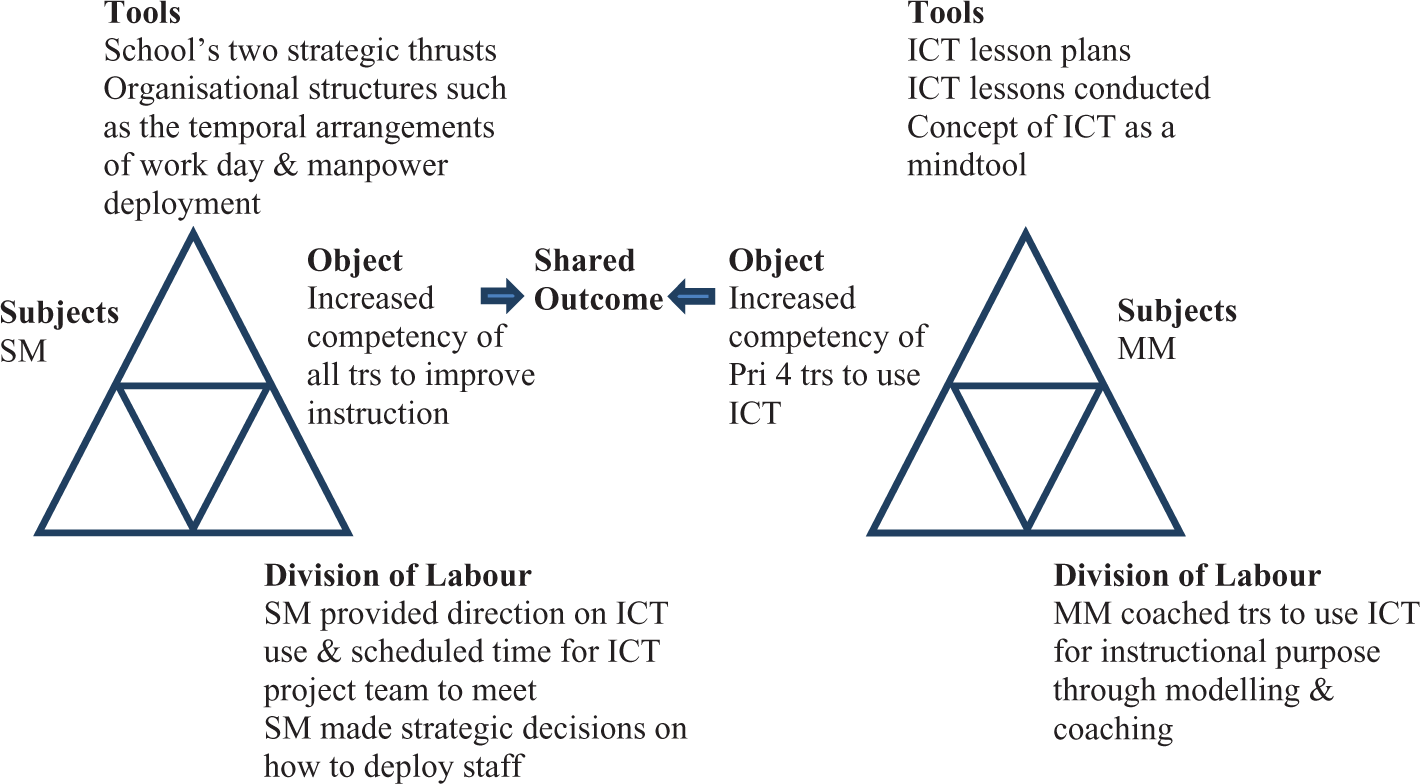
Activity systems at school and ICT project levels: tools and division of labour.
That the leadership provided by SM and MM were perceived to be mutually supportive is seen in the teachers’ articulation of the importance of both the time provided by SM and the sharing and discussion of lesson plans facilitated by MM during the time given: …gave us more time to reflect, MM how to go about teaching lessons, prepares us, if…you don’t come together and sit down and discuss the lessons,…I’ll just wait till the last day and then I just go in to the classroom. And that’s where you…face problem. (Mun Fai, teacher, third interview, italics by researchers). I think the time tabled schedule given to us, it is a form of support…For example the sharing of lessons right. It helps to make me more confident in conducting the lesson, at least I know what’s going on. I think that’s a very important support for teachers. (Nisha, teacher, first interview, italics by researchers).
In summary, SM provided MM with the time and ‘authority’ to coach the teachers in the use of ICT, while MM used the time provided to share and facilitate the discussion of ICT lesson plans. SM set the direction for the use of ICT in Greenville Elementary while MM supported this direction at the department level, mainly through decisions as to which topics could best be taught using ICT. This division of labour between senior and middle management emerged through an analysis of the tools used by the two groups of leaders in their respective activity systems. The finding in this case study showed that Senior Management mainly harnessed the organisation structures which they had authority over as tools, while Cassie’s and Sarah’s main tools to enable the primary 4 teachers to use ICT were their design, sharing, discussion and implementation of ICT lesson plans.
The impact of norms on the distribution of leadership
The norms which impacted the distribution of leadership were inferred mainly through interviews, during which Senior Management articulated the thinking behind some of the decisions they made, or when Middle Management shared the problems they faced in implementing the ICT reform. The adoption of the Activity Theory as a lens alerted researchers to the potential impact of norms, which might otherwise have been neglected.
One norm which stood out was the importance of an official position for middle management. In explaining Sarah’s role in the Lead ICT reform, besides acknowledging Sarah’s content expertise in Science, Liz (Vice-Principal) further observed that Sarah had an important role to play in the Science department because of her sphere of influence in holding an official post: Because of Sarah’s position, she’s the LH [Level Head] in Science, so she will be in a better position to kind of like sell it to the HOD that this is good and so on and so forth and also to keep the HOD updated and also to show that science is involved in the whole Lead project and not just Mathematics alone. (Liz, VP, second interview).
Cassie noted that the leadership provided by Sarah was ‘expected, because as a Level Manager and Level Head, ‘it’s expected’ (second interview). Certainly, Azman viewed Sarah’s appointment as Level Head for Science as important when he said that Cassie needed Sarah’s support because ‘Ms Chin is from Science’ (first interview). In addition, as Level Manager, Sarah provided support to Cassie because ‘ICT is for all subjects’ (Azman, first interview), and Sarah’s role as Level Manager meant she was officially in charge of all the subjects at the Primary 4 level. Indeed, Sarah’s decision to assign the teachers to develop English and Science lessons was not disputed by any of the teachers, regardless of the subject committee which they belonged to.
Conversely, while Sarah’s role as Level Manager and Level Head and Cassie’s official role as ‘in charge’ of the ICT project enabled them to provide leadership, there were occasions when they felt constrained by the Heads of Department, who were considered to be higher up in the organisation hierarchy. Both Cassie and Sarah mentioned that they faced constraints, as the desired outcome of the Lead ICT activity system might be seen as clashing with the department structure and the department’s priorities: It’s very hard one you know. Because their own department they also protect their own you know. You see, they have their own programmes, you see they don’t want you to upset their programmes. (Sarah, first interview). Normally Lead ICT is led by IT HOD or a HOD so they may not have some problems which I face because I’m a Senior Teacher, all right? Because as a Senior Teacher, your empowerment sometimes is not there, right, so certain things like I know is a bit of a touchy or sensitive issue, it’s easier to work through Liz [VP]. (Cassie, second interview).
Conclusion
The use of Activity Theory in this case study of distributed leadership identified two interrelated activity systems: mutually supportive leadership performed by senior and middle management who had access to different tools; and the impact of social norms on the distribution of leadership.
While third-generation Activity Theory appears to have been used mainly in the literature to analyse interactions between two normally separate activity systems, like schools and Universities, virtual and physical classrooms (Murphy and Manzanares, 2008; Sannino and Nocon, 2008), this paper suggests the potential of using the third-generation Activity Theory to analyse interactions between activity systems within the same organisation, particularly between the whole school activity system at the organisational level and a project-level activity at the process level. In this case study, the use of the third-generation Activity Theory shed light on how Senior Management simultaneously supported the Primary 4 ICT project and harnessed this same ICT project as a tool to grow the teachers’ use of ICT in the rest of the school, beginning with the Primary 5 teachers the following year. This change strategy by Senior Management was revealed as a result of the use of third-generation Activity Theory, which sensitised the researchers to examine the ICT reform as involving macro and micro activity systems.
In addition, the analysis of the two activity systems enabled the researchers to reveal leaders at different levels, and the leadership they performed, based on the tools that were available to them within their respective activity systems and job scope. As distributed leadership inherently assumes concurrent levels of leadership (Principal, Middle Management and teachers), and leaders at different levels are presumably involved in different yet interdependent activity systems (school, department, project, class), it makes sense to use Activity Theory to understand the relevant activity systems that the various leaders are involved in, the interactions amongst these activity systems, and how all these impact the way leadership is distributed and performed. Therefore, the use of Activity Theory has the potential to help researchers weave together the generally separate literature and research on leadership by Principals, Vice-Principals, middle managers, and teacher leaders, who may operate in different activity systems within the school.
In addition, the focus in Activity Theory on the social–cultural aspect of any leadership activity is useful in the examination and understanding of distributed leadership, since it is generally acknowledged that leadership, distributed or otherwise, is very much context-based. The majority of distributed leadership studies have taken place within a Western context, with a few exceptions (Mercer and Ri, 2006). Although not explicitly articulated, there seems to be an unspoken assumption that distributed leadership is inherently more democratic in nature, with some studies explicitly assuming links between distributed leadership and democratic/participative leadership (Woods and Gronn, 2009; Woods et al., 2004).
However, in the Singapore context, as shown in our case study, it is possible for distributed leadership to be actualised in a context in which authority is highly respected, by ‘legalising’ and empowering the distribution of leadership through the organisation structure, similar to Gronn’s (2002b) concept of institutionalising the distribution of leadership through harnessing structural relations and creating official leadership roles. It is also akin to Spillane’s concept of the distribution of leadership by design, through the creation of formally designated leadership positions (Spillane, 2006).
This does suggest, though, that there might be a limit to the degree of distributed leadership in a cultural context in which authority is highly respected. In this case study, distributed leadership appeared to have been mainly exercised by a Senior Teacher, Middle Management and Senior Management, all of whom were perceived to have more status and authority than the typical teacher. This implies that it might be less likely for distributed leadership in such a context to include teacher leaders, unless these teachers are given an official designation or role that clearly indicates to their peers that they are in charge.
On the other hand, understanding how social norms can impact leadership activity can enable leaders to come up with innovative solutions, through exploiting the social norms or organisation structures to enable more levels of people to take on leadership roles. As Lumby (2013) noted, leaders operate within complex structures of power that can both create and constrain their opportunities to lead. Hence, this paper suggests the value of using Activity Theory to study the complex construct of distributed leadership, as it provides a more nuanced understanding of the social and cultural context which shapes and which is shaped by the leadership activity.
Footnotes
Funding
This research received no specific grant from any funding agency in the public, commercial, or not-for-profit sectors.