







Abstract
There is wide recognition that early childhood experiences are critical to a child’s development and their subsequent life chances. However, little research has been undertaken into leadership in early years settings, which is so influential in this regard. This article summarizes research into the leadership of Sure Start Children’s Centres, which provide support to the most vulnerable children and families. Completed by the National Foundation for Educational Research (NFER) on behalf of NCSL, this research involved a review of literature on early years leadership and the production of 25 case studies of leaders of ‘highly effective’ children’s centres. The study identified three specific challenges faced by leaders of children’s centres. Two of these, ensuring positive outcomes for children and dealing with change, are particularly salient in light of challenges affecting leaders in times of austerity. The third, increasing the visibility and value of leadership, is a perennial challenge for the sector. The study found that leaders demonstrated eight core behaviours to address these challenges. These included engaging responsively with families, using evidence to drive improvement, motivating and empowering staff and embracing integrated working. The authors recommend that these behaviours inform the delivery of future leadership development for these leaders.
Keywords
Introduction
There is now wide recognition that early childhood experiences are critical to a child’s development and in turn, their subsequent life chances (Anda et al. 2006). While parents are the primary influence in children’s lives, most children in England will also at some point before starting primary school, access government-funded early education and childcare provision located in ‘early years’ 1 settings.
The early years sector is diverse. Much education and childcare is informal in nature and comes from parents, families and friends. More formal provision is provided by childminders, nurseries and pre-schools. In 2013, there were 54,000 childminders and 26,000 nurseries and pre-schools registered on the Early Years Register, 2 which collectively accounted for more than 1.25 million places.
Sure Start Children’s Centres represent a further element of England’s early years sector. These were established in the Childcare Act 2006 to provide support to the potentially most vulnerable children and their families. In 2013, these centres numbered over 3000.
In June 2011, the National College for School Leadership commissioned the National Foundation for Educational Research (NFER) to undertake a major study into the nature of leadership in 25 ‘high performing’ Sure Start Children’s Centres (Sharp et al., 2012). This study recognized the critical role leaders of children’s centres play in meeting the needs of the most disadvantaged children and families (National College for Leadership of Schools and Children’s Services, 2011). It also acknowledged the strong body of evidence that demonstrates the relationship between leadership and the provision of effective services in early childhood settings (Harris et al., 2003; Muijs et al., 2004; Sylva et al., 2012; Vandall and Wolfe, 2000).
However this study was also motivated by the fact that despite the importance of this issue, there had to date been relatively little consideration given to the leadership of children’s centres (Dunlop, 2008; Mistry and Sood, 2012). Indeed, while a number of studies had been undertaken into different aspects of the Sure Start programme (Anning et al., 2007; Dahl and Aubrey, 2005; Melhuish et al., 2010), little explicit consideration had been given specifically to leadership. For instance, Anning et al. (2006) found leadership to be important in providing an environment that values and celebrates the diversity of different professionals, but offered little on the specific nature of day to day leadership practice in this regard. Meanwhile Rodd (2005) provided a more extensive consideration of leadership within the broader context of early childhood in general, rather than Sure Start Children’s Centres in particular. Elsewhere Siraj-Blatchford and Manni’s (2006) review of effective leadership in the early years dated from a similar period and was wider in scope, so the degree to which it focused explicitly upon children’s centres was therefore inevitably more limited. Both Rodd’s and Siraj-Blatchford and Manni’s work is revisited later in this article.
A further motivation for this study was the relative lack of profile enjoyed by leaders in this sector, both in general but more specifically in comparison with their colleagues in schools. This lack of profile reflects the wide variety of leaders’ professional backgrounds and the absence of any single, dominant career path. This was found to result in the emergence of many ‘accidental leaders’ in children’s centres and across early years more broadly (Ebbeck and Waniganayake 2003; Osgood, 2004; Rodd, 2005).
This article therefore summarizes the findings from this study of leadership in Sure Start Children’s Centres, which sought to address both this lack of knowledge and raise awareness of the work of children’s centre leaders, by exploring further the key challenges they face and in turn establishing the behaviours, knowledge, skills and attributes needed for the role.
Background
While formally established in the Childcare Act 2006, the origins of Sure Start Children’s Centres grew from the 1998 Cross-Departmental Review of Services for Young Children, which highlighted the importance of a coordinated strategy of early interventions, to improve outcomes for the most disadvantage young children (Melhuish et al., 2005). At the same time, the Review recommended an area based system of support for all children aged under five, beginning with those in the most deprived areas. This was established through Sure Start, which heralded the introduction of a network of centres, initially concentrated on children and families in the 20% most deprived wards that collectively housed more than one-half of the country’s poorest families (Melhuish and Hall, 2007).
Sure Start was motivated by the recognition of the strong correlation between deprivation and multiple forms of disadvantage across a range of indices, including education, childcare, health and family support. It therefore sought to provide integrated services for young children and their families in each of these aspects, with the overarching aim of securing improvements in the life chances of those growing up in disadvantaged neighbourhoods. However, the ambition of Sure Start was bolder than simply protecting the most vulnerable young people and its overarching aim involved the wider transformation of the most deprived communities. Melhuish et al. (2005) summarize this ambition thus: by improving, early in life, the developmental trajectories of children known to be at-risk of compromised development, Sure Start Local Partnerships (SSLPs) aimed to break the intergenerational transmission of poverty, school failure and social exclusion. (Melhuish et al., 2005: 4)
The introduction of the Childcare Act 2006 saw two further phases of expansion through the development of Sure Start Children’s Centres, controlled by local authorities and more universal in their scope. This heralded something of an explosion in provision, with the government guaranteeing funding for 2500 children’s centres by 2008 (phase 2). By 2010 (the end of phase 3), a total of 3500 children’s centres were in existence, compared with 524 in 2003.
Consecutive evaluations of Sure Start repeatedly found evidence of its positive impact on the families it served. One of the earliest assessments was completed by Ofsted (2008a) and based upon 30 visits to children’s centres in 2006–7. This study concluded that children moving from children’s centres to schools were generally well prepared and that children’s centres effectively served the needs of families who attended. However, Ofsted also reported some reservations as to the penetration of children’s centres at that time and the extent to which they adequately reached their target audience of the most deprived families. Ridley-Moy (2007) also found high levels of parental satisfaction with the individual services offered by children’s centres, reporting that parents believed their children benefited from the learning and socializing opportunities they offered and that parents benefited personally from meeting with other parents.
Later evaluations revealed a more nuanced picture of the impact Sure Start Children’s Centres were having on families. For instance the National Evaluation of Sure Start (NESS) assessments of the impact of Sure Start found that despite a number of methodological challenges, it was possible to draw several conclusions as to the contributions this support made. NESS found that at age five, involvement in Sure Start had positive effects in relation to children’s health and levels of obesity (Melhuish et al., 2010) but was more equivocal in terms of child development (Melhuish, 2013). The study also found evidence that Sure Start was having a positive impact on families in terms of reducing levels of chaos, isolation and the use of harsh discipline, while at the same time promoting improvements in children’s home learning environments. However, the study was unable to find clear evidence of improvements in school readiness, when considered in terms of children’s early language, numeracy and the social skills needed to succeed in relation to the foundation stage profile.
A follow-up study two years later found that some of these positive benefits could still be identified among 7 year olds, with an continued reduction in harsh discipline and continued improvement in children’s home learning environment (Melhuish et al., 2012). However, there was less evidence to demonstrate consistent effects from Sure Start for child development at this age (Melhuish, 2013).
In the aftermath of the 2010 general election, the newly elected coalition government commissioned a number of independent reviews of evidence. Several of these explored areas relevant to Sure Start Children’s Centres, and collectively represented the most thorough re-examination of issues relating to poverty, well-being and life chances in the early years, ever seen in England. While these reviews been subject to criticism in some quarters, 3 they have nevertheless been influential in the development of early years policy and important in stimulating further debate on the importance of early intervention and early years support in promoting improvements in children’s lives.
For instance the independent review on poverty and life chances, chaired by Field (2010: 5) reported that: We found overwhelming evidence that children’s life chances are most heavily predicated on their development in the first five years of life. It is family background, parental education, good parenting and the opportunities for learning and development in those crucial years that together matter more to children than money, in determining whether their potential is realised in adult life.
Similarly, Allen’s (2011: 16) review of early intervention found that: … different parts of the brain develop in different sensitive windows of time. The estimated prime window for emotional development is up to 18 months, by which time the foundation of this has been shaped by the way in which the prime carer interacts with the child.
While the coalition government’s vision for ‘Families in the Foundation Years’ (Department for Education and Skills, 2012) retained a commitment to a network of Sure Start Children’s Centres, it is noteworthy that this was focused more sharply on those in greatest need. At the same time, the wider programme of austerity measures across public services contributed to both volatility and contraction across the children’s centres sector. For instance, 200 centres closed between 2012 and 2013, while greater diversity emerged in the structure and precise organization of such centres (Ofsted, 2014). These trends have in turn had important implications for the nature of leadership roles in children’s centres, as noted in the findings section of this paper.
Methodology
The exploration of leadership in highly performing centres described in this article comprised four strands.
Strand 1 involved a desk study of published and semi-published literature, relating to leadership of children’s centres and early years more broadly. Items published between 2003 and 2011 were included in this phase, which considered empirical and evaluation research, policy and discussions of theory and practice. A range of databases was interrogated as part of this, including the British Education Index (BEI), ChildData and Social Policy and Practice. Practitioner journals and government and associated websites were also explored. The review focused on exploring the key challenges facing children’s centre leaders and the behaviours associated with leadership that were effective in addressing these challenges.
Strand 2 of the study involved a call for evidence via NFER’s network of links with local authorities. This sought to identify materials that, while not confidential, were less well publicized and able to offer further insight into these issues.
Strand 3 gathered original empirical evidence on the nature of leadership practice, which was identified as being effective in addressing the challenges children’s centre leaders faced. This involved the production of 25 case studies of leadership practice in ‘highly performing’ Sure Start Children’s Centres. The research team used Ofsted inspection reports to identify ‘highly performing’ centres. While recognizing that Ofsted judgements have criticized on grounds of validity and reliability, 4 they were nevertheless judged to represent the most comprehensive and consistent source of data on the quality of leadership in children’s centres available in England.
In order to enable sufficient exploration in the fast-changing environment in which children’s centre leaders work, the research team and National College agreed to focus the case studies in the following ways:
five case studies of centres where the setting and leadership were judged by Ofsted
5
to be ‘outstanding’ in single-centre settings (type 1); five case studies of centres judged by Ofsted as good overall, with outstanding potential for improvement and good or outstanding leadership in single-centre settings, so that researchers could understand leaders’ journeys towards increased effectiveness and unpack some of the challenges leaders face (type 2); fifteen case studies of leadership judged by Ofsted to be ‘outstanding or good’, exploring new and emerging organizational models for children’s centres including multi-setting contexts and where leaders work across settings and the wider system (type 3).
Although the main criterion for selection was Ofsted inspection judgements, a few of the leaders were identified as good or outstanding through local authority contacts because their settings had not been inspected recently (and/or with the current leader in place). In these cases, local authority staff based their nominations on evidence (such as an ‘annual conversation’ informed by data on uptake, attendance and parental feedback).
The final sample comprised 15 phase 1 centres, 9 phase 2 centres and 1 phase 3 centre. Eight of the centres in the study also had formal responsibility for other centres/sites, as part of a ‘hub and spoke’ model.
All research was conducted in accordance with NFER’s Code of Practice. 6 Research participants were fully informed about the purpose of the research through written information sent with the initial request to participate. Interviewees were again informed about the purpose of the research and the proposed use of the data at the beginning of all interviews. The research team asked all participants for their active consent to take part and for their interviews to be audio-recorded. Participants were informed that centres, local authorities and individuals would not be identified in the report. In response to a request from one participant to have their centre’s participation in the research acknowledged, all participating centre leaders were asked whether they wished their centres to be included in the acknowledgements. We asked leaders to check with their colleagues (including local authorities and/or governing bodies, as appropriate) if they needed to do so. Verbatim quotes were not attributed to specific individuals, settings or areas. Vignettes illustrating leadership behaviours used pseudonyms for individuals and adopted a letter-code system for settings to preserve anonymity.
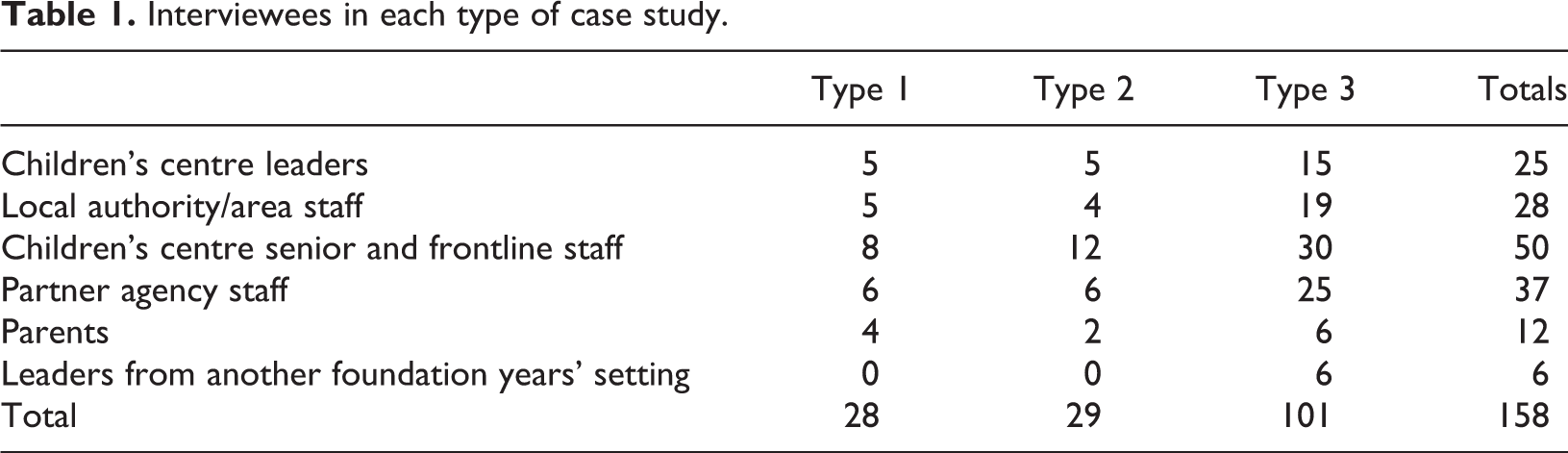
Each case study involved interviews with local authority staff, children’s centre leaders, children’s centre staff, staff from other agencies and parents, together with the collection of relevant documents. The interviews focused on leadership behaviours, challenges and support needs. A total of 158 interviews were conducted as part of these case studies. The interviewers took comprehensive notes and as noted above, audio recordings were made of the interviews, with interviewees’ permission. Interviews were then written up into a common template, drawing extensively on the audio recordings to check their accuracy of interpretation and to transcribe direct quotes. Interview notes were analysed within and across case studies, using the MaxQDA qualitative software package. Interview data were divided into substantive areas (relating to the study’s aims) and then analysed to identify emerging themes and categories.
Table 1 summarizes the nature of interviews completed in each type of case study.
Interviewees in each type of case study.
Strand 4 of the study involved the presentation of emerging findings to practitioners at the British Early Childhood Educational Research Association conference and three regional workshops with the National College’s Children’s Centre Leaders Network. These presentations and their subsequent focused discussions enabled the research team to validate the findings from the study and further develop their related recommendations.
Findings and Discussion
This section outlines the evidence collected in the case studies phase of this study, and describes the main challenges facing children’s centre leaders together with the leadership behaviours found to be effective in addressing them. It also offers broader insight on the context for centres gained through the literature review.
This section is organized in two parts. The first outlines the findings from the literature review on the main challenges facing children’s centre leaders, before offering additional empirical evidence in support of this. The second part of this section then utilizes the evidence from the case studies to consider the behaviours leaders demonstrate to effectively address these challenges.
Challenges Facing Children’s Centre Leaders
Arguably any attempt to gain a rounded appreciation of the nature of effective leadership is unavoidably compromised unless it is accompanied by efforts to secure a deeper understanding of the context within which it enacted. Indeed contingency-based theories of leadership are fundamentally premised on the principle that a leader’s effectiveness is determined by the extent to which their style addresses the various demands of the context within which it is situated (Fiedler, 1976; Graen and Uhl-Bien, 1995).
The literature review from this study identified three principal challenges facing children’s centre leaders. These are: making leadership visible and valued; ensuring positive outcomes for children; dealing with the complexity of change.
The first part of this section explores the evidence from the literature review on each of these challenges in turn, before utilizing relevant evidence from the case studies completed as part of this study to add further depth.
Making Leadership Visible and Valued
While the last decade witnessed a marked increase in the volume of early childhood research, especially in the USA (Sammons et al., 2012), the absence of a strong discourse on leadership remains a notable feature of the early years sector and one which in particular differentiates it from school leadership (Woodrow and Busch, 2008). Heikka et al. (2013: 3), for instance, note that ‘published papers in this sector of education are sparse and difficult to locate’. This paucity of evidence can in turn be seen as indicative of a broader lack of profile for early years leaders and an undervaluing of the function they fulfil (Bush, 2013). A number of factors contribute to this.
First, relative to other comparable sectors, the early years’ workforce is characterized by a particularly high level of diversity (Nutbrown, 2011). As noted in the introduction, the nature of the sector itself is both broad, varied and includes a wide range of providers, for instance in terms of size, governance and focus. One consequence of this is that there is considerable variety in the ways in which leadership roles are operationalized across early years contexts (Aubrey et al., 2012). While the introduction of the National Standards for Children’s Centre Leaders (Department for Education and Skills, 2007) and work by writers such as Siraj-Blatchford and Manni (2006) have added some insight into this, there nevertheless remains a lack of consensus as to the exact nature of the children’s centre leaders’ role, compared with colleagues in the schools sector.
This diversity is also reflected in the wide variety of early years leaders’ professional backgrounds and the absence of any single, dominant career path (Osgood, 2004; Rodd, 2005). Ebbeck and Waniganayake (2003) note the existence of many ‘accidental leaders’ in the early years sector, while Moyles (2004) has highlighted how such workers often view themselves foremost as practitioners rather than leaders. Meanwhile Aubrey et al. (2012) found that early years leaders often develop a tacit knowledge of leadership that has been neither explicitly taught nor verbalized. Collectively, these factors can lead to a devaluing of leadership which in turn can have significant consequences for organizational effectiveness and the impact services have on the children and families supported.
The 25 leaders involved in this study reflected this diversity. While most had an education background, this was gained in a variety of settings, including early years, primary and secondary sectors. Several came from a social care background (including family support, youth work, housing, homelessness and women’s refuge), while a handful of others were from childcare or health. Some had been project managers in local government, the voluntary sector or private sector. There were also several career changers, including those who originally worked in retail, banking and telecommunications. One such leader reflected on their commitment to the relatively new profession of children’s centre leader as follows: I find it to be a huge advantage and a disadvantage to a certain extent, not to have a service specific background. If anyone asks what my professional heritage is now I have to say it is integrated centre leadership. I get quite evangelical – and our profession as children’s centre leaders needs to grow – so I have become a bit of an advocate. I think ‘where’s your passion? Where’s your allegiance?’ (Centre Leader)
In terms of raising the profile of leadership and its associated value, several children’s centre leaders interviewed in this study demonstrated a commitment to their own leadership development, both for its own sake and as a model for others to follow. However, at the same time, some noted how they prioritized the learning of others when resources were tightest. While such sentiments are clearly admirable, this can have a disproportionate impact on the overall effectiveness of the services offered and potentially be counterproductive in the long term.
Ensuring Positive Outcomes for Children
Achieving positive outcomes for children is the overall aim of children’s centres (Department for Education, 2013). It is therefore a key challenge for centre leaders and one which is particularly pertinent during the current climate of austerity. Core to this is framing the centre’s activities to identify, engage and then support the families in greatest need to promote: child development and school readiness; parenting aspirations and parenting skills; child and family health and life chances.
Achieving these outcomes presents a number of specific challenges for children centres leaders.
First, by definition, children’s centres principally serve those families and children with the most complex and challenging lives. This brings with it several additional challenges. Foremost among these is how to effectively engage with vulnerable parents and families, who frequently find it difficult to access the support available to them.
The development of outreach based support is especially important in overcoming this particular challenge (Siraj-Blatchford and Manni, 2006; Crocombe et al., 2013). Effective engagement means taking a more active and authentic approach to developing mutually trusting relationships with families, listening to the views of parents on the support they require (Ofsted, 2008b), engaging them in decision making and helping them to contribute to services as parent volunteers (Klavins, 2008).
The focus on serving those with the greatest and most complex challenges also necessitates a greater degree of cross-agency working (Aubrey et al., 2012; Waniganayake et al., 2000). While effective partnership working is often a cornerstone of positive approaches to supporting these families, the challenges associated with achieving such ways of working should not be underestimated. For instance McInnes (2007) and Siraj-Blatchford and Manni (2006) have described the difficulties associated with partnership working in the early years, highlighting for instance the challenges relating to the different values, ethos and professional codes associated with the various groups concerned.
Ensuring essential data is effectively shared is also key to providing support to families, although culture and systems often impede this (Evans, 2006; McInnes, 2007; Orr, 2011). Building high levels of mutual trust and social capital is critical therefore in ensuring the effective co-ordination of services targeted at these families (Beaty, 2010; Coleman, 2010; Department for Education and Department of Health, 2011; Together for Children, 2010).
Many of these themes emerged in this study and interviewees often highlighted in particular the challenges associated with outreach and partnership working. These issues, together with others such as the development of positive and mutually trusting relationships, are explored further in the second part of this section.
Dealing with the Complexity of Change
While change affects many leaders (indeed it is an inevitable and essential element of leadership itself) those in children’s centres continue to face a particularly turbulent period, stemming from financial cuts, restructuring and increasing accountability.
In recent years, public services across the board have experienced unprecedented changes in funding arrangements, coupled with cuts in overall levels of resourcing.
In children’s centres the proposed introduction of payment by results (abandoned in 2013) was intended to achieve a greater focus on the core purpose of children’s centres, that is, to improve child development and school readiness among young children and to reduce inequalities. This includes identifying, engaging and supporting the most disadvantaged (Foundation Years, 2013).
Further challenges stem from the emergence of new models for organizing and governing children’s centres. In some (but not all) instances these have been driven by financial considerations. Elsewhere there is evidence of an emerging wider form of ‘system leadership’ across children’s centres, as leaders work across localities to promote improved outcomes for children and families.
Finally, leaders of children’s centres have been significantly affected by the findings of a number of high profile reviews which directly or indirectly impact upon early years provision. These include the Allen (2011), Field (2010), Munro, (2011) and Tickell, (2011) reviews highlighted earlier in this article. While each review has been subject to criticism, they have nevertheless had a significant impact on both policy and practice in early years.
Again these themes are explored further in the next section of this article.
Leader Behaviours in Highly Performing Centres
Having identified the main challenges affecting children’s centre leaders, this study then sought to explore the key behaviours leaders utilized to address them. As noted, the review of literature identified eight broad behaviours, which were explored and developed further through the case studies, and subsequently validated through practitioner workshops. These behaviours are: having a clear vision to improve outcomes for children and families; engaging responsively with families; using evidence to drive improvements in outcomes; using business skills strategically; facilitating open communication; embracing integrated working; motivating and empowering staff; being committed to their own learning and development.
The remainder of this section describes the empirical evidence gathered in this study in relation to these behaviours.
Having a Clear Vision to Improve Outcomes for Children and Families
This study found that effective leaders established a clear vision for their setting, linked to the core purpose for children’s centres but contextualized in relation to local needs. They believed strongly in what they were trying to achieve and pro-actively tackled the specific challenges affecting local families. This vision was communicated verbally and modelled through their day to day leadership practice. For example, one children’s centre leader demonstrated her vision by prioritizing the children and families in the most deprived areas of her patch. Described by a colleague as having ‘positive outcomes for children and families very strongly at the top of her agenda’, this leader used performance data to ensure staff focused on reaching these particular children and families.
The leaders interviewed stressed the importance of ensuring that priorities were shared. One centre leader had taken responsibility for leading a cluster earlier in the year and since her appointment, engagement figures had increased every month. She explained that she had achieved this by: Everyone buying into that shared vision and understanding what their own remit is within that … being very clear and focused and taking ownership of what their role is. Once you’ve all bought into a shared vision, people do take responsibility, they’ll take risks, and they’ll be creative with reaching those outcomes for families and children. (Centre leader)
Co-constructing a vision is invariably challenging and views on the extent to which a vision is genuinely shared may vary between leaders and followers. Establishing a collective view is especially problematic in cross site and multi-agency work where values, custom and practice vary. However evidence from interviews with professionals from outside the individual centre frequently supported the view that such visions were frequently widely shared. A key strategy in this involved centre leaders working with others to establish a broad, ‘fuzzy’ vision which staff in individual contexts then nuanced to best address priorities for their specific communities. A community midwife explained how the leader in her centre had involved her from the beginning in this process: The centre leader showed vision in seeing the importance of involving midwives early in the development of centres, because the midwife is an anchor in finding out where a problem may lie in a family. (Community midwife)
Engaging Responsively with Families
Leaders interviewed in this study highlighted the need for open-mindedness, in order to respond positively to the needs families identified. Indeed, this was often a key strategy in building the trust necessary to ensure buy in and secure better outcomes for families. This involved understanding their families’ changing needs and making sure that service design and delivery were flexible enough to meet these. One centre worker described this in terms of ‘doing with’, rather than ‘doing to’, reflecting: I guess it’s looking at outcomes creatively and really breaking them down into the factors involved, rather than sticking to old mind-sets that are based on service provision … and seeing yourself not just as a service provider but as collaborating with the community. (Centre staff member)
Many centres had parent forums but some recognized that these may not necessarily attract the families most in need. One worker explained how staff in her centre decided to re-launch their parent forum because they found that parents attending the centre were ‘not representative of the local population’. This had been successful in achieving a more united and inclusive board, as one parent commented: ‘I attended a few children’s centres before. Every centre had divided groups (of parents). But since the first day here I didn’t see that. That’s why I’m here to this day.’ There was also the challenge of tempering parents’ views on priorities with what it was possible to provide in practice. Sometimes the leadership team needed to feedback and negotiate with parents, to plan work that offered progression for parents and children.
Leaders in these centres prioritized being visible to families and often demonstrated this by engaging in the delivery of frontline activities (for example, by accompanying staff on home visits) and greeting parents upon arrival at the centre. This hands-on approach helped parents feel that the leader was both approachable and trustworthy, and also role-modelled positive behaviour for staff. For leaders themselves, this frontline engagement provided valuable reflection time: For an effective leader, you’ve got to keep in touch with the ground level, with what’s going on. I think it’s really easy as a leader to move away from reality. You can move to a strategic level and you can focus on that, but you (mustn’t) forget the grass-roots. (Centre Leader)
These leaders made sure that parents were actively involved and valued as partners by establishing forums, gathering feedback and running services. Leaders also often sought to build capacity and skills among their local communities. For instance, 70 per cent of staff in one centre had originally been parent volunteers. The leader in this centre also worked with parents to develop a support package to train parents to Levels 2 and 3 in early years work.
Clearly the investment such strategies required had particular implications in austere times and in turn may at first sight be considered potentially unsustainable. However interviewees were clear that true sustainability could only be achieved by developing deeper, two-way relationships with the families they served and by the kinds of activity outlined above.
Using Evidence to Drive Improvements in Outcomes
This study found that leaders in highly performing centres effectively used evidence to address their core purpose and support families in the greatest need, for example by pinpointing the location of those who were not currently using the centre’s services. As one interviewee explained: It’s about using the data we’ve got and looking at the different targeted groups that we need to work with. (Centre leader)
Evidence used by centres in this study comprised a wide range of quantitative and qualitative data, and local intelligence, gathered by centre staff in the course of their work. A particular focus was placed on data which highlighted the actual impact of services rather than just their reach.
The most effective leaders established a baseline for their centre’s performance and monitored improvements over time, for example by interrogating quarterly reports produced by local authority data officers. They also developed their centre’s own evidence-base, for instance, by rigorously collecting users’ views on services, which they used to improve the quality of provision. For example, one centre tailored its provision of parenting programmes to offer short, 12-hour sessions, rather than a full 12-week programme, based on evaluations of previous activities. These leaders also focused on gathering broader knowledge of what worked in practice. In addition, they communicated and explained key messages from their data to a range of interest groups, in order to drive improvements further. One interviewee explained why this was a key leadership behaviour in the following terms: I am appalled to hear (other children’s centre leaders) saying ‘It’s really difficult to show we’ve made a difference’. Just because it’s difficult, it doesn’t mean you shouldn’t try. There’s something fantastic about being able to show you’ve made a difference. (Centre leader)
The ability to turn information into intelligence was clearly critical here. However, in data rich environments, such as these, this is also a potential over-simplification of what in practice is both science and art.
Using Business Skills Strategically
This research highlighted the value of high levels of business acumen for leaders in children’s centres. Financial and organizational skills were both found to be important, with the ability to manage budgets, staff, buildings and other facilities also at a premium.
Moreover though, increased budgetary constraints required leaders to demonstrate a level of entrepreneurship which would not necessarily be associated with their role. This included effectively identifying opportunities to deliver services in innovative ways and leveraging additional resources.
Being able to effectively manage their budget and demonstrate value for money was clearly key to this. Some leaders (particularly those from centres that were independent or had charitable status) described being ‘thrifty’ and ‘creative’ in their bids for alternative sources of funding. These leaders also understood the need to market their services and promote the work of the children’s centre to strategic decision makers: You’ve got to be a really good salesperson. You’ve got to market and sell yourself and your product and your belief all of the time. And you’ve got to market yourself to your seniors, the people who are the strategy makers, the senior managers, and that’s what’s really difficult. (Centre leader)
Facilitating Open Communication
As noted already, effective leadership of children’s centres is fundamentally premised on strong interpersonal relationships, based in turn on high levels of mutual trust. This study found that clear and open communications were critical to this. The case study leaders encouraged an honest dialogue with partners and other agencies, with a two-way flow of information. One interviewee explained that clear communication was particularly important in periods of uncertainty, including for instance, the wider climate of austerity in the provision of public services: Day-to-day talks and communication are really important in this time of change because staff are nervy and communities are worried about where children’s centres are going. It’s about having clarity all the time, and keeping people up to date when there’s new information. (Centre leader)
The content and timeliness of communications were also crucial. Trust and positive relationships with parents were promoted by ensuring prompt responses to their queries, for instance either on the same day or the next. As one centre leader explained: ‘It is important to communicate the right information to the right people at the right time – otherwise you have got a problem from the word go’ (centre leader).
These efforts to promote communication were recognized and appreciated by others interviewed as part of the case studies. For instance, a chair of trustees summarized the value of this, in the following terms: She has a policy that she will communicate as much as possible, as quickly as possible, so that there is a very healthy atmosphere around the centre. If you have a question then you can ask it and if it can be answered, it will be answered. Also (there is) a sense that if people are concerned about things, then she will try and find out as quickly as possible.
Embracing Integrated Working
As noted earlier in this article, effective collaborative working between different agencies is fundamental to the success of children’s centres. It is to be expected then that this study found that effective leaders pro-actively championed constructive and inclusive approaches to integrated working with teams from a range of professional backgrounds. These leaders identified how other services could complement the expertise in their centre. They also sought to build high levels of trust between different professionals from different agencies, by recognizing variations in professional backgrounds and culture, and working to overcome such potential barriers. Approaches to collaboration were most impactful when they built shared understanding and partners appreciated each other’s working cultures, the pressures and challenges they faced, the priorities they worked towards and the terminology they employed.
Integrated working presented many challenges, but as one children’s centre leader said: ‘It’s the only way to move forward.’ Key skills for integrated working included listening and working together: It is about being humble, listening to their priorities, their perspectives, their difficulties and being quick to spot how you can help them. (Head of early years)
Empirical evidence from this study found effective leaders were clearly committed to building genuine two-way partnerships. A key strategy to promoting partnerships involved pro-actively sharing resources, space and equipment (or encouraging the co-location of services) to support the delivery of additional sessions and services in the centre, for example by health visitors, midwives or speech and language therapists. Some children’s centres had purpose-built community rooms and individual consulting rooms, which enabled them to serve as a hub for multi-disciplinary service delivery. Leaders in these settings demonstrated an appreciation of the need to manage the wider strategic context for the partnership by working closely with senior managers from different services. They also worked closely on a day-to-day, operational level, with team members from different services. One interviewee summed up her attitude to integrated working in the following terms: ‘I call myself an integrated leadership practitioner. I just know that that’s the right way to work’ (centre leader).
Focusing on the child was a key strategy in encouraging joint working and there was clear evidence of a form of moral leadership among the leaders in this study. Processes such as the common assessment framework (CAF) and team around the child (TAC) further supported the centre’s core purpose. Elsewhere, leaders sought to overcome potential operational issues through joint team meetings and away days, which promoted greater understanding between professionals. Joint training sessions also provided a mechanism for better understanding joint working practices.
Motivating and Empowering Staff
Motivating and empowering staff is critical to the effective leadership of children’s centres, not least because leading professional from other agencies relies foremost upon transformational leadership approaches. Leaders in this study demonstrated the ability to display both group and individualized consideration to motivate staff, for instance by adopting strongly collaborative and inclusive leadership styles. They identified opportunities for individuals’ professional development, by delegating and distributing leadership activities, as well as by supporting formal training and encouraging reflective practice. Leaders in these centres also recognized the collective power of shared and cascaded learning, and particularly of co-constructed knowledge.
Particular consideration was shown to tackling under-performance sensitively by creating a no-blame culture: People can make mistakes as long as we learn from them. By being open and honest with staff, they’ll tell you what’s going on, what’s upsetting them, and then you can address that in more of a positive way. (Centre leader)
However, at the same time, leaders in the case studies displayed a moral commitment to addressing genuine instances of under-performance when required. As a manager of a family centre said: ‘Children only get one chance and they deserve high quality at all times. We need to enable practitioners to do their best at all times’ (centre leader).
These leaders also recognized the importance of celebrating their workforce, praising and thanking individuals for their efforts. As one leader said: ‘It is important to play to people’s strengths and give people opportunities to shine.’
Being Committed to Their Own Learning and Development
A key characteristic of these highly performing leaders was the priority they placed on learning, to improve the quality of services offered to families. This commitment to lifelong learning included maintaining a clear understanding of policy developments and linking theory and policy with practice. Many case study leaders were also engaged in formal learning opportunities, including undertaking the National Professional Qualification for Integrated Centre Leadership, the early years foundation degrees or master’s qualifications.
By modelling this commitment to their own learning, these leaders also encouraged others to invest in their professional development. Engaging in self-reflection was a particularly important strategy, as one early years specialist teacher noted: ‘[my centre leader] is very good at facilitating critical practice and asking appropriate questions as a critical friend’ and as a result reflective practice is ‘very much more part of training now’.
As noted earlier, the leaders in this study often demonstrated a tendency to put their own development behind that of others, displaying a selflessness which was recognized and appreciated by many of those they led. This philosophy was consistent with their wider commitment to protecting the interests of the children and families they supported, and in turn resonated with the broader principles of servant leadership. While such an approach may be laudable, it nevertheless presents the potential risk that gaps in their knowledge and expertise develop, and which in turn could have significant implications for the overall effectiveness of the centre.
Conclusion
Children’s centres are not just services. They are the conduit for how, as a society, we protect children, support families and enable them to grow. (Tickell 2013: 24)
Despite this assessment of the potential contribution of children’s centres to improvements in child welfare, this particular aspect of the early years sector finds itself (not for the first time) at something of a crossroads. After the sustained expansion in the latter part of the last decade, recent years have seen children’s centres decline in number and ongoing constraints in public sector spending suggest that this trend may potentially continue. At the same time, centres have increasingly been called to focus services on a smaller number of the most challenging families, rather than provide more broadly spread support to their communities. This article has highlighted the ability to operate in such a climate of austerity as a key element of a broader capacity to manage change, which in turn, is one of three key challenges for children’s centre leaders. The potential turbulence created as a consequence of the 2015 general election suggests that this skill will remain at a premium.
While the introduction of the core purpose for centres has to some extent served to clarify their overarching role (for the time being at least), the ongoing discourse over the precise purpose of the early years sector and the contribution children’s centres should have within this, nevertheless presents uncertainty for leaders and centres more broadly. This article has highlighted the importance of being able to develop a clear vision for children and families. At the same time, it has also emphasized the essential role data plays in planning and delivering services, thereby ensuring that centres respond to the needs of the families they support. As debate continues around the relative merits of universal services and targeted support, and how best to ensure that young children from the most disadvantaged backgrounds reach the necessary level of readiness for school, these leadership behaviours will remain fundamental to the overall success of our children’s centres.
In any event, helping families to effectively tackle the complex challenges they face demands contributions from a range of professionals and service areas. Multi-agency working has become more commonplace in schools in the last decade, and remains a cornerstone of children’s centres and their leadership. In times of pressure, developing multi-professional teams is central to realizing the vision for children’s centres. Indeed, the ability to promote integrated working is potentially the unique selling point for this group of leaders. Effective communication is key to motivating and empowering staff from both within and without the centre, to make a real and sustained difference to the lives of the most vulnerable in society.
In conclusion, the eight behaviours described in this article are intended to provide an agenda for leadership within the sector. At the same time, it is hoped that this article will make a valuable contribution to the discourse on how best to support the preparation and development of all leaders, including the ‘accidental’ ones, in this most complex of children’s services.