







Abstract
This paper examines the preparation of school principals in Malaysia, and the aspiration of the Malaysian Education Blueprint 2013–2025 to ensure high-performing school leaders in every school. It reports on the principal preparatory programme, the National Professional Qualification for Educational Leaders, which is mandatory to those who aspire to be school principals. Documentary analysis was undertaken on materials used for leadership training programmes by the National Institute of Educational Management and Leadership or Institut Aminuddin Baki (IAB), which is the country’s main leadership training and development centre, equivalent to the National College for Teaching and Leadership in England. Eight primary and secondary schools, chosen by stratified purposive sampling, were selected for the study. Interviews were conducted with principals and assistant principals of the eight schools, to establish how they were selected and prepared for their leadership roles. Interviews with Ministry of Education and IAB officials offered a provider perspective while an interview with an education minister clarified the policy and political contexts of the study. The findings of the study draw attention to the need to refine the selection criteria, with a focus on higher entry standards to ensure excellent leadership in schools, an emphasis on instructional leadership to improve student learning in schools, the conflict between central direction and the importance of situational leadership, and the political imperative for programme outcomes.
Keywords
Introduction
The Malaysian Education Blueprint (MEB) was launched in 2013 by the Ministry of Education (MoE). It is a major reform of the education system intended to span 12 years, from 2013 to 2025. Concern about the low ranking of Malaysia in international reviews of learner performance, for example in the Trends in International Mathematics and Science Study 2011, Programme for International Student Assessment (PISA) 2009 and PISA 2015 reports, has led to a focus on the need to prepare and develop high-performing principals who can provide the instructional leadership believed to be necessary to improve student outcomes (Ministry of Education, 2013: E-4). The MEB outlines an ambitious plan to ensure that there are high-performing leaders in every school and stresses that ‘an outstanding principal is one focused on instructional and not administrative leadership’ (Ministry of Education, 2013: E-27).
On the international front, large scale school reforms put pressure on educational leaders as ‘torchbearers of educational change’ (Pashiardis, 2001: 1) in initiating and sustaining school transformation. This echoes the opinions of Bush and Glover (2004), Day et al. (2011), Gurr et al. (2006) that successful schools are led by high performing principals. However, it is pointed out that although principal leadership is necessary, it is insufficient (Marcoulides et al., 1995) as their control of school improvement is indirect (Usdan et al., 2000). This view is supported by advocates of distributed leadership, that there is a need for multiple leadership (Harris, 2004), lateral forms of leadership (Harris, 2006), and that ‘heroic leadership’ is not sufficient (Gronn, 2002: 2). While issues of school leadership are increasingly debated, it has become the priority both in the international scene as well as in Malaysia to prepare and develop principals and head teachers as school leaders as they are vital for school performance. This is the view taken by the MoE, which echoes the view of Leithwood et al. (2006) that high performing principals in schools could improve student outcomes and that ‘the quality of school leaders is the second biggest school-based factor in determining student outcomes, after teacher quality’ (Ministry of Education, 2013: E-27). Bush (2009) and Huber and Hiltmann (2010) argue that every effort should be made to prepare school leaders for headship. Thompson believes that ‘leadership development should not be left to chance, but should be a part of a planned effort at all levels’ (Thompson, 2010: 98). This provides the context for the current author’s study of leadership preparation for principals. In Malaysia, the head teachers of secondary and primary schools are called principals and headmasters/headmistress respectively. For this study, the title principal is used to refer to both categories.
Developing school leaders as heads of schools to improve school performances has been the priority of many countries (Lumby et al., 2008). The National Professional Qualification for Headship (NPQH) in the UK (Bush et al., 2010), Certificate for Principalship in Hong Kong, and the Principal Qualification Programme in Ontario, Canada (Huber and West, 2002) are among the few mandatory programmes that prospective principals need to attend prior to their appointment as heads of schools. To address the need for high performing school principals and the belief that enhanced school leadership by principals will contribute to school improvement, the Malaysian MoE has given priorities to several measures: refining the selection criteria for future principals by making the National Professional Qualification for Educational Leaders (NPQEL) mandatory; refining the successive planning where all new principals have to undergo the compulsory Principals’ Residency and Immersion Programme (Prime 1); improving preparatory and continuous professional development; and introducing a performance and competency based performance management approach (Ministry of Education, 2013, 2014).
The MEB reports that ‘55% of today’s principals received no preparatory or induction training before or during their formative first three years of principalship’ (Ministry of Education, 2013: E-17). To address this shortcoming, the MoE made the NPQEL mandatory to ensure that all teachers who are committed to be school principals in the future would have had undergone the necessary preparatory phase. The NPQEL programme, based on the NPQH framework in England (Lodge, 1998), is designed and implemented by the National Educational Management and Leadership Institution or Institut Aminuddin Baki (IAB), which is the country’s main training and development centre, equivalent to the National College for Teaching and Leadership in England, for school leaders in Malaysia.
While preparation and development of principalship contribute to student learning and school improvement (Crow, 2006), it is also important that students are prepared and developed in ways that they contribute to outcomes that are desirable to the society that they are in (Lumby et al., 2008). Preparation programmes need to be tailored to their context and its specific needs (Coles and Southworth, 2005; Lumby et al., 2008). Hallinger (1995: 4) warns of transferring Western knowledge without paying attention to local culture. In Malaysia, the national context, in which political purposes are important with an emphasis on local moral and spiritual beliefs (Bajunid, 1996; Shah, 2006), as stipulated in the National Educational Philosophy, should be taken into account in leadership preparation.
The study examines the extent and nature of principal preparation in Malaysia with a focus on the NPQEL. The study sought to address nine research questions but this paper focuses primarily on the following questions: Which groups are being targeted for leadership training? What attributes or skills do the leadership programmes intend to develop?
These questions also guide the structure and content of the paper.
Literature review
This study was informed by three literature strands identified by Bush (2009: 376): the need for leadership preparation; the content of leadership preparation programmes; and leadership preparation processes.
The need for leadership preparation
School-based management and high-stake testing (Brundrett et al., 2006; Bush, 2009; Earley and Weindling, 2004) have made principals accountable for student results. These heightened expectations place demands on principals to improve teaching and learning. In Malaysia, the administrative training has traditionally been in the form of short in-service courses provided by central or local administrative bodies (Bajunid, 1994; Levine, 2005). Such programmes provided knowledge and skills in record- keeping, financial and office administration, curriculum management, and school management, but these are management-focused content, with a lecture-centred pedagogy, and such a structural-functionalist approach does not address the need for ‘school leaders to have the capacities needed to improve teaching, learning and students’ development and achievement’ (Warwas, 2015: 312). As a result, an effective principal preparation programme is a ‘necessity for facing the “tsunami” of challenges associated with the leadership position in the 21st century’ (Santhanamary and Hamdan, 2011: 149).
The increasing complexity of school contexts also means heavier responsibility for the principal (Rahimah, 2002) and requires meeting the demands from various stakeholders (Daresh, 2004; Hussein, 2008). Most principals ascend to headship via a range of leadership tasks and roles, described as ‘middle management’ (Bush, 2009: 375). These new leaders could easily feel overwhelmed (Bright and Ware, 2003; Earley and Bubb, 2013; Hobson et al., 2003); research in Malaysia by Azlin (2006) and Rahman et al. (2015) has reported problems of isolation, lack of principalship knowledge and inability to integrate theories and practice as challenges faced by novice principals, and this, in turn, has adverse effects on academic excellence at school (Daresh, 2006). While Fullan (1991: 344) believes that quality learning experiences of principals are important, Bush (2008) argues that experience alone is not enough to produce effective leaders and Clarke and Wildy (2010) show that there is a link between how school leaders are prepared for their role and student outcomes. This awareness has led to leadership preparation and development gathering momentum across the world, for example, in the United States, France, Scotland, Estonia, Slovenia, India, and Malta (Bush, 2008; Bush and Jackson, 2002; Warwas, 2015). Principal preparation programmes in Hong Kong and Singapore are well established, internationally known, and highly effective (Ng, 2012; Pang, 2006).
The content of leadership preparation programmes
Bush and Jackson (2002) found considerable similarities in the content of educational leadership programmes in different countries and this implied that there exists an ‘international curriculum’ in these programmes. Similarities are found in the main components of leadership, teaching and learning, and management, which means that there is a common understanding of the type of knowledge and skills that aspiring principals should acquire (Earley and Weindling, 2004; Moorosi and Bush, 2012). The NPQEL in Malaysia is designed to enhance the competence of aspiring school heads in six core areas: vision development; instruction and achievement; change management and innovation; resource and operation; interpersonal relationships; and self-management (NPQEL, 2012). These NPQEL components are in line with the ‘international curriculum’ (Santhanamary and Hamdan, 2011). Work by Bush and Glover (2012) and Robinson (2007) advocated standardised preparatory programmes that inclined towards an ‘international curriculum’. However, an earlier work by Oplatka (2004: 44) warns of the need to suit different leadership styles to the different career stages and different context the principal is in and citing that instructional leadership is more suitable for established and experienced principal than those in the early stages of their career. This has implications on the content of the leadership preparatory programme.
Leadership preparation processes
In Malaysia, principals are selected through ‘time-based’ promotion. According to the Civil Servants Legislation, government officers will only be promoted according to their seniority in the post (Cabinet Committee Report, 1979). From January 2007, interested parties may apply for the post of principal but the pathway is through the various administrative posts such as The Head of Subject Panel, The Head of Department, Afternoon Supervisor, Senior Assistant of Co-curriculum, Senior Assistant of Students’ Affairs and Senior Assistant for Academic, (Sazali, 2006) in that order. With the mandatory NPQEL, teachers who have more than 10 years of teaching experience, who are in the middle or senior management/leadership team, and have consistently secured more than 80% in their annual appraisal, can apply online to attend the NPQEL programme. Such applications need to be approved and supported by the principal, the district and state education offices, and the shortlisted candidates are interviewed and approved by IAB.
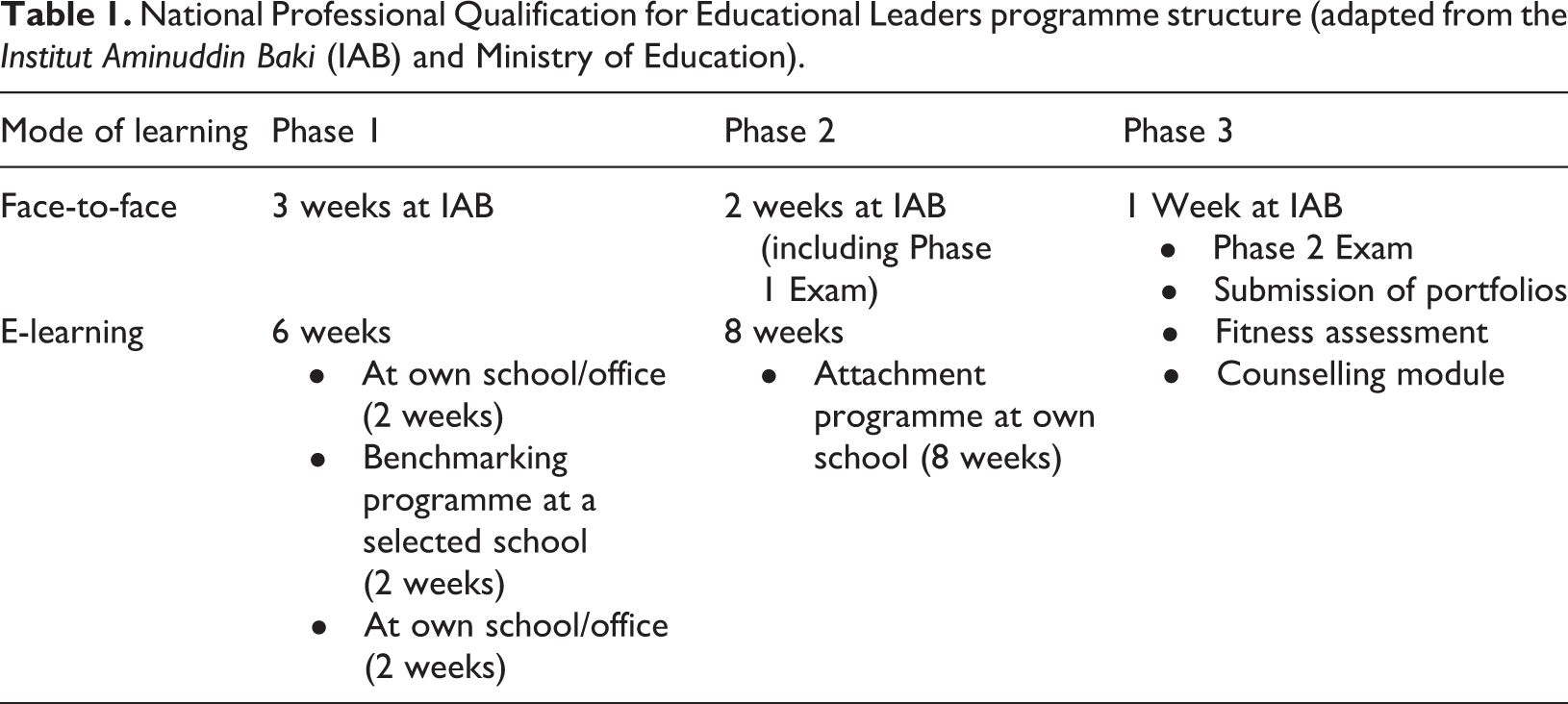
The NPQEL programme takes five months to complete but is divided into three phases with six weeks of face-to-face sessions at IAB and 14 weeks of e-learning in the schools where they work as shown in Table 1. During the e-learning phase, participants carry out two consultation activities: a benchmarking programme of two weeks in another school and four weeks in their own school in Phase 1; and the attachment programme of eight weeks in Phase 2, which is carried out in their own school. Participants have to sit for exams, quizzes and complete assignments and portfolios based on any of the three components: leadership and management; curriculum and co-curriculum management; and finance and office management. The school where the two weeks placement or benchmarking is carried out is selected by the NPQEL participant and the principal of the school would act as mentor. A Dutch study (Hulsbos et al., 2015) shows that such workplace learning through working on improvement, innovation and reflection, is valued by school leaders.
National Professional Qualification for Educational Leaders programme structure (adapted from the Institut Aminuddin Baki (IAB) and Ministry of Education).
Methodology
This exploratory qualitative approach aims to provide new knowledge about principal preparation in Malaysia based on the criteria found in the MEB. This data-theory perspective provides an interpretive orientation and a detailed understanding of the principal preparatory programmes from the perspective of the various providers, the school principals and their respective vice-principals. The use of respondent triangulation addresses reliability and validity through comparing the outcomes from the various interviewees (Silverman, 2005). This was augmented by document analysis of the NPQEL. Such multiple sources of data help to address the issue of construct validity (Johnston and Christensen, 2014: 261).
The study was conducted in the state of Selangor, which is the most populous state and has the largest economy in Malaysia with RM128.815 billion (USD42billion) in 2010, thus making up 23% of the total gross domestic product of Malaysia. There are 459 schools, with 123 primary, 298 secondary, 10 boarding Islamic and 28 private and international schools as of April 2015. Despite its vibrant cities and thriving economy, there are also rural and sub-urban schools. The availability of such varied types of schools enabled the author to carry out a study based on stratified purposive sampling (Briggs et al., 2012) as shown in Table 2.
Sampling frame for the study.

For both primary and secondary schools, one is located in the Federal Territory of Kuala Lumpur, one from a rural area, one from a sub-urban area and one from an urban area which is the administrative centre of Putrajaya.
Data collection
Data were collected through two methods, documentary analysis and interviews, to provide methodological triangulation.
Documents
An analysis of all the relevant documents provided an ‘excellent starting point for researchers [by] illustrating how things are described and linked’ (Prior, 2003: 490). Both national level policy documents, specifically the MEB and the documents of the NPQEL, provided a platform for understanding the macro context regarding national aspirations and the micro context regarding the preparation of principals. While the MEB is a national policy document that reflects the government’s aspirations, the NPQEL documents indicate the features of the preparatory leadership programmes for the country’s aspiring principals. A critical review of these documents provided a starting point for the interviews. With an interpretive stance, it showed that there is a gap between the content of the NPQEL documents and the aspirations stated in the MEB.
Interviews
Semi-structured interviews were conducted with 21 participants. Purposive sampling identified the providers: two IAB officers; two officers from the Ministry of Education; and an education minister. Stratified purposive sampling by role and school type of participants led to the identification of 16 ‘information rich’ (Patton, 1990) participants: eight principals; and eight vice-principals who are senior assistants for academics (Table 2), who also provided respondent triangulation (Brundrett and Rhodes, 2014). The four officers offered a provider perspective while the education minister clarified the policy and political context of the study. The school participants were interviewed to establish how they were selected and prepared for their leadership role. Sammons et al. (2014) recommend the use of interviews to provide insights. The interviews yielded rich and detailed data about the selection and preparation of these school leaders. The semi-structured interviews allowed for flexibility in question wording and order, thus allowing the author to be ‘on target while hanging loose’ (Braun and Clarke, 2013: 78). Probes were used to tease out further information.
Five sets of interview protocols based on the nine research questions were built for the five different providers: IAB; MoE; the education minister; the principals; and vice-principals. The interview protocols have a common core, but are customised for each group. The two research questions were designed: To examine the selection criteria of candidates for the principal preparatory programmes, To examine the content and effectiveness of the programmes, with a particular focus on instructional leadership.
Data analysis
Thematic analysis was used as it provides a flexible and useful tool (Boyatzis, 1998), which can potentially provide a rich and detailed, yet complex, account of data (Braun and Clarke, 2013: 4). Through thematic analysis of the interview data which reported on experiences, meanings and the reality of participants, the author was able to acknowledge the ways individuals make meaning of their experiences and how the broader social context impinges on those meanings. Themes were obtained through the inductive approach and therefore strongly linked to the data themselves (Patton, 1990). The process of coding was completed without trying to fit the data into pre-existing coding frames or the author’s analytic preconceptions. Hence, the themes that were identified in this study emerged from the data.
Findings and discussion
Rationale for leadership preparation in Malaysia
High-performing principals for all schools
The belief that high-performing principals are the catalyst to improve and create excellent schools (Bush and Glover, 2004; Robinson et al., 2008) is strongly echoed by the education minister: I believe high-performing principal is very important. In fact, it is very critical, when you were talking about developing leaders. So that’s the most crucial point. And it is good that the Blueprint, in one of the shifts, have talked about grooming principals to be high-performing principals. (Minister of Education) Our aim is to make sure that every school is led by a high performing principal. Such principals must have the skills and knowledge to work with the community and students. (MoE Officer). A high-performing principal is very important for the success of a school. A high performing principal, not necessarily has a Masters or PhD degree, but must have the correct attitude so that they can influence others and have followers and does not have characteristics that are not wanted. (IAB Officer) Instructional leadership skills? Nobody really tells us what it is exactly and how to do it? No one tells us how to go about it. (Head teacher 2)
Recruitment and selection of school principals
Keits de Vries raised the question, ‘What determines who will become a leader and who will not?’ (Keits de Vries, 1993: 3). In a hierarchical and highly centralised system, promotion to principalship has been based on seniority of the candidates as reflected below: My name was nominated by the principal and it was sent to the District Education Office and then to the State Education Office and finally to the MoE when I reached the seniority and in the zone for promotion. (Head teacher 3) Under the system, the principal suddenly finds that he/she becomes the principal. He/She has no training, just based on what he/she learns while in school. (MoE Officer 1) If given the post, I will take but I won’t go and look for it. So I won’t go for the NPQEL. I heard it is very intensive and besides I don’t think I want to take all that trouble to be a principal because the problem is the responsibility. It is too much and too heavy. (Vice-Principal 1 Secondary School). I think the Minister of Education has made it very clear that it is based on meritocracy. The NPQEL is compulsory, anybody who wants to be a principal needs to go through that. (Education Minister) I will not go for the NPQEL. It means I have to spend time and effort to take and pass the course and then be eligible for promotion to be principal. Then the NPQEL also does not guarantee that I will be the principal. Why all the trouble when the principal’s responsibilities are so heavy and I have to take care of the whole school. Besides, the pay increase is not much difference from a senior teacher? (Vice-Principal 3 Secondary School)
From administrative to instructional leadership
The education minister reiterated the point made in the MEB that ‘an outstanding principal is one focused on instructional and not administrative leadership’ and that effective school leaders can raise student outcomes by as much as 20% (Ministry of Education, 2013: E-27): The principal must make efforts to monitor teachers’ and students’ work, no interruption of lessons, constant evaluation to make sure students learn well. The principal must do all he/she can to make sure that instruction is given the top most priority. We don’t want to see principals spending their time doing administrative stuff. Administrative stuff can be given to his/her assistants to do. (Education Minister) I believe management of money is important. As principals, we must know how to spend the money and when to spend and how much to spend. (Principal 2 Secondary School) Financial management: I depend so much on my chief clerk on that aspect. But it is about accounting and allocation. A principal needs the skill to do that. (Principal 3 Secondary School)
To add to the dilemma, the term instructional leadership became so common that ‘anything and everything’ (Hallinger and Murphy, 1985: 217) and ‘everything a principal does’ (Marks and Printy, 2003: 373) to support the achievement of students, and the ability of teachers to teach is considered an instructional leadership. This has resulted in uncertainty about what it means to be an effective instructional leader, as expressed by IAB Officer 2: Many principals do not practice instructional leadership not because they don’t want to but because they do not know what they must do to be instructional leaders. (IAB Officer 2)
The content of leadership preparation programmes in Malaysia
The programme provider claims that the NPQEL programme is effective and that participants found the training to be satisfactory. This claim is substantiated by Aziz (2003), Educational Planning and Research Development (2006), Ruhaya et al. (2006) and Rusinah and Lee (2006): The candidates will gain leadership and management knowledge and skills. We find that they are performing much better than those who didn’t go for the NPQEL. (IAB Officer) You see the whole course is within 5 months. So every day for one whole month during the face-to-face lectures, from 8 o’clock in the morning to 5 o’clock sometimes 6 o’clock. I tell you that from morning to evening lectures, lectures, lectures. (Vice-Principal 2 Secondary School) This NPQEL should be supplemented with practical experience. Now they have the ‘attachment’ programme so there is some practical work there but still it is not real life experience. (Principal 2 Primary School) Only NPQEL is not enough. There are so many things a head teacher must know. Besides, the duration of 5 months is definitely not enough. I spent years and years to gain those knowledge and skills and you want to teach others to be high performing principals in 5 months? There must be a practical aspect to it. More time be allotted to the person to learn hands on. (Principal 4 Primary School)
How leadership programmes are delivered in Malaysia
Programme delivery
All participants interviewed felt that the IAB trainers lack the practical experiences to teach them how to be high-performing principals as they did not have prior experience in this role. This affects the credibility of the trainers and participants considered them as moderators instead of role models, which aspiring principals need. Similar findings are reported by Educational Planning and Research Development (2006) and Santhanamary and Hamdan (2011). This is aptly put by a participant: The trainers at IAB have not headed a school before and no experience and they want to teach us who have been in schools for 20 years? (Vice-Principal 2 Secondary School)
Assessment
The evaluation of the NPQEL participants is based on all the components: exam (40%); attachment programme (30%); benchmarking programme (10%); and e-learning assignments (20%) (NPQEL, 2012). Based on the participants’ feedback, this is too heavy and too theoretical and does not serve the purpose. The quizzes, exams and assignments are all based on lectures. They are all theories and I gain no practical knowledge or skills from such exams and quizzes. E-learning, you have assignments for e-learning, quiz, all kinds of things, which is also quite time-consuming. After all the exams, then what? (Vice-Principal 2 Secondary School).
Mentoring
One aspect of the NPQEL that was found to be important is to be mentored by the principal of the school where participants chose to do their benchmarking. This is probably due to the opportunity to learn from a principal whom participants felt could be their role model: I help to guide these teachers who do their NPQEL programme. They come here to do their assignments and benchmarking. I have guided so many so here I have a leader guide programme. I also guide all my own teachers to be leaders. Each one of them has a folio that showcases their work and achievement. I give them opportunity to give talks and to lead on certain projects. This way they already learn leadership and when they become head teachers or principals, they would have gotten the skills. (Principal 3 Primary School) Mentoring builds up a professional learning community. I did a lot of mentoring when I was a principal and lo and behold today they are doing exactly what I did to mentor those principals in my state. They are also playing the role, using the same concept of leaders developing leaders, leaders guiding leaders and leaders leading leaders. (Education Minister).
Conclusion
Answering the research questions
Which groups are being targeted for leadership training?
In the mandatory NPQEL, though it tries to select candidates based on meritocracy, the onus has been placed on teachers who are interested in holding the post in the future to apply to attend the programme. This self-selection through sieving out those who have no interest to be a school principal, also eliminates those really good teachers who can be good principals. In the absence of specific leadership evaluation of teachers, the selection of candidates for the NPQEL is still based on seniority. Thus, the challenge remains that those who attended the NPQEL programmes are really qualified and have the leadership competencies required to be high-performing principals.
The study shows that the effectiveness of principals depends on appropriate training (Bush, 1998: 331; Hess and Kelly, 2005: 3), thus, it remains a challenge for IAB to prepare future leaders to be high-performing principals who can address the continuous change and varied needs in schools. In addition, the quality of the preparation experience relates to the willingness of potential candidates to take up the tough job and their ability to succeed in it. Thus, recruiting the right people and preparing them comprehensively, is essential to improve the pool of available school principals.
What attributes of skills do the leadership programmes intend to develop?
Malaysia has a highly centralised system and a mandatory principal preparatory programme would ensure that principals are trained to follow national aspirations and policies as Bush aptly describes it as a ‘vehicle for ensuring compliance with national imperatives’ (Bush, 2013: 459). In Malaysia, it is not compulsory for principals to have a second or third degree, so a mandatory NPQEL may provide the necessary theoretical knowledge and skills to equip these aspiring principals for running schools.
The 21st century principals are ‘leaders for student learning’ (Steyn, 2008: 893), trained to be instructional leaders with the capacity to increase student achievement and learning. Skills such as the ability to collect, analyse, and use data in ways to inform decision-making and build further progress, are important and should be factored into the leadership preparatory programmes.
To conform to the ‘international curriculum’ would place the NPQEL programme at par with that of other countries. However, leadership is context-sensitive (Antonakis et al., 2003) and Malaysian local practices, values and beliefs need to be taken into consideration as such elements affect the ways things are done in different schools.
The NPQEL, like most leadership preparatory programmes leans toward the ‘periphery and content’ of leadership (Frost, 1993: 14) and not taking into consideration that leadership is a process. Leadership exists in the organisational space wherein relationships develop and operate to effect significant changes. Leadership does not exist within a person or persons but in a relationship among people (Frost, 1993: 14). As a result, a leadership preparatory programme should take into consideration that principals need skills to work with 21st century teachers who are more interested in being a part of the process that gives them some influence and impact on major decisions being made in schools.
Programmes for training school leadership have been criticised for equipping principals with skills for running present-day schools and not for guiding and developing schools for the future (Lashway, 2003: 140; Levine, 2005: 66). To address the changing context of education, there should be different types of leadership preparation for different types of schools (Wong, 2004: 143). Principals need to be equipped with skills as schools move toward a focus on wholeness or sustainability in solving difficult issues and making progress.
Overview
The aim of the NPQEL is to train high-performing principals to helm schools and take them to levels of excellence in all aspects. The implications of this aim are profound and challenging but the attributes, skills, and characteristics of high-performing principals are not clearly specified.
It is important to be mindful that, in promoting instructional leadership, principals should not marginalise the importance of management in schools as they encounter both administrative and educational leadership tasks (Bush et al., 2010; Devos and Bouckenooghe, 2009; Earley and Weindling, 2004). Nevertheless, Malaysia has joined the world in realising that there is a need for principal preparation. But ‘becoming a school leader is an ongoing process of socialisation’ (Duke, 1987: 261; Earley and Weindling, 2004) and Malaysia appears to be unsure about how to secure improvement in respect of instructional leadership.
Footnotes
Declaration of conflicting interests
The author(s) declared no potential conflicts of interest with respect to the research, authorship, and/or publication of this article.
Funding
The author(s) disclosed receipt of the following financial support for the research, authorship, and/or publication of this article: The author received funding support for the research from BELMAS.