







Abstract
The present research examines the functioning of subject coordinators as boundary managers. According to this approach, effective team leaders move back and forth across the team boundary, by means of internal activities, which focus on internal team processes, and external activities, which focus on connecting the team with the external environment in which it operates. The research model suggests that internal and external boundary management activities will promote team learning, which in turn will advance team outcomes (innovation and organizational citizenship behavior (OCB)) as well as organizational outcomes (academic achievements of students). Eighty-three subject coordinators and 260 teachers from elementary and junior high schools were studied. In general, structural equation modeling supported the mediating role of team learning in the relationship between boundary management and outcomes. The findings revealed positive relationships between internal and external activities and team learning, as well as between team learning and innovation and OCB. No significant relation was found between team learning and academic achievements. Implications, limitations, and future research directions pertaining to the boundary-related roles of subject coordinators are discussed.
Keywords
Introduction
Over the past several decades, the literature on education administration has increasingly been referring to leadership not only in the context of the individual who stands at the head of the organization, but also as a phenomenon that can be detected in the various strata of the school (Forst, 2012). This approach has highlighted the importance of the role of middle managers, who are given managerial authorities and are expected to guide and lead in their areas of expertise (Naylor et al., 2006). In the educational context, subject coordinators are, in fact, middle managers who manage their subject teaching teams; and at the same time, they act as the link between the school administration and the teaching staff, between the subject team and the entire school community, as well as the professional community outside the school (Wong et al., 2010). Several scholars have focused on the role of the coordinator as a middle manager (Busher, 2005; Ho and Tikly, 2012). In the last two decades, the literature has emphasized the complex role of middle-managers (Bennett et al., 2007; Bush and Glover, 2012). Subject coordinators have to lead a team’s internal processes, and advise and monitor colleagues in their teaching; but at the same time, also to represent the team before the senior management, and to implement school policies in the team (Gunter, 2001). This approach reflects the system perspective (Bertalanffy, 1968), which identifies school as composed of elements linked through their relationship. This means that subject teams do not operate in a vacuum but function within the context of a dependency relationship with the organizational environment in which they act (Langan-Fox and Cooper, 2013).
The present study departs from the system perspective, and suggests examining the role of the subject coordinator as a boundary manager. This approach proposes that effective team leaders move back and forth across the team boundary. Boundaries may be crossed between the team and its organization, between teams within the same organization, and between the team and its external environment. Boundary activities may be divided into two categories: internal activities; and external activities. This research attempts to promote a theoretical model that focuses on the boundary activities of subject coordinators, whereby the main claim is that internal boundary activities, as well as external boundary activities will increase the effectiveness of both the team and the organization. We propose a mediation model that attempts to explain the mechanism by which the boundary activities promote effectiveness. Generally speaking, the mediator variable serves to clarify the nature of the relationship between the independent and dependent variables. Accordingly, the present model suggests that the internal and external boundary management activities of the subject coordinator promote team learning (the mediator variable), which in turn promotes team outcomes (innovation and organizational citizenship behavior (OCB)) as well as organizational outcomes (students’ academic achievements).
Theoretical background and hypotheses
Subject coordinators as boundary managers
Subject coordinators are the pedagogical authority responsible for a specific subject matter. They are expected to lead, and guide their colleagues in the teaching of the subject. They are required to manage the internal activities of the subject teaching team, to manage the professional ties between the team and external professional entities, and to help the principal run the school (Wong et al., 2010). According to the system perspective, teams do not act in a vacuum but within a context, which necessitates mutual interactions with the environment in which they operate (Langan-Fox and Cooper, 2013). This perception requires the team leader to simultaneously manage both the internal and external environments of the team in order to provide support, gather information, recruit resources, and connect the team to the environment both within the organization and outside of it (Johnson and Fauske, 2000). Accordingly, effective team management is such that it maintains a balance between managing the internal environment of the team and managing the environment outside the team boundaries.
Druskat and Wheeler (2003) proposed a detailed classification of team boundary management activities that comprises two broad categories of internal activities and external activities. Internal activities focus on the processes that take place within the team, and include four dimensions: (a) relating refers to leader’s act of the building trust and exhibiting caring towards the team members; (b) scouting refers to the gathering of information regarding the needs, strengths, and weaknesses of the team and of each of its members; (c) persuading is an activity aimed to help the team understand the implications of its decisions and actions. This activity enables the leader to guide the team in setting priorities that are in line with the organizational objectives; and (d) empowering includes behaviors aimed at giving the team a feeling of capability and developing its self-management abilities. External activities focus on connecting the team to its external environment and they include three dimensions: (a) relating refers to the development of political and social awareness. The leader must identify the needs and interests of other teams and other position holders in the school, and of stakeholders outside the school; (b) scouting involves information gathering activities outside the team boundaries. The objective of scouting is to clarify the organization’s objectives and collect information, both within the organization and outside of it; and (c) persuading refers to behaviors of the leader that are directed at mustering external support for the team. The leader persuades other teams and other stakeholders to promote achievements in the discipline in light of the “diagnosis” results.
The present study suggests that in order to promote team effectiveness, it is important that team leaders know how to allocate their managerial resources when managing the internal environment of the team, but at the same time, they must invest also in the mutual relations with the external environment (Benoliel, 2012). Specifically, we propose a mediation model that suggests that boundary management on the part of the coordinator will be positively related to organizational learning, which in turn will be positively related to outcomes at the team and school levels.
The relationship between boundary management and team learning
Team learning is defined as “a process, in which a team takes action, obtains and reflects upon feedback, and makes changes to adapt or improve” (Edmondson, 2002: 129). According to Kostopoulos et al. (2013), team learning undergoes four stages that affect and complement each other: (1) intuition – identification of an idea based on the personal experience of a team member, which occurs at the individual’s cognitive level; (2) interpretation – clarification of the idea by means of a social-cognitive process that provides a verbal or action-based explanation and creates a common team language; (3) integration – conversion of the re-formulated idea into coherent team action; (4) codification – documentation of the activities and information created through the team’s interactions, so as to enable the newly created information to be saved and serve as a basis for the ongoing learning process. Studies that examined factors that precede team learning indicated the importance of the role of the leader in promoting processes and mechanisms of team learning (Künzle et al., 2010). We propose to deepen this understanding by examining the relationship between the subject coordinator’s boundary activities and team learning.
Internal activities and team learning
Team learning is a phenomenon that is created in a process of forming mental models that are common to the team members, through interactions that include sharing of information, clarification, and re-formulation of ideas (Kostopoulos et al., 2013). We suggest that internal activities of relating and empowerment, which include reinforcing the team members’ sense of capability, caring, and willingness to listen and respect the team members, will create a supportive and safe atmosphere among team members, and will encourage processes of team learning. Edmondson (2002) showed that an atmosphere of psychological safety – when team members feel that they may speak freely about their ideas, problems, and mistakes – is positively linked to team learning. Psychological safety, when created by the team leader, encourages team members to cooperate and promotes the development of learning mechanisms within the team. Similarly, internal activities of scouting and persuading promote thought processes and dialog among the team members, as part of the learning processes. Such activities give meaning to the team’s work and thus increase the team members’ motivation to propose ideas and discuss them as part of the common discourse within the team (Edmondson and Roloff, 2009).
External activities and team learning
Taking a social network’s perspective, Perry-Smith and Shalley (2003) emphasized that in order to promote team learning, the team leader must establish relationships with entities outside the team. Such interactions enable the acquisition of new information and knowledge, allow the team to update itself on innovations and changes, and expose the team to varied thought perspectives. All these provide learning resources that enable the team to develop new ideas and adapt better to the environment. DiPaola and Tschannen-Moran claim that “schools must continually exchange information and resources with the environment to survive…Effective school leaders recognize that reciprocal influences between the school and the environment are as significant as relationships within the organization to the creation and maintenance of high functioning schools” (DiPaola and Tschannen-Moran, 2005: 61). Indeed, in their research, conducted in middle schools in Virginia, USA, they found that adopting the system perspective (bridging strategy), and investing resources in developing connections with the community, positively impacted on student achievement. In addition, since teams require external resources, they depend upon the support and valuation of external stakeholders, such as their management or professional community. External relating activities, which enable the leader to identify the needs and interests of the various stakeholders, as well as persuasion activities that expose the team achievements, enable the leader to recruit resources that the team requires in order to develop and reinforce team learning.
The relationship between team learning and outcomes at the team and school levels
Further, according to the study model, we suggest that team learning is positively related to team innovation and OCB, as well as to academic achievements of the students.
The relationship between team learning and innovation
Innovation is defined as “the intentional introduction and application within a role, (work) group or organization of ideas, processes, products or procedures, new to the relevant unit of adoption, designed to significantly benefit the individual, the group, organization or wider society” (West and Farr, 1990: 9). Innovation is a process that includes two consecutive stages: proposing original and new ideas (the creativity stage); and turning them into beneficial outcomes (the implementation stage) (Amabile, 1988). Proposing creative ideas may begin with a specific team member, but the team learning work environment is the factor that encourages open interaction among team members, enabling the innovative ideas to be refined and honed. Teams that are characterized by high levels of team learning typically exhibit work patterns of sharing and exchanging information and knowledge, and open discussions that expose team members to contradicting opinions and approaches and enable them to ask questions, to be heard and to argue without fear of social sanctions – all critical components of team creativity (Fisser and Brawaeys, 2010). Innovation, however, requires not only the raising of innovative ideas, but also their implementation and dissemination. Here too, researchers emphasize that the success or failure in implementing such ideas depends on the team’s work environment characteristics (Hülsheger et al., 2009). The learning model emphasizes that the learning cycle requires the team to convert the re-formulated ideas into coherent team action. Through the common understanding formed in the interpretation process, the team assimilates the ideas in the form of procedures, work practices, and so on. Codification means that the activities and information created through the team interactions are documented so as to enable the newly created knowledge to be saved as a basis for the ongoing learning process (Kostopoulos et al., 2013). In general, previous studies have found a positive connection between learning and innovation (Fisser and Brawaeys, 2010). For instance, Cochran-Smith and Lytle (1999) found that learning in teacher teams enabled the creation of new knowledge in the team, which contributed to developing innovative work methods.
The relationship between team learning and OCB
Organizational citizenship behaviors refer to all behaviors that are above and beyond the formal job definition and are designed to promote the organization’s goals (Somech and Drach-Zahavy, 2000). Although such behaviors are carried out by individuals, research shows that OCB may be regarded as a team phenomenon, and so teams differ in the level of OCB they display (Ehrhart and Naumann, 2004). Team learning can encourage team OCB through the learning mechanisms that develop within the team. Team learning requires planned and unplanned interactions among team members, as well as active participation in the team’s work processes (Armenakis et al., 1993). The need to work together and to be actively involved strengthens cohesion among team members, enhancing their willingness to offer mutual assistance and investment beyond the team members’ formal job requirements (Srivastava et al., 2006). Another mechanism that may explain this relationship is based on the claim that the learning processes encourage team members to change their job perceptions. In other words, team learning processes widen the teachers’ perspective beyond their formal role in the classroom, and elevate the team members’ willingness to contribute above and beyond the call of duty, to promote team goals and organizational goals alike (Somech and Drach-Zahavy, 2004).
The relationship between team learning and students’ academic achievements
Subject teaching teams in schools generally consider the essence of their role to be the improvement of teaching quality and of their students’ achievements in the subject they specialize in (Wong et al., 2010). Learning processes usually focus on diagnosing and identifying problems in the professional domain, and attempting to find and assimilate solutions for continuous improvement. They enable team members to raise problems they encounter in the classroom, discuss them with the team members, and be exposed to a variety of solutions. These processes provide them with solutions that may be implemented in the classroom, in order to improve their students’ achievements (Edmondson and Roloff, 2009). Empirical support for this relationship is provided also by various studies (Mclaughlin and Talbert, 2006). For instance, Roy and Hord (2006) found that team learning that included discussion, peer learning, and norms of cooperation was positively related to academic achievement.
The mediating role of team learning
Finally, we propose that team learning mediates the relationship between the coordinator’s boundary activities and the outcomes. Support for this claim may be found in the classic model of team effectiveness – Input–Process–Outcomes – which describes three stages for developing team effectiveness (Ilgen et al., 2005). The first stage (Input) involves activities, which are performed by the team leader, that mold the work environment in which the team operates. These activities affect the team’s work processes (Process), which in turn affect the Outcomes. The model suggests, accordingly, that the team leader’s activities, which are directed inward towards the team with the objective of shaping the team objectives and providing guidance, support, and empowerment, as well as the external activities that provide resources and support from external stakeholders, all provide the appropriate environment that encourages processes of team learning. Team learning enables the team members to share information, discuss problems openly, and seek solutions, which in turn promote the outcomes at both the team and school levels (Gallimore et al., 2009).
Method
Sample and procedure
The initial sample consisted of 85 subject teaching teams from elementary and junior high schools. The final sample included only 83 teams in which at least 60% of team members and 100% of team coordinators answered the questionnaires. Forty-two of the teams were involved in teaching sciences and 41 taught language studies. These disciplines were selected since they are among the four “core subjects” and are included in the Meitzav exams (school growth and effectiveness evaluation), a national evaluation metric that encompasses all Israeli elementary and junior high schools.
The average number of teachers in each team was 4.75 (standard deviation (SD) = 2.77). The average number of years of membership in a team was 5.68 (SD = 3.98). In all, 260 teachers participated in the study (225 women and 35 men). The average number of years in the profession was 12.68 (SD = 8.88). In terms of academic degrees, 164 teachers had a bachelor’s degree and 76 teachers had a master’s degree. Of the 83 subject coordinators who participated in the study, 86% were women. The average number of years in the profession was 13.55 (SD = 9.20). Forty coordinators had a bachelor’s degree, 42 had a master’s degree, and one had a PhD. To avoid one-source bias, data were collected from three sources: team members evaluated the boundary leadership of the team leader and team learning; subject coordinators evaluated the innovation and team OCB variables; and Meitzav scores in the subjects relevant to the study teams were used to measure academic achievements.
Measures
All scales were measured using a 5-point Likert scale ranging from very seldom (1) to very often (5).
Boundary management
Boundary management was measured using a questionnaire developed by Druskat and Wheeler (2003) and adapted and validated for schools by Benoliel (2012): (1) Internal activities: Relating (4 items) (“How often does the team’s leader show team members that he or she cares about them”) (α = 0.84); Scouting (4 items) (“How often does the team’s leader gather information about the needs and problems of the team”) (α = 0.91); Persuading (4 items) (“How often does the team’s leader convey information to the team about how their work helps the school to achieve its goals”) (α = 0.87); Empowering (2 items) (“How often does the team’s leader delegate responsibility and decision-making authority”) (α = 0.87); and (2) External activities: Relating (4 items) (“How well does the team’s leader understand school politics) (α = 0.85); Scouting (6 items) (“How often does the team’s leader seek information and advice from peers in school for the team benefit) (α = 0.91); Persuading (7 items) (“How often does the team’s leader act as a representative of the team with parts of the school environment (e.g., parents, educational ministry, and district)) (α = 0.92).
Team learning
Team learning was measured using a questionnaire developed based on the learning model presented by Kostopoulos et al. (2013). The questionnaire included four sub-scales that correspond to the four stages of learning: Intuition (3 items) (“The members of our team can improvise”) (α = 0.83); Interpretation (3 items) (“In our team, we manage to develop a empowering and creative dialog on issues that are related to the team task”) (α = 0.91); Integration (3 items) (“In our team, we succeed in agreeing on the activities we perform”) (α = 0.88); and Codification (3 items) (“In our team, we are strict about recording how we did the job”) (α = 0.91).
Team OCB
Organizational citizenship behavior was measured using a questionnaire formulated by Somech and Drach-Zahavy (2000), which was adapted in the present study to suit the team context. The questionnaire consisted of three sub-scales: (a) OCBs towards the student (8 items) (“Team members stay after school hours to help students with class materials”) (α = 0.83); (b) OCBs towards colleagues (7 items) (“Team members help absent colleagues by assigning learning tasks to their classes”) (α = 0.80); and (c) OCBs towards the school as a whole (8 items) (“Attend functions not required but which help the school’s image”) (α = 0.86).
Team innovation
Team innovation was measured using a five-item scale, adapted from West and Wallace (1991), that reflects the extent of team-initiated changes in the previous six months with respect to work objectives, working methods, teaching methods, and the development of skills (“The team developed innovative ways of accomplishing work targets/objectives”) (α = 0.85).
Academic achievements
Academic achievements were measured using the Meitzav external achievement exams in two core subjects, according to the sampled teams’ subject matter: Science; and Native Language. Meitzav is a Hebrew acronym for “Growth and Efficiency Measures of Schools” (Beller, 2010). The Meitzav achievement assessments are administered to students at two grade levels: the fifth (elementary schools); and the eighth (junior high schools).
Control variables
Team size and the time since the establishment of the team (i.e., the time the team has been working as a team) were chosen as control variables. Previous studies showed that team size affects team processes and performance; and that the time the team has been working together also impacts team outcomes (Hülsheger et al., 2009).
Confirmatory factor analysis (CFA) using the LISREL 8 program (Joreskog and Sorbom, 1996) was used to analyze the internal structure of the present five study scales (internal activities, external activities, team learning, team OCB, and team innovation), as compared with a one-factor model. CFA can be considered as the appropriate technique rather than an exploratory factor analysis as CFAs are used when a theoretical rationale for an a priori factor structure is present. Given each of the five scales derived from recognized theories and measures, a rationale for a five-factor, and not for a one-factor structure, clearly underlay this model. As suggested in the literature (Kline, 1998), the following recommendations for goodness-of-fit indexes were adopted to assess the model fit: that the Chi-square statistic divided by the degrees of freedom ratio (χ 2/df) be less than 3; that the values of a comparative fit index (CFI), a normed fit index (NFI), and of Tucker–Lewis coefficient (TLI) be greater than 0.90; and that the root mean square error of approximation (RMSEA) be up to 0.05 while being acceptable up to 0.08. Results showed that the five-factor solution had good fit indexes (χ2(28) = 42.32, χ2/df =1.51, CFI = 0.98, NFI = 0.95, TLI = 0.97, RMSE = 0.079), and provided a better fit to the data than did the one-factor model (χ2(36) = 356.01, χ2/df =9.91, CFI = 0.59, NFI = 0.57, TLI = 0.49, RMSE = 0.33). These results indicated that the five scales of the present measurement model represent concepts that are not only theoretically, but also empirically, distinguishable.
Level of analysis
In the present study, the team is identified as the unit of analysis, so team innovation and team OCB were measured at the team level. The team leader’s internal and external activities and team learning were represented by an aggregate of the responses of the team members to the team level of analysis. It was critical to demonstrate high within-team agreement to justify using the team average as an indicator of a team-level variable (r wg; James et al., 1993). A value of 0.70 or above is suggested as a “good” level of within-group inter-rater agreement (James et al., 1993). The team leader’s internal and external activities and team learning scales exceeded this criterion (the average rwg score for internal activities was 0.77, for external activities 0.80, and for team learning 0.81). We also calculated intra-class correlations (ICC): ICC (1) reflects the extent of within- versus between-group variability, and ICC (2) provides an estimate of the reliability of the group means (Bliese, 2000). Values were ICC (1) = 0.19; ICC (2) = 0.44 for internal activities; ICC (1) = 0.33; ICC (2) = 0.64 for external activities; and ICC (1) = 0.26; ICC (2) = 0.57 for team learning. These values were comparable to the median or recommended ICC values reported in the literature (Bliese and Halverson, 1996) and so we concluded that aggregation was justified for these variables.
Preliminary analysis
To assess whether or not there were significant differences in the proposed variables between elementary and junior high schools, and between Language and Science teams, we used multivariate analyses of variance. The results indicated no significant differences between those sub-groups for any of the variables (internal and external activities, team learning, and team and organizational outcomes) (p > 0.05).
Results
Table 1 presents the means, standard deviations, and correlations for the study variables.
Means, standard deviations, and correlation matrix of study’s variables.
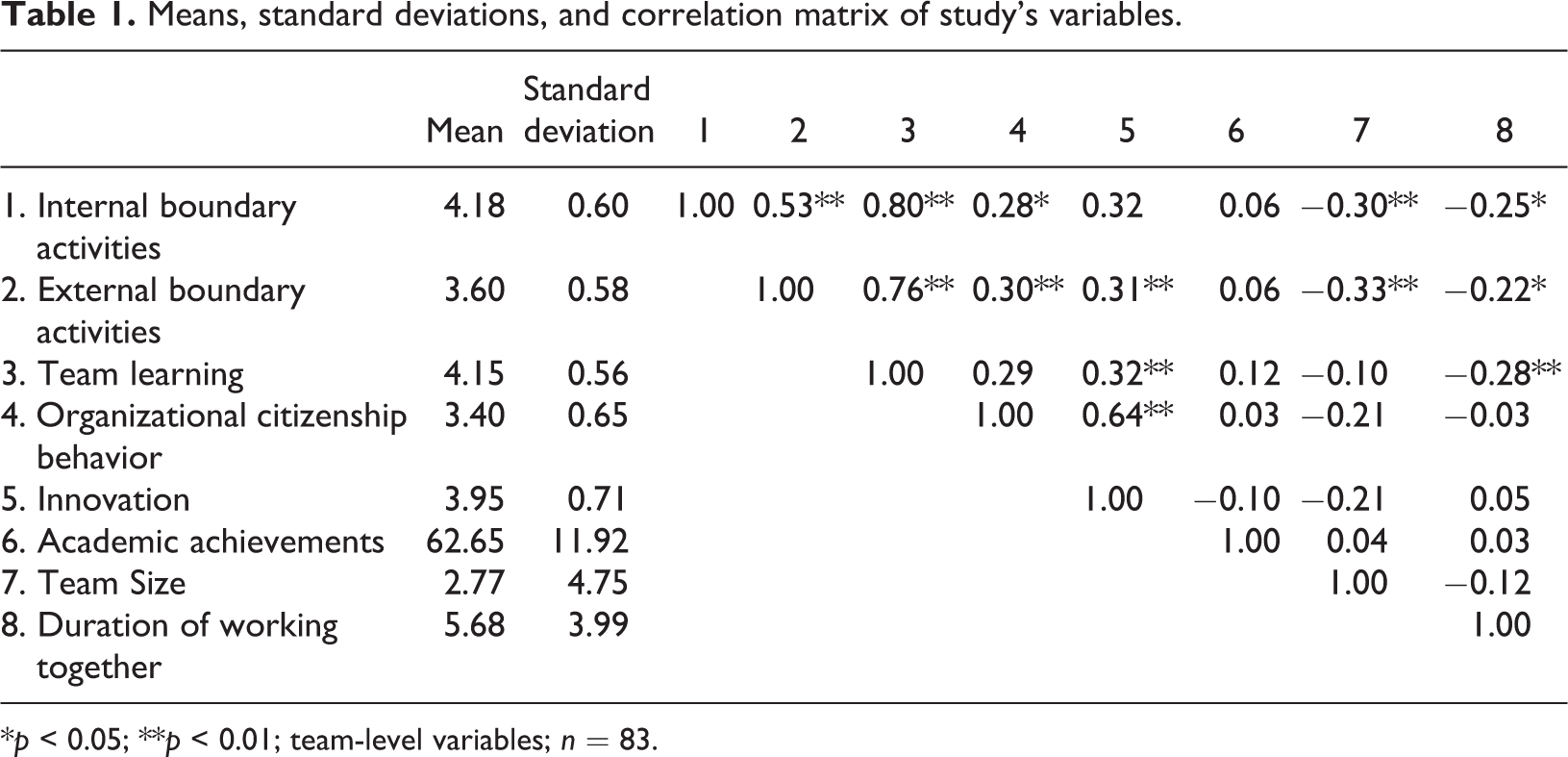
*p < 0.05; **p < 0.01; team-level variables; n = 83.
To test the study model, we conducted structural equation modeling (SEM). James et al. (2004) argued that this is a more appropriate technique than multiple regressions for testing mediation. They pointed out that the baseline model for the multiple regressions (Baron and Kenny’s, 1986 approach), is a partial mediation model, and such a baseline is not appropriate in a test for complete mediation. As Shrout and Bolger noted, “Because the test of the association between X and Y may be more powerful when mediation is taken into account, it seems unwise to defer considering mediation until the bivariate association between X and Y is established” (Shrout and Bolger, 2002: 429). MacKinnon et al. (2002) noted that a simultaneous test of the significance of both the path from an initial variable to a mediator and the path from the mediator to an outcome provides, relative to other approaches (such as Baron and Kenny’s steps), the best balance of type I error rates and exhibits greater statistical power. Accordingly, we followed the recommendations of James and colleagues (2004), and utilized the SEM approach to test the mediation model. Further, to provide a more rigorous test of whether the mediated effects found in the model are statistically significant, we conducted bootstrap analyses tests. According to Mallinckrodt et al. : “Bootstrap methods treat the collected research sample as a ‘population reservoir’ from which a large number of random samples are drawn with continuous replacement such that the probability of selection for any given case remains equal over every random draw…Empirical distributions resulting from bootstrap analyses are especially useful for estimating the confidence interval of a given population parameter. This principle is fundamental for testing the statistical significance of an indirect effect” (Mallinckrodt et al., 2006: 373–374). We used PROCESS, a computational tool that uses a bootstrapping technique (5000 boots) to estimate the confidence interval (CI) of the mediation effect.
In the present study, the full mediating model describes the relationship between the team leader’s internal/external activities (initial variables) and team learning (mediating variable), and between team learning (mediating variable) and team OCB, team innovation, and academic achievements (outcome variables). To support the full mediation model (Model 1), we compared Model 1 with a partially mediated model (Model 2), which is the same model but with additional paths: from the initial variables (leader’s internal/external activities) to the outcome variable (OCB, innovation).
SEM analysis to test the model for team leader’s internal activities
The results of Model 1 (full mediation) showed a good fit to the data (χ2(28) = 37.949, χ2/df =1.355, CFI = 0.976, NFI = 0.916, TLI = 0.961, RMSEA = 0.066). The fit of Model 2 (partial mediation) was almost identical to that of Model 1 (χ2/df = 1.50; CFI = 0.969, NFI = 0.917, TLI = 0.945, RMSEA = 0.078), with the difference in fit being non-significant (Δχ2 = 0.44, p > 0.05). Accordingly, Model 1 is a more parsimonious model that achieves the same fit, therefore, providing overall support for the mediated model (see Figure 1).
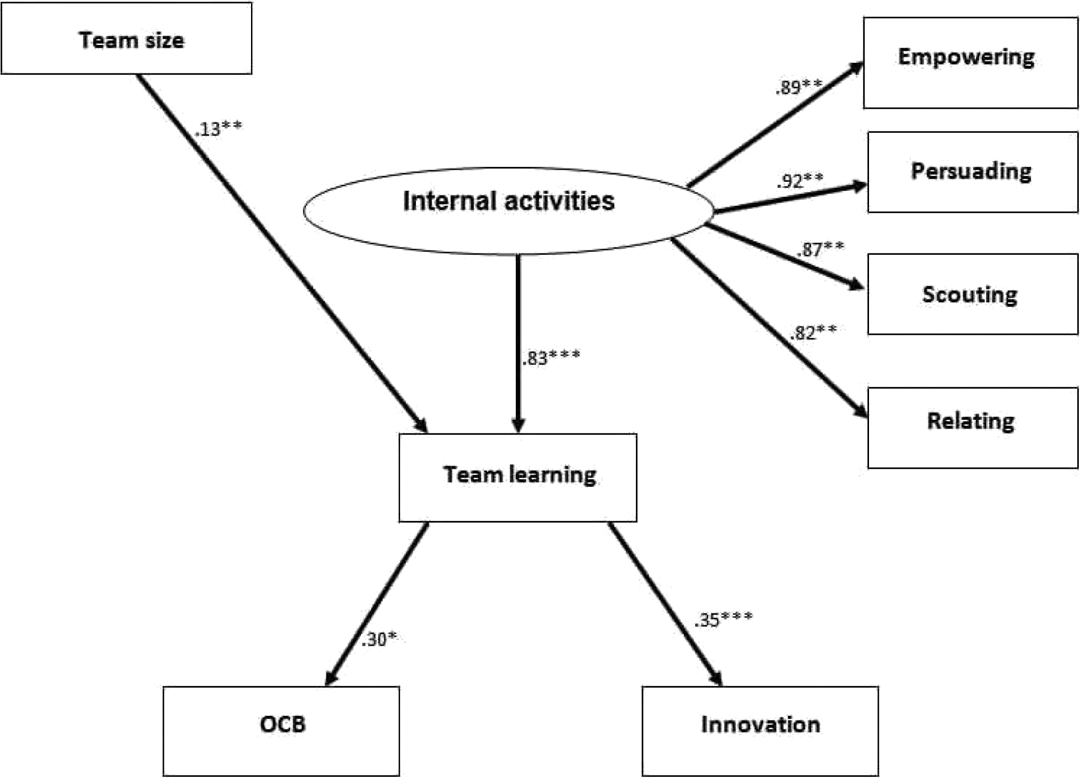
Estimated path coefficients for the model (leader’s internal boundary). Note: Standardized parameter estimates for the theoretical model; only significant relationships are presented. *p < 0.05; **p < 0.01; ***p < 0.001.
Hypothesis 1a suggests a positive relationship between team learning and the internal activities of the team leader. As is evident from Figure 1, the findings support this hypothesis, since a significant positive relationship was found between the internal activities of the team leader and team learning (β = 0.83, p < 0.001). Regarding the relationship between team learning and outcomes on the team and organization levels (Hypothesis 2), the findings indicate a positive relationship between team learning and team innovation (β = 0.35, p < 0.001) and between team learning and team OCB (β = 0.30, p < 0.05). No significant relationship was, however, found between team learning and academic achievements (p > 0.05). In other words, hypotheses 2a and 2b were supported, while hypothesis 2c was not.
Hypothesis 3a proposed that team learning mediates the relationships between leader’s internal activities and team (innovation and OCB) and organizational outcomes (academic achievements). Because no significant relationship was found between team learning and academic achievements, the analyses were conducted only for team outcomes. The mediation analysis, based on Monte Carlo simulations, supports the hypothesis for innovation (β = 0.29, CI 95% [0.07, 0.51]) and OCB (β = 0.24, CI 95% [0.02, 0.46]) (see Table 2).
Results of structural equation modeling analysis for predicting the relationship of leader’s internal boundary activities (initial variables) to team learning (mediator), team organizational citizenship behavior (OCB), team innovation and students’ academic achievements (outcome variables).
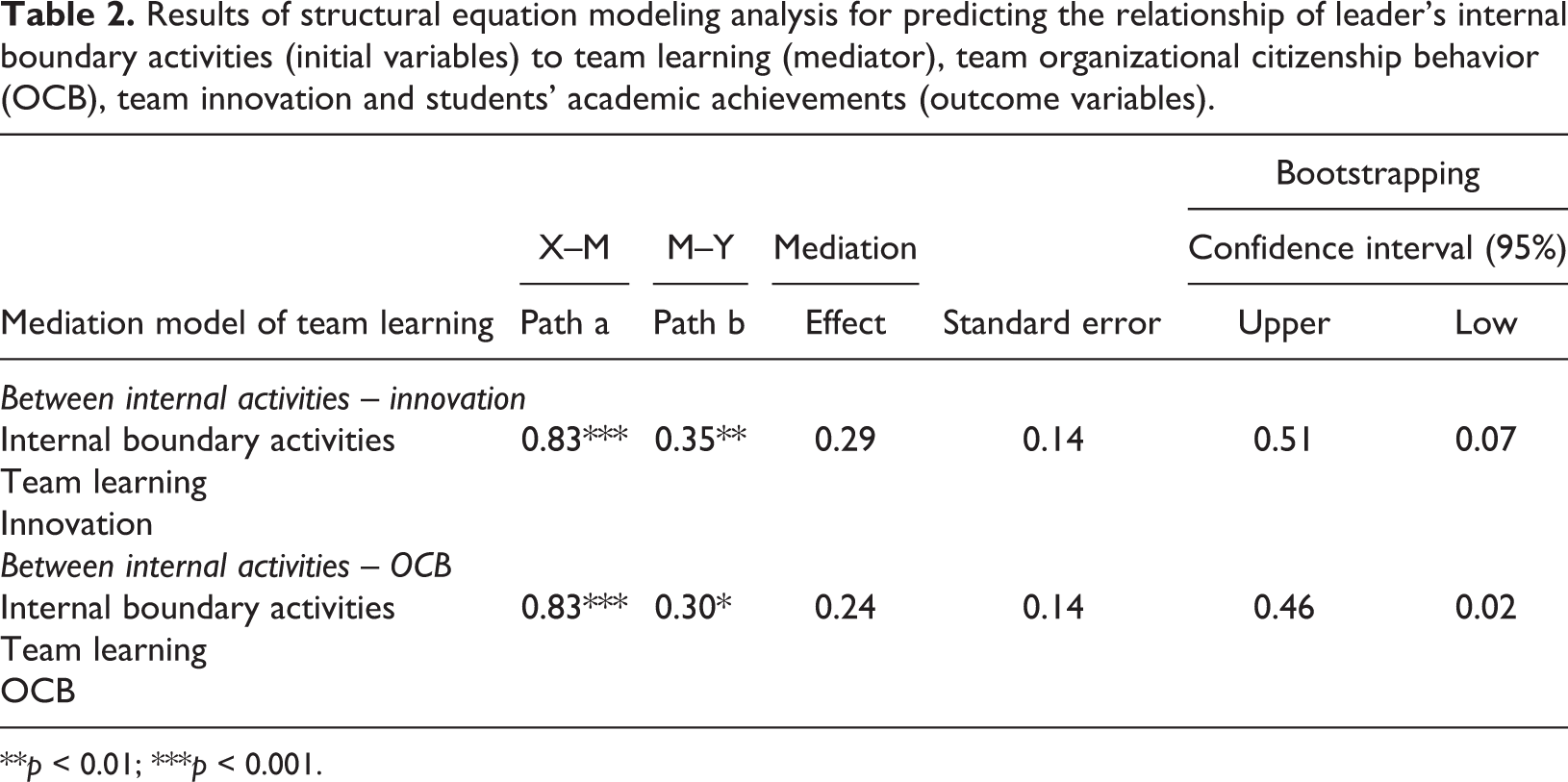
**p < 0.01; ***p < 0.001.
SEM analysis to test the model for team leader’s external activities
The results of Model 1 (full mediation) showed a good fit to the data (χ2(20) = 29.383, χ2/df =1.469, CFI = 0.973, NFI = 0.922, TLI = 0.951, RMSEA = 0.07). The fit of Model 2 (partial mediation) was almost identical to that of Model 1 (χ2/df = 1.68; CFI = 0.966, NFI = 0.925, TLI = 0.929, RMSEA = 0.091), with the difference in fit being non-significant (Δχ2 = 0.86, p > 0.05). Accordingly, Model 1 is a more parsimonious model that achieves the same fit, therefore, providing overall support for the mediated model (see Figure 2).
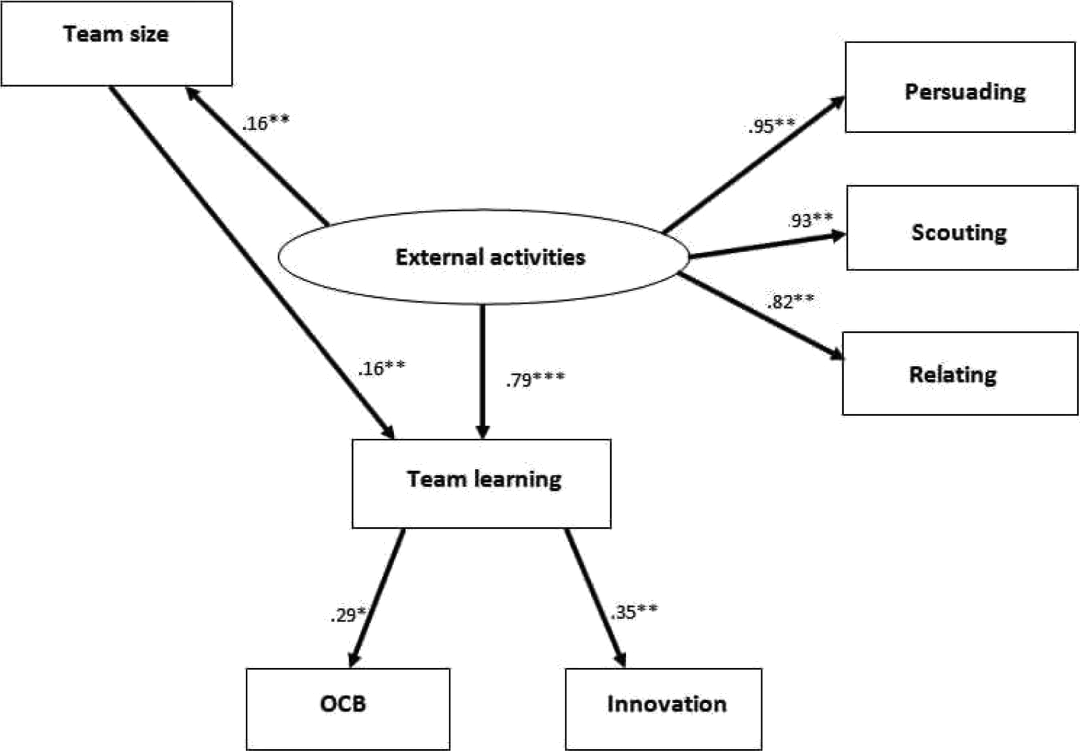
Estimated path coefficients for the model (leader’s external boundary). Note: Standardized parameter estimates for the theoretical model; only significant relationships are presented. *p < 0.05; **p < 0.01, ***p < 0.001.
Hypothesis 1b suggests a positive relationship between team learning and the external activities of the team leader. The findings support this hypothesis, since a significant positive relationship was found between the external activities of the team leader and team learning (β = 0.79, p < 0.001) (see Figure 2). Regarding the relationship between team learning and outcomes on the team and organization levels (Hypothesis 2), the findings indicate a positive relationship between team learning and team innovation (β = 0.35, p < 0.001), and between team learning and team OCB (β = 0.29, p < 0.05). No significant relationship was, however, found between team learning and academic achievements (p > 0.05). In other words, hypotheses 2a and 2b were supported, while hypothesis 2c was not.
Hypothesis 3b proposed that team learning mediates the relationships between leader’s external activities and team outcomes (innovation and OCB), and organizational outcomes (academic achievements). Because no significant relationship was found between team learning and academic achievements, the analyses were conducted only for the team outcomes. The mediation analysis, based on Monte Carlo simulations, supported the hypothesis for team innovation (β = 0.28, CI 95% [0.03, 0.50]) and for team OCB (β = 0.23, CI 95% [0.06, 0.45]) (see Table 3).
Results of structural equation modeling analysis for predicting the relationship of leader’s external activities (initial variables) to team learning (mediator), team organizational citizenship behavior (OCB), team innovation and academic achievements (outcome variables).
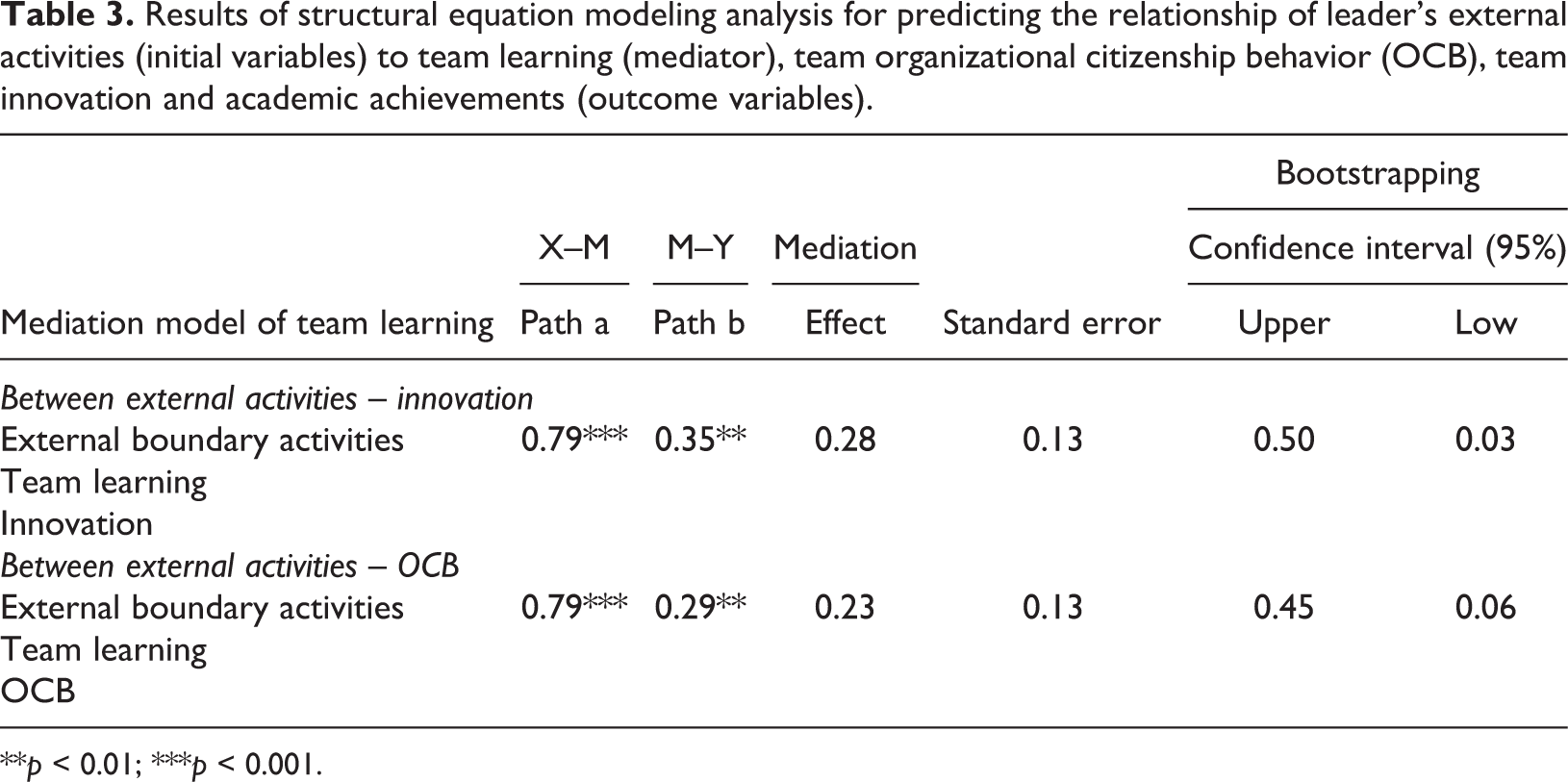
**p < 0.01; ***p < 0.001.
Discussion
The research findings show, on one hand, that those subject team leaders, who invest in internal activities of creating cooperation and team cohesion, as well as in strengthening the sense of empowerment and team capability, contribute to their teams’ functioning and effectiveness. On the other hand, investing in activities that are directed at the team’s external environment, which prevent the team from becoming isolated by forming connections with external entities, exchanging information, and expanding resources, also advances the team functioning and effectiveness (Druskat and Wheeler, 2003). Furthermore, the findings showed that team learning is a mechanism that mediates between the boundary activities and team outcomes. These findings enrich our understanding of the essence of the role of team leader in the school and contribute, both theoretically and empirically, to several aspects of the education management discipline. First, the findings support current claims that effective managers must cross the boundary and move inwards and outwards simultaneously (Bennett et al., 2007; Bush and Glover, 2012). Although it may be claimed that such activities compete for limited resources, it seems that if the manager succeeds in maintaining a balance between internal activities and external activities, such activities can reinforce each other and create mutual synergy (Benoliel, 2012). This outlook supports a shift from an either/or approach to a both/and approach and makes room for the development of a more holistic approach to management.
Second, the findings show that boundary activities are positively related to team learning. We found a positive relationship between the coordinator’s internal activities and team learning. This finding was consistent with previous studies that showed that the manager has critical influence over the learning processes and the mechanisms that develop within a team (Brueller and Carmeli, 2011). Two social psychology theories may be used to explain this relationship. According to the theory of social contagion (Hatfield et al., 1994), positions, beliefs, and behaviors can spread among groups that are in interaction with one another for extended periods of time. Since leaders control the time, the resources, and the mutual relationship of their employees, they have more opportunities to express and convey their feelings, positions, and behavior. Thus, it is likely that they, rather than the team members, will be the “source of cohesion” (Sy et al., 2005). Thus, team leaders who exhibit behaviors of caring, and empowerment, which establish norms of cooperation and promote learning, will encourage the same behaviors among their team members (Peterson and Luthans, 2003). The social learning theory (Bandura, 1977) emphasizes the importance of social processes, such as observation and modeling, in shaping of perceptions and behaviors. Team leaders constitute a source for modeling since teachers consider them to be powerful, high-status individuals with whom their relationships are based on dependency in all that pertains to resources, and reward. Therefore, leaders who exhibit behaviors of listening and sharing serve as role models for team members and enable the development of norms that promote team learning processes (Peterson and Luthans, 2003).
With respect to external activities, the research findings support the hypothesis that external activities are positively related to team learning. The findings reinforce the system perspective, according to which the role of the team leader is to manage the team’s internal environment, but also to connect the team to the external environment in which it acts (Benoliel, 2012). Since team members often do not come in contact with the extra-school environment, the coordinator plays a critical role in “bringing the environment to the team”. External activities include behaviors such as gathering information from senior management, regarding school policy and objectives information (Busher, 2005; Gunter, 2001); or obtaining external support and resources for the team, by presenting the team to other teams and stakeholders in a way that may promote the team’s interests (Wallace, 2002). These external activities enable the team leader to gain political understanding, identify power centers and networks, position the team in the organizational hierarchy, and expand the ability to recruit resources in order to achieve the team objectives (Druskat and Wheeler, 2003). Indeed, in his article on the formative role of principals in the education system, Gurr (2015) emphasizes that an important component of principals’ success is the connections with various role-holders that expose the school to a variety of information and broaden thought perspectives.
Third, the findings reveal a positive relationship between team learning and team outcomes of innovation and OCB. The findings support the idea that team learning advances team socio-cognitive processes that enable the creation of work norms of transparency, psychological security, and sharing, which are important for improving team functioning and effectiveness (Kurland, 2006). As for the relationship between team learning and innovation, the findings are consistent with previous research (Edmondson and Roloff, 2009), which suggests that team learning that includes processes of information gathering, raising ideas, interpretation, and integration advances innovation. For instance, Barker and Neailey (1999) argued that team learning creates permanent learning mechanisms that are critical for innovation, such as reflective thought processes regarding the job, documentation that enables to learn from mistakes, and the development of new ideas based on past experience. Regarding the outcome of team OCB, the research findings indicate a positive connection between team learning and team OCB, as was hypothesized. These findings suggest that organizational learning not only contributes to enhancing team effectiveness, but also reinforces values and norms of volunteering, involvement, and the desire to contribute above and beyond formal job requirements. Somech and Drach-Zahavy (2004), who studied the relationship between team learning and OCB in schools, suggested that team learning processes enhance the feeling of belonging as well as the personal responsibility and commitment of the team members, which in turn contribute to the team members’ willingness to invest in citizenship behaviors, which are above and beyond their formal job requirements.
Unexpectedly, no support was obtained for the hypothesized positive relationship between team learning and students’ academic achievement. Although many factors can influence the latter, previous research has already supported this particular link (e.g., Timperley, 2008). As mentioned, the present study used the Meitzav exams to evaluate students’ achievements. It would be well to investigate this relationship using other validated tests developed by the education system to evaluate student achievements.
Finally, our research findings show that internal activities, as well as external activities performed by the coordinator are positively related to team learning, which in turn is positively related to team innovation and team OCB. This model answers the call by researchers to identify mediating variables that can explain team effectiveness (Hülsheger et al., 2009). These findings provide additional support for the classical Input–Process–Outcomes model, which explains the mechanism that translates the coordinator’s activities into team effectiveness. According to the model, the coordinator’s boundary activities, which are directed outward, enable the team to understand the context in which it operates, recruit resources, and muster support, while the inward-directed activities strengthen the team’s identity and cohesion and cooperation among team members. Boundary management provides the team with the appropriate conditions for developing learning mechanisms and processes, which lead to improved team effectiveness (Ilgen et al., 2005).
Limitations and future research
Despite the study’s contribution, this research has several limitations that must be taken into consideration. First, the study method raises questions regarding causation. For instance, it is difficult to determine the relationship between the coordinator’s boundary management and team learning: the model suggests that coordinators’ boundary management encourages team learning, but it can be equally claimed that teams that are strong on team learning encourage boundary activities on the part of their coordinators. Furthermore, the relationship pattern may be spiral, with boundary management encouraging learning, and learning in turn reinforcing the coordinator’s boundary activities. In order to investigate the mutual relations between the model variables, we recommend conducting longitudinal studies. Secondly, in the present study the mediating and the outcomes variables were at the team level. Future research should extend the inquiry to other variables, embedded in different levels of the team context. For example, we focused on team learning: further research should examine this variable in parallel at the team and organizational levels. Identifying such parallelism could help us to better understand the relative impact of the team versus the organizational context. Similarly, the model focuses on two team outcomes: innovation and OCB; research may be expanded to include additional outcomes. At the individual level, it is important to examine the implications for the teacher’s wellbeing and classroom functioning. At the school level, additional measures should be used to examine the implications for the students’ achievements and deepen knowledge about the implications for other stakeholders such as parents. Finally, to enable generalization of the results, it is important to collect data in different working contexts and cultures, as well as from various stakeholders, such as superintendents and parents.
Managerial implications
The research findings may help coordinators construct action plans that will enable them to balance and integrate internal and external boundary activities so as to promote team effectiveness. Such practices will support them in setting priorities and allocating resources, both as boundary guards, who are concerned with the consolidation of the team and who, at the same time, also tend to the relationship with the environment so as to prevent their teams from becoming isolated and expand their resources (Druskat and Wheeler, 2003). Further, the findings that reveal a positive relationship between team learning and team outcomes reinforce the claim that it is important to turn educational teams into learning communities (Sibley and Parmelee, 2008). Development of values and norms of transparency, openness and cooperation integrated with the development of learning mechanisms, such as the development of structured practices of reflective discussion, the establishment of feedback and documentation processes, will all turn teams into learning communities, which are an important condition for improving effectiveness (Popper and Lipshitz, 2000).
Footnotes
Declaration of Conflicting Interests
The authors declared no potential conflicts of interest with respect to the research, authorship, and/or publication of this article.
Funding
The authors received no financial support for the research, authorship, and/or publication of this article.