







Abstract
Indian universities have been facing difficulty getting world-class status as a very few Indian higher educational institutions have made it through the global rankings. We need to understand the unique challenges of the Indian higher education sector and what academic leaders of globally ranked institutions do to respond to those challenges. The interview-based qualitative study was designed to identify the key roles and responsibilities of leaders. Nvivo Pro was used for the initial analysis of the interview scripts of twelve academic leaders of globally ranked higher educational institutions. Nine responsibilities – visioning, fundraising, safeguarding, managing intellectuals, attracting bright students, social inclusion, social responsibility, engaging into academics, and administration – were explored under four latent categories of academic leadership roles that included boundary spanning, nurturing human talent, social contribution, and operations using a ‘six-step thematic analysis approach’. These roles are discussed in the ‘Results and discussion’ section with respect to the challenges that the Indian higher education sector faces. Our paper identified a unique emerging theme ‘social inclusion’ that plays a vital role in the worldwide status of Indian higher education. We provide a few guidelines for developing and strengthening Indian academic leadership as well.
Introduction
With changing higher education (HE) systems in the past few decades (Bryman, 2007; Bush et al., 2017), research-intensive universities have become core to HE in the 21st century (Altbach, 2007). These universities range from small, subject-specific academic institutions to large comprehensive universities offering a wide range of disciplines at all degree levels (Altbach, 2007). Such institutions with international rankings are known as ‘World-class universities’ (WCUs) (Holmes, 2006) and are regarded as an ideal for any academic system (Wang et al., 2011). However, initiatives for creating such institutions without paying attention to how the leadership of such institutions can be developed are unlikely to succeed (Eacott and Asuga, 2014). Moreover, competing on a global scale requires localized knowledge and histories. Narrowing down from the world, Asian countries, known as tiger economies (Hallinger, 2004), are the most diverse in terms of physical, socio-economic and political aspects, and are going through different stages of national development (Suwanwela, 2006). Since HE in these countries has recently evolved, their way of operating has been imported from Western countries (Teferra and Altbach, 2004). Thus, it becomes vital to know how compatible these adopted models are with the respective national socio-economic context. In the following section, we try to understand the Indian socio-economic context in the light of some of the challenges.
Indian context and challenges
Leadership in one context might not be suitable for another. These contextual variables include size (Mech, 1997) and focus of an institution, nature and extent of centralization, past leadership experiences and learnings, and other community-related and socio-economic aspects (Hallinger, 2018). Hence, having a clear understanding about these factors is very important for determining institutional success (Birnbaum, 1986).
The growth of Indian HE in the past two decades is attributed to the growing Indian economy (Agarwal, 2006). Although Indian HE has successfully addressed many challenges (Stolarick, 2014), it still faces some (Agarwal, 2006). For example, the Indian Institutes of Technology (IITs) and Indian Institutes of Management (IIMs) are top-ranked institutions securing places in global rankings such as Quacquarelli Symonds (QS) and Times Higher Education World University Rankings (THE-WUR). Despite having potential, these institutes appear to be at a critical juncture (Gulhati, 2007). Multiple external and internal challenges faced by these institutions reduce optimism about being able to achieve excellence (Jayaram, 2011). Following are the challenges woven around three criteria given by Salmi (2009) for such WCUs – abundant resources, concentrated talent and appropriate governance.
Resources
Resource abundance is an essential element characterizing most WCUs (Rumbley et al., 2008). These ‘resources’ are mainly financial resources, since setting up an institute involves huge cost. WCUs have mainly four sources of financing: government funding; sponsored research; endowments and gifts; and tuition fees (Salmi, 2009). In Western Europe, public source is a major source for academic activities along with endowment funds. The National University of Singapore in Asia too, has been very successful in getting substantial endowment funding (Salmi, 2009). This financial backup provides universities with greater security and the ability to concentrate on institutional priorities. The richest US private universities receive, on average, more than US$40,000 yearly endowment per student (Usher and Savino, 2006). Hence, unlike most of the universities across the globe, the USA does not rely on short-term grants of government funding. Even South African schools having infrastructural issues, lacking physical or financial resources and being located in poor socio-economic regions are considered as ‘no-fees’ schools, and can get more funding from the state government as compared to other well-off schools (Mestry, 2018). However, even in the most industrialized and wealthiest developing nations, academe faces intense fiscal problems (Teferra and Altbach, 2004). Weak capacity of the state to fund HE hinders effective financial management of schools (Mestry, 2018).
HE financing in India is a shared responsibility between the government and the students (Tilak, 1993); however, it can be classified as either public or private. Although no direct estimates are available for private funding in India (Agarwal, 2006), it involves contribution from private funding agencies, donors and students. Data say that household contribution to the revenue stream of Indian HE Institutes (HEIs) is around ₹190 billion (Agarwal, 2006). This figure is surprising, since approximately 43% of the institutes are privately run and more than 30% of the total enrolments are in private institutes (Agarwal, 2006). Moreover, deliverables by these private institutions are of great concern (Teferra and Altbach, 2004). Many corporate giants and foreign universities have started educational services driven by profit motives and started capturing the growing HE market (Teferra and Altbach, 2004). Such institutes are criticized for accountability issues. For the increasing private universities, the growing middle class and its affordability for HE has been a great relief (Agarwal, 2006). Unlike Western countries, where the majority of funding comes from the public sources, public expenditure on HE in India has remained very low for over twenty years (Agarwal, 2006). It constitutes around 12% of the total public expense on education as compared to around 20% in most other countries (CABE, 2005). Out of approximately 81% of total government funding for all education flowing from an education department/ministry at either the Centre or State level, only about 25% comes from the central government (Agarwal, 2006) of which only 10% goes into HE as compared to more than 30% by the federal government in the USA (Agarwal, 2006). Around 42 technical institutions are funded by the central government; the rest are funded through the University Grants Commission (UGC), which is the core financing body of the central government and the apex body for HE in India (Stolarick, 2014). However, out of the 86.4% Indian universities falling under the purview of the UGC, only 44.7% are funded by UGC based on their accreditation and scoring (Stolarick, 2014). Thus, funding of top-tier institutes has always been top priority for central authorities, yet critical to their research output (Altbach, 2009). On the other hand, private and not very reputed institutes have to depend on tuition fees because most of the public funding goes into public institutes (Momaya et al., 2017). Hence, for them, the Indian demographic shift is timely and most suited (Agarwal, 2006). Despite all the disadvantages, this higher private stake helps in improving accountability and achieving quality outcomes. The following section discusses how financial issues create ‘talent’ crunch considering talent as the next essential criteria for WCUs.
Talent
Best faculties and brightest students have always been the standard of WCUs (Salmi, 2009). Talent refers to the brightest minds of faculties and students (Salmi, 2009). However, building intellectual capacity has been a concern since decades ago for many developing countries (Teferra and Altbach, 2004). Many developing countries have witnessed great loss of such talent due to the issue of brain drain (Teferra and Altbach, 2004). Deteriorating university status and higher paying jobs outside their economy are the main reasons behind this loss. Similar issues persist in India too.
In global comparison, the salaries of Indian academics are 25% of the average HE professionals’ salaries (Altbach, 2009) in the USA. Although the Indian government attempted for a significant salary increase, it does not compare favorably with developed countries (Agarwal, 2006). Further, salaries cover about 95–98% of the total HE budget leaving next to nothing for other expenditure (Indiresan, 2007). This leads to severe faculty crunch with nearly one-third of the vacant posts even in Indian premier institutes such as the IITs and IIMs (Gupta and Gupta, 2012). Moreover, since private universities do not get funding, they pay their academics comparatively less (Indiresan, 2007). This creates a bias between the government and private institutes, leading many best-qualified people not to choose academia as a career. Since a handful of qualified academicians are available, major backlog has to be filled with the less qualified academics (Indiresan, 2007). Although this leads to the issue of meritocracy, this extremely cheap labor force has been majorly attributing to the Indian economic growth (Agarwal, 2006). Thus, India has huge potential in terms of the large knowledge pool, and demographic shift and economic pressure, along with some institutional interventions, can make this transition successful.
As far as student talent is concerned, Indian students are bright and globally acclaimed (Indiresan, 2007). Due to the growing income level of parents, the growth of Indian HE post- 1980 has been demand-driven (Agarwal, 2006; Altbach, 2009). The right of ‘access to education’ (Indiresan, 2007) calls institutes to admit students in mass (compromising the quality?). Moreover, Indian parents seek education just to get degrees (Indiresan, 2007), so the prime objective of creating new knowledge is being compromised. Therefore, student quality at many top institutes has been diminished. This orientation for mass also leads to employment issues (Indiresan, 2007). The brightest students look for opportunities outside the country for their career and further studies due to lack of top-tier institutes which can nurture their talent. Thus, the issue of funding has recursive effects on faculty hiring and student admission. However, rising technological awareness enabling knowledge workers to move across borders gives rise to the global occupational structure, which can be leveraged for a collaborative talent pool. Apart from that, existing brands such as IITs and IIMs can be utilized creatively for national benefit (Agarwal, 2006). All this is possible only when institutional leaders get enough support from the external environment.
Governance
The third criterion for WCUs is appropriate governance (Salmi, 2009). ‘Governance’ means regulatory framework. Along with funding, governance is another main attribute of rankings. Although HE projects the governing body as accountable and answerable for important decisions like staffing policies, financial sustainability, and estate and infrastructure related matters (Dawkins, 2018), the success of most HE systems (like the one in the USA) across the world is attributed to their independence from the state. These institutions experience complete autonomy and are not bound by bureaucracies. They respond to global demands quickly, with agility. However, that is not the case everywhere; most developing countries face challenges pertaining to governance. These countries follow the stakeholder model of governance, which assumes that all stakeholders having interest in the institute should have a say in governance (Connolly, Farrell and James, 2017). This model is threatened by the skill-based model of governance because an educational setup with multiple stakeholders faces many challenges pertaining to governance due to conflicting interests among stakeholders. HE settings also are threatened when the roles of the agent and the principal in HE get reversed as per the agency theory (Dawkins, 2018; Massy, 2010). According to Bush (2016), in most countries, academic leaders (ALs) depend on and are accountable to the government. For example, ‘Government involvement in African universities is the norm’ (Teferra and Altbach, 2004) because the vice-chancellors are known to be appointed by an education minister (Teferra and Altbach, 2004). Similarly, ‘European universities suffer from poor governance and insufficient autonomy’ (Aghion et al., 2007). Autonomy here has been discussed with regard to financial control, faculty hiring, compensation regulations (Aghion et al., 2008), self-governance and student admission (Bush, 2016), along with the role of government in the appointment of university presidents, and is crucial for HE (Suwanwela, 2006).
In India as well, important matters are controlled by a certain group of influential people leaving ALs with the least autonomy. The leader/faculty-hiring procedures in India suffer from political interference (Indiresan, 2007) as witnessed by many globally benchmarked Indian institutions (Kapur, 2010). One possible reason for such issues in India is their complex structures. Indian institutions differ in terms of size, number of programs offered and the stake-holding patterns. Multiple controlling bodies and complex rules/regulations govern the HE system apart from the UGC as the apex body. Thirteen professional councils at the national level, five at the state level, state governments, and affiliating universities are the key stakeholders in governance (Agarwal, 2006). These governance issues negatively impact ownership of ALs (Kapur and Mehta, 2004) because the state bodies exercise central control (Gorden, 2002). Apart from leaders, politically appointed teachers also negatively impact micro-governance matters such as syllabus (Indiresan, 2007) further impacting the quality of graduates who are often misfits in industry and lack the basic skill sets required by the industry (Indiresan, 2007). Moreover, research suffers in the process. Thus, Indian universities lack interaction with the world of innovation and end up being ‘Ivory towers’ (Indiresan, 2007). However, there have been positive changes in the Indian HE governance in the past few years. The Right to Information Act (2005) imposes transparency requirements on HEIs (Agarwal, 2006). It will help them build confidence among the different stakeholders and bring institutional governance into focus (Agarwal, 2006). Thus, bright students, growing opportunities and changing dynamics in India are creating an advantageous job market for academicians (Agarwal, 2006); however, India has to leverage these opportunities through right leadership.
Leaders either craft the context which they are in (Oplatka, 2016) or they try to fit in. The issues described above have different ground realities and require critical interface of academic leadership with institutional ownership (Gorden, 2002). For example, financial issues are rooted into more intense problems such as population and the demographic profile of India. Talent issues persist because of funding issues followed by lower income of academic professionals, the issue of brain drain and mental and social barriers of parents. Governance issues are driven by complex institutional ownership structures, autonomy issues and interference. Thus, severe socio-economic issues hinder the growth of Indian HE rather than just surface-level issues as discussed by Salmi (2009) in his framework for WCUs. Thus, a leadership empowered with ownership, autonomy and power, and which can understand the underlying issues, is a must for attaining institutional excellence (Kok and McDonald, 2017).
Academic leadership
Leading an HEI to an international standard is purely a social endeavor. Its collaborative approach promotes a sense of shared mission. However, ALs have to face the uncertainty of dualities inherent in global institutions. These longitudinal dualities require them to connect boundaries across cultures (Keller, 2015). Further, HE is built mainly of intellectuals; hence, academic leadership requires a unique skill set (Bolman and Gallos, 2011). In a country such as India, where there are issues related to funding, talent acquisition, autonomy, political interferences and social inclusion (Kezar et al., 2005), leadership asks for mind, soul and stamina all together. Although the success of an institution is majorly attributed to academic leadership (Simkins, 2005), the literature is ambiguous about who the ALs are and what they do (Evans et al., 2013; Tight, 2002). Researchers delve into issues of academic leadership (Middlehurst and Elton, 1992) while raising the fundamental question of ‘What style of leadership or approaches to lead are associated with the educational leadership?’ (Bryman, 2007). The following section discusses academic leadership in detail.
Who are they?
Because HE has a special nature of work, it demands management and leadership to be interdependent and synergetic (Millett, 1989). Most international institutions have a single-person leadership known as director, director general, education director, executive director, head, principal, president; Council of International Schools, 2013), vice-chancellor (VC) and dean; most of them are core administrators (Shattock, 2013). However, there may be different titles for the same position within different contexts. People occupying these positions are generally the final authority in the institute on whom lies the onus of all-important decisions.
What do they do?
Leadership is a function of what leaders do. Teaching and research are embedded into the core functionality of academic leadership (Griffith and Mullins, 1972), sometimes referred to as instructional/intellectual leadership also. While focusing on teaching–learning, intellectual leaders deal with intellectuals such as faculties and students, whereas, instructional leaders focus on long-term growth and improvement by aligning programs and guiding the staff in the right direction (Bridges, 1967). Bush (2003) renamed instructional leadership as learning-oriented leadership. ALs also play the role of managers where they solely focus on tasks, functions and behaviors (Gumus et al., 2018). When they perform as managers, staff work is facilitated (Leithwood et al., 1999). According to Thompson and Harrison (2000), ALs perform four managerial roles: management of activities, resources, change, and self. Since these roles emphasize on the implementation of practices mandated by higher authorities, they might be more relevant for countries where education is centralized (Gumus et al., 2018). ALs also engage in administrative activities such as negotiating on important decisions (Montez et al., 2003), raising funds and engaging smartly into political activities along with strategic activities such as maintaining an egalitarian culture, fostering fair and anti-discriminatory policies, keeping up with technological changes and implementing them. ALs play a crucial role in maintaining interpersonal relationships in turbulent/changing times (Barber et al., 2010). Transformational leaders, in such times, elevate employees’ awareness regarding the institutional vision and inspire them to think more about the institution, sidestepping self-interest (Marks and Printy, 2003). However, this model has weaknesses too. Transformational leadership might turn into a vehicle to control faculties (Bush, 2017); hence, this model must be revised considering the nuances of the national culture (Litz and Scott, 2017). Further, ALs cannot manage huge transformational tasks single-handedly since they are involved in multiple tasks (Huber, 2014). Hence, they need to distribute authority among second-level or third-level people in order to successfully achieve institutional goals. This leadership style is known as distributed leadership (Gumus et al., 2018). Although interpersonal relationships can be built with the help of credibility, experience and human skills (Spendlove, 2007), modern networked institutions provide leaders with the opportunity to span boundaries and engage in activities across levels (Pilbeam and Jamieson, 2010) eliminating any major human interaction. This networked leadership is a key change driver in the educational sector and capable of optimizing performance by building a more collaborative culture (Diaz-Gibson et al., 2017). What works best for Indian academic leadership depends purely on the Indian context. The term AL for our study refers to the top-most authority of an HEI. In this paper, we aim to draw a comprehensive framework for various roles and responsibilities of Indian ALs. We also discuss how these roles help in catering to the challenges discussed above.
Methodology
A qualitative approach to research has been adopted to explore the roles and responsibilities that Indian ALs perform in order to excel globally.
Participants
Indian institutes, ranked in the QS, THE-WUR or Financial Times (FT) in 2015 were taken as sample institutes, and their leaders were interviewed. The sample consisted of three central universities, three IITs, two IIMs, one state private institute, one public university (Indian Institute of Science/IISc) and one deemed university. Out of eleven institutes, a total of twelve ALs were selected for interview, who were either the current or former leaders of these institutes at least for a period of three years between 2000 and 2015 (see Table 1). All the ALs were males out of which three were VCs to central universities, one was VC to a state private university, seven were directors to autonomous institutions, and one was the founding dean to a state private institute. Eight ALs served their institutes as a leader for at least three to six years, three served for at least eight to ten and one AL served his institute for less than three years (see the footnote). Following is the summary of the leaders’ sample.
Profile of the academic leaders interviewed.
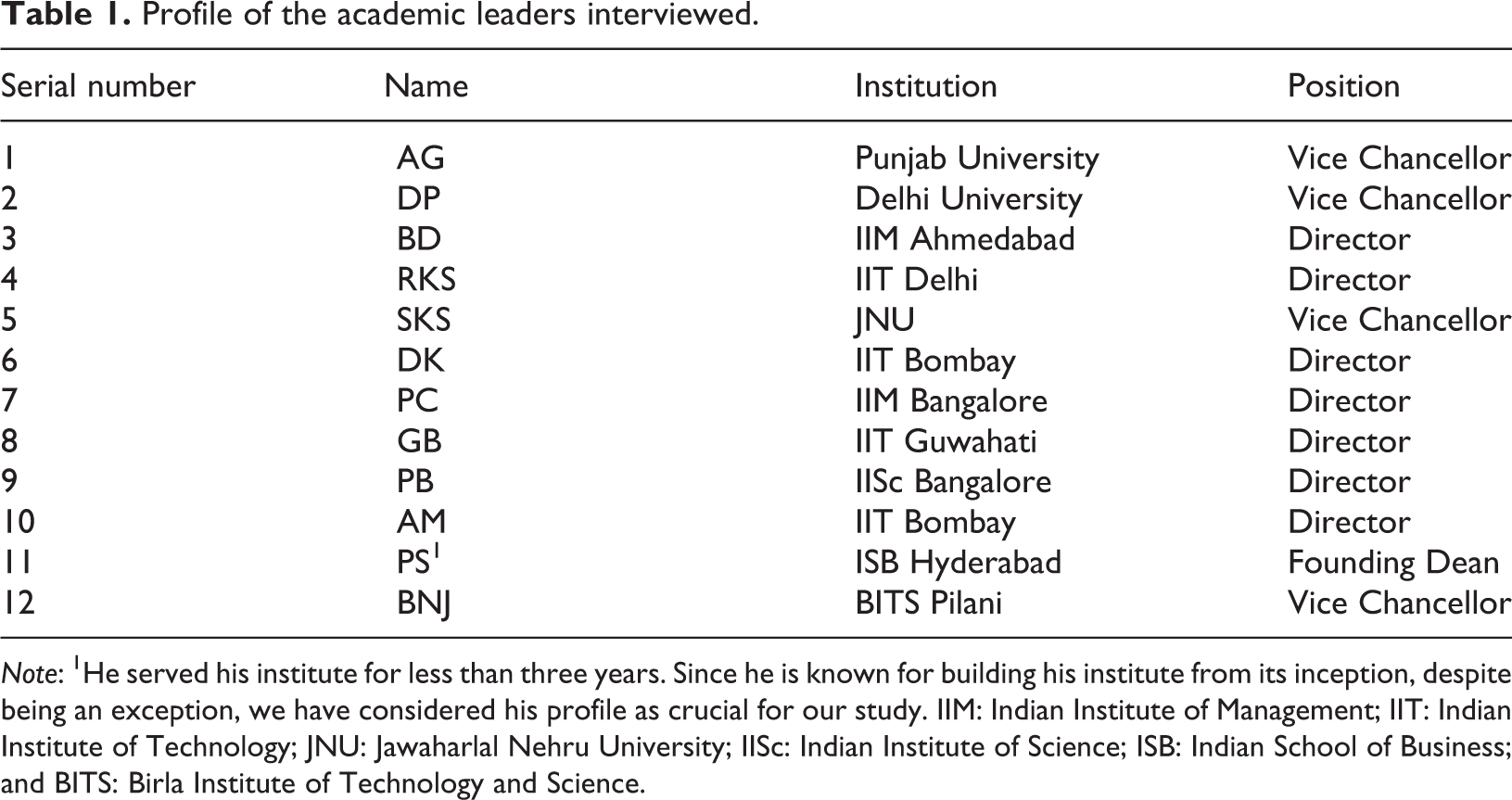
Note: 1He served his institute for less than three years. Since he is known for building his institute from its inception, despite being an exception, we have considered his profile as crucial for our study. IIM: Indian Institute of Management; IIT: Indian Institute of Technology; JNU: Jawaharlal Nehru University; IISc: Indian Institute of Science; ISB: Indian School of Business; and BITS: Birla Institute of Technology and Science.
Data collection
Semi-structured in-depth interviews were conducted to understand the world views of the ALs. A brief introduction about the Indian HE scenario was followed by generic questions about how ALs perceive institutional excellence and what different activities they perform for achieving/maintaining the world-class status. Interviews lasted for between 30 minutes and 1.5 hours. Eleven interviews were recorded with informed consent with one interview reported in the form of a hand-written memo. Audio files were then verbatim transcribed for further analysis.
Data analysis
The theme is a thought unit that captures an important aspect within the data that relates largely to the research question (Braun and Clarke, 2006). Since our study focuses on roles and responsibilities of Indian ALs, we based the analysis on the different activities performed by them and made inferences with respect to our research question. Thematic analysis is a foundational flexible method for qualitative data analysis in and beyond psychology (Braun and Clarke, 2006). Systematically conducted thematic analysis yields very meaningful results (Nowell et al., 2017). It can be conducted in two distinct ways: inductive; and deductive. Since we are basing our paper on primary data, we have used the inductive approach, while in the deductive approach, the researcher uses a pre-existing theoretical framework to fit in the primary data.
Although there is no best way to conduct a thematic analysis (Boyatzis, 1998; Tuckett, 2005), we adopted a six-step process explained by Braun and Clarke (2006). These steps are: transcription; generating thought units; identifying themes; reviewing; defining and naming; and report generation. The initial thought unit generation and ‘theme conception’ were conducted using Nvivo Pro, 11th version. Reviewing, defining, naming and renaming of the themes were then done by researchers, which was subject to the inter-rater reliability (Smaling, 1992) between researchers. The inter-rater reliability of more than 85% was achieved on the randomly chosen transcripts. We then discussed these themes with each other and generated ‘latent themes’ where the initial themes were grouped together based on common attributes. The ‘latent thematic analysis’ aspect (Braun and Clarke, 2006) was adopted to classify themes at the second level in order to deal with commonness in data and drawing sound results. This allows researchers to go beyond the descriptions provided by participants and theorize the data further based on the interpretations. We then reported these ‘initial’ and ‘latent’ themes in our ‘Results and discussion’ section, where we have also discussed their relevance and importance for the challenges faced by the Indian HE sector.
Thematic analysis
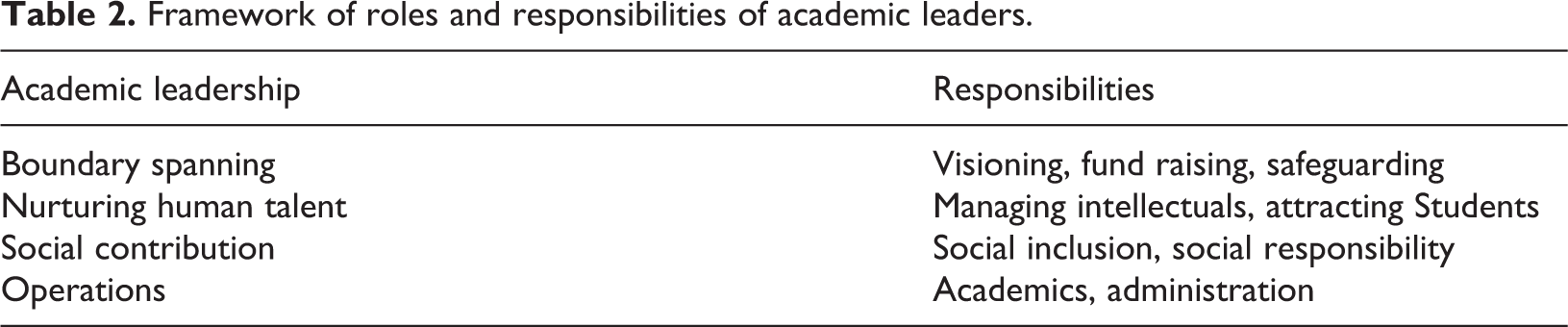
Fourteen functional themes – teaching and research, strategic management, social contribution, safeguarding, negotiation, resource management, people management, mentoring and coaching, facilitation, institution building, external affairs, development and growth, administration, and learning – were identified using Nvivo Pro 11. These themes resulted from the initial processing and were subject to further scrutiny and purification. Teaching and research, facilitation and administration were the three most emerging themes because they were mentioned the maximum number of times by maximum number of people. The rest of the themes were moderate in their mention and number of sources. In the initial review process, after having mutual contemplation among the authors, we omitted certain themes, merged some with others and renamed some with more appropriate labels. Further, we adopted a functional perspective of looking at different AL activities for identifying the latent themes. For example, ALs were involved in a range of activities, which included the most strategic and long-term oriented tasks on one side of the continuum to the most routine tasks, such as taking account of the day-to-day operations of the institute, on the other side. After carrying out due discussions involving each author, we constructed the final roles and responsibility framework mentioned in Table 2.
Framework of roles and responsibilities of academic leaders.
Results and discussion
Boundary spanning
The boundary spanning role focuses on the ALs’ ability and orientation towards different external stakeholders while envisaging the future of the institution. Leaders are expected to deal with external constituencies in their daily life. This requires not only the ability to smartly manage these stakeholders when it comes to strategic management and fund raising but also the ability to resolve critical yet significantly important problems for the institution, which calls for safeguarding the institution from environmental threats with the help of strong negotiation powers apart from engaging in routine external affairs. Thus, this role involves three main responsibilities: visioning; fund raising; and safeguarding the institution.
Visioning
Vision was precisely discussed by ALs while talking about strategic management. Hence, we have termed this function as visioning. ‘Vision’ involves the ability to consider the long-term future (Adair, 2002; Beare, 2001) as well as understanding the current contextual setting of the organization (Davies and Davies, 2004). Vision has been differently manifested by different leaders. “Quality is a vision and it should be the prime agenda in the strategic plan of ALs.” “I hired the best suitable people for my university as I feel university runs by the vision of its faculties and not the VC.” “People respect a leader more for the kind of vision he/she has. Even if you are a great researcher or great Nobel Prize winner but if you are terrible people manager, people will not respect you.”
Fund raising
For Indian ALs, fund raising was the spinal responsibility. They perform an important role as fund raisers to supplement their department budgets (Benoit, 2005). Setting up an institute requires huge funding and, with the explosion of knowledge and competition, these requirements have rapidly increased (Reisberg, 2011). Raising such huge amounts requires the ALs to use their know-how about different sources of funds and strong networking skills for engaging with external constituencies (Hecht et al., 1999) such as donors and different private/government financial agencies. They ensure effective utilization of the fund by understanding the requirements of different stakeholders and devise a fair distribution plan (Benoit, 2005). “I raised funds by simply building the brand for management development programs (MDPs), executive development programs, consulting, etc. I had opened so many research centers and we had offered so many products overseas.” “You don’t just have to devise the tuition fee structure so that all the expenses are covered, but you have to generate some surplus out of that too for the uncertainties.”
Safeguarding the institution
Unlike others, safeguarding is the most undocumented and unique responsibility in the Indian context. ALs emphasized on safeguarding when there were issues of autonomy and interference. ALs use their negotiation skills for safeguarding an institution (Hecht et al., 1999). “Government wanted to encroach the financial, operational and administrative autonomy. Fortunately, the decision that I took proved right for my people and my institution; otherwise, my name would have been defamed.”
Nurturing human talent
The process of nurturing an intellect starts with hiring the best pool followed by forcing their early development and continuously increased challenges up to evaluating the weed (Quinn et al., 1997). Apart from focusing on their individual development, keeping their morale high and managing productive relations amongst peers becomes top priority for the leaders (Benoit, 2005). Since Indian ALs focused more on faculty and students, this role includes managing intellectual faculties and attracting the best students as two important responsibilities.
Managing intellectuals
Faculties are the most powerful set of people, as the vision of ‘quality education’ cannot be implemented without their cooperation and support. They should be selected with utmost caution. Indian ALs engaged in both right hiring and appropriate treating. Unlike other organizations, HEIs call for a special skill set for managing intellectuals. “Leading a HEI is all about dealing with independent minds. Building consensus is vital in order to take important decisions. If the consensus is not built in some critical decision, effective people management skills are imperative.” “Our institute was able to survive through the decline in the industry in the year 1990 because we allowed our people to do what they wanted to do internally in order to fix the problem and there was no outside influence.”
Attracting best students
Quality education rendered through faculty is going to be realized in terms of students’ outcomes. Vision can also not be implemented without the brightest students in place, being the most important resources for any HEI. Hence, like faculty recruitment, merit-based student admission is also the responsibility of ALs. “It is the leader’s duty to ensure that students are most abled and aspired to achieve their life goals. For that they need to devise fair and transparent, merit-based admission process for attracting bright talent…. this should be the top most priority of ALs.”
Social contribution
Social contribution indicates ALs’ moral duty towards society. This role resembles the ‘servant leadership’ approach, as the best test of servant leadership is knowing ‘what is the effect of leadership on the least privileged segment of the society’ (Greenleaf, 1973). Universities are expected to perform as ‘corporate enterprises’ in order to produce bright graduates who can steer the nation into the competitive global economy and produce critical citizens who can contribute towards a vibrant society (Reddy, 2004). Apart from education, these institutes are expected to contribute towards the welfare of society in terms of educating the rural population, skill development and empowerment of women, and social uplifting of other deprived sections of society. Leadership being the face of such HEIs, effective leadership is an essential ingredient for this positive social transformation (Astin and Astin, 2000). This role includes two sub-themes, namely, social inclusion and social responsibility.
Social inclusion
The emergence of this sub-theme is a unique contribution of our paper. Admitting the brightest students not only from across regions but also across races and castes is a great task for ALs for addressing the historically shaped marginalization and exclusion in India. Social inclusion is based on the value of equity and access in education. Equity – the trait of being fair and impartial – is viewed as the ability of the brightest students to study in the best university regardless of their socio-economic backgrounds (Kumari, 2014). The Indian government helps in fulfilling this goal by sponsoring these under-privileged students with the help of different grants and scholarship schemes. “The biggest strength of the IIT systems is the entrance exam. It is conducted with the utmost transparency. Moreover, it is made sure that the brightest of the students who clear this exam with highest score are admitted irrespective of what they are and where they come from. They don’t even have to pay for their education.” “Merit-based and transparent admission system ensures the elevated quality of employment too. For example, the Union Public Service Commission entrance exam is conducted in the farthest of the rural and suburb areas. Moreover, students can write their exams in as many as 22 languages. Along with the quality, this ensures equity in employment too.”
Social responsibility
The ALs must have a broader vision of serving the larger community apart from core education because that is the main purpose of any educational institution. “During my visit to our library, I came across few students preparing for the competitive exams using our library resources. They were not officially part of our institute and there were many objections from our people. But I ordered to allow them as I feel it was one of the ways we could facilitate these people who don’t have access to desired resources.” “Being a top-class institution, we never deviate from the English language; however, when it comes to serving the society, we never take a back seat also. We deliver many programs to women in suburbs and rural areas in their local language and I personally encourage my students to initiate and engage in such social activities.”
Operations
Activities described under this theme are purely routine, yet significantly important for institutional growth. Miller and Miller (2001) explained a similar notion in their transactional approach to leadership. Two types of activities, academic and administrative, emerged under this role. Performing academic duties concerned with teaching and professional learning of students along with faculty (Southworth, 2002) calls for the instructional approach to leadership. Administration in the education sector means more than mere implementation of the strategic and operational plans, where they require decision-making/managerial capabilities along with political smartness in order to get things done (Bush et al., 2006). The managerial approach to leadership given by Leithwood et al. (1999) suggests that ALs focus on operational functions such as planning and budgeting, and some governance functions such as implementation (Caldwell, 1992). The political approach to leadership is explained as when the conflicts between stakeholders are resolved in favor of the most powerful protagonist (Bush, 2003). Following are the details of both of these responsibilities.
Academics
Academic activities involve imparting knowledge to students while continuously upgrading the knowledge base through intensive research and by adopting modern teaching–learning methods and tools. We found that academic leaders (ALs) were fascinated by different academic activities like teaching and research. “How well an institution does depend on how effective the teachers are; hence, even being at the leadership position, I never left my connection with teaching and teaching was my prime responsibility.” “Ranking of an institute is based on the research conducted by its people; hence, I emphasize on bringing industry-specific projects and try to engage and involve faculties into it.” “Research and consulting are the core activities of our institute where each of the faculty members, including me, is involved and the revenue from these activities covers about 40% of the total revenue.”
Administration
Administration denotes the governing structure and the processes of decision-making. It is based on the clarity of the roles of ALs, senior government administrators, and trustees (Gayle et al., 2011). Most of the leaders mentioned administrative responsibility and effective governance as the most important part of their position. “In order to ensure the smooth execution of plans, ALs must ensure an appropriate governance system is in place at the institutional level.” “We survived even after 100 years because our governing structure was designed by the British government very carefully. Our governing council is the only one which is self-constituted.”
Although there is no particular order in which the importance of these four roles can be appraised, after understanding what the leaders believed, we have put them in the following order: (a) nurturing human talent; (b) social contribution; (c) boundary spanning; and (d) operations. However, focus on a particular role depends on the evolution stage of the institute along with its requirements for smooth functioning. For example, a newly started institute might have its focus on raising funds. Once the minimum is achieved, other roles come in as priority.
Conclusion
We interviewed eminent leaders from the top-ranked Indian institutions so that we can suggest to the larger Indian HE industry about what their leaders should do to grow and excel. However, addressing such a diverse sector based on the views of a very niche-based institutional sample becomes the limiting factor. India has varied sets of institutes ranging from autonomous, single-program, and small-scale private institutes to comprehensive, government funded, large public universities operating in all disciplines. This means that the Indian HE system cannot be neatly organized under a single typology (Sen, 1982). However, it can be better understood with the help of five dimensions, which include: governance; financing; degree levels; programs offered; and language (Stolarick, 2014). Every Indian institute/university has unique needs based on its evolution stage. It is thus important for ALs of these institutions to understand the primary need for the institute and to focus on fulfilling that particular need ensuring gradual growth of the institute and moving to higher-order needs. ALs can try to raise the status of their institutes so that they can gain the resources and support required from the external environment. Once they have achieved the minimal desired state for survival, attaining the required resources, and eliminating micro-level issues within the institute, they can focus on the macro-level guidelines for leadership roles, as described in this paper, for achieving excellence.
This paper adopts the framework developed by Salmi (2009) for WCUs. As discussed in the ‘Indian context and challenges’ section, we conclude that Indian institutions face challenges pertaining to all the criteria suggested by Salmi. However, these challenges are generic and rooted into more country-specific aspects than institute-specific aspects. For example, the economic background of people and their diverse demographic profile along with the huge Indian population are the main attributes of these challenges leading to issues such as brain drain, academic paralysis, lack of autonomy, and political interference. Taking undue advantage of the increasing demand for education and a susceptible Indian context, many institutes lay their foundation on unethical grounds, and are run by imposing fraudulent practices. On the other hand, the roles discussed above strongly appeal for a fair and ethical modeling of an AL. Hence, we suggest that Indian ALs set the right fundamentals from the beginning by adopting ethical quality measures in hiring talent across levels starting with students, faculties, and up to the leadership till they exit, rather than just focusing on superficial measures of being world-class. Once this ideology is implemented, replicating the above roles becomes an easy task for ALs on the way to academic excellence.
Practical implications
Leadership is a multi-dimensional concept and incorporates intellectual, social (Wepner et al., 2008), instructional, visionary, and administrational aspects, each of which supports different ‘styles’ of leadership (Rayner, 2008) as discussed earlier. Leadership determines the success or failure of an institution (Simkins, 2005); hence, we have three major practical takeaways for ALs. First, the boundary spanning section opens up with the visioning ability of ALs. Vision is an essential characteristic of ALs (Bryman, 2007), and significantly important for institutional success (Benoit and Graham, 2005). Thus, we imply that Indian ALs must be visionary. We have covered academic roles in our ‘Operations’ section; however, for all HE sectors, teaching and research is not merely an operational activity, but the core foundation. Despite the fact that ALs are required to engage in managerial roles, they remain most effective when they place major emphasis on instructional activities (Dinham et al., 2013). By setting the example of their academic credentials and achievements into teaching and research, they can instill academic vision into the faculty and students. Thus, academic credentials are of highest importance in HE world-wide (Bolman and Gallos, 2011; Spendlove, 2007). Most of the ALs we interviewed also reiterated the same by showing their involvement and engagement into core academics, that is, teaching and research. Hence, our second implication is that ALs must be academicians by their candidature (must be PhD or post-doctorate) and orientation (i.e., must be primarily into teaching and research). Further, India is subject to social dynamics and new change avenues. This changing scenario in the 21st century calls for a modern leadership style (Bush et al., 2017) in education, which is based on the values of creative thinking and innovation (Jones et al., 2014). Lumby (2013), in her paper, suggested that leadership activities must have an equal involvement of other staff also. Despite different voices against the distributed leadership style, she said that it is the theory of choice in the 21st century and has the capability to create an apolitical workplace. Due to the prevailing issues of political interference and autonomy, India needs more shared and collaborative leadership than administrative leadership. Moreover, ALs cannot manage multiple tasks single handedly (Huber, 2014). Hence, we imply that distributed leadership is more appropriate in the Indian HE setup. The ‘distributed leadership approach’ is most influential and can be used to shape up perceptions of individuality, involvement and influence (Bolden et al., 2009); it also has the potential for enhanced outcomes (Bush and Glover, 2014; Hallinger and Heck, 2010). Hence, in a context such as India, a combination of visionary and distributed styles of academic leadership is desired in order to build WCUs.
Footnotes
Declaration of conflicting interests
The authors declared no potential conflicts of interest with respect to the research, authorship, and/or publication of this article.
Funding
The authors received no financial support for the research, authorship, and/or publication of this article.