






Abstract
The objective of this paper is to determine the extent to which adopting Nonaka’s SECI knowledge-creation processes enhances strategic planning capacity in the context of Hong Kong school education.A quantitative questionnaire survey is conducted to examine the predictive effects of the knowledge-creation processes of the SECI model on strategic planning processes. Data is collected from 42 principals and 392 teachers from 42 schools. A multilevel structural equation model is applied to examine the predictive effects of the mechanism on strategic planning capacity. Results show that the combination process of the SECI knowledge-creation model predicts strategic planning capacity, while a collaborative culture enables the process of knowledge externalization and combination. In response to the international debate on culture and context-dependent issues in using Nonaka’s SECI model for knowledge creation, this study reaffirms that the SECI model is largely dependent on Japanese collaborative culture. The study also brings theories of knowledge management into discussion of strategic management in the school context. To enhance school planning capacity, school leaders should cultivate a collaborative culture to support the alignment of different departments in the knowledge combination process to craft strategies for development planning.
Introduction
Education Quality Assurance policies and the high speed with which knowledge is expanding have impacted on and created challenges for school management. School management has become more challenging, complex, analytic, and data driven. Developing an innovative management approach to support schools in leveraging knowledge from existing organizational information and data resources to plan for improvement will provide practical help to school leaders and also contribute to existing school management theories. Schools in Hong Kong have long faced a variety of challenges in terms of development under education reforms and curriculum reforms designed to meet the demands of a knowledge society (Education Commission, 1997, 2000). The literature reveals that strategic planning plays an important role in facilitating school improvement. It helps schools survive in a turbulent policy environment by coping with changes and challenges generated by government policies and market forces (Ewy, 2009; Taylor et al., 2008). Enhancing strategic planning capacity not only helps school leaders acquire a more accurate understanding of the internal and external organizational environment of their school, but also supports the coordination of different management tasks for improving the quality of teaching and achieving school objectives. Institutionalizing a management mechanism and practices that help schools and teachers enhance school planning capacity is critical to school development.
Since the introduction of the Quality Assurance policy outlined in the Education Commission Report No. 7, schools in Hong Kong have encountered a variety of challenges in terms of accountability and development (Cheng, 2011). They have to collect data and information to formulate strategic planning for school development and have to show accountability to their stakeholders and society by reporting their performance and school development plans (Education Bureau, 2014). However, the recent report of the Impact Study on the Implementation of the 2nd Cycle of the School Development and Accountability Framework on Enhancing School Development in Hong Kong shows that schools consider “development planning as occasional events rather than ongoing process” (Macbeth, 2014: 46). The report echoes many research studies that find a desire to institutionalize a mechanism that will support school leaders in implementing ongoing strategic planning (Ewy, 2009; Hodgson and Chuck, 2003; Taylor et al., 2008). The mechanism for planning should be characterized by embedding a recursive communication process in a planning production cycle (Spee and Jarzabkowski, 2011), decontextualizing the strategies through dialogue (Spee and Jarzabkowski, 2011), practising strategies for further improvement (Marchiori and Bulgacov, 2012), and contextualizing those strategies through a genre-based plan (Cornut et al., 2012). Identifying a recursive knowledge-creation mechanism that involves dialogues and practices of strategies in an organizational context to develop those strategies for school development planning (SP) could practically inform Quality Assurance (QA) policy and theoretically contribute to the literature of school planning.
Applying knowledge management (KM) in school education is a new concept. Schools need a KM model to help them conceptualize disparate elements of the complete picture in a way that leads to deeper understanding of how the knowledge process works within the organization. The name of the SECI model is taken from the first letters of the four knowledge conversation processes: socialization, externalization, combination, and internationalization. The model focuses on knowledge spirals that explain how tacit knowledge is transformed into explicit knowledge and then back again as the basis for individual, group, and organizational innovation. The fundamental question underpinning the theory is how to build a KM mechanism to convert tacit knowledge in the school environment and the organization into explicit knowledge, and then to crystallize it into an innovative plan for school development (Marchiori and Bulgacov, 2012; Spee and Jarzabkowski, 2011). The theory also includes ideas of how to re-conceptualize organizational design and strategy from the perspective of knowledge creation. Nonaka’s knowledge-creation theory is the most influential and widely referenced theory to represent the study of KM (Hislop, 2013).
This study examines whether institutionalizing Nonaka and Takeuchi’s (1995) SECI knowledge-creation mechanism within schools can enhance their planning capacities by verifying the collaborative culture that facilitates the institutionalization of the mechanism. The SECI model has been widely adopted for teacher learning and knowledge building in school education (Tee and Lee, 2011). Institutionalizing the SECI mechanism as an organizational practice to manage organization knowledge (Nonaka et al., 2006) has great potential to enhance strategic planning (Wolf and Floyd, 2013). As a recursive knowledge-creation mechanism, the SECI model facilitates interactive dialogue (Pälli and Lehtinen, 2013) and strategies, practices and activities to create knowledge for crafting strategies (Hoon, 2007; Marchiori and Bulgacov, 2012). This is why the SECI model is selected as the knowledge-management model for this study. However, the effectiveness of the SECI model for knowledge creation is largely cultural and contextual (Hong, 2012) and knowledge is embedded in the context of the event and culture of an organization (Glisby and Holden, 2003). Since very few studies have been conducted to identify the organization factor in institutionalizing a SECI mechanism in the school context or to analyze its effect on improving strategic planning, the proposed theoretical framework is an attractive proposition that should contribute positively to this field. A mixed-method approach has been adopted as the research strategy. A quantitative questionnaire survey was conducted to collect data. Two-level structural equation modelling was then applied to examine the predictive effects of the mechanism on strategic planning capacity and to verify the collaborative culture for institutionalizing the SECI mechanism.
Literature review
Strategic planning is an overarching process that involves aligning goals with vision, assessing internal and external environmental components of the organization, analyzing the information and data collected, and formulating and monitoring plans to tackle the impact and challenges generated by the external environment (Allison and Kaye, 2005; Cheng, 2011; Fidler, 1998; Peterson, 1999). Through these processes, school leaders and teachers can articulate institutional goals and priorities, coordinate and reorganize decisions within schools, and deal with an increasingly turbulent environment and the challenges schools face (Weindling, 1997). Strategic planning helps schools survive in a turbulent policy environment by coping with the changes generated by government policies and market forces (Cheng, 2011). Strategic planning involves dialogue and communication practices that draw on a set of professional convention and knowledge (Marchiori and Bulgacov 2012). Institutionalizing a mechanism that involves dialogue for creating strategies and practices to refine strategies may therefore improve strategic planning. In term of process, it can be conceptualized by a planning stage, implementation stage, and evaluation stage. The planning stage involves strategic analysis and choice (2002; AL-Zboon and Hansan, 2012; Fidler, 1996, 2002). The Education Bureau of Hong Kong has proposed and conceptualized the process of strategic planning in Hong Kong schools into planning, implementation and evaluation (Poon, 2008).
KM in schools can be conceptualized as a collection of strategic management activities that support school leaders and teachers in collecting information or using the organization’s knowledge resources to plan and carry out their teaching and other tasks effectively (Cheng, 2012, 2015; Hansen et al., 1999; Nonaka et al., 2006; Zack, 1999). These KM practices can help capture, codify, and distribute knowledge in schools through the application of information and communication technologies, or through human interaction, so it can be shared by all teachers. Good KM provides schools with adequate communication channels for school leaders and teachers to discuss school issues with management. School leaders and teachers reflect on and review feedback from others and further develop strategies and plans for improving school-based policy and teaching effectiveness. School policies can be adjusted in light of teacher feedback to maximize student learning.
KM literature tends to classify knowledge into tacit and explicit knowledge according to its role and nature (Smith, 2001). Tacit knowledge resides in human minds and includes the experiences, skills, and expertise of individuals, which are difficult to articulate, whereas explicit knowledge can be easily communicated via written forms such as plans, reports, and manuals (Nonaka and Takeuchi, 1995). The strategies for managing knowledge are therefore dichotomized into personalization-oriented, which deal with tacit knowledge, and codification-oriented, which deal with explicit knowledge (Zack 1999). Organizations implement these KM strategies to leverage existing tacit knowledge and codify it into explicit knowledge as resources for development. A spectrum, ranging from the personalization-oriented to the codification-oriented, is commonly adopted to classify different KM models (McAdam and McCreedy, 1999). Many KM models are personalization-oriented. For example, Wiig’s (1993) model emphasizes the development of a semantic network for effective knowledge sharing. Von Krong and Roos’s (1995) model explains the socialization of knowledge among individuals within the semantic network. Choo’s (1998) model emphasizes using the sense-making process to articulate how information can be fed into the actions of an organization through decision making. These models explain how knowledge can be socially constructed among people. However, they have limitations in explaining how tacit knowledge can be converted to explicit knowledge and how explicit knowledge can be manage in different levels of an organization. To address these limitations, Nonaka and Takeuchi (1995) streamline the knowledge socialization process from the individual level to group and organizational levels and introduce the processes of converting tacit to explicit knowledge to develop the SECI model. The SECI model integrates the ideas of personalization and codification to explain how tacit knowledge can be socially created by teachers and codified from the departmental to the school level. For these reasons, this study adopts the SECI model as the analytical lens to analyze the knowledge-management process in SP.
The SECI model is a two-dimensional matrix depicting four possible scenarios of tacit and explicit knowledge interaction or conversion (see Figure 1). This model involves, and can be measured by, four knowledge-conversion processes: socialization, externalization, combination, and internalization. The initial letters of these four phases give the SECI model its name, and these processes can be fed into the school strategy planning process.
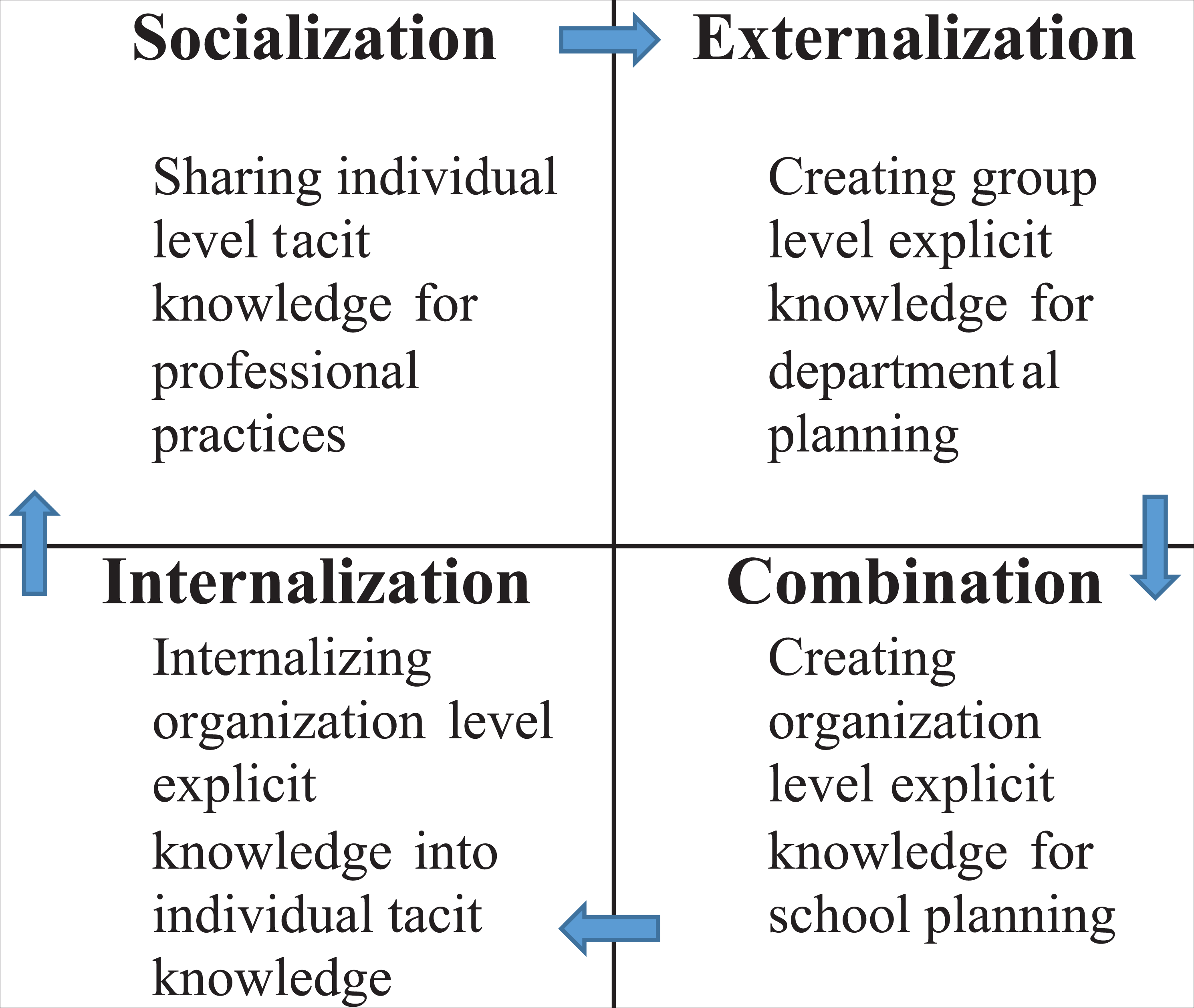
The SECI model for school planning.
In terms of the SECI model, socialization is the process of transforming the tacit knowledge of one person into the tacit knowledge of another. In the school planning process, the socialization process involves a dialogue between teachers through which they communicate the vision and purposes of their plans and share knowledge and experience for formulating strategies. However, teachers in Hong Kong may not have enough time or personal commitment to share or to socialize their tacit knowledge and experiences systematically in personal conversation. The knowledge socialization process may happen in the knowledge externalization process for strategic planning. For example, it takes place in department meetings as a form of professional dialogue to socialize and codify teachers’ tacit knowledge into departmental explicit knowledge as documents. It seems that the socialization process could be embedded in the externalization process in Hong Kong context.
Externalization is the process of articulating group tacit knowledge into group explicit knowledge, converting it from dialogue into text records, via which the group tacit knowledge can be codified in the department development plan. In the school strategic planning process, department heads facilitate essential dialogue among colleagues as a way to sort out and integrate their suggestions for formulating their departmental strategic plan. The application of professional learning communities (Hord and Sommers, 2008) or communities of practice (Wenger, 2008) in schools to leverage pedagogical knowledge to improve teaching and learning involve knowledge externalization in which teachers’ tacit knowledge is leveraged and codified as teaching and learning plans. Nurturing joint enterprise, mutual engagement, a shared repertoire, and mutual accountability among teachers (Wenger, 2008), the key characteristics of a Communities of Practice (CoP), can enhance the knowledge externalization process. Conducting lesson study is also a typical knowledge externalization process to leverage individual teacher knowledge and codify it into a specific subject teaching and learning plan (Cheng, 2018). A culture of team learning (Senge, 1990) which enables professional dialogues among teachers for collaborative lesson planning can also promote the process of knowledge externalization.
Combination, in which people representing different departments formulate the plans collectively, is the process of converting departmental explicit knowledge into a more usable form of collective explicit organizational knowledge. In the context of school planning, the knowledge combination process tends to happen in whole school and academic committee meetings, which sift and integrate suggestions from each subject department to develop teaching and learning policy. The idea of system thinking proposed by Senge (1990) to develop learning organization could be an organizational practice to enable the combination process. School principals and vice-principals play a critical part, as knowledge leaders (Nonaka and Takeuchi, 1995) of the school, in facilitating the knowledge combination process. They engage department heads in the planning strategies and operations and assemble internal and external data by using departmental documents. The whole senior management team creates manuals, and documents information, from all over the school. Its members engage in planning and implementing presentations to transmit newly created pedagogies (Nonaka et al., 2000).
Internalization is the process of understanding and absorbing the collective explicit knowledge of departments and individuals through practising the knowledge. It is the process via which teachers absorb the newly created school-level knowledge through teaching practices. The knowledge internalization process involves teachers’ conversion of school-level explicit knowledge through teaching practices into their own tacit knowledge. However, teaching guides that state practices to apply the school-level explicit knowledge may not be available to teachers in Hong Kong, and so many tend to internalize it through a learn-by-doing approach. It seems that the knowledge internalization process is not a predictor for strategic planning. The school strategic planning process involves documentation of departmental and school explicit knowledge. Therefore this study examines the knowledge externalization and combination processes to analyze department development planning and school strategic planning respectively. The knowledge socialization and internalization processes, which deal with the conversion of tacit knowledge, are excluded from this study for predicting school planning.
The applicability of the conversion processes in school contexts is constrained due to their roots in the collaborative knowledge sharing culture of the Japanese corporate context. Such a culture and context is defined as “Ba” by Nonaka and Takeuchi (1995). “Ba” in Japanese means culture, context, and field. It is an important condition for successful operation of the knowledge process of the SECI mechanism. In knowledge-management literature, a collaborative culture is an enabler of knowledge sharing (Awad and Ghaziri, 2004; Bock et al., 2005; Figurska, 2012). Nonetheless, the effectiveness of the application of the SECI knowledge-conversion processes depends on culture and context (Andreeva and Ikhilchik, 2011; Glisby and Holden, 2003). Cheng (2018) finds that a collaborative culture is the “Ba” required to operate lesson study for creating pedagogical knowledge in Japanese schools. In this study, collaborative culture is proposed as the predictor of the externalization and combination knowledge-conversion processes. Effective collaboration among teachers from different departments facilitating joint efforts to promote students’ learning performance can be an indicator for measuring the collaborative culture. However, teachers working in the same school tend to be bound by the school culture, and they may be nested in a collaborative culture within the same school despite their individual education and characteristics. To isolate the cultural effect of schools from characteristics of individual teachers, the data structure of this study will be a two-level model with residuals at the teacher level and school level (Hox et al., 2018; Rabe-Hesketh et al., 2009). Although education level, years of experience, and working experience (age) have been found to be uncorrelated with the behaviours for knowledge sharing (Hameed et al., 2019; Zhao, 2010) in multivariate designs, it is still worth testing these factors to identify the existence of the influences from both teacher individual-level and school-level hierarchies on knowledge sharing.
A theoretical model explains the relationships between KM and strategic planning (see Figure 2). It is a two-level structural equation model that illustrates the predictive effects of the knowledge-conversion process on the school planning process at both school and teacher level. Collaborative culture is an enabling factor that facilitates operation of the SECI model. Teacher education level, teaching experience, and rank are teacher-level contextual factors that may affect the implementation of the SECI mechanism. The research question of the study is: To what extent do the knowledge-conversion processes of the SECI model enhance strategic planning capacity in schools?
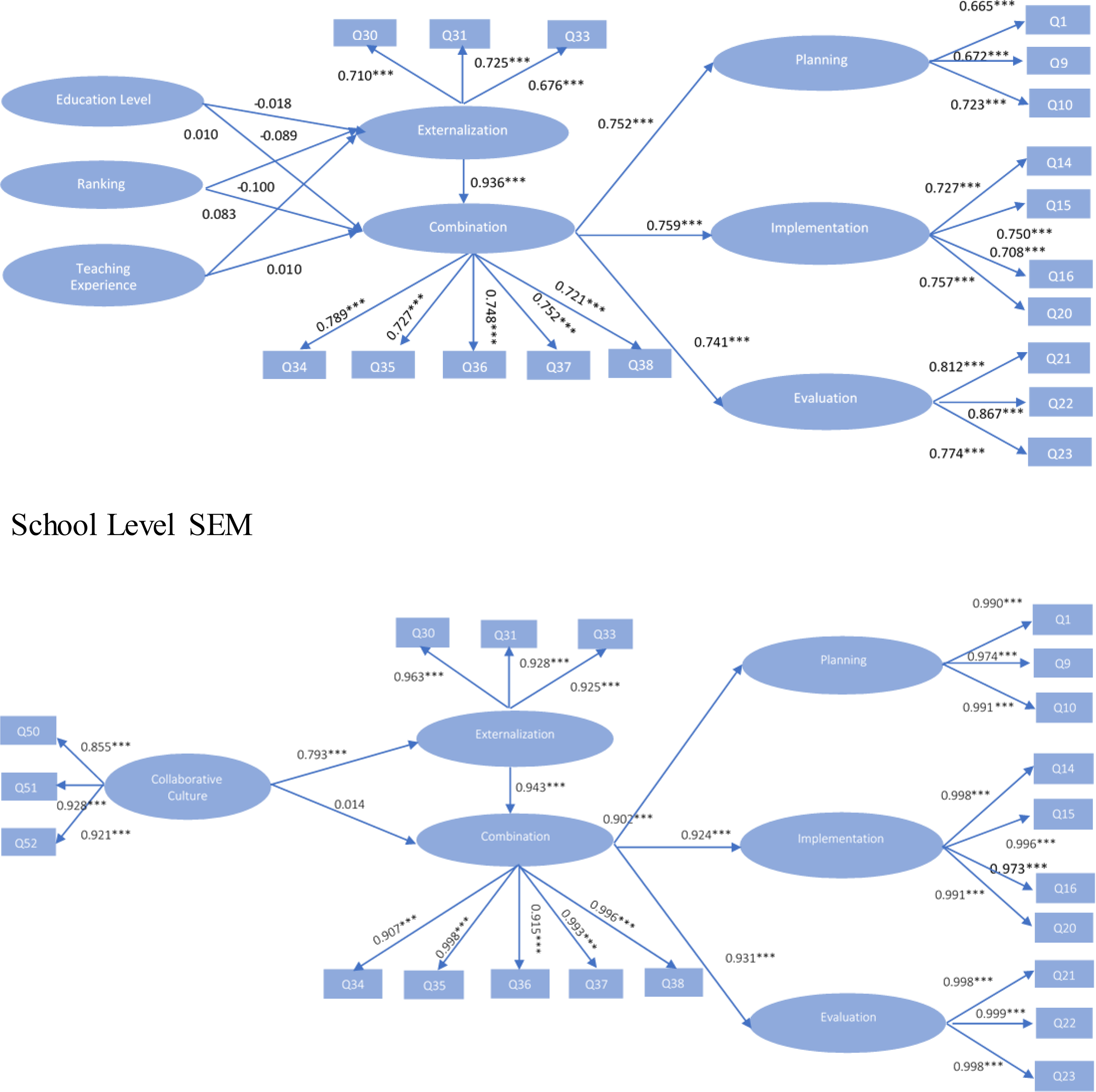
Two-level SEM ***p<0.01.
Research methods
A questionnaire survey was conducted in 17 primary schools and 25 secondary schools. Multilevel model structural equation modelling (SEM) was applied to confirm the theoretical model. Principals, vice-principals, heads of department (HODs), and senior teachers were questioned on how and why their plans are formulated regarding the four SECI processes and the collaborative culture.
Participants
The subjects of this study were school principals, vice-principals, HODs and senior teachers from 42 schools randomly selected from around 1000 schools in Hong Kong. A group sample size of 40 is sufficient to test the between-level factors (Meuleman and Billiet, 2009). The principals and the 10 HODs and senior teachers who took part in formulating school plans in the 42 schools constituted the research sample. 462 teachers (11 teachers/per school x 42 schools) made up the sample of the research project. The teachers were invited to complete survey questionnaires sent with the invitation letters and information sheets. Eventually 392 teachers sent back the finished questionnaires. The response rate was 84.8%. The demographics of the samples are illustrated as followings. 48.2% of the respondents are bachelor’s degree holders and 48.7% are master’s degree holders. 45.2% of the respondents had been promoted to a senior rank and 54.8% served at the basic rank. 40.6% of the respondents had over 20 years of teaching experience, 42.4% had 11–20 years of experience, 15.1% had 6–10 years of experience, and only 1.9% had less than 5 years of experience.
Survey tool(s)
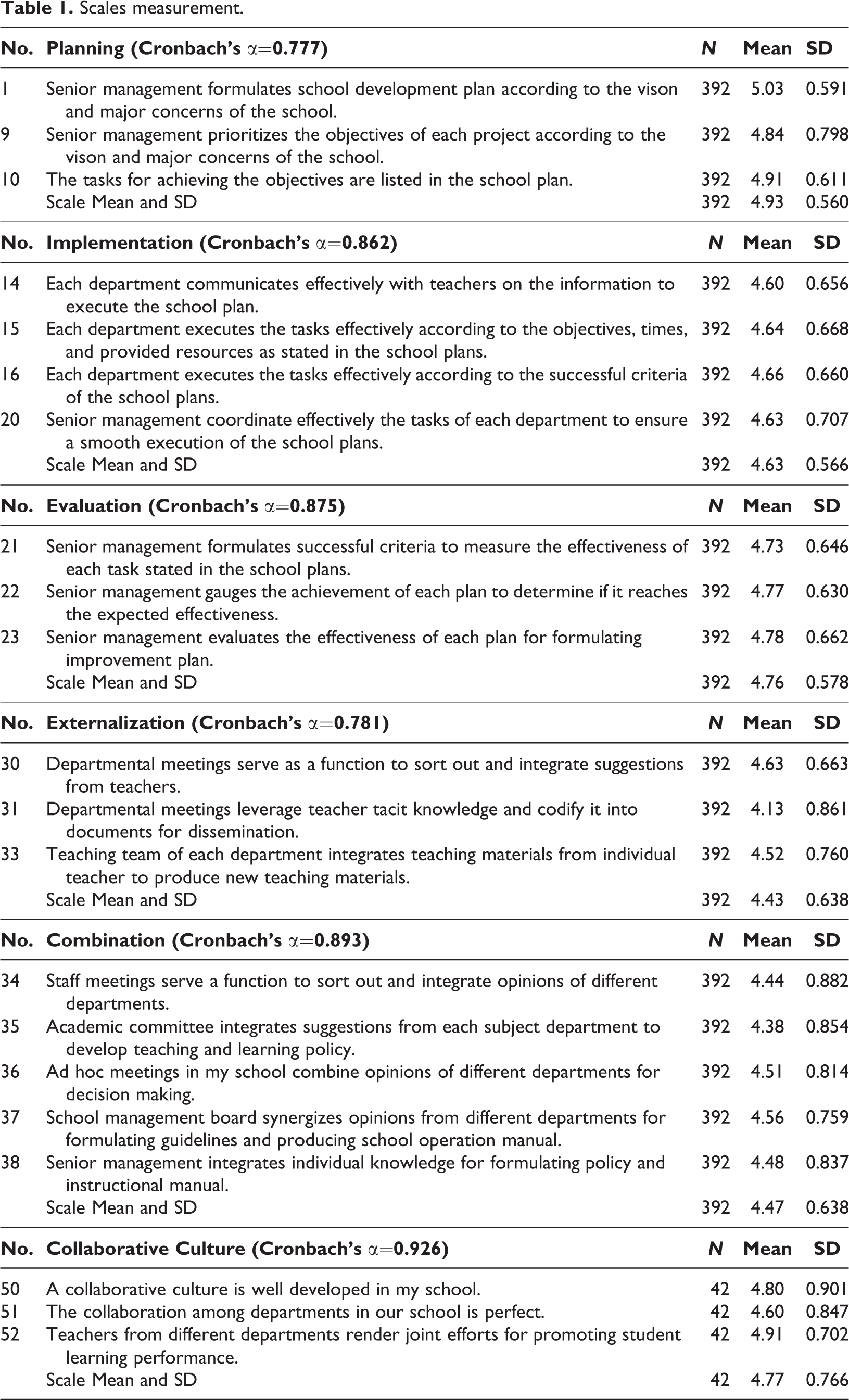
There were two sets of questionnaires. The first set was designed to collect data on the cultural factors for institutionalizing the SECI mechanism from the school principals and vice-principals by adopting Ruppel and Harrington’s (2001) studies of knowledge sharing culture and Cheng’s (2012) study of knowledge strategies respectively (see Table 1). The second set was designed to collect data on the four SECI processes and the strategic planning capacity from HODs and senior teachers. The items for measuring SECI processes were adopted and revised from the studies of Tee and Lee (2011) and Tammets et al. (2013), which were conducted in schools. The items for measuring SP capacity were adopted from studies by Cheng (2011, 2013). The scale for strategic planning capacity incorporates 10 items (see Table 1) with a Cronbach α reliability of 0.87 (Cheng, 2013). This questionnaire consists of two sections. Section 1 covers rank, years of teaching experience and educational background. Section 2 consists of 16 items for measuring the four knowledge-conversion processes in their schools. All items in section 2 of both questionnaires are measured using a 6-point Likert-type scale ranging from 1 (strongly disagree) to 6 (strongly agree). Participants were asked to indicate how they perceive their behaviour with regard to all items.
Scales measurement.
Data collection
After obtaining approval from the principals of the target schools to conduct the survey and for a staff member to be appointed to distribute and collect the questionnaires in the schools, the package materials, including the questionnaires, cover letters explaining the purpose of the survey and giving assurances of ethical research principles, together with instruction sheets, were sent by mail to the target schools. The completed questionnaires were collected by the appointed researcher coordinators of each school and sent back to the researcher.
Data analysis
A two-level SEM analysis was applied to examine the predictive effects of the knowledge process on the strategic planning capacity and to identify the school-level and teacher-level factors for institutionalizing the SECI mechanism. Teachers working in the same school tend to be bounded by the school characteristics, and they are nested in schools. The data structure of this study is a two-level model with residuals at the teacher level and school level. The school residuals (school effects) represent unobserved school characteristics including the factors for institutionalizing the SECI model that affect teacher perception. It is these unobserved variables which lead to correlation between perceptions for teachers from the same school. Therefore, the residual variance is partitioned into a between-school component (the variance of the school-level residuals) and a within-school component (the variance of the teacher-level residuals). A multilevel SEM model helps to recognize the existence of teacher-level and school-level hierarchies by allowing for residual components at each level in the hierarchy (Rabe-Hesketh et al., 2009). Level 1 (teacher-level) variables for predicting the four knowledge-conversion processes include education level, teaching experience, and present rank. Level 2 variables (school-level) are for predicting the knowledge-conversion processes (see Figure 2).
Findings
The reliability coefficients of all the scales range from 0.777 to 0.926 (as shown in Table 1), which was judged adequate for this study. The structural and measurement coefficients from the completely standardized solution under maximum likelihood are presented in Figure 2. The goodness-of-fit statistics are shown in Table 2. (RMSEA = 0.050 < 0.06; CFI = 0.969 > 0.95; TLI = 0.959 > 0.95; SRMR(W) = 0.035 < 0.08; SRMR(B) = 0.072 < 0.08). The 2-level SEM confirms the theoretical framework of this study. The proposed cutoff values for the fit indices are as follows: RMSEA ≤ 0.06; CFI ≥ 0.95; TLI ≥ 0.95; SRMR ≤ 0.08 (Hu and Bentler, 1999). The multilevel SEM model fits the data reasonably well. The results of the Mplus show that the chi-square value is not significant for the overall model, χ2 = 696.335, df= 356. As an absolute fit index, the chi-square assesses the discrepancy between the sample covariance matrix and the implied covariance matrix based on the hypothesized model. A non-significant chi-square value suggests the model may be a reasonable representation of the data. However, the assessment of fit using the chi-square test is confounded by sample size. When the sample size is large, the small difference between the sample covariance matrix and the reproduction covariance can be found to be significant. In this study, SRMR(W) = 0.035, SRMR(B) = 0.072, whereas RMSEA = 0.050. Given that this is a very stringent model, these fit indexes CFI=0.969, and TLI =0.959 show the model fits the data fairly well.
Assessment of model fitness for the multilevel SEM model.

The teacher-level SEM shows that the knowledge combination process predicts planning (β = 0.752, p < 0.01), implementation (β = 0.759, p < 0.01), and evaluation (β = 0.741, p < 0.01), and the knowledge externalization process predicts the knowledge combination process (β = 0.936, p < 0.01). The school-level SEM also shows that the knowledge combination process predicts planning (β = 0.902, p < 0.01), implementation (β = 0.924, p < 0.01), and evaluation (β = 0.931, p < 0.01). The knowledge externalization process also serves as a predictor for the knowledge combination process (β = 0.943, p < 0.01). The collaborative culture predicts the externalization process (β = 0.793, p < 0.01). All the paths in the model were significant at the 0.05 level. The knowledge combination process enhances the strategic planning capacity of schools, and the knowledge externalization process facilitates the knowledge combination process. However, the knowledge externalization process does not have direct predictive effects on strategic planning capacity. Nor do teacher education level, ranking, or teaching experience. However collaborative culture does predict the knowledge externalization process. These findings imply the importance of collaborative culture in bonding teachers from the same department to externalize their tacit knowledge into explicit knowledge and networking each department to combine departmental explicit knowledge into school-level explicit knowledge for enhancing the school strategic planning capacity.
Discussion
The strategic planning process in the Hong Kong school context is constructed via a planning, implementation, and evaluation (PIE) process. The PIE process for strategic planning is framed by the Education Bureau of Hong Kong as a management cycle under the School-based Management and Quality Assurance policy (Poon, 2008). The mean (4.93) of planning process is higher than both the means of implementation process (4.63) and evaluation process (4.76), reflecting a knowing and doing gap (Pfeffer and Sutton, 2000) existed between the planning and implantation process. This finding proved that there is a need for creating knowledge to bridge the gap probably through institutionalization a knowledge-management mechanism in school.
The knowledge combination process predicts the PIE processes for strategic planning. It involves collaborative planning, implementation of knowledge for realizing the major concerns of schools, and evaluation of whether the knowledge from each department can be organized into school-level explicit knowledge for school development. The combination process provides a platform for different departments to produce collective school-level explicit knowledge that is usable for, and also critical to, for school development. This finding verifies the argument of Genzberger (1994) that the knowledge combination process is an integral part of decision making in many organizations. The combination process supports school-level PIE processes to formulate major concerns of the school plans and produces school-level explicit knowledge to enhance the school’s strategic planning capacity.
The knowledge externalization process predicts the knowledge combination process, but it cannot directly predict the PIE process for strategic planning. Even though the externalization process enables socializing of knowledge and codifying collective tacit knowledge, the captured explicit knowledge is bounded and contextualized by the different nature of the departmental subject knowledge (Savage, 2012). Teachers externalize their tacit knowledge through dialogue and codify into text records as subject-level development plan. The applications of the departmental explicit knowledge are limited to the implementation of departmental development plans only. That is why the knowledge externalization process operated in the departments cannot directly predict the PIE process for strategic planning. The knowledge externalization process should be conducted before the knowledge combination process, otherwise, teachers’ tacit knowledge cannot be leveraged and codified into department-specific knowledge, and the combination process among different departments cannot proceed.
Teaching experience, rank, and levels of education are not predictors for the knowledge externalization and combination processes, while the collaborative culture does predict the externalization process only. These findings are same as those in the studies of Zhao (2010) and Hameed et al. (2019), which reflect that institutionalizing of the SECI mechanism depends on a collaborative culture rather than teacher individual factors. In the Hong Kong school context, almost all the teachers are bachelor’s degree holders with teacher-training qualifications. The difference in education level between a qualification of master’s degree and bachelor’s degree is not large enough to initiate knowledge sharing among the teachers. Therefore, the education level does not predict any of the knowledge-conversion processes. Regarding the rank, seniority and leader supports are factors that impacted to knowledge sharing (Bell DeTienne et al., 2004; Bryant, 2003; Zárraga and Bonache, 2003). However, the HODs serve as administrative managers rather than knowledge managers who facilitate discussion among teachers in the departmental meetings, despite being promoted to a senior rank. Moreover, even where teachers within a department are usually employed at the basic rank, there is no power distance (Hofstede, 1999) among them to motivate their knowledge sharing. Surprisingly, teacher experiences do not predict the knowledge externalization and combination processes. This may be due to the fact that most of the respondents of the study were experienced teachers, and only 1.9% of them had less than 5 years of teaching experience. The difference among their experiences are not large enough to create an enabling factor for knowledge sharing. These findings reaffirm the assumption of this study that the collaborative culture is a critical enabler to operate the SECI mechanism.
Collaborative culture predicts the knowledge externalization process of the SECI model. Knowledge sharing is an aspect not easily introduced in a context that lacks a culture of collaboration (Holden and Glisby, 2003). This finding confirms Glisby and Holden’s (2003) assertion that collaborative culture enables knowledge sharing and creation for crafting department plans. However, collaborative culture cannot predict the knowledge combination process directly. The combination process is predicted only by the knowledge externalization process. This finding reflects the existence of subject knowledge boundaries among different departments which resist the combination of department plans into the school strategic plan. Teachers from different departments may also have priorities of collective interest which affect the knowledge combination process (Chow et al., 2000). As proposed by Senge (1990), crossing subject knowledge boundaries requires systems thinking ability from different department heads. To enable the knowledge combination process for school planning, school leaders should practise the five disciplines of organization learning to cultivate an organizational learning culture, to develop a shared vision and enhance the system thinking of their department heads. Nevertheless, the collaborative culture enables the knowledge externalization process for crafting strategies at departmental levels, such that department heads can combine their departmental strategies for school strategic planning. This study confirms the power of the externalization and combination processes of the SECI model in enhancing strategic planning capacity in schools.
In a nutshell, the findings of this study also confirm that the construction of the SECI model is embedded in the context of Japanese industrial corporations pervaded by a collaborative culture. Japanese-style knowledge socialization is unique to Japan, and thus the SECI model may not invariably thrive in the context of other countries’ socialization styles (Beechler and Bird, 1999). The barrier of culture difference can affect the effective transposition of the SECI model to other countries. Chinese culture, for example, has a significant impact on the openness of Chinese to sharing private knowledge (Michailova and Hutchings, 2006) and the individual self-interest (greed) emphasized by the culture reduces knowledge sharing (Lu et al., 2006). These factors can minimize the effect of the process of knowledge socialization in the Chinese context. Moreover, Chinese culture is unique in a sense that it can be differentiated in its degree of “collectivism” for knowledge sharing from the knowledge combination process in the Japanese context (Michailova and Hutchings, 2006). The cultural differences between Japanese and Chinese may hinder teachers’ knowledge sharing in the knowledge combination process of the SECI model. Developing a culture of teacher collaboration in schools could have an indirect influence on knowledge sharing by lowering greed (Lu et al., 2006) that help to operate the SECI model.
Conclusion
The study reaffirms that collaborative culture is a critical enabling factor to operate the SECI mechanism to create knowledge for strategic planning. The SECI model emerged from a Japanese culture characterized by a high degree of collaboration. This study responds to the international debate on the importance of culture and context-dependent issues in using Nonaka’s SECI model for knowledge creation. The findings of this study also situate the theories of KM into strategic management in the school context and suggest a new area of research into how to embed KM into school leadership and management. KM can be conceptualized as strategic management that uses information and knowledge as school resources for realizing strategic plans and management processes including formulating, implementing, monitoring, and evaluating strategic plans. KM can thus enhance school performance. The SECI model supports schools in introducing a knowledge-creation platform and mechanism that acquires, applies, shares, retains, and even creates knowledge. KM can be used not only for problem solving and decision making but also for crafting strategies for school improvement. Institutionalizing a KM mechanism in schools can help schools enhance their strategic planning capacity to cope with the rapid changes generated by the complex and challenging policy environment.
Implications
To enhance the knowledge combination process for effective school planning, school leaders need to be aware of teachers’ perceptions of systems thinking, their abilities to see the school as a whole rather than a collection of parts. To promote systems thinking for improving the knowledge combination process, in terms of leadership, culture, and policy, three organizational aspects are suggested to school leaders for consideration. From a leadership perspective, school leaders must have a personal belief in using knowledge as a resource for school development before working with teachers to develop such a vision. From a culture perspective, school leaders should nurture a culture of trust with teachers by placing the interests of the pupils first, carrying out what has been agreed upon and acting in the interests of teachers. They should empower teachers and enhance teachers’ professional development through providing support for collaborative lesson plans, implementation and evaluation activities. From a policy perspective, they should formulate policy to involve different departments in the knowledge combination process to craft strategies for development planning. Teachers from different departments with different subject training backgrounds can be invited to socialize their ideas and values with the school leaders to exercise systems thinking. They have to regularly review existing shared decision-making policies in their schools to ensure that systems thinking is being enacted. The implementation of KM in schools could be one way to promote school strategic planning to address the QA policy in Hong Kong. Potential further research may include examining whether Senge’s (1990) system thinking for organizational learning could serve as the “Ba” to operate the knowledge combination process and to bring together knowledge from different departments as school explicit knowledge to implement strategic management. Investigating how school leaders can cultivate organizational trust and develop collaborative cultures to operate the SECI model is a suitable subject for further study.
Footnotes
Declaration of conflicting interests
The author(s) declared no potential conflicts of interest with respect to the research, authorship, and/or publication of this article.
Funding
The author(s) disclosed the following financial support for the research, authorship, and/or publication of this article: This paper is supported by the Research Grants Council of Hong Kong SAR under a General Research Fung project (18610915) - Knowledge Management for Enhancing School Strategic Planning Capacity: Examining the SECI Knowledge Creation Model in School Context.
