







Abstract
Educational leadership is essential to implement information and communications technologies in schools but the leadership practice of information and communications technologies coordinators, a position role that supports teachers to implement information and communications technologies, appears limited. The present study applies a distributed perspective to leadership and investigates aspects of information and communications technologies coordinator context that would facilitate leadership. Twenty-seven information and communications technologies coordinators were surveyed on their schools’ structures and mechanisms that mediate their leadership practice. Descriptive statistics show that a wide range of structures and mechanisms in different quantities and with different qualities can be available to coordinators. The majority of coordinators have neither additional position roles nor a teaching load, but the coordinators have organizational unit assignments and attend daily, routine interactions. A case study illustrates how specific structures and mechanisms would facilitate leadership for information and communications technologies implementation. It is recommended to design an information and communications technologies coordinator role as a formal position role, for a school to employ more than one information and communications technologies coordinator, and to develop an information and communications technologies coordinator’s teaching load, organizational unit assignments and routine interactions according to school needs. Several possible populations of information and communications technologies coordinators are identified for further research.
Keywords
Introduction
The improvement of teaching and learning practices through the implementation of information and communications technologies (ICTs) is a goal of increasing importance, evidenced by national programs to provide schools with ICT infrastructure (Skues and Cunningham, 2013), and to adapt education systems to the 21st century (Avidov-Ungar and Shamir-Inbal, 2017). It is also clear that ICT implementation is a complex process (León-Jariego et al., 2020) as studies have shown many regions neither systematically nor in a systemic way have achieved ICT implementation (McDonagh and McGarr, 2015; Skues and Cunningham, 2013; Tondeur et al., 2010). Many people must participate to realize full ICT implementation in schools (Murphy et al., 2017).
Educational leadership, which refers to the mobilization and influence of people to develop and achieve a school’s corporate goals (Gumus et al., 2018), is necessary to implement ICTs (Moreira et al., 2018). Leaders can strongly influence teachers’ efforts to use ICTs (Chen et al., 2013) and schools have needed to identify leaders who can help teachers with the technological and pedagogical aspects of implementing ICTs (Avidov-Ungar and Hanin-Itzak, 2017). A principal, who has long been considered a school leader (Harris, 2013), cannot be the only source of leadership for ICT implementation in a school, because a principal is engaged in many time-consuming managerial tasks (Gumus et al., 2018).
The ICT coordinator
The ICT coordinator is a formal position role that supports teachers to implement ICTs (Woo and Law, 2020). While there are claims that the ICT coordinator role has existed since the 1980s (León-Jariego et al., 2020), the ICT coordinator has been a subject of international research for only the past 20 years (Moreira et al., 2018). Studies show that the role is not ubiquitous in schools. Within the past decade, regions in Australia (Skues and Cunningham, 2013), Ireland (McDonagh and McGarr, 2015) and the United States (Murphy et al., 2017) have not had an ICT coordinator role in schools. While there are claims the role is widespread in Spain (Moreira et al., 2018), there is also evidence that some Spanish schools lack the role, and the availability of the role varies by region (León-Jariego et al., 2020). The role can also be non-permanent, as Tondeur et al. (2010) found that some schools have lost the ICT coordinator role without sufficient, external support.
ICT coordinators have been found in a wide range of school contexts for ICT implementation. Studies have showed that schools with an ICT coordinator have differed in terms of ICT usage (McDonagh and McGarr, 2015) and capabilities to facilitate ICT implementation (Skues and Cunningham, 2013; Tondeur et al., 2010). Schools within the same geographical region have shown severe differences in the degree of ICT integration in classrooms (McGarr and McDonagh, 2013).
The ICT coordinator’s individual tasks can cover a wide range of possibilities. For example, an ICT coordinator can perform technical and pedagogical functions (León-Jariego et al., 2020), administrative functions (Avidov-Ungar and Hanin-Itzak, 2017) and planning and management tasks (Moreira et al., 2018). However, the literature contrasts these possibilities with much evidence that in everyday practice an ICT coordinator provides technical support, such as answering technical questions (Rodríguez-Miranda et al., 2014) and maintaining hardware and software (Moreira et al., 2018). The ICT coordinator role has not focused on curriculum and pedagogy (McDonagh and McGarr, 2015). The ICT coordinator’s possible tasks and their actual tasks appear to be influenced by national and regional policies (Avidov-Ungar and Shamir-Inbal, 2017; McDonagh and McGarr, 2015; Moreira et al., 2018) and, especially in the absence of such policies, to perceptions of principals (Murphy et al., 2017), teachers (Moreira et al., 2018) and individual ICT coordinators (León-Jariego et al., 2020).
While much literature has conceptualized the ICT coordinator as a leader (Avidov-Ungar and Shamir-Inbal, 2017; Lai and Pratt, 2004; León-Jariego et al., 2020; McDonagh and McGarr, 2015; Moreira et al., 2018; Rodríguez-Miranda et al., 2014; Tondeur et al., 2010), and the ICT coordinator has been perceived as performing more leadership than principals and teachers (Chen et al., 2013), when assessing ICT coordinator leadership by the role’s actual tasks, the everyday leadership of ICT coordinators appears limited. At the same time, these studies on ICT coordinator leadership (Avidov-Ungar and Hanin-Itzak, 2017; Avidov-Ungar and Shamir-Inbal, 2017; Lai and Pratt, 2004; León-Jariego et al., 2020; McDonagh and McGarr, 2015; McGarr and McDonagh, 2013; Moreira et al., 2018; Tondeur et al., 2010) appear to have researched from a similar theoretical perspective: leadership has been framed as an individual property, and the ICT coordinator as an individual change agent. In this way, ICT coordinator leadership studies have focused on the ICT coordinator’s individual tasks.
The implementation of ICTs is a complex process, and developing position roles to better mobilize and influence people to implement ICTs presents an ongoing challenge (Woo and Law, 2020). Applying a different theoretical perspective in research may lead to new theoretical knowledge, methodological insights and empirical evidence that further develop the role and its contributions to leadership. In an effort to broaden understanding of leadership in a school for the implementation of ICTs (Chen et al., 2013) and an ICT coordinator role vis-à-vis ICT implementation (León-Jariego et al., 2020), this paper is interested in operationalizing a different theoretical perspective on leadership to investigate how ICT coordinators mobilize and influence people.
Distributed leadership
Distributed leadership is a model of leadership (Gumus et al., 2018). Although it lacks a neat and consistent definition, the literature has provided principles that distinguish this model of leadership from other models (Harris and DeFlaminis, 2016). First, distributed leadership frames leadership beyond the domain of a single person (Harris, 2013). Second, distributed leadership frames leadership within the domain of people who have the aptitude, ability and conviction to realize corporate goals. As a result, leaders do not necessarily need formal position roles and authority, and they can be found informally and within and across an organization (Bush and Ng, 2019; Harris and DeFlaminis, 2016; Tian et al., 2016). At the same time, not every person must have a hand in leading (Spillane and Healey, 2010). Importantly, leadership is framed not as an individual property but as an organizational property (Bush and Ng, 2019). Specifically, leadership is corporate practice that emerges from the interactions of people and aspects of organizational context, and is distributed to people and aspects of context (Spillane et al., 2008).
The utility of a distributed leadership model is not as a definitive guide or blueprint, but as an analytical lens that enables researchers to think about aspects of context that would facilitate leadership, and to provide empirically grounded examples of that leadership in action (Harris and DeFlaminis, 2016). An ongoing challenge is operationalizing distributed leadership’s core principles for empirical study, because there are different operationalizations that generate different insights and conclusions (Spillane and Healey, 2010).
Through the lens of distributed leadership, leadership for ICT implementation falls within the domain of the ICT coordinator role. As leadership is corporate practice, it is facilitated by and distributed to aspects of an ICT coordinator’s context. Thus, to investigate how ICT coordinators mobilize and influence people, this paper focuses on aspects of an ICT coordinator’s context and which aspects of context would facilitate leadership for ICT implementation. This paper operationalizes these aspects of context as organizational infrastructure; that is, a school’s structures and mechanisms that function as a scaffold to enable and to focus colleagues’ interactions on teaching and learning change (Hopkins and Spillane, 2015). Based on a literature review, fine-grain components of organizational infrastructure that mediate teaching and learning change in schools have been identified. The next section defines these components for the investigation.
Organizational infrastructure
Formal and informal infrastructure
Organizational infrastructure in a school comprises both formal and informal aspects. Formal infrastructure is officially recognized and intentionally designed. For example, formal structures are grade-level teacher teams and teacher position roles. Informal infrastructure is not officially recognized and may be self-organized. For example, informal infrastructure includes unintended interactions and arrangements (Spillane et al., 2011).
Interaction mechanisms
An interaction mechanism is a ‘point of leverage’ (Wenger, 1998) facilitated by organizational infrastructure. It can be either formal or informal, and either routine or ad hoc.
Organizational routines
An organizational routine is a formal interaction mechanism. It is a ‘repetitive, recognizable pattern of interdependent actions involving multiple actors’ (Spillane et al., 2016). It scaffolds the frequency and continuity of interaction between teachers. Researchers have defined routines as at least once-monthly interactions (Stein and Coburn, 2008). Examples of organizational routines are teacher team meetings, parent meetings and lesson studies.
Organizational units
Organizational units refer to formal divisions within an organization. They group individual actors, with an emphasis on technical rationality and competence for the achievement of educational goals (Spillane et al., 2016). Organizational units in a school can be grade-level teacher teams and subject area teacher teams.
Position roles
Position roles refer to the formal social categories of individual actors in a school. They include teachers, department heads, principals and ICT coordinators. Schools create position roles and structure roles in hierarchical levels through different responsibilities and work (Barley and Tolbert, 1997). Leadership can be designated through position roles (Spillane and Healey, 2010). A person can hold more than one position role in a school.
Summary
An ICT coordinator’s organizational infrastructure has been conceptualized as comprising formal and informal aspects, interaction mechanisms, organizational routines, organizational units and position roles. Each organizational infrastructure component, such as the organizational unit, may be available to a coordinator and evidenced, for example, when a coordinator is assigned to an organizational unit. Likewise, the component may be unavailable such as when a coordinator has not been assigned to any organizational units. A component has different aspects, such as its quantity; for example, the number of organizational units to which a coordinator has been assigned. For this paper’s investigation, the availability, quantity and quality of an ICT coordinator’s organizational infrastructure enable and limit leadership for ICT implementation. It stands to reason that differences between ICT coordinators in the availability, quantity and quality of ICT infrastructure components would translate into differences in the facilitation of leadership for ICT implementation.
Research context and objectives
This paper contributes to the literature on ICT coordinators and leadership for ICT implementation by applying a distributed perspective to leadership and investigating aspects of ICT coordinator context that would facilitate leadership. The paper’s theoretical framework operationalizes aspects of ICT coordinator context into components of organizational infrastructure, each of which has been conceptualized as having availability, quantity and quality. The paper describes an explanatory and embedded mixed methods study (Cohen et al., 2017; Creswell, 2013) that collected quantitative data on ICT coordinator organizational infrastructure and then qualitative data to explain the quantitative results in detail and from an individual perspective. Survey questionnaire data were collected from an accessible population of ICT coordinators with the objectives (a) to assess the availability, quantity and quality of ICT coordinator organizational infrastructure components; and (b) to explore patterns in these components. The results informed a qualitative case study with the objective (c) to explain how ICT coordinator organizational infrastructure components would facilitate leadership for ICT implementation. The paper attempts to answer three research questions: What specific components compose an ICT coordinator’s organizational infrastructure? What similarities and differences are there in the availability, quantity and quality of ICT coordinators’ organizational infrastructure components? How would particular ICT coordinator organizational infrastructure components facilitate leadership for ICT implementation?
Method
Participants
Since ICT coordinators may be the most knowledgeable about ICT coordinator organizational infrastructure, they were targeted for the survey questionnaire. Twenty-seven ICT coordinators (63% male) participated in the survey. The study used a purposive, convenience sampling technique (Cohen et al., 2017) since ICT coordinators have not been a well-defined population and may be hard to reach, particularly in Asia where the study was conducted. First, the sample was developed from an accessible population of ICT coordinators who participated in a strand for technology coaches and leaders at an educational technology conference in Manila, Philippines. Of the 17 strand participants invited to take the survey questionnaire, 6 (35%) participated. Although many studies of ICT coordinators have relied on small, non-probability samples (Avidov-Ungar and Shamir-Inbal, 2017; Lai and Pratt, 2004; McGarr and McDonagh, 2013; Skues and Cunningham, 2013), to increase the scale of data for the study it was decided to invite more participation by snowball sampling: strand participants were encouraged to invite other ICT coordinators to take the survey questionnaire; and invitations to take the survey questionnaire were tweeted to hashtags recommended by the strand leader. By these means, an additional 21 people participated.
Instrument
This paper presents results from a 23-item, structured survey questionnaire created by the author to collect data on characteristics of the ICT coordinator role in schools. Seven items obtained background information on participant coordinators and their schools, and 10 items collected fine-grain data on organizational infrastructure: items were created for each organizational infrastructure component specified in this paper’s theoretical framework. Each item was formulated to gather information about the availability, quantity and/or quality of a component: items that collected data on the availability of an infrastructure component were formulated to collect nominal scale data (e.g. Does your technology coach or leader role have a formal leadership designation in your school?); items that collected data on both the availability and quantity of an infrastructure component were formulated to collect ratio scale data (e.g. In addition to your technology coach or leader role, how many other full-time, formal position roles do you have in your school?); and items that collected data on other aspects were formulated using nominal, ordinal or interval scales. To capture data on the dynamic of an ICT coordinator’s formal and informal infrastructure, two Likert-scale questions were formulated. Additionally, two items in the survey were open and gathered nominal data about the position role (i.e. What is the official job title of your ICT coordinator role?) and background information (i.e. In which country is your school?).
To increase the validity of the survey instrument, two rounds of cognitive interviews under concurrent think-aloud technique (Bielick, 2017) and a round of piloting were conducted. First, using an initial draft of the instrument, a cognitive interview was conducted with one of the educational technology conference organizers. To arrive at the final survey instrument, a revised draft was piloted with two ICT coordinators, and another cognitive interview was conducted with one of those ICT coordinators.
Procedures
The survey instrument was delivered on a Google form in English language. Participants could complete the survey in 10 minutes. While coordinators filled in the survey anonymously, they could leave their name and their school name if the investigator needed to clarify survey responses.
After receiving approval from conference organizers, the survey was announced to strand participants, emailed to them, and disseminated through Twitter. Reminders about the survey were sent to strand participants after the conference and the survey was closed about one month after the conference.
Data analysis
Data were organized and prepared in Excel and analyzed in SPSS. To specify the components that compose an ICT coordinator’s organizational infrastructure, descriptive statistics techniques were applied to the survey data. The descriptive statistics include frequency distribution of responses, and for ratio-scale data, mean, mean difference, standard deviation, minimum value and maximum value. To give readers a sense as to similarities and differences in the availability, quantity and quality of ICT coordinators’ organizational infrastructure components, descriptive statistics were systematically compared by items, organizational infrastructure components and other units of analysis.
To illustrate how an ICT coordinator’s organizational infrastructure would facilitate leadership practice, a representative case of an ICT coordinator is presented. The case was selected according to the high agreement between the participant ICT coordinator’s survey responses and the major descriptive results. In responding to the survey, the case ICT coordinator indicated willingness to be contacted to clarify the responses.
Results
Background information
Table 1 lists participant and school background data: 88.9% of ICT coordinators have a degree or diploma in education or pedagogy; 59.3% of coordinators have between 5 and 15 years of teaching experience.
ICT coordinator and school background information.
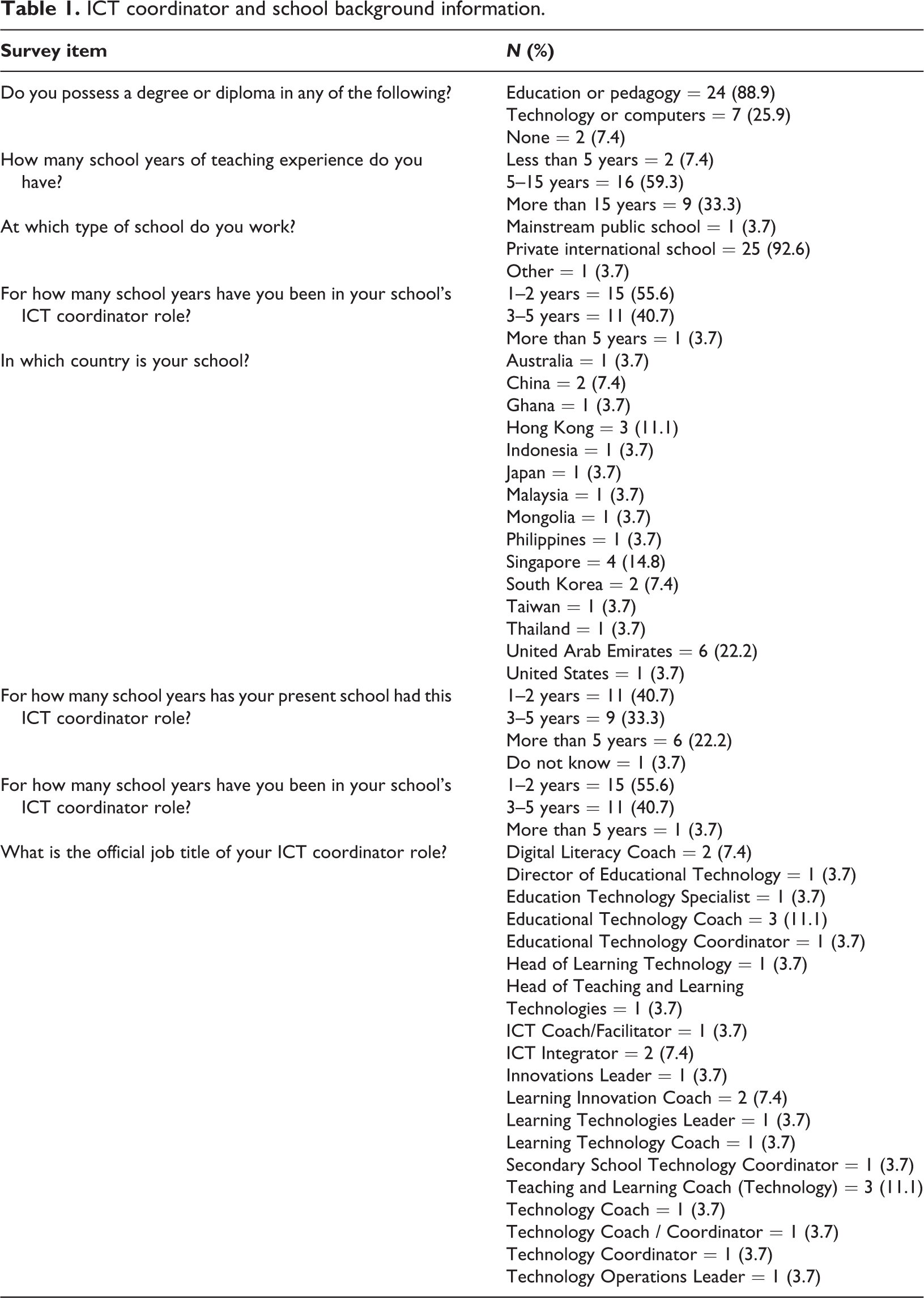
As regards participants’ schools, 92.6% of ICT coordinators work in private international schools, which are largely self-contained schools operating free of government constraints (Friesen, 2010) and are growing in numbers in Asia (Woo, 2013). Participants’ schools are distributed across 15 countries. Schools from the United Arab Emirates contribute the greatest number of participants (n = 6). Twenty-two participants contributed their schools’ names to the study, identifying 18 unique schools.
Regarding the background of the ICT coordinator role at the school, 42.3% of coordinators report that their school has had an ICT coordinator role for one to two years, and 34.6% of coordinators report their school has had the role for three to five years, and 55.6% of coordinators have been the ICT coordinator in their school for one to two years at the time of study. The study collected 19 job titles of ICT coordinators.
Organizational infrastructure
Table 2 lists the frequency distribution of response results. The results are organized around each component and comparisons of the availability, quantity and quality of components in the population of ICT coordinators. The results of the survey questionnaire show the study’s ICT coordinator population evidence the widest operationalized range for the availability, quantity and quality of organizational infrastructure components: for example, some ICT coordinators have no additional position roles and others have more than five; some ICT coordinators are assigned to no organizational teams and others to more than five; and some coordinators attended no daily, routine interactions and others attend more than five.
Organizational infrastructure descriptive statistics.
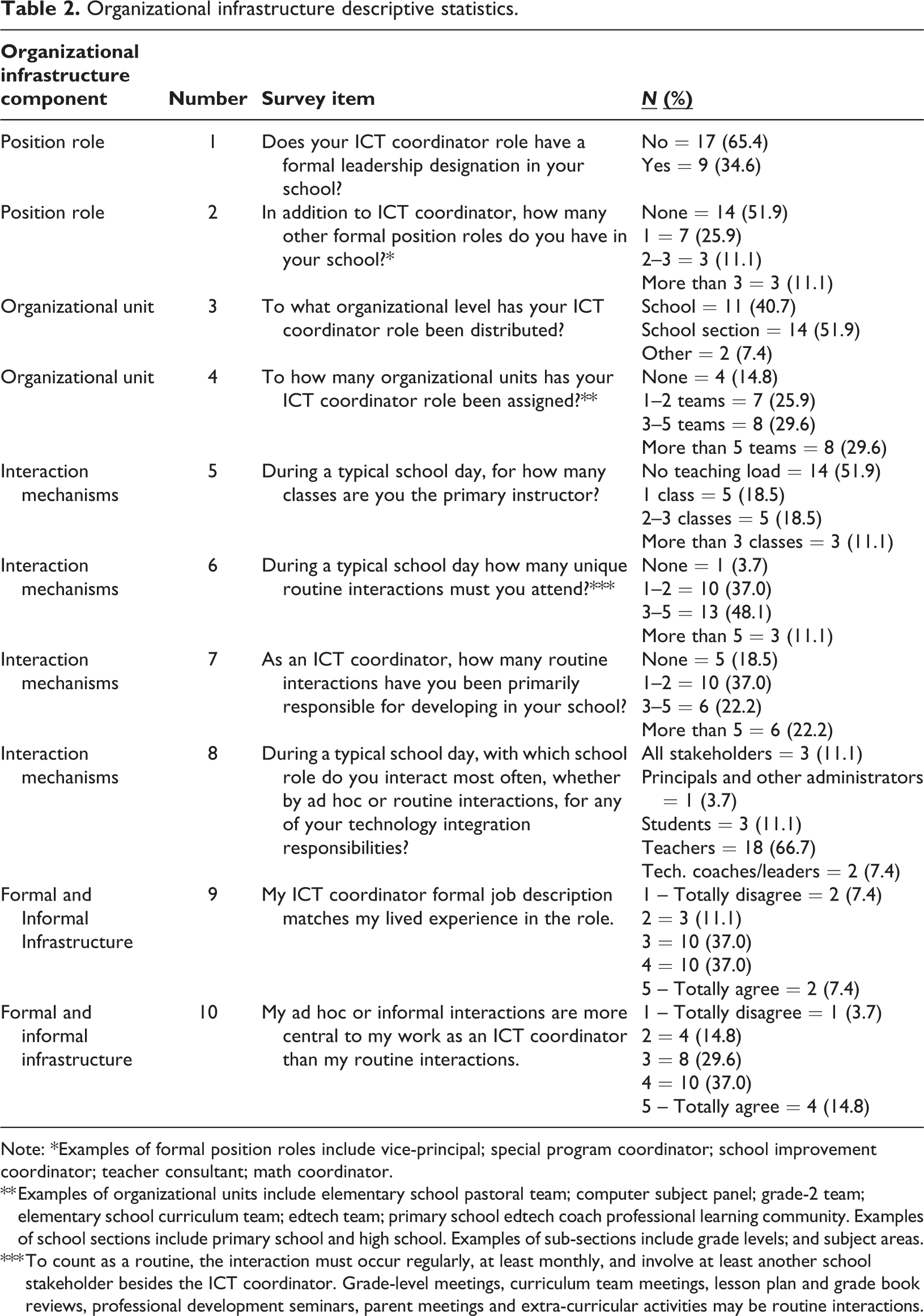
Note: *Examples of formal position roles include vice-principal; special program coordinator; school improvement coordinator; teacher consultant; math coordinator.
** Examples of organizational units include elementary school pastoral team; computer subject panel; grade-2 team; elementary school curriculum team; edtech team; primary school edtech coach professional learning community. Examples of school sections include primary school and high school. Examples of sub-sections include grade levels; and subject areas.
*** To count as a routine, the interaction must occur regularly, at least monthly, and involve at least another school stakeholder besides the ICT coordinator. Grade-level meetings, curriculum team meetings, lesson plan and grade book reviews, professional development seminars, parent meetings and extra-curricular activities may be routine interactions.
Position roles
It was found that 65.4% of coordinators do not have a formal leadership designation, and 51.9% do not have an additional position role. Of the 48.1% of ICT coordinators (n = 13) with additional position roles, the most frequent response is to have one additional position role.
Organizational units
It was found that 92.3% of coordinators are distributed to either of two organizational levels: 53.8% of coordinators are distributed to the school section-level. All of these section-level coordinators report working in private international schools. It was found that 38.5% of coordinators are distributed to the school-level. Two coordinators are distributed to other organizational units: one to a school district, and another to three grade levels.
Only 14.8% of coordinators report not having been assigned to any organizational teams. Of the 85.1% of coordinators (n = 23) who report having been assigned to organizational teams, the most frequent response of coordinators is an assignment to between 1 and 2 organizational teams and to more than 5 organizational teams.
Interaction mechanisms and organizational routines
It was found that 96.2% of coordinators (n = 26) report attending at least one daily, routine interaction; and only one coordinator reports not attending any. Of coordinators who attend daily, routine interactions, the most frequent response is to attend between three and five routine interactions. Furthermore, only 18.5% of coordinators report not having created any routine interactions. Of the 81.4% of coordinators (n = 22) who created at least 1 routine interaction, the most frequent response of coordinators is having created 1–2 routine interactions.
Routine teaching is unavailable for 53.8% of coordinators, who report on a typical day having no classes for which they are the primary instructor. For the 46.1% of coordinators (n = 12) who report having classes, the most frequent response of coordinators is to have one class. Additionally, 69.2% of coordinators interact with teachers the most on a typical day.
Formal and informal infrastructure
The two items about the formal and informal infrastructure dynamic show that an ICT coordinator’s formal and informal infrastructure can be influential in facilitating leadership for ICT implementation. It was found that 51.8% of coordinators either agree or totally agree with the statement ‘My ad hoc or informal interactions are more central to my work as a technology coach or leader than my routine interactions’, whereas 18.5% either disagree or totally disagree. At the same time, 44.4% of coordinators either agree or totally agree with the statement ‘My technology coach or leader formal job description matches my lived experience in the role’, whereas 18.5% either disagree or totally disagree.
Additional units of analysis
The survey results show different populations of ICT coordinators so that conducting an opportunistic, comparative analysis to identify finer-grain similarities and differences in ICT coordinator organizational infrastructure components is possible. The analysis involves cross-tabulation and comparison of means.
First, the organizational infrastructure components of ICT coordinators with a formal leadership designation, coordinators without a formal leadership designation, section-level coordinators and school-level coordinators are compared. It was found that ICT coordinators with a formal leadership designation (n = 9), those without (n = 17), school-level coordinators (n = 10) and section-level coordinators (n = 14) share the most frequent response to 3 organizational infrastructure items: they most often respond not having any additional position roles, interacting most often with teachers on a daily basis, and not having a teaching load. In addition, it was found school-level coordinators and section-level coordinators most often respond not having a formal leadership designation. These most frequent responses are also the most frequent responses for the same items for this study’s total population of ICT coordinators.
Second, a population of five ICT coordinators from the same private international school in the United Arab Emirates was identified from the survey questionnaire results. One coordinator reports his job title as the Director of Educational Technology and four coordinators report their job title as Teaching and Learning Coach (Technology). The five coordinators’ organizational infrastructure components are analyzed to identify similarities and differences in the availability, quantity and quality of components for the two ICT coordinator position roles, and for each coordinator.
The two ICT coordinator position roles show distinct aspects: the Director of Educational Technology is assigned to the school-level organization whereas three Teaching and Learning Coaches are assigned to school sections and one is assigned to three grade levels. The Director of Educational Technology interacts with technology coaches and leaders the most on a daily basis whereas the Teaching and Learning Coaches interact with teachers the most. However, the four Teaching and Learning Coaches’ responses to other organizational infrastructure items are not uniform: a wide range of responses was identified for the number of additional position roles, the number of organizational units assigned and the number of organizational routines created.
The next section presents a representative case study of an ICT coordinator who had participated in the survey and who illustrates some principal findings.
A representative case study
The representative ICT coordinator’s name is Sam (pseudonym). His job title is Digital Literacy Coach. He works in a private international school in Singapore. The school employs eight Digital Literacy Coaches, all of whom were previously full-time teachers in the school. They compose the Digital Literacy team at the school. The school is in its third year with Digital Literacy Coaches and Sam is in his third year in the Digital Literacy Coach role.
Sam leads through an extensive, formal infrastructure. He has been distributed to a primary section of the school and, besides the Digital Literacy team, has been assigned to more than five organizational units. These include grade-level teacher teams, the primary section curriculum team, a steering committee and Tech Mentors, a group of teachers whom Sam trains to provide ICT implementation support for other teachers in the school. On a typical day, Sam attends more than five routine interactions including grade-level, teacher team meetings. He has created more than five routine interactions in the school. These include the routine meetings of Tech Mentors, additional grade-level teacher team meetings, and weekly meetings to train a group of students to provide ICT implementation support to classmates and teachers.
On a typical day, Sam is the primary instructor for two classes in grade 5, and Sam’s case illustrates how ICT coordinators can create routine interaction mechanisms. Originally, all Digital Literacy Coaches had no teaching load, but in the previous school year, Sam and another Coach had asked school leaders for a teaching load. They asked for a load to more conveniently develop innovative classroom practices and exemplars, and to be more credible in the eyes of teachers. In this way, Sam and his colleague were granted a double-lesson teaching load for the present school year. Other coaches in the school have no teaching load.
Sam agrees that his formal job description matches his lived experience, but he added that he had not always agreed. Sam provided several examples in which he had to negotiate with school leaders so that the job description would match his everyday practice. For example, Sam had been incidentally interacting with primary curriculum unit members through his grade-level, teacher team meetings, and through ad hoc, informal interactions. Since Sam believed his job should be more pedagogy- and curriculum-centered than technology-centered, he negotiated with his school leaders for membership in the curriculum team. He negotiated for the membership to be recognized in his job description. Sam is the only Digital Literacy Coach in the school with a curriculum team assignment.
Discussion
The study’s ICT coordinator population evidences the widest operationalized range for the availability and quantity of formal organizational infrastructure components. In this way, a wide range of possible formal organizational infrastructure is available to the ICT coordinator role just as the literature documents a wide range of possible ICT coordinator individual practices and a wide range of possible school conditions for ICT implementation. Nonetheless, the study’s frequency distribution of responses and the analysis of additional units identify similarities in the availability, quantity and quality of formal organizational infrastructure. These patterns indicate that some components and aspects may be prioritized over others when considering which specific organizational infrastructure components would facilitate leadership for ICT implementation.
More than half of the ICT coordinators in the present study do not have any additional, formal position roles in their schools, some have a formal leadership designation and some agree with the congruence of job description and lived experience. These findings support the claim that ICT coordinators can be a distinct occupational groups in schools (Friesen, 2010; Wong, 2008). Furthermore, while leaders do not necessarily need a formal position role or authority in a distributed model of leadership, the findings raise aspects of a formal ICT coordinator position role to consider for facilitating leadership for ICT implementation. Specifically, a formal position role, a formal leadership designation and a realistic job description can address barriers to ICT coordinator leadership found in the literature, such as the non-recognition of an ICT coordinator role, the low status of the ICT coordinator role (McGarr and McDonagh, 2013) and the role’s ambiguity (León-Jariego et al., 2020; Rodríguez-Miranda et al., 2014) in schools.
The results from the survey questionnaire and case study show that a school can employ more than one ICT coordinator, create different types of ICT coordinator roles and compose an organizational unit of ICT coordinators. Evidence of several ICT coordinators in a school and of different types of ICT coordinator roles in a school is not found in the literature, and this study’s finding may be attributed to private international schools, which can comprise several school sections (Woo, 2013), spend non-trivial financial resources on ICT implementation (Friesen, 2010) and employ more than one ICT coordinator (Woo and Law, 2020). To facilitate leadership for ICT implementation, the findings support León-Jariego et al.’s (2020) recommendation that a school build a team of ICT coordinators rather than employ a single ICT coordinator position role. The present study adds that other school types should consider not only employing more than one ICT coordinator and composing an ICT coordinator organizational unit, but also differentiating ICT coordinator roles through formal organizational infrastructure.
Results from the survey questionnaire and case study show that ICT coordinators in the same school do not need to belong to the same number and type of organizational units. Importantly, the assignment of an ICT coordinator to organizational units is an essential consideration for the facilitation of leadership for ICT implementation. While studies have not claimed an ideal number of organizational unit assignments for an ICT coordinator, time may be a factor for determining any number. Another important consideration is the types of organizational units to which an ICT coordinator should be assigned to facilitate leadership for ICT implementation. Law and Yong (2020) have identified the importance of assigning the ICT coordinator to an ICT implementation team. The case study shows that ICT coordinators can be assigned to teacher teams and a curriculum team. These assignments may be essential to address the problem of the ICT coordinator role not focusing on curriculum and pedagogy (McDonagh and McGarr, 2015).
It is unexpected to find that more than half of coordinators do not have a teaching load, and the case study provides reasons why an ICT coordinator would want a teaching load. Previous studies have only found ICT coordinators with a teaching load, and the teaching load, whether full-time or part-time, has been perceived negatively, because teaching takes time away from people to complete ICT coordinator individual tasks (Lai and Pratt, 2004; León-Jariego et al., 2020; McDonagh, 2011; McGarr and McDonagh, 2013; Rodríguez-Miranda et al., 2014). The present study raises to schools the consideration of, first, whether to facilitate leadership for ICT implementation by providing an ICT coordinator with a teaching load; and second, if a school provides classes to an ICT coordinator, what number and quality of classes to provide so as to realize the benefits of teaching for the facilitation of leadership but not the time barriers established by previous studies.
Conclusion
A study’s theoretical perspective on leadership influences its research focus and conclusions. This paper demonstrates that a distributed model of leadership can be a useful analytical lens to think about aspects of an ICT coordinator’s organizational context that would facilitate leadership for ICT implementation. The paper contributes survey questionnaire findings and patterns on the availability, quantity and quality of some organizational infrastructure components for a population of ICT coordinators. It contributes a case study that provides individual perspective and details to how organizational infrastructure would facilitate leadership for ICT implementation. The empirical evidence can inform incremental steps not only in developing the ICT coordinator position role to better mobilize and influence, but also in disambiguating ICT coordinator practice and expectations for stakeholders. Educators should consider creating a formal ICT coordinator position role. They should also consider creating a team of ICT coordinators in a school. ICT coordinators should be assigned to organizational units, particularly teacher teams. It is important to consider the costs and benefits of providing an ICT coordinator with classes to teach. Besides, the organizational infrastructure of ICT coordinators in the same school does not need to be uniform to facilitate leadership for ICT implementation.
This paper is an initial attempt to apply a distributed perspective on leadership to ICT coordinator research. It must be considered in the broader context of ICT coordinator and leadership studies. The study has several limitations and presents opportunities for further research into ICT coordinators and leadership for ICT implementation using a distributed perspective. First, the generalizations made in this paper should be considered theoretical because of the study’s non-probability sample. For example, the ICT coordinator organizational infrastructure presented in this study should not be generalizable across all private international schools, or nations represented. Further survey questionnaire research can use more robust sampling strategies. That research should aim to make statistical generalizations about ICT coordinator organizational infrastructure. The present study identifies units of analysis that could compose possible ICT coordinator populations for research. These include ICT coordinators in private international schools; and for comparative studies, ICT coordinators with teaching loads and those without, coordinators with formal leadership designations and those without, and school-level coordinators and section-level coordinators. Incidentally, this paper casts a net across schools in 15 countries to understand ICT coordinators and leadership for ICT implementation in a broader, transnational perspective. There are opportunities to identify ICT coordinator populations within these countries, and to develop more transnational ICT coordinator studies.
Second, this paper has framed leadership for ICT implementation as an organizational property. Leadership is inclusive of people who have the aptitude, ability and conviction to realize corporate goals. Therefore, the research into aspects of context that would facilitate leadership is not limited to an ICT coordinator position role. ICT subject teachers, technicians and other position roles can be better developed to mobilize and influence people to implement ICTs. Research focusing on these position roles’ organizational infrastructure should raise additional considerations for the facilitation of leadership for ICT implementation.
The paper has identified a range of ICT coordinator organizational infrastructure components. However, there are other components that can be explored and may provide more insights into the facilitation of leadership for ICT implementation. These include formal reporting relationships or informal instructional advice and information networks, for example. Examining organizational infrastructure in larger systems, such as school districts or school federations, could reveal other structures and mechanisms from which leadership for ICT implementation emerges. Ultimately, given that the school contexts for ICT implementation appear diverse across societies, as does ICT coordinator organizational infrastructure, additional case study appears necessary to provide in-depth knowledge. This study provides one case and the literature would benefit from additional, representative cases of ICT coordinator organizational infrastructure in different contexts.
Footnotes
Declaration of conflicting interests
The author(s) declared no potential conflicts of interest with respect to the research, authorship, and/or publication of this article.
Funding
The author(s) received no financial support for the research, authorship, and/or publication of this article.

Ethical approval
All procedures performed in studies involving human participants were in accordance with the ethical standards of the institutional and/or national research committee (Human Research Ethics Committee EA1510015) and with the 1964 Helsinki declaration and its later amendments or comparable ethical standards.