







Abstract
The articulation of school autonomy into practice nationally, regionally and locally is highly situated in terms of what it enables or impedes with regard to the professional autonomy of principals and teachers. Principal autonomy does not necessarily mean greater teacher professional autonomy. In this paper, we draw on a three-year qualitative study investigating the social justice implications of school autonomy reform in Australia. We present interview data from a case study of a large secondary college to present two conflicting stories of autonomy. Supported by a managerial restructure reflecting distributed leadership, we juxtapose the positive account of autonomy expressed by the leadership team with the negative one expressed by teachers. We explore the justice implications of this disjuncture and argue the importance of critically examining the complex ways in which the intentions and enactments of distributed leadership can be differently articulated and understood within the context of school autonomy reform.
Introduction
For decades, the policy trend internationally has been towards greater school autonomy with Charter Schools (USA), Academies (UK), Free Schools (Sweden), Self-Governing Schools (New Zealand) and Australia's latest version of Independent Public Schools. The rationale within a neoliberal framing of systemic school reform has been that greater school autonomy and localised decision making will lead to more efficient and effective use of resources and improve student outcomes (Organisation for Economic Co-operation and Development, 2020). This, it is argued, results from principals having greater control over budgets and staffing facilitated in most instances by the overseeing role of Boards or Councils comprising parent and community members (Blackmore et al., 2022).
Whilst the rhetoric and claims about autonomy are similar in policies cross-nationally, the articulation of school autonomy into practice nationally, regionally and locally is highly situated in terms of the practices that it enables or impedes. How principal autonomy is exercised and experienced can vary considerably within education systems and schools (Heffernan, 2021; Heffernan and Pierpoint, 2020). Principal autonomy does not necessarily mean greater teacher professional autonomy. In a three-year qualitative study investigating the social justice implications of school autonomy reform, conflicting stories emerged in interviews across multiple case studies about how school autonomy enabled principals to produce policies, install organisational structures and processes and establish priorities. Principal agency operated within systemic parameters to enact autonomy in ways that had significant implications for teacher practice and their professional autonomy (Keddie et al., 2020a, 2020b; Niesche et al., 2021).
In this paper, we draw on data from one case study of school autonomy reform. Dorton Secondary College (DSC) (pseudonym) is located in a rapidly expanding outer suburb of a large Australian metropolis (detailed below). The school's rapid growth prompted the principal, Elias (pseudonym), to initiate an organisational restructuring in 2018 that distributed leadership (DL) to a range of teaching staff across new vertical and horizontal groupings. The distribution of leadership in schools is a key feature of the professional standards for Australian principals, distributing responsibility across the school through ‘delegation, collective responsibility and shared authority’ to leading teachers (Australian Institute for Teaching and School Leadership, 2016: 11).
A key theme that surfaced in the interviews with 18 staff members was the disconnect between how autonomy was experienced by the executive team and many of the teachers, best illustrated by Tara (pseudonym), an early-career teacher: Our leadership team isn't visible … they have this separate building where they hide out … the people that are making the decisions and the people who are actually doing the work, it‘s like we are at two different schools.
In this paper, we explore the social justice implications of this disconnect as it is situated within the school's new organisational structure of what appeared to be DL.
DL and teacher autonomy
A significant body of literature studying principals’ views of school autonomy, including principals in our study, shows that school principals generally favour greater autonomy over school budgets and staffing (Keddie et al., 2020a, 2020b; Niesche et al., 2021; Thomson, 2009). What principals in nearly all Australian and international studies find most difficult about school autonomy reform is that all the risk and responsibility is devolved to them, along with the administrative overload associated particularly with recruiting staff. These issues are magnified in hard-to-staff schools including those situated in regional, rural or outer-suburban locations which have higher levels of disadvantage (Lampert et al., 2021; Rowlands et al., 2020).
School autonomy devolves responsibility and power to principal/leadership teams. How this autonomy is experienced within schools through policies, structures and decision-making processes in relation to teacher professional autonomy is highly dependent on the decisions of these teams. Principals can mobilise the freedoms of school autonomy in ways that undermine teacher professional autonomy (e.g. through adopting a managerial and hierarchical approach) and/or enable teacher autonomy (e.g. through inclusive decision-making processes and respect for teacher professionalism) (see Keddie et al., 2020a, 2020b).
There is significant literature on DL which emerged after the detrimental effects of a decade of self-managing (autonomous) schools had become evident (e.g. in Victoria, Australia) along with the focus on the principal as the hero leader (Gronn, 2000; Gronn, 2002; Wood and Case, 2006). DL offered a possible counter to neoliberal individualistic notions of leadership (Hartley, 2007). It imparted a new prominence to ‘shared leadership, variously described as democratic leadership, collegiality, participative leadership, and distributed leadership’ (Crawford, 2012: 611). At the same time, Spillane (2005) from the USA argued that this prominence often reduced DL to the view that everyone is a leader. The debates that ensued in the literature in the 2000s were about whether schools can be democracies; whether the policy and school context make DL difficult; whether DL removes hierarchies and imparts greater power to those with expertise in what could be considered to be earned or emergent leadership; whether DL could co-exist with the accountabilities required of schools; or whether it is about a structure or relationships between actors or a network of relationships and practices (Crawford, 2012). Other debates were associated with how DL can inadvertently lead to power being exerted in new and unintended ways (Gronn, 2009).
Spillane (2006; 2005) shifted the focus from people to practice and identified patterns of DL such as collaborative, collective, coordinated and parallel leadership, yet he warned that these ‘multiplying taxonomies’ (Lumby, 2013: 581) are not synonymous with the practices of DL. Spillane (2005: 144) argued that a distributed perspective frames leadership practice in a particular way, not simply as individual actions but the ‘product of interactions among school leaders, followers, and their situation’. But within these debates about what DL was and how it could be analysed, there was some agreement that DL could be both democratic and autocratic (Spillane, 2006). That is, an authoritarian leader could boost informal leadership without changing hierarchical power structures thereby exploiting others’ desire to be involved but not necessarily to their benefit – for example, devolving responsibility to teachers without enabling them the power to change things. A democratic form of DL, in contrast, would flatten hierarchical power structures to the benefit and inclusion of all involved – for example, including teachers in decision making and trusting them to use their professional judgement individually and collectively. This form of DL leads to a greater sense of individual agency and collective wellbeing (Woods, 2011). There is agreement across the DL literature (drawing on organisational learning and theories of change) that distributing roles to enable leadership that enables agency is more likely to create a sense of ownership over, and willingness to implement, change. Also agreed across the literature is that more diversity in leadership, which a distributed approach enables, is beneficial in complex organisations such as schools (Hatcher, 2005).
The DL literature sits beside the longstanding literature on what teachers (rather than systems) consider as enabling school quality and effectiveness: participative decision-making, collaboration and clarity of rules with significant autonomy to exercise professional judgement because of the complexity of what teachers do (Crowther et al., 2009). The teacher leadership literature focuses on whole of school planning where teachers and principals ‘work mutualistically with a shared purpose’ (Conway, 2014: 32). Teacher leaders are those who could convey convictions about a better world; facilitate communities of learning; strive for pedagogical excellence; confront barriers in the school's culture and structures; translate ideas into sustainable systems of action; and nurture a culture of success (Conway, 2014: 34). This literature, which positions teachers as possessing worthwhile knowledge that can inform policy and practice, aligns with action research approaches to school reform and theories of learning organisations which view teachers as knowers and doers in producing valued knowledge to inform policy and practice (Edwards-Groves et al. 2016).
Within these debates, Lumby (2013: 586) suggests three ways of considering the DL narrative of sharing leadership:
The headteacher retains an authoritative leadership role, but …leadership by the many runs beneath or in parallel, over which the headteacher has no more control than other staff members The headteacher uses their individual power to create the environment in which distributed leadership can grow, by means of establishing structures and processes and building staff leadership capacity … The headteacher uses his or her individual power to take assertive or even aggressive action to impel people into a leadership role with a distributed leadership justification …
In Lumby's analysis, supporting teacher professional autonomy aligns with the principal establishing structures and processes to build teacher leadership capacity (point 2 above). But Lumby goes further and argues that the literature does not raise issues of power and control, a common failing of much of the leadership and school improvement literature other than that undertaken by critical antiracist, feminist, and postcolonial scholars (Fuller, 2021). They consider power as exerted overtly and covertly and as diffuse in organisations with both positive and negative benefits in how it is exercised and experienced, both reproducing and sometimes challenging unequal power relations.
Because power distribution is not always considered in the DL literature, Tian and Nutbrown (2021: 1) in their ‘retheorising’ of DL argue that in schools DL as a policy and practice can be ‘misused as a managerial tool’ reinforcing epistemic injustices. As we argue, in this paper, just because teachers appear to have greater professional autonomy on an organisational chart and as perceived by the principal, doesn't mean they feel, or are, autonomous. Tian and Nutbrown (2021) draw on Fricker’s (2015) theorising of epistemic (in)justice as testimonial and hermeneutical. Testimonial injustices occur when there is a misjudgement and undervaluing of ‘the contribution of information and opinion’: a ‘speaker suffers a credibility deficit caused by prejudice of the hearer’ (Fricker, 2015: 79). Hermeneutical injustices relate to a lack of comprehension where hermeneutically marginalised groups do ‘not have access to equal participation in the generation of social meanings’, meaning the scope for silencing and misunderstanding is greater (Fricker, 2013: 1319). The effects of epistemic injustice are to question the credibility and intelligibility of individuals, thus eroding ‘their confidence as knowers, testifiers, and thinkers’ (Tian and Nutbrown, 2021: 5). Epistemic injustice can occur for whole social groups such as teachers who share similar epistemic disadvantage due to an undervaluing of their contribution and a lack of shared language and understanding of their work. DL processes in schools can be misused along these lines to marginalise, silence and reject teachers as knowledge contributors thereby undermining their professional autonomy (Tian and Nutbrown, 2021).
School autonomy reforms have increased the scope of decision-making for principals at a local level over such things as budgets and staffing as well as increasing the risks, responsibilities and workload of principals (Riley et al., 2021). It is thus unsurprising that some form of delegating responsibility through DL has become a standard feature of leadership (i.e. the Australian professional standards for principals) especially given DL is considered a solution to the problem of principal overwork as a ‘pragmatic tool’ redistributing the workload down to teachers (Tian et al., 2016: 146). The following outlines our research context and processes and presents the conflicting narratives of the executive leadership team (ELT) and teachers.
Research context and processes
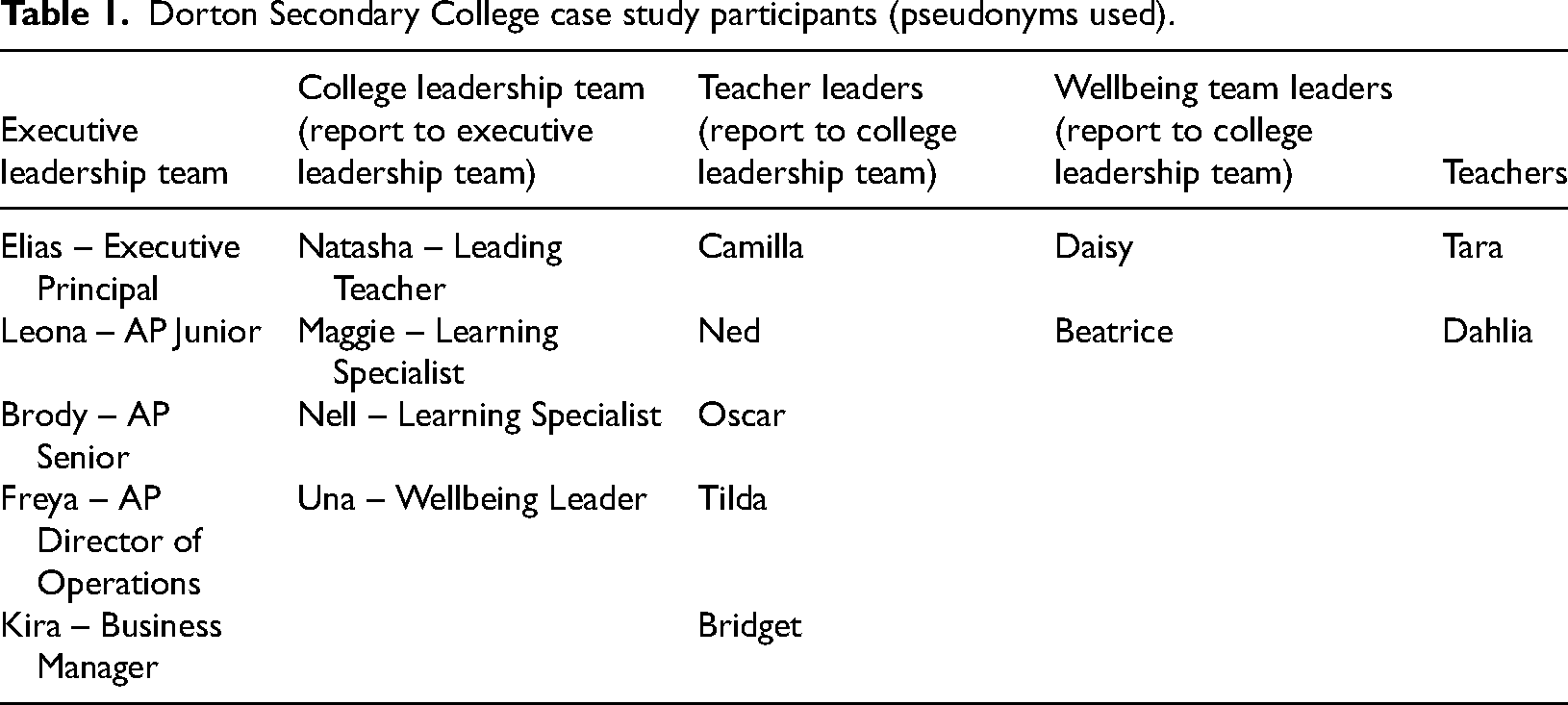
Dorton Secondary College is one of five case study schools involved in a three-year Australian Research Council project exploring the social justice implications of school autonomy reform in Australia. The project is investigating the ways in which autonomies granted to principals in devolved public education systems enable and constrain social justice outcomes. Three team members in pairs conducted semi-structured interviews with 18 members of staff ranging from senior executive leadership, leading teachers, graduate teachers and support staff (Table 1). As the data generation occurred during lockdowns due to the 2021 COVID-19 pandemic, interviews were conducted on-line and were 60–90 min in length. The interviews explored participant understandings of school autonomy as it relates to social justice and examined equity concerns relating to how this reform was shaped by the particularities of context including how leadership and management were conceptualised and distributed and how this reflected different ideas about teacher professional autonomy.
Dorton Secondary College case study participants (pseudonyms used).
The data were organised and coded using Nvivo. Initial analysis involved coding the data in relation to the key concepts explored in the research such as ‘managerial’ and ‘professional autonomy’, ‘social justice’, ‘equity’. While these codes directed our organisation of the data into particular themes, there was significant overlap in each category – for example, while issues of management guided how the transcript data were sorted in the ‘managerial’ code, this code also included data associated with the codes ‘professional autonomy’, ‘social justice’ and ‘equity’. This process sought to capture the broadness of the issues raised within each code. In this paper, we examine the data coded in the managerial autonomy code. In this code, we included interviewee talk and explanation associated with the schools’ management structure and processes including the different expectations articulated by different respondents about particular roles and responsibilities and their distribution. Given the study's focus on school autonomy and social justice, we were particularly interested within this code, to foreground how issues of power operated within the school's hierarchical structure in ways that were seen as enabling and/or constraining for leaders and teachers.
Further analysis of the data following the initial coding involved an iterative process of exploring how participants’ experiences resonated with and could be explained in relation to the broader literature about the impacts of school autonomy reform. This process brought to light a significant disjunction between the experiences of autonomy expressed by the ELT and the teachers at DSC. This disjunction led to subjecting the data to further analysis drawing on the different articulations of power, inequity and leadership relations examined in the DL literature (especially Spillane's idea that DL could play out in both autocratic and democratic ways and Lumby's three notions of DL as sharing leadership) including how these articulations led to relations of epistemic injustice (testimonial and hermeneutic).
About the school
Dorton Secondary (DSC) is a large secondary college (grades 7–12) in a growing commuter suburb 35 km from the central business district of an Australian capital city. DSC has a large and culturally diverse student population with 43% having a language background other than English. The school has grown rapidly, doubling its size in the last ten years with more than 1200 students.
The newly implemented complex hierarchical management restructuring in 2018 includes two sub-schools (junior and senior). The hierarchy has the ELT comprising the principal, four assistant principals including two sub-school principals, a director of curriculum and enrichment and a director of operations, as well as a business manager; the college leadership team (CLT); and a range of school teams who report to the ELT and CLT such as school support services, year level teams, etc. The vertical structure was between the junior and senior schools each with associate principals and within these sub schools, year level and curriculum leaders. A third vertical grouping was the wellbeing team and a fourth vertical group was administration. The horizontal hierarchy in each subgroup includes learning specialists, leading teachers, heads of curriculum, heads of year levels and other positions of responsibility (team leaders) and teachers (see Table 1). The organisational chart reflected a distribution of positional leadership across multiple activities within the school.
Elias (principal) argued that one of the aims of the restructure was to build the teaching and leadership capacity of middle leaders and teaching staff, many of them graduates or Teach For Australia (TFA) interns, due to a high staff turnover. Beatrice (student wellbeing leader) commented that there were around 40 new teachers a year (36% of staff). This high turnover was attributed to the complex demographics of the school including the high levels of student need and the high levels of violence. Additionally, high staff turnover meant that relatively inexperienced staff were moved into leadership positions quickly, giving the appearance of leadership capacity building and then many were quickly recruited elsewhere, adding to the churn.
Teacher turnover and transience were seen as significant in exacerbating issues of behaviour management. While staff were provided with regular professional development in the area of student wellbeing and behaviour management, Beatrice commented that ‘the high turnover of teachers …[lead to] a lack of traction and consistency in how student behaviour was addressed’. Maggie (learning specialist) commented on the resulting loss of institutional knowledge and agreed with Camilla (teacher leader) who noted the lack of ‘refresher’ PD and the tendency for the staff to move on to other forms of PD before ‘mastering any of them’. Adding to this was that the restructure was implemented in the year prior to COVID and therefore had not ‘settled down’. There was also a sense of precarity about teachers’ roles as many staff were in acting leadership positions, exacerbating staff stress. This was the troubling context confronting the leadership team.
The ELT narrative
When first speaking with the principal, Elias, we were provided with a colour coded chart of the school's new organisational structure and its complex leadership hierarchy. The chart indicated numerous middle level leadership positions in areas such as curriculum and pastoral care across the school. Elias explained that this re-structuring was ‘necessary’ in light of a ‘doubling of enrolments over ten years’ to provide a more concerted focus on student learning outcomes. He referred to this restructuring as a creative exercise of school autonomy within the frameworks and systems of compliance, resource delivery and academic programs mandated by the department of education. Elias explained: …the Department has very clear systems and requirements; but [there] is a high degree of opportunity for schools to develop within those frameworks and systems; and quite unique ways of providing education in a learning environment for students and a work environment for its professionals there as well.
This structural change involved a ‘re-focus on the work of middle leaders’ to concentrate more on ‘instructional leadership’ in relation to building ‘the capacity and expertise of teachers’ through targeted ‘professional learning about evidence-based practice’ and ‘creative ideas around how to improve outcomes for students’.
Such leadership capacity building, as Elias further argued, was especially important given the school's ‘relatively young [staff] profile’. In the new structure team leaders were designated to support class teachers which sometimes involved a focus on students in the form of ‘intervention’ and ‘behavioural support’. Deputy principal, Brody, also commented on the ‘significant support’ and ‘investment’ in staff especially in relation to in house professional development for capacity building and leadership training, provided by external consultants.
Elias also mentioned the wellbeing support available for staff, as he explained, ‘we have really increased that level of staff support; and we have a staff well-being action team’ where ‘middle level leaders’ are trained to support staff well-being through ‘well-being focussed conversations’, counselling and other ‘proactive well-being supports for staff’. He argued that the management structure was designed to facilitate communication between teachers and leaders in relation to ‘various needs across teams and various locations within the school as they arise’. This required the processes and systems to be ‘pretty agile and responsive to [the] ebbs/troughs, peaks and flows throughout the year’.
Consistent with these comments, Nell (learning specialist) and Daisy (student wellbeing leader) expressed positive views about the new organisational structure at DSC and the support available to staff. Nell commented, for example, ‘I think it's a very supported school’ with ‘well-structured’, ‘well-chosen’ and professionally supported leadership teams who are ‘really passionate about their work’ and ‘very open to hearing ideas and suggestions’. Daisy also spoke positively of the support she received as a new staff member and that she ‘liked that [she] had a lot of autonomy in [her] role’. She said she felt ‘trusted to deliver and just do what [she] felt was needed’.
Members of the ELT Leona (assistant principal) and Brody (assistant principal) spoke of the prescribed processes at DSC that were necessary for managing large and culturally diverse schools. Brody, for example, described the processes of behaviour management as ‘prescribed’ but that this was not ‘hugely different from what other schools are generally doing’ and that it didn't undermine teacher professional autonomy.
This narrative tells a positive account of school autonomy or more accurately, principal/leader autonomy, as enabling the creation of an organisational structure of shared leadership that benefits the school. There is a sense, in the views of the ELT, that the new structure, although hierarchical, reflects a distribution of leadership through embedding a sense of shared decision-making and collegiality throughout the school (Spillane, 2006). This is evident in the ELT's self-reported focus on caring for, and investing in, teachers in terms of providing professional development, capacity building, high levels of wellbeing support and leadership development. The structure of DL is conceptualised by the principal and leadership team as increasing support for staff in ways that respond to their needs and the specific needs of the students. The ELT expressed a positive view of the new structure as enabling teacher support and [relative] autonomy, avenues for hearing teachers’ ideas, and instilling trust. The processes of DL at DSC would seem, according to the ELT narrative, to be more democratic than autocratic (Spillane, 2006). Drawing on Lumby's heuristic, Elias might be construed as using his ‘individual power to create the environment in which distributed leadership can grow, by means of establishing structures and processes and building staff leadership capacity’ (Lumby, 2013: 586).
The teachers’ narrative
Our interviews with nine staff members at DSC (who occupied various teaching and team leading roles) painted a very different picture to this ELT narrative. In general, they felt disempowered by the structures and practices expected by the ELT. The main issues of concern were about the micro-management of teachers’ work and a lack of support for their wellbeing. A key problem here, as staff mentioned, was a sense that the executive leadership did not understand the reality of teachers’ work, as Beatrice (student wellbeing leader) stated: ‘I don't think they have a clear picture of the reality of what it's like for classroom teachers’.
Micro-management, surveillance and lack of support
Many of the teachers spoke of feeling micro-managed and under surveillance by the prescriptive, process- and accountability-driven ways they were expected to organise their time and work. Being micro-managed was clearly a point of resentment. Camilla (teacher leader) explained: ‘I think, generally speaking, teachers here would say that our time is very strictly micro-managed; and that they wish it wasn't so’, as did Maggie (CLT – learning specialist), ‘I do think we have relatively little autonomy. The work we do is more or less dictated … there's quite a bit of pressure to do things in the way that we’re told’.
This micro-managing played out in the strict timetabling of teachers’ work and duties. Maggie (CLT – learning specialist) described ‘the busy schedule of meetings’ organised by the leadership team that they were expected to attend beyond their classroom teaching, for example, professional learning, teaching team meetings and learning area meetings where the content of the meeting to be covered was prescribed. Micro-management also played out in relation to when teachers could leave after a workday through the explicit rules about use of time. Camilla (teacher leader) explained, for example, that some staff got in trouble if they ‘left five/ten minutes earlier than scheduled’ regardless of the reason. She gave an example where she and a colleague were sent ‘a nasty email’ after leaving the school ten minutes early one day even though she tended to start her workday an hour earlier than was required. Camilla spoke of other forms of micro-managing such as the executive team checking up on teachers’ lodging of student reports. She conceded the necessity of some level of surveillance but stated that ‘the response definitely is people feeling like they are being watched … feel[ing] targeted’. On this issue of micro-management of time, Maggie (CLT – learning specialist) commented that ‘the staff is crying out for … just a bit of understanding of their workload and their situation’ and wanted more ‘choice’ over how they used their time at school.
Other forms of micro-managing were associated with the online and offline processes and systems that were designed to report, account for and support student wellbeing (including issues of behaviour management). Several of the teachers referred to these processes and systems (especially the centralised online portal for reporting student behavioural and wellbeing issues) as ineffective and inefficient because of the time it took to create a report then gain a response. Multiple stories were provided about student behavioural issues (which had escalated due to COVID as students were unsettled by several lockdown periods and their enforced absence from school). These incidents were logged on the portal or reported to team leaders and not followed up, or followed-up and dealt with inconsistently, often when it was too late to address the incident. Camilla (teacher leader) stated, ‘I think the frustration comes from trying to follow the processes that are set out and then they don't get followed up on the other end and you have got no autonomy to kind of take over that process’. Despite this, as Beatrice (student wellbeing leader) commented, often ‘teachers are told off by [leadership] because they don't follow the incomprehensible system’.
Given these issues, some, but not all of them, arising from the restructure, many of the teachers expressed their sense of not feeling heard or trusted, as Camilla (teacher leader) explained, ‘I think one of the things that staff have always commented here, since I started, has been that they don't feel trusted … I think there's very low trust between staff and leadership’. Oscar (teacher leader) agreed, ‘I think there's a general sentiment around that which conveys a lack of trust in staff’. Maggie (CLT - learning specialist) commented: ‘staff feel that there's a real lack of empathy in the leadership team … for teachers’ [but] there's a great deal of empathy for students. … there's unending patience for students’. This lack of empathy was evident for some of the teachers in how these behaviours were addressed by the ELT. Maggie noted, for example, the tendency for the executive, through their middle leaders, to focus more on what teachers are doing wrong in instances of behavioural problems with students rather than on students – through observing and criticising teachers’ planning and practice. Tara (teacher) illuminated these issues. She described feeling really ‘disheartened and rattled’ when she began her time at the school in relation to the high levels of challenging student behaviours including violence. She spoke of feeling overwhelmed about the amount of her time taken up managing and reporting these behaviours. She noted her concern that the ‘people making the decisions [the ELT] and the people who are actually doing the work, it's like we are in two different schools’.
Another issue for teachers was the inflexibility of the organisational roles and relationships between the horizontal (executive/teachers) and vertical divisions (teachers/health and wellbeing). As suggested earlier, teachers expressed frustration with systems where they were responsible for students but were not given the power to access key information about student wellbeing issues. Teachers were unable to directly act on wellbeing referrals with the personnel in the wellbeing unit because they needed to be triaged and actioned first by the team leaders who in turn, because of this process, were extremely overworked and overwhelmed with too many referrals. Despite numerous attempts at ‘solutions’ from leadership: …none of them have made anything better. In the three years that I have been at school, the system has got more and more dysfunctional. Teachers have lost more and more autonomy, while getting more and more responsibility (Beatrice, student wellbeing leader)
Nell (and some of the other teacher leaders) recognised that the intention of the restructure was to streamline the processes for addressing student wellbeing and behavioural issues, so they were dealt with separately. However, they noted how the same processes limited their capacities for dealing with these issues and effectively supporting students. Consequently, teachers were over-burdened with following up students on behaviour management issues and frustrated that they lacked the agency to work with all the resources available in the school to address student needs. Furthermore, teachers were held responsible for student behaviours with team leader interventions focusing on their teaching rather than students being held responsible for their behaviour. These factors impacted on these teachers’ pedagogical and professional way of viewing their work and self-efficacy, but also their health and wellbeing (Riley et al., 2021).
Many of the teachers and teacher leaders expressed concern about staff wellbeing and safety given students’ challenging and often violent behaviours especially in the school yard. Beatrice (student wellbeing leader) commented that, especially following COVID, ‘we have come to this really steep impasse; where it's like, everyone is struggling; the kids are really violent; there are lots of things happening with kids/teachers’. Una (CLT - wellbeing) agreed. She spoke of many ‘critical [behavioural] incidents at [the school] … with students’ but that there is ‘no actual support for the teachers, other than [reporting to the education department]. She noted, ‘we have put forward suggestions [to the executive leadership]; but it's been … shut down’.
This lack of support was noted by Tara (teacher) who reported that she was struggling and feeling ‘really overwhelmed’ with ‘a lot of challenging behaviours’ in her classroom. She further explained when she arrived at the school: I was basically left to my own devices … the person that was supposed to be supporting me … was annoyed at me for seeking support elsewhere. There were instances of …me being very upset and her just basically saying, “Oh, well, we’re all in the same boat. Get over it,” … I honestly ended up having to go to my doctor … he was like, “You need to leave this school.” … so I actually went on medication, anxiety medication, which helps me manage the issues.
Tara noted the continual emotional toll these experiences had on her, she told us that ‘the sad thing is now, because it's a daily occurrence, it's normalised, unfortunately’.
This sense of disconnect was magnified by the spatial distancing between the ELT and teachers, as Tara (teacher) explained, the executive are not ‘visible’, they are situated in a ‘separate building where they hide out. So, when they are saying to us, ‘Oh, well, safety is a state of mind … well, it's easy for you, because you are not on the frontline’. Along these lines, Nell (CLT – learning specialist) commented on the ways in which the ELT tried to frame challenging and violent student behaviour in positive ways. She raised this concern with the leadership team: I said, “We have got some really stressed teachers at the moment.” They said, “No, they are not. We don't have stressed teachers. Don't say that they are stressed. We don't want to say that they are stressed” and I said, “But they are”. And they said, “Let's just focus on the positives. If you have managed to have a successful class, that's a positive.” And I said, “But that's just toxic positivity. That is not helpful”
Nell noted that she ‘was not popular’ after bringing these issues to the ELT, that ‘it was poorly received’ and they were ‘not ready to hear that’. She described more broadly that ‘the walls go up when there is potential criticism’. The effect was to silence her in the future because she felt she lacked agency to ‘break that cycle of frustration that teachers are having’ because they were ‘not willing to hear’ her even though ‘what [they] were doing [wasn't] working’. Consequently, she would as a member of the CLT, despite feeling conflicted, self-manage to protect herself.
The teachers’ story differs markedly from the ELT narrative. In theory and intention, the restructure to distribute leadership from the perspective of the ELT was meant to better support and streamline teachers’ work so they can better support student learning and behavioural needs. In practice, as we found in nearly all of our teacher interviews, this restructure positioned teachers with a lack of autonomy – evident in their feelings of being micro-managed, mistrusted and unsupported.
At Dorton, according to the teachers, it seemed that there was restructuring without redistribution of power and access to resources, as a collaborative version of DL would require. The teachers had no processes through which to be involved in executive decision making and individual complaints/suggestions seemed to be ignored. The opportunities for the leadership team to create a different, more collegial, ethos of shared responsibility was possible under the new structure, but the teachers experienced this structure as one of prescription and surveillance which was de-professionalising, reducing a sense of agency or autonomy and severely impacting on relational trust (Edwards-Groves and Grootenboer, 2021; Edwards-Groves et al., 2016). The failure to listen to the teachers together with micro-management led to teachers feeling frustrated, despairing, and angry as well as fearful they would be ‘in trouble’ if their actions deviated from what was expected by the ELT (Blackmore, 2011).
This narrative resonates with what Lumby (2013) refers to as a direct exertion of power by individuals in an authoritative approach to DL. Counter to this approach, as is well recognised in the education leadership and DL literature, is relational trust, collaborative communities and shared power which are critical for creating a positive school ethos leading to school and learner improvement (Sanchez et al., 2020; Weinstein et al., 2020). As Blackmore and McNae (2021: 241) argue ‘Teacher ownership of change is considered fundamental to changing and sustaining new practices’.
Concluding discussion: Issues of epistemic justice and DL
The comparison of the two stories reveals epistemic injustices. As noted earlier in reference to Fricker's work (2015), testimonial injustices are caused by a misjudgement and undervaluing of the speaker – in this instance classroom teachers – their contribution is not viewed as credible which ‘is caused by the prejudice of the hearer’ (Fricker, 2015: 79). Such injustices are evident at DSC in the ELT's presumptions about what is needed and good for the school's teachers in terms of the specific forms of capacity building, professional learning and wellbeing support made available for teachers but apparently without their input or consultation. In this respect, teachers were not positioned as credible, competent or trustworthy but rather as requiring guidance, regulation and surveillance. Hermeneutical injustices at DSC were also occurring as teachers felt a disconnect between how the ELT understood and conceptualised their work as distinct from how they understood and conceptualised their work, as if working in two different schools. Teachers therefore felt disempowered and silenced as they were unable to develop shared meanings about the realities of their work with the ELT. For example, their fears relating to their own safety were mis-conceptualised by the ELT as a state of mind and their stress didn't exist because, ‘we don't have stressed teachers’. What we see here is a form of systemic injustice – where the teachers share similar epistemic disadvantage as they are marginalised by the ways in which the school system and, in particular, the power of the ELT operates (Tian and Nutbrown, 2021).
This case study clearly illustrates that drawing on the concept of DL in policies or organisational charts cannot be mistaken for collegial or shared modes of leadership (Zulkifly et al., 2020). Teacher professional autonomy within a DL framing is linked to who holds and exerts power and whether power and access to resources is also redistributed. Power was exercised at DSC through the distributed delegation of responsibility in both direct and prescriptive ways and through indirect forms of persuasion through a focus on procedural processes and surveillance. There was little evidence that co-ownership of the processes of decision-making occurred (aside from within the ELT) despite the principal's claims. Empirical evidence of schools with ‘steep’ hierarchical structures and ‘one power base’ tend to indicate low staff morale and lagging performance (Tian et al., 2016: 153), as indicated in the teachers’ narrative. While the intention of the principal and executive team at DSC had been to build leadership capacity by developing structures and processes which could lead to supportive relationships, their actions focusing on the procedural rather than the relational meant the restructure did not fulfil this intent. The inflexibility of the structure and decision-making processes together with the prescriptive nature of the delegated roles inhibited the capacity of teachers to respond to students’ learning and wellbeing needs. This meant teachers felt mentally, physically and emotionally neglected and exhausted and added to their lack of professional self-efficacy and autonomy (Skaalvik and Skaalvik, 2010) and contributed to a very real issue of teacher attrition at DSC (Gallant and Riley, 2017; Botha and Fuller, 2021). Such attention to how power is distributed is significant in making transparent the ways in which DL can both enable and constrain teacher agency and collective wellbeing (Lumby, 2013) to dispel notions (mythologies) of DL as an inherently positive and democratic form of leadership (Tian and Nutbrown, 2021.)
The disparities between the ELT and teacher narratives indicate unintended consequences arising from the school's new organisational structure which further enforce the view that structural change does not lead to cultural change. It was not the intention of Elias to use his power (within the school's DL model) to undermine teacher autonomy, far from it – as we have mentioned, his aim for the restructure was to create middle leaders and build teacher capacity and expertise. Lumby’s (2013: 585) words are instructive here: The effects of power are not necessarily achieved consciously. School leaders do not generally set out deliberately to marginalize or to privilege particular individuals over others. They may be perfectly sincere in their wish to redistribute power, to be inclusive. This is not the point. The preferences of the dominant group may appear so normal, so everyday to themselves and others, that both their dominance and their contestability does not even occur to people.
Tian and Nutbrown (2021: 3) argue that ‘epistemic justice does not require the abolition of organisational hierarchy’ but it does require those ‘with decision-making power’ in this case the ELT to recognise ‘other people whose voices deserve to be heard because they are in a position to speak from knowledge and experience or to make an epistemic contribution’. This recognition requires that the ELT acknowledge and problematise the epistemic privilege (Mohanty, 2003) that obscures their capacity to see and value the professional knowledge and expertise that teachers at DSC can bring to the ELT's endeavours to create a democratic, supportive and socially cohesive school for all staff and students. This disruption is required in realising the generative intentions and possibilities of the DL model at DSC – so that it moves away from an autocratic form that imposes management and builds capacity through prescriptive and rigid structures and practices to a democratic form that builds teacher capacity through inclusion, trust and collaboration (Lumby, 2013; Spillane, 2006).
For Tian and Nutbrown (2021: 1) building ‘epistemic justice and reciprocity into DL requires three moves: building trust and self-trust; re-distributing epistemic resources; and reconfiguring relational justice’. At DSC, this would mean the ELT respecting and supporting teachers to do their work and allowing teachers greater flexibility and autonomy over their day-to-day activities as well as demonstrating empathy and generosity to a staff working under extremely difficult conditions. It would involve a focus on the co-production of knowledge and a recognition of how epistemic diversity can be mobilised to enhance collegiality and the capacity to develop shared ways of addressing shared problems. This would enable a more integrated approach to student learning, health and wellbeing enabling, for example, case teams including teachers, team leaders and health and wellbeing staff to work together (with parents) to address specific areas of student need. Collegial and collaborative approaches (Lumby's type 2 of DL) to DL may also be enabled by participation of early career and mid-career teachers on the ELT as participants in decision making or middle level leadership teams being created which focus on what teachers consider to be important. This approach would build awareness ‘of how [the] practices and behaviours [of the ELT] are impacting teachers’ experiences and, ultimately, their perceptions’ (Sanchez et al., 2020: 18) which would lead to and thereby address the disconnect illustrated here between their self-perception and teacher perception of ELT leadership.
Our exploration in this paper of the different forms of leadership that can occur within the notion of DL is important in light of the diversities and complexities in how principals and leadership teams are currently mobilising their autonomy. As we have argued, school autonomy has created a situation where all the risk and responsibility for school management has been devolved to school leaders. In large and complex schools, like DSC, situated in outer urban contexts with high levels of staff transience and student disadvantage, some form of DL is crucial to enable effective and efficient management. In this context, DL can be a ‘pragmatic tool’ as noted earlier (Tian et al., 2016) for alleviating the workload intensity of school leadership through redistributing workload down to teachers. However, as we have illustrated, it is an approach that can exert power in ways that undermine teachers’ autonomy and their sense of professional integrity and value which, in the case of DSC led to a lack of mutuality and shared purpose between teachers and the ELT. All of this tells us that we should question the intentions and realities of DL and not underestimate its power to ‘enact inequality’ and injustices (Lumby, 2013: 592). Without attending to how power relations are distributed, any discussion of DL may merely be ‘a language trick to sell more leadership mythology and to disguise power abuse’ (Tian and Nutbrown, 2021: 10).
Footnotes
Declaration of conflicting interests
The authors declared no potential conflicts of interest with respect to the research, authorship and/or publication of this article.
Funding
The authors received no financial support for the research, authorship and/or publication of this article.
