







Abstract
This study aims to explore reimagined accountability through collective efforts initiated by school leaders and to challenge the fixed notion of accountability prescribed by policy scripts. Drawing on studies highlighting humanizing leadership and the metaphors of “agora” and “bazaar,” I investigate how school leaders (re)construct and (re)define meanings of accountability in their daily practices. Using portraiture as research method, I analyze qualitative data collected through observation, interviews, and artifacts in a rural school in the United States, over the course of the 2018–2019 school year. In contrast to prevalent discourses around technical, performance-driven approaches to accountability, the principal and teachers in this portraiture illuminate a culture of accountability deeply rooted in care, respect, and shared responsibility to support students’ growth. This accountability space exemplifies student-centeredness, teachers’ professional agency, and belonging as community in the daily interactions and symbolic celebrations. I conclude this article by highlighting the importance of leadership in constructing school accountability by offering examples of habits of mind and practice to humanize school education. This research also extends policy enactment studies by exploring accountability portrayed in daily leadership practices.
Keywords
Introduction
Educational scholars have warned of possible damages and consequences from a narrowly defined understanding of accountability that relies on technicist managerial approaches (Ball, 2003, 2021; Biesta, 2004). According to Biesta (2004), there are two distinctive meanings of accountability: (1) a technical, narrowly defined accountability accompanying performance-driven audit culture, and (2) a general, broadly defined meaning that carries connotations of responsibility and answerability. Although the early discourses on accountability in education were more to do with the general meaning focusing on a system of mutual and professional responsibility to colleagues, communities, and society (Poulson, 1996), this early notion has shifted with large-scale policy initiatives that promote efficiency, cost-effectiveness, market competition, and an economic ethos (Ball, 2021; Biesta, 2004). In the context of United States (U.S.), No Child Left Behind (NCLB) Act of 2001 is a representative policy that infused the technicist view of accountability at the core of school systems and its revised version, Every Student Succeeds Act (ESSA) (2015), still carries the legacy of NCLB (McShane and DiPerna, 2018).
In school settings, these two different meanings of accountability coexist and are complicatedly entangled, especially in leadership practices. Research has criticized technicist accountability approaches arguing that they narrow the boundary of educational leadership and deprofessionalize leaders’ identities (Cranston, 2013; Foster, 2004). On the other hand, empirical studies on school leadership have highlighted possibilities of constructing accountability that is more humane, democratically exercised, and ethical to students that they serve, beyond the imposed form of technicist accountability (see DeMatthews, 2016; Goessling et al., 2020; Ishimaru, 2019; Khalifa, 2018; Liou and Liang, 2021). The latter line of research suggests that school leaders, including principals and teachers, can critically challenge the technicist accountability prescribed by policy mandates; create a different form of accountability that aligns more with general accountability, prioritizing mutual responsibility and answerability to students, colleagues, and communities. However, what is less known is about how school leaders construct and redefine meanings of accountability through their daily practices, beyond the technicist notion of accountability.
The current study fills this gap by exploring how school accountability can be reimagined through leadership practices. My purpose is not to interpret prevalent accountability discourses in current education as positive or normative directions. I do acknowledge damages from the application of technical accountability in educational leadership. Rather, my focus is to shed light on reimagined accountability that can be achieved through collective efforts initiated by school leaders who lead changes on the ground. Using portraiture as research method (Lawrence-Lightfoot and Davis, 1997), I analyze qualitative data collected from school leaders at a rural elementary school, as counter-narratives to the narrowly defined accountability discourses.
Background literature: Educational leadership in accountability discourses
Education systems around the globe have utilized varying logics in developing and implementing school accountability depending on cultural and historical contexts as well as institutional arrangements (Kim and Yun, 2019). In the U.S., federal- and state-level policies have adopted a technicist logic utilizing performance measures, accompanying incentives, punishment, and additional supports for improvement (Figlio and Loeb, 2011), while other countries, such as Finland, Norway, and Denmark, have adopted more professional, process-driven approaches to accountability (Verger et al., 2019). Scholars have argued that such technical accountability narrows the boundary of leadership and undermines the leaders’ identities.
For example, Foster (2004) theorized that the globalized economy accelerates competition between individuals and governments, which impose attention on standards and indicators in schooling, while overlooking the question of the purpose of schooling. Foster (2004) indicated that rules, regulations, and state controls imposed through accountability policies can reduce leadership roles to mere agents of the state. Similarly, Cranston (2013) argued that the established notion of school leaders and leadership in education literature has been limited by technicist accountability narratives. For Cranston (2013), leadership under the accountability regime is “typically ‘defined’ in sets of standards and statements of expectations as to what school leaders should do” (p. 129). In this context, school leaders are expected to become doers who follow policy due to fear of sanctions, reducing their abilities to oversee government policies and agency to be creative (Cranston, 2013). Empirical studies offer evidence that warrants the concerns of the above theoretical critique. Duke et al.'s (2003) asserted that the sociopolitical context drove school leaders to focus on student performance on high-stakes tests, subsequently changing the meaning of “being a leader” (Duke et al., 2003: 199). Similarly, Carpenter et al. (2014) noted that recent American federal and state education policy discourses within the Obama/Duncan Administration's Blueprint for Reform have narrowed the definition of school leadership with a focus on evaluation. Their findings suggest that the globalized values, such as market, surveillance, and performativity, embedded in the US accountability policy form new parameters for “effective” educational leadership.
As such, scholars regard recent policy environments employing technicist accountability as controlling school leaders. To this end, it is important to consider Cranston's (2013) proposal of changing accountability discourses as one way to resolve the problem. Cranston (2013) asks us to critically examine the purpose and areas of school leadership, shifting the discourses about leadership from ones that are reactive and respond to externally imposed agendas to instead a notion of professional responsibility that accounts for shared understanding, mutual support, and trust. In this sense, leaders’ enactment of accountability can be informed by Byrne-Jiménez and Yoon's (2019) “heart-whole thought experiment” (p. 1)—framing leadership that embraces the habits of love. Given the current educational environments that undermine humanity, Byrne-Jiménez and Yoon (2019) reimagined leadership as an act of love, another new way to lead. Similarly, the current study seeks a possible form of accountability that is more humane and democratically constructed in schools, rooted in professional agency, as a counter-narrative to the policy-driven accountability prevalent in education. Building on Cranston (2013) and Byrne-Jiménez and Yoon (2019), the following section examines leadership literature highlighting general meanings of accountability (Biesta, 2004) widely shared among school leaders.
Framing the study
Humanizing accountability through educational leadership
Several scholars in education have highlighted more general meanings of accountability reflected in leadership practices. Their studies have focused on leadership efforts to meet the diverse needs of students, teachers, and communities, despite ongoing struggles coming from top-down policy mandates and technical accountability logic (e.g., DeMatthews, 2016; Ishimaru, 2019; Mediratta and Fruchter, 2003; Khalifa, 2018; Liou and Liang, 2021). In this line of research, “accountability” is what leaders’ daily practices embody and organically constructed through interactions among multiple stakeholders, including school leaders, staff, students, communities, and intentions of policymakers. Therefore, top-down policy mandates that carry performance-driven, evaluative approaches are only one dimension of “accountability” school leaders address among many (See Gore et al., 2022). Instead, leaders in these studies show their efforts to humanize accountability with more democratic, reciprocal, and shared practices. Leadership efforts found in these findings can be grouped into three: (1) centering students as a whole person, (2) developing teachers as a profession, and (3) building and sustaining relations with communities.
First, centering students through a holistic understanding of who they are in schooling is essential to humanize leadership practices. Research suggests that leaders need to strive for student-centered accountability in schools by prioritizing care, equity, and students’ best interests (Kim, 2020a; Kim and Weiner, 2022). This requires a holistic understanding of each student as a whole person, not just seeing them through scores or numbers they produce to meet the policy mandates (Khalifa, 2018; Salazar, 2013). In doing so, leaders need to pursue equity prioritizing the needs of students from marginalized communities, such as students with special needs, students of color, and/or students from economically disadvantaged homes, while making efforts to minimize the unintended negative outcomes of policy mandates (DeMatthews, 2018; Ishimaru, 2019; Khalifa, 2018).
Second, developing teachers as leaders speaks to accountability to the profession. Earlier studies on internal accountability (e.g., Carnoy et al., 2003; Elmore, 2004; Firestone and Shipps, 2005; Newmann et al., 1997) highlighted the importance of building the individual and collective capacity from inside the organization to solve the problems identified by local education professional. Such internal accountability can be achieved by developing mutual responsibility and professional agency in schools (Hargreaves and O’Connor, 2018). According to Edwards (2005), professional agency enables teachers and school leaders to extend their commitments beyond prescribed indicators in policy documents, collaboratively exercise professional discretion, and also challenge and modify unjust policies that undermine the needs of students and communities.
Third, building relationships with communities enables schools to construct sustainable and more democratic accountability. For example, in Goessling et al.'s (2020) study, accountability is framed “as relational process” (p. 24) in which all members of the community engaged in co-creating indicators for schooling. In negotiating the contentious pressures from the sociopolitical context, a sense of belonging and resilience played a critical role in developing a democratic process for constructing accountability (Goessling et al., 2020). Knowing and connecting with communities is critical in leading to support students’ needs and their growth, especially when resources are limited (Alvarez Gutiérrez et al., 2022).
Using the metaphors of “agora” and “bazaar” to understand accountability
Based on the assumption that school leaders are active agents who enact and modify policies on the ground (Ball et al., 2011; Lipsky, 2010), this study seeks to follow their narratives to understand how accountability can be reimagined and reconstructed in schools. To do this, I use the metaphors of “agora” and “bazaar” (O’Kelly and Dubnick, 2020) to frame my approaches to the understanding of accountability. 1 O’Kelly and Dubnick (2020) define two accountability spaces, “agora” and “bazaar,” taking into account decision-making processes in everyday operational terms. O’Kelly and Dubnick presupposed that “agora” is “a ‘primordial’ accountability space upon which other spaces rely” (p. 47, emphasis in original). In agora, a contingent and fluid space, collective purposes and norms emerge not given by others as individuals’ daily interactions continue and social relationships are developed. Agora denotes “the everyday, ordinary, story of collective purpose emerging from people's being together” (O’Kelly and Dubnick, 2020: 60). Such collective purpose is constantly constructed and negotiated through ongoing interactions among individuals and social structures, which can be explained by the other metaphor, “bazaar,” rooted in ground-level exchange elements. As compared to “agora,” a foundational space where people being together and publics emerge, in the space of “bazaar,” individuals utilize the exchange to work toward objectives, thicken social ties, and develop reciprocal stances via negotiations as they pursue each other's interests jointly (O’Kelly and Dubnick, 2020). These exchanges can help actors construct shared norms and facilitate interests emerging. In this way, individuals develop practical rationales and act upon the collaboratively formed foundations toward accountability (O’Kelly and Dubnick, 2020).
Taken together, understanding accountability with the metaphors of “agora” and “bazaar” suggest that the contexts and directions of “accountability” need to be considered as a “territorial claim” (O’Kelly and Dubnick, 2020: 72) that is polemical, not fixed, because the meaning of accountability is not a priory given but is constructed by individuals of school communities based on their mutual exchange.
Methods
I use portraiture (Lawrence-Lightfoot and Davis, 1997) to vividly illuminate “accountability” enacted in school leadership practices. Portraiture as a qualitative method shares certain features of phenomenological and ethnographic research paradigms, but what makes it unique is that portraiture balances artistic resonance and scientific rigor in exploring human and organizational lives (Lawrence-Lightfoot and Davis, 1997). As portraiture affords capturing the complexity and nuanced human experiences as well as illustrating deeper understandings of specific concepts (Lawrence-Lightfoot and Davis, 1997), it is useful to situate my participants’ narratives about “accountability” within social and cultural contexts of the research site. Moreover, as portraiture is explicit about the empathetic regard of participants (Lawrence-Lightfoot and Davis, 1997), using portraiture in this study well supports my purpose to reveal “accountability” by honoring the participants’ voices.
Research site and key participants 2
This portraiture draws on a year-long ethnographic fieldwork at Spring Elementary school (K-5), a rural school in a Midwestern state in the U. S., over the course of the 2018–2019 school years. Spring Elementary School (K-5) was predominantly white and enrolled approximately 400 students, many of whom came from economically disadvantaged families in the rural Lake district. A few years ago, prior to the study, Spring Elementary was flagged by the state department for being a group of schools with the largest within-school gap in the state standardized test scores between the high-performing groups and low-performing groups in the school. However, during time of data collection, they were no longer on the state's flagged list due to progress they made over time. Throughout the fieldwork, I found the understanding of “accountability” and related phenomenon shared among staff at Spring Elementary is grounded in relationality and collective growth.
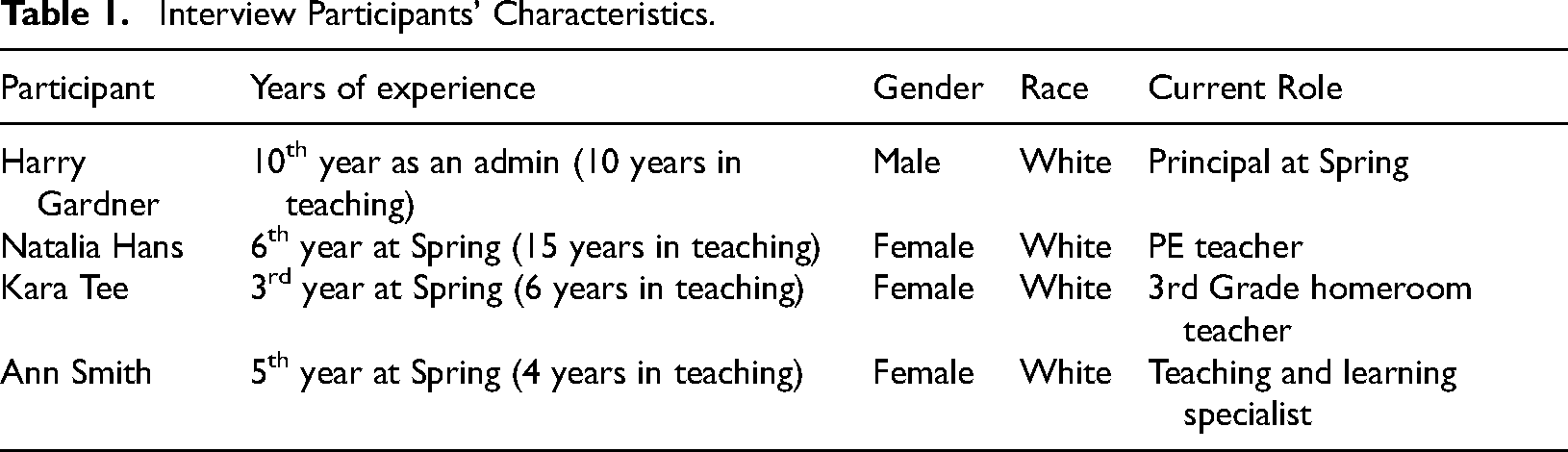
This portraiture includes four interview participants as focal actors: Principal Harry Gardner and three teacher leaders at Spring Elementary—Natalia Hans, Kara Tee, and Ann Smith (See Table 1). Although the study was designed to focus on school principals’ work, I also interviewed three teachers serving on leadership committees at Spring Elementary. Harry started his 10th year at Spring Elementary as a principal, after working as a teacher for another 10 years in a neighboring district. Natalia was a physical education teacher with six years of teaching experience at Spring Elementary, along with 10 years teaching middle school science prior to transitioning to Elementary physical education. Whenever I visited Spring, I would see her interacting with students in the gym or discussing ideas with Harry in the hallway. Kara was a third-grade homeroom teacher in her third year at Spring Elementary, after teaching at two different elementary schools for four years. Kara completed her administration internship hours with Harry during the 2017–2018 school years and continued to participate in multiple planning committees. Ann was in her fifth year at Spring Elementary, serving as a teaching and learning specialist, a new position created starting with the 2018–2019 school years. Previously, she spent four years as a special education teacher at Spring. Since her responsibility involved instructional coaching and intervention to support students with special needs, I often saw Ann leading teacher professional development at the grade level to support intervention and having discussions with Harry and teachers about instructional strategies.
Interview Participants’ Characteristics.
Data collection and analysis
Data were collected through observation, individual interviews, and artifacts over the course of the 2018–2019 school year. I visited Spring Elementary monthly, spending six to eight hours per visit. In total, my fieldnotes recorded approximately 50 hours of observations, focusing on the principal's interactions with teachers, students, and families, which accompanied multiple observations of important school events (e.g., graduation ceremony, teacher–parent conference), teacher professional development, and daily routines, such as meetings, recess, classroom visits. I conducted eight interviews in total at Spring, five with Harry and three with the teacher leaders (one with each). As the original study focused on principal leadership, I interviewed Harry (both conversational and semistructured) throughout my visits to understand his interpretations of incidents that I observed and his perceptions of accountability. At the end of the school year, I convened a semistructured interview with each of the three teacher leaders. Teacher interviews focused on their meaning of accountability in relation to their role and the culture at Spring Elementary school. All interviews, with each ranged from 45 to 80 min, were audio-recorded and transcribed verbatim. Additionally, I collected artifacts which included photos of school displays, learning activities, and events, as well as school documents and policy briefs.
To analyze data, I conducted iterative thematic coding (Saldaña, 2021) to portray the participants’ narratives about accountability situated in the context of Spring Elementary. I first attuned to all sources of data by reading line by line along with memos mapping accountability narratives. I used a narrative thinking approach (Freeman, 2017), applying the concept of “agora,” while reading the data to explore the participants’ shared understanding of accountability in the space of Spring Elementary. With this focus, I revisited data again to analyze how such meanings of accountability manifested in leadership practices, highlighting notable scenes showing relational exchanges that construct accountability, thinking with “bazaar” as a metaphor. This stage of analysis identified several themes that aligned with the framework described above. I then portrayed narratives under each theme through a cyclical writing process while searching for disconfirming evidence.
Using multiple sources of data and my engagement with the fieldwork enabled me to offer detailed context that helps readers better understand the participants’ perspectives—an important element of portraiture research. Although my analyses focused on the principal and his interactions, complemented by teacher leaders’ interviews and fieldwork, my intention was not to place principals at the center of leadership and/or reify the idea that leadership is granted for formal positions or innate identities (e.g., gender, race). Rather, I wanted to acknowledge existing studies that show school leaders’ (principals and teacher leaders) critical role in developing structures, shared norms, and relationships that facilitate transformational changes in schools.
Findings
Reclaiming the culture of accountability: School as a space of “agora”
On an early May morning, as I drove to visit Spring Elementary, the sun shone brightly over the green grasses alongside the road perfectly matching with the mood I had observed in the school throughout my visits. However, I immediately remembered that today was when third-grade students would take the state standardized test. Remembering the levels of anxiety, stresses, and tensions I felt during my visits to other schools, I sympathized with students and teachers at Spring who might carry those discomforts in contrast to the beautiful spring weather. However, my observation of Harry and other teachers during the test sessions taught me that my concerns were unjustified. The testing day was just like other days I had been at the school. When a third-grade boy came to the principal's office asking for help, Harry followed him to the classroom and resolved his login issues to enter the testing website. Students were calm. Harry and teachers ensured everything was ready for students with smiles.
Curious about how students felt about the testing, I went to see the students outside during recess. I walked with Hannah as she snacked. Hannah was a third-grade girl in Kara's classroom. Her teacher, Kara, would walk with students and give them snacks during recess which I sometimes joined. I asked Hannah, “How was the testing this morning? Are you nervous about the result?” She told me, I was. I mean I don’t think I did a bad job, but I didn’t complete the question 4. I had to write a lot. Mrs. Tee [Kara] told me ‘It's okay. If you missed schools several days, it might be hard to know all the questions.’ That makes me feel better.
Hannah recently missed school several days because her mom had given birth seven weeks early and had to stay in the hospital. Hannah, the eldest child, had been taking care of her younger siblings, missing school, and was still worried about her mom staying in the hospital. Hanna later told me there would be additional 1:1 sessions with Kara to make up for the lessons she missed. In spite of this, she wanted to do her best for the English Language Arts (ELA) test that morning. Kara warmly soothed Hannah's worries about the test, concerned with what Hanna had to cope with at home. All the third-grade teachers prepared snacks and comforted their students with smiles.
This image of testing day overlaps with my interviews. When I asked about participants’ meanings of accountability, the prevalent narrative I heard was about “doing what's best” that is deeply rooted in “collaboration,” “shared responsibility,” “mutual trust,” and “students-centeredness.” Although they were in compliance with the policy mandates, such as standardized testing, the third-grade reading law, small group intervention, as elements of accountability, my fieldwork confirmed that this compliance was peripheral to the culture of accountability at Spring. Instead, their accountability reflected a collectively shared “growth mindset” among staff members who were willing to go beyond the standards or policy mandates to “best serve students.” Harry seemed to set the tone for this shared mindset, as he noted: …if I become overwhelmed and anxious and upset [about accountability pressures], then that will trickle down to staff members. So, I look at all these challenges and try to have the optimistic lens of an opportunity. We can grow and get better and be the best we can be for STUDENTS [Harry's emphasis].
This sentiment seemed to be shared among teacher leaders. Even though they addressed challenges to meet certain requirements related to student assessment, tracking data, and curriculum alignment mandated by the state and/or district, they expressed “love” and “joy” of what they do, regarding these policy initiatives as possible resources and tools for student success that they devote themselves to.
Developing habits of mind and practice: “bazaar” in leadership practices
The culture of accountability shown in the earlier section was grounded in the daily human interactions among members of Spring Elementary as a space of “agora.” In this current section, I portray three exemplary themes that represent “bazaar,” the exchange elements of generating the collective directions of “accountability”: Student centeredness, professional agency, and belonging as community.
Student centeredness: Meeting students where they are
At Spring Elementary, student centeredness stood out in everyday interactions and this guided “where accountability should be headed.” Walking around the Spring building reminds me of Ann's comment, “definitely there's a very strong passion for kids in our building.” I loved seeing photos hanging on the walls, capturing both Spring students’ dramatic movements with big smiles and their serious efforts in classrooms, on the playground, and on field trips. The teachers highlighted how every classroom was “set up for the comport of kids.” This student-centeredness permeated interactions between students and educators. During his interview, when asked about his perceptions of accountability, Harry emphasized: “It starts with students….We have to meet students where they are and try to take them as far as we can.” Harry's efforts to “meet students where they are” were visible, in particular with his “frequent flyers” who often visited his office for behavioral issues. Harry would meet them and collect multiple aspects of qualitative data about each student through his active listening to students and teachers, through playing sports with his students on the playground during recess, and through his daily greeting and check-in in the parking lot, cafeteria, and classrooms.
During my visit in October, Andrew, a fourth-grade boy who would often visit the principal's office, came to see Harry. Andrew was diagnosed as emotionally impaired, but his mother refused any additional special education services. That particular morning, Andrew was having issues with his music teacher Joe. Andrew refused to apologize to her and was sent to the principal's office. Harry gave Andrew some Lego blocks to let him play with. Andrew looked still angry. Harry asked, “When you think about school, what do you look forward to?” “Umm, gym!” Andrew answered with smile. Harry said, “Okay, you look forward to gym. What about recess and lunch?” Andrew seemed to think for a second, said, “Ummm, I like recess time. And lunch.” Confirming Andrew's angry face becoming jovial, Harry said, “What else? What about the readers’ theater?” Andrew immediately answered with smile “Oh, I like it.” Harry took memos about what Andrew said and added, “Andrew, help me understand. Sometimes, learning is hard. You know that. It seems like you enjoy reading though. Why don’t you let Olivia [his teacher] help you learn?” Andrew, with an unhappy voice and face again, complained about Olivia asking him to apologize to Joe, which he does not want to. Harry carefully reminded Andrew that recess is coming, saying “If you want to apologize to Joe, you can have time for the recess. Just think about it.” After taking time for himself, Andrew wrote an apology letter and went back to classroom. That same afternoon, Andrew was at recess, running, and playing soccer with other kids as well as with Harry. Andrew looked just like the other kids on the playground. Harry's efforts to learn about students and support them were connected with his self-reflective thoughts that “We as human beings, make lots of mistakes. Adults have categories in his or her mind, we sometimes forget they (these kids) are only 10 years old…” Harry's desire to “meet students where they are and help them learn” and courageous acknowledgement that adults’ (including himself) misjudgment can harm students’ potential was starting point of his accountability perceptions, which eventually informed the best decisions to support each student's growth.
The qualitative data Harry collected through his rich interactions with students and the way he collected data about students on a daily basis were shared with teachers, parents, or district leaders when making any significant decisions for each student. On other occasions where teachers sought Harry's advice for making decisions about students, such as formal data meetings tracking student achievement as well as informal conversations, Harry shared multiple aspects of data he gathered as examples that can inform teachers’ decisions. Ann's interview confirmed that, while numbers, scores, and student progress bars were utilized to track students’ progress, the rich qualitative data collected by Harry and teachers were used to “contextualize and humanize” their decisions, seeing “every student as unique.” In this way, student centeredness aligns with equity instead of equality, echoing Harry's comment: “Each individual needs to feel belonging and receive supports at school to succeed.”
Professional agency: Investing in teachers as professionals
Supporting students’ growth requires teachers’ expertise. Collective growth as a norm of accountability at Spring was driven by the idea of “teachers as professionals,” which requires long-term investment to grow. At Spring Elementary, the state-mandated teacher evaluation was just “minimum standards” to meet “what others want teachers to be accountable.” Harry believed this evaluative form does not speak to “accountability to the profession.” Teacher leaders instead sought “collective growth” through “collaboration,” “affirmation,” “trust,” and “shared responsibility” as part of accountability. As Harry noted, “the better I can be for my teachers, the better they can be for their students,” Harry offered formal and informal support for teachers to “grow as leaders.” For instance, he made himself leading weekly morning assembly with students so that teachers can have grade-level professional development meetings during that time. His ability to secure and coordinate financial and human resources from within as well as outside the district supported the teachers at Spring to attend workshops, conferences, and other learning opportunities not necessarily required by the district. One of the critical elements in developing teachers at Spring Elementary was the fact that teachers were invested for the long term, rejecting a market-driven, short-sighted approach. Especially, Harry's leadership in supporting his teachers accompanied building relations through “time and history” of disagreement, mutual understandings, and “caring and cheering.”
The day in February 2019 when the county's Best Five Teachers 3 were announced brought me immersive narratives about how teachers at Spring Elementary are supported and grow as leaders. With the support of a local magazine, the county had been awarding Best Teachers Award for nine years, which involves a rigorous selection process that requires nomination, multiple rounds of reviews, and observations with external committees. Like any regular day, Harry was planning classroom “checking ins” with students and teachers at 9:45. I followed him to the first-grade teacher Miranda's classroom. Sitting quietly near a pair of students working on worksheets at the corner, Harry observed what they were writing for minutes, having conversations to praise how they were good at it. When Miranda finished responding to several students asking for help, Harry went to her showing his phone screen to Miranda. After his whispering to her, Miranda hided her mouth with surprise and added, “Oh my god, Oh my god, Really?” While laughing, she leaned on Harry's shoulder. Her eyes became teary. Harry then headed to the fifth-grade teacher Samantha's classroom, where she was alone while her students were in the gym. After answering to Samantha's question about her planning class event, Harry showed her the email stating she was in Best Five. Samantha's hands covered her face saying, “I feel so, so happy. I am so honored.” Tear came down from Samantha's eyes. “Thank you so, so much.” Samantha said while crying. Harry said, “You deserve it. I am so happy for you.” Samantha asked, “How are others?” “Miranda, Natalia, and you are in Best Five.” Harry replied with smile. Samantha said, “So exciting. I am so proud of being at Spring.” Harry proudly told me, “We have had three teachers in Best Five for the last eight years. This year we have three. So, we have now six Best Five teachers at Spring!”
Around 10:30, I joined Harry driving to the district to deliver this glorious news to PE teacher Natalia, who was in the district Professional Learning Community (PLC). During this 8-min drive, Harry shared his story of each teacher, when I asked how he supported them. I am so proud of them. Especially Samantha who reinvented herself 7–8 years ago… She went from top down authoritarian ways. She and I, we had times not seeing each other's eyes. She left Spring to work at the middle school, but the middle school principal didn’t want her.…Samantha later came back to me and said, ‘I want to work here’ and I said ‘of course. I want to have you….if you don’t agree with me, I am the first person you need to tell me. It's fine to disagree.’ It took time to rebuild our relationships….One day my wife and I went to see her musical performance in town. She knew I care for her. Now, our relationship is phenomenal.
He also shared history with Miranda who once “smashed her pencil to the ground in front of me [him]” years ago because of their disagreement on school–parent relationships. After some weeks, Harry invited her for lunch and from that conversation, Harry learned Miranda experienced foster care when she was a kid. His efforts to learn about each teacher as a whole person, like he did for his students, required patience, respect, and courage to learn from others.
Arriving at the parking lot of the district building, Harry described the moment he hired Natalia, remembering her confirming herself as a "risk taker" who wanted transition from being a science teacher to a PE teacher. Harry guided me to the room where all PE, Arts, and Technology teachers from the different schools in the district gathered to develop the district's Essential Standards for each subject. Ten teachers were individually at work on their laptops, asking questions within small groups from time to time. Harry first talked with Kathy, a technology teacher at Spring, who asked some questions, and then approached Natalia stealthily and discussed several standards. Natalia seemed to assume his visit was a regular one since Harry would visit the district's PLC meetings to support his teachers when any attended. Harry told Natalia that “You are in Best Five. Congrats,” which brough big smile on Natalia's face. Kathy congratulated Natalia with a warm hug. On our way back to school, Harry explained his intention behind the visit: “I want to show I care what they do and what they are doing is important.…I spent pretty much time with Kathy because she had some questions. I don’t know about the answers, but I can let the curriculum director, or my boss know about her questions.”
Observing the joyful tears and celebrations for teachers, I choked up several times during the day. The behind-the-scenes stories shared between Harry and teachers, especially Samantha and Miranda, affirmed the “love” and “faith” that Harry consistently infused into his relationships with teachers, and played a significant role in motivating teachers to “reinvent” themselves and grow. Instead of letting Samantha and Miranda leave his school or the profession because of their past struggles and mistakes, Harry's belief that “We would grow together” eventually helped teachers thrive as professionals. Moreover, his support for teacher development suggests the importance of leadership roles bridging available resources and building structural supports, which can develop a more collaborative, professionally driven, and growth-oriented accountability culture at Spring Elementary.
Belonging as community: Celebrating collective accomplishment together
Like other rural schools, Spring Elementary was at the center of their local community. The sense of belonging was shared among students, staff, and members of the local communities, who all have ties to the school. This sense of belonging also helped Spring Elementary to sustain its culture of accountability, which was evident in my observations of multiple school events where many community members engaged and celebrated students’ growth.
On the sunny day of June 2019, I was invited to Spring's Graduation Ceremony. Unlike other visits, Harry was wearing a black suit with a red-white stripe tie. As soon as I entered the building, I saw kindergarteners wearing flower necklace lining up to make a tunnel. The fifth graders walked through the tunnel while other kids and teachers standing clapped their hands. They were walking to the local church right across the school building, where Spring graduation ceremonies have been held for years. Harry explained church was an important resource for the community and having the ceremony there was because of space.
There were almost 200 adults sitting in the chapel room. Samantha was playing calm piano music. Students walked in a row and sat side by side in the chairs prepared for them on the stage. They walked slowly looking straight ahead as if they were on the fashion runway. Harry stood up at the microphone. He had members of the graduation committee, including community members, parents and teachers, stand up, asking all of us to thank them. Like other school events in Spring, this graduation ceremony was not planned by Harry but rather by the committee members who took leadership. Harry called each student's name and a fifth-grade teacher Karl handed them their diplomas. Students hugged their teachers. Claps and cheers from the guests filled the room.
Scanning the room, Harry said, “Is John here? A former Spring, he will talk about the transition to the bigger school.” John was a seventh grade at junior high and graduated Spring Elementary. Harry intentionally recruited John as a speaker to lift him up after finding out that John had been injured. A teenage boy wearing a support device on his legs came to the stage and started giving a speech: You’ve learned a lot. It includes how to tie your shoes, how to spell your name, and how to read books.…But I want to highlight the importance of relationship. You will keep being thankful relationships built here and at your middle school. Spring is the coolest one for sure, my experience with friends from Oak and Forest (the other two elementary schools in the district) was also good. Don’t be afraid of being in the bigger world.
John's speech was most relevant for those students on the stage who were about to depart Spring where they had created so many memories over the past six years. Followed by applause for John, Harry delivered his speech. … First, I want you to know that you all have a special place on my heart. It was hard to say your real names without saying your nicknames. …I love seeing you have grown up from Pre-K and will miss your hugs and hi-fives. Second, there is a quote that “change the world and make the world better place.” However, I have to challenge this. Please stand up if you are parents or guardians. (Half of them stood up). Please stand up if you are grandparents (80% of the guests were standing up). You [students] already made changes. See. You changed them [adults standing up]. So, I will say to you, keep changing the world. (Clapping came). Third, you’re always gonna matter to me. I’m still gonna care about you. Even you are in high school, tacking your records. I am not your principal anymore, but you’re always gonna matter to me. Love you all.
I saw many teary eyes in the room. Teachers and guests, including myself, used handkerchiefs or sleeves to wipe away tears. His speech led me to reflect on the purpose of schooling for these young students. Teachers and Harry expressed their collective recognition of students’ growth and brought pride to students, parents, and other community members. Spring graduation reminded me that schools are “for students” and they move educators and parents to be changed. Centering young students as part of the Spring community, I could feel every single student and community member owned their place at Spring Elementary. Such community-engaged practices well align with Harry's understanding of “accountability to the community” where educators need to contribute to the next generation of society.
Discussion
The portrait of Spring Elementary illuminates how accountability can be reimagined through educational leadership. Despite prevalent discourses around technical, performance-driven approaches to accountability (Ball, 2003; Biesta, 2004), the principal and teachers in the current study showed accountability that is more professionally responsible (Cochran-Smith, 2021; Cranston, 2013; Stone-Johnson and Weiner, 2022) and more humane (Byrne-Jiménez and Yoon, 2019; Kim, 2020a). The culture of accountability at Spring Elementary was deeply rooted in care, respect, and shared responsibility to support students’ growth. This accountability space (“agora”) exemplified student-centeredness, teachers’ professional agency, and belonging as community depicted in the daily interactions and symbolic celebrations (“bazaar”). Although participants were aware of meeting policy mandates (e.g., testing, student discipline, small group intervention) as a form of technicist accountability, they constructed more humane and generative accountability to support students’ holistic development, which goes beyond matrices given to them by others.
This article extends research highlighting the importance of leadership in constructing new ways of thinking and constructing accountability in schools (Cranston, 2013; Byrne-Jiménez and Yoon, 2019; Goessling et al., 2020). Tensions between top-down policies in the accountability regime and the agency of educational leaders on the ground are inevitable. Thus, educational leadership in such a context requires professional responsibility accompanying constant reflection on the values, vision, and purpose of schooling (Kim, 2020Cranston, 2013). Portraits in this study offer some examples of habits of mind and practice that support humanizing accountability in schools.
First, embracing a student who they are as a whole person is essential to humanizing the practice of accountability, which aligns with research on humanizing pedagogy highlighting the importance of trust, relations of reciprocity, and students’ overall well-being (e.g., Bartolomé, 1994; Salazar, 2013). As education is about nurturing human beings, relational aspects of leadership cannot be disregarded in developing collective efforts to construct a culture of accountability. In this sense, participants’ interactions with students and Harry's collecting qualitative data concerning their well-being exemplify how leaders can understand students as whole persons, not just as “objects” of policy mandates and standards. Harry's approaches to teachers also reflect the holistic view of individual human beings. He tried to learn about Samantha and Miranda as a person when they had conflicts, which helped them develop mutual trust Harry's daily interactions and genuine engagement with each individual were valuable resources that informed decisions to best support student and teacher growth.
Second, as part of accountability to the profession, it is important to recognize and develop teachers as professionals. Literature has shown the teaching job as a profession requires long-term investment and cultivating professional agency that eventually led teachers to exceed standards and collectively grow (e.g., Hargreaves and O’Connor, 2018). Without long-term investment in teachers’ growth, Spring Elementary may not have had six Best Five Teachers. For example, what made Samantha reinvent herself would have been shared responsibility and norms that were facilitated by Harry's efforts to support “teachers as professionals” who need to grow continuously. However, teacher policies utilizing market logic in current educational environments are likely to undermine such leadership efforts to invest in and strengthen the profession. Nevertheless, Harry's firm belief that teachers can learn from mistakes and grow enabled his teachers to thrive with high expectations, regardless of policy standards to meet. This way, teachers are empowered as leaders and better support their colleagues and students.
Third, celebrating student growth with communities is critical to developing and strengthening belongingness. Research on community-centered leadership implies that genuine care and support for students without communities is impossible (Alvarez Gutiérrez et al. 2022). The process of developing democratic, reciprocal accountability in schools requires voices of communities where students belong to (Goessling et al., 2020). Spring Elementary's graduation ceremony implies that celebrating and recognizing student growth as a community can strengthen belongingness. Inviting community members in the process of planning the ceremony, having John as a speaker, and acknowledging how students changed adults in the room, all show Spring Elementary is part of the community and each student owns their place. This type of celebration would bring more impacts on students’ growth than glorifying their test scores, graduation rates, and other types of metrics that do not allow space for individual students and community members to be recognized.
Moreover, my methodological approach extends policy enactment studies (Ball et al., 2011; Lipsky, 2010). Utilizing O’Kelly and Dubnick's (2020) metaphors, “agora” and “bazaar,” enabled me to explore general accountability depicted in leadership practices and resist the fixed notion of accountability that is bounded by certain terms, goals, and intentions in existing policy documents. Imagining school as an agora, a primordial space where accountability emerges, was useful to encounter and identify accountability constructed by leaders’ daily practices as a bazaar where a reciprocal stance is developed. Further, this approach supported the nature of portraiture, elaborating situated narratives and cultural contexts of the research site.
With the outbreak of COVID-19 pandemic, my study, even done in the pre-COVID, still offers a possibility that schooling can be more humanely than we often conceptualize. The prevalence of accountability discourses undermining humanity in policy and research may not fully capture leadership efforts to enact accountability more humane in schools. To explore new ways of schooling in a time of crisis with the pandemic, racial injustice, and gun violence traumatizing school communities, researchers and leaders need to reimagine key concepts and ideas of education (like accountability) to inform how schools can better embrace humanity and serve the needs of every student. This can be done by creative thinking about leadership that goes beyond policy scripts and asking schools what to do (See Kim, 2020b). Relatedly, policies at multiple levels need to offer structures and resources that local leaders can utilize to sustain their accountability culture in a way that values professional agency in constructing accountability based on the needs of students, educators, and communities. Given these conditions, school leaders need to consciously develop habits of mind and practice that humanize their interactions with others, implementation of policy mandates, and role of leadership. For leadership educators and professional development programs, one way to promote such process is to utilize storytelling and/or case analysis informed by real-world practices like this portrait to facilitate leaders’ reflective praxis toward equity and humanity as part of their reimagined accountability.
Footnotes
Declaration of conflicting interests
The author declared no potential conflicts of interest with respect to the research, authorship, and/or publication of this article.
Funding
The author disclosed receipt of the following financial support for the research, authorship, and/or publication of this article: This work was supported by the Michigan State University College of Education Summer Research Renewable Fellowship.
