






Abstract
Relying on the social cognitive theory, which postulates that human behaviour is due to social experiences and cognitive interpretation, the current study seeks to investigate the mediating role of collective teacher efficacy (CTE) in the relationship between principals’ systems thinking (PST) and school effectiveness in terms of academic emphasis and student academic achievement after accounting for students’ socioeconomic backgrounds. A three-source survey design with self-report and non-self-report data was used, from a sample of 423 participants from 71 elementary schools in Israel. The sample included school management team (SMT) members and teachers who were not SMT members. Data were aggregated at the school level of analysis. The results from structural equation modelling and bootstrapping analysis indicated that CTE partially mediates the relationship between PST and academic emphasis, irrespective of the students’ socioeconomic backgrounds. Theoretical and practical implications are discussed.
Keywords
Introduction
There is considerable research evidence for the important role of school leadership in promoting school effectiveness (e.g. Leithwood et al., 2020; Özdemir et al., 2021). One leadership approach that has been proposed for effective school management is principals’ systems thinking (PST), as it offers a new way of considering events and processes that allows principals to better understand complex situations that arise in their schools (Shaked and Schechter, 2020). PST is defined as a holistic approach that advocates seeing the whole picture, that is, a broad, general view of the school system's components in the context of its environment. This approach places the study of wholes before that of parts; instead of trying to break systems down into parts to understand them, systems thinking focuses on how the parts function together in networks of interaction (McCaughan and Palmer, 2018). The reasoning is that to improve the whole, the interactions among the parts need to be optimised. For example, managing interactions between the teachers in a school may result in improved performance, thereby promoting school effectiveness. This interactive approach enables the perception of reality from different viewpoints under an array of influencing factors. Shaked et al. (2018) conceptualised PST as having four core characteristics: adopting a multidimensional view, openness to a variety of opinions, leading wholes, and evaluating significance.
Despite the above, many researchers consider that the impact of leadership on school effectiveness is mediated through teacher beliefs, behaviours and practises (Bellibaş et al., 2020; Hallinger et al., 2020; Park et al., 2019). Accordingly, we sought to investigate the direct and indirect influences of PST on school effectiveness through the mediating role of collective teacher efficacy (CTE). CTE was chosen as a mediating variable in the model because it is acknowledged as being one of the most significant routes from a principal's leadership to students’ academic achievement (Goddard et al., 2015; Meyer et al., 2020; Voelkel and Chrispeels, 2017). CTE is defined as the beliefs that group members hold about their shared ability to organise and execute a plan of action to reach desired goals (Bandura, 1997). It is based on Bandura's social cognitive theory (1989), which focuses on human agency in social contexts and the ways that people exercise a certain level of control over their own lives. A sense of self-efficacy is central to the exercising of control; however, social cognitive theory acknowledges that personal behaviour operates within a wide network of social-structure influences. Therefore, the theory extends the perception from mechanisms of human agency to collective agency, that is, beliefs in the interactive dynamics of group members toward achieving goals (Bandura, 1997). Accordingly, we propose to investigate the mediating role of CTE on the relationship between PST and school effectiveness outcomes in terms of academic emphasis and student academic achievement after accounting for the students’ socioeconomic status (SES) (see Figure 1).

Research model. Collective efficacy mediates the relationship between PST and Academic emphasis and GEMS.
This study may contribute to the existing body of research on educational leadership and policies in the following ways. First, it highlights the importance of building a work environment in the school that produces CTE, leading to school effectiveness. Second, while the literature points to PST as effective leadership that promotes school effectiveness (Benoliel et al., 2019), few studies have examined the mechanisms that lead to this outcome. Third, we consider students’ SES in our model because research has shown that teachers and principals serving students with low SES face more challenges in their work, such as students’ inappropriate behaviour and inherent difficulties due to a low academic background, with implications for school effectiveness (Lavy and Ayuob, 2019). Hence, this research uses an innovative and integrative model to explore a possible mediating path between PST and the outcomes of academic emphasis and student academic achievement through CTE. Exposing this mediating mechanism may reveal an important path toward promoting student effectiveness regardless of socioeconomic background, where all students can equally enjoy a nurturing learning environment.
Theoretical background and hypotheses
Principals systems thinking and school effectiveness
PST is a discipline for seeing the whole picture; the focus is not only on the trees—symbolising snapshots of certain events or limited domains—but also on the forest, that is, the overall phenomenon, investigating the underlying patterns, structures, and assumptions that lead to an event and creating an understanding of the system's relationships (Shaked and Schechter, 2020). Empirical quantitative research has found that PST consists of four core characteristics: (1) adopting a multidimensional view, that is, the principal's ability to contemplate several aspects and dimensions of a given issue simultaneously, by attributing that issue's emergence and existence to a wide range of potential sources (e.g. understanding that certain components of the school affect the way some of its other components function); (2) openness to a variety of opinions, reflecting the principal's willingness to listen to diverse people and ideas, which derives from his/her self-awareness of his/her own limitations and readiness to learn from others (e.g. involving teachers in decision-making processes); (3) leading wholes, referring to the principal's ability to see any topic in the school from a holistic perspective, that is, the big picture and not just its individual parts (e.g. offering solutions that affect the entire work environment, rather than just specific details); (4) evaluating significance, which is seen in the principal's ability to envision elements of school life according to their level of importance and relevance for the entire system (e.g. spotting small events that are nonetheless meaningful) (Shaked et al., 2018).
PST leads to an improved understanding of the impact of various decisions on the organisation as a whole, thus helping principals make better decisions toward enhancement of students’ academic achievement (Marshall and Fisher, 2018). Nevertheless, many studies have indicated that this enhancement is achieved indirectly through conditions designed to affect the quality of teaching and learning in schools (Benoliel, 2020; Heck and Reid, 2020; Liu and Hallinger, 2018). In this context, studies have shown that PST can have a number of positive effects on teachers’ attitudes and behaviours: for example, research has found that PST leads to a common positive sense of shared work and responsibility, promoting the use of flexible methods for teaching, learning, and holistic thinking (Chen-Levi et al., 2021). Moreover, PST has been found to create a positive work environment for the school staff, facilitating teachers’ job satisfaction and organisational commitment (Benoliel et al., 2019). In addition, research has shown that teachers’ positive attitudes and behaviours and a positive work environment promote school effectiveness (Bellibaş et al., 2020; Park et al., 2019). Therefore, the aim of the present study is to examine the mediating role of CTE in the relationship between PST and school effectiveness.
The relationship between PST and CTE
The present research suggests that PST may improve teachers’ efficacy beliefs as a group. CTE refers to the beliefs that group members hold about their shared ability to organise and execute a plan of action necessary to reach desired goals (Bandura, 1997). Collective efficacy beliefs are based on Bandura's social cognitive theory (1989) which explains human behaviour as being influenced by a triadic reciprocal relationship involving human behaviour, personal factors (including cognition), and environmental factors. According to social cognitive theory, efficacy beliefs are bolstered or undermined by the presence or absence, respectively, of four core sources: enactive (mastery) experiences—the individual's experiences from the successes and failures of his or her group (e.g. of teachers); social persuasion—encouragement from influential others (e.g. principal); modelling (or vicarious learning)—observation of other groups’ (e.g. of teachers) success; and affective states—one's emotional and physiological states (Adams and Olsen, 2019; Bandura, 1997).
In the school context, CTE describes teachers’ perceptions in a specific school about their shared ability to execute the plans of action needed to enhance student learning and performance (Goddard et al., 2004; Goddard and Skrla, 2006). It is based on a collective performance analysis of the teaching task and an assessment of the teaching competence of the school faculty as a whole (Tschannen-Moran and Barr, 2004), and it is a powerful parameter for understanding the quality of school life and teachers’ well-being (Guidetti et al., 2018). Previous research has identified principals’ activities that may enhance teachers’ self-perception as a competent group (Cansoy and Parlar, 2018; Ninković and Knežević Florić, 2018). These include promoting and encouraging a supportive environment that offers teachers opportunities and responsibilities that they are able to fulfil; building opportunities for implementing successful practises that have been tried in other schools; and organising events to improve communication with teachers, emphasising common objectives and teacher participation in school decision-making (Cansoy and Parlar, 2018). Other research has indicated that a principal who encourages teacher collaboration strengthens CTE (Meyer et al., 2020).
PST is a leadership approach that creates a supportive and empowering environment (Nadav et al., 2020). It involves a multidimensional view and a broad and comprehensive perspective of the situation, and thus each problem in the school is examined from a large number of aspects. This view considers teacher groups’ past successes and failures. In addition, the principal's openness to a variety of opinions allows teachers to learn from a variety of other teacher groups’ successes and practises (Shaked and Schechter, 2017). Moreover, principals who demonstrate systems thinking activities encourage their teaching staff to be active in decision-making processes and to take responsibility for school goals and achievements (Nadav et al., 2020). According to Cansoy and Parlar (2018), when teachers are involved in decisions related to school goals and policies, they may feel that they have control over events. Hence,
H1. There is a positive relationship between PST and CTE.
The relationship between CTE and school effectiveness
Educational studies differ in their opinions regarding the use of different indices to measure school effectiveness. Researchers have emphasised that a school is a complex organisation and therefore many factors can contribute to effectiveness (Bailes, 2015). Recognising school complexity has led to the use of the constituency approach (Connolly et al., 1980), which suggests incorporating several indices for the measurement of effectiveness since effectiveness in one area may not necessarily imply effectiveness in another. Therefore, in the present study, we examine school effectiveness using two variables: academic emphasis and student academic achievement.
Furthermore, some of the prominent characteristics of school effectiveness refer to developing high expectations from students and teachers, an atmosphere of order and discipline conducive to learning, an emphasis on basic-skill acquisition, and monitoring of students’ progress (Hallinger and Heck, 2011). Academic emphasis and student academic achievement involve these competencies. Academic emphasis refers to the combination of teachers who set high, but reasonable goals, students who respond positively to the challenge of those goals, and a principal who supplies the resources and exerts influence to attain those goals (Hoy and Miskel, 2013). Student academic achievement in this study refers to objective outcomes of standardised tests that examine the level of achievement in the various content areas that are taught in schools and, in particular, the core subjects (mathematics, native language, and English). The choice of student academic achievement is consistent with recent research that examined school effectiveness through student academic achievement (Jarl et al., 2021). Accordingly, academic emphasis and student academic achievement represent a school that works systematically and continuously towards self-improvement to achieve its goals by maximising its physical and human resources while maintaining the well-being of the teachers and students (Benoliel, 2021). Thus, school effectiveness focuses on promoting students’ academic and social outcomes regardless of the socioeconomic composition of the student body (Ramberg et al., 2019). We suggest that CTE facilitates school effectiveness.
Academic emphasis
The literature points to academic emphasis as a central element in a school's organisational health (Gray et al., 2016; Seashore Louis and Lee, 2016). Academic emphasis is an organisational feature that refers to the extent to which the school is driven by the quest for academic excellence, that is, aspires to high academic achievement (Hoy and Miskel, 2013). Academic emphasis is one of the components of a school's academic optimism and has been found to be positively related to student academic achievement, regardless of the school's demographic characteristics or students’ SES (Leithwood et al., 2020; Malloy and Leithwood, 2017; Mitchell et al., 2016). It reflects a school climate in which teachers set high but achievable academic goals for the students. There is an orderly and serious learning environment, the teachers believe in their students’ ability to attain high achievements, and the students value academic achievement (Hoy and Miskel, 2013). Schools characterised by an academic emphasis convey a clear and consistent message to the school community that the academic success of all students is both possible and critical. The teachers in these schools focus on and strive for student achievement and offer strong, individualised support to ensure that every student achieves at a high level (Straková et al., 2018).
Moreover, academic emphasis is one of the factors of a self-regulatory climate with positive consequences on student achievement (Adams et al., 2016). According to Gray and Mitchell (2021), teachers with high collective efficacy invest a great deal of effort in identifying, instructing, and helping students with difficulties and in encouraging students’ academic achievement. Similarly, research findings have indicated that teachers characterised by high collective efficacy beliefs trust in the ability of their school staff as a group to promote student learning and achievement by putting forth the sustained effort and persistence required to reach the goals (Voelkel and Chrispeels, 2017). Therefore, we propose that CTE may be an antecedent of academic emphasis, by creating an ordered work environment that reinforces the focus on and striving for students’ high academic achievement. Hence,
H2. There is a positive relationship between CTE and academic emphasis.
Student academic achievement
Students’ academic achievement in the present study refers to the Growth and Efficiency Measures of Schools (GEMS) test, which examines achievement levels in the core subjects: Mathematics, Native Language (Hebrew/Arabic), English, and Science and Technology, and is administered to students at two grade levels: grade 5 (elementary school) and grade 8 (junior high school). The GEMS examination, administered every 4 years, examines the extent to which elementary schools meet the expected student mastery levels for national curricula in various core subjects. GEMS examinations serve as a tool for the Israeli Ministry of Education to direct and control teaching and learning in schools (Nir et al., 2016).
Students’ academic achievements play a key role in creating quality graduates who will become pioneers and as a result, will be responsible for the country's economic and social improvement (Glapaththi et al., 2019). Previous studies have demonstrated that CTE has a positive influence on students’ academic achievement and performance (Donohoo, 2018; Goddard et al., 2015; Voelkel and Chrispeels, 2017). In addition, CTE has been found to help reduce inequity by closing achievement gaps for students with low SES (Goddard et al., 2017). According to Liu (2020), this is because CTE represents teachers’ trust in their ability to achieve the school's educational targets and goals. Therefore, teachers with high collective efficacy beliefs will likely work harder, using various strategies to motivate student learning, attend to the demands of low-ability students, and change students’ perceptions of their ability. As a result, student academic achievement will increase. Hence,
H3. There is a positive relationship between CTE and student academic achievement.
Mediation model
Based on the reviewed theoretical perspectives, we propose a mediation model of PST's impact on school effectiveness (academic emphasis and student academic achievement) through CTE (see Figure 1). We postulate CTE as an important mediating variable, suggesting that it serves as a significant motivational factor for teaching and learning processes (Goddard et al., 2017; Maroofi and Mohammadi, 2019), thereby promoting school effectiveness. Our rationale for proposing a mediation model lies in the fact that research to date has indicated that principals’ influence on school effectiveness operates indirectly through mediating variables—via teachers’ attitudes and behaviours—to create conditions that shape effective teaching and learning processes in the school; these processes, in turn, have positive implications for school effectiveness outcomes (Benoliel, 2021; Hendriks and Scheerens, 2013; Liu and Hallinger, 2018; Tan, 2018). Hence, we hypothesise that:
H4. CTE mediates the relationships of PST to (a) academic emphasis and (b) student academic achievement.
Method
Study setting
Israel's national school system serves approximately 2 million students in about 5200 schools, with about 73% in the Jewish sector and 27% in the Arab sector (Israel Central Bureau of Statistics, 2020). The educational system is structured into three main stages of education according to student age: (a) elementary school, grades 1 to 6; (b) middle school, grades 7 to 9; and (c) secondary school, grades 10 to 12. The current study is based on the responses of school management team (SMT) members and teachers, all working in elementary schools from the Jewish sector, which represents the largest component of the Israeli educational system (BenDavid-Hadar, 2016).
The Israeli student achievement distribution in international examinations is characterised by a low level of achievement combined with a wide achievement gap between high- and low-performing students, as evidenced by the Gini coefficient, which measures a nation's distributional inequality. The gap is mainly expressed between schools with different levels of SES based on the students’ backgrounds (Organization for Economic Co-operation and Development – OECD, 2016). Mindful of this important achievement gap, educational policy in Israel has been directed towards narrowing it.
Participants and procedure
Data were collected from 71 randomly chosen elementary schools in Israel. Overall, 423 participants from state-secular and state-religious schools were randomly sampled. Data were collected from three sources, with self-report and non-self-report data, to minimise problems associated with the same source bias (Avolio et al., 1991; Urick and Bowers, 2014). The sample included SMT members and school faculty (teachers who are not SMT members). In Israeli schools, SMT members are teachers who have pedagogical and administrative responsibilities and who have functionally interdependent relationships with the principal and teachers (Benoliel, 2021). Although the term may differ slightly among countries, most of the Israeli SMT tasks are primarily management and instructional, similar to the tasks of leadership teams in the United States and European countries (Tuytens and Devos, 2019).
For the school characteristics, school size was based on the number of enrolled students, with an average of 349.85 enrolled students per school (SD = 172.87). Distribution of the school size ranged between 73 and 756 enrolled students, with a median of 332, skewness of −.025, and kurtosis of −.672, indicating a normal distribution (Curran et al., 1996). The schools’ nurturing index (NI) reflects the overall socioeconomic, familial, and demographic risk factors characterising each school's student body as a whole. The NI is calculated by the ministry for the differential allocation of budgets to schools based on the SES of the school's student body. The school NI score ranges from 1 to 10, with a high NI score reflecting schools with students from low SES backgrounds which therefore receive larger budgetary allocations. In the present sample, the schools’ average NI score was 5.57 (SD = 1.98), with a distribution ranging between 1.40 and 9.02.
Of the 333 SMT members who were asked to participate, 211 agreed (response rate = 63.36%), with an average of 2.97 participants per school; 49.8% of the SMT members were women; their average age was 40.65 years (SD = 5.69) and their average job tenure in the profession was 12.40 years (SD = 4.99). With respect to education, 40.3% had BA degrees and 58.3% held a MA. The SMT members included 7.1% deputy principals, 24.2% grade-level coordinators, 43.1% subject coordinators, 15.6% counsellors, and 10% key school officials.
Regarding school faculty, of the 333 teachers who were asked, 212 agreed to participate (response rate = 63.66%), with an average range of 2 to 3 participants per school; 56.1% of the teachers were women; their average age was 38.80 years (SD = 6.53) and their average tenure in the profession was 11.03 years (SD = 5.21). With respect to education, 2.8% held a teaching certificate, 50.5% had a BA, and 46.4% had an MA. These sample characteristics are roughly representative of Israeli schools and their educational workforce (Israel Central Bureau of Statistics, 2020).
Data collection was performed in several steps. After receiving approval for the research project from the Israeli Ministry of Education, elementary schools were randomly selected from a list of schools provided by the ministry. First, we contacted each school's principal, explained the study's purpose, guaranteed anonymity, and emphasised the importance of candid answers. After the principals committed to having their school participate, the questionnaires were distributed to SMT members and teachers for completion. Participants took part voluntarily through validated questionnaires. SMT members completed questionnaires on PST. Teachers completed questionnaires on collective efficacy and academic emphasis. Principals, SMT members, and teachers provided demographic information. Only SMT members and teachers who had worked in the school for more than 1 year were included in the study to ensure that all respondents had sufficient time to develop perceptions and attitudes toward their organisations, principals, and co-workers. For student academic achievement and school SES, the information records (i.e. non-self-report measures) for each school, provided by the Ministry of Education, were used.
Measures
Unless otherwise noted, participants answered questions on a 5-point Likert scale, ranging from (1) ‘Never’ to (5) ‘Always’.
Principals’ systems thinking
PST activities were assessed by Shaked et al.'s (2018) 17-item questionnaire (e.g. ‘The principal tends to suggest solutions that affect the entire work environment, rather than just specific details’; α = .76). The confirmatory factor analysis (CFA) for PST indicated high goodness-of-fit indexes, χ2(55) = 110.234, comparative fit index (CFI) = .942, incremental fit index (IFI) = .944, root mean square error of approximation (RMSEA) = .069, and included four sub-dimensions: (a) evaluating significance (e.g. ‘The principal tends to take unexpected occurrences into account’; 4 items); (b) openness to a variety of opinions (e.g. ‘The principal engages in dialogue with those holding educational outlooks that differ from his/her own’; 4 items); (c) leading wholes (e.g. ‘At meetings and discussions, the principal tries to present most points of view’; 3 items); (d) adopting a multidimensional view (e.g. ‘During decision-making, the principal tends to view the entire picture before examining its details’; 6 items).
Collective teacher efficacy
Collective efficacy was measured using a scale based on that of Tschannen-Moran and Barr (2004), which contains 12 items reflecting individual subjects’ perceptions of the extent to which their respective teams are capable of functioning effectively (e.g. ‘How much can teachers in your school do to help students master complex curriculums?’; α = .85). CFA indicated that the two-dimensional construct of CTE provides good fit indices, χ2(45) = 104.586, CFI = .926, IFI = .928, RMSEA = .079. Based on the CFA, the two sub-dimensions were collective efficacy for instructional strategies (e.g. ‘How much can teachers in your school do to produce meaningful student learning?’; 6 items) and collective efficacy for student discipline (e.g. ‘How much can teachers in your school do to respond to disruptive students?’; 6 items).
Academic emphasis
Academic emphasis was measured by a sub-scale adapted from The Organizational Health Inventory for Elementary Schools (Hoy and Miskel, 2013) which included 5 items (e.g. ‘Students respect others who get good grades’; α = .80).
Students’ academic achievement
Students’ academic achievement was measured using the standardised GEMS examinations given in elementary school. This study focused on the schools’ mean scores for students’ native language, mathematics, and English. For each participating school, student achievement scores in the students’ native language, mathematics, and English were located and given as a mean score per subject per school from the Ministry of Education webpage. The grades represented the average achievement of the school, on a scale ranging from 0 to 100.
Control variables
We controlled for the variables school size and school SES. These variables were chosen because the literature indicates a connection between them and leadership, teachers’ attitudes and behaviours, and student academic achievement (Paletta et al., 2017).
Level of analysis
In the present study, the school is identified as the unit of analysis. Therefore, students’ academic achievements were assessed at the school level (retrieved as a school score from the Ministry of Education's data set). PST was an aggregate of the responses of SMT members. Collective efficacy and academic emphasis were aggregates of the responses of individual teachers. Theoretically, Rousseau (1985) advocated the use of composition theories that elucidate the functional similarity of structures at various levels. Teachers’ perceptions of their work environment are likely to be similar for teachers from the same schools because the collaborative work and frequency of communication among teachers create common norms of work and behavioural patterns (Jehn et al., 1997).
To statistically justify aggregation of measures from individual teacher ratings to the school level, mean within-group interrater reliability (rWG) values (Dunlap et al., 2003; James et al., 1993) were calculated, indicating the degree of agreement among teachers. An rWG value of .70 or higher is suggested to be very strong (LeBreton and Senter, 2008). Then, before aggregating individual-level scores to the group level by mean, intraclass correlations (ICCs) were calculated. ICC(1) reflects the extent of inter- versus intra-group variability and ICC(2) provides an estimate of the reliability of the group means (Bliese, 2000). ICC(1) values generally ranged from 0 to .50, with a median value of .12, justifying aggregation and group-level analysis (James, 1982). Although there is no common agreement regarding the cut-off for ICC(2), Glick (1985) suggested that ICC(2) values over .60 are desirable to justify aggregation when the group size is >10 members (Bliese, 1998). However, in our case, where the group size was two to three members, the applicability of ICC(2) analysis for justifying data aggregation is limited. In addition, scholars have suggested that lower ICC(2) values are acceptable as long as rWG and ICC(1) values are high, and significant F statistics are observed (Dietz et al., 2015; Shin et al., 2017).
Our results demonstrated the following: for the PST sub-dimensions, rWG = .75, ICC(1) = .15, ICC(2) = .35 and F = 1.53, p < .01 for adopting a multidimensional view; rWG = .90, ICC(1) = .44, ICC(2) = .70, F = 3.37, and p < .001 for openness to a variety of opinions; rWG = .81, ICC(1) = .26, ICC(2) = .52, F = 2.06, and p < .001 for leading wholes; rWG = .74, ICC(1) = .16, ICC(2) = .36, F = 1.56, and p < .01 for evaluating significance. For CTE, we found rWG = .91, ICC(1) = .33, ICC(2) = .59, F = 2.44, and p < .001 for instructional strategies; and rWG = .88, ICC(1) = .19, ICC(2) = .42, F = 1.72, and p < .001 for student discipline. For academic emphasis, we obtained rWG = .94, ICC(1) = .45, ICC(2) = .71, F = 3.42, and p < .001. Thus, there was sufficient statistical justification for aggregating individual perceptions of PST, CTE, and academic emphasis at the school level of analysis (see Bliese, 2000).
Data analysis
We examined the direct and indirect effects of PST on academic emphasis and student academic achievement via CTE. We tested our model using the structural equation modelling (SEM) approach proposed by James et al. (2006). The analysis was based on AMOS version 21. According to James et al. (2006), this is a more appropriate procedure than multiple regressions for testing mediation because it enables testing for both full and partial mediation. Specifically, to examine if the mediation is partial, a direct path is added from the independent variable to the outcome variables. Moreover, a simultaneous test of the significance of both the path from a predictor to a mediator and the path from the mediator to an outcome (the test SEM applies) affords the best balance of type I error rates and displays better statistical power relative to other approaches (MacKinnon et al., 2002).
In the present study, the full mediating model describes the relation of PST (independent variable) to CTE (mediating variable), and that of collective efficacy to academic emphasis and student academic achievement (dependent variables). To support the partial mediation model, the full mediation model (M1) was compared to a partially mediated model (M2), which is the same model but with additional paths from the input variable (PST) to the outcome variables (academic emphasis and student academic achievement). To gauge model fit, several goodness-of-fit indices were used (absolute and relative indices) (Jöreskog and Sörbom, 1996). χ2 values, which provide a statistical basis for comparing the relative fit of nested models, were indicated. A better fit of the partial model with a significant χ2 as compared to the full mediation model would suggest that collective efficacy partially mediates the relationship of PST to academic emphasis and student academic achievement.
Finally, we used the bootstrapping procedure, based on a 5000 bootstrap sample size, to ascertain the presence of indirect effects (Preacher and Hayes, 2008). This approach is recommended when testing for mediation in small samples due to biased variance and standard error estimates using conventional mediation approaches (Hayes, 2015).
Results
Means, standard deviations, internal reliability, and inter-correlation matrix for all key variables included in the analysis are reported in Table 1.
Means, standard deviations, range (minimum–maximum), and correlation matrix of study's variables, N = 71.

PST: Principals’ Systems Thinking; CTE: collective teachers efficacy; SES: socioeconomic status.
*p < .05; **p < .01;***p < .001.
Structural model testing
The results of the full mediation model (M1) presented an acceptable fit to the data χ2/df = 1.217; χ2(44) = 53.558; CFI = 0.969; Trucker–Lewis index (TLI) = 0.953; IFI = 0.971; RMSEA = 0.053. However, the alternative partial mediation model, M2, showed goodness-of-fit indices χ2/df = 1.04; χ2(43) = 44.889; CFI = 0.994; TLI = 0.991; IFI = 0.994; RMSEA = 0.025 that were significantly better than the full mediation M1, χ2(1) = 8.669, p < .01. These results suggest that the partial mediation model fits the data better than the full mediation model.
The SEM in Figure 2 summarises the partial mediation model M2. In the present study, the control variables of school SES and school size were significant. Findings (see Figure 2) showed that the overall model explains 40% of the variance in student academic achievement and 38.8% of the variance in school academic emphasis.
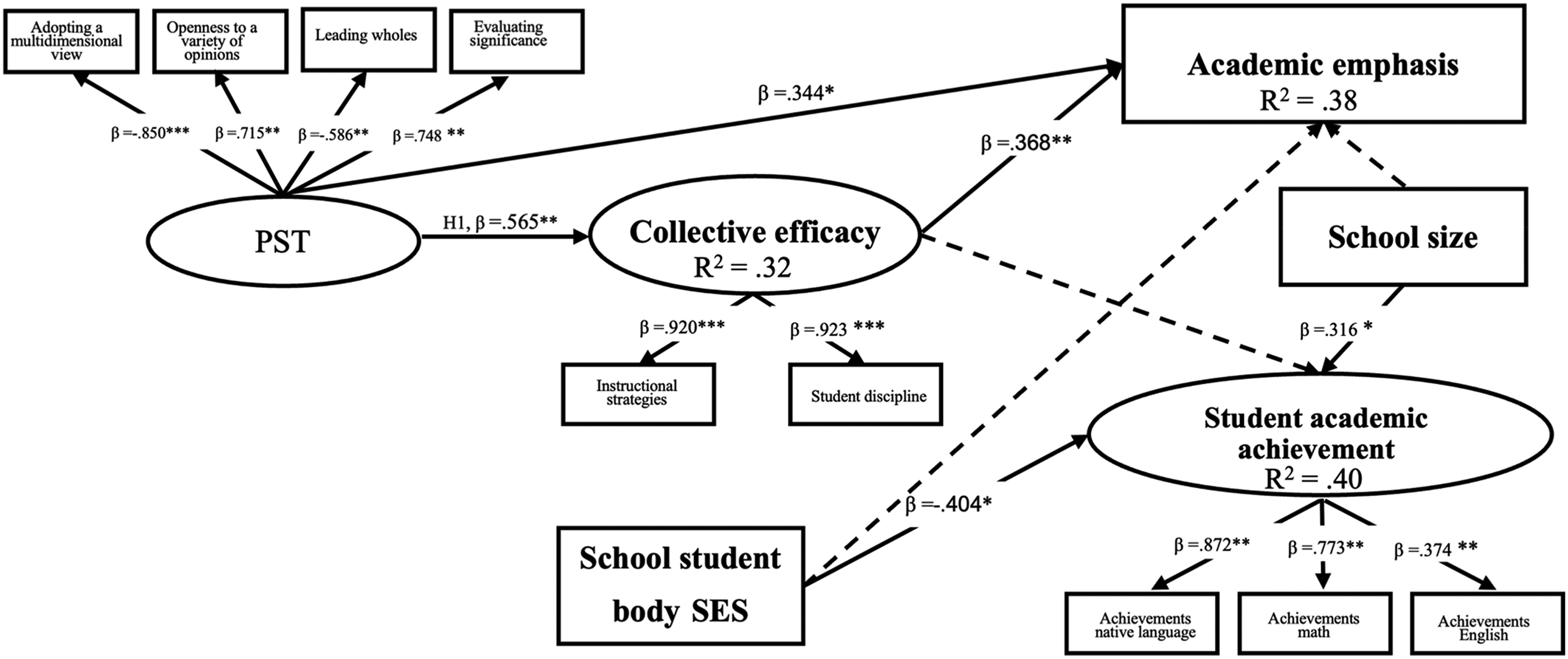
SEM results for the proposed model-partial mediation Model 2. Standardized parameter estimates for the theoretical model; *p < .05, **p < .01, ***p < .001; χ2/df = 1.02; χ2(44) = 45.192; CFI = 0.996; TLI = 0.994; IFI = 0.996; RMSEA = 0.020.
H1 focuses on the relationship between PST and CTE. The findings in Figure 2 indicated that PST is positively and significantly related to CTE (β = 0.565, p < .01). Our findings fully confirm H1.
H2 focuses on the relationship between CTE and academic emphasis. Results indicated positive and significant relationships between CTE and academic emphasis (β = 0.368, p < .01). These findings fully confirm H2.
H3 focuses on the relationship between CTE and student academic achievement. No significant relationship was found (p > 0.05). These findings are not in line with H3.
H4 addresses the mediating role of CTE between PST and school effectiveness, academic emphasis, and student academic achievement. Only the indirect path (PST–CTE–academic emphasis) proved significant. In addition, PST was positively and significantly correlated to academic emphasis (β = 0.34, p < .05). The results showed that PST has significant direct and indirect effects (i.e. through CTE) on academic emphasis. These results indicate that collective efficacy partially mediates the relationship between PST and academic emphasis and student academic achievement. These findings partially confirm H4.
As already noted, to provide a more rigorous test of whether the mediated effect found in the model was statistically significant, bootstrap analyses were performed (Shrout and Bolger, 2002). The total effect of PST on academic emphasis was both statistically significant and meaningful (β = 0.663, CI [0.269, 1.274], p < .001). This total effect was comprised of a moderate direct effect (β = 0.413, CI [0.154, 0.977], p < .001) and a smaller indirect effect through CTE (β = 0.250, CI [0.062, 0.679], p < .001). The bootstrapping analysis reaffirmed that the indirect effects of PST on academic emphasis were both statistically significant and meaningful (see Table 2). This mediation analysis, based on 5000 bootstrap samples, offers further support for a partial mediation model with respect to academic emphasis with strong statistical significance (i.e. p < .01).
Bootstrapping results for the standardised direct, indirect, and total effects of variables in the conceptual model.

PST: principals’ systems thinking; CTE: collective teachers efficacy; SE: standard error.
*p < .05; **p < .01;***p < .001.
Discussion
This study examined the direct and indirect effects of PST on school effectiveness through the mediating role of CTE. Specifically, drawing upon social cognitive theory, we investigated the mediating role of CTE between PST and school academic emphasis and between the former and student academic achievement after accounting for students’ SES background and school size. Overall, our results provide support for the main argument of the study that PST has direct and indirect effects (through CTE) on school effectiveness; moreover, they are in agreement with previous research demonstrating a positive influence of CTE on teachers’ behaviours that promote a positive learning environment for teachers and student (Donohoo, 2018). The results showed that when principals exercise systems thinking, CTE increases, which in turn increases the school's academic emphasis. Importantly, the partial mediation model points to two mechanisms promoting school academic emphasis: through PST leadership and through CTE behaviour. These findings deepen our understanding of the role of PST in promoting school effectiveness.
First, the results of this study indicated a positive relationship between PST and CTE. Our analysis supports the notion that teachers can develop a sense of collective efficacy, dependent on the school principal's leadership (Karacabey et al., 2020). PST conveys the ‘big picture’ to teachers through the perspective of successful team-led processes (Nadav et al., 2020). It seems that in this way, the principal strengthens the teachers’ belief in their shared ability to achieve the desired results and thus shapes their collective sense of efficacy. Principals’ behaviours serve as direct enactive experiences for teachers which, according to social cognitive theory, are one of the most influential core shapers of efficacious beliefs (Bandura, 1997).
Second, the findings showed that CTE is significantly related to a school's academic emphasis. CTE may create more room for teachers to engage in academic emphasis. This finding coincides with previous studies indicating that the stronger the teachers’ collective efficacy beliefs, the more sustained effort and persistence they will invest in achieving school goals (Voelkel and Chrispeels, 2017). These teachers believe that they can reach the set goals and therefore see failures as temporary obstacles to be overcome; they invest effort in advancing students’ academic goals and achieving academic school success.
Third, regarding student academic achievement, no significant relationship was found, other than with school SES and school size. The literature indicates that collective efficacy, academic emphasis, and faculty trust in students and parents are three mutually reinforcing elements constructing a unifying cultural structure that has been labelled academic optimism, predicting student academic achievements regardless of school SES (Hoy and Miskel, 2013; Wu et al., 2013). Perhaps these three constructs need to be examined together to elicit a broader understanding of the influence of CTE on school effectiveness, especially as it concerns the impact of school SES. Moreover, the cultural structure of academic optimism encompasses cognitive, behavioural, and emotional components. In the present study, we focused on collective efficacy—which expresses the cognitive component, and academic emphasis—which expresses the behavioural component of academic optimism, without referencing the emotional component of students’ motivation which is expressed as trust in the faculty (Hoy and Miskel, 2013). This component may be significant for completing the cultural structure of academic optimism and facilitating students’ academic achievement. Future studies would do well to explore the influence of the three constructs (individually and combined) making up academic optimism on student academic achievement. Furthermore, our findings might be explained by the difference in the method of measurement and institutional characteristics related to the Israeli educational context. We recommend future studies to examine this relationship in other contexts.
Fourth, the present findings indicated that collective efficacy serves as a partial mediator in the relationship between PST and academic emphasis. Thus, PST seems to create a work environment that has a further influence on the learning climate in the school. Through PST competencies, namely, leading wholes, adopting a multidimensional view, and evaluating significance and openness to a variety of opinions, principals may improve the schools’ work environment, and motivate teachers and students alike to seek academic excellence. Our research shows that efficacy beliefs can potentially be cultivated through PST. PST includes cognitive aspects (e.g. the ability to evaluate the significance of events in everyday school life for the system as a whole) and social aspects (e.g. openness to learning from the diverse people in the school's various environments) (Nadav et al., 2020). Therefore, the use of PST may cultivate CTE beliefs based on social cognitive theory and thereby increase the likelihood of school effectiveness. These results are consistent with previous studies suggesting that PST helps schools improve based on a deeper understanding of the ‘big picture’ in the school system (Benolielet al., 2019).
Finally, and importantly, the current findings suggested that PST and CTE can improve academic emphasis above and beyond the impact of school SES. This finding is particularly important because, to date, most interventions to promote school effectiveness have focused on providing additional resources at a high economic cost to the educational system, such as extra mentoring and tutoring (Lavy and Ayuob, 2019). According to this finding, PST and CTE might be used as mechanisms to promote academic emphasis irrespective of school SES. These mechanisms may be tools for creating more excellent and equitable schools and communities. Therefore, these findings may help in devising an appropriate policy response to promote a serious learning environment, in which teachers believe in their students’ capacity to succeed, and the students respect academic achievement.
Limitations and future research
Several limitations of the study warrant further attention in future research. First, the cross-sectional nature of our study yielded associations among variables in the proposed model. This precludes us from making strong causal inferences of directionality among variables. The use of a combination of longitudinal research and case studies of schools in which principals and teachers report on school academic emphasis and academic achievement could create a more solid foundation for deducing causal relationships between PST and these variables of school effectiveness. In addition, some of the data were self-reported and therefore subject to bias. However, studies indicate that self-reporting data are not as limited as previously believed, because people often appraise their social environment accurately (Khan et al., 2009). Therefore, it is assumed that the activities reported by the participants represent the actual situation.
Another limitation stems from the homogeneity of the sample. The population examined in this study included teachers, school faculty, and principals from elementary schools in Israel, which limits the ability to generalise the findings to the secondary education system or other samples consisting of different structural or demographic characteristics. Other social and cultural contexts can be studied in future research to enable generalising the findings to broader populations and to examine the results’ international validity. Similarly, a comparative study between various countries may shed light on the mediating role of CTE in the relationship between PST and student academic achievement.
This study only examined one mediator—CTE. Other mediators, such as academic emphasis, teacher trust, teacher agency, and teacher commitment have also been found to mediate the effects of school leadership on school effectiveness outcomes (Hallinger et al., 2018; Liu and Hallinger, 2018; Piyaman et al., 2017). Replication of this type of model testing with multiple mediators/paths would offer further insight into how PST is related to school effectiveness. Finally, this study examined school effectiveness using two variables: academic emphasis and student academic achievement. It is important that future studies extend the inquiry to additional indicators that explain school effectiveness, for example, school violence, team effectiveness, and teachers’ withdrawal behaviours.
Conceptual and practical implications
The research findings contribute to an evolving knowledge base that both explores and analyses the paths between PST and school improvement by positioning CTE as an important mechanism facilitating academic emphasis. These findings highlight PST's direct and indirect effects (through CTE) on academic emphasis, irrespective of school SES. These results may offer opportunities for further research on the role of PST and CTE as a mechanism for school effectiveness in striving for equal opportunity learning for all students in terms of different outcome variables such as school violence, teachers’ absenteeism, and more. These findings suggest including the development of PST competencies in the principals’ preparation and professional development programs, through workshops or seminars. In addition, teachers’ professional development programs can include team meetings in which teachers can discuss their successes to strengthen CTE beliefs.
Footnotes
Declaration of conflicting interests
The authors declared no potential conflicts of interest with respect to the research, authorship, and/or publication of this article.
Funding
The authors received no financial support for the research, authorship, and/or publication of this article.
