






Abstract
Instructional leadership is a school leadership approach with a strong focus on the development of teaching and learning. This study explores how instructional leaders act to promote social justice and eliminate school inequities. The participants in this qualitative study were 24 Israeli elementary school principals. Data collection was based on semi-structured interviews, and data analysis was theory-driven. The findings revealed that instructional leaders incorporated a social justice perspective into the three key dimensions of instructional leadership—defining the school mission, managing the instructional program, and developing a positive school learning climate—to address three main areas of inequity in the school: outcomes, belongingness, and discipline. This study suggests that as an instructional leader, the principal has to take specific actions supported by particular intentions to ensure fairness and equity.
Introduction
Instructional leadership focuses on principals prioritizing the improvement of teaching and learning in their schools and being heavily involved in shaping curriculum and instruction (Glickman et al., 2017; Neumerski et al., 2018; Shaked, 2023). Considered one of the most effective frameworks for school leaders (Kaparou and Bush, 2016), instructional leadership has been shown to impact student achievement, particularly in math and language subjects (Day et al., 2016; Hou et al., 2019). Therefore, researchers, policymakers, and educators view instructional leadership as a crucial responsibility for principals (Bush, 2015).
In addition to prioritizing instructional leadership, principals are also expected to promote social justice in their schools. This involves examining how various factors such as race, gender, and socioeconomic status impact the learning environment (Theoharis, 2007). Principals must believe that all students can succeed and that schools should be structured to provide equal opportunities for all students (Furman, 2012; Wang, 2018). They must also monitor current educational arrangements, identify sources of inequality, and take action to support equity and fairness (DeMatthews and Mawhinney, 2014; Gay, 2018).
The current study explores how principals as instructional leaders promote social justice, seeking to understand how advancing equity and fairness can become part of the principal's instructional leadership responsibility. Given that in the Western world white, heterosexual, middle-class, able-bodied, nonimmigrant students tend to achieve higher levels of success, face less severe discipline, and feel more connected to their schools (Copur-Gencturk et al., 2020; Dutil, 2020), this question is of high priority.
Specifically, the present study focuses on the Israeli school system, which supports an instructional leadership framework for principals (Capstones, 2008) and serves approximately 1.95 million students in Grades 1–12 attending nearly 5400 elementary, middle, and high schools (Israeli Ministry of Education, 2022). The Israeli school system has significant achievement gaps between racial and ethnic groups and students of different socioeconomic rankings (Berkowitz et al., 2015). The OECD Program for International Student Assessment (PISA) found that Israel has the largest gaps internationally between high- and low-performing students, which have barely decreased over time (OECD, 2019). In this study, Israeli principals were interviewed about how they incorporate social justice promotion into their instructional leadership role.
Exploring how principals promote social justice as instructional leaders, this study has theoretical and practical contributions. Theoretically, it provides insights into the nexus of instructional leadership and social justice and how they can be integrated. Practically, it reveals how principals can effectively promote social justice within their instructional leadership role. Hence the importance of the current study.
Theoretical background
To provide a foundation for this study, this section will first outline the key dimensions of instructional leadership. Then it will examine the main areas of inequity in schools that principals are expected to address. Finally, it will discuss the possibility that instructional leadership and social justice in schools relate to and influence each other.
Instructional leadership
Instructional leadership is a school leadership approach in which principals free themselves as much as possible from bureaucratic tasks and focus their efforts on implementing teaching methods that positively affect student learning (Glickman et al., 2017; Shaked, 2023). From the perspective of this approach, the principal's main responsibility is to establish best practices in teaching (Hallinger et al., 2020; Stronge et al., 2008). Above all, principals as instructional leaders are expected to create a school environment that is conducive to classroom teaching and student learning so that students can achieve higher academic results (Kaparou and Bush, 2016; Neumerski et al., 2018). Instructional leadership has been around for almost 100 years, with one of its earliest research studies dating back to 1926 (Gray, 1934). Despite its long history, it remains a widely studied school leadership framework (Hallinger and Wang, 2015; Hallinger et al., 2020).
The classic mainstream conceptualization of principals’ instructional leadership suggests that it encompasses three dimensions: defining the school mission, managing the instructional program, and developing a positive school learning climate (Hallinger and Murphy, 1985; Hallinger and Wang, 2015; Shaked, 2023). These dimensions are presented next.
The first dimension, defining the school mission, involves the principal's responsibility to adhere to a clear instructional vision for the school – framing the school's instructional goals and communicating those goals to all necessary parties (Hallinger and Murphy, 1985). According to Murphy et al. (2007), this dimension includes developing, articulating, implementing, and stewarding the vision. Cobb et al. (2018) argued that goals for student learning and a vision of high-quality instruction lie in the center, surrounded by three facets: (a) supports for teacher learning, (b) instructional materials and assessments, and (c) supplemental supports for struggling learners. A shared instructional vision was found to predict improved school performance (Qadach et al., 2020). Therefore, principals should provide, understand, monitor, and communicate a clear instructional vision and a sense of direction for the school (Francois, 2014). Principals’ clarity of thought and a sense of purpose means that they can get the best out of their staff, which is key to influencing the work in the classroom and raising the standards achieved by the learners (Day and Sammons, 2013).
The second dimension, managing the instructional program, is about the principal's responsibility to regulate and control the instructional program – coordinating the school's curriculum, supervising and evaluating instruction, and monitoring students’ progress (Hallinger and Murphy, 1985). Murphy et al. (2007) broke this dimension down into three programs: (1) instructional program – hiring and allocating staff, supporting staff, and protecting instructional time; (2) curricular program – setting expectations and standards, providing opportunities to learn, and aligning the curriculum; (3) assessment program –establishing assessment procedures, monitoring instruction and curriculum, and using data. Goldring et al. (2015) disaggregated the instructional management category into six subcategories: (1) classroom observations; (2) evaluation of teachers, curriculum, and educational programs; (3) coaching teachers; (4) developing educational programs; (5) professional development for teachers; (6) other instructional tasks (e.g., reviewing student data, fulfilling special education duties).
The third dimension, developing a positive school learning climate, expects the principal to create a culture of ongoing improvement and high expectations for students and teachers – protecting instructional time from threats, providing incentives to motivate teachers, providing incentives to encourage students’ learning, promoting staff members’ continual professional development, and maintaining high visibility for quality interactions with teachers and students (Hallinger and Murphy, 1985). The importance of a positive learning climate was highlighted in the literature (Thapa et al., 2013), and the principal was found to have a decisive impact on creating a positive learning climate in the school (Cherkowski, 2016). In this context, Anderson and Pounder (2018: 533) claimed that “supervision includes a full array of leadership and organizational policies and practices intended to support and improve a school's teaching and learning environment.”
Research has provided compeling evidence that instructional leadership is an effective way to improve school performance and student achievement (Day et al., 2016; Mitchell et al., 2015). Instructional leadership has been correlated with positive school outcomes, including higher instructional quality and improved student achievement (Goddard et al., 2021; O’Donnell and White, 2005). Even after controlling for other variables such as student demographic characteristics, instructional leadership remains consistently responsible for significant changes in student academic results (Hallinger and Wang, 2015; Hou et al., 2019; Shatzer et al., 2014). For this reason, principals are repeatedly called upon to uphold the mantle of instructional leadership by continuous, direct involvement in various curricular and instructional issues (Hallinger et al., 2020; Kaparou and Bush, 2016).
Social justice in schools
Educational researchers see the principal as responsible for promoting social justice in their schools. The principal has to “make issues of race, class, gender, disability, sexual orientation, and other historically and currently marginalizing conditions … central to their advocacy, leadership practice, and vision” (Theoharis, 2007: 223). Moreover, the principal needs to be involved in “identifying and undoing these oppressive and unjust practices and replacing them with more equitable, culturally appropriate ones” (Furman, 2012: 194) and “altering these [unjust] arrangements by actively engaging in reclaiming, appropriating, sustaining, and advancing inherent human rights of equity, equality, and fairness in social, economic, educational, and personal dimensions” (Goldfarb and Grinberg, 2002: 162). In other words, the principal should “foster successful, equitable, and socially responsible learning and accountability practices for all students” (Brown, 2004: 80) by “understanding the inequities that persist in schools and taking action” (DeMatthews, 2015: 145) because “leadership without an understanding of systemic inequity can reproduce oppression” (Bertrand and Rodela, 2018: 14).
Principals with social justice orientation are committed to creating a new social order where all students have access to the same opportunities and resources (Jean-Marie et al., 2009). They work to identify and address systemic issues that prevent marginalized students from achieving well-being and success and actively work to replace the existing unequal structures with more equitable ones (DeMatthews and Mawhinney, 2014). They determine the correct and incorrect current practices and act to correct the incorrect practices (Rivera-McCutchen, 2014), investigating and identifying the inequalities hidden within the day-to-day management of the school (DeMatthews, 2014).
Moreover, principals with social justice orientation create an environment where teachers can review their beliefs about students from different backgrounds and their values regarding factors such as race, class, language, and sexual orientation. They foster a culture of openness and inclusivity, where teachers feel comfortable discussing and addressing any unconscious biases they may have (McKenzie et al., 2008). They think about why and how the school is unfair to some students and implement inclusive education (Canlı and Demirtaş, 2022; Capper and Young, 2014).
According to the existing literature, to promote social justice in school, the principal must address three main areas of inequity: outcomes, belongingness, and discipline (Celeste et al., 2019; Pearman et al., 2019). Regarding inequity in outcomes, the principal needs to focus on closing achievement gaps. Based on the belief that all students can succeed academically, the principal has to transform the school into a space where all students achieve proficiency, regardless of their characteristics (Brooks et al., 2017). The principal needs to encourage teachers to uphold high standards and foster a growth mindset for all students, ask them to provide students with educational opportunities tailored to their individual needs (Wang, 2015), and expect them to keep an open mind, avoid assumptions, and prevent situations where assessments of student performance are implicitly based on unconscious biases (Copur-Gencturk et al., 2020).
Regarding inequity in belongingness, the principal is required to promote culturally responsive teaching, which relates teaching content to diverse students’ customs, languages, and life experiences (Gay, 2018), based on the idea that every student brings unique cultural strengths to the classroom (Muñiz, 2019). The principal also has to promote inclusive education, where all children, regardless of their differences or special needs, attend the same school and the same classrooms (Amor et al., 2019; Flores and Bagwell, 2021). The principal must create genuine learning opportunities for groups that have traditionally been excluded, such as children with disabilities and immigrants, and allow diverse groups to grow side by side, to the benefit of all (DeMatthews and Izquierdo, 2018; Messiou, 2017).
Regarding inequity in discipline, the principal is should aim to pay close attention to punishment gaps. School discipline policies often disproportionately affect underprivileged students through exclusionary policies (Dutil, 2020; GAO, 2018). The principal has to eliminate school discipline disparities and promote disciplinary practices committed to keeping all students in learning environments (Johnson and Constant, 2021). Therefore, the principal is expected to adopt a disciplinary approach that focuses on positive reinforcement rather than punishment, proaction rather than reaction, and cooperation rather than top-down decision-making, which can achieve much more social justice compared to the traditional, punishment-oriented approach (Oxley and Holden, 2021).
The relationship between instructional leadership and social justice in the school
The previous sections discussed instructional leadership and social justice in schools. How do these two relate to each other? Apparently, their mutual effects are multidimensional. According to Chen (2017), “Diversity … informs instructional leadership” (p. 19). For her, instructional leaders should foster trust within the learning environment by developing new pedagogical approaches that reflect tolerance, cultural awareness, and inclusion and nurturing positive relationships with students. Moral Santaella (2022) found that successful principals not only understand and believe in social justice but also use strategies that combine transformational and instructional leadership to change the dire situation of their disadvantaged schools, seeking excellence from equity.
To implement community-engaged leadership for social justice, DeMatthews (2018) recommended building instructional leadership on the assets of urban, low-income students of color and their families. Howley et al. (2019) found that principals developed inclusive instructional leadership in a statewide professional development program that expanded the construct of instructional leadership to incorporate a focus on social justice and equity.
Rigby (2014) proposed social justice as one of the three alternative logics of instructional leadership. This logic is “focused on the experiences and inequitable outcomes of marginalized groups,” and it “challenges the current ‘neutral’ systems that engender the reproduction of inequality in our society” (p. 618). From this perspective, social justice is both the justification for and the desired result of instructional leadership: the importance of instructional leadership stems from the fact that it is a means to address and reduce disparities in educational opportunities and outcomes for different groups of students. Instructional leadership is an essential tool for creating a more just and equitable educational system, and for this reason, the principal needs to put effort into it.
However, instructional leadership focuses mainly on improving the performance of the school as a whole and not on improving the achievements of all students. It has a school-wide effect, bringing about an overall change that does not necessarily have the same impact on different groups of students within the school. Quite differently, social justice in schools means improving the academic results of disadvantaged students (Theoharis, 2007). Principals promoting social justice challenge the limitations of race, class, disability, gender, sexual orientation, and socioeconomic situation by increasing achievement among all students (Koçak, 2021).
This point was well demonstrated in the study of Gümüş et al. (2022), who recently found that while instructional leadership might be beneficial in reducing the achievement gaps between schools, it may not make much difference in reducing the disparity between different socioeconomic groups within schools. Based on their findings, Gümüş et al. (2022) claimed that “the existing understanding of instructional leadership may not be sufficient in itself to compensate for the disadvantages of students from a difficult home/family background” (Gümüş et al., 2022: 432).
Moreover, instructional leadership concentrates primarily on the effectiveness of teaching methods. On the other hand, from the social justice perspective, principals need to ensure that the quality instruction is also inclusive and culturally responsive, connecting the taught contents in an equitable and respectful way with diverse cultures and languages. All students should read texts that describe their and their families’ relevant life experiences, as well as texts that help them learn about diverse others’ experiences in the world (Gay, 2018; Muñiz, 2019). Similarly, instructional leadership emphasizes the importance of a learning-oriented environment. From a social justice perspective, on the other hand, the painful reality of persistent disparities in exclusionary discipline rates between white and minority children (Dutil, 2020; GAO, 2018; Pearman et al., 2019) demands that the desired learning-oriented environment be achieved in a fair and equitable way.
Therefore, instructional leadership does not necessarily lead to improved equity of outcomes, belongingness, and discipline in the school. Given the vitality of social justice issues and potential connection to leadership in modern education systems, the current study used interviews and content analysis to gain insight into Israeli school principals’ perspectives on how advancing equity and fairness has become part of their instructional leadership responsibility.
Research context: the Israeli system's endorsement of instructional and social justice
Preparation programs for school principals in Israel place a strong emphasis on instructional leadership. The Ministry of Education, which oversees these programs, stated that “instructional leadership will be the main axis of learning in the preparation program” so that “the program will provide up-to-date and applied knowledge in this field, and especially on the subject of the relationship between the improvement of education, teaching and learning, student achievements and the role of the school principal” (Israeli Ministry of Education, 2019: 5). In line with this policy, principal preparation programs are based on the following five pillars: (a) improving teaching and learning; (b) designing future schools; (c) team leadership and professional development; (d) evidence-based management; (e) budget and resource management (Berkovich, 2014).
While instructional leadership is emphasized in Israeli principals’ preparation programs, social justice leadership is more implicitly conveyed. Capstones, the institute responsible for training school principals in Israel, defined the role of Israeli principals as instructional leaders who must improve the education and learning of “all students.” This focus on the individual student is also reflected in the four dimensions of the Capstones (2008) framework for school leadership: shaping the future image of the school – developing a vision and creating change; leading the team and fostering its professional development; focusing on the individual; and managing the relationship between the school and the surrounding community. However, preparation programs’ attempt to encourage principals to prioritize equity for diverse individual students are secondary to the main focus on instructional leadership. As a result, principals often develop their approach to social justice based on their own values and educational perspectives. Formative experiences that influence their worldview and their personal ethos also shape their organizational vision (Arar, 2015; Oplatka, 2013; Yoeli and Berkovich, 2010).
Method
Qualitative research methods that allow participants to share their experiences and provide researchers with insight into their perspectives are ideal when existing knowledge about a studied phenomenon is limited (Merriam and Tisdell, 2016), as in the current study. The following sections describe the sample, gathered information, and analytical strategies used in this study.
Participants
This study focused only on elementary school principals to avoid addressing differences in instructional leadership between elementary and secondary (middle and high) schools (Gedik and Bellibas, 2015; Hallinger, 2012). The sampling for this study was a purposive one, which selects ‘information-rich’ cases. Research has shown that purposive sampling is more effective than random sampling in qualitative research, supporting assertions made by qualitative methodologists (van Rijnsoever, 2017). Therefore, 12 superintendents from all six Israeli school districts were asked to recommend potential participants who they believed were demonstrating instructional leadership while also promoting social justice in their schools. Because of significant differences between the sectors in the Israeli education system in the understanding of leadership for social justice (Arar, 2015), the participants of this study were all from the Hebrew-speaking sector, while principals from the Arabic-speaking sector will be studied separately.
It should be noted that the concepts’ instructional leadership’ and ‘social justice’ were not explained to the superintendents. There may have been diversity in how they understood these concepts, which may have led to a small proportion of study participants not fully fitting the purpose of the study. To involve “as many subjects as necessary to find out what you need to know” (Kvale and Brinkmann, 2009: 113), the current sample included 24 principals. Of them, 15 were women and 9 were men. Their average age was 51.54, with an average of 11.13 years of experience as principals. As for their education, one principal had a doctorate, 18 principals had a master's degree, and five had a bachelor's degree. Table 1 presents information on the study participants. The table also indicates which category of findings (see below) was mentioned by each study participant.
Study participants’ information.

Interview data collection
Interviews explored how principals as instructional leaders promote social justice through questions such as: “How do your efforts to promote student achievement involve offering support to students that addresses possible barriers?”; “In your opinion, how should social justice issues influence your work to improve the quality of teaching?”; “From your point of view, how does fairness relate to the management of the school's instructional program?”. While the participants were asked to answer predefined questions, the researcher as an interviewer altered the order of the questions and added new questions based on the participants’ answers, and encouraged them to expand their answers. This allowed the interviewer to “respond to the situation at hand, to the respondent's emerging worldview and new ideas on the subject” (Merriam and Tisdell, 2016: 111).
All the interviews were recorded and transcribed verbatim. The average length of the interviews was about an hour. Three follow-up interviews were conducted to clarify questions that emerged during the review of the transcripts (with an average length of 15 min). For ethical reasons, all participants were informed that their participation was voluntary and that they could leave the study at any time (none did). It was made clear that the superintendent who recommended them as possible participants would not know whether they participated in the study. They were assured of confidentiality (pseudonyms were used), and signed a written consent based on understanding the study's purpose.
Data analysis
In this study, analysis of the interview data began by sorting through the data to identify statements related to the question of how principals as instructional leaders promote social justice. This sorting, which “is not something separate from the analysis. It is a part of analysis. The researcher's decisions – which data chunks to code and which to pull out … are all analytic choices” (Miles et al., 2014: 12). The identified statements were then coded. The codes consisted of “essence-capturing” (Saldaña, 2016: 4) words or short phrases (e.g., no child left behind, literature from a variety of authors, fair discipline), representing the perceptions of the principals on this topic (Creswell and Poth, 2018). These coded statements were then related to the three main dimensions of instructional leadership: defining the school mission, managing the instructional program, and developing a positive school learning climate (Hallinger and Murphy, 1985). Thus, it was a theory-driven data analysis, guided by a specific theoretical framework. This means that the researcher carefully considered how the coded data related to the chosen theoretical framework and used the theoretical framework to interpret the results of the analysis. Theory-driven data analysis can help researchers better understand the data they are working with and provide a clear and structured approach to data analysis (Rossman and Rallis, 2012). It should be noted that additional findings that could provide insight into the concept of social justice for instructional leadership, which emerged from data analysis, will appear in another article.
Findings
Analysis of interviews with Israeli principals revealed that instructional leaders promoted social justice by incorporating a social justice perspective into the abovementioned three dimensions of instructional leadership: defining the school mission, managing the instructional program, and developing a positive school learning climate (Hallinger and Murphy, 1985). While these findings are guided by Hallinger and Murphy's (1985) dimensions of instructional leadership, they also represent the dense-richness of data. The findings are presented next, supported by participants’ utterances.
Defining the school mission
Under the first dimension of instructional leadership, defining the school mission, eight study participants who sought to promote social justice (see Table 1) expanded the school's instructional goals to focus not only on quality teaching and learning and high academic results in general but also on improving the achievements of everyone who studies at school, leaving no one behind. This idea was articulated by the participants as a moral commitment to take care of all learners without exception, including those from disadvantaged backgrounds. For example, Emily said: “Our goal is to provide quality teaching and learning with the aim of achieving high academic results for the entire student body. However, the goal also includes a focus on closing any achievement gaps among different groups of students.” For her, the school's instructional goals must explicitly include all the students, regardless of their initial starting point or their possibly disadvantaging characteristics. On the other hand, David claimed that the pursuit of social justice causes the school to set unambitious instructional goals: “The commitment to inclusion and equal opportunities means that instead of allowing the best students to reach their potential, we take everyone at the pace of the slowest. It does no one any good.” According to David, the concern for the weak students harmed the realization of the abilities of the strong students and thus harmed the school's goal of improving achievements.
Study participants mentioned that the national outcome measures do not hold them accountable for each individual child's improvement. For example, the Ministry of Education's external standardized ISEG tests (Indices of School Efficiency and Growth – MEITZAV) evaluate schools by their mean scores, but high means do not require high scores for all students. High means could be achieved by a small group of outstanding students. Deborah said that for this reason, her school used ability grouping, which is the practice of grouping students based on their perceived academic abilities or achievement levels. She claimed that despite the potential negative effects of ability grouping, including increased inequality and stigmatization, this practice improved the school's mean scores. At the same time, Albert asserted: “The easiest way for us to get a high mean score is by focusing our efforts on strong students and giving up on struggling students. However, the school's goal must be high scores for all students.”
Moreover, the external standardized tests do not give an accurate picture of social injustice in the school because the mean score of each school on these tests does not include the special education students. Linda said that in the year her school participated in the national tests, she invested less resources in the special education classes. However, other study participants viewed the improvement of teaching, learning, and outcomes of special education students as part and parcel of the school's instructional goals. Donna claimed: “Our goals go beyond the external tests, seeking to improve curricula and instruction for each and every student.” For her, the school goal should be about improving educational outcomes for all students, regardless of any potentially marginalizing characteristic such as gender, race, socioeconomic status, sexual orientation, and physical ability or disability.
Managing the instructional program
Under the second dimension of instructional leadership, managing the instructional program, seven study participants who emphasized social justice believed that the school's instructional program should not only be effective but also take into account the diversity of its students. Study participants claimed that the culture that many students experienced at home and in their community was represented at school in a stereotypical way or was not even represented at all. Thus, they wanted the instructional program to incorporate students’ cultural identities and experiences into the classroom and consider cultural differences as assets rather than barriers to learning. As Jessica said: “The instructional program is inclusive and respectful of cultural differences, using these differences as opportunities for learning and growth.” She was concerned that implementing culturally responsive teaching strategies might require significant time and resources. However, she added: “This can help to create a more engaging and meaningful learning experience for all students while also helping to close achievement gaps.”
Study participants required teachers to employ culturally-responsive teaching. They instructed teachers to include literature from a variety of authors, cultures, and parts of the world. They argued that all students should read about characters who look like them and their families in order to see school as relevant to who they are and the community they live in. At the same time, they expected students to read texts that helped them learn about others. As Nancy said: “I want protagonists from different countries of origin to be visible in the classroom, and authors from different countries of origin to be represented in the classroom library.” For Nancy, the teaching methods should be not only compatible with the standards but also sensitive to diversity. However, Anne asserted that under culturally-responsive teaching, teachers make assumptions about their students based on their race, ethnicity, or cultural background, leading to overgeneralization and stereotyping. For her, “Teachers should not focus too much on cultural issues and neglect the academic content of the curriculum.” She added that cultural responsiveness might lead to conflicts between students of different cultural backgrounds or between students and teachers if cultural differences are not fully understood or respected.
Study participants claimed that some teachers undervalued the potential for academic success among students from minority groups and set low expectations for them. Sandra explained: “I'm sure my teachers never say a student is dumb. But the fact that they don't say something doesn't mean the student doesn't hear it.” Therefore, they required teachers to set achievable but challenging tasks while expressing confidence in the abilities of all students. Angela knew that socioeconomic background was a significant predictor of student achievement. However, she said: “When I observe classes, I examine if the teacher gives all students the benefit of an equally long wait time when they ask questions. For me, this is a sign of the level of expectations from the student.” Kimberly claimed that “Even the best and most dedicated teacher may hold beliefs that should not – but do – affect how they grade their students,” and therefore encouraged teachers to recognize their own biases and understand how they may unconsciously judge students differently based on their background and marginalizing characteristics.
Developing a positive school learning climate
Under the third dimension of instructional leadership, developing a positive school learning climate, 11 study participants who aspired to apply social justice in their school (see Table 1) emphasized the need to improve classroom management while also giving students a voice, encouraging the expression of ideas and opinions, and practicing empathy. Although study participants believed school discipline was crucial, they qualified how this discipline should be implemented because, for them, not every path to achieving improved student behavior was legitimate. Michelle explained: “We have to create a positive and inclusive learning environment where students feel heard and respected.”
Study participants aspired to manage student behavior without showing disrespect toward some kinds of students. Jennifer explained: “We have to bring about an improvement in student learning. However, we must do it in a respectful way, particularly concerning students from weaker families and communities, because students respect teachers they feel respect them.” Similarly, Susan said: “If teachers haven't done the work to build healthy relationships with their students, especially those they consider particularly challenging, they might find it difficult to manage their class.” On the other hand, Linda argued that “Today, respecting students means that teachers must always agree with their opinions or decisions. So how can we hold them accountable for their behavior and academic performance?”. From Linda's perspective, the value of students’ respect is overestimated and misinterpreted and therefore harms the ability to manage learning in the classroom.
Study participants also opposed any expression of inequity, where students from marginalized groups were more likely to experience overuse of harsh punitive consequences and, particularly, exclusionary discipline practices such as suspension and expulsion that could pose a risk to their chances of academic success. Betty claimed: “Frequently sending very specific students out of their classrooms for disciplinary violations, without a plan as to what should happen next, is simply unfair.” Charles said that a zero-tolerance policy created a safe and orderly school environment by sending a strong message that certain behaviors will not be tolerated. However, he asserted: “If zero tolerance means that students with very distinct characteristics are more likely to experience harsh punitive consequences such as suspension and expulsion – I don't want it.” Therefore, study participants called for proactive and preventative approaches to school discipline, which are not characterized by control-driven punitive mechanisms intended to maximize student compliance. Evelyn explained: “We must ask ourselves whether the school's disciplinary policy exists to exert power over our students or to foster positive and holistic human development.”
Discussion
The present qualitative investigation of Israeli principals with expertise as both instructional and social justice leaders identified how study participants incorporated a social justice perspective into the three key dimensions of instructional leadership. Under the first dimension, defining the school mission, study participants expanded their school instructional mission to clarify that their school's instructional improvement goals must be applied to all students, without exceptions, regardless of their potentially marginalizing characteristics. Under the second dimension, managing the instructional program, study participants ensured that the teaching was not only of high-quality but also inclusive and culturally responsive and that the teachers did not undervalue the academic potential of students from minority groups. In this context, they mainly narrowed inequity in students’ sense of belongingness. Under the third dimension, developing a positive school learning climate, study participants emphasized that the school's disciplinary policies, which instructional leadership views as a prerequisite to improving student learning and achievements, should reflect social justice. In this context, study participants strived to reduce the inequity in school discipline. Table 2 illustrates how study participants expanded the three dimensions of instructional leadership (left column) by incorporating social justice perspectives (middle column) to address the various inequities in the school (right column).
Instructional leadership dimensions, social justice perspectives, and school inequities.
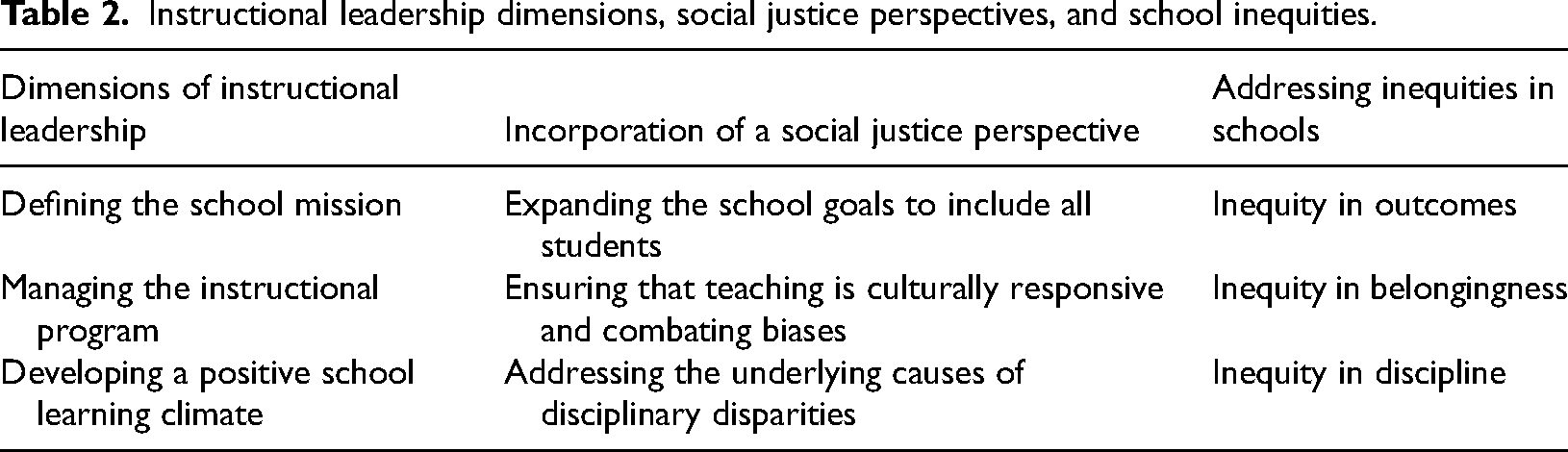
It should be noted that the three school inequities are interconnected because they can reinforce each other in a vicious cycle. For example, if students experience harsh discipline, they may feel disconnected from the school community and have lower academic outcomes, leading to a further sense of not belonging. Alternatively, students who do not feel a sense of belonging may be more likely to engage in disruptive behaviors, leading to harsh disciplinary consequences and further marginalization. Addressing these inequities requires a holistic approach that acknowledges their interconnectivity. However, the findings pointed to the central inequity that was positively affected under each dimension of instructional leadership
Instructional leadership has been described as contributing to social justice (DeMatthews et al., 2016). However, the current study suggests that instructional leadership's dimensions do not inevitably lead to equitable school outcomes unless they are complemented by a social justice orientation. Study participants emphasized that even when they succeed as instructional leaders, the resulting increased whole-school gains in achievement levels may reflect a core group of excellent students without reaching every student who is struggling. This may reinforce DeMatthews et al.'s (2016: 759) contention that some instructional leaders “are heavily concerned with managing organizational effectiveness related to student achievement and often justified by false claims of ‘social justice’ to close achievement gaps through teaching and leading to standardized tests.” Not every improvement in school achievement is beneficial for social justice and reducing disparities because there is a need for direct intention to improve the achievements of all students, including the disadvantaged ones.
As this study's findings illustrate, the instructional leadership's emphasis on effective strategies may come at the expense of culturally responsive teaching, which recognizes and values the diverse backgrounds of students, and involves understanding and incorporating the cultural perspectives and experiences of students into the curriculum and teaching methods (Gay, 2018; Muñiz, 2019). Similarly, the focus of instructional leadership on a positive learning climate may be accompanied by the unequal and unfair treatment of students from specific racial, ethnic, or socioeconomic backgrounds in terms of disciplinary actions such as suspension or expulsion (Dutil, 2020; Johnson and Constant, 2021).
Thus, social justice must inform instructional leadership (Chen, 2017). According to this study's findings, by virtue of social justice, the principal as an instructional leader has to set clear and inclusive academic goals that reflect the diverse needs and abilities of all students, provide opportunities for teachers to learn how to teach in a culturally responsive way and ensure that the curriculum reflects the diverse perspectives and experiences of all student, and review school-wide disciplinary policies to ensure that they are fair and unbiased. The principals in the current study described how social justice tenets of equity, respect, and fairness should consistently shape instructional leadership dimensions. Specifically, as instructional leaders, principals first and foremost need to ensure that the teaching in their schools is of high quality; yet, from a social justice perspective, they additionally need to ensure that the teaching is culturally responsive and teachers are free of biases. Similarly, principals as instructional leaders also need to cultivate the school learning climate; yet, from a social justice perspective, they have to ensure that the school's disciplinary policies promote equity by focusing on preventive and proactive practices while avoiding strategies associated with higher rates of exclusion.
Rigby (2014) suggests that social justice is one of the alternative logics of instructional leadership and it is particularly focused on addressing and reducing disparities in educational opportunities and outcomes for marginalized groups of students. For her, instructional leaders play a crucial role in social justice by actively working towards creating a more equitable and just educational environment. Nonetheless, this study suggests that the connection between social justice and instructional leadership is intricate. Principals must implement instructional leadership dimensions grounded in social justice and build on the assets of students, families, and the community (DeMatthews, 2018). They have to consciously utilize instructional leadership dimensions to integrate excellence and equity (Moral Santaella, 2022) because instructional leadership does not inherently contribute to social justice. Only when instructional leadership's dimensions are combined with a social justice orientation can social justice be seen as the “logic” underlying instructional leadership. Only when school leaders recognize the unequal circumstances of marginalized groups and work resolutely to eliminate inequities in outcomes, discipline, and belongingness can they successfully raise all students’ academic achievements while “preparing students as critical citizens, and ensuring heterogeneous, inclusive classrooms” (Rigby, 2014: 618).
While instructional leadership can contribute to social justice, there are some instances where they may come into conflict. Instructional leaders may become overly focused on improving academic outcomes, leading them to neglect important aspects of social justice, such as promoting equity and inclusivity. They may not provide enough support for students from underrepresented groups, leading to disparities in academic outcomes and perpetuating systemic inequalities. They also may not fully understand or appreciate their students’ cultural backgrounds, leading to insensitive or inappropriate practices. To prevent conflicts between instructional leadership and social justice, it is vital for instructional leaders to prioritize equity and inclusivity in all the dimensions of their work. By doing so, they can promote social justice while also improving academic outcomes for all students.
The tensions between instructional leadership and social justice can arise when instructional leadership highlights improving academic outcomes for individual students, while social justice emphasizes the need for systemic change that addresses structural inequalities and promotes equity and inclusion for all students. Instructional leaders must balance high expectations with support because social justice recognizes the need to provide accommodations for students who face additional challenges due to systemic inequalities. To address these tensions, instructional leaders must be willing to make difficult decisions that prioritize social justice principles over competing demands or interests and find solutions that promote equity and inclusion for all students.
Practically speaking, principals must use a social justice perspective to answer questions about instructional leadership. They need to implement instructional leadership in ways that eliminate inequities and ensure no one is left behind. Toward that end, it seems advisable to explicitly develop the social justice perspective of principals. Educators should discuss the contribution of social justice to instructional leadership with potential principals in preparation programs and with novice principals in mentoring programs given to beginning principals who are in the process of becoming instructional leaders. The combination of instructional leadership and social justice is also relevant in later stages of school leadership and should be discussed in professional development meetings of active inservice principals. In addition, principals should be evaluated by their superintendents for the extent to which they reduce gaps within their school, not only between their school and other schools. Based on this study's findings, the integration of social justice with instructional leadership should be promoted by all those associated with and involved in the critical endeavor of educational leadership.
Compared to existing research, this study provides new data on how principals promote social justice as instructional leaders. However, it has several limitations. First, since the findings were collected in Israel, their cross-cultural validity was not proven. As mentioned above, Israeli principals become instructional leaders mainly through preparation programs (Israeli Ministry of Education, 2019) while becoming social justice leaders as part of their personal system of values (Arar, 2015; Oplatka, 2013; Yoeli and Berkovich, 2010). This separation can cause difficulty in combining instructional leadership with social justice. Future comparative research would do well to explore how principals integrate instructional leadership and social justice orientation in different countries to validate the current findings’ generalizability. Second, the data collected for this study were self-reported. Thus, the study could not control for the possibility that respondents were providing socially desirable responses. Future research could explore the integration between instructional leadership and social justice through direct observations and interviews with teachers describing their principals. Third, this study did not identify correlations between the principals’ perceptions of instructional leadership and social justice and their characteristics, such as gender, experience, and education. Such differences may be identified in future research using a larger sample.
Footnotes
Declaration of conflicting interests
The author(s) declared no potential conflicts of interest with respect to the research, authorship, and/or publication of this article.
Funding
The author(s) received no financial support for the research, authorship, and/or publication of this article.
