







Abstract
This study aims to: (a) examine the direct and indirect relationships between principal leadership and student achievement through school processes in Hong Kong and Macau, and (b) investigate how school contexts as conditions for leadership mechanisms linking principal leadership to student achievement. Using a novel approach—multigroup multilevel structural equation modeling—and drawing on PISA 2022 data, we find that school context not only influences leadership and student outcomes but also moderates both the magnitude and the mechanism through which leadership exerts its influences along different pathways. This study advances the understanding of leadership effectiveness by tackling the questions of “under what conditions does leadership matter most?” and “in what ways can leadership practices be responsive to various school contexts?” The findings suggest that school leaders need to collaborate with teachers and staff to situate core leadership practices into their school’s condition and culture. Leader preparation programs should focus not only on fostering leaders’ commitment to core values and educational improvement, but also on developing their sensitivity to students’ needs and adaptability in complex situations and on providing them with resources that may inform their own judgement and inventiveness in their interactions with teachers and local contexts.
Keywords
There is a converging consensus that effective principal leadership plays a significant role in promoting school development and increasing student achievement (Grissom et al., 2021; Leithwood et al., 2020b). Research shows that the impact of principals on student achievement is comparable to that of teachers (Grissom et al., 2021), and occurs mainly indirectly via a host of important factors in school processes (Leithwood et al., 2020b). In light of this, recent research in educational leadership has been largely devoted to identifying potential pathways through which principals’ impacts on students are mediated to help school leaders stay focused on the most promising areas of practice (Leithwood et al., 2020b).
While these general pathways provide a roadmap for leadership, the effectiveness of leadership practices is not context independent; rather, it intersects with both broader cultural contexts and local conditions of the school in which principals work (Hallinger, 2018). On the one hand, school contexts inform how a generic set of leadership practices needs to be adapted to align with the specific needs and constraints of schools (Urick & Bowers, 2014; Warwas, 2015). On the other hand, features of the context can moderate the effects of school leadership as well as the mechanisms by which school leaders affect student learning (Tan, 2018). However, research empirically investigating how school contexts moderate the ways through which principal leadership influences student learning remains limited.
Our study aims to address this knowledge gap by examining how the relationships between principal leadership, school processes, and student achievement vary across different school contexts. Using data from the Program for International Student Assessment (PISA) 2022, this study answered two research questions:
How does principal leadership directly and indirectly relate to student achievement through three aspects of school processes: teachers’ job satisfaction, teacher collaboration, and self-efficacy in Hong Kong and Macau? How does the mechanism by which principal leadership relates to student achievement differ across diverse school contexts?
This study goes beyond prior strands of school leadership literature both conceptually and methodologically. First, unlike existing PISA-based studies that predominantly focus on the contextual effects on direct effects of leadership behavior using the interaction effect approach (Smith & Gümüş, 2022; Tan et al., 2024), we carefully delineate how multiple mediated pathways and underlying mechanisms of leadership effects, including both direct and indirect effects, function differently across varied school settings. Second, by focusing on Hong Kong and Macau, the two Special Administrative Regions (SARs) of China, this study brings an international perspective to the body of educational leadership literature and supports the development of a globally valid knowledge base. As social systems characterized by a hybrid of Eastern and Western influences and bilingual education, Hong Kong and Macau offer an ideal context for this inquiry. Their cultural and political similarities also allow us to effectively “control” for macro-level cultural factors, thereby enabling a more precise examination of how local school-level contexts moderate the magnitude and mechanism of leadership effects. Third, we leverage multigroup multilevel structural equation models (MGMLSEM), a method that combines the advantages of multilevel modeling, multigroup analysis, and structural equation modeling, and enables researchers to compare differences across subpopulations. Given its rare application in leadership research, the adoption and demonstration of this method not only helps address this methodological gap but also offers a new analytical perspective for the field.
Conceptual framework and contextual background
In the conceptual framework (see Figure 1), at the student level, a set of background variables, along with grade repetition (used as a proxy variable of prior achievement), are conceptualized as predictors of students’ mathematics achievement. At the school level, principal leadership is hypothesized to be associated with math achievement directly and indirectly through its influence on teachers’ job satisfaction, collaboration, and self-efficacy. Importantly, the magnitude and mechanism of principal leadership effects are expected to be vary across school contexts. The discussion that follows draws on theoretical and empirical literature to substantiate and elaborate this conceptual framework.
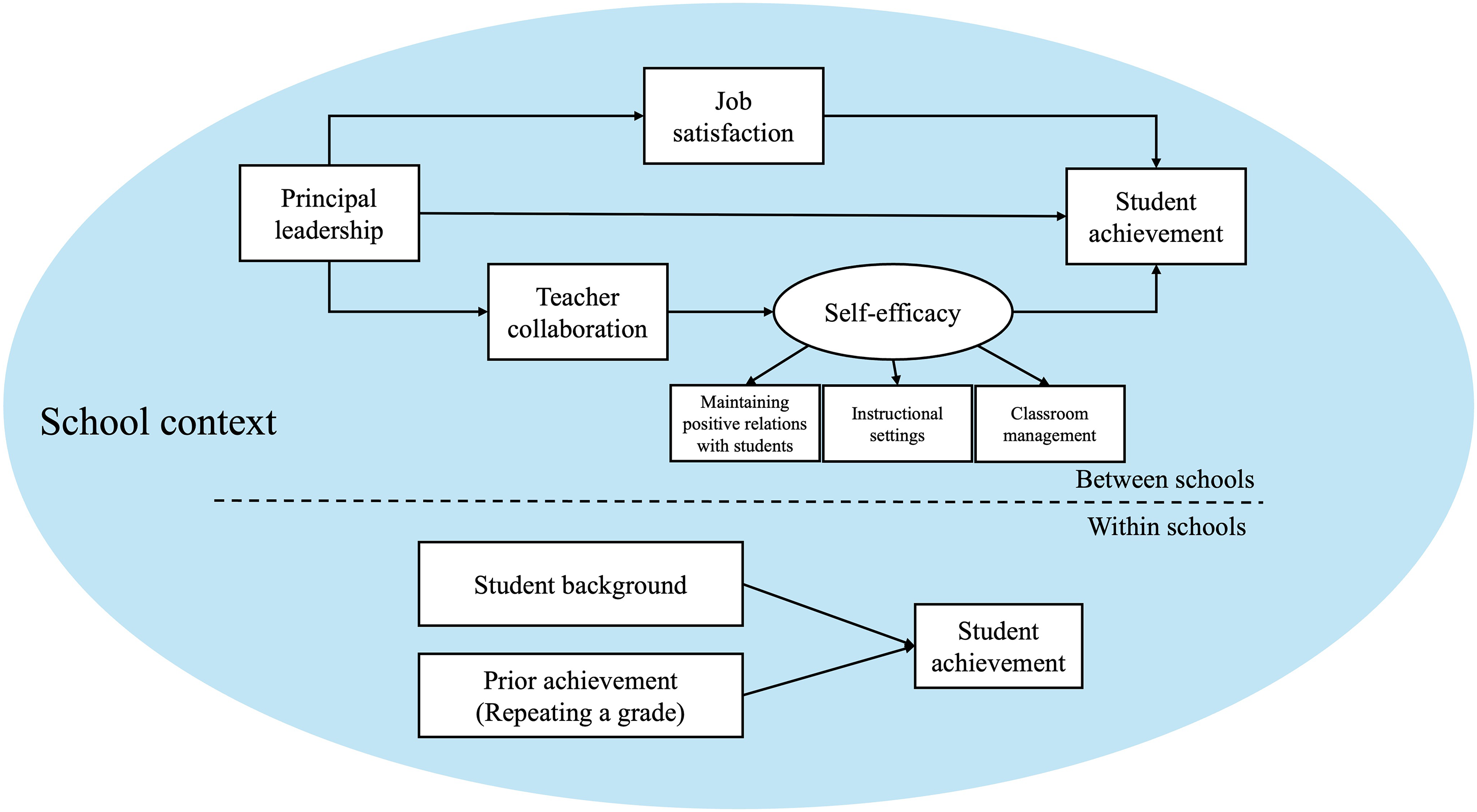
Conceptual framework.
The indirect and direct effects of principal leadership
A substantial body of literature has demonstrated that effective principals can contribute to large positive changes in student learning (Grissom et al., 2021) both directly and indirectly through multiple pathways. Direct effects arise from principals’ direct interaction with students, including classroom walkthroughs, individual conversations, and discipline management (Grissom & Loeb, 2011). Indirectly, principal leadership shapes school processes that support learning (Wu & Shen, 2026). Prior research has identified several potential mediating mechanisms, such as improving teachers’ individual and collective efficacy and well-being, and fostering safe, inclusive, and supportive learning environments (Leithwood et al., 2020b; Shen & Wu, 2025). However, empirical evidence remains insufficient to determine which school processes most strongly mediate leadership effects, and we contribute to the literature by examining two pathways: improved teacher job satisfaction, and enhanced teacher collaboration and self-efficacy in teaching.
Teachers’ job satisfaction
Job satisfaction refers to a feeling of fulfillment and contentment within their work environment. Research identifies principal leadership as a key predictor of teachers’ job satisfaction (Bellibaş et al., 2025). Teachers tend to be more pleased with their jobs when principals communicate clear expectations aligned with a shared vision, provide individualized support, and empower teachers to lead and excel (Bogler, 2001; Wu & Wu, 2026). Teachers with higher job satisfaction tend to invest more time and energy in interacting with students (Hoque et al., 2023). As Hoque et al. (2023) concluded, “highly satisfied teachers give their best to their students’ success” (p. 1). Satisfied teachers are also more willing to enhance instructional quality, adapt innovative teaching strategies, and engage in collective efforts to improve student achievement.
Teacher collaboration and teachers’ self-efficacy in teaching
Another indirect path examined in this study involves teacher collaboration and self-efficacy in teaching. Teachers’ self-efficacy in teaching refers to teachers’ beliefs about their capacity to organize and enact the course of action related to teaching that promotes student learning (Goddard & Kim, 2018). Research shows that teachers’ self-efficacy is multidimensional, encompassing instructional practices, classroom management, and relationship building with students (Ma et al., 2025; Zee & Koomen, 2016). A meta-analysis of 165 studies found that these dimensions are closely related to the quality of classroom processes. On average, the relationship between self-efficacy and student achievement is positive, but the evidence remains scant and uneven, varying across subjects and educational levels. This underscores the need for further research in this area (Ma et al., 2025; Zee & Koomen, 2016).
Teacher collaboration refers to teachers working together to improve student performance through knowledge sharing, reflective dialogue, shared inquiry, and mutual support for continuous learning. Research indicates that principal leadership fosters quality collaboration (Vangrieken et al., 2015). When leaders deliberately build supportive structures and share decision-making authority, genuine collaboration grounded in openness, trust, and support is more likely to take root across a school (Hargreaves, 2019; Honingh & Hooge, 2014; Wu et al., 2020). Such collaboration is linked to meaningful positive changes, including stronger teachers’ self-efficacy (Çoban et al., 2023; Y. Liu et al., 2021). Yet the existing evidence about teacher collaboration is still underdeveloped and fragmented in design and scope, and often inattentive to the contextual conditions that shape when and how these relationships emerge (Weddle, 2022).
Leadership effects and school contexts
Principal leadership does not operate in a vacuum. Contingency theory suggests that leadership effectiveness depends on its alignment with organizational context (Klar & Brewer, 2013; Yukl, 2011). Beyond contingency theory, scholarship on contextual leadership further underscores that school leaders take time to craft their leadership practices to align with the unique demands of the context. While a generic set of core leadership practices may be broadly applicable across schools, these practices must be thoughtfully adapted to local contexts (Hallinger, 2018; Leithwood, 2020a; Oc, 2018). Moreover, effective leadership is not dictated by the context but responsive to it, as leaders exercise professional judgment in calibrating their practices to fit organizational conditions. Although the need to give more attention to context in leadership research has been embraced, much remains unknown about how leadership practices operate responsively across school contexts. Within the relatively small body of quantitative studies that examine how leadership effects vary across school contexts, three main approaches can be identified.
The first approach, common in earlier research, partitions samples by school contextual variables and examines the effects and mechanisms of principal leadership within each subsample (Tan, 2018). Using this approach, Sebastian and colleagues applied the same conceptual framework to urban elementary (Sebastian et al., 2016) and high schools (Sebastian et al., 2017) to study how principal and teacher leadership influence student achievement growth via organizational processes. They found that leadership in creating a safe and positive learning environment with shared high expectations relates to student learning in both settings, but the pathways differed. In elementary schools, principals’ influence on the learning climate was mainly indirect through teacher leadership, whereas in high schools both direct and indirect effects were evident. This difference was attributed to the distinct organizational demands of high schools, where principals often assume greater direct responsibility for shaping the school climate (Sebastian et al., 2016, 2017). This split-sample approach, however, often reduces statistical power, and leads to inflated standard errors and less precise estimates.
The second approach leverages interaction effects to capture how contexts moderate principal leadership effects by including interaction terms in regression and structural models (e.g., Sebastian & Allensworth, 2019; Smith & Gümüş, 2022). For example, studies using the U.S. PISA 2015 data found that school size negatively moderates the direct impacts of principal leadership (Wu et al., 2020a, 2020b), with smaller effects observed in larger size schools. This pattern may be due to principals’ fewer opportunities for direct interactions with students in these schools and their greater reliance on indirect influence through middle-level leaders and teachers. Similarly, Smith and Gümüş (2022), using data from Danish teachers and students, showed that principals’ dialogue with teachers on student achievement has stronger impacts on student performance in low-SES schools. This approach of adding interaction term also faces limitations, including issues of multicollinearity, the need for larger sample sizes to detect effects, and challenges in results interpretation (Cohen et al., 2015).
The third approach relies on meta-analytic methods, coding school contextual variables as moderators to investigate the heterogeneity in leadership effect sizes (Liebowitz & Porter, 2019; Tan et al., 2024). This approach, however, depends heavily on the quality of reporting in primary studies. In practice, limited contextual information of school samples only constrains meta-analyses to several broad categories, such as grade level or country. Other important aspects of school contexts, such as school location, socio-economic composition, and size are often omitted (Shen & Wu, 2025). Moreover, much of this work focuses primarily on direct effects of principal leadership. It is still unclear how school context impacts multiple mechanisms through which school principals influence student learning.
In contrast to prior work, the present study neither splits the sample, nor relies on interaction terms. Instead, we employ a novel approach—multigroup multilevel structural equation modeling. To our knowledge, this approach has rarely been applied in educational leadership research, yet it offers substantial potential for uncovering complex relationships across different groups.
Methods
Data source
This study uses data from the Program for International Student Assessment (PISA) 2022. Coordinated by the Organization for Economic Cooperation and Development (OECD), PISA is an internationally comparative study of 15-year-old students’ reading, math, and science literacy in about 80 countries and educational systems. PISA has been conducted every three years since 2000, and due to the covid-19 pandemic PISA 2022 was delayed for a year. The sample for this study was from two SARs of China: Hong Kong and Macau. Both economic systems represent post-colonial, semi-autonomous Chinese regions with hybrid East-West and bilingual education systems. The sample includes 10,291 students and 4251 teachers in 209 schools. By focusing on Hong Kong and Macau, this study expands the diverse and globally relevant knowledge base in educational leadership (Hallinger & Kovačević, 2019).
Variables and measures
Student achievement
PISA assesses skills that students have acquired at the end of compulsory education in core subjects. Math literacy was the major domain in PISA 2022 and was also our focus in this study. Each student only completed a subset of all possible test items, so scores for each student for each subject were reported through 10 plausible values. Following OECD guidelines (OECD, 2009) and the procedures documented in the Mplus User's Guide (Muthén & Muthén, 1998–2017), analyses were conducted using the 10 plausible values provided by PISA.
Principal leadership
In PISA 2022, a derived variable was created to capture teachers’ perception of principal leadership. This variable was based on seven items assessing how frequently school principals engage in key leadership practices, including collaborating with teachers to address classroom discipline, observing instructional practices, offering feedback to teachers based on observations, supporting teachers’ co-operation to develop new teaching practices, ensuring teachers improve teaching skills, promoting shared responsibility among teachers for students’ learning outcomes, and organizing people and activities to facilitate the teachers’ work (OECD, 2024). Responses were rated on a four-point scale ranging from never or rarely to very often.
School process: job satisfaction, teacher collaboration, and self-efficacy
Teacher job satisfaction was measured by four items on a four-point Likert scale reflecting the extent to which teachers are satisfied with their job environment (e.g., I enjoy working at this school). Teacher collaboration was assessed using four items capturing the frequency of teachers participating in teaching-related collaborations (e.g., exchanging teaching materials, attending team conferences) with response options ranging from Never to Once a week or more. Teachers’ self-efficacy in teaching was measured using 12 items asking teachers’ perceived ability in managing classroom, maintaining positive relationships with students, and delivering classroom instruction. Response options for these items were on a four-point scale ranging from Not at all to A lot (OECD, 2024).
Student and school background variables
Four student background variables were included as controls: gender, age, immigrant status, socio-economic status (SES), and grade repetition,which served as a proxy for prior achievement. These background variables have been consistently shown in prior research to be associated with academic achievement and were commonly included in leadership effectiveness studies as controls (Heck & Hallinger, 2009).
To examine how school context shapes the mechanisms linking leadership to student achievement, we focused on three contextual variables: school size, location, and socio-economic composition. These ambient contextual features are often conceived of as so important that school leaders need to make sense of their effects and respond accordingly (Tan et al., 2024; Grissom et al., 2021). Schools were categorized separately for each variable. Specifically, school location was split into three groups: schools in villages or towns, in small cities, and in large or mega cities. For school socioeconomic status, given the absence of a direct school-level SES measure in PISA, student SES was aggregated to the school level to capture school socio-economic composition. Schools were then categorized into low-SES, medium-SES, and high-SES categories by quantile: lowest quantile, middle 50%, and highest quantile, respectively. Similarly, schools were categorized into small-, medium-, and large-size groups based on quantiles. Details about the coding of these variables, as well as the descriptive statistics, are reported in the Supplementary File.
Analytic strategy
We used an MGMLSEM approach to investigate how principal leadership influences student learning through school processes, and how the mechanisms do not function uniformly across school contexts. We chose MGMLSEM because it is particularly well suited for answering our research questions. MGMLSEM extends multigroup structural equation models to accommodate a multilevel data structure (Mayer et al., 2014; Raufelder et al., 2018). This method integrates the strengths of both multigroup structural equation models and multilevel analysis, enabling the analysis of complex and hierarchical data structures across groups. Building on the advantages of multilevel analysis, the MGMLSEM approach estimates standard errors more accurately, and allows the researcher to examine both the influence of individual- and organizational- level predictors (Raudenbush & Bryk, 2002). In addition, the multigroup component makes it possible to test whether measurement properties and structural relationships of variables differ across distinct groups (Mayer et al., 2014; Schenke et al., 2017). This feature of MGMLSEM is particularly valuable for educational research, as it provides the ability to account for contextual effects, and offers the opportunity to unpack nuances of a program or school practice, thereby helping to answer the question not only of what works, but also for whom, and under what conditions. Given the strength of this approach and its limited use to date, this study also contributes to the field by providing an illustrative example of its application.
The model procedure and specification are described in the following steps. We started with an unconditional model where no predictors are included to estimate the proportion of the variance of student outcome at the within- and between-group levels and the intraclass correlation. Next, we conducted MGMLSEM analyses for school groups categorized by location, socioeconomic status, and school size. For each categorization, we followed the same modeling procedure. First, we estimated an MGMLSEM model to address our first research question and examine the direct and indirect effects of school leadership on student learning via teachers’ job satisfaction, teacher collaboration, and teacher self-efficacy. We imposed group equality constraints on path coefficients and factor loadings to test whether the structural relationships among variables and measurement properties of teacher self-efficacy were invariant across groups. Student-level background variables were also included in the model as controls for math achievement. In our second MGMLSEM model, the equality constraints for the direct and indirect paths from principal leadership to student learning were released. In other words, the parameters of the paths were freely estimated within each school group. Therefore, we were able to examine how the mechanisms of principal leadership influence differed across different schools. Model 3, relative to Model 2, further relaxed the equality constraints on the factor loadings of teachers’ self-efficacy. This step was undertaken to test the measurement invariance of the teacher self-efficacy construct across different groups.
The adequacy of each model, which was assessed using multiple model fit indices, including Chi-squared, Root Mean Square Error of Approximation (RMSEA), Comparative Fit Index (CFI; Raykov & Marcoulides, 2006), Akaike Information Criterion (AIC), and separate for within-group and between-group, Standardized Root Mean Square Residual (SRMR) (Kline, 2016). Evaluating which of these models best fit the data and their corresponding estimates of parameters helps to answer our first and second research questions.
We used R for data wrangling and Mplus 8 (Muthén & Muthén, 1998) for statistical modeling and testing. Missing data in Mplus were handled using full information maximum likelihood (FIML), which estimates model parameters using all available data points (Muthén & Muthén, 1998–2017; Yamashita et al., 2021). Reliability, validity, and measurement invariance were examined, and detailed results and the Mplus syntax used for model estimation are available in the Supplementary Files.
Results
Results of model evaluation
The result of the unconditional model with no predictors showed an intraclass correlation of 0.387 in math. This indicated that 38.7% of the variance in math achievement was attributable to differences between schools and supports the use of multilevel modeling. We next tested our hypothesized models of how principal leadership was related to student learning. For each of the three school-level contextual variables, we estimated and compared three MGMLSEM models. By progressively releasing equality constraints on path coefficients and factor loadings, we investigated whether, and to what extent, the mechanisms through which principal leadership influences student outcomes differ across various contexts.
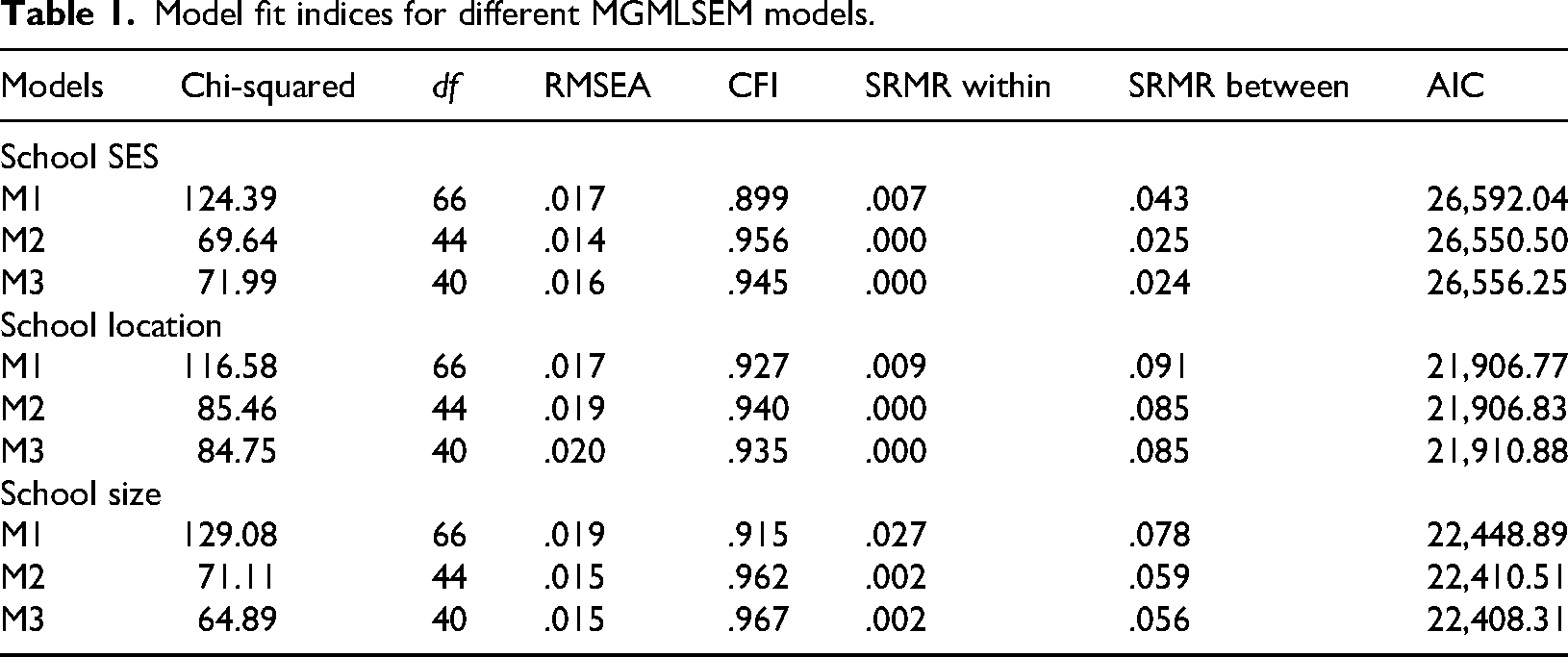
These models were evaluated by considering whether they demonstrated theoretically soundness, model parsimony, and goodness of fit to the data. Table 1 summarizes the adequacy of fit of each proposed model. Based on multiple model fit indices, Model 2, which did not impose equality constraints on path coefficients and allowed leadership effects on student learning to vary across school groups, was considered the best model because it achieved a better balance between model fit and parsimony. Model 3 did not show a significant improvement in model fit over Model 2. In some cases, Model 3 performed even worse. These findings support our proposition that the mechanisms of principal leadership effects on student achievement vary across schools. The following section turns attention to the specific parameter estimates in our best models (Model 2) to unpack how the mechanisms might be similar and different in various types of schools.
Model fit indices for different MGMLSEM models.
How do the relationships between principal leadership, school process, and student math achievement vary across low-, middle-, and high-SES schools?
We examined whether and to what extent the relationships between principal leadership, school process, and student math outcome differ across schools with varying SES levels (see Table 2). At the student level, female students and those who repeat a grade scored lower in math, but immigrant students outperformed nonimmigrants across low-, middle-, and high-SES schools. Students’ SES was a significant and positive predictor for high math scores in low and high SES schools but not in middle SES schools. In addition, students’ age was positively associated with higher math scores, particularly in middle- and high-SES schools.
Results of the MGMLSEM by school SES.
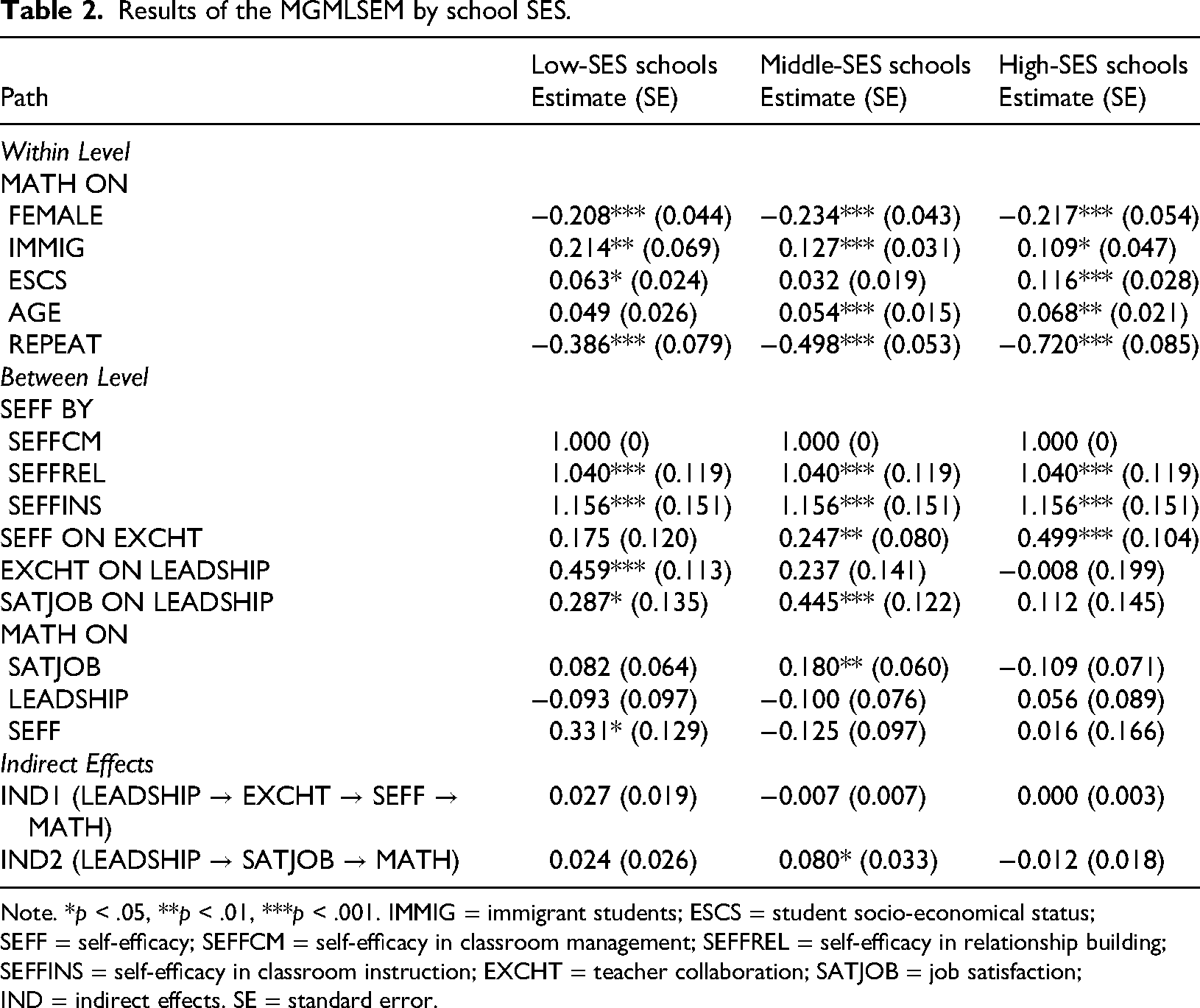
Note. *p < .05, **p < .01, ***p < .001. IMMIG = immigrant students; ESCS = student socio-economical status; SEFF = self-efficacy; SEFFCM = self-efficacy in classroom management; SEFFREL = self-efficacy in relationship building; SEFFINS = self-efficacy in classroom instruction; EXCHT = teacher collaboration; SATJOB = job satisfaction; IND = indirect effects. SE = standard error.
Between schools, principal leadership was positively related to teacher job satisfaction in low- and middle-SES schools but not in high-SES schools (
How do the relationships between principal leadership, school process, and student math achievement vary across schools locations in villages or towns, small cities, and large or mega cities?
Across schools in different locations (see Table 3), female students and those who repeated a grade had lower test scores than their counterparts. Students age and socio-economic status were important positive predictors of math scores in schools located in a small or large city, but not in schools in a village. Immigrant students in schools located in less urbanized districts (“small city,” as defined by PISA) outperformed their peers, whereas in other schools their performance did not differ from that of nonimmigrant students.
Results of the MGMLSEM by school location.
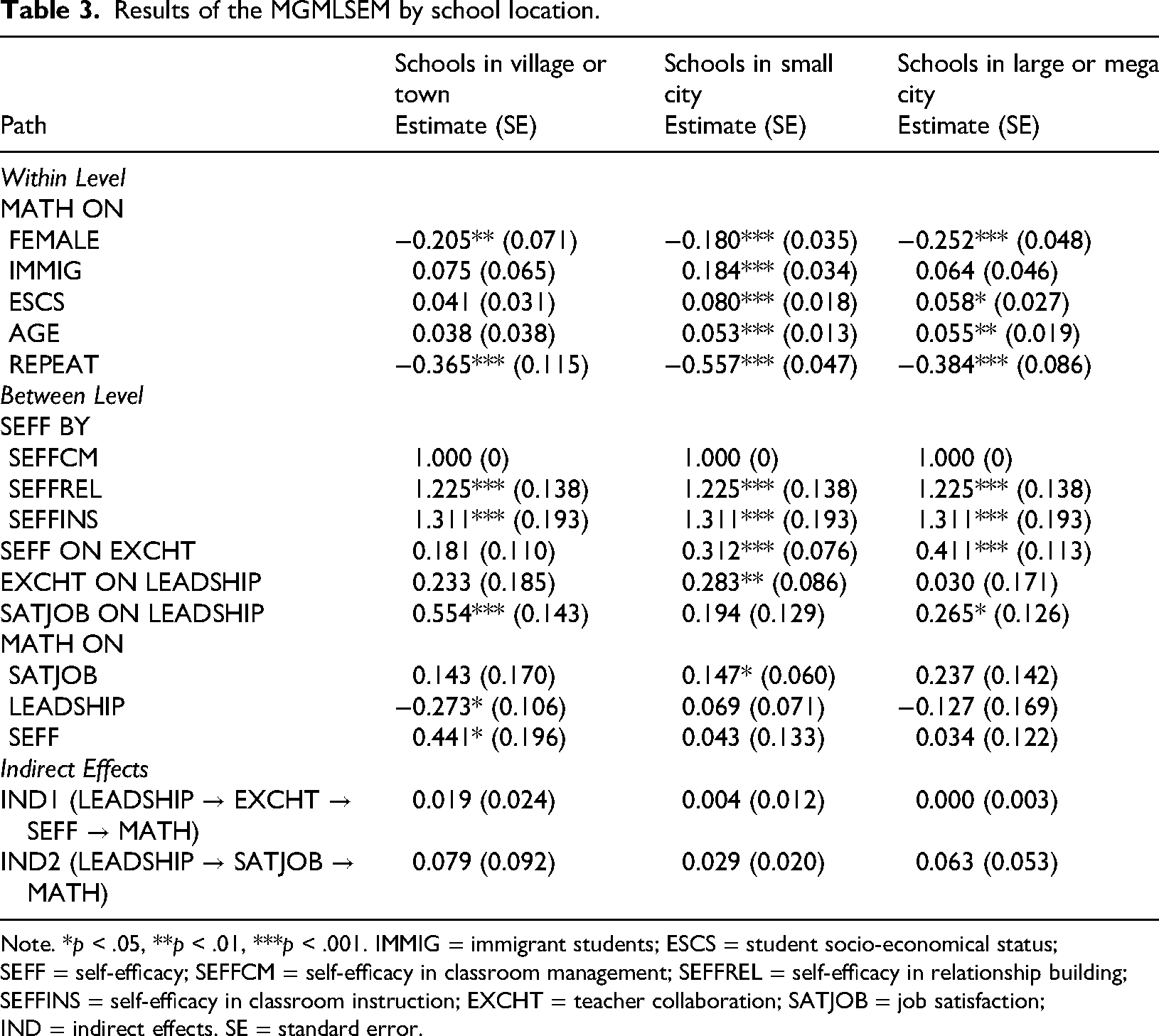
Note. *p < .05, **p < .01, ***p < .001. IMMIG = immigrant students; ESCS = student socio-economical status; SEFF = self-efficacy; SEFFCM = self-efficacy in classroom management; SEFFREL = self-efficacy in relationship building; SEFFINS = self-efficacy in classroom instruction; EXCHT = teacher collaboration; SATJOB = job satisfaction; IND = indirect effects. SE = standard error.
At the school level, principal leadership was positively associated with teachers’ job satisfaction in both small village (
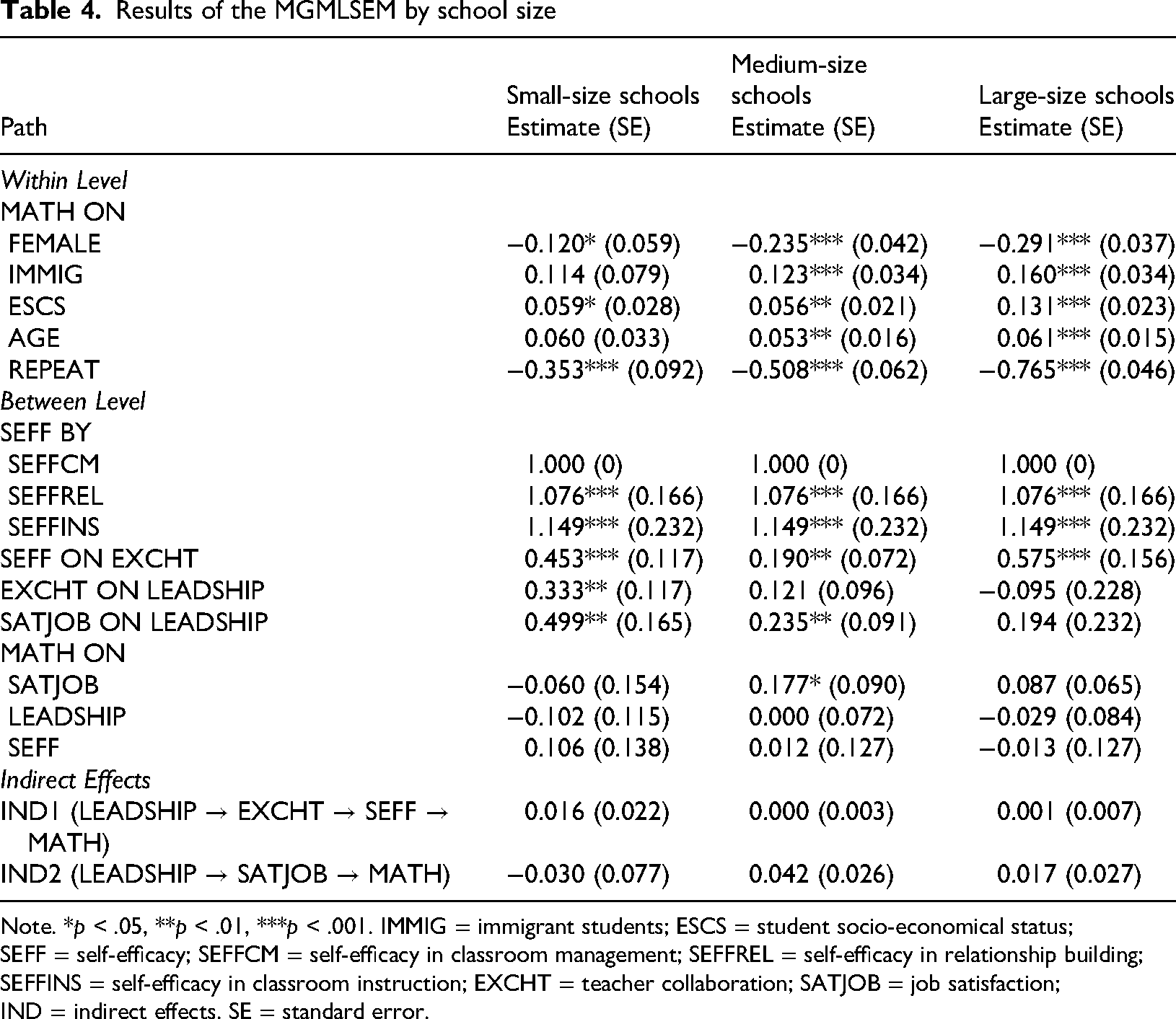
How do the relationships between principal leadership, school processes, and student math achievement vary across small-, medium-, and large-size schools?
Table 4 presents the results that illuminate how the relationship between principal leadership, school process, and student achievement differ across schools of varying sizes. At the student level, student SES was positively associated with math scores, while being female and repeating a grade were negatively related to math score. These relationships hold across schools of different sizes. In addition, immigrant students had statistically significantly higher math scores than nonimmigrant students in middle- and large-size schools.
Results of the MGMLSEM by school size
Note. *p < .05, **p < .01, ***p < .001. IMMIG = immigrant students; ESCS = student socio-economical status; SEFF = self-efficacy; SEFFCM = self-efficacy in classroom management; SEFFREL = self-efficacy in relationship building; SEFFINS = self-efficacy in classroom instruction; EXCHT = teacher collaboration; SATJOB = job satisfaction; IND = indirect effects. SE = standard error.
Regarding the schooling process, while the relationship between principal leadership and teacher collaboration was observed only in small schools, the relationship between teacher collaboration and teacher self-efficacy was positive and significant across all school sizes, with the strongest effect in large schools. A positive relationship between principal leadership and teacher job satisfaction was found in small- (
Discussion
This study makes several important contributions to the school leadership literature. First, it demonstrates that school context conditions both the magnitude and the mechanisms of leadership influence. The nature and strength of principal leadership impacts on student learning are not uniform; rather, they vary across school contexts of differing SES levels, sizes, and degrees of urbanicity. Our findings on variation across school SES levels are of particularly significance. Not only because research in this area remains limited but also because existing leadership effectiveness studies have largely concentrated on differences in the “magnitude” of leadership effects. For example, Tan et al.'s (2024) meta-analyses suggested SES does not moderate the magnitude of leadership effects. However, to what extent leadership influences student learning is only one dimension of leadership influence. Our study highlights another angle of this issue: SES shapes the mechanism through which leadership influences student learning. In middle SES schools, the path from leadership to student achievement via teacher job satisfaction was positive and statistically significant, whereas the same pathway was weaker or nonsignificant in higher-SES schools. This suggests that leadership practices aimed at enhancing teacher job satisfaction may particularly pay off in middle SES contexts, albeit less so in more advantaged school settings.
Similarly, school location is an active condition that plays a role in the relationship between principal leadership and school process. In small village schools, a negative direct impact of principal leadership on student learning is observed. This finding appears counterintuitive at first glance, but it becomes far less difficult to explain once the PISA measurement items are unpacked. Principal leadership as measured in PISA 2022 tends to focus more on instructional leadership (OECD, 2024), but in small village schools in Hong Kong and Macau where infrastructure and financial resources are more limited, principals who spend their time more on building external relationships, obtaining resources, and seeking community support may be more effective (Klar & Brewer, 2013; Masumoto & Brown-Welty, 2009). These activities are crucial for school improvement in that context; however, they are not featured prominently in PISA surveys and traditional instructional leadership frameworks. Another reason could be that some instructional leadership practices, such as class observation, are interpreted as principal intrusion in Hong Kong and do not directly associate with instruction improvement (Lee et al., 2012).
We also observed the patterns of leadership effects tied to school size. Prior studies underscored the role of leadership in facilitating collaboration and improving job satisfaction (Çoban et al., 2023; Grissom et al., 2021). We found that these effects are more pronounced in small-size schools. On the contrary, the relationships between principal leadership and teacher job satisfaction and collaboration were not statistically significant in high-SES and large size schools. This may be because, in smaller schools, principals engage in more frequent direct interactions with teachers (and even students). This could be owing to the fact that principal leadership may be more distributed, or their impacts are mediated by middle leaders such as department heads in very large schools (Leithwood & Jantzi, 2009).
Second, our findings collectively contribute to the classical debate in the field of educational leadership. Many previous principalship studies focus primarily on “does leadership matter?” “What leadership practices matter the most?” and “through what does leadership matter?” (Grissom et al., 2021; Leithwood et al., 2020b). This study is among a small handful to tackle the dimension of “under what conditions does leadership matter most, and in what ways should leadership practices be adapted to suit various school contexts?” This underexplored area necessitates a more nuanced and dynamic understanding of leadership activities and effects. On the one hand, some pathways are consistently meaningful across contexts, suggesting their ubiquitous potential as levers for improving schools (Çoban et al., 2023; Leithwood et al., 2020b). On the other hand, the magnitude, mechanism, and timing of the impacts of certain leadership practices vary widely depending on how leaders adjust these practices in response to contextual conditions (Leithwood et al., 2020a). The core leadership practices do not show their impacts automatically and immediately. Instead, they need to be activated through proactive and thoughtful actions (Kovačević et al., 2023).
Third, methodologically, this study is among the first, if any, to employ a MGMLSEM approach to examine the relationship between principal leadership, schooling process, and student outcomes. Using MGMLSEM, we were able to simultaneously model leadership impacts at multiple levels and test whether those effects hold consistently across different contexts of schools. Rather than treating school background variables as merely control or antecedent variables, our approach positions school context as a focal part of the analysis. We demonstrate the value of MGMLSEM in unpacking the contingent nature of leadership effects and offering more insights about how leadership makes effects “under what conditions.” This contributes to moving beyond the one-size-fits-all assumptions of past research. Beyond the “under what conditions” question, MGMLSEM can also be used to answer the “for whom” question. We encourage researchers to leverage the power of this method to explore how school leaders should tailor their skills and practices to maximize the gains for different groups of students.
Our findings have practical implications. For building and district leaders, it is important to deeply internalize the essence of core leadership practices and pathways through which they are linked to student and school outcomes and collaborate with teachers and staff to develop contextually responsive leadership strategies. These practices need to be woven into their school's condition and culture to activate and maximize their impacts (Hallinger, 2018; Tan, 2018). For leadership preparation programs, the point is not to prescribe what leaders should do by offering a fixed set of “core practices” applicable to all schools. When leadership is framed in this way, school leaders are positioned as passive implementers of predefined practices, therefore undermining the very agency that constitutes leadership in the first place. Rather, the key at stake is to activate school leaders’ commitment to core values and embodiment of effective practices, develop their sensitivity to students’ needs and adaptability in complex situations, and provide them with resources that may inform their own judgement and inventiveness in their interactions with teachers and local contexts (Hallinger, 2018; Klar & Brewer, 2013; Leithwood et al., 2020a).
There are several limitations of this study that suggest direction for future research. First, although our data is large-scale and recent, they remain cross-sectional. As a result, the mechanisms identified between principal leadership and student achievement should be interpreted as correlational rather than causal. As many scholars have argued, there is still a limited number of educational leadership research using longitudinal data and causal designs (Grissom et al., 2021). Future research that adopts these approaches would be particularly valuable for examining the dynamic interplay between principal leadership and school contexts, particularly how they influence one another over time and how they interactively shape student learning. This line of research would be significant for moving the field forward. Second, while this study focuses on two pathways from principal leadership to student learning, some other indirect paths have also been shown effective. Future research applying similar methods to examine the variation of these alternative pathways across diverse school contexts would contribute meaningfully to building this knowledge base.
Third, this study can be extended from Hong Kong and Macau to other countries and economies. We think that the mechanisms linking school context and leadership practices may be context-dependent and manifest in different forms within school conditions that are themselves embedded in broader community, social, cultural, and policy contexts (Shen & Wu, 2025). For example, urban schools in Hong Kong and Macau differ markedly in student demographics, resources, opportunities and challenges than those in the United States. It is within these layered contexts that leadership practices are enacted. At the same time, what this study seeks to demonstrate is that questions about effectiveness and efficiency of leadership are far less meaningful without reference to the specific contexts and the complexities of the task, person and situation. This insight we suggest is transferable across different geographical locations, countries, and cultures.
A compelling future extension of research would be understanding principal leadership from the perspective of contingent complexity and investigating how school leaders act effectively in the interplay of broader cultural and political contexts and more localized school systems (Kovačević et al., 2023; Muñoz et al., 2023). Here, our conception of a contingent complexity perspective is not necessarily equivalent to treating context as a statistical variable (whether as an independent, control, moderator, or mediator). Of course, in some cases, adding context as a variable in statistical models may help deepen understanding from a contextual standpoint. But this can never be taken for granted. In a large body of research, the two are decoupled: many leadership studies treat context merely as a variable to be “controlled for,” thereby downplaying or even sidestepping the theoretical engagement with context itself. Even in studies that conceptualize context as a moderator, school context is often framed as an external constraint which defines the possibility of leadership practices and the potential of their effectiveness. From a fully contextual perspective, we value the importance of context, but this is not to say that leaders are entirely constrained or devoid of agency. Rather, a contextual perspective calls for attention to how leaders actively learn about, interpret, and negotiate their contexts, and how they make responsible and thoughtful decisions on that basis.
In conclusion, this study employs MGMLSEM to examine three school contextual factors and their roles in linking principal leadership to student academic achievement. The findings provide empirical support for contextual leadership and contingency theory and suggest that the role of school context in leadership effectiveness is not only reflected in differences in magnitude (how much leadership matters) but, more fundamentally, in differences in mechanisms and processes (how leadership matters). We argue that discussions of context and leadership effectiveness should move beyond comparisons of effect sizes and attend more closely to how context conditions the pathways through which leadership practices operate. From this perspective, school contexts should not be viewed as external constraints on leadership action, but rather as an arena that enables principals’ agency, guiding leaders’ judgments about what actions need or do not need to be taken, and how action should be undertaken within specific institutional, cultural, and policy settings.
Supplemental Material
sj-docx-1-ema-10.1177_17411432261434762 - Supplemental material for Principal leadership, school processes, and student achievement: Examining contextual heterogeneity in leadership mechanisms via multigroup multilevel structural equation modeling
Supplemental material, sj-docx-1-ema-10.1177_17411432261434762 for Principal leadership, school processes, and student achievement: Examining contextual heterogeneity in leadership mechanisms via multigroup multilevel structural equation modeling by Huang Wu, Sijia Zhang and Jacob M Marszalek in Educational Management Administration & Leadership
Footnotes

Funding
The authors received no financial support for the research, authorship, and/or publication of this article.
Declaration of conflicting interests
The authors declared no potential conflicts of interest with respect to the research, authorship, and/or publication of this article.
Supplemental material
Supplemental material for this article is available online.
Author biographies
References
Supplementary Material
Please find the following supplemental material available below.
For Open Access articles published under a Creative Commons License, all supplemental material carries the same license as the article it is associated with.
For non-Open Access articles published, all supplemental material carries a non-exclusive license, and permission requests for re-use of supplemental material or any part of supplemental material shall be sent directly to the copyright owner as specified in the copyright notice associated with the article.
