







Abstract
The predominant reliance on variable-centred analytical approaches in studies of distributed leadership and teacher academic optimism has often overlooked individual-level heterogeneity, potentially resulting in oversimplified conclusions about their relationship. This study addresses these gaps by employing a person-centred approach to uncover latent profiles of perceived principal distributed leadership and their associations with dimensions of teacher academic optimism. Drawing on data from 1407 Malaysian primary school teachers, the study first validated the distributed leadership construct through exploratory and confirmatory factor analyses, followed by latent profile analysis. Three distinct leadership profiles, namely low-, moderate- and high distributed leadership were identified. A robust check showed that rural and urban schools did not differ significantly in their likelihood of belonging to any of the three distributed leadership profiles. Teachers in schools characterised by high distributed leadership exhibit stronger academic optimism across academic emphasis, trust in students and parents, and teachers’ sense of efficacy compared to those in moderate or low distributed leadership profiles. The emergence of these differentiated profiles underlines the limitations of uniform policy prescriptions and highlights the necessity for context-sensitive leadership strategies.
Keywords
Introduction
The rise of distributed leadership in educational literature stems from the recognition that leadership cannot rely solely on a single, heroic individual (Harris et al., 2022; Thien et al., 2025). This approach marks a departure from traditional top-down leadership models, emphasising collaboration and the sharing of responsibilities among teachers within schools (Bush and Ng, 2019). Reflecting shifts in the educational landscape, distributed leadership has become one of the most prominent concepts for understanding educational leadership since 2005 (Adams et al., 2025a; Gümüş et al., 2018; Mifsud, 2023).
Foundational perspective theorises distributed leadership practice as constituted through the interactions of leaders, followers, and situations, rather than as the work of a single formal leader (Spillane et al., 2001). Likewise, distributed leadership has been theorised as a form of coordinated action arising from interdependence and division of labour among organisational members (Gronn, 2002). Such theoretical foundations of distributed leadership suggest that it is unlikely to operate as a uniform or monolithic phenomenon across schools. These perspectives imply that distributed leadership may vary across schools depending on how leadership relations, participation structures, coordination, and organisational routines are enacted in practice. For instance, some schools may exhibit strong leadership support but limited teacher participation in decision-making, whereas others may demonstrate cohesive leadership teams alongside weaker supervisory guidance. From this perspective, it is arguable that distributed leadership may exist in distinct profiles shaped by how its dimensions combine within school contexts. Yet, despite this theoretical possibility, much of the empirical literature has continued to treat distributed leadership as a relatively uniform variable, estimating average net effects across samples rather than examining whether different profiles exist.
Apart from that, one teacher-related outcome that has attracted growing attention in distributed leadership literature is teacher academic optimism (Akyürek and Bülbül, 2024). Teacher academic optimism refers to teachers’ positive beliefs that they can promote students’ academic success through effective teaching, trust in students and parents, and a strong emphasis on academic achievement (Hoy et al., 2008). This construct is important because it reflects a psychologically and professionally enabling orientation that may shape teachers’ persistence, expectations, and commitment to student learning (Straková et al., 2018). Previous studies have generally reported positive associations between distributed leadership and teacher academic optimism across different contexts (Börü and Bellibaş, 2021; Chang, 2011; Malloy, 2012; Thien and Chan, 2022; Thien et al., 2021). These findings suggest that when leadership is shared and collaborative, teachers may be more likely to experience professional trust, collective responsibility, and confidence in their capacity to support student learning.
However, most of the existing empirical evidence of distributed leadership-teacher academic optimism relationship has been generated through variable-centred approaches such as regression, structural equation modelling, and multilevel analysis, which estimate relationships at the level of sample averages (Börü and Bellibaş, 2021; Thien and Chan, 2022; Thien et al., 2021). Although these approaches are valuable, they implicitly assume population homogeneity and may therefore obscure meaningful subgroup or profile differences (Hickendorff et al., 2018; Howard and Hoffman, 2018). In the context of distributed leadership, this limitation should deserve attention because average positive effects do not reveal whether teachers are experiencing similar forms of principals’ distributed leadership or whether different profiles of perceived distributed leadership practices are associated with teacher academic optimism.
A person-centred approach offers a useful way to address this limitation. Latent profile analysis (LPA) enables researchers to identify subgroups of teachers who report similar patterns across multiple dimensions of perceived principal distributed leadership, thereby revealing whether distinct distributed leadership profiles exist within the population (Bergman and Anderson, 2010; Collins and Lanza, 2009; Spurk et al., 2020). In this sense, the value of LPA in the present study is not merely methodological. It also offers a theoretically meaningful extension by testing whether perceived principal distributed leadership is better understood as a set of differentiated configurations or combinations of dimensions rather than a single linear continuum.
Furthermore, examining how these latent profiles relate to the dimensions of teacher academic optimism can generate new knowledge about whether academic emphasis, trust in students and parents, and teachers’ sense of efficacy respond similarly or differently to distinct profiles of distributed leadership. Such a perspective moves beyond the conclusion that distributed leadership is “positively related” to teacher academic optimism and instead asks which profiles of distributed leadership matter.
Besides, in a highly centralised and policy-driven education system such as Malaysia, distributed leadership may not be enacted uniformly across schools. This is because formal organisational structures, hierarchical expectations, school-level capacity, and contextual differences in collaboration may shape how leadership is shared, supported, and supervised in practice (Bush and Ng, 2019). This makes Malaysia a theoretically relevant context for examining whether distributed leadership is experienced as distinct profiles rather than as a uniform construct, particularly in a system where hierarchical authority and collaborative expectations may coexist in tension (Zabidi et al., 2023).
Accordingly, the present study seeks to extend prior research in two ways. First, it examines the underlying factor structure of distributed leadership among Malaysian primary school teachers to establish the construct's multidimensional applicability in this context. Second, it adopts a person-centred approach to identify latent profiles of perceived principal distributed leadership and to investigate their relationships with the three dimensions of teacher academic optimism. The study addresses the following research questions:
What is the underlying factor structure of Malaysian primary school teachers’ perceptions of distributed leadership? What latent profiles can be identified based on Malaysian primary school teachers’ perceptions of their principals’ distributed leadership? What are the relationships between the perceived principal distributed leadership profiles and teacher academic optimism dimensions?
This study offers a theoretical extension by investigating whether distributed leadership is better understood as a configurational construct composed of differentiated combinations of dimensions rather than a single linear continuum. The presence of distinct profiles would suggest that distributed leadership theory should account not only for leadership distribution, but also for the ways its dimensions co-occur in practice.
Literature review
Distributed leadership
Gronn's (2000) concept of distributed leadership centres on the idea of conjoint agency, where leadership emerges through the collaborative efforts of interdependent individuals. This perspective challenges traditional notions of singular leadership roles and underlines the value of team-based approaches (Bush and Glover, 2012). The conceptual shift from singular leadership to distributed leadership has been significantly shaped by the foundational work of Spillane et al. (2001), Gronn (2002), and Harris (2008). This shift responds to the increasing complexity of educational leadership and the need to alleviate the burdens placed on principals and senior leaders (Thien and Chan, 2022). Distributed leadership promotes leadership responsibilities which are shared among teachers and staff, fostering a culture of dynamic process as well as highlighting collaboration and mutual accountability (Spillane, 2005; Youngs, 2017). Specifically, Gronn (2002) described distributed leadership as dynamic interactions among individuals while Harris (2008) emphasised interdependence and collaboration. Spillane (2005) framed it as a socially distributed process, where decision-making authority is collectively enacted.
While Spillane et al. (2001), Gronn (2002), and Harris (2008) provide the broad theoretical foundations of distributed leadership, the present study adopts Hulpia et al.'s (2009b) conceptualisation as the operational framework for analysis. Compared with broader conceptual accounts, Hulpia et al.'s conceptualisation translates principal distributed leadership into school-based dimensions that are directly observable and meaningful to teachers in their day-to-day work. Specifically, Hulpia et al. (2009b) conceptualised distributed leadership in terms of leadership team cohesion, participative decision-making, leadership support, and leadership supervision. These dimensions capture how distributed leadership is experienced in schools and therefore provide a more empirically operationalisable basis for examining teachers’ perceptions.
The adoption of Hulpia et al.'s (2009b) conceptualisation also aligns with the person-centred focus of the current study. Although distributed leadership is often examined as a single construct with average effects across samples, its theoretical foundations suggest that it may not operate uniformly across schools. Furthermore, the dimensions of distributed leadership may not develop to the same extent in every school. For example, some schools may demonstrate strong leadership support but limited teacher participation in decision-making, whereas others may exhibit cohesive leadership teams alongside weaker supervisory guidance. In this sense, distributed leadership may take different profiles depending on how its dimensions combine within school contexts. Hulpia et al.'s (2009b) multidimensional conceptualisation is therefore particularly suitable for LPA, as it allows the current study to examine whether teachers perceive distinct patterns of distributed leadership rather than a single uniform construct. The four dimensions of distributed leadership suggested by Hulpia et al. (2009b) are as follows.
Cohesive leadership team. This dimension is characterised by transparency, mutual trust, and open communication. This dimension underlines the importance of collaborative efforts and shared understanding among school leaders and teachers. Participative decision-making. This dimension involves actively engaging teachers in decision-making processes, which enhances their sense of belonging and institutional commitment. Leadership support. This dimension refers to setting clear goals, articulating a shared vision, and fostering professional development. School leaders play a crucial role in motivating and empowering teachers. Leadership supervision. This dimension refers to the formal oversight provided by principals, ensuring accountability and alignment with school objectives.
Teacher academic optimism
Academic optimism has emerged as a noteworthy organisational construct in educational research, particularly due to its consistent association with student achievement—even when controlling for socioeconomic status (Hoy et al., 2006; McGuigan and Hoy, 2006; Wagner and DiPaola, 2011). Hoy et al.'s (2006) foundational study identified a collective set of beliefs encompassing academic emphasis, teacher efficacy, and faculty trust in students and parents, framing these as interrelated dimensions of a school's academic optimism.
The present study adopts the concept of academic optimism as articulated by Hoy et al. (2006), which integrates three interrelated teacher beliefs: (a) academic emphasis (behavioural), (b) trust in parents and students (affective) and (c) teachers’ sense of efficacy (cognitive) (Mascall et al., 2008).
Academic emphasis. This dimension is conceptualised as a behavioural dimension in which a school prioritises academic excellence through high yet attainable expectations, a structured and purposeful learning environment, and a collective belief in students’ potential to succeed (Hoy & Feldman, 1987). Teachers who exhibit strong academic emphasis are not merely implementers of curriculum but are also proactive agents in cultivating a focused and achievement-oriented classroom climate (Kurz, 2006). Teachers’ trust in students and parents. This dimension is conceptualised as a relational and affective dimension of effective schooling. Straková et al. (2018) described it as the emotional capacity to build reciprocal and respectful relationships while Hoy et al. (2006) defined trust as a willingness to be vulnerable based on the belief that others will act in one's best interest. Higher levels of trust correlate with increased teacher self-efficacy, which in turn enhances instructional planning and delivery (Woolfolk Hoy et al., 2008). Teachers’ sense of efficacy. This dimension is conceptualised as a cognitive construct reflecting educators’ beliefs in their capacity to influence student learning and engagement (Tschannen-Moran and Woolfolk Hoy, 2001). It is a critical determinant of teacher behaviour, particularly in how educators respond to student needs. Teachers with high efficacy are more likely to invest time in supporting struggling students and reinforcing academic success. Conversely, those with low efficacy may disengage or adopt inefficient practices.
Distributed leadership and teacher academic optimism: A person-centred approach
Although distributed leadership is often associated with positive school and teacher outcomes (Akyürek and Bülbül, 2024), the literature infers that its enactment is not uniformly beneficial or consistent across contexts. Some studies have noted that distributed leadership may be constrained by hierarchical authority structures, reduced to formal delegation rather than genuine collaboration, or enacted unevenly depending on school culture, leadership capacity, and policy conditions (Doguş et al., 2025). These critiques indicated that distributed leadership should not be assumed to operate as a universally coherent construct. Rather, its effects may vary across contexts, particularly in centralised education systems such as Malaysia. This makes it important to examine whether teachers perceive distinct profiles of principal distributed leadership rather than treating it as a single homogeneous construct.
Despite its growing prominence in educational leadership literature over recent decades (Adams et al., 2025a), the discourse surrounding distributed leadership remains largely celebratory, often stressing its positive associations with teacher psychological outcomes such as academic optimism (Akyürek and Bülbül, 2024; Chang, 2011; Mascall et al., 2008; Thien and Chan, 2022). For instance, Börü and Bellibaş (2021) reported that distributed leadership explained the largest proportion of variance in teacher academic optimism compared to instructional and transformational leadership within Turkish schools. Similar findings have been echoed in diverse contexts such as Canada (Malloy, 2012), Malaysia (Thien and Chan, 2022), and Taiwan (Chang, 2011), using conventional statistical techniques such as regression and structural equation modelling. However, these studies predominantly adopt a variance-centred approach, which inherently assumes sample homogeneity and overlooks the possibility of latent subgroups within the population (Ferguson and Hull, 2019). Simply treating all individuals as part of a single undifferentiated group, variable-centred analyses may obscure meaningful variations in how distributed leadership is perceived and enacted across different school contexts. Moreover, the generalisability of findings derived from a single undifferentiated group remains questionable, particularly when applied to real-world educational settings where leadership practices and teacher responses are far from uniform (Özdemir et al., 2023). The oversimplification inherent in variable-centred models may lead to reductive interpretations of leadership phenomena, failing to account for the nuanced interplay between leadership styles and teacher psychological-related outcomes (Özdemir et al., 2023).
To address these limitations, a person-centred approach, namely LPA, offers a more robust framework for capturing the diversity of experiences and perceptions within educational settings. LPA recognises that individual differences are not random but patterned, and these patterns can be meaningfully grouped into latent profiles (Bergman and Anderson, 2010). This approach is particularly valuable in educational studies, where shared behavioural patterns may be masked by aggregate-level analyses (see Sezgin et al., 2024). Thus, this current study advances the proposition that distinct profiles of perceived principal distributed leadership can be identified and these profiles are related to the dimensions of teacher academic optimism.
In light of these methodological concerns, the present study seeks to advance the literature by identifying latent profiles of perceived principal distributed leadership and examining their associations with the dimensions of teacher academic optimism. This shift from a variable-centred to a person-centred lens is not merely methodological but also reflects a deeper understanding of the complexity and contextual variability of principal distributed leadership in schools.
Drawing on the preceding literature, Figure 1 presents the conceptual framework of the study. Figure 1 illustrates how the four dimensions of perceived principal distributed leadership informed the identification of latent profiles, which were then compared across the three dimensions of teacher academic optimism.
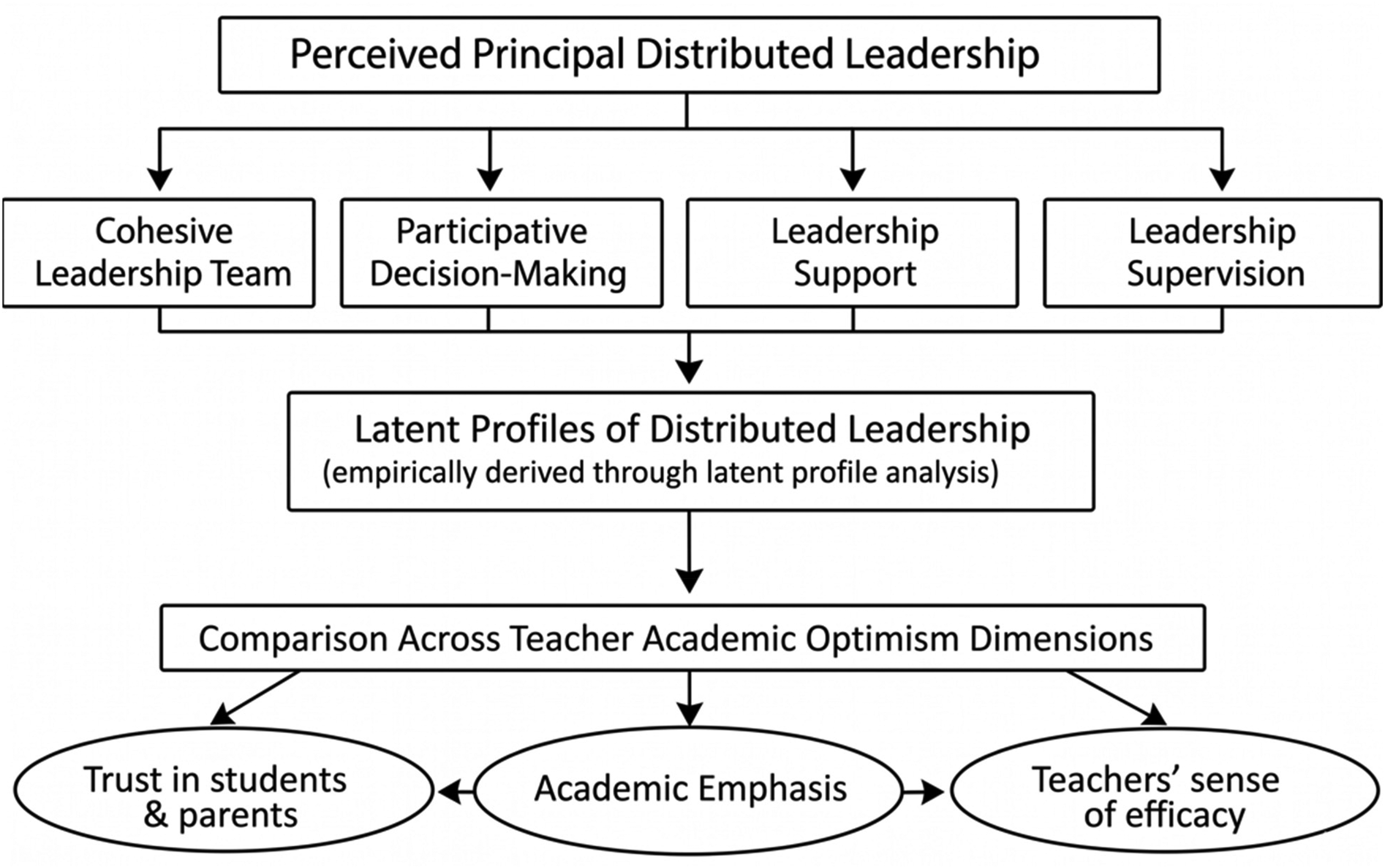
Conceptual framework. Source: Author-generated. Initial visualisation supported by ChatGPT (OpenAI).
Methods
Sample
This study employed a cross-sectional correlational survey research design. The target population comprised primary school teachers currently working in two states located in the northern zone of Malaysia. There are two main reasons for including only teacher samples rather than school principals. First, this approach helps avoid potential bias that may arise from principals’ self-reports of their own distributed leadership practices. Second, teachers regularly experience principals’ distributed leadership practices through their daily work, making them well-positioned to provide informed perceptions.
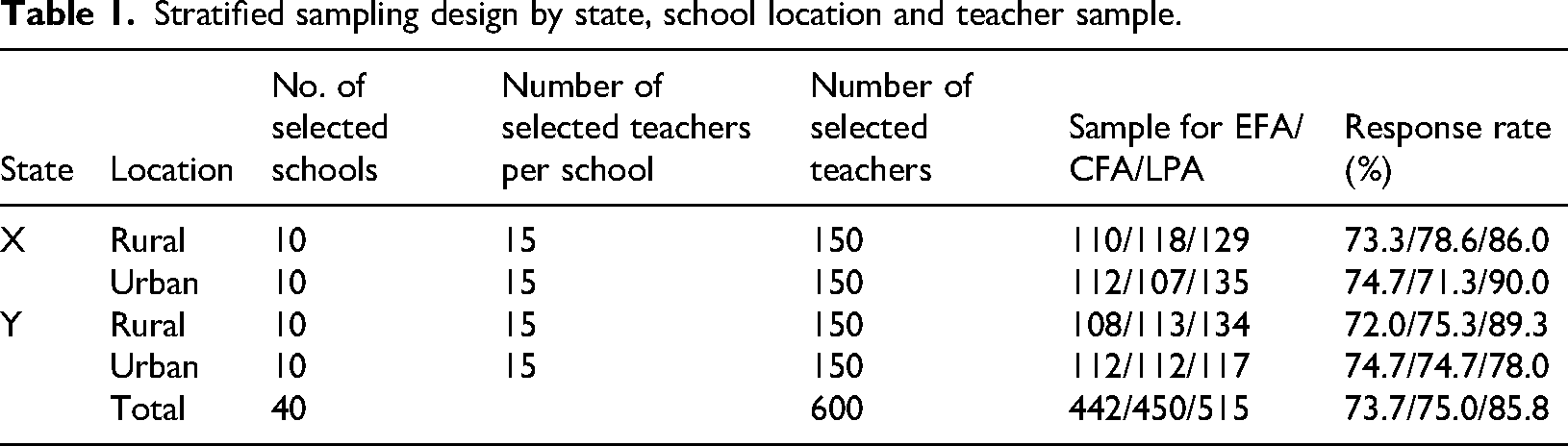
A stratified sampling technique was used at the school level, with schools stratified according to location (urban or rural). From each state, 10 primary schools were selected randomly with an equal number drawn from rural and urban areas, resulting in 40 schools (10 schools × 2 areas [urban and rural] × 2 states) in total. Within each selected school, the sampling frame comprised academic teachers only. Teachers holding administrative or leadership positions (e.g. Heads of Department and subject heads) were excluded from the study. This means no further stratification at the teacher level was applied. Subsequently, 15 teachers were randomly selected from each school, yielding a targeted sample size of 600 teachers (40 schools × 15 teachers). A total of 442 completed questionnaires were received, yielding a response rate of 73.7%. This dataset was analysed using exploratory factor analysis (EFA). The similar sampling technique was employed for the confirmatory factor analysis (CFA), resulting in 450 completed questionnaires and a response rate of 75%. For the LPA, the similar sampling technique was adopted. The collected questionnaires were 515, indicating a response rate of 85.8%. According to Hair et al. (2019), the sample sizes of 400 to 500 are considered sufficient for performing EFA and CFA. Meanwhile, a sample size around 500 can ensure accuracy in identifying a correct number of latent profiles for LPA (Nylund et al., 2007). Table 1 presents the number of selected schools, targeted teachers, and samples for the EFA, CFA, and LPA, together with their respective response rates.
Stratified sampling design by state, school location and teacher sample.
Instrumentation
This study applied teacher self-reported questionnaires for data collection. To assess teachers’ individual perceptions of distributed leadership, Hulpia et al.'s (2009a) scale was utilised, which includes two dimensions: leadership support (10 items) and cohesive leadership team (10 items). Additionally, the dimensions of leadership supervision and participative decision-making (6 items) were measured using the scale developed by Hulpia et al. (2009b). Leadership supervision (3 items) was rated on a 5-point Likert scale ranging from 1 (never) to 5 (always) while cohesive leadership team, leadership supervision, and participative decision-making dimensions were all rated on a 5-point Likert scale ranging from 0 (strongly disagree) to 4 (strongly agree). All four dimensions demonstrated good internal consistency, with Cronbach's alpha values exceeding 0.80 (Hulpia et al., 2009a, Hulpia et al., 2009b).
This study adapted Chang's (2011) 19-item teacher academic optimism scale to measure the three dimensions of teacher academic optimism, namely academic emphasis (8 items), teachers’ trust in students and parents (7 items), and teachers’ sense of efficacy (4 items). The participants rated on a 6-point Likert scale ranging from (1) strongly disagree to (6) strongly agree. The Cronbach's alpha values of the dimensions of academic emphasis, teachers’ sense of efficacy, and teachers’ trust in parents and students were ranged between 0.76 and 0.92, indicating good internal consistency of the teacher academic optimism scale.
These two scales were then translated into Malay from the original English versions using the back-translation method (Brislin, 1970). This translation process aimed to preserve the intended meaning rather than achieve a word-for-word translation. The researcher collaborated with one English language expert and one Malay language expert from a local research-based university. Both experts, who were unfamiliar with the original scales, independently translated the Malay version back into English. The research team then reviewed and compared both versions, resolving any discrepancies to ensure accuracy and semantic consistency. Subsequently, the preliminary translated version was reviewed by three primary school teachers to evaluate the clarity and appropriateness of the items for the primary school context.
Data collection
Consent for the study was obtained from the Ministry of Education and the respective State Education Department. Subsequently, permission was sought from the school heads of the selected schools. Teacher self-reported survey questionnaires were distributed directly by the researcher and research assistants. Participants were informed about the purpose of the study and clear instructions for completing the hardcopy questionnaire were informed to them. Participation was entirely voluntary. Participants were assured of the confidentiality of their responses. All participants were given one week to complete the questionnaires.
Data analysis procedure
To address Research question 1, we first examined the structure of principals’ distributed leadership to determine whether the survey items reflected a smaller set of factors. The analysis was conducted in two stages. First, EFA was conducted using the first dataset of 442 teacher responses using IBM SPSS 29 to identify how the items naturally grouped together. Principal axis factoring with varimax rotation was used to simplify interpretation. Following Tabachnick and Fidell (2007), items with factor loadings below 0.50 or substantial cross-loadings (≥0.50) were removed. Second, CFA was conducted using Mplus 8.3 to verify whether the factor structure identified in the EFA was supported by the data. Model fit was evaluated using the fit indices, including Chi-square (χ2), χ2/df, RMSEA, CFI and TLI (Hu and Bentler, 1999). Convergent validity and discriminant validity were also assessed using statistic estimates, including loadings, average variance extracted (AVE), composite reliability (CR), and the Fornell–Larcker criterion (Fornell and Larcker, 1981).
To address the Research question 2, LPA was conducted in Mplus 8.3 to identify whether teachers could be classified into distinct groups based on their perceptions of principals’ distributed leadership. This analysis was used to determine whether different patterns of distributed leadership could be observed across schools. Models were estimated using maximum likelihood with robust standard errors (MLR), beginning with a one-profile model and progressively increasing the number of profiles until model fit no longer improved meaningfully (Ferguson et al., 2020). Model selection was based on statistical criteria, including Akaike (AIC), Bayesian (BIC), Sample-Size Adjusted (SSA-BIC), entropy, posterior probabilities, and the Lo–Mendell–Rubin (LMR) Adjusted LRT Test and bootstrapped likelihood ratio (BLRT) Test. Solutions containing very small profiles (fewer than 5% of the sample) were not retained. The final profile solution was selected based on both statistical fit and interpretability. For a robust check, R3STEP was used to examine whether profile membership differed by school location. To address Research question 3, Bolck–Croon–Hagenaars (BCH) method was used to compare the profiles on dimensions of teacher academic optimism. These procedures were chosen because they provide more reliable comparisons across latent profiles (Asparouhov and Muthén, 2014; Muthén and Muthén, 2017).
Results
Descriptive statistics
Table 2 presents the overall mean score for distributed leadership (M = 3.164, SD = 0.398), which suggests a moderately practised distributed leadership approach within the school context. Among its four dimensions, leadership supervision (M = 3.258, SD = 0.479) emerged as the most prominent while cohesive leadership team (M = 3.092, SD = 0.383) was the least emphasised. This variation may reflect differing levels of emphasis across distributed leadership functions. The standard deviation values reveal notable variability among respondents. For distributed leadership, the standard deviation values range from 0.383 (cohesive leadership team) to 0.479 (leadership supervision), indicating that perceptions of leadership supervision are more dispersed, possibly reflecting inconsistent implementation or differing experiences among teachers. Similarly, teacher academic optimism recorded a moderate mean score (M = 4.464, SD = 0.552), indicating a generally moderately elevated perception among teachers. The three underlying dimensions also reflected moderate levels. Importantly, all variables were correlated statistically at the significance level of 0.05. School location was not significantly associated with distributed leadership, teacher academic optimism, or their respective dimensions, with all correlations being very small in magnitude. These findings suggest that urban–rural differences were not substantial at the bivariate level.
Descriptive statistics and correlation.
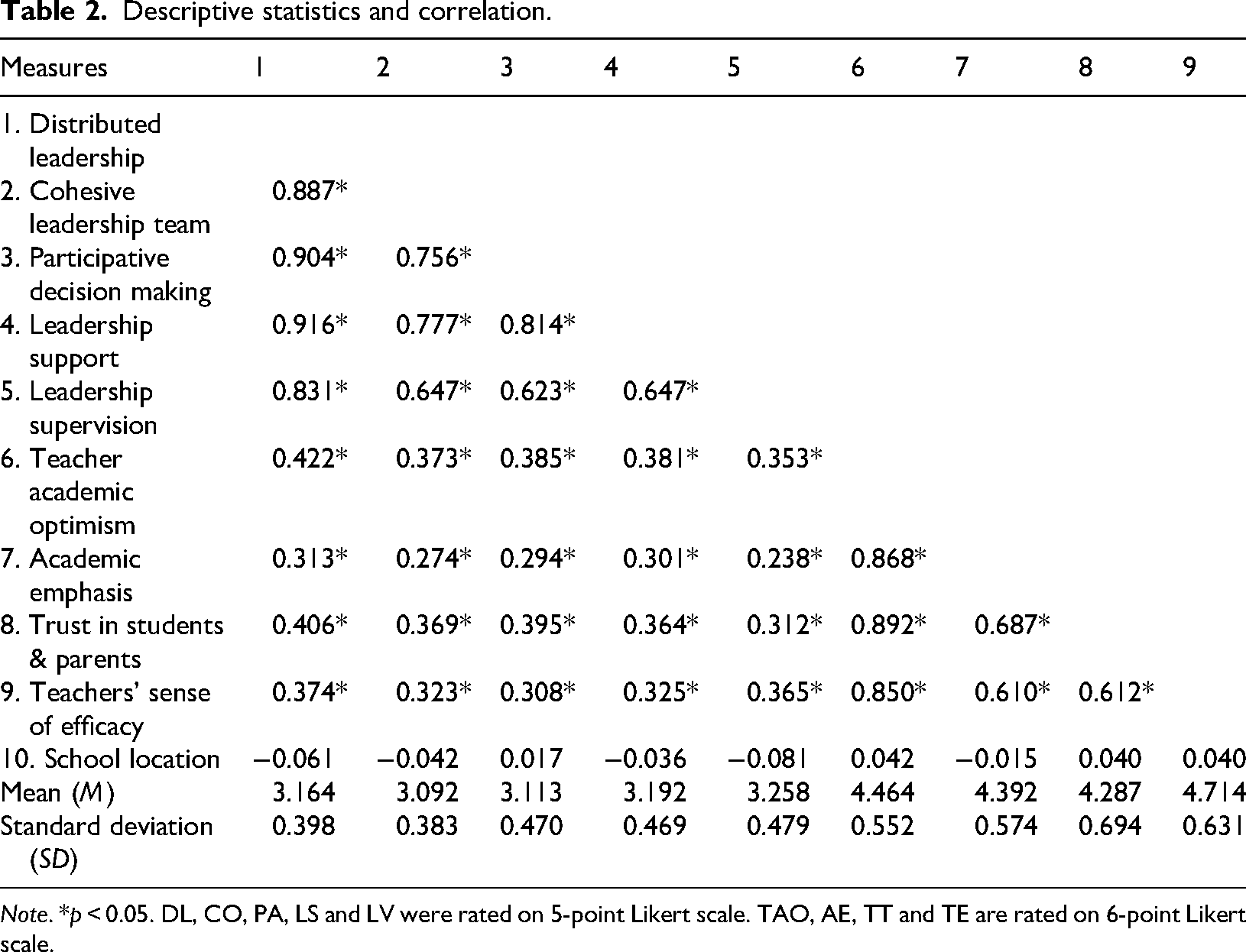
Note. *p < 0.05. DL, CO, PA, LS and LV were rated on 5-point Likert scale. TAO, AE, TT and TE are rated on 6-point Likert scale.
Exploratory factor analysis (EFA)
EFA shows that the Kaiser–Meyer–Olkin (KMO) measure of sampling adequacy value was 0.951 while the Bartlett's test of sphericity was χ2 (442, df = 300) = 10,517.75, p < 0.001. Thus, the findings validated the factorability of the correlation matrix and confirmed that all variables are sufficiently correlated (Pallant, 2020). Table 3 depicts four extracted factors. All the items were loaded on the original dimensions with the loading values exceeding the threshold of 0.50 except four items (PA1, CO5, CO9 and CO10). These four items were removed during EFA because they did not meet the predetermined cutoff values of factor loadings of 0.50 for primary factor loadings. This decision was further supported by the cross-loading pattern and theoretical considerations. PA1 showed almost identical primary and secondary loadings (0.431/0.430), indicating weak discriminant clarity. Conceptually, PA1 appears to reflect delegation of leadership responsibilities rather than genuine participation in decision making. Similarly, the three deleted items under cohesive leadership team appeared to capture competence-based role placement (CO5), efficiency in carrying out duties (CO9; 0.444/0.301), and jurisdictional clarity (CO10; 0.497/0.295). These items are more closely related to structural or managerial role functioning than to the collaborative and relational unity implied by team cohesion. The conceptual overlaps may explain why some items did not function exclusively as indicators of their intended latent factors.
Principal component analysis.
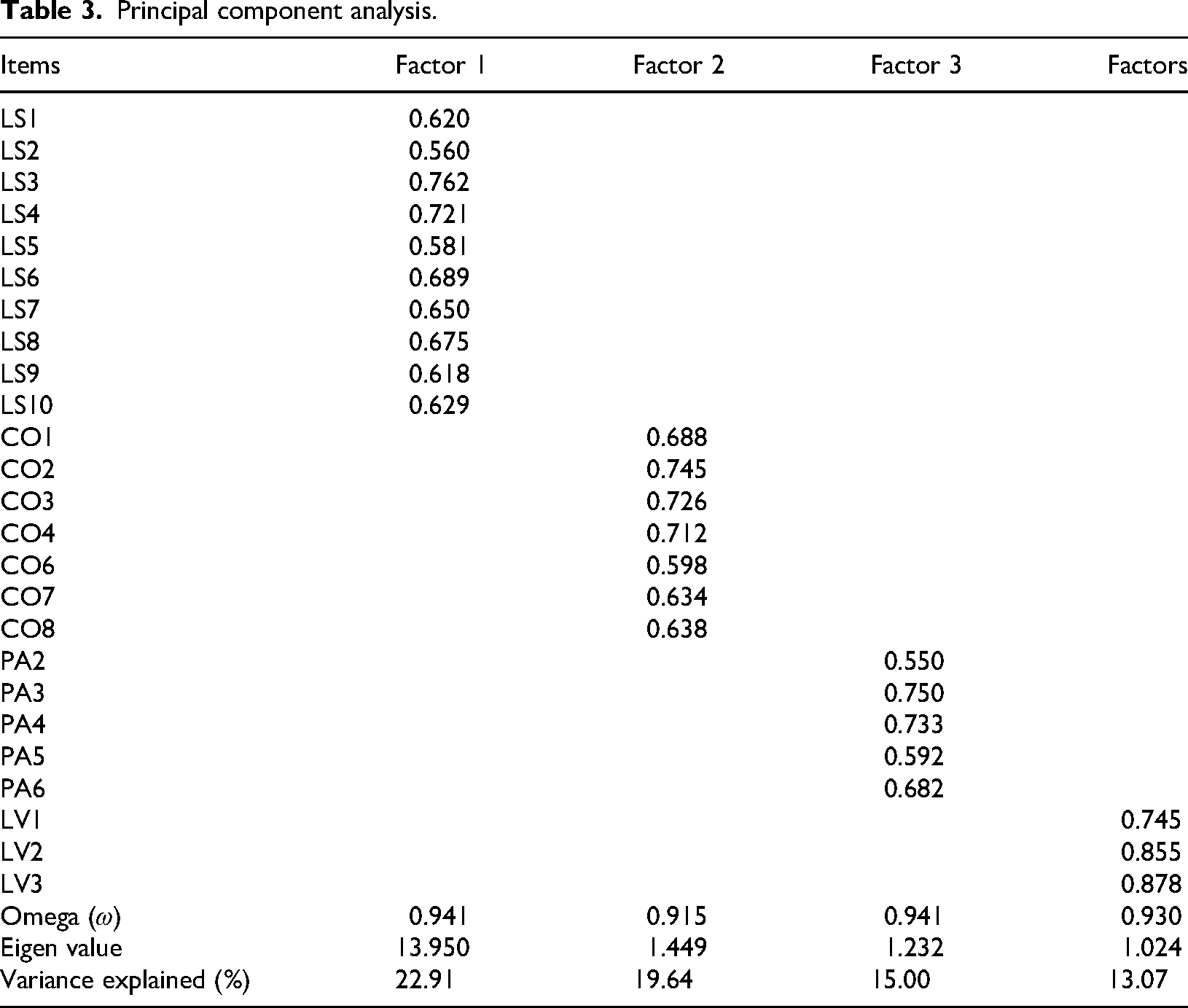
After deleting these four items, a total of 25 items from the four extracted actors attributed to 70.62% of the variance explained on perceived principal distributed leadership. The four extracted factors revealed McDonald's omega (ω) values ranging from 0.915 to 0.941.
Confirmatory factor analysis (CFA)
CFA was performed on the 450 cases in the dataset using the maximum likelihood method. The hierarchical 4-factor model appeared as the best-fitting model with the fit indices all satisfied the suggested thresholds: χ2 (df = 271, N = 450) = 861.950, p < 0.001. The significant results of Chi-square (χ2) are expected due to its sensitivity to the sample size (Tabachnick and Fidell, 2007), χ2/df = 3.181, RMSEA = 0.070, 95% CI [0.064, 0.075], CFI = 0.944, and TLI = 0.938. All factor loading values for the dimensions of distributed leadership exceeded the recommended threshold of 0.50 (see Appendix 1). The AVE and CR values were also above the cut-off points of 0.50 and 0.80, respectively, thereby supporting convergent validity. In addition, the square root of the AVE for each construct was greater than its correlations with other constructs, confirming the establishment of discriminant validity (see Appendix 2).
Latent profile analysis
Table 4 presents the results from the one- to four-profile models. LMR and BLRT tests are significant at p < 0.001 for all the profile models. The 4-profile model produced lower AIC and BIC values compared to the 2-profile model and 3-profile model. However, a proportion of the 4-profile model is found below the minimum recommended size of 5% of the sample. The values of AIC, BIC and SSA-BIC of the 3-profile model are found lower than the corresponding values of 2-profile model. The 3-profile model also showed satisfactorily classification accuracy, with an entropy value of 0.994, well above the threshold of 0.80 (Ferguson et al., 2020) and higher than the 2-profile model. Overall, these findings supported the 3-profile model as the most optimal model of the data. Posterior assignment probabilities for each profile were 0.14, 0.40 and 0.46, respectively, indicating well-separated profiles and further supporting the stability and interpretability of the 3-profile model.
Model fit indices for profile solutions (N = 515).
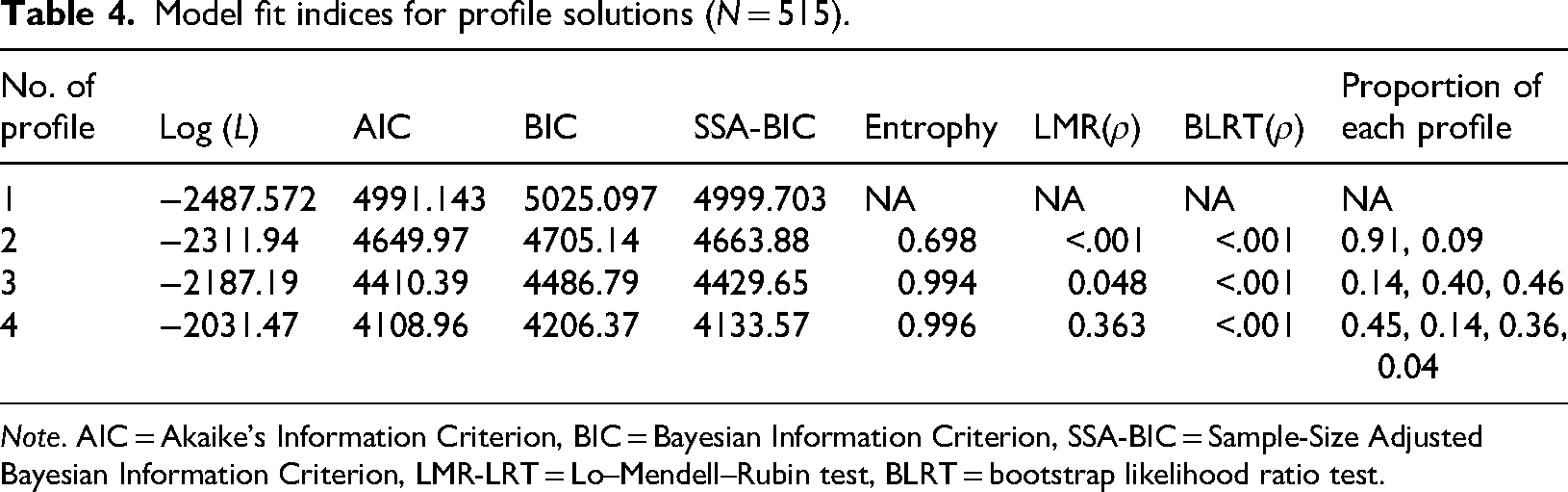
Note. AIC = Akaike's Information Criterion, BIC = Bayesian Information Criterion, SSA-BIC = Sample-Size Adjusted Bayesian Information Criterion, LMR-LRT = Lo–Mendell–Rubin test, BLRT = bootstrap likelihood ratio test.
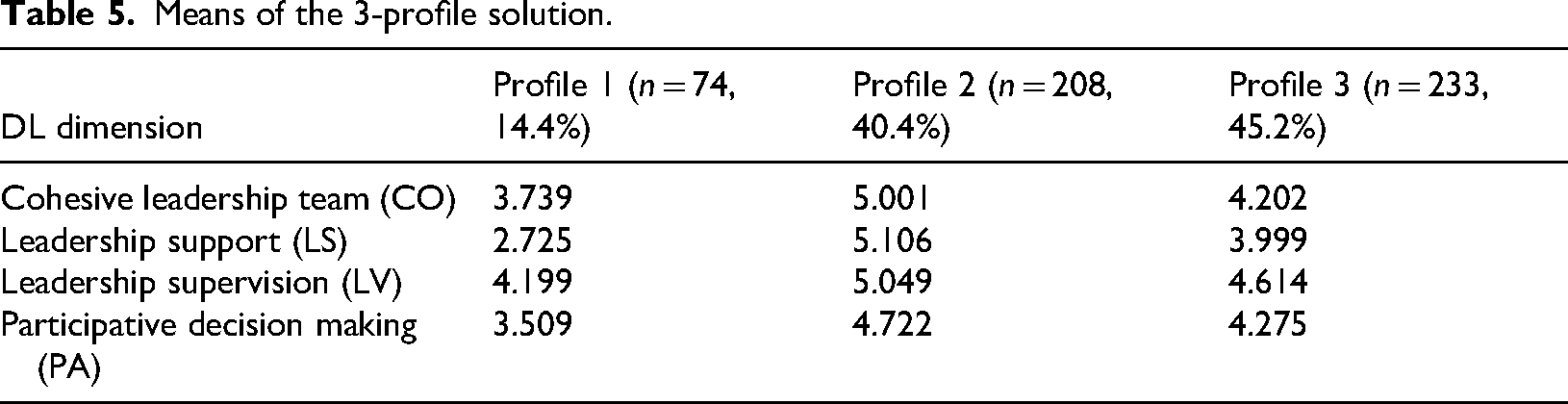
For the 3-profile model, Table 5 shows that 14.4% of teachers were classified into Profile 1, followed by 40.4% in Profile 2, and 45.2% in Profile 3. Investigation of the mean scores across the four dimensions of perceived principal distributed leadership revealed distinct patterns for each profile. Profile 1 reflected a siloed form of leadership characterised by weak collective unity, low levels of participative decision-making, and limited leadership support. Accordingly, this group was labelled “low distributed leadership”. Profile 2 represented an idealised form of collective and participatory leadership, distinguished by relatively high mean scores across all four dimensions, particularly leadership support and supervision. Profile 2 was labelled as “high distributed leadership”. Profile 3 demonstrated moderate levels across the four dimensions, suggesting a partially cohesive leadership team with some support, supervision, and participative decision-making, though not fully optimised. Hence, this group was labelled “moderate distributed leadership”. The patterns of these three profiles are further illustrated in Figure 2.
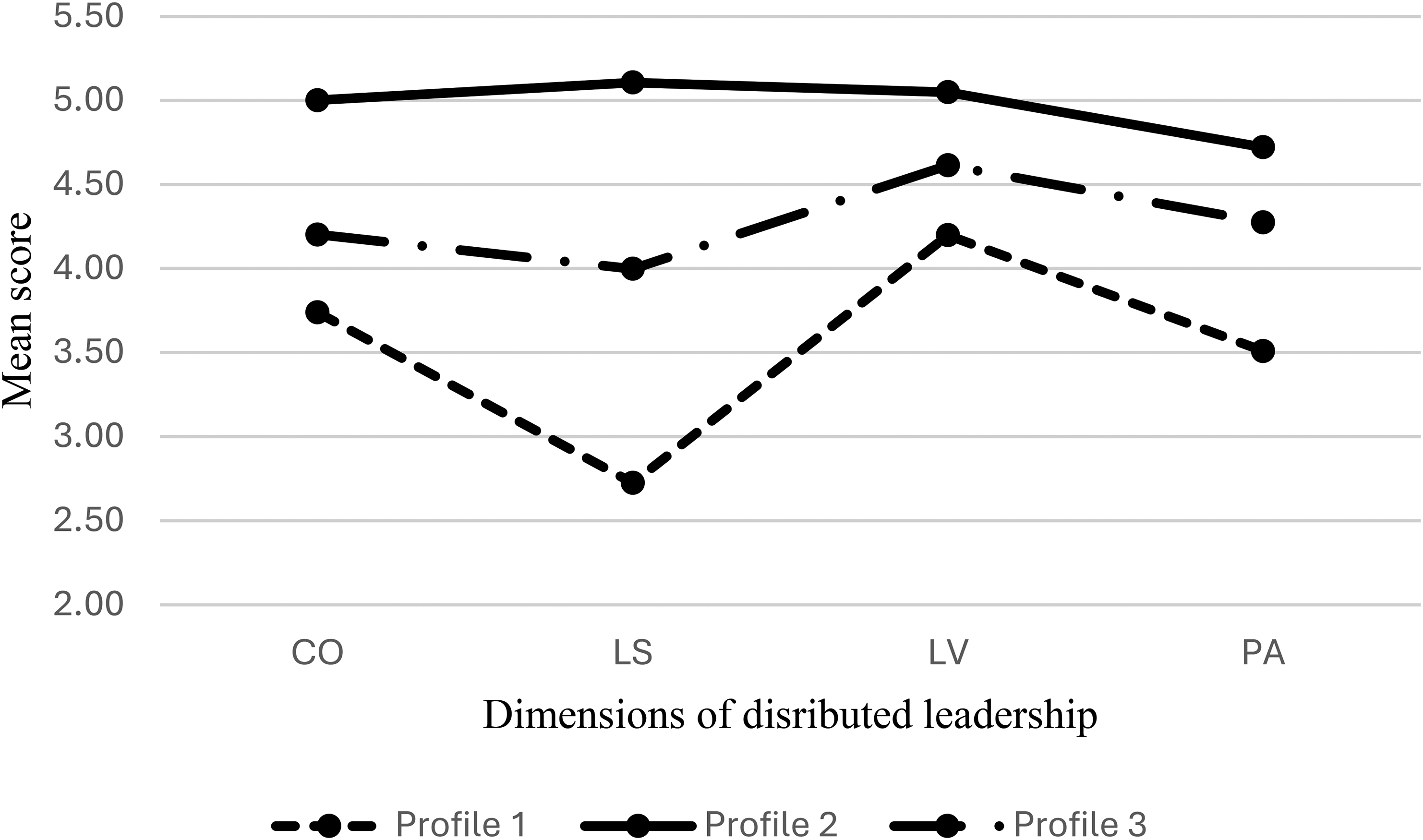
Mean scores of profiles 1 to 3.
Means of the 3-profile solution.
For a robust check, the analysis was extended using the odds ratios (OR) from the tests of categorical latent variable multinomial logistic regressions based on the three-step procedure (R3STEP) to examine whether membership in the three-profile solution differed by school location (rural versus urban schools). The R3STEP results indicated that school location (0 = rural, 1 = urban) did not significantly predict latent profile membership. Specifically, all multinomial logistic comparisons across the three profiles were non-significant. Profile 2 versus Profile 1 (OR = 0.903, p = 0.741), Profile 3 versus Profile 1 (OR = 0.947, p = 0.871), and Profile 3 versus Profile 2 (OR = 1.049, p = 0.826). These findings suggest that rural and urban schools did not differ significantly in their likelihood of belonging to any of the three distributed leadership profiles. This non-significant finding may reflect a degree of system-level standardisation in the Malaysian school context. In Malaysia, schools across rural and urban areas operate under similar policy implementation and administrative procedures (Thien et al., 2020). This would reduce the likelihood that rural–urban differences emerge clearly at the latent profile level.
Relationship between profiles and teacher academic optimism dimensions
Figure 3 presents the mean scores of the three teacher academic optimism dimensions across the three distributed leadership profiles. The findings show a clear gradient pattern. Teachers in the high distributed leadership profile reported the highest levels of academic optimism across all three dimensions, followed by those in the moderate distributed leadership profile, whereas teachers in the low distributed leadership profile reported the lowest levels.
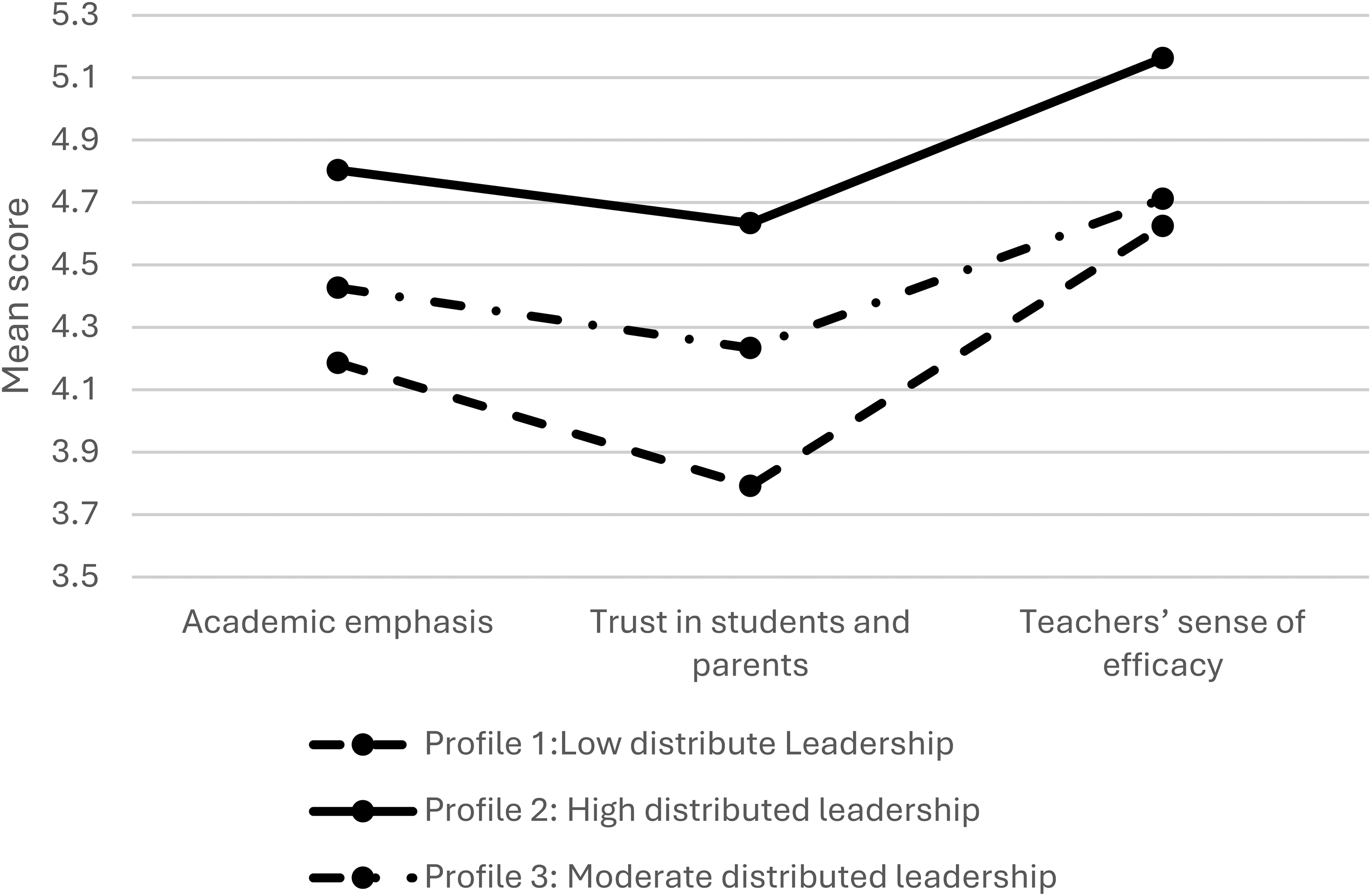
Mean scores in teacher academic optimism dimensions across profiles.
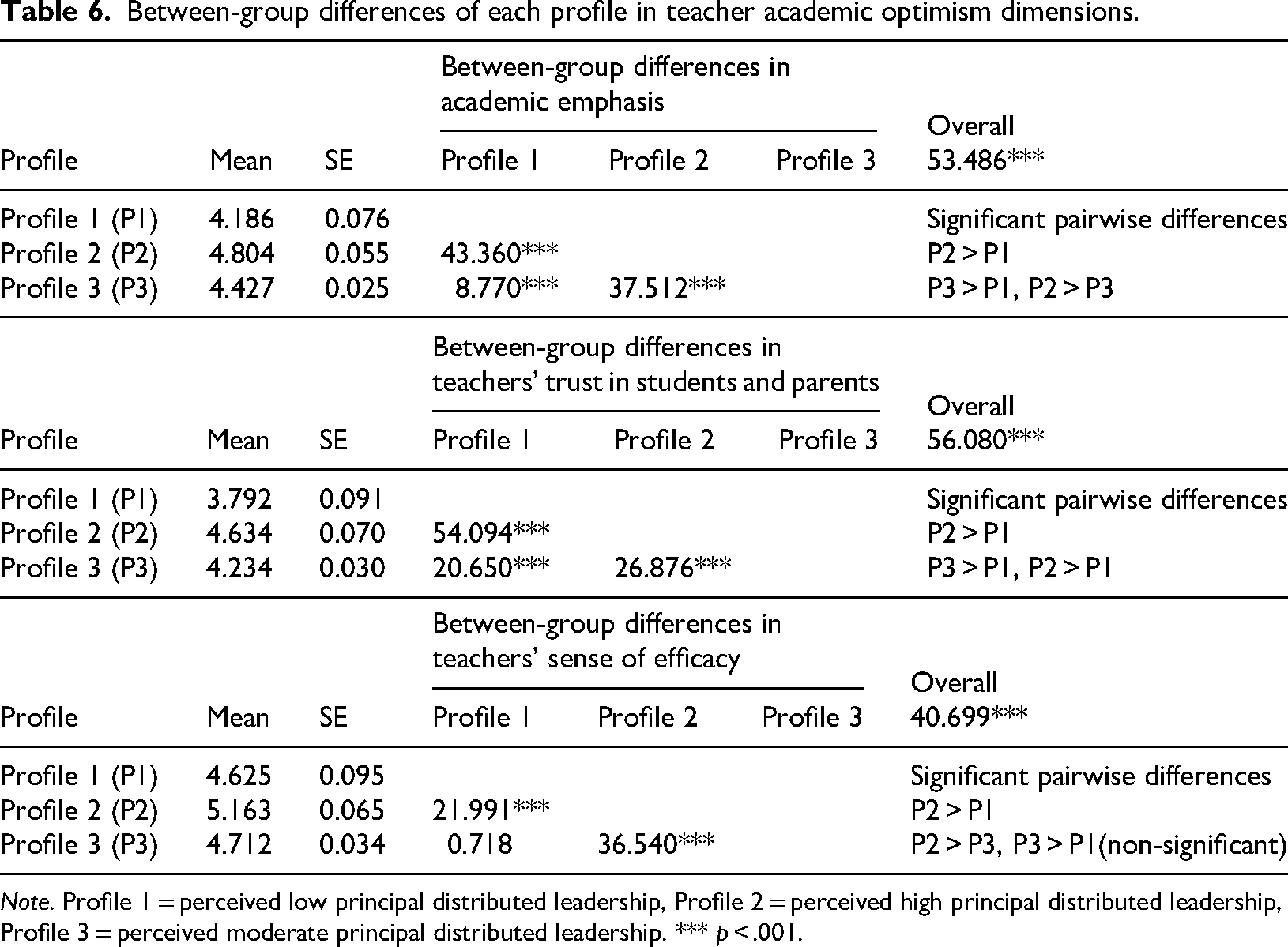
Table 6 shows the between-group differences of each profile in teacher academic optimism dimensions and the corresponding statistical comparisons. For academic emphasis, the overall BCH test was statistically significant (χ2 = 53.486, p < 0.001). Teachers in the high distributed leadership profile reported the highest mean score (M = 4.804, SE = 0.055), followed by the moderate profile (M = 4.427, SE = 0.025), and the low profile (M = 4.186, SE = 0.076). Pairwise comparisons showed that the high profile scored significantly higher than both the low profile (χ2 = 43.360, p < 0.001) and the moderate profile (χ2 = 37.512, p < 0.001), while the moderate profile also scored significantly higher than the low profile (χ2 = 8.770, p < 0.001). These findings suggest a pattern of profile 2 > profile 3 > profile 1 in academic emphasis.
Between-group differences of each profile in teacher academic optimism dimensions.
Note. Profile 1 = perceived low principal distributed leadership, Profile 2 = perceived high principal distributed leadership, Profile 3 = perceived moderate principal distributed leadership. *** p < .001.
For teachers’ trust in students and parents, the overall BCH test was significant,
For teachers’ sense of efficacy, the overall BCH test remained significant
Discussion
The reliance on variable-centred analysis, which did not consider individual differences, risks producing overly reductive interpretations of the relationship between distributed leadership and teacher academic optimism. This study responds to such methodological limitation by identifying distinct latent profiles of perceived principal distributed leadership and investigating their associations with the three dimensions of teacher academic optimism within the Malaysian primary school context. By adopting a person-centred lens, the study offers a more differentiated understanding of how principal distributed leadership is experienced by teachers. The findings yield several important insights as follows.
Factor structure of distributed leadership
The results of the EFA and CFA analyses affirm the factor structure of principal distributed leadership as a four-dimensional construct, consistent with the original work by Hulpia et al. (2009a) within the Malaysian primary school context. The retention of the four dimensions of principal distributed leadership, which are cohesive leadership team, participative decision-making, leadership support, and leadership supervision indicates a degree of cross-cultural validity. However, the need to exclude items raises questions about the cultural and systemic alignment of principal distributed leadership practices in a developing society such as Malaysia. It is plausible that these items reflect distributed leadership behaviours more commonly observed in the Western educational systems, which may not fully resonate with the hierarchical or policy-driven realities of Malaysian schools.
In relation to this concern, four items (PA1, PA2, LS1, and LS2) were excluded due to low factor loadings and cross-loadings. Beyond statistical criteria, their exclusion reflects contextual realities of Malaysian primary schools operating within a centralised education system. For example, Items PA1 (Leadership is delegated for activities critical for achieving school goals) and CO5 (In our school, the right man sits on the right place, taken the competencies into account) emphasise distributed authority and personnel placement, contrasting sharply with the hierarchical decision-making norms and centralised teacher deployment managed by the Ministry of Education (Thien et al., 2025). Similarly, CO9 (The leadership team is willing to execute a good idea) and CO10 (It is clear where members of the leadership team are authorised to) assume a degree of operational that conflicts with the bureaucratic adherence required by national education policies. These findings suggest systemic factors influence the distributed leadership practices (Bush and Ng, 2019), contributing to ongoing debates on cross-cultural validity. The item removal highlights how distributed leadership dimensions may manifest differently in centralised education systems, underlining the need for contextual adaptation in principal distributed leadership research.
Latent profile analysis
The three profiles identified in this study, namely low, moderate, and high perceptions of principal distributed leadership were empirically derived through LPA. To our knowledge, this study is the first to examine distributed leadership profiles using LPA in the literature. As such, there are no established distributed leadership profile typologies derived from person-centred approach against which the present findings can be directly compared. In the absence of prior profile-based classifications, the interpretation of the identified profiles was guided by established distributed leadership theory rather than by a priori typologies.
In this study, distributed leadership has been conceptualised as leadership practice based on Hulpia et al.'s (2009b) multidimensional perspective in school settings, emerging through the interactions of leaders, followers, and situations, and as collaborative action distributed across organisational members rather than concentrated in a single actor (Gronn, 2002; Spillane et al., 2001; Harris 2008). Viewed from this perspective, distributed leadership is inherently multidimensional and may vary in the degree to which its component practices are enacted across schools. Accordingly, the identified profiles were labelled low, moderate, and high distributed leadership because they reflected systematically different overall levels across the four distributed leadership dimensions. In this sense, the labels of these three profiles are not intended to denote fixed typologies established a priori, but theory-informed interpretations of varying levels of distributed leadership enactment across school contexts.
Although the proportion of low distributed leadership profile is relatively small (14.4%), it may nonetheless represent leadership tends to be more centralised, inconsistently distributed, or inadequately communicated. The low distributed leadership profile may reflect leadership practices characterised by limited collaboration, where roles are either insufficiently defined or predominantly concentrated in the principal (Baştea et al., 2023). Such patterns may hinder team cohesion and suggest underlying challenges, such as underdeveloped internal leadership capacity or constrained professional trust. This profile appears to align with top-down decision-making structures, which stand in contrast to the participatory leadership principles advocated in the Malaysian Education Blueprint 2013–2025. These observations raise important questions about the policy-practice gap, particularly in schools where principals may not yet possess the confidence to effectively delegate leadership responsibilities (Bush et al., 2018). This concern was evident in this current study where leadership support was perceived as minimal.
The dominance of the moderate distributed leadership profile (45.2%) suggests that while elements of distributed leadership are present in Malaysian schools, they may not yet be fully institutionalised or consistently practised. This pattern may reflect systemic constraints, including hierarchical school cultures, limited professional autonomy, and uneven leadership capacity among principals to enact distributed leadership meaningfully. For instance, Bush and Ng (2019) found that distributed leadership in Malaysia often takes the form of allocative delegation rather than emergent collaboration, shaped by the local highly centralised education system. Similarly, Thien and Chan (2022) observed that while distributed leadership positively influences teacher academic optimism, its enactment varies depending on local school context and principal disposition. The moderate profile may also reflect a blend of developmental and compliance-oriented supervision, where principals’ decision-making is partially inclusive but still bounded by hierarchical norms. As supported by Bush et al. (2018), the current findings highlight that Malaysian principals often operate within top-down structures, which can limit their ability to foster collegiality and shared leadership. Moreover, inconsistent leadership support could be influenced by individual principals’ capacity and confidence, both of which have been noted as barriers to effective distributed leadership (Baştea et al., 2023).
The presence of a substantial high distributed leadership profile is noteworthy because it reflects emerging practices that align with Shift 5 of the Malaysian Education Blueprint 2013–2025, which emphasises building leadership capacity beyond the principal and nurturing teacher professionalism. However, the fact that only about 40% of schools exhibit a high distributed leadership profile reveals a critical gap. This limited prevalence suggests that systemic constraints such as the Malaysian centralised education system continue to restrict the diffusion of distributed leadership practices. In such contexts, principals often retain decision-making authority and leadership delegation remains minimal, which may explain why most schools fall into moderate or low distributed leadership profiles. This underlines the tension between local national policy aspirations and on-the-ground realities, where hierarchical norms and compliance-driven accountability inhibit broader leadership distribution (Bush and Ng, 2019). Consequently, this finding signals the need for targeted interventions to bridge the gap between policy intent and practice.
Relationship between profiles and teacher academic optimism dimensions
Beyond the significant direct linear relationship between distributed leadership and teacher academic optimism as well as its three dimensions (Thien and Chan, 2022), this current study contributed new knowledge by supporting that the relationship between principal distributed leadership and teacher academic optimism is not uniform across its dimensions. All the three dimensions of teacher academic optimism are found increased progressively across the low, moderate, and high distributed leadership profiles. When teachers perceive leadership teams as cohesive, decision-making processes as participative, and principals as supportive and constructively supervisory, they may be more likely to experience the school as coordinated, academically focused, and relationally supportive (Lelieure et al. 2024). Such organisational conditions may help reinforce academic emphasis and strengthen teachers’ trust in students and parents.
The findings indicate that teachers in schools characterised by high distributed leadership (Profile 3) exhibit stronger academic optimism across all dimensions – academic emphasis, trust in students and parents, and sense of efficacy – compared to those in moderate or low distributed leadership. These findings can be explained through the mechanisms of social cognitive theory, which are mastery experiences, vicarious learning and social persuasion (Bandura, 1997). First, high distributed leadership provides teachers with mastery experiences by involving them in decision-making, enabling them to witness the tangible impact of their contributions to student learning (Nadeem, 2024). Such successful experiences are likely to reinforce their confidence in maintaining rigorous academic standards, which account for the higher academic emphasis observed in Profile 3. Second, distributed leadership fosters vicarious learning as teachers observe peers effectively engaging parents and motivating students, which strengthens collective trust and the belief that similar strategies will succeed in their own practice (Nadeem, 2024). Finally, the collaborative culture inherent in distributed leadership promotes social persuasion, where encouragement and recognition from colleagues and school leaders affirm teachers’ capabilities, thereby enhancing their sense of efficacy (Bandura, 2000).
Our findings supported that only high levels of perceived distributed leadership are associated with meaningful gains in teachers’ sense of efficacy. One possible explanation is that teachers’ sense of self-efficacy is not only shaped by principals’ distributed leadership, but also likely influenced by teacher autonomy and collaboration among peers. Thus, only high distributed leadership may generate sufficiently strong professional support and empowerment to elevate teachers’ sense of efficacy in a meaningful way.
Conclusion
This study advances prior variable-centred research that established a positive relationship between distributed leadership and academic optimism by adopting a person-centred approach. Specifically, it explores distinct profiles of principal distributed leadership and examines how these profiles covary with each dimension of teacher academic optimism. This approach offers a more nuanced understanding of how teachers’ perceptions of principal distributed leadership relate to their professional beliefs and attitudes.
The identification of distinct principal distributed leadership profiles underlines the need for differentiated policy responses. A uniform or one-size-fits-all strategy for distributed leadership development is unlikely to address the diverse realities of school contexts. Instead, tailored interventions should be designed to reflect the specific characteristics and developmental needs of each profile. For example, schools characterised by low distributed leadership may require foundational efforts to provide significant leadership support and opportunities to participate in decision-making among teachers, while those with moderately distributed leadership may benefit from strategies that deepen collaboration and shared accountability. These findings also highlight the importance of systemic support structures, including the formation of cohesive leadership teams, mechanisms for participative decision-making, and sustained supervision and mentoring for school leaders. Policies should not only advocate for distributed leadership on principle but must be responsive to contextual diversity across schools, acknowledging that distributed leadership may manifest differently depending on school size, culture, and resource availability. Thus, a robust policy approach must go beyond advocacy to actively shape the leaders’ capacities that allow principal distributed leadership to thrive in real-world educational settings.
However, the findings should be interpreted with caution. Given the absence of prior person-centred studies examining distributed leadership profiles, the present findings should be viewed as an initial empirical mapping of variation in distributed leadership enactment, offering a basis for future research to replicate, refine, or extend these profiles across contexts. The current study employed cross-sectional research design. These limitations further highlight the need for future studies, particularly longitudinal and qualitative research. For the longitudinal studies, repeated measures latent class analysis (RMLCA) (Rivera et al., 2018) could be used to explore how principal distributed leadership and teacher academic optimism dimension can unfold over time. As this study relied on teacher self-reports for the survey, future research could incorporate school principals’ surveys, classroom observations, and documentary evidence to further enhance the rigor of the findings.
In conclusion, the confirmation of the four-factor model of perceived principal distributed leadership provides a robust foundation for person-centred analyses, ensuring that the principal distributed leadership being profiled is both theoretically grounded and empirically validated. This study opens new avenues for comparative research, enabling educational researchers to examine how principal distributed leadership profiles and their associations with teacher academic optimism dimensions vary across different school types and educational systems.
Footnotes

Ethics approval and consent to participate
Approval for the involvement of human participants in this study was obtained from the Ministry of Education Malaysia (KPM.600-3/2/3-eras921127).
Funding
The author received no financial support for the research, authorship and/or publication of this article.
Declaration of conflicting interests
The author declared no potential conflicts of interest with respect to the research, authorship and/or publication of this article.