







Abstract
This study examines how novice principals lead reform when change is first encountered not as a clearly defined agenda for implementation but as emotionally disruptive condition. Drawing on a qualitative multiple-case study of three schools, it traces how disruptive events unsettled established meanings, triggered sensemaking, and consequential through leadership practice. The findings show that reform began not with technical execution, but with interpretive work undertaken when trust, direction, or organizational identity became unstable. Leadership became consequential when these interpretations were enacted through practices that reorganized relationships, coordinated participation, and reoriented collective action. The analysis further identifies three differentiated reform trajectories: stabilization through trust reconstruction, expansion through collective generation, and regeneration through identity re-articulation. By conceptualizing reform leadership as a process linking emotional disruption, sensemaking, and enactment, the study offers a processual account of how novice principals make reform interpretable, actionable, and sustainable under conditions of uncertainty.
Keywords
Introduction
Contemporary school reform increasingly unfolds under conditions of uncertainty, ambiguity, and affective disruption, requiring school leaders not merely to implement policy but to interpret, negotiate, and enact change within complex organizational settings. Research in educational leadership has shown that reform is mediated locally through leaders’ sensemaking, professional judgment, and relational coordination rather than carried as a fixed policy script (Ball et al., 2012; Datnow, 2020; Ganon-Shilon and Schechter, 2017; Spillane et al., 2002). Leadership scholarship has likewise emphasized that school leaders frequently work under conditions of instability and contested expectation, where direction must be constructed rather than assumed (Coburn, 2005; Crawford, 2012; Pashiardis and Brauckmann-Sajkiewicz, 2022). At the same time, scholarship on organizational emotion shows that affect shapes how actors interpret and act (Huy, 2012; Maitlis et al., 2013).
The gap is critical for novice principals who often face constrained authority and emerging legitimacy in the context of change (Johnson and Crow, 2017; Oplatka, 2012). While research acknowledges these challenges, it has paid less attention to how emotionally disruptive conditions shape the sensemaking processes through which novice principals interpret reform and enact leadership. What remains underdeveloped becomes consequential for leadership action.
The study addresses the gap by examining how emotional disruptive conditions trigger sensemaking in novice principals’ leadership and how this sensemaking translates into practices that reconfigure interaction and reform trajectories. Through a multiple-case qualitative study, it conceptualizes leadership as an interpretive, relational accomplishment through which emotional disruption becomes actionable in practice.
Research context
Taiwan's secondary education system has been shaped by policy diversification, demographic decline, and institutional restructuring (Hung, 2019; Ministry of Education, 2019). In this context, novice principals often lead with limited authority and still-emerging legitimacy (Johnson and Crow, 2017; Oplatka, 2012), conditions intensified by reform-related disruption, stakeholder tension, and emotional demand (Arar, 2018; Grissom et al., 2021). This study treats such vulnerability as an analytic vantage point for examining how novice leadership is constituted under uncertainty. To explain how leadership takes shape under such conditions, the study draws on scholarship on emotion, sensemaking, and leadership practice.
Literature review
Reform enactment as interpretive and relational work
Educational reform is not implemented as a fixed policy script but enacted through local interpretation, mediation, and organizational response. Coburn (2005) and Spillane et al. (2002) show that policy enters school as something that must be interpreted within particular institutional conditions rather than simply carried out as designed. Honig and Hatch (2004) further argue that school leaders must actively craft coherence across multiple external demands. Taken together, the literature establishes that reform leadership is not reducible to implementation fidelity; it involves constructing direction, coordinating participation, and negotiating meaning under conditions that are often unstable or contested.
Yet this line of work leaves an important question underdeveloped. It explains how reform is mediated in practice but gives less attention to how reform first becomes a leadership problem. In other words, we know much about how reform is organized once leaders begin to work on it, but less about the conditions under which existing meanings break down and interpretive work becomes necessary in the first place.
Sensemaking, uncertainty, and the problem of leadership
Sensemaking theory is useful for addressing this issue because it explains how actors construct workable meanings when existing frames no longer hold (Weick, 1995). In school leadership research, Ganon-Shilon and Schechter (2017) show that leaders’ sensemaking is central to how reform complexity and ambiguity are understood, while Ganon-Shilon et al. (2021) demonstrate that principals’ interpretations shape consequential organizational decisions during reform implementation. This literature makes clear that leadership under reform is deeply interpretive rather than merely procedural.
At the same time, the literature often treats uncertainty as a general condition of leadership rather than asking what makes interpretive work especially urgent in particular reform situations. It also tends to stop at the level of interpretation, leaving less clear how sensemaking becomes consequential as leadership. Thus, while existing studies explain why leaders must interpret reform, they tell us less about how disruption activates that interpretive process and how interpretation is translated into organizational action.
Emotion as a condition of interpretive leadership
A further limitation concerns emotion. Research on educational leadership increasingly recognizes that emotion is embedded in leadership practice rather than external to it (Berkovich and Eyal, 2020). This work is important because it challenges purely rational or procedural views of leadership and shows that organizational life is experienced affectively as well as cognitively (Yamamoto et al., 2014). However, emotion is still often treated as an accompaniment to leadership rather than as a condition that shapes when leadership becomes interpretive in reform contexts. Anxiety, uncertainty, disappointment, or loss may do more than color participants’ experiences. They may disrupt established meanings, re-order what becomes salient, and render previously workable understandings inadequate. From this perspective, emotion is not simply part of the background of reform. It may be part of the process through which reform first becomes experienceable as a problem requiring leadership. A focus on emotional disruption therefore adds analytical precision to reform and sensemaking scholarship by specifying what triggers interpretive work under conditions of change.
Novice principals and the missing link in reform leadership research
These issues are especially consequential for novice principals. Research on beginning principals has emphasized role transition, early socialization, and the challenge of becoming established leaders (Arar, 2018; Browne-Ferrigno, 2003; Jerdborg, 2026) further shows that novice principals must establish authority while responding to competing demands while Kilinç and Gümüş (2021) and Nordholm et al. (2025) suggest that newly appointed principals are still forming their professional identity and role understanding during the early phase of principalship. This literature makes clear that novice leadership is not simply an early version of established leadership, but a distinct phase in which authority, routines, and professional foothold remain in formation.
What remains underdeveloped, however, is how this still-forming leadership position intersects with the interpretive demands of school reform. We know that beginning principals face uncertainty and transition, and we know that reform requires interpretation and mediation. But we know less about what happens when these conditions converge in reform situations that are first experienced as emotionally disruptive. For novice principals, reform may be especially consequential not only because it introduces change, but because it does so when their own legitimacy, routines, and leadership identity are still unsettled. In such contexts, leading reform and becoming a leader are likely to unfold simultaneously.
Conceptual framework
The study conceptualizes reform leadership as a process through which emotional disruption, sensemaking, and leadership practice become dynamically linked in novice principals’ work (Pashiardis and Brauckmann-Sajkiewicz, 2022). Reform is first encountered as a disruptive condition in which established meanings no longer hold, making interpretation necessary (Maitlis and Christianson, 2014; Weick, 1995).
Sensemaking is understood as socially accomplished, as principals and stakeholders work to define what the disruption means, what is at stake, and how the school should respond. Leadership becomes consequential when these interpretations are enacted through practices that reorganize relationships, participation, and direction (Spillane et al., 2004). From this perspective, reform does not unfold as a single pathway of implementation. Rather, reform trajectories may be stabilized, expanded, or regenerated depending on how disruption is interpreted and enacted in context. The framework therefore guides the analysis of how novice principals make reform interpretable, actionable, and sustainable under conditions of uncertainty.
The conceptual relationships are summarized in Figure 1.
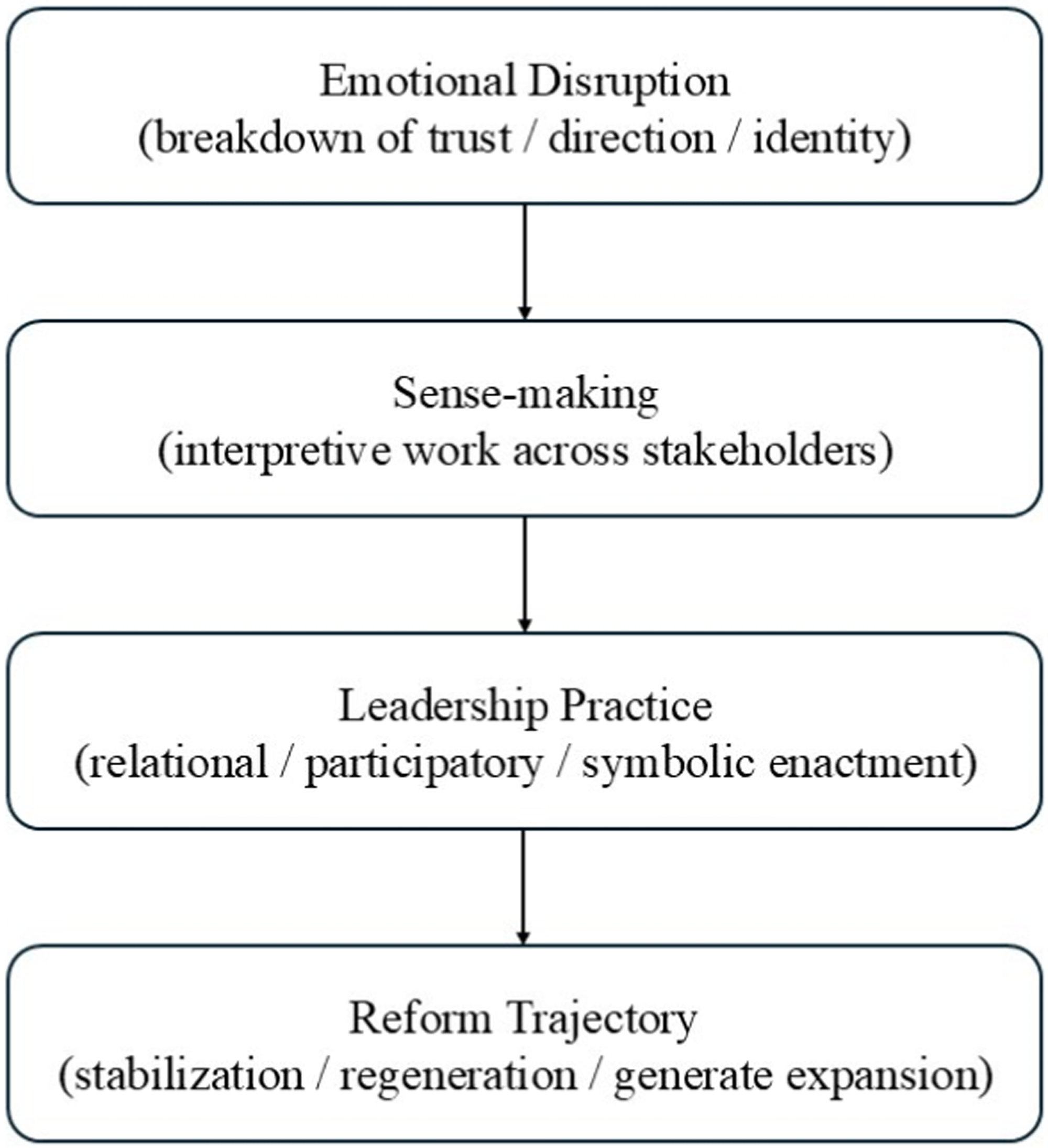
Conceptual framework.
Research questions
The study examines how novice principals lead reform when change is first encountered as emotionally disruptive. It focuses on how disruption, sensemaking, and leadership practice become linked in the enactment of reform. The study is guided by the following questions:
How is reform-related disruption experienced as emotionally significant by novice principals and stakeholders?
How do novice principals make sense of such disruption and enact that sensemaking in leadership practice?
How do these processes generate differentiated reform trajectories over time?
Methodology
Research design, case selection, and comparative logic
This study employed a multiple-case qualitative case study design to examine how novice principals engaged in emotion-triggered sensemaking during school reform. A multiple-case design was appropriate because the study focused on leadership as a situated and processual practice rather than as a set of decontextualized variables (Stake, 2006; Yin, 2018). The purpose was not to compare schools as fixed institutional units, but to analyze how reform-related disruption was experienced, interpreted, and enacted during the early phase of principalship.
Cases were selected purposively for analytical relevance rather than institutional similarity. Five criteria guided case selection. First, all three schools were led by novice principals who assumed office on 1 August 2024, providing a common temporal point of entry into principalship. Second, each principal encountered a significant reform-related event shortly after appointment. Third, the event disrupted existing routines, expectations, relationships, or organizational direction. Fourth, the disruption generated tensions among multiple stakeholder groups, including administrators, teachers, and parents. Fifth, the principal was required to respond through interpretation, mediation, and relational coordination rather than through straightforward technical implementation.
The strategy did not seek representativeness in a statistical sense. Rather, it aimed to construct analytically comparable cases in which a common process could be examined under different organizational conditions. The unit of analysis was therefore not the school itself, but the process of emotion-triggered sensemaking as it unfolded in response to reform-related disruption. This comparative logic enabled identification of recurring processual patterns while preserving contextual variation across cases.
Identification of critical events
Critical events were defined as reform-related situations that significantly disrupted established routines, expectations, relationships, or organizational direction. They were identified through preliminary document review and initial interviews with principals and key participants. Three criteria guided identification: (1) the event was perceived by participants as consequential rather than routine; (2) it had observable implications for school practice or reform direction; and (3) it elicited emotional responses such as anxiety, uncertainty, disappointment, or loss.
This definition aligned with the study's focus on reform not as a neutral policy process, but as a moment of disruption in which prior meanings became unstable and new interpretations were required.
Research sites and participants
The study was conducted in three public junior high schools in northern Taiwan: Hibiscus School, Lotus School, and Iris School. The schools differed in size, location, and educational setting, and the principals differed in professional background and leadership orientation. This variation allowed examination of whether similar processual dynamics could be identified across substantively different reform contexts.
At Hibiscus School, the principal was a 49-year-old man with a master's degree in physical education. His leadership philosophy emphasized mobilizing teachers, students, and parents through motivational strategies, and its reform orientation highlighted parent-school co-learning as a distinctive feature of school development. The school was located in New Taipei City in a quiet, mountain-adjacent area with an orderly and stable campus environment. It enrolled 540 students in 22 classes and employed 35 teachers.
At Lotus School, the principal was a 53-year-old woman with a master's degree in public health. Her leadership philosophy emphasized liberal education values and inquiry-based practice, and her action orientation focused on experimental education and STEAM development. The school was located in Taipei City near a major science park and technology hub, and its environment was shaped by this technology-oriented context. It enrolled 212 students in 11 classes and employed 49 teachers.
At Iris School, the principal was a 48-year-old woman with a master's degree in education. Her leadership philosophy emphasized global citizenship and international mindedness as core elements of educational identity. Her action orientation included collaboration with universities, advocacy of bilingual education, and a leadership vision centered on learning communities, student-centered pedagogy, and adaptive learning pathways. The school was located in Taipei City near a major national university and in an international tea tourism area. It enrolled 241 students in 12 classes and employed 37 teachers.
Participants included 3 principals, 6 administrators, 12 teachers, and 3 parent representatives, for a total of 24 participants. At each school, two administrators, four teachers, and one parent representative were selected purposively based on their sustained involvement in reform processes and their ability to articulate their experience of change. The multistakeholder strategy was essential because the study examined not only principals’ interpretations, but also how meanings were contested, and reconfigured across organizational positions.
Data collection
Data were collected from two qualitative sources: semistructured interviews and school-level documents. Using multiple sources supported triangulation and enabled participants’ retrospective accounts to be examined alongside formal organizational records (Creswell and Poth, 2018; Miles et al., 2020). A total of 24 interviews were conducted, one with each participant. The interview focused on four domains: (1) the reform-related event and why it mattered; (2) participants’ emotional responses and perceived tensions; (3) interpretations of what the event meant for the school; and (4) perceptions of how the principal responded and how the reform developed over time. Each interview lasted approximately 60 to 90 minutes, was audio-recorded with consent, and was transcribed verbatim. Follow-up interviews were conducted when clarification was needed or when preliminary analysis suggested that event sequence, stakeholder interpretation, or reform trajectory required further elaboration.
To preserve positional distinctions and support comparison, participants were coded by school and role. At Hibiscus School, the principal was coded as HP, administrators as HA1–HA2, teachers as HT1–HT4 (teachers), and the parent representative as HR. At Lotus School, the principal was coded as LP, administrators as LA1–LA2, teachers as LT1–LT4, and the parent representative as LR. At Iris School, the principal was coded as IP, administrators as IA1–IA2, teachers as IT1–IT4, and the parent representative as IR. Parent data were used not to reconstruct internal decision making comprehensively, but to capture how leadership mediation was interpreted from outside formal school positions.
Documentary materials were analyzed in parallel with interview data to situate participants’ interpretations within formal organizational discourse and decision making (Yin, 2018). Across the 3 cases, 167 documents were collected, including school affairs meeting minutes, administrative meeting records, homeroom teachers’ meeting minutes, teaching and research group records, curriculum development committee records, and parent committee meeting minutes.
Documents were selected according to three criteria: first, they had to be directly relevant to the focal reform process or critical event in each case. Second, they had to contain evidence of how reform priorities, concerns, decisions, or disagreements were formally articulated. Third, they had to contribute to temporal reconstruction by showing how leadership responses and reform direction developed over time. Each document was assigned a code indicating school, document type, and sequence. This procedure enhanced methodological transparency by making explicit why documents were included and how they contributed to case reconstruction.
Data analysis
Data analysis followed an iterative and comparative process combining within-case reconstruction and cross-case analysis (Miles et al., 2020; Stake, 2006). The analysis proceeded in four stages. First, interview transcripts and documents were read repeatedly to construct a preliminary narrative for each case. This stage identified the focal reform event, the emotional responses it generated, the stakeholders involved, and the sequence through which the situation evolved.
Second, the initial coding focused on four analytic dimensions: emotional disruption, interpretive work, leadership enactment, and emerging direction over time. Early codes included fear of exposure, uncertainty about reform meaning, loss of school identity, reassurance, co-construction, symbolic acknowledgement, and renewed direction.
Third, codes were compared within and across cases and refined into a provisional codebook. Through constant comparison, the initial codes were consolidated into higher-order categories: emotional disruption, reframing of the problem, translation of interpretation into practice, and differentiated reform trajectories (Saldaña, 2016). Interview and documentary data were read together at this stage to examine convergence, divergence, and temporal development. Emotion was analyzed not simply as expressed feeling, but as an indicator of interpretive disturbance—that is, moments in which existing understandings became unstable and new meanings had to be constructed.
Fourth, cross-case analysis was conducted through a common set of analytic questions: What events triggered disruption? How was that disruption experienced? What did the principal interpret as the core problem? How was the interpretation enacted in practice? What trajectory of reform emerged over time? The structured comparison enabled identification of recurring processual patterns while preserving case-specific variation. The findings were ultimately organized around the sequence of disruption, sensemaking, enactment, and trajectory.
Research collaboration, trustworthiness, and ethics considerations
The research team consisted of the principal investigator and two master's-level research assistants. The assistants supported data collection, transcript preparation, document organization, and preliminary case-level coding. The principal investigator led the cross-case analysis, refined the coding framework, adjudicated interpretive differences, and was responsible for the manuscript.
To strengthen trustworthiness, the team met regularly throughout the study to compare coding decisions, refine category definitions, and discuss emerging interpretations. When analytic disagreement arose, the team returned to interview excerpts and documentary evidence to determine which interpretation was better supported by the data. These discussions functioned as analytic checking rather than as a search for mechanical agreement.
Trustworthiness was further enhanced through triangulation across interviews and documents, comparison across stakeholder positions and cases, and iterative movement between within-case reconstruction and cross-case interpretation (Creswell and Poth, 2018; Tracy, 2020). The purpose of triangulation was not to produce a single uncontested account, but to examine how disruption and leadership response were interpreted differently across organizational positions and how these interpretations informed the reconstruction of reform trajectories.
Ethical approval was obtained from the Research Committee of National Taiwan Normal University. All participants provided informed consent prior to participation. Pseudonyms were assigned to schools and individuals, identifying details were removed from transcripts, and all identifying details were removed from transcripts and documentary materials.
Additional details on the interview protocol, analytic framework, and documentary coding scheme are provided in the Appendix to enhance methodological transparency.
Findings
Emotional disruption as the condition that made reform leadership interpretive
Across the three schools, novice principals encountered reform first not as a clearly bounded agenda for implementation, but as an emotionally disruptive condition that unsettled expectations, relationships, and organizational meaning.
This pattern extends research showing that school leaders make sense of reform under conditions of ambiguity and uncertainty by indicating that the onset of interpretive leadership is often emotional as well as cognitive. Ganon-Shilon and Schechter (2017) argue that school leaders confront reform through ongoing interpretation under complex conditions, while Thomson and Greany (2025) show that leadership in uncertain times is shaped by the need to establish working routines while simultaneously managing relational and organizational strain. The present cases add that, for novice principals, reform became a leadership issue precisely because it was first experienced as a disturbance rather than clarity (Mahfouz, 2020).
At the same time, the cases differed in the form that disruption took. At Hibiscus School, disruption took the form of defensive anxiety organized around surveillance and evaluation. At Lotus School, it appeared as compressed ambiguity surrounding reform direction. At Iris School, it was experienced as collective loss tied to institutional identity. These differences mattered because they shaped what each principal had to interpret, what kind of leadership response became necessary, and how reform was subsequently redirected.
At Hibiscus School, the introduction of a walkthrough system quickly became emotionally charged. Teachers did not initially experience classroom visits as instructional support, but as exposure to scrutiny (HHT-6). As one teacher explained, “When people entered my classroom, it did not feel like support. It felt as though I was being checked, as if I might do something wrong” (HT2). This perception altered everyday interaction. An administrator noted that “after the first meetings, teachers became more cautious and less willing to speak openly when classroom practice was discussed “(HA1). The principal similarly described the early phase as unsettling: “I felt that I was losing trust before I had the chance to build it. What came to me first was not the reform itself, but the tension around it” (HP). In this case, reform was initially experienced less as instructional change than as a threat to professional safety and relational trust.
At Lotus School, disruption was less confrontational but more diffuse. The move toward experimental education generated uncertainty among teachers and concern among parents, not because stakeholders openly rejected change, but because the direction of change remained underdefined (LTR3). A teacher recalled, “We were told to move toward experimental education, but many of us were still asking what it actually means here” (LT3). A parent made a similar observation: “There seemed to be a direction, but not yet a shared understanding of what the school was trying to become” (LR). The principal described this as a different kind of emotional pressure: “Everyone wanted clarity from me, but I was also still trying to understand what this reform should mean in our context” (LP). Here, disruption took the form of interpretive compression: reform was present as expectation, but absent as shared meaning.
At Iris School, emotional disruption was experienced more openly as institutional loss. The termination of the IB program was described not simply as a program change, but as the disappearance of a valued organizational identity (ISM2). One teacher reflected, “It was not simply that the programme ended. It felt as if something central to the school had been taken away” (IT1). An administrator added, “people were not only uncertain about what would come next but were also grieving what had been lost” (IA2). The principal similarly framed the challenge in emotional terms: “The real difficulty was not only responding to policy change. It was leading people through disappointment” (IP). In this case, reform did not simply interrupt routines; it unsettled the school's sense of self.
Taken together, the three cases show that emotional disruption did not remain internal to individual principals, but circulated across teachers, administrators, and parents. At Hibiscus, it narrowed trust and participation. At Lotus, it generated uncertainty around meaning and direction; at Iris, it destabilized identity and required emotional acknowledgement before movement could resume. Across all three schools, reform became a leadership issue because emotional disturbance unsettled taken-for-granted meanings and rendered previous interpretive routines insufficient. The pattern resonates with work on emotion in educational leadership, including Berkovich and Eyal (2020) and Zembylas (2007), but it also sharpens sensemaking-oriented leadership scholarship by showing that emotional disruption is not merely part of the background of leadership work; it was often the condition that made leadership interpretive in the first place. Ganon-Shilon and Schechter (2017) are especially useful here because they position school leaders’ sensemaking as central under ambiguity, whereas the present findings show that such interpretive work is frequently activated through disturbance rather than ambiguity alone.
From emotional disruption to sensemaking: Reframing trust, direction, and identity
Emotional disruption became consequential because it triggered interpretive work. Principals did not respond only by adjusting procedures or managing events. They were compelled to ask what disruption meant, why stakeholders were reacting as they did, and what kind of response could restore direction and legitimacy. This movement echoes the broader sensemaking tradition associated with Maitlis and Christianson (2014), but it also extends research showing that school leaders’ interpretations shape how reform is understood and acted upon in practice. Ganon-Shilon and Schechter (2017) show that leaders’ sensemaking is central to how reform complexity is interpreted. The present cases make a further point: the interpretive problem was not reform in the abstract, but a specific emotional-organizational problem that had to be named before action could be reorganized.
At Hibiscus School, the principal's interpretation shifted as teacher reactions accumulated (HTR6). He explained, “At first, I thought some teachers were simply resistant to change. But after listening more carefully, I realized the stronger emotion was fear
At Lotus School, sensemaking was triggered less by overt confrontation than by absence of a stable narrative (LCD6). The principal reflected, “The issue was not that people disagreed too much. The issue was that we were using the same words but not yet sharing the same meaning” (LP). A teacher's comment captured the same interpretive difficulty: “If every person imagines something different when we say, ‘experimental education,’ then of course people will feel uncertain” (LT2). Here, emotional disruption did not point primarily to fear or grief, but to multiplicity without coherence. The principal’s task was therefore not to eliminate uncertainty immediately, but to understand ambiguity as evidence that the school lacked a shared interpretive frame through which reform could become collectively actionable.
At Iris School, emotional disruption triggered deeper reflection on institutional identity and future direction (ISM2). The principal recalled, “After the IB programme ended, the question was no longer how to preserve what we had. The question became who we were now, and what kind of future could still make sense” (IP). A teacher similarly described the shift: “We had to stop asking how to replace IB and start asking what kind of school we wanted to become” (IT3). In this case, the principal's sensemaking moved beyond immediate policy response to existential questions about continuity, identity, and possibility. Reform could not proceed until the school's loss had been reinterpreted as a problem of redefinition rather than restoration.
Across the three schools, emotional disruption triggered sensemaking by interrupting established interpretive routines and forcing principals into active meaning construction. Yet the focus of the work differed systematically across settings, with trust at Hibiscus, direction at Lotus, and identity at Iris. The shared process, then, was not a uniform sequence of reaction, but a common movement from disturbance to interpretation shaped by the specific problem each case made visible. In this respect, the findings are consistent with Maitlis and Christianson (2014), but they also push school leadership research further by showing that novice principals’ sensemaking was activated through emotionally charged disruptions rather than ambiguity alone. Ganon-Shilon and Schechter (2017) help clarify this point because they show why leaders’ sensemaking matters in reform contexts, whereas the present cases specify what emotionally precipitates that work.
Enacting interpretation: Translating sensemaking into leadership practice
The findings further show that emotional-triggered sensemaking mattered only when it was translated into visible action. Across all three schools, principals moved from interpretation to enactment by embedding new meanings in routines, interactions, and symbolic acts. This point connects closely to research showing that principals’ sensemaking shapes organizational decisions, including the structuring of action and the allocation of resources within reform contexts. Ganon-Shilon et al. (2021) demonstrate this during national reform implementation. The present cases extend that line of work by showing that interpretation became consequential as leadership only when it was enacted in forms that others could experience, recognize, and work within.
At Hibiscus School, the principal redesigned the walkthrough process after recognizing that the core problem lay in teachers’ fear of exposure. Administrative records indicate that observation procedures were revised to include peer dialogue and reflective follow up rather than one-way observation (HAM7). Teachers experienced this shift as meaningful rather than cosmetic. One teacher commented, “When the principal joined as a participant rather than as someone inspecting us, the atmosphere changed. It felt less like being evaluated and more like learning together” (HT4). Another added: “I was still nervous, but I no longer felt that the purpose was to catch mistakes” (HT1). Leadership practice here gave organizational form to the principal's reinterpretation of reform: if the issue was vulnerability rather than resistance, then the walkthrough system had to be redesigned in ways that reduced fear and reopened professional interaction.
At Lotus School, the principal responded to ambiguity by creating spaces in which meaning could be co-constructed rather than delivered from above. Collaborative curriculum forums brought teachers and parents into ongoing discussion of what experimental education should look like in this school (LPC3). A teacher explained, “At first we wanted the principal to give us a clear answer. Later, we began to see that we had to build that answer together” (LT2). A parent made a similar point: “We were not simply being informed about reform. We were being invited to shape what the reform would become” (LR). What is notable here is that uncertainty itself became productive. Rather than treated solely as a deficit to be removed, it became a condition for participation, shared design, and collective meaning-making. Leadership practice thus translated interpretive ambiguity into participatory generation of meaning.
At Iris School, leadership practice centered on symbolic reconstruction. The principal organized public occasions and internal conversations that explicitly acknowledged the ending of the IB program while articulating a renewed educational direction. One teacher reflected, “What helped was that the school did not pretend nothing had happened. We were allowed to name the loss and that made it possible to move forward” (IT3). An administrator likewise noted: “Those moments helped people reconnect. They gave form to what we had all been feeling” (IA1). In this case, leadership did not work primarily by clarifying procedures or broad deliberation alone. It worked by acknowledging collective grief and converting it into a basis for continuity. Symbolic recognition was therefore not peripheral to leadership practice; it was the mechanism through which reform regained emotional and organizational legitimacy.
Across the cases, the common pattern was that sensemaking gained organizational force only when enacted through practice. Yet the practices themselves varied in analytically important ways. Hibiscus emphasized relationally sensitive redesign, Lotus emphasized participatory generation, and Iris emphasized symbolic repair. Emotion-triggered sensemaking, then did not translate into a single leadership repertoire. It became consequential through forms of action that matched the emotional and interpretive demands of each setting. The finding reinforces the broader claim, developed in work such as Ganon-Shilon et al. (2021) and Spillane et al. (2004), that leaders’ interpretive work matters insofar as it is translated into organizational arrangements rather than remaining at the level of cognition or discourse alone.
Differentiated reform trajectories: Stabilization, expansion, and regeneration
The finding shows that emotion-triggered sensemaking shaped not only immediate responses to disruption, but also the trajectory of reform over time. Across the three schools, reform was redirected through cycles of emotional disturbance, interpretation, enactment, and reorientation. Yet the direction of change differed from case to case. At Hibiscus, reform moved toward relational stabilization. At Lotus, it moved toward generative expansion. At Iris, it moved toward identity regeneration. Framed against reform enactment research, this is significant because it suggests that reform outcomes are better understood as qualitatively different trajectories rather than as stronger or weaker versions of implementation. Coburn (2005) and Spillane et al. (2002) show why policy enactment is locally mediated; the present findings extend that insight by indicating that such mediation can redirect reform toward analytically distinct pathways rather than simply uneven levels of uptake. At Hibiscus, the walkthrough controversy gradually evolved into a broader shift in the school's professional learning culture. What had initially been experienced as surveillance later became associated with peer dialogue, shared reflection. One teacher explained, “Now classroom visits felt different. They were no longer something done to us. They had become part of how we learn from one another” (HT2). An administrator described a similar change: “In the beginning, people were protecting themselves. Later, they began to share more openly” (HA2). The trajectory here was not one of dramatic transformation, but one of relational recovery. Reform became sustainable because trust was sufficiently rebuilt for participation to stabilize.
At Iris School, the loss of the IB program led to a different kind of reorientation. Rather than restoring what had been lost, the school began to reconstruct itself through a new configuration that combined international orientation with local priorities (ICD6). An administrator described the shift as follows: “It was not a return. It was a second beginning. We had to define ourselves differently” (IA1). A teacher added, “Once we stopped trying to get back exactly what had been lost, we were able to imagine what might come next” (IT2). In this case, reform was not stabilized in its earlier form; it was regenerated along a different path. Leadership mattered because it enabled the school to move from grief over a lost identity toward the active reconstruction of a renewed one.
Across the three schools, reform did not move linearly from policy to implementation. Instead, it was reoriented through emotionally grounded sensemaking. While a common process was evident, the outcome differed: Hibiscus stabilized reform through rebuilt trust, Lotus generated reform through collective engagement with uncertainty, and Iris renewed reform by transforming institutional loss into future direction. Novice principals, then, did not simply manage disruption; they reconfigured reform by mediating the meanings that made change actionable. The cases thus suggest not uneven outcomes of one process, but distinct pathways of reform trajectories.
Cross-case synthesis: A shared process with differentiated reform effects
Across the three cases, reform followed a common process: emotional disruption triggered sensemaking, and sensemaking, once enacted, redirected reform. Leadership thus emerged not as policy execution, but as meaning reconstruction under unsettled conditions. The cases, however, produced distinct reform effects: Hibiscus rebuilt trust, Lotus expanded reform through engagement with uncertainty, and Iris transformed loss into renewed identity. Emotion-triggered sensemaking was therefore a shared process, but with differentiated pathways shaped by the specific emotional and organizational demands of each context. The findings also suggest that novice principals’ self-forming leadership position intensifies the work of interpreting disruption while organizing change.
Discussion
The study examined how novice principals led school reform when reform was encountered not as a clearly specified agenda for implementation, but as an emotionally disruptive condition. Across the three cases, reform did not initially present itself as a technical task. It appeared instead as a disturbance to trust, direction, or organizational identity. Reform leadership therefore began not with implementation, but with disruptions of meanings that had previously sustained coordinated action. Leadership became necessary when principals had to determine what disruption mean, what it placed at risk, and how a workable direction could be re-established.
The analysis advances a central claim: reform leadership becomes consequential when emotionally disruptive conditions trigger sensemaking that is enacted in organizational practice. This claim extends existing work on policy enactment and educational sensemaking in three respects. First, it identifies emotional disruption as a trigger of interpretive leadership. Prior research has shown that reform is interpreted locally rather than implemented mechanistically and that school leaders rely on sensemaking to act under ambiguity and complexity (Ganon-Shilon and Schechter, 2017; Ganon-Shilon et al., 2021). What the present study adds is greater specificity about the conditions under which such interpretive work becomes pressing in novice principals’ reform leadership. In these cases, principals did not begin with a stable reform agenda requiring translation into practice. They confronted situations in which organizational meanings had already become unsettled. What rendered reform consequential was not ambiguity in the abstract, but its experience as emotional disturbance. Emotion, in this account, is not treated as a residual reaction or contextual background. It forms part of the condition through which reform becomes recognizable as problem requiring leadership. The study thus refines work on emotion in educational leadership by showing that emotion helps constitute, rather than merely accompany, the onset of leadership work (Berkovich and Eyal, 2020; Zembylas, 2007).
Second, the study clarifies that sensemaking becomes consequential as leadership only when enacted in practice. Existing scholarship has established that leaders interpret reform and shape organizational understandings of change. The present findings show that interpretation alone is insufficient. Across the three cases, principals were consequential because they translated into practices that reorganized trust, participation, and collective action. At Hibiscus, it occurred through relational redesign around classroom walkthroughs. At Lotus, it occurred through participatory arrangements that enabled collective authorship of reform. At Iris, it occurred through symbolic work that acknowledged loss while legitimating renewed direction. The point is not simply that leaders frame reform differently. It is that leadership becomes consequential when interpretation is rendered organizationally workable. This extends sensemaking-based accounts of reform leadership beyond cognitive framing toward the practical enactment of meaning in collective action (Crawford, 2012; Spillane et al., 2004).
Third, the study shows that reform outcomes are better understood as differentiated trajectories than as varying implementation. Reform leadership is often assessed in terms of stronger or weaker enactment of a common agenda. The present cases indicate a different analytic logic. Reform was stabilized through reconstruction of trust, expanded through collective generation, and regenerated through re-articulation of organizational identity. The significance of this finding is conceptual rather than descriptive. It suggests that reform outcomes should not be treated primarily as scalar variation in implementation success, but as qualitatively distinct trajectories produced through the interpretation and enactment of disruption. Local mediation, in this sense, does not merely produce uneven uptake; it may redirect reform toward different organizational futures.
These points are especially consequential for understanding novice principals, as research has typically emphasized transition, socialization, and identity formation (Arar, 2018; Nordholm et al., 2025). This present study adds that novice principals do not simply lead reform while lacking experience. They establish themselves as leaders through the very process of responding to reform. The work intensified because emotionally disruptive conditions emerge while their authority, routines, and organizational foothold remain in formation. What distinguished novice principals, then, is not only limited experience, but the simultaneously of leading change and becoming a leader through that work.
Taken together, the findings reposition reform leadership as a process that begins in disruption rather than implementation, become consequential through enactment rather than interpretation alone, and generates different trajectories rather than variable degrees of policy uptake. The study therefore makes three related theoretical contributions: it conceptualizes emotional disruption as a trigger of interpretive leadership; it shows that sensemaking becomes consequential as leadership only when enacted in organizational practice; and it demonstrates that reform trajectories of stabilization, expansion, and regeneration then as varying degrees of implementation. More broadly, the analysis suggests that leadership research should pay closer attention to the conditions under which reform first becomes experienceable as a problem. If reform is often encountered not as clarity but as disruption, leadership is better understood not as the execution of pre-given agenda, but as the situated reconstruction of meaning, legitimacy, and collective direction under unsettled organizational conditions.
Conclusion
The study has argued that novice principals’ reform leadership is best understood not as the implementation of a defined agenda, but as the reconstruction of meaning under emotionally disruptive conditions. Across the three cases, leadership became consequential when disruption unsettled established understandings and principals responded by interpreting the situation and enacting a workable direction in practice.
In doing so, the study makes three contributions. It identifies emotional disruption as a trigger of interpretive leadership, shows that sensemaking becomes consequential only when enacted in organizational practice, and reconceptualizes reform outcomes as differentiated trajectories of stabilization, expansion, and regeneration rather than variable degrees of implementation. The study therefore advances a processual account of reform leadership in which disruption, interpretation, and enactment are analytically inseparable.
The findings also sharpen understanding of novice principals by showing that leading reform and becoming a leader are simultaneous processes. More broadly, they suggest that leadership under reform should be studied less as policy execution and more as the situated reconstruction of meaning, legitimacy, and collective direction under unsettled organizational conditions.
Limitations
The study is based on a small number of cases in a specific national context, so its contribution is analytical rather than statistical. Future research should examine whether the processes identified here travel across other institutional and policy settings.
The study also focuses on novice principals and therefore does not capture how emotion-triggered sensemaking may evolve over longer leadership trajectories. Longitudinal work would help clarify how these processes develop over time.
Methodologically, the analysis relies mainly on retrospective interviews and documentary materials. These sources provide access to participants’ interpretations; they cannot fully capture the immediacy of emotional experience as it unfolds in practice. Observational or real-time approaches could strengthen understanding of how emotion operates in leadership processes.
Finally, while the study identifies emotional disruption as central to reform leadership, its primary analytical emphasis remains on sensemaking. Future research could specify more clearly how affective, cognitive, and relational dynamics interact in shaping leadership under unsettled conditions.
Footnotes

Funding
The author discloses receipt of the following financial support for the research, authorship, or publication of this article: The research reported in this article was supported by the National Science and Technology Council (Taiwan).
Declaration of conflicting interests
The author declared no potential conflicts of interest with respect to the research, authorship, and/or publication of this article.
Data availability statement
The data that support the findings of this study are not publicly available due to ethical restrictions related to participant confidentiality. Data may be available from the corresponding author upon reasonable request and with permission from the participating schools.
Author biography
Appendix A. Interpretive protocol
Interviews were semistructured and focused on four areas:
Sample prompts included:
Appendix B. Analytic framework
The analysis was guided by four dimensions: (1) emotional disruption, (2) interpretive work, (3) leadership enactment, and (4) reform trajectory.
Cross-case comparison was guided by five questions:
Appendix C. Documentary coding scheme
Documents were coded by school, document type, and sequence number.
School identifiers:
Document types:
A total of 167 documents were collected across the three cases and were used to identify critical events, trace organizational discussion, and contextualize interview accounts.