






Abstract
School violence is shaped not only by student behavior but also by broader social dynamics and school level conditions, making leadership, and teacher-related factors especially important for understanding safer school climates. This study examines the direct and indirect associations (via teachers’ professional commitment) of transformational and transactional leadership with school violence. To reduce common method bias, data were collected from two sources: 213 senior management team members (SMT) and 213 teachers who were not SMT members, drawn from 71 middle and high schools in the Arab educational system in Israel. Data was aggregated at the school level of analysis. Structural equation modeling and bootstrapping analysis indicated that teachers’ professional commitment functions as a mediating mechanism linking both leadership styles to school violence. Higher professional commitment appears to enhance the effectiveness of principals’ leadership practices, supporting stronger leadership processes at the school level and contributing to a safer, more positive learning climate. Implications for theory and practice are discussed.
Introduction
School violence is a persistent social and educational problem (Alonso-Rodríguez et al., 2025), expressed through bullying, harassment, exclusion, and diverse forms of physical, emotional, and social harm within the school environment (Smarrelli et al., 2024). This enduring phenomenon undermines the sense of safety and belonging that educational institutions are expected to foster, disrupts students’ learning processes, and adversely influences their psychological wellbeing, academic engagement, and overall development (Benoliel, 2020; Fantus and Newman, 2021). Schools with a positive climate are those in which students feel emotionally and physically safe and where respectful, collaborative relationships between students and teachers are promoted (Turanovic et al., 2022). However, most existing research has focused on identifying individual, school-level, and community factors associated with school violence and victimization, with limited attention to the broader social context and the interplay of social and administrative values shaping how violence is managed in schools (Berkowitz, 2025; Hajazi et al., 2019). This gap remains despite widespread recognition that school violence is a key indicator of school functioning, with significant consequences for students, teachers, and overall school outcomes (Darling-Hammond and DePaoli, 2020).
The current study proposes to examine the direct and indirect relationship (through professional commitment, PC) between principals’ leadership styles (transformational and transactional leadership) and school violence in the Arab educational system in Israel. Accordingly, this study has two main aims: first, to examine the direct influence of principals’ leadership styles on school violence; and second, to investigate the mediating role of teachers’ PC in the relationship between leadership styles and school violence within the Arab educational system in Israel (see Figure 1). This study focuses on the Israeli Arab educational system, as culture shapes leaders’ behavioral patterns and perceptions and influences how organizational structures and processes are designed (Benoliel, 2017; Nassir and Benoliel, 2023, 2025a; Hallinger, 2018). Transformational leadership, widely recognized as a universally effective and value-driven approach across both collectivistic and individualistic contexts (Aycan et al., 2013; Boies et al., 2015), is characterized by inspiring and motivating employees through a clear organizational vision, role modeling, creativity, and individualized consideration (Bass et al., 2003). In contrast, transactional leadership—which emphasizes clear goals, structured expectations, and performance–reward contingencies supported by contingent rewards and corrective feedback (Maheshwari, 2022)—often fits cultural contexts that value stability, predictability, and clearly defined roles.
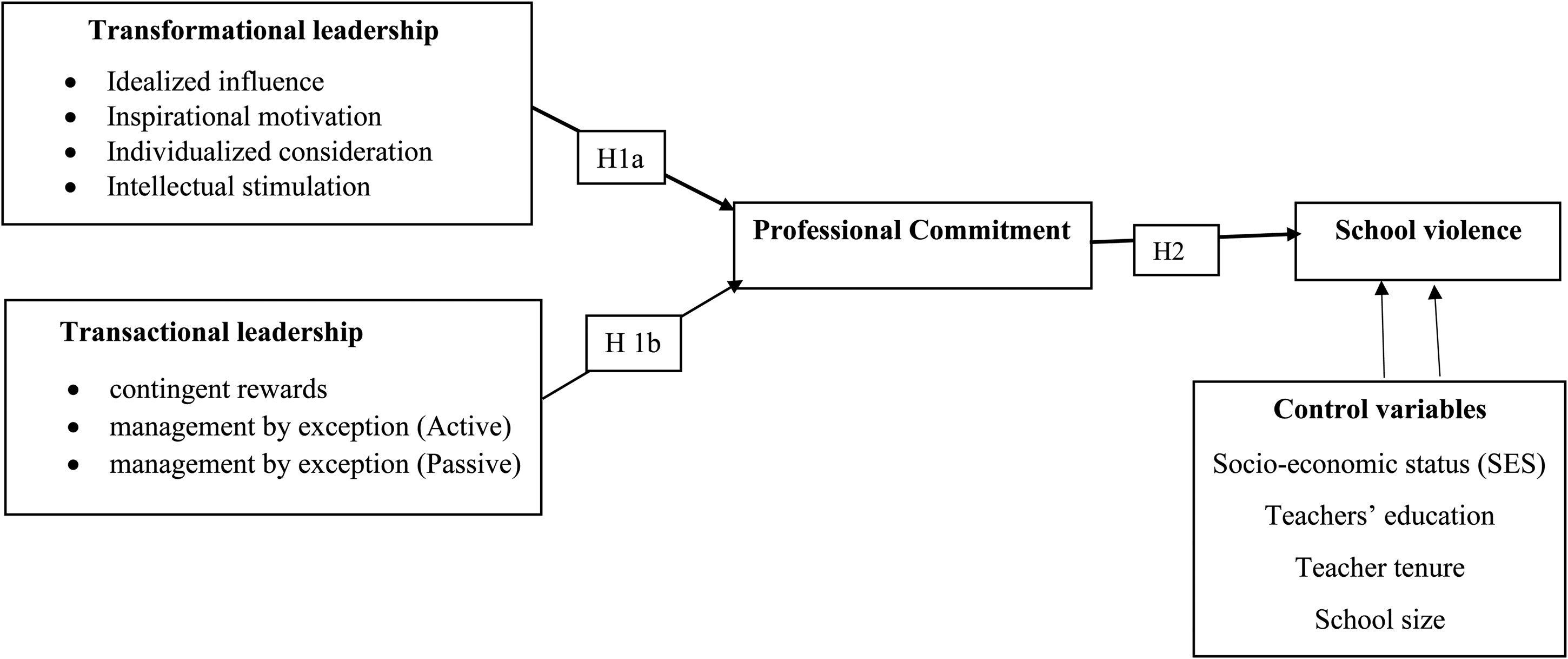
Research model.
This study draws on Role Theory to explain how principals’ leadership behaviors shape teachers’ perceptions, attitudes, and actions within schools. Role theory suggests that individuals’ workplace behavior is guided by the norms, expectations, and responsibilities associated with their socially and structurally defined roles, which shape how they are expected to act and how their behavior is evaluated by others (Anglin et al., 2022; Biddle, 1986; Eagly, 1987; Eagly and Karau, 2002). In school settings, principals may function as key role senders who define, reinforce, and communicate expectations regarding appropriate professional conduct. Accordingly, transformational and transactional leadership may shape how teachers interpret their responsibilities, experience their work environment, and respond to student behavior. In the current study, Role Theory offers a conceptual lens for understanding how principals’ leadership styles—transformational and transactional—define, reinforce, and shape the professional roles of teachers, influencing how teachers interpret their responsibilities, experience their work environment, and respond to student behavior. Transformational leadership may communicate shared purpose, collaboration, and support, whereas transactional leadership may shape role expectations through monitoring, rewards, and corrective actions. In that sense, principals’ leadership behaviors may function as role cues that shape teachers’ understanding of their professional responsibilities and appropriate conduct within the school (Anglin et al., 2022). Thus, while principals shape teachers’ roles through expectations and structure, teachers’ identification with the school community determines the extent to which these roles are internalized and translated into PC and behavior. Therefore, teachers’ PC may reflect the extent to which these role expectations are internalized, providing a theoretical link between principals’ leadership practices and school violence.
The main argument of this study is that principals’ leadership serves as a situational role cue that activates or constrains teachers’ role-consistent behavioral responses, thereby shaping school climate and influencing levels of school violence. In the Arab educational sector in Israel—where cultural norms emphasize hierarchy, collectivism, and social harmony (Nassir and Benoliel, 2023, 2025a)—leadership practices carry particular weight in signaling expectations, defining role expectations, clarifying responsibilities, and signaling acceptable professional conduct. Culturally congruent leadership can strengthen teachers’ professional functioning and reduce violent incidents by aligning authority, clear role boundaries, and expectations aligned with cultural expectations (Hallinger, 2018). However, while transformational leadership promotes autonomy and innovation, these emphases may be less effective in authority-oriented and conservative contexts (House et al., 2004). By contrast, transactional leadership provides role-clarifying cues that shape teachers’ sense of professional responsibility and may therefore better support the maintenance of a safe and orderly school climate. From a role-theory perspective, the crucial issue is not only whether leadership provides structure or inspiration, but how teachers interpret these cues, internalize them as part of their professional role, and translate them into everyday conduct within the school.
Prior research links principals’ leadership to teachers’ PC, but evidence relies mainly on cross-sectional self-report studies in specific contexts, limiting generalizability and yielding inconsistent findings regarding the relative influence of transformational and transactional leadership (Jabeen et al., 2019; Jabeen et al., 2020). Research on teachers’ attitudes is similarly mixed, as job satisfaction has been positively associated with PC, while earlier studies report inconsistent results (Bashir, 2017). By contrast, school violence research has employed more rigorous designs, such as mediation analyses, longitudinal data, and multisource structural equation modeling (SEM). However, this research has primarily focused on school climate, paternalistic leadership, and job satisfaction, rather than on transformational and transactional leadership and teachers’ PC (Benbenishty et al., 2025; Tarablus and Yablon, 2023). Moreover, although teacher commitment has been linked to lower school violence, this has been examined in a different cultural context and without considering leadership antecedents. Thus, a gap remains regarding whether and how principals’ transformational and transactional leadership relate to school violence through teachers’ PC in the Israeli Arab educational system. Accordingly, less is known about whether teachers’ PC serves as the proximal mechanism through which transformational and transactional leadership are translated into school violence outcomes, particularly in Arab schools in Israel. The present study addresses this gap by examining the mediating role of teachers’ PC in the relationship between principals’ leadership styles and school violence, while also highlighting how the meaning and effects of leadership styles may depend on the culturally specific context in which they are enacted.
Such an investigation offers meaningful contributions to the literature on educational leadership and school violence. School violence is widely recognized as a critical challenge for educational systems, as it undermines students’ wellbeing, academic achievement, and sense of safety, and disrupts the broader school climate (Che et al., 2024). Understanding how principals’ leadership styles shape teachers’ professional attitudes and their capacity to manage student behavior is, therefore, critical for developing more effective school-based prevention strategies. Moreover, whereas prior research in Arab schools has focused largely on participative, paternalistic, and democratic leadership, little empirical attention has been given to these two leadership styles in relation to school violence. By incorporating teachers’ PC as a mediating mechanism, the study identifies an additional pathway through which leadership influences school climate and student behavior indirectly. Practically, examining these dynamics within the culturally specific context of the Israeli Arab educational system provides insight into how principals may adopt leadership strategies that strengthen teachers’ commitment and support safer, more effective schools.
The research questions that guided this investigation are: RQ1. Do transformational leadership and transactional leadership correlate with teacher PC? RQ2. Is PC related to school violence? RQ3. Is PC a mediating mechanism in the relationship of principals’ leadership styles (transformational vs transactional) to school violence?
Theoretical background and hypotheses
Coping with school violence in the Israeli educational system
School violence refers to intentional behaviors that cause physical, psychological, social, or sexual harm within the school context or during school-related activities (Berkowitz, 2025; Turanovic and Siennick, 2022). It includes behaviors such as hitting and fighting, verbal insults and threats, social exclusion, damage or theft of property, bullying, and bringing or using dangerous objects at school (Sifunda, 2023). School violence leads to negative consequences at multiple levels. Among teachers, it is associated with emotional difficulties and impaired wellbeing (Camodeca and Nava, 2022; Carretero Bermejo et al., 2022). Also, research indicated that school violence contributes to mental-health difficulties such as anxiety and burnout (Fleming et al., 2012; Hong et al., 2022). Rising levels of violence further undermine teachers’ commitment and negatively affect their performance (Duran et al., 2021), and have also been shown to reduce job satisfaction, increase teachers’ intentions to leave the profession, and weaken their PC (Cheung et al., 2018; Li et al., 2019; Liu et al., 2019). Among students, school violence is linked to lower academic achievement (Gimenez et al., 2024) and to increased nonattendance and dropout, while also harming students’ wellbeing and the overall school climate (Cornell et al., 2010; Olweus and Breivik, 2014). At the organizational level, school violence disrupts the educational process and creates substantial challenges for school principals (Al-Makhariz, 2022), while imposing substantial monetary costs on the educational system (Cuellar et al., 2018).
Within the Israeli Arab context, recent reports (NAMEE, 2022), described school violence as a complex and ongoing phenomenon that unfolds across multiple settings in and around the school. The findings indicate that students report exposure to various forms of violence, including verbal, physical, social, and digital aggression, as well as bullying, threats, and incidents involving conflicts between students and staff. The data further suggest that some students experience fear that leads to school avoidance, and that violence may extend beyond the school grounds into the broader community and daily environment. At the same time, the report emphasizes efforts undertaken by schools to monitor violent incidents, strengthen students’ sense of safety, and develop preventive and educational responses aimed at reducing harm and improving the overall school climate.
Since the establishment of the state, the Arab minority has more than doubled, so that in 2021, the Arab minority numbered approximately 1.97 million people and reached 21% of the total population in Israel (CBS, 2021). The Arab population is religiously diverse, with approximately 85% identifying as Muslim, about 7% as Christian, and about 8% as Druze (CBS, 2021). Most of the Arab minority live in separate villages and cities, with only a small portion living in mixed cities. Arab society is characterized as a collectivist society that tends to exhibit high levels of uncertainty avoidance and a preference for power and authority distances (Da'as et al., 2021). Managers in Arab society are more authoritarian and less cooperative, and their hierarchical status in society is higher than that of their Jewish counterparts (Berson et al., 2015; Nassir and Benoliel, 2023, 2025a). The cultural context of Arab schools in Israel provides an important lens for understanding how principals enact leadership and how school dynamics are shaped (Hallinger, 2018). In addition, recent research in the Arab educational system in Israel suggests that leadership processes should be understood in relation to culturally embedded organizational dynamics and their implications for teachers’ commitment and school violence (Nassir and Benoliel, 2025c). More broadly, studies indicate that the influences of leadership may vary across national and educational contexts rather than remain uniform across settings (Chen et al., 2022). Arab schools in Israel have been described as operating in a context marked by collectivist norms, hierarchical relations, and relatively high power distance, alongside gradual shifts toward greater teacher participation and professional autonomy (Abd El Qader and Benoliel, 2024; Nassir and Benoliel, 2025a). Accordingly, the cultural and organizational context of Arab schools may shape how leadership practices are enacted and interpreted, with implications for teachers’ PC and broader school dynamics. Recent research performed in Arab schools in Israel suggests that leadership practices should be understood in relation to collectivist norms, hierarchical expectations, high power distance, and structural constraints that shape how teachers interpret authority, participation, and professional expectations (Nassir, 2026). Research has shown that leadership can be influenced by contextual features of national, regional, and educational systems, and that the relationships between leadership styles and student achievement differ across countries such as Germany and China (Chen et al., 2022). Transformational leadership has been defined by Bass (1999, p. 11) as “moving the follower beyond immediate self-interest.” This type of leadership is based on emotional attachment and partnership, which is accompanied by motivational arousal (Brown et al., 2019) and includes four subdimensions: (1) Charisma refers to the degree to which the leader behaves in a way that makes his followers want to emulate him; (2) Inspirational motivation refers to the degree to which the leader expresses an inspiring vision; (3) Individualized consideration refers to the degree to which the leader takes care of the personal needs of the teachers and their aspirations; (4) Intellectual stimulation relates to the degree to which the leader challenges prejudices (Boies et al., 2015). Research has shown that principals who are perceived as transformational leaders create supportive and empathetic relationships with the school staff and are inspirational models (Berkovich and Bogler, 2021).
Transactional leadership focuses on setting goals, clarifying the link between performance and rewards, and providing feedback to keep the teacher focused on completing tasks (Abd El Qader and Benoliel, 2024). Therefore, the teachers’ behaviors and activities are adjusted to the expected rewards. It is driven by exchange without an attempt to achieve an organized goal or to produce an organizational outcome (Nguni et al., 2006). Transactional leadership is manifested through the following behavioral structures: contingent rewards, management by exception (Active), and management by exception (Passive) (Bogler, 2001). Contingent rewards link the goal to rewards, clarify expectations, provide necessary resources, set mutually agreed-upon goals, and provide various kinds of rewards for successful performance. Management by exception may be active: leaders actively monitor the work of their subordinates, watch for deviations from rules and standards, and take corrective actions to prevent mistakes. Passive management by exception: leaders intervene only when standards are not met or when the performance does not meet expectations. The purpose of the present study is to examine how principals’ transformational and transactional leadership styles are related to school violence, both directly and indirectly, through teachers’ PC.
Principals’ leadership styles and professional commitment
Professional commitment refers to teachers’ psychological attachment to and identification with the teaching profession itself (Morrow and Wirth, 1989). In educational settings, PC reflects teachers’ internalization of professional values and responsibilities, which guide their day-to-day decisions and conduct, particularly in school contexts where teaching practices cannot always be closely monitored (Firestone and Pennell, 1993; Weick and McDaniel, 1989). A research study by Bello (2012) indicated that PC is a feeling of passion and loyalty of a worker toward her or his institution. In this sense, PC differs from OC, which refers to attachment to the school as an organization, and from motivation, which refers more broadly to the willingness to invest effort in work-related activities. Teachers’ PC is therefore particularly relevant to the present study because it captures teachers’ orientation toward their professional role rather than only toward the organization in which they work. Teachers’ PC is crucial for achieving good instruction (Firestone and Pennell, 1993). PC may foster individualistic modes of work (Somech and Bogler, 2002). From a role theory perspective, PC may be understood as reflecting the extent to which teachers internalize the norms, expectations, and responsibilities associated with their professional role.
Transformational leadership: Research indicated that transformational leadership can develop and foster positive feelings and attitudes among teachers regarding their vocation (Huang et al., 2021). Research showed that an encouraging work environment strengthens teachers’ sense of mission and contributes to higher levels of achievement (Avidan and Sabov, 2020). Transformational leaders tend to inspire loyalty among teachers and foster a strong attachment to the organization (Bacha and Kosa, 2022). Studies report that transformational leaders enhance teachers’ morale and stimulate feelings of loyalty and dedication, which further deepen their PC (Chirchir et al., 2014). The Arab society is characterized as a collectivistic culture, and high levels of power distance and authority are prevalent (Da’as et al., 2021). Research has shown that the effects of transformational leadership are universal across collectivistic and individualistic cultures (Aycan et al., 2013). For example, Jabeen et al. (2019), found a significant and positive relationship between transformational leadership and work-related commitment, suggesting its relevance for PC. Therefore, following the role theory perspective, transformational leadership may strengthen teachers’ PC by communicating meaningful professional expectations through vision, support, recognition, and shared purpose, thereby encouraging teachers to internalize their professional role in a more value-based and identity-consistent manner.
Transactional leadership
Research has shown that transactional leadership is positively correlated with PC. Research by Jabeen et al. (2020) demonstrates that transactional leadership is significantly and positively associated with teachers’ job commitment, as clear expectations, supervision, and performance-based rewards encourage teachers to invest greater effort in their work. Additional findings from a study conducted in Pakistan indicate that transactional leadership is a meaningful positive predictor of PC, as contingent rewards and structured role expectations create a motivating work environment (Jabeen et al., 2019). Taken together, these findings suggest that transactional leadership promotes teachers’ PC by providing clarity, consistency, and incentives that reinforce desired behaviors. From a Role Theory perspective, transactional leadership is expected to promote teachers’ PC through role clarification, performance contingencies, and reinforcement of expected professional behaviors. By providing structure and clear expectations, transactional leadership may strengthen teachers’ understanding of their professional responsibilities. Hypothesis 1a: There is a positive correlation between transformational leadership and teachers’ PC Hypothesis 1b: There is a positive correlation between transactional leadership and teacher's PC
The relationship between PC and school violence
Teachers, as role models who spend considerable time with students, play a central role in the educational system; thus, their PC and engagement can significantly contribute to preventing school violence (Che et al., 2024). Moreover, research indicates that highly committed teachers are more likely to engage in social exchange relationships that go beyond formal role expectations, providing students with enhanced care and support, including investing additional effort in addressing disruptive and violent behaviors and seeking to modify students’ conduct (Andersen et al., 2021). Empirical research reinforces this view. A study by Sharma and Jha (2020) on schools in India revealed that schools where teachers exhibited high levels of emotional commitment and established strong rapport with students reported lower incidences of violent conflicts among students. Similarly, schools in which teachers are committed to lesson planning, student engagement, and classroom management experience fewer instances of physical fights, vandalism, and disruptive behavior (Che et al., 2024). In addition, research highlights that teachers who are dedicated to their instructional responsibilities, continuously strive to enhance their teaching strategies, and maintain a strong sense of professional identity are less likely to encounter violent incidents in their classrooms (Kraft et al., 2020). Taken together, these findings suggest that strengthening teachers’ PC can foster safer and more stable school environments. Hypothesis 2: Teachers’ PC is negatively correlated to school violence.
Mediation model
Although prior studies have pointed to several possible pathways linking leadership to school violence, including school climate and teachers’ job satisfaction, these explanations do not fully capture the role of teachers as the immediate professional agents responsible for interpreting, regulating, and responding to student behavior (Nassir and Benoliel, 2025b). Drawing on Role Theory, the present study proposes that teachers’ PC provides a more proximal explanatory mechanism, as research indicates that PC reflects the extent to which teachers internalize professional norms, responsibilities, and role expectations that guide their day-to-day conduct in preventing and addressing school violence (Anglin et al., 2022). In this sense, PC is theoretically distinct from broader contextual explanations, such as school climate, and from more general attitudinal variables (Bashir, 2017). PC captures teachers’ internalized professional orientation and therefore provides a more proximal explanatory mechanism linking leadership to school violence. Accordingly, the proposed mediation model assumes that principals’ leadership shapes role expectations, that teachers’ PC reflects the internalization of these expectations, explaining how leadership is indirectly associated with school violence.
Drawing on Role Theory, principals’ leadership behaviors function as role cues shaping teachers’ understanding of professional responsibilities, role expectations, and school norms. In Arab schools, where collectivistic values and respect for authority are emphasized, principals play a central role in reinforcing these expectations. Transformational leadership may shape role understanding through vision, collaboration, and support, whereas transactional leadership reinforces role clarity through clear expectations and rewards. As teachers internalize these roles and align with school norms, they may develop stronger PC and become more motivated to protect the school environment and address violence. Hence, Hypothesis 3: PC mediates the relationship of transformational leadership to school violence. Hypothesis 4: PC mediates the relationship of transactional leadership to school violence.
Method
Participants and procedure
Data was collected from two respondent groups to reduce, rather than eliminate, potential common method bias associated with single-source designs. The sample comprised 426 participants from 71 middle and high schools in the Israeli Arab educational system, with an average school enrollment of 656 students (SD = 377). To test the proposed relationships, we employed a two-source survey design using respondents from Arab schools in Israel. Schools were recruited through principals who were contacted in random order from an official list of Arab middle and high schools provided by the Israeli Ministry of Education. The study sample consisted of two groups: (1) teachers serving on the school management team (SMT), with 213 participants responding out of 355 invited (60% response rate); (2) teachers not holding SMT positions, from whom 213 responses were obtained out of 296 invitations (72% response rate), with an equal number of respondents randomly drawn from both teacher groups. In the Israeli school context, SMT are generally composed of senior staff members, such as vice principals and other central officeholders. These teams are primarily responsible for both administrative and instructional functions, with the principal typically serving as the team leader (Abbott and Bush, 2013). Table 1 presents background characteristics of the study participants.
Descriptive analysis of the participants.

Note. N = 426.
Following ethical approval from the university's institutional review board and authorization from the Israeli Ministry of Education (no. 12147), recruitment was carried out through Arab school principals who were contacted in random order and briefed on the study aims. After school-level consent was obtained, participation invitations were distributed to both SMT members and teachers. Participation was voluntary. SMT members completed the measures of principals’ transformational and transactional leadership, whereas teachers completed the measures of PC and school violence; all respondents also provided demographic details. To promote honest responding, confidentiality was emphasized, and participants were informed that results would be presented only in aggregated form, such that no individual or school could be identified. Because the study examined school-level relationships, individual responses were aggregated to the school level. This decision was supported by acceptable rWG, ICC(1), and ICC(2) values (see level of analysis for details and Table 2).
Descriptive statistics, frequencies, rWG, ICCs, and inter correlations matrix for the key variables (N = 71).
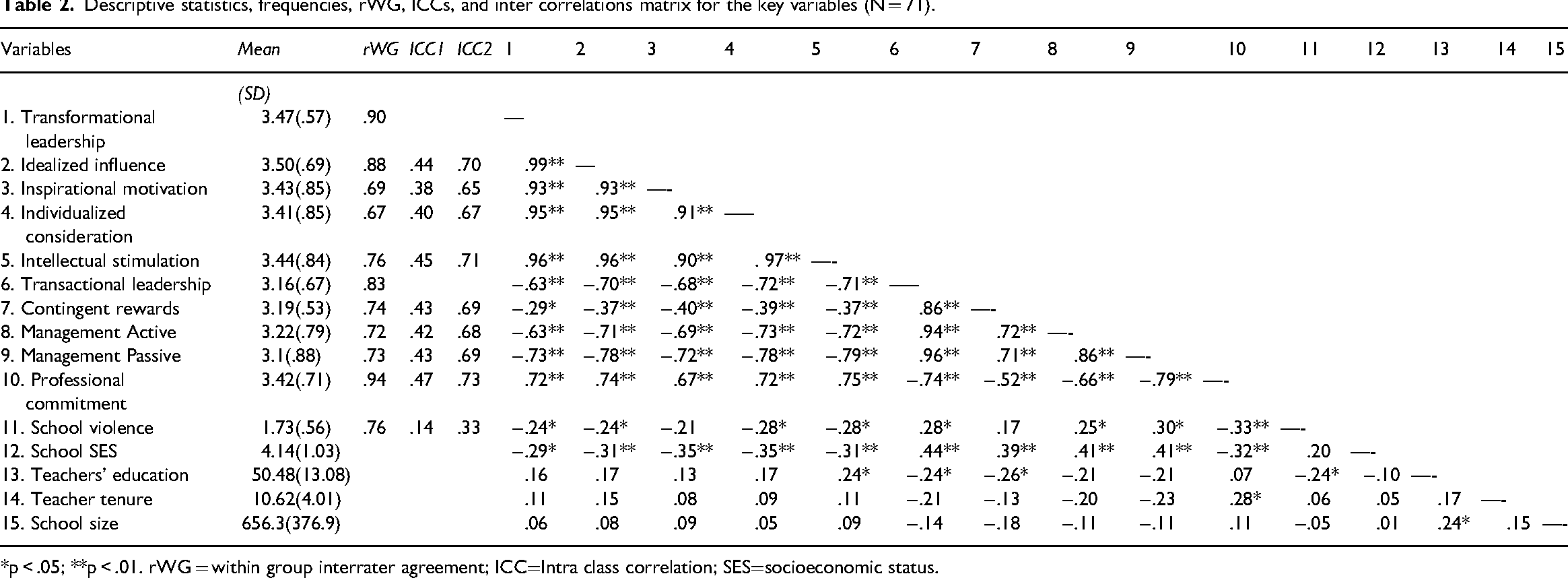
*p < .05; **p < .01. rWG = within group interrater agreement; ICC=Intra class correlation; SES=socioeconomic status.
Measures
Transformational and transactional leadership
Leadership style was assessed by the MLQ (Multiple Leadership Questionnaire), Form 5X-Short (MLQ-5X) (Avolio et al., 1999). The questionnaire consists of 31 items. Four factors of transformational leadership are distinguished (20 items). A Confirmatory Factor Analysis (CFA) was used to evaluate the multidimensionality of transformational leadership. The results supported the four-dimensional structure of transformational leadership, with good fit indices: χ2/df = 1.41; Comparative Fit Index (CFI) = .991, Tucker-Lewis Index (TLI) = .987, Incremental Fit Index (IFI) = .991, and Root Mean Square Error of Approximation (RMSEA) = .044. Transformational leadership was modeled as a latent construct represented by its four observed subdimensions : (1) Idealized influence (11-items; e.g. “I trust him, and with him I can overcome any obstacle”; α = .94), (2) Inspirational motivation (2-items; e.g., “Serves as a role model for me”; α = .96), (3) Intellectual stimulation (4-items; e.g., “Makes me justify my opinion using logical arguments”; α = .95), and (4) Individualized consideration (3-items; e.g., “Listens to my problems and concerns”; α = .76).
Transactional leadership
Involves three factors (11items): The results of CFA supported the three-dimensional structure, with good fit indices: χ2/df = 1.24; CFI = .996; TLI = .993; IFI = .997, and RMSEA = .033. Based on this result, transactional leadership was modeled as a latent construct represented by its three observed subdimensions: (1) Contingent reward (4-items; e.g., “Talks about special rewards for good work”; α = .93), (2) Active management by exception (3-items; e.g., “Focuses on finding irregularities, exceptions, or deviations from what I was assigned to do”; α = .91), (3) Passive management by exception (4-items; e.g., “If I don't bother him, he won't bother me”; α = .94).
Professional commitment
PC was assessed using Lodahl and Kejner's (1965) questionnaire, which was specifically adapted for use in educational settings and validated within the Israeli educational system (Bogler, 2005; Somech and Bogler, 2002). A 20-item questionnaire was used (e.g., “I will stay after my teaching hours to complete a task, even if I do not receive compensation for it”; α = .89).
School violence
School violence was measured by a subscale adapted from Erhard's (2000) 15-item scale (e.g., “Students threaten and bully”; α = .96).
Control variables
Students’ socioeconomic status, school size, teaching tenure, and teachers’ education were chosen as control variables because they correlate with teacher behaviors and school outcomes (Xie and Ma, 2019).
Level of analysis
In the research hypotheses, the school is identified as the unit of analysis. Therefore, leadership styles were an aggregate of the responses of SMT members. Teachers’ PC was an aggregate of the responses of individual teachers. School violence was an aggregate of the responses of teachers. Justification for aggregation is provided by theoretical and empirical arguments (Rousseau, 1985). Theoretically, Rousseau (1985) advocated the use of composition theories that elucidate the functional similarity of structures at various levels. The perceptions of teachers about their work environment are likely to be similar to the perceptions of teachers from the same schools because the collaborative work and frequency of communication among teachers create common norms of work and behavior patterns (Jehn et al., 1997).
To statistically justify the aggregation of measures from individual teacher ratings to the school level, mean rWG values—Within-Group Interrater Reliability (Dunlap et al., 2003; James et al., 1993) were calculated, which indicate the degree of agreement among teachers. High within-group agreement was established to justify using the group average as an indicator of group-level variables; a value of .70 or greater is suggested as a “good” amount of within-group interrater agreement (rWG: James et al., 1993). All scales exceeded this level (see Table 2). Then, before aggregating individual-level scores to the group level by mean, intraclass correlations (ICCs) were calculated. ICC(1) reflects the extent of within versus between-group variability, and ICC(2) provides an estimate of the reliability of the group means (Bliese, 2016). As indicated by Bliese (2016), ICC(1) generally ranges from 0 to 0.50 with a median of 0.12. The results support the use of the average scores as organizational measurements (Table 2). Importantly, the decision to aggregate was based not on a single statistic alone, but on the combination of within-school agreement, between-school variability, modest cluster size, and the theoretical conceptualization of the focal constructs as school-level phenomena. At the same time, some ICC(2) values indicate only moderate reliability of the aggregated group means and should therefore be interpreted with appropriate caution. Importantly, the proposed variables—leadership and school violence—are conceptualized as emergent organizational phenomena. Specifically, school violence was aggregated in accordance with its theoretical definition as a school-level construct reflecting shared beliefs among staff (Benoliel, 2021; Benbenishty et al., 2016), which cannot be meaningfully interpreted at the individual level.
Data analysis
Hypotheses were tested using SEM in AMOS 21.0. Mediation was assessed following the SEM-based procedure described by James et al. (2006). We first estimated a full mediation model and subsequently evaluated partial mediation by adding a direct path from the predictor to the outcome. Simultaneous estimation of the predictor–mediator and mediator–outcome paths within SEM is advantageous because, relative to alternative approaches, it provides a favorable balance between type I error control and statistical power (MacKinnon et al., 2002).
In the present study, the full mediating model describes the relation of transformational and transactional leadership (independent variables) to teachers’ PC (mediating variables), and of teachers’ PC to school violence (dependent variable). To support the full mediation model (M1), M1 was compared to several competitive models. To gauge model fit, several goodness-of-fit indices were used (absolute and relative indices) (Jöreskog and Sörbom, 1996). The χ2 values, which offer a statistical basis for comparing the relative fit of nested models, were indicated. To investigate the mediational effects, we computed direct relationships, indirect relationships, and total effects. We tested their significance using 5000 bootstrap samples to test the bias-corrected confidence interval (CI) at 95% (MacKinnon and Fairchild, 2009), with effects deemed significant if CIs excluded zero (Memon et al., 2018). This more conservative approach is recommended for mediation analysis because indirect effects often have a non-normal sampling distribution.
Results
Table 2 presents the means, standard deviations, intercorrelation matrix, rWG, and ICC for all key variables included in the analysis.
Hypothesis test and overall model fit
Measurement model testing
First, a CFA was performed to determine unidimensionality, convergent validity, and discriminant validity of the variables (Jöreskog and Sörbom, 1996). The measurement model provided an acceptable fit to the data, χ2/df = 1.40, x2(1026) = 1440.49, CFI = .933, TLI = .920, IFI = .935, RMSEA = .076, and all of the indicators had statistically significant (p < .05) factor loadings (p > .50) on their intended constructs, establishing the posited relationships among indicators and constructs (Hair et al., 1998).
Convergent validity
Three conditions must be met to establish convergent validity (Fornell and Larcker, 1981). First, all factor loading in CFA were significant at p < .001. Second, the average variance extracted (AVE) for all research constructs exceeded 0.50, namely transformational leadership (.85), transactional leadership (.75), PC (.71), and school violence (.80), indicating that the items of the proposed scales explain more variance in the underlying construct than that attributable to the measurement error. Third, the reliability for each factor of the proposed construct was higher than .70. So, convergent validity was achieved.
Discriminant validity
Regarding discriminant validity, first, AVE should be greater than 0.50 (Fornell and Larcker, 1981). Second, AVE should exceed the maximum shared variance: .61 for transformational leadership, .61 for transactional leadership, .58 for PC, and .11 for school violence. AVE of the proposed variables meets these conditions. So, discriminant validity was achieved for the measurement model.
Structural model testing
To examine the proposed mediational role of teacher PC, we computed direct effects as well as indirect effects. A deviation in the fit statistics can be attributed to model misspecification (Muthén and Asparouhov, 2013). Specifically, M1, which tested indirect relationships (through PC) between transformational leadership and transactional leadership, and school violence, showed good fit indices (χ2(56) = 71.95, χ2/df = 1.29; CFI = .983; TLI = .975; IFI = .984; RMSEA = .064). Comparisons with the alternative models indicated no significant improvement in model fit (see Table 3). Accordingly, M1 was retained as the preferred model.
Comparison of fit indices of different models in study for structural equation model.
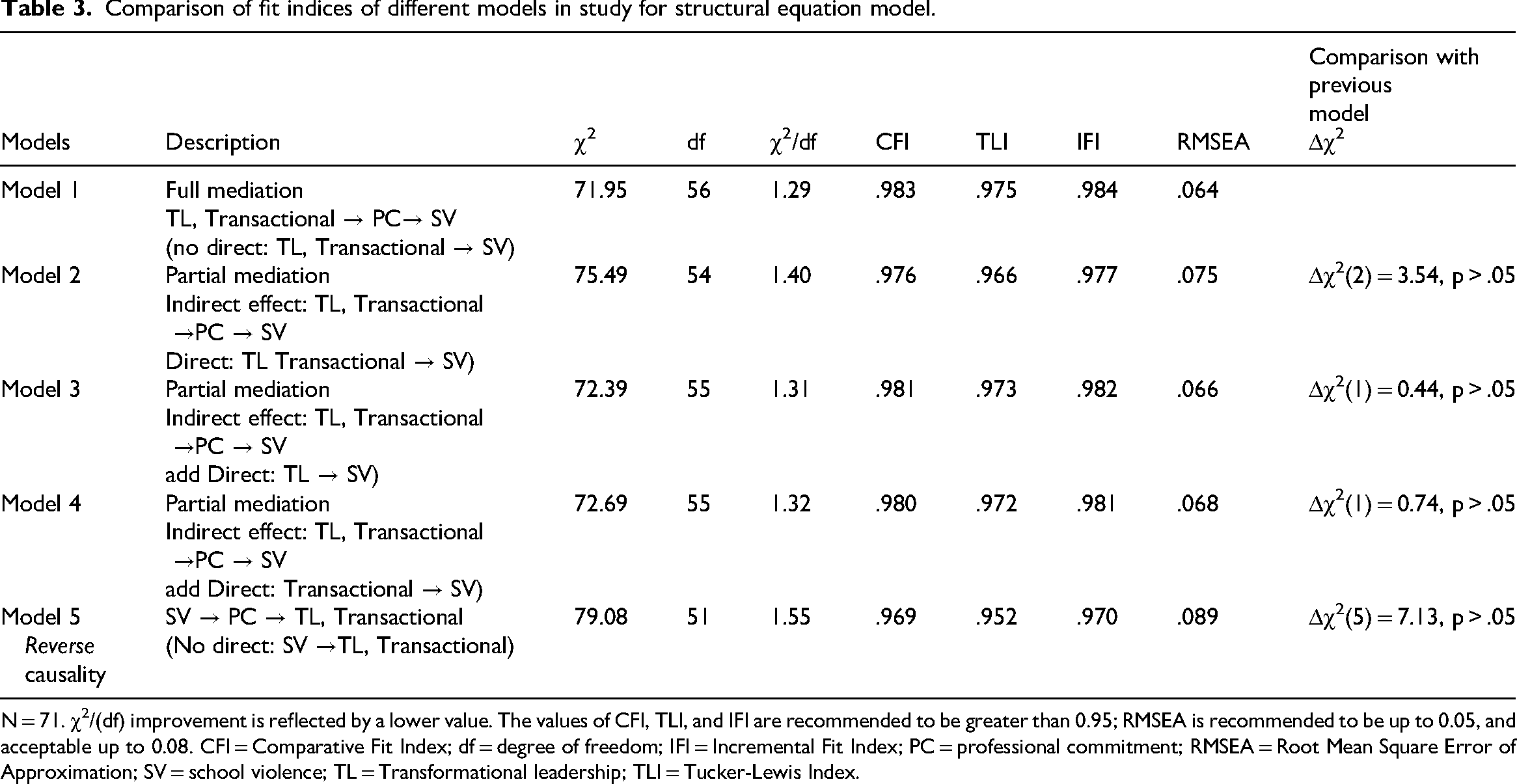
N = 71. χ2/(df) improvement is reflected by a lower value. The values of CFI, TLI, and IFI are recommended to be greater than 0.95; RMSEA is recommended to be up to 0.05, and acceptable up to 0.08. CFI = Comparative Fit Index; df = degree of freedom; IFI = Incremental Fit Index; PC = professional commitment; RMSEA = Root Mean Square Error of Approximation; SV = school violence; TL = Transformational leadership; TLI = Tucker-Lewis Index.
Findings of SEM for M1 (Table 4 and Figure 2) indicate that the overall model explained 64.7% of the variance in teachers’ PC, and 17.6% of the variance in school violence. The control variable of teachers’ education was significant. H1a concerns the relationship between transformational leadership and PC. A significant positive correlation was found between transformational leadership and PC (β = .39, p < .001); thus, H1a was supported.
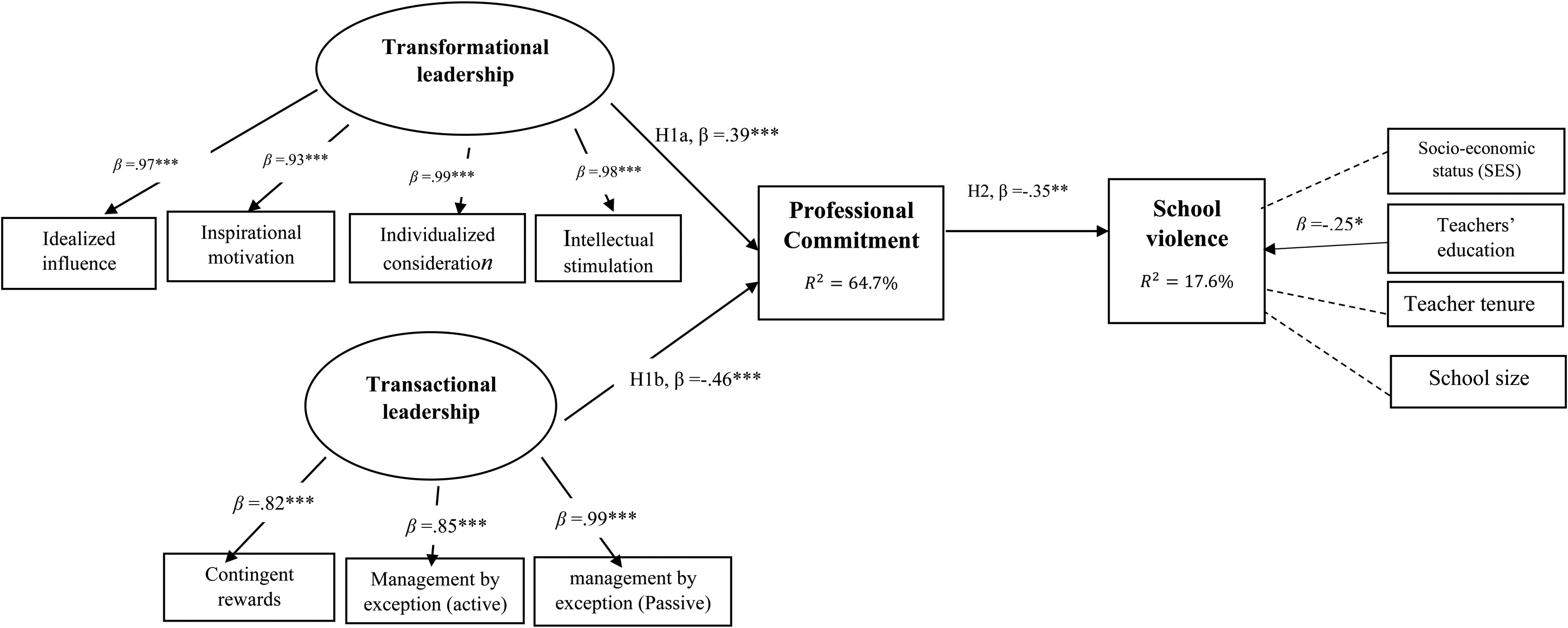
Structural equation model results: professional commitment fully mediated the relationships between transformational and transactional leadership and school violence (N = 71). Standardized parameter estimates for the theoretical model; *p < .05; **p < .01; ***p < .001. Model fit indices indicated a good fit to the data, χ2 = 71.95, χ2/df = 1.29, CFI = .983, TLI = .975, IFI = .984, RMSEA = .064. Dashed lines indicate nonsignificant effects. CFI = Comparative Fit Index; IFI = Incremental Fit Index; RMSEA = Root Mean Square Error of Approximation; TLI = Tucker-Lewis Index.
Direct and indirect effects of TL and Transactional leadership on SV through PC.
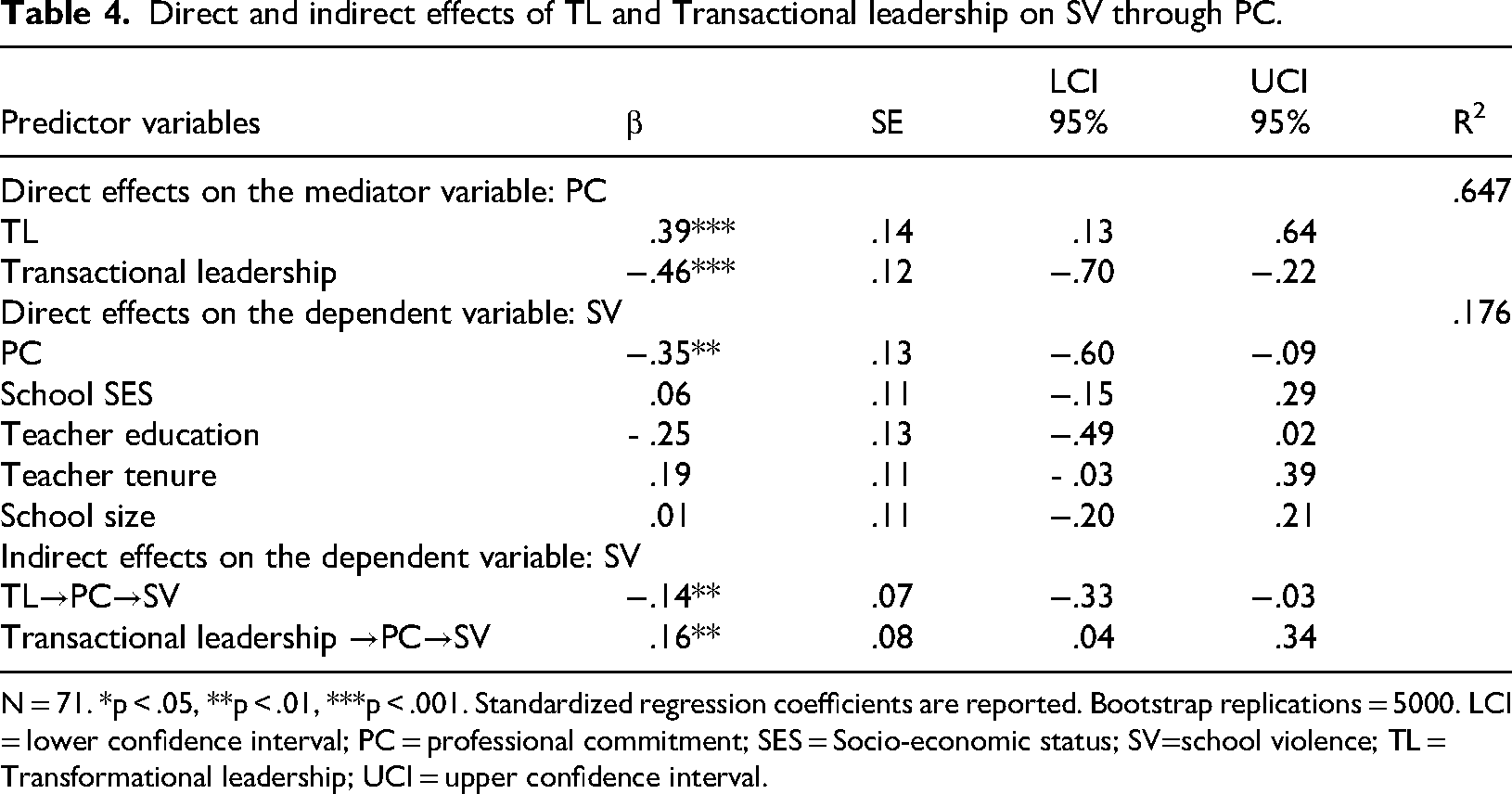
N = 71. *p < .05, **p < .01, ***p < .001. Standardized regression coefficients are reported. Bootstrap replications = 5000. LCI = lower confidence interval; PC = professional commitment; SES = Socio-economic status; SV=school violence; TL = Transformational leadership; UCI = upper confidence interval.
H1b concerns the relationship between transactional leadership and PC. A significant negative correlation was found between transactional leadership and PC (β = −.46, p < .001). Therefore, H1b was not supported.
H2 concerns the relationship between teachers’ PC and school violence. Teachers’ PC was negatively correlated to school violence (β = −.35, p < .01). Therefore, H2 was supported. To provide a more rigorous test of the mediated effects, bootstrap analyses were performed using 5000 bootstrap samples and bias-corrected 95% CIs (Hayes, 2013; please see Table 4).
Discussion
School violence has harmful implications for students’ wellbeing, learning, and overall school climate. Accordingly, the literature highlights the importance of strengthening schools’ internal capacity to prevent violence, including teachers’ active involvement and collaboration with relevant stakeholders (Berkowitz, 2025; Che et al., 2024). In the Israeli Arab context, this challenge is further intensified by escalating community violence. Evidence suggests that broader community conditions can be reflected within schools; thus, exposure to surrounding violence is associated with negative student outcomes and with reduced teacher safety and wellbeing, which may weaken the educational climate (Ghanamah, 2025). Against this backdrop, the present study examines how principals’ leadership styles shape teachers’ PC and how PC, in turn, relates to school violence.
First, the findings related to H1a–H1b indicate partial support for the proposed relationships. Consistent with H1a, transformational leadership was positively associated with teachers’ PC, aligning with prior evidence that transformational behaviors can foster more positive professional attitudes, strengthen a sense of mission, and reinforce dedication—processes that are theoretically consistent with higher PC. At the same time, H1b was not supported: instead of a positive correlation, transactional leadership was negatively associated with PC. In contrast to earlier studies conducted in Pakistan, which linked transactional leadership to stronger PC through role clarity, structured supervision, and performance-based reinforcement (Jabeen et al., 2019; Jabeen et al., 2020), the Arab educational system in Israel may reflect a transitional sociocultural context. While still shaped by collectivism and hierarchy, recent work suggests a growing shift toward more autonomy-supportive professional expectations among teachers (Nassir and Benoliel, 2025a). In this context, transactional leadership may be experienced less as a supportive structure and more as heightened managerial control. Practices such as close monitoring, management-by-exception, and corrective feedback may therefore undermine teachers’ sense of professional discretion and identity, reducing PC. This suggests that similar transactional practices may be interpreted differently depending on norms of authority and professional interaction within schools (Hallinger, 2018). In the Israeli Arab context, where principal–teacher relations may be more hierarchical and less participatory, transformational leadership, through supportive relationships and meaning-focused guidance, may instead signal respect and professional value, strengthening the identity-based component of commitment. Overall, these findings suggest that teachers’ PC may be more responsive to meaning- and relationship-based leadership cues than to exchange-based regulation, offering a culturally grounded explanation for the positive association between transformational leadership and PC alongside the negative association between transactional leadership and PC. From a Role theory perspective, these findings suggest that teachers’ PC may be more responsive to leadership cues that communicate meaning, support, and professional value than to cues centered primarily on monitoring and conditional exchange.
Second, in relation to hypothesis 2, the findings indicated that teachers’ PC was negatively correlated with school violence, meaning that higher levels of PC were associated with lower levels of student violent behavior. One plausible interpretation is that PC is reflected not only in teachers’ attitudes but also in their instructional discipline and role clarity. Research pointed out (Killen and O’Toole, 2023) that the professionally committed teachers tend to monitor classroom behavior more consistently, maintain high expectations for students’ academic engagement, and adopt teaching strategies that enhance students’ interest and engagement, thereby reducing opportunities for misbehavior to escalate into aggression. In addition, research showed (Hattie, 2023; Waldbuesser et al., 2021) that teachers with strong PC typically invest greater effort in preparing structured lessons, instructional innovation, and effectiveness in supporting students’ learning, providing feedback, and organizing learning routines, which limits unstructured time a recognized risk factor for disruptive and violent conduct. Within Arab schools, where teachers often operate in socially close communities and are expected to model responsibility and appropriate conduct, such practices may be especially influential: PC can strengthen both authority and relational trust, enabling teachers to prevent, contain, and de-escalate conflicts more effectively. Taken together, these findings suggest that PC may function as a culturally embedded protective mechanism that supports classroom organization and contributes to lower levels of school violence.
Second, in relation to hypothesis 2, the findings indicated that teachers’ PC was negatively associated with school violence, meaning that higher levels of PC were linked to lower levels of student violent behavior. One possible interpretation is that PC may be reflected not only in teachers’ attitudes but also in their instructional discipline and role clarity. Prior research suggests that professionally committed teachers tend to monitor classroom behavior more consistently, maintain high expectations for students’ academic engagement, and adopt teaching practices that may reduce opportunities for misbehavior to escalate into aggression. Within Arab schools, where teachers often operate in socially close communities and are expected to model responsibility and appropriate conduct, such practices may be especially relevant. Taken together, the present findings are consistent with the interpretation that PC may function as a protective school-level factor associated with lower levels of school violence.
Third, with respect to hypothesis 3, the findings indicated that teachers’ PC mediated the relationship between transformational leadership and school violence; that is, transformational leadership was indirectly associated with lower levels of school violence through its positive association with PC. One theoretically informed interpretation is that transformational leadership may communicate vision, recognition, and moral legitimacy in ways that strengthen teachers’ identification with their professional role (Nassir and Benoliel, 2025b). From this perspective, PC may reflect the extent to which professional expectations are internalized and translated into teachers’ everyday conduct within the school. In turn, this pattern may help explain why transformational leadership was indirectly related to lower levels of school violence in the present study. This interpretation is also consistent with the view that lower levels of school violence may be associated not only with administrative control or disciplinary tightening, but also with teachers’ stronger professional orientation and proactive engagement in maintaining school order (Cuellar et al., 2018).
Finally, with respect to hypothesis 4, the findings revealed a significant indirect effect of transactional leadership on school violence through teachers’ PC. The indirect effect suggests that higher transactional leadership was associated with higher levels of school violence through reduced PC. One possible interpretation is that, in the present context, practices such as close monitoring, management-by-exception, and corrective feedback may be experienced less as supportive role clarification and more as managerial control, thereby weakening teachers’ sense of professional discretion and identification with their professional role. This result is important because it may reflect broader sociocultural changes taking place within Arab society in Israel, which has been described as undergoing a gradual transition from more traditional, hierarchical, and collectivist norms toward greater openness to self-expression, professional autonomy, teacher participation, and career advancement. In such a transitional context, leadership practices based primarily on control, monitoring, and conditional exchange may be experienced as less compatible with teachers’ emerging professional expectations and may therefore weaken their PC.
The present findings, therefore, suggest that PC may serve as an important organizational mechanism through which leadership is associated with school functioning. This finding aligns with previous research emphasizing the role of commitment in shaping teachers’ engagement and normative conduct and showing that principal leadership contributes to safer school environments not only directly, but also indirectly through teachers’ professional orientation and everyday role enactment (Berkovich, 2024). In addition, the study findings suggest that the effects of transformational and transactional leadership on teachers’ professional orientations may depend on cultural norms, authority relations, and expectations regarding professional autonomy, rather than being uniform across settings. This is relevant to educational systems serving ethnic minority or culturally distinct communities, particularly those characterized by collectivism, hierarchical leadership traditions, and tensions between traditional authority and teacher participation. Importantly, the present study deepens our understanding regarding the role of teachers’ PC as a proximal mediating mechanism through which leadership is translated into violence-related school outcomes within the culturally specific context of Arab schools in Israel.
Limitations and future studies
Despite the contribution of the present findings, several constraints should be acknowledged. Because the study relied on a cross-sectional design, the temporal ordering among leadership, teachers’ PC, and school violence cannot be established, and alternative directional patterns remain plausible; longitudinal or time-lagged designs would strengthen causal interpretation. Accordingly, the present findings should be interpreted as associations and indirect effects consistent with the proposed theoretical model, rather than as evidence of causality. Single-level SEM was used in the analysis. Although the data have a hierarchical structure (teachers nested within schools), the school was defined as the unit of analysis, and aggregation was statistically supported by rWG, ICC(1), and ICC(2). This approach is consistent with the study's focus on school-level phenomena and allowed for the examination of collective patterns. At the same time, we acknowledge that alternative analytic strategies could further disentangle within- and between-school variance. Future research may therefore benefit from applying hierarchical linear modeling or multilevel structural equation modeling to provide more fine-grained estimates and to explicitly model potential ICC effects associated with shared school contexts. In addition, the relatively small number of respondents per school may limit the precision of school-level estimates, and future research would benefit from larger within-school samples. Moreover, the sample focuses exclusively on the Israeli Arab educational system, limiting the possibility to generalized the results to other educational sectors in Israel, as cultural and organizational conditions differ across systems. Moreover, key constructs were assessed via questionnaires, which may be influenced by perceptual and reporting biases; future studies could integrate additional informants and non-self-report indicators (e.g. administrative records or observational measures) to triangulate the findings. Finally, the current model focused on PC as the central mechanism linking leadership to school violence; future research would benefit from expanding the framework to include additional teacher and student outcomes (e.g. academic achievement, motivation, wellbeing, and broader indicators of school safety and climate) to capture the multifaceted ways leadership shapes school functioning.
Implications
The present study highlights teachers’ PC as a central process through which principals’ leadership is linked to school violence. The pattern supports a fully mediated pathway: transformational leadership is associated with stronger PC, and stronger PC corresponds with lower levels of school violence, producing a meaningful indirect effect. In contrast, transactional leadership is related to lower PC and, indirectly, to higher violence, implying that transactional practices may become counterproductive. These findings suggest that efforts to reduce school violence should prioritize strengthening the organizational conditions that sustain teacher PC, rather than relying mainly on reactive, incident-based responses. Such conditions include leadership development that emphasizes transformational practices alongside clear and consistent expectations, school-level support that enables teachers to invest in students, and structured pre-service and in-service training focused on prevention and intervention, ideally implemented in coordination with parents and community partners. At the school level, principals can promote PC by articulating a shared school vision, providing individualized professional and emotional support, recognizing teachers’ contributions, and creating collaborative structures such as peer-learning groups. At the policy level, leadership development programs for principals in Arab schools may incorporate training that helps balance hierarchical norms with growing expectations for participation and professional autonomy. Such practices may also be integrated into school improvement and violence prevention initiatives by allocating time and support for collaborative teacher structures, rather than relying solely on discipline-oriented responses. Together, these implications offer more concrete and context-sensitive guidance for both school leaders and policymakers.
Footnotes
Funding
The authors received no financial support for the research, authorship, and/or publication of this article.
Declaration of conflicting interests
The authors declared no potential conflicts of interest with respect to the research, authorship, and/or publication of this article.
Author biographies
