







Abstract
The normative ‘heroic leadership’ discourse positions school principals as transformative visionaries, yet in highly centralised systems this narrative breaks down, giving rise to the twin challenges of ‘incomplete autonomy’ and ‘street-level management’. This phenomenological study examines how 15 principals in Türkiye's centralised education system respond to structural disempowerment: how they make sense of authority gaps and develop creative insubordination practices to keep their schools running. Data were collected through in-depth interviews and analysed using reflexive thematic analysis informed by phenomenological reduction. Three themes emerged: (1) Structural Siege and the Experience of Incomplete Autonomy, (2) Sensemaking and Creative Insubordination Under the Grip of Incomplete Autonomy, and (3) Lack of Psychological Safety and the Bureaucratic Vice. Principals are not passive implementers; when rigid regulations clash with urgent educational needs, they act – moving along a continuum from legitimate discretion to creative insubordination – to prevent schools from grinding to a halt. Yet these informal practices come at a cost: persistent investigation threats generate psychological insecurity and emotional exhaustion; a negative case reveals that relational trust with superiors can transform this adverse climate. When principals bear full accountability yet lack the tools to act, an unsustainable autonomy paradox emerges; reforms placing institutional trust and structural flexibility at their core are essential.
Keywords
Introduction
School principals in highly centralised education systems occupy a structurally impossible position: they are held fully accountable for school outcomes yet systematically deprived of the authority and tools needed to produce them. Although critical scholarship has challenged the romanticised image of school principals as heroic change agents for over two decades (Collinson et al., 2018; Gronn, 2009), the normative discourse positioning principals as instructional leaders or transformative architects continues to shape policy expectations and mainstream research agendas (Cansoy et al., 2025; Gümüş et al., 2018; Hallinger et al., 2020; Leithwood et al., 2020). Global education policies increasingly place responsibility for improving student outcomes on principals’ shoulders (Keddie, 2015; Pont et al., 2008). Yet this leadership narrative substantially loses its functionality when confronted with structural realities on the ground (Kim and Weiner, 2022): recent longitudinal studies demonstrate that school administrators function as street-level managers operating amid uncertainties, contradictory bureaucratic demands, and insufficient institutional resources (Davidovitz and Schechter, 2024; Sanfuentes et al., 2026). Drawing on Lipsky's (2010) street-level bureaucracy theory, this perspective frames school management not as vision-building but as a mediation practice bridging the gap between policymakers’ rigid regulations and the field's pedagogical and human needs (Hupe and Buffat, 2014; Maynard-Moody and Musheno, 2012).
This gap between escalating leadership expectations and structural constraints is conceptualised in the literature as the autonomy paradox (Nordholm et al., 2023; Wermke and Salokangas, 2021): policymakers burden principals with school improvement responsibilities while narrowing their scope of action through bureaucratic constraints, generating an expectation of visionary transformation from administrators deprived of decision-making authority (Gunter and Ribbins, 2002; Wermke et al., 2024). The uncritical transfer of Western-origin leadership models to centralised systems deepens this paradox (Cansoy et al., 2025; Harris et al., 2016; Oplatka, 2004). In Türkiye's Ministry of National Education (MoNE) centralised system, principals lack legal authority over personnel selection, budget management, and curricular flexibility (Cansoy et al., 2025; Gümüş et al., 2021), what Kim and Weiner (2022) term incomplete autonomy: full accountability without managerial tools.
This asymmetry transforms principalship into a survival struggle caught between compliance demands and operational imperatives (Eranıl et al., 2026); yet current scholarship insufficiently examines how schools function under conditions where structural constraints narrow the field of action (Clarke and O’Donoghue, 2017). The psychological costs of navigating this structural contradiction – emotional exhaustion, psychological safety deficiency, and burnout – remain largely invisible in the dominant leadership discourse, which continues to celebrate principals as heroic agents of change rather than examining the conditions under which they actually work (Collinson et al., 2018; Friedman, 2002).
Against this backdrop, Weick's (1995) sensemaking theory suggests that under intense uncertainty and constraint, administrators orient toward pragmatic plausibility rather than full regulatory compliance. When rigid regulations clash with urgent educational needs, principals generate informal pathways and exercise managerial agency to prevent systemic gridlock (Maynard-Moody and Musheno, 2012; Sanfuentes et al., 2026). Conceptualised as creative insubordination (Brieschke, 1985; Crowson and Porter-Gehrie, 1980), this action constitutes an ethical mechanism serving institutional sustainability rather than personal interest (Haynes and Licata, 1995; Sanfuentes et al., 2026).
This study phenomenologically examines the lived experiences of school principals structurally deprived of managerial tools under incomplete autonomy, revealing their sensemaking processes and creative insubordination strategies, and demonstrating empirically that autonomy is not solely a legal right granted by the state but a dynamic field of agency constructed from below at heavy psychological cost (Ball et al., 2011; Wermke and Salokangas, 2021).
Conceptual framework
Building on this structural diagnosis, the conceptual framework interrogates the normative Western literature idealising school administrators as heroic leaders with unlimited authority and transformative vision (Collinson et al., 2018; Gunter and Ribbins, 2002; Hallinger, 2018). The conceptual architecture rests on four interconnected pillars: (1) the collapse of the heroic leadership myth and street-level management, (2) the autonomy paradox and managerial agency under incomplete autonomy, (3) from leadership illusion to pragmatic improvisation, and (4) creative insubordination as a sensemaking process.
The collapse of the heroic leadership myth and street-level management
Contemporary scholarship rejects the assumption of heroic leaders capable of single-handedly transforming schools, emphasising that leadership is dynamic and context-dependent (Leithwood et al., 2020). As Hallinger (2018) states, it is imperative to bring context out of the shadows since context determines what administrators structurally cannot do before determining what they can. Through Lipsky's (2010) street-level bureaucracy theory, administrators are reframed not as passive mediators but as actors who shape policies on the ground through their discretion (Gassner and Gofen, 2018; Hupe and Buffat, 2014; Sanfuentes et al., 2026).
This study identifies four empirically observable mechanisms through which street-level management operates in educational settings: rule adaptation (modifying central directives to local conditions), resource rationing (reallocating scarce resources under constraints), pragmatic workarounds (developing informal solutions when formal channels are blocked), and client-oriented prioritisation (privileging student and teacher needs over procedural compliance).
The autonomy paradox and managerial agency under incomplete autonomy
Two analytically distinct yet related concepts frame the asymmetric tension between autonomy and accountability (Bush, 2013; Keddie, 2015). The autonomy paradox (Nordholm et al., 2023; Wermke and Salokangas, 2021) is a macro-structural phenomenon: New Public Management policies impose strict performance targets while tightening central oversight, generating a systemic contradiction between expanded responsibility and constrained authority (O’Day, 2002; Verger et al., 2019). Incomplete autonomy (Kim and Weiner, 2022) denotes its most severe manifestation: a condition in which principals possess virtually no discretionary tools (neither staff selection, nor budget management, nor curricular flexibility) yet bear full institutional and legal accountability. In Türkiye's hyper-centralised system, the autonomy paradox does not merely constrain principals; it strips them of the very instruments through which autonomy could be exercised, producing an incomplete autonomy impasse. Principals are not entirely passive; Davidovitz and Schechter (2024) explain how administrators generate agency within constraints through their agentic leaders concept. Understanding these dynamics in Türkiye requires acknowledging a context that fits neither the Anglo-Saxon school-based management tradition nor the Global South periphery: a secular unitary state with a Napoleonic centralised bureaucratic heritage, where hierarchical deference norms coexist with pragmatic problem-solving imperatives, and where creative insubordination carries not merely professional but legal risk under Civil Servants Law No. 657 (Cansoy et al., 2025; Oplatka, 2004).
From leadership illusion to pragmatic improvisation
The distributed leadership concept (Spillane, 2006), frequently invoked as an explanation for coping with structural constraints, creates a conceptual illusion in centralised systems (Bush and Ng, 2019): a principal whose decision-making authority is structurally constrained cannot share leadership they do not possess (Lumby, 2013). Indeed, distributed leadership risks becoming a normative prescription that obscures structural constraints; when imposed rhetorically without accompanying redistribution of formal authority, it transfers operational burden downward while leaving the centralised power structure intact (Bolden, 2011; Tian et al., 2016). This study therefore conceptualises informal task-sharing not as distributed leadership but as a pragmatic coping strategy for maintaining managerial capacity within systemic constraints (Bush and Ng, 2019; Gronn, 2009; MacBeath et al., 2012).
Creative insubordination as a sensemaking process
The mechanism enabling principals to sustain school operations lies in Weick's (1995) sensemaking theory and its practical manifestation as creative insubordination (Brieschke, 1985; Crowson and Porter-Gehrie, 1980). When central regulations clash with urgent needs, principals invoke the plausibility over accuracy principle (Ganon-Shilon and Schechter, 2017; Koyama, 2014), an ethical mechanism preventing systemic collapse rather than arbitrary rule deviation (Haynes and Licata, 1995; O’Laughlin and Lindle, 2015; Sanfuentes et al., 2026). Critically, creative insubordination is not a unitary concept; it operates across three analytically distinguishable dimensions: a moral dimension, in which principals prioritise humanitarian needs over procedural compliance; a strategic dimension, in which long-term pedagogical initiatives are pursued through informal channels; and a routine dimension, in which everyday operational obstacles are resolved through pragmatic shortcuts. This multi-dimensional conceptualisation moves beyond the binary framing of compliance versus deviance prevalent in the existing literature. Yet this process carries a heavy psychological cost: continuously taking risks in regulatory grey areas generates emotional labour intensity, psychological safety deficiency and burnout (Cribb and Gewirtz, 2007; Eranıl et al., 2026; Friedman, 2002).
Together, these four pillars constitute the analytical lens through which this study examines principals’ lived experiences. The first pillar – street-level management – provides the empirical vocabulary for identifying what principals do when formal authority is absent. The second pillar – the autonomy paradox and incomplete autonomy – explains why they find themselves in that position. The third pillar – pragmatic improvisation as a substitute for distributed leadership – reframes the informal task-sharing observed in the findings. The fourth pillar – creative insubordination as sensemaking – supplies the conceptual grammar for interpreting how and why principals deviate from formal rules. Taken together, the framework allows the study to move from individual narratives to structural patterns, reading each participant's account as both a personal experience and a systemic symptom (Moustakas, 1994).
Method
Research design
This study was designed within the phenomenological tradition (Moustakas, 1994; van Manen, 1990; Creswell and Creswell, 2023). Phenomenological inquiry was adopted as a methodological necessity to examine principals’ lived experiences of incomplete autonomy and creative insubordination: standardised quantitative instruments are structurally insufficient for capturing the cognitive tensions administrators experience between top-down policies and urgent operational needs (Denzin and Lincoln, 2018; Patton, 2015). Accordingly, the study operates at the intersection of macro-structural analysis and micro-phenomenological inquiry: the conceptual framework identifies the structural conditions that produce incomplete autonomy, while the phenomenological design examines how these conditions are lived, experienced, and navigated by the actors embedded within them. The analytical movement from individual experience to structural pattern follows phenomenology's commitment to revealing the essential structure of a phenomenon through its varied manifestations (Moustakas, 1994).
Research context
Türkiye has a strictly hierarchical educational management structure centred on MoNE (Eranıl et al., 2026; Gümüş et al., 2021), governing approximately 18 million students and 1.2 million teachers across 81 provinces (MoNE, 2024). School principals are not appointed to a permanent post; following a written examination and training by the National Education Academy, they are designated for 4-year terms. When the designation period expires, the principalship automatically terminates and the administrator reverts to classroom teaching unless reapplication is made (maximum two terms, 8 years, at the same institution; MoNE, 2026). This temporary status structurally weakens principals’ institutional standing and creates a deterrent against initiative. Principals lack legal authority to independently select teaching staff (governed by Civil Servants Law No. 657), manage professional development, flexibilise curricula, or control school budgets (Cansoy et al., 2025; Şahin et al., 2018). This context embodies the autonomy paradox: full institutional accountability is imposed on principals while their tools of action are taken away (Wermke and Salokangas, 2021).
Participants
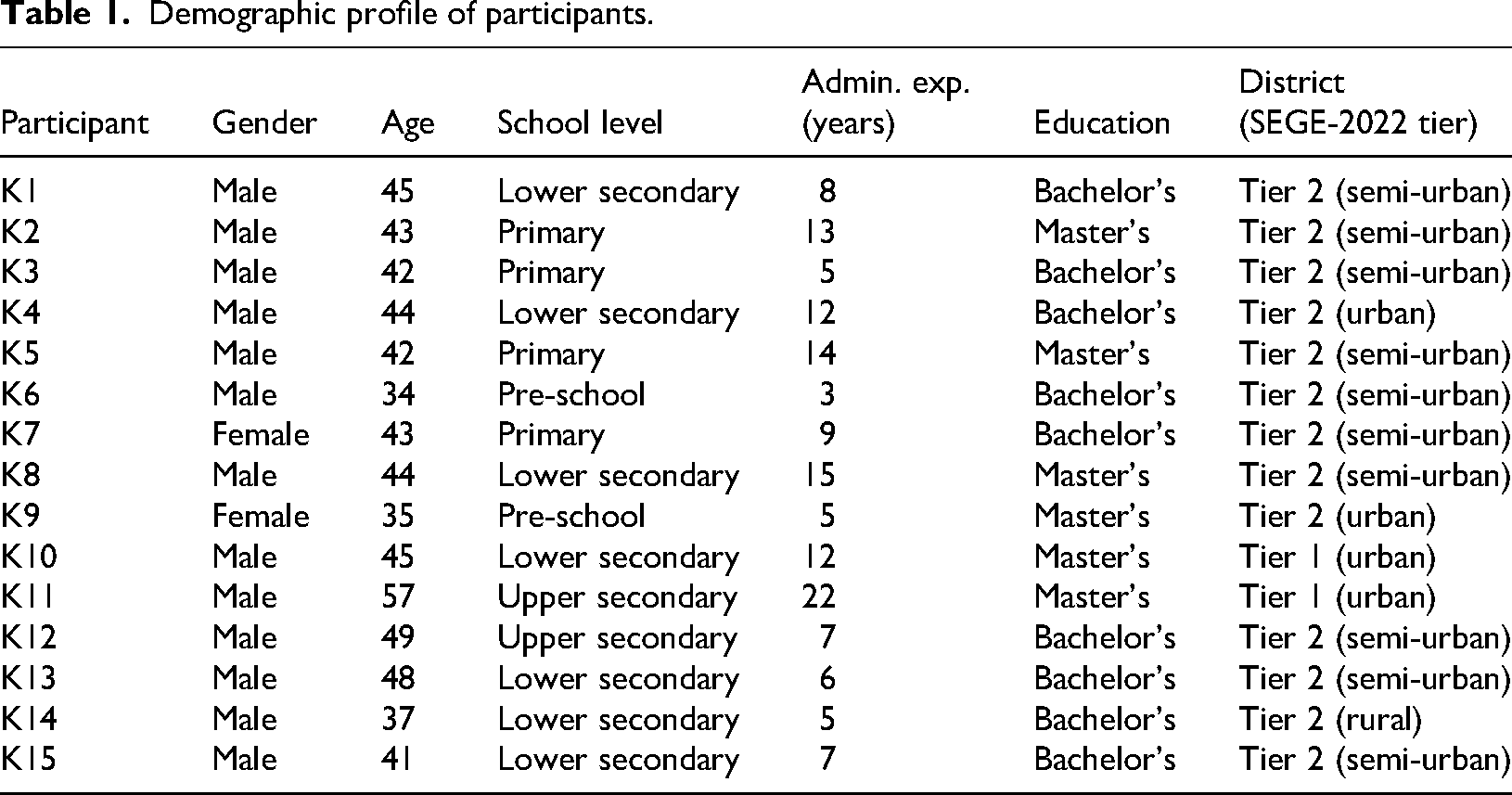
Participants were selected using purposive sampling with criterion and maximum variation techniques (Creswell and Creswell, 2023; Patton, 2015). Inclusion criteria required: (1) at least 3 years of principalship at the same school, (2) service in districts with varying socioeconomic characteristics, and (3) voluntary consent. Data collection and preliminary analysis proceeded simultaneously, guided by data saturation (Guest et al., 2006); thematic saturation was reached by the twelfth interview, and three additional interviews confirmed no new themes emerged (N = 15). Each principal was assigned codes K1 to K15. Participants served in three districts of Denizli province, classified by the Ministry of Industry and Technology's District Socio-Economic Development Index (SEGE-2022; Acar et al., 2022) as Tier 1 (n = 2) and Tier 2 (n = 13). Although these districts represent the upper development tiers within Denizli, the province itself spans Tier 1 to Tier 5 across its 19 districts. This concentration in relatively developed districts paradoxically strengthens the findings: if incomplete autonomy is experienced with such intensity in well-resourced settings, constraints are likely more severe in less developed contexts. The study group exhibited diversity in school level (pre-school: 2, primary: 4, lower secondary: 7, upper secondary: 2), administrative experience (3–22 years), age (34–57), educational attainment (bachelor's: 9, master's: 6), and gender (male: 13, female: 2). Table 1 presents the demographic profile.
Demographic profile of participants.
Data collection
Data were collected using a semi-structured interview protocol drawing on Lipsky's (2010) and Kim and Weiner's (2022) frameworks. Questions comprised scenario-based and open-ended items designed to elicit principals’ specific crisis moments, initiatives taken when facing legal obstacles, and sensemaking processes through Weick's (1995) plausibility principle (Creswell and Creswell, 2023). Expert review by two educational management academics preceded data collection; pilot interviews were subsequently conducted to validate the protocol.
Given the highly sensitive nature of the research topic, examining principals’ ‘creative insubordination’, ‘bending regulations’ and ‘informal initiative-taking’ that carry legal and administrative risk, audio recording devices were not used. This decision was empirically grounded in pilot study experience: both pilot participants explicitly stated they would not disclose informal practices if recorded, confirming that recording devices suppress candid responses in sensitive research contexts (Corbin and Strauss, 2008; Lincoln and Guba, 1985). To safeguard data quality, four systematic measures were employed: (a) real-time detailed field notes capturing verbatim expressions and contextual observations; (b) field notes expanded within 30 minutes post-interview; (c) expanded summaries sent to participants within 48 hours for respondent validation (all fifteen confirmed accuracy); and (d) analytical decisions documented through a MAXQDA audit trail (Kuckartz and Rädiker, 2019). Each interview lasted 45 to 60 minutes. Ethical approval was granted by the Social and Human Sciences Research and Publication Ethics Committee of Pamukkale University (decision no. 68282350/2025/03, dated 19 February 2025) and the study adhered to APA (2020) ethical standards.
Data analysis
Analysis employed Braun and Clarke's (2021) reflexive thematic analysis integrated with Moustakas's (1994) phenomenological analysis steps across five stages: (1) bracketing normative leadership assumptions through analytical memos (époché); (2) deep familiarisation treating each participant's statements with equal value (horizontalization); (3) open coding to identify meaning units reflecting lived experiences; (4) filtering codes through the conceptual framework via deductive analytical flexibility, yielding the three main themes detailed in the Findings section; and (5) following Moustakas's (1994) composite descriptions approach, transforming individual experiences into an integrated narrative revealing the structural essence of incomplete autonomy. MAXQDA software managed the analytical process and created an audit trail (Kuckartz and Rädiker, 2019).
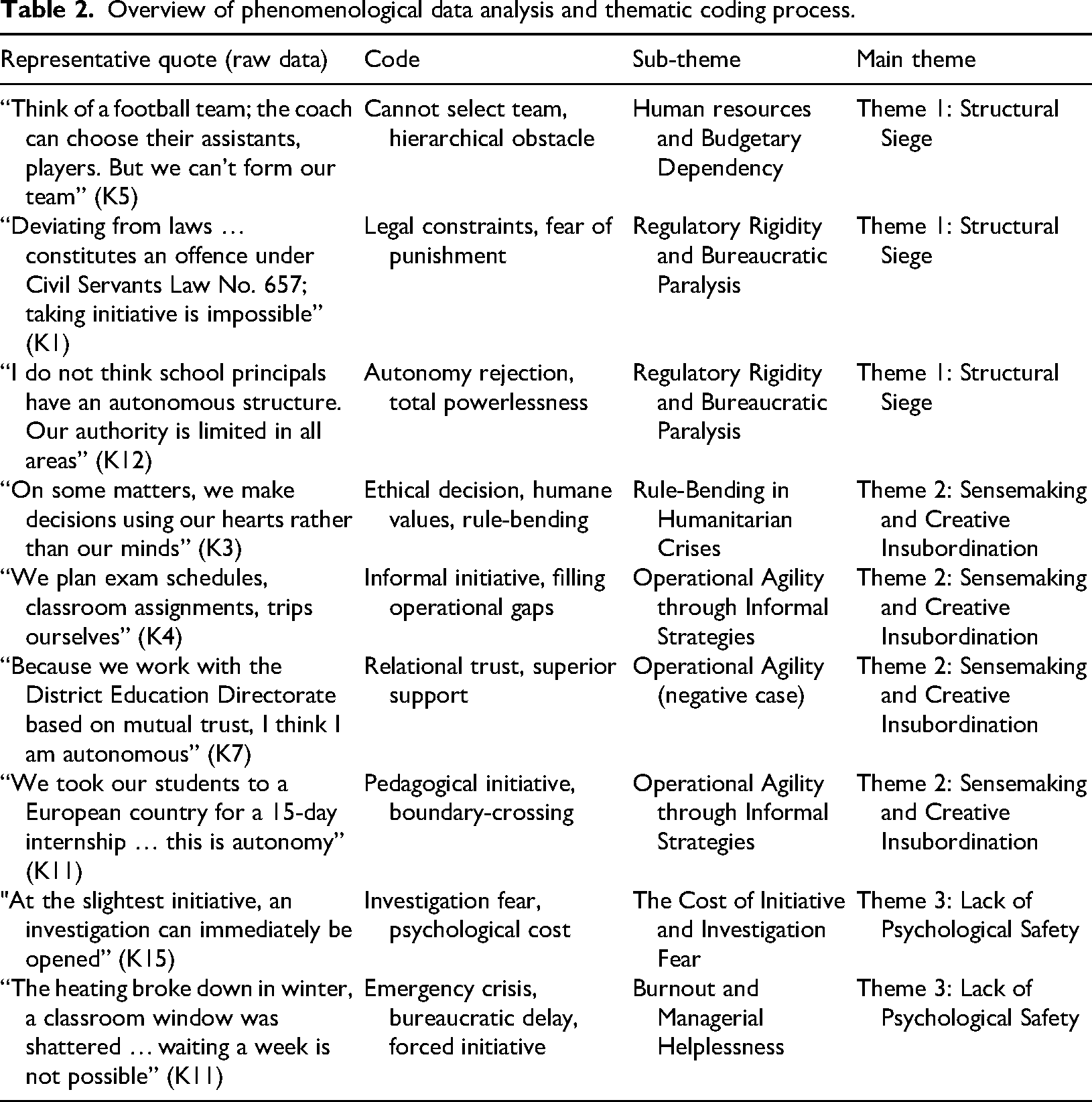
Table 2 presents an overview of the coding process, illustrating how representative participant quotes were progressively transformed into codes, sub-themes, and main themes.
Overview of phenomenological data analysis and thematic coding process.
Trustworthiness and researcher role
Methodological quality was ensured through Lincoln and Guba's (1985) criteria of credibility, transferability, dependability and confirmability. For credibility, interview summaries and preliminary findings were sent to participants for member checking (Creswell and Creswell, 2023). Expert review was obtained from a qualitative researcher during the code-to-theme transformation stage. A critical distinction must be underscored: Braun and Clarke (2021) epistemologically reject intercoder reliability in reflexive thematic analysis; the external researcher's role was to function as a critical friend, questioning thematic interpretations, suggesting alternative readings, and deepening the reflexive process (Smith and McGannon, 2018). Notably, this study deliberately privileges principals’ first-person lived experience, consistent with phenomenology's epistemological commitment to understanding a phenomenon from the perspective of those who experience it (Moustakas, 1994; van Manen, 1990); incorporating perspectives from other actors would have shifted the design toward case study or grounded theory, fundamentally altering its epistemological purpose. Transferability was ensured through thick description of the research context, participant characteristics and Türkiye's centralist bureaucratic structure (Geertz, 1973; Lincoln and Guba, 1985). For dependability and confirmability, all analytical decisions were documented through MAXQDA analytical memos (Braun and Clarke, 2021).
Regarding reflexivity, the researchers employed Moustakas's (1994) époché to bracket their positionality as academics within the normative leadership literature, preventing these assumptions from filtering principals’ lived experiences. The researchers’ lack of direct administrative experience within MoNE reduced the risk of identification with system insiders while potentially limiting comprehension of tacit practices on the ground (Berger, 2015). These tensions were subject to continuous self-questioning, recorded in the researcher diary (Braun and Clarke, 2021; Patton, 2015).
Findings
The findings are organised under three main themes, each grounded in the conceptual framework and analytical process described above.
Theme 1: Structural siege and the experience of incomplete autonomy
The first theme centres on the ontological conflict between the leadership role formally attributed to principals and their actual legal powerlessness in the field. Participants’ experiences reveal that they are street-level managers (Davidovitz and Schechter, 2024; Lipsky, 2010) compelled to operate within boundaries determined by the central bureaucracy.
Human resources and budgetary dependency. At the core of principals’ incomplete autonomy (Kim and Weiner, 2022) experience lies the inability to form their own teams or manage material resources. K5 articulated this through a striking metaphor: “Think of a football team; the coach can choose their assistants, players, physiotherapist. But we can’t form our team. Whichever staff the centre assigns to our school, we must carry on with them; we have no initiative to shape our team according to our vision. If we want to improve educational quality, we absolutely must have a say in forming our teams”. (K5)
A parallel sense of structural siege was equally evident in budget management. K1 described the deprivation: ‘Having no revenue as a rural school, with very limited allocations, renders us inadequate in many areas’. K2 concurred: ‘We are not sufficiently autonomous in financial matters. Decision-making and withdrawing funds for urgent school repairs takes a long time’ (K2).
Regulatory rigidity and bureaucratic paralysis. K14 captured the constraining effect succinctly: ‘The education system and the style of management tie the principal's hands’ (K14). K1 described the resulting paralysis: “Deviating from laws, regulations, and the curriculum constitutes an offence under Civil Servants Law No. 657; taking initiative on any matter is simply impossible for us”. (K1)
Theme 2: Sensemaking and creative insubordination under the grip of incomplete autonomy
Yet within this structural siege, the second theme reveals that principals are not entirely passive; they use their discretion through informal channels to sustain the school's daily operation. When central rules clash with urgent human or operational needs, principals invoke Weick's (1995) plausibility over accuracy principle, engaging in creative insubordination (Brieschke, 1985).
Rule-bending in humanitarian crises. Creative insubordination manifested most clearly when bureaucratic procedures proved too cumbersome for humanitarian crises. Principals abandoned the system guard identity and acted as citizen-agents (Maynard-Moody and Musheno, 2000). K10 described: “I allowed a teacher whose relative had a traffic accident to leave without waiting for formal procedures… Often, doing something takes less time than processing the bureaucracy for it”. (K10)
Operational agility through informal strategies. A critical analytical distinction must be drawn here: principals’ field initiatives are positioned along a continuum from legitimate discretionary space to creative insubordination where rules are consciously bent. K4 described the legitimate discretionary end: “We can plan exam schedules within the school ourselves… Language classroom arrangements, teacher-class assignments, sports activities, trips, parent meetings, I can take initiative on these”. (K4)
K13 summarised the macro–micro duality: ‘Directives from higher authorities are carried out, but when it's a school-internal matter, we can make decisions on our own initiative’ (K13). At the furthest end of the continuum, K11 demonstrated creative insubordination extending to long-term pedagogical initiatives: ‘At our vocational training centre, we took our students to a European country for a 15-day internship… this is autonomy’ (K11), autonomy constructed from below when not granted from above. The progression from K4's exam planning to K11's international programme corresponds to the routine and strategic dimensions of creative insubordination, respectively, confirming that the concept operates across analytically distinguishable registers of agency.
K4 further noted that initiative boundaries are shaped by superiors’ attitudes as well as the legal framework: ‘Whether one takes initiative depends on risk perception and the extent to which superiors support that initiative’, indicating that autonomy requires attending to organisational climate and relational trust, not only formal regulations.
A noteworthy finding concerns informal task-sharing with teachers. K9 stated: ‘Although the principal chairs the committee, all decisions are made jointly with the committee’ (K9), while K4 emphasised: ‘Success is teamwork. Strong leadership alone is not enough’ (K4). However – and consistent with the third pillar of the conceptual framework – this sharing represents not the democratic delegation envisaged by normative distributed leadership models (Spillane, 2006) but a pragmatic coping strategy to lighten an operational burden the principal cannot bear alone (MacBeath et al., 2012). Taken together, the practices documented across Theme 2 map directly onto the street-level management mechanisms identified in the conceptual framework: K10's emergency leave decision exemplifies rule adaptation; K1's resource deprivation (documented in Theme 1) and K9's informal personnel procurement reflect resource rationing and pragmatic workarounds, respectively; and K3's ‘decisions using our hearts’ and K11's pedagogical initiatives illustrate client-oriented prioritisation at its most expansive.
Theme 3: Lack of psychological safety and the bureaucratic vise
The third theme reveals the heavy psychological costs of principals’ creative insubordination efforts and initiative-taking, costs that remain structurally invisible yet operate as a powerful deterrent within the system.
The cost of initiative and investigation fear. Participants’ experiences reveal a deep deficit of psychological safety (Edmondson, 1999). The fear of being reported functions as an invisible barrier preventing many principals from utilising even the limited scope of action legally available to them. K15 articulated this bureaucratic vice: “In Türkiye, being autonomous is very difficult because laws are very restrictive, granting principals no room for manoeuvre. Everything is planned centrally and we are merely expected to implement. At the slightest initiative, at the slightest complaint, an investigation can immediately be opened. This inevitably pushes administrators away from taking risks”. (K15)
Burnout and managerial helplessness. Bureaucratic pressure depletes schools’ problem-solving capacity, as principals’ energy is spent completing procedures rather than exercising educational leadership. K6 expressed this exhaustion: “Reducing bureaucratic processes would speed things up and increase the school's productivity. I wish I could make decisions about professional development without getting caught up in procedures, and plan and implement the training that is needed”. (K6)
However, a notable exception to this general pattern emerged. K7, who established a trust-based relationship with superiors, expressed feeling autonomous unlike the vast majority of other participants: ‘Because we work with the District Education Directorate based on mutual trust, I think I am autonomous. Our director provides support rather than pressure in our working sphere, which enables me to use initiative’ (K7). This negative case suggests that autonomy is not solely a matter of legal authority; relational trust can transform even structural constraints (Edmondson, 1999). Yet K7's experience is contingent on an individual relationship, not a systemic guarantee; unless this trust becomes institutionally embedded, it is unlikely to create a sustainable autonomy climate.
In this prevailing climate of low psychological safety, autonomy is experienced not as empowerment but as heavy emotional labour (Hochschild, 2012) and managerial helplessness arising from trying to protect students and teachers under the constant threat of accountability. Creative insubordination keeps the school alive but depletes the administrator's psychological capital and lays the ground for burnout (Eranıl et al., 2026).
Discussion and conclusion
This phenomenological study critically intervenes in educational management literature dominated by normative heroic leadership myths (Collinson et al., 2018) by presenting the lived experiences of school principals under incomplete autonomy (Kim and Weiner, 2022) within a strictly centralised system. The discussion proceeds through three analytical lenses that directly correspond to the study's conceptual pillars and empirical themes: the structural roots of incomplete autonomy and agentic management (Themes 1–2; Pillars 1–2), the mechanics of creative insubordination as sensemaking (Theme 2; Pillar 4), and the psychological costs of navigating the bureaucratic vice (Theme 3; Pillar 4), before turning to the broader implications of the autonomy paradox for centralised systems globally.
Incomplete autonomy, agency and street-level management
Theme 1's central finding is that the football coach metaphor represents a vivid manifestation of incomplete autonomy. While traditional leadership models rest on Anglo-Saxon school-based management assumptions where principals can select staff and allocate budgets (Caldwell and Spinks, 1992; Leithwood et al., 2020; Nordholm et al., 2025), this study indicates that principals in this context are reduced to bureaucratic implementers whose scope of action has been structurally narrowed (Cansoy et al., 2025; Eranıl et al., 2026; Hammersley-Fletcher et al., 2021; Toprak et al., 2023). K4's occupational safety specialist example encapsulates the paradox in microcosm: responsibility without competence, accountability without authority.
However, principals are not entirely passive; they exhibit agentic management (Davidovitz and Schechter, 2024) by constructing de facto autonomy spaces through the system's interstices (Cribb and Gewirtz, 2007; Salokangas and Wermke, 2020; Wermke and Salokangas, 2021). This study extends Lipsky's (2010) street-level bureaucracy theory to hyper-centralised systems, suggesting that educational administrators rewrite policy on the ground amid structural impossibilities (Hupe and Buffat, 2014; Sanfuentes et al., 2026).
Beyond rules: The search for plausibility and creative insubordination
When a principal allows a teacher to leave for a family emergency without formal authorisation, this enacts Weick's (1995) plausibility over accuracy principle: full regulatory compliance would cause the system to seize up, so principals choose the pragmatic and morally defensible option, an ethical lubrication mechanism that prevents systemic collapse (Maynard-Moody and Musheno, 2012) rather than arbitrary rule deviation (Brieschke, 1985; Crowson and Porter-Gehrie, 1980; O’Laughlin and Lindle, 2015).
Critically, the findings introduce an important analytical nuance: principals’ field initiatives are positioned along a continuum from legitimate discretionary space (exam planning, trip organisation) to creative insubordination where regulations are consciously bent (unauthorised international internship programmes, emergency fund use without central approval). This continuum perspective enriches the binary framing prevalent in the existing literature by revealing the graduated and contextually negotiated nature of principals’ sensemaking. The three dimensions of creative insubordination are empirically confirmed: humanitarian crises triggered the moral dimension (K3, K10), long-term pedagogical projects reflected the strategic dimension (K8, K11), and everyday operational problem-solving constituted the routine dimension (K4, K13), each entailing different degrees of rule deviation and psychological costs.
Beyond the continuum of initiative, the findings also speak to the structural pervasiveness of incomplete autonomy across institutional levels: a pre-school principal (K6) and an upper secondary principal (K12) articulated virtually identical constraints, suggesting the autonomy deficit operates as a system-level phenomenon. The variation in creative insubordination behaviours (e.g. K11's proactive initiatives) appeared to relate more to individual seniority and professional disposition than to school level per se.
A notable negative case merits theoretical attention: a participant who established trust-based relations with superiors experienced herself as autonomous, unlike the vast majority of the sample. This finding suggests that relational trust (Edmondson, 1999) can transform structural constraints into enabling conditions. However, this trust bond remains contingent on an individual relationship; unless systemically embedded through organisational design, it is unlikely to create a sustainable autonomy climate, resonating with Nordholm et al.'s (2022) observation that the relationship between centralisation and principal autonomy is more complex than formal governance structures suggest.
This study's most original contribution is the empirical evidence that in this strictly centralised system, creative insubordination is not an exceptional aberration but a daily survival strategy keeping schools operationally functional (Cansoy et al., 2025; Sanfuentes et al., 2026). This extends Sanfuentes et al.'s (2026) Chilean longitudinal work in three respects: by examining permanent structural disempowerment rather than a temporary reform process; by revealing the lived experience dimension through a phenomenological lens; and by rendering visible the psychological costs – safety deficiency, emotional labour and burnout – that a behavioural focus did not capture.
Theme 3 extends this contribution by rendering visible a dimension that behavioural accounts of street-level management have consistently overlooked: the psychological cost structure of creative insubordination. The findings reveal that investigation fear (K15), CİMER-driven self-restriction (K3) and burnout-driven managerial helplessness (K6, K11) are not individual pathologies but predictable systemic outcomes of the incomplete autonomy impasse – precisely what the fourth pillar of the conceptual framework anticipated. K7's negative case is analytically instructive here: it demonstrates that the psychological safety deficit is not inevitable but contingent on relational and organisational conditions. That a single trust-based supervisory relationship was sufficient to transform the autonomy experience underscores the structural fragility of the system: wellbeing in this context depends not on systemic design but on the contingencies of individual relationships.
Global implications: The autonomy paradox and beyond
This cross-national resonance extends further: similar structural constraints have been documented in Malaysia (Bush and Ng, 2019) and Pakistan (Javed et al., 2026), suggesting that the autonomy paradox may represent a structural pathology common to centralised systems (Oplatka, 2004).
Türkiye, however, reveals a structurally more constrained variant of this paradox. Whereas principals in Anglo-Saxon systems possess at least some decision-making tools (Keddie, 2015; Wermke and Salokangas, 2021), principals here have been deprived of both tools and goals. Several context-specific features intensify this: the temporary designation system denying principals permanent administrative status; the CİMER citizen complaint mechanism enabling any parent to trigger a formal investigation with a single online submission; and a deeply embedded inspection culture discouraging initiative. All authority is concentrated at the centre, yet accountability falls on the individual principal (Cansoy et al., 2025; Kılınç et al., 2024; Toprak et al., 2023). Among the principals interviewed in this study, participants’ accounts suggest that where decision-making capacity is withheld yet accountability is maximised, the rhetoric of educational leadership may be experienced as an additional source of institutional pressure rather than empowerment (Eranıl et al., 2026; Friedman, 2002), fostering not innovation but fear and unconditional compliance (Ege et al., 2024; Levatino et al., 2024), and what Ball (2003) terms performative fabrication.
Conclusion
Viewed from the outside, principalship appears as a position of hierarchical authority; experienced from within, it constitutes an erosive buffering function (DiPaola and Tschannen-Moran, 2005; LeChasseur et al., 2018) caught between rigid bureaucratic demands and the field's pedagogical and human needs. The findings of this study suggest that principals in this context are not the boundary-transcending heroic leaders that normative literature claims (Collinson et al., 2018) but street-level managers who frequently risk their professional security to reach into the lives of students and teachers under severe incomplete autonomy (Davidovitz and Schechter, 2024; Lipsky, 2010). Their creative insubordination (Brieschke, 1985) is a struggle to make the voice of morality and plausibility heard when the centre loses touch with context (Weick, 1995). As Hallinger (2018) emphasises, leadership capacity cannot be built without bringing context out of the shadows. Accordingly, expecting visionary transformation from administrators deprived of decision-making tools while maximising their accountability is a romantic bureaucratic illusion (Keddie, 2015; Wermke and Salokangas, 2021).
While these findings emerge from a single national context and cannot be directly generalised to all centralised systems, the structural patterns identified in this study, including the asymmetry between accountability and authority, the reliance on informal strategies, and the psychological costs of creative insubordination, provide analytically transferable insights (Lincoln and Guba, 1985) for examining similar dynamics in other hyper-centralised educational contexts.
Limitations and future research
The interpretive epistemological foundations of this study should be considered; phenomenological findings do not claim to represent entire education systems (Cansoy et al., 2025). The male-dominant gender distribution (13 male, 2 female) largely reflects Türkiye's demographic structure, where female principals constitute only 7% of the total, compared to the OECD average of 47% (Beytekin and Yuce, 2023). The two female participants reported markedly different autonomy experiences, one describing trust-based autonomy through a supportive district director, the other experiencing the same structural constraints as the male majority, suggesting the gender–autonomy intersection in hyper-centralised systems warrants dedicated investigation. Future research employing purposive sampling across school levels could illuminate whether autonomy negotiation differs by institutional context. Furthermore, all participants served in Tier 1 to 2 districts (SEGE-2022; Acar et al., 2022); principals in less-developed rural districts (Tiers 3–5) may experience incomplete autonomy differently, and future research should explore these contexts. Audio recording could not be obtained due to the administrative risks inherent in examining creative insubordination; pilot participants confirmed they would not disclose informal practices if recorded. Although this limits the capture of some extended narratives (Patton, 2015), it was mitigated through real-time field notes, immediate post-interview expansion, respondent validation within 48 hours, and a complete MAXQDA audit trail (Creswell and Poth, 2018; Kuckartz and Rädiker, 2019). Future research should employ large-scale quantitative or mixed-methods designs, as well as multi-perspectival ethnographic studies examining how principals’ grey-area actions are interpreted by other system actors (Kim and Weiner, 2022; Sanfuentes et al., 2026).
Policy and practice implications
The findings necessitate restructuring educational policies in systems with similar structural characteristics, with reforms addressing field-level realities rather than normative rhetoric. First, legal protection mechanisms or a Good Faith Protocol should be developed to prevent principals’ plausibility-seeking initiatives from triggering administrative investigations, transforming control-based bureaucracy into a trust-based structure (Ansell et al., 2010). As expressed through the concept of controlled autonomy (Weiner and Woulfin, 2017), local initiative spaces can be integrated within central governance: creating flexible school budget expenditure items or allocating a proportion of teacher appointments to school-level selection could alleviate the coach-without-a-team impasse (Cansoy et al., 2025). Current accountability regimes should evolve from punitive compliance-checking toward intelligent accountability (O’Neill, 2013) that supports administrators’ risk-taking for student benefit.
Second, formal administrator-to-administrator mentoring networks should be established to prevent principals from becoming isolated in their street-level management crisis and experiencing deep emotional exhaustion (Eranıl et al., 2026). Such networks would facilitate information-sharing about navigating bureaucratic obstacles and strengthen the psychological safety administrators most urgently need (Browne-Ferrigno and Muth, 2004; Edmondson, 1999). The negative case identified in this study, where relational trust with superiors transformed the autonomy experience, underscores that institutional trust-building, rather than merely regulatory reform, may be the most powerful lever for sustainable leadership capacity.
Footnotes
Acknowledgements
An earlier version of this study was presented as an oral presentation at the EJER Congress 2024.

Ethical considerations
Ethical approval for this study was granted by the Social and Human Sciences Research and Publication Ethics Committee of Pamukkale University (decision no. 68282350/2025/03, dated 19 February 2025). Informed consent was obtained from all participants prior to data collection.
Consent to participate
Informed consent was obtained from all participants involved in the study prior to data collection.
Funding
The authors received no financial support for the research, authorship, and/or publication of this article.
Declaration of conflicting interests
The authors declared no potential conflicts of interest with respect to the research, authorship, and/or publication of this article.
Data availability statement
The data supporting the findings of this study are available from the corresponding author upon reasonable request.
Author identifying information
All identifying information related to the authors and their institutions has been included only in this title page to ensure anonymized peer review.