







Abstract
Although leadership has been extensively studied, relatively little is known about the behavioral shifts that newly appointed leaders experience during role transitions. This study explores the lived experiences and motivations underlying such shifts among newly appointed university leaders in Tanzania, using the Theory of Planned Behavior as a theoretical lens. An interpretative phenomenological analysis was conducted with six leaders appointed within the previous three years at two public Tanzanian universities. Data were collected through semistructured interviews and analyzed using Clarke and Braun's six-phase thematic framework. The analysis identified five interconnected factors driving participants’ behavioral shifts: new role expectations and requirements, shifting priorities from individual to institutional growth, the need for control and authority, tone-setting and standards, and the disparity between prior abilities and new leadership responsibilities. These shifts varied systematically by leadership level (QA Directors, College Principals, and Heads of Department), reflecting differences in subjective norms and perceived behavioral control within resource-constrained, hierarchical contexts. They underscore the importance of rigorous vetting, structured succession planning, seniority considerations, performance-based selection, and targeted mentoring/induction programs to support smoother transitions in sub-Saharan African higher education.
Keywords
Introduction
Leadership remains one of the most discussed aspects of the higher education system (Dopson et al., 2019). Numerous issues in higher education stem from academic and organizational leadership (Pani, 2017). Many studies have investigated leader behavior in the realm of organizational leadership to ascertain what successful leaders do (Kaluza et al., 2020), particularly how leadership transitions influence followers (Li et al., 2020), leaders’ personalities (Li et al., 2021), and the challenges they pose to new leaders (Falls and Allen, 2020), They have overlooked the behavior of newly appointed leaders when they take charge (Hernandez Ibar et al., 2025). In this context, leadership literature lacks sufficient information about the behaviors of newly appointed university leaders as they assume their roles and the motivations behind their actions. While the broader Educational Management Administration and Leadership literature has examined leadership in African educational contexts (Hallinger, 2018; Zuze and Juan, 2020), research on intrapersonal behavioral shifts during leadership transitions remains limited. These intrapersonal processes complement, rather than replace, the structural and practice-oriented frameworks dominant in Educational Leadership and Management (ELM) scholarship. For example, distributed leadership (Lumby, 2019; Mifsud, 2024) and instructional leadership (Liu et al., 2021; Shaked, 2023) emphasize shared practices, decision-making, and organizational outcomes. However, they pay limited attention to the individual cognitive and motivational adjustments that occur at the precise moment of the first transition to a promotional role, which is the focus of the present study. By illuminating these microlevel behavioral shifts through the Theory of Planned Behavior (TPB), this study responds to calls for greater attention to individual role transitions within the ELM, particularly in sub-Saharan African higher education contexts (Bush, 2022; Hallinger and Kovačević, 2022), by investigating how newly appointed leaders behave and why they do so after transitioning from nonleadership to leadership roles. This transitional process is referred to as a behavioral shift, which, according to Tasselli et al. (2018), is viewed as a temporary or permanent change in an individual's behavior compared to previous patterns, often contextual and contingent on role demands (Furr and Funder, in press; Kelemen et al., 2020). In this study, behavioral shift was conceptualized as a temporary context-contingent adjustment during leadership transitions, distinct from long-term personality transformations, although it may evolve into the latter if left unaddressed (McClean et al., 2019).
Some studies have linked behavioral shifts with changing environments, including a shift from traditional command-and-control styles to more collaborative or flexible approaches (Sary et al., 2024). During role transitions, new leaders may be tempted to assert themselves by acting differently (Sy and McCoy, 2014) or feel pressured to adopt behaviors that are more aligned with their new roles (Li et al., 2021). While relatively modest changes in the quantity and focus of a leader's behavior may be anticipated and accepted by followers, newly appointed leaders may unintentionally disrupt their relationships with their teams by behaving noticeably differently from the outset (Suurd Ralph and Barling, 2022). A new leader's behavioral shift may be perceived as inaccurate or unnoticed, thus having little effect on how the leader is perceived. This is because automatic cognitive processes favor efficiency over granularity when processing information (Lord et al., 2020) unless there is clear motivation and a personal benefit for the observer to direct their attention to more detailed behavioral information (Schunk and DiBenedetto, 2020). Previous studies have indicated frequent fluctuations in leader behaviors (Kelemen et al., 2020), confirming that while traits may influence average behavior, varying situations, events, and contexts drive intrapersonal changes in behavioral patterns (Furr and Funder, in press). Although such behavioral shifts may be necessary and occasionally desirable (McClean et al., 2019), evidence suggests that overall consistency in within-person behavior rather than change is advantageous for a range of leadership outcomes (Matta et al., 2017; Suurd Ralph and Barling, 2022), including perceived leadership effectiveness. Research on behavioral shifts is limited to newly appointed leaders’ roles; thus, the implications of behavioral shifts when assuming a new leadership role are not fully understood, despite leader role changes being a common occurrence in specific contexts such as self-managing teams (Adriasola and Lord, 2019; Lord et al., 2020). This study contributes to the literature in two ways: First, it provides a theoretical explanation for why behavioral changes occur when taking up a leadership role, particularly regarding first promotions, utilizing the TPB as an underpinning framework to predict and interpret shifts through attitudes, norms, and control. Additionally, while much is known about the significance of leadership behaviors in various leadership styles (MacLaren et al., 2020), this is the first study to explore how newly appointed university leaders behave and why they act as they do. Finally, the study employed a phenomenological research design to investigate the reasons for the behavioral shift from nonleadership to leadership. The chosen method enables the audience to better understand when a behavioral shift is most likely to occur, and how it affects organizational effectiveness. Moreover, this study suggests an innovative approach to mitigate the negative behavioral shifts of newly appointed leaders, thereby improving institutions and followers while maintaining a healthy working environment.
Theoretical lens
Several leadership theories have been applied in educational settings, including distributed and instructional leadership, which are prominent frameworks in the field of ELM (Liu et al., 2021; Lumby, 2019; Mifsud, 2024; Shaked, 2023). These approaches primarily address ongoing shared practices, decision-making processes, and organizational and teacher outcomes rather than the individual cognitive and motivational processes that occur at the precise moment of the first promotion role transition. For example, studies by Kinnunen et al. (2024) and Bush (2022) revealed the dominance of concepts such as academic, distributed, educational, and transformational leadership, with limited attention paid to individual role transition processes in higher education contexts, particularly in sub-Saharan Africa (Hallinger and Kovačević, 2022). Thus, this study deliberately used the TPB to examine behavioral shifts among newly appointed leaders in Tanzanian universities.
According to Ajzen and Fishbein (2005) and Bosnjak et al. (2020), intention-shaped behaviors are influenced by attitudes, subjective norms, and perceived behavioral control. External factors can also directly facilitate or inhibit behavior, irrespective of purpose, depending on the extent to which the individual controls behavior and the accuracy of perceived behavioral control in representing actual behavioral control. The TPB confirms that human beings act rationally, guided by their attitudes, subjective norms, and perceived behavioral control (Conner, 2020). These factors may not be consistently active or conscious during decision-making; however, they can lay the groundwork for decision-making. This study seeks to uncover the underlying values and ideas that shape decision-making and drive behavioral shifts among new leaders in universities. The rationale for using TPB is grounded in the factors that drive decisions that lead to behavioral changes. To clarify and make it more specific to leadership transitions in constrained environments such as resource-limited Tanzanian universities, the TPB, with its three core components, is presented as follows: Attitudes, as the core element of TPB, are an individual's positive or negative evaluation of performing a behavior shaped by beliefs about its outcomes (Ajzen, 1991). In this study, new leaders’ attitudes were shaped by role shifts, which are often influenced by anticipated benefits, including organizational success. Subjective norms encompass perceived social pressures from significant others (e.g., colleagues and administrators) and the motivation to comply with these pressures (Bosnjak et al., 2020). In this study, university leaders were expected to adopt authoritative behaviors that reflect cultural norms in hierarchical Tanzanian institutions in which collectivism may amplify group pressure. Perceived behavioral control (PBC) refers to the simplicity or difficulty of enacting behaviors due to internal (e.g., skills) and external factors (e.g., resources, obstacles) (Ajzen and Fishbein, 2005). In the context of this study, in Tanzanian universities, where budgets and administrative support may be limited, the PBC highlights how leaders perceive control over actions amid incomplete volitional control, such as navigating unfamiliar responsibilities without adequate training, which results in disparities between their prior abilities and new duties. External constraints (e.g., time shortages) reduce perceived self-efficacy.
Although many strengths of TPB can be utilized, it has been criticized for its emphasis on rational choice, which may overlook nonrational influences such as emotions and cultural contexts (Thomas, 2025). The TPB assumes that individual’s act primarily based on deliberate evaluations of attitudes, norms, and control; however, this may undervalue unconscious or affective drivers, such as emotional responses such as excitement or anxiety during leadership transitions, which can shape behaviors implicitly rather than through explicit intentions. In emotional contexts, affect can serve as a background factor that influences beliefs. However, TPB does not fully integrate these background factors into its framework.
Culturally, the TPB's individualistic focus limits its applicability to collectivist societies. For example, leaders may change their behaviors not only because of perceived control but also because of emotional and cultural pressures, such as the fear of social ostracism. To mitigate these limitations, this study interprets the findings through TPB, allowing for emergent emotional and cultural themes. Future extensions could incorporate affective predictors for greater cultural sensitivity (Conner, 2020).
Context of the study
This study was conducted in Tanzania, and six new university leaders were selected, with three from each university. Universities were selected based on similarities in their organizational structures and leadership hierarchies. Therefore, insights gained from these institutions will be invaluable and serve as a model for other universities with similar characteristics. University leadership was chosen as an area because of the response to the gap identified by Hernandez Ibar et al. (2025), who studied intrapersonal behavioral shift in temporary leadership role transition and its effect on perceived leadership effectiveness, and recommended that further research should seek to replicate the findings in more naturalistic organizational settings with permanent or emerging leaders. This study was designed to investigate the behavior of new university leaders in raising awareness of the fundamental reasons for their behavioral changes after assuming leadership.
Method
This study examines the reasons behind these behavioral changes by utilizing the planned behavior theory to enhance the audience's understanding of the issue. An interpretative phenomenological approach (IPA) was adopted, focusing on participants’ lived experiences to ascertain the causes of these behavioral shifts. The IPA was employed to delve into the subjective, lived experiences of newly appointed leaders regarding their behavioral shifts, providing an idiographic focus on how they make sense of these changes in their personal and professional contexts (Smith, 2017). The IPA is particularly suited to this study, as it emphasizes double hermeneutics, the researcher interpreting participants’ interpretations, allowing for a deeper understanding of phenomena such as role transitions that are inherently personal and contextual. This approach complements thematic analysis by prioritizing experiential meanings, ensuring that the analysis remains grounded in participants’ perspectives rather than purely theoretical constructs. The IPA was integrated with Clarke and Braun's (2017) six-step framework, in which the initial familiarization and coding phases incorporated phenomenological bracketing to suspend preconceptions and enhance the interpretative depth of theme generation and review. The data collection method employed was an in-depth interview, chosen for its effectiveness in gathering rich, detailed data that enabled an in-depth exploration of complex issues and participants’ perspectives. This method also facilitates rapport building, enables the researcher to adapt questioning to the flow of conversation, enhances the validation of findings, and provides deeper insights by capturing subjective perspectives and experiences related to the issue under investigation. Interviews were conducted face-to-face, yielding profound insights from interviewees’ perspectives and experiences.
Purposive sampling was employed to select two QA Directors, two College Principals, and two heads of department (HoDs) from two public universities with comparable organizational structures and leadership hierarchies. Participants were chosen because they had been appointed within the last three years (ensuring “newly appointed” status), represented three distinct leadership levels (QA Directors focus on institutional standards, principals oversee college-wide strategy, HoDs manage day-to-day departmental operations), and were willing to openly discuss sensitive behavioral changes. Other recently appointed leaders were omitted if they exceeded the three-year threshold. This sampling strategy provided maximum variation across roles while maintaining homogeneity within the institutional context, enabling meaningful comparisons of behavioral shifts across leadership levels.
The sample size of six participants was deliberately small and homogeneous, in keeping with the idiographic commitments of IPA. The IPA prioritizes the depth of understanding and nuanced, case-by-case analysis of lived experience over breadth, making a relatively small, carefully selected sample both appropriate and powerful for generating rich insights (Smith et al., 2022). Samples of this size (typically 4–10 participants) are common in published IPA studies in educational leadership and higher education contexts because they enable detailed double hermeneutic interpretation while allowing sufficient variation to identify patterns of convergence and divergence (e.g., Ganly et al., 2022; Marais, 2022; Noon, 2018; Wiggins, 2017). In this study, the six participants offered maximum variation across three distinct leadership levels (QA Directors, College Principals, and HoDs) while maintaining homogeneity in key contextual factors: recency of appointment (within the last three years), public university setting in Tanzania, and comparable institutional structures. Data saturation was achieved by the fifth interview, with the sixth interview confirming that no new themes or patterns had emerged. This sample enabled an in-depth exploration of the underresearched phenomenon of intrapersonal behavioral shifts during the first promotion transitions in a resource-constrained sub-Saharan African higher education environment. Although larger samples or mixed methods are valuable in other paradigms, they are neither necessary nor optimal for IPA's experiential and contextual focus, particularly when studying sensitive self-reported behavioral changes among senior academic leaders.
Braun and Clarke's six steps were used to analyze the data. Themes were derived using Braun and Clarke's (2017) six-phase framework interpretatively: (1) Familiarization involved repeated transcript readings and note-taking; (2) Initial codes were generated inductively (e.g., ‘role mismatch’ from mentions of skill gaps); (3) Codes combined into candidate themes (e.g., grouping ‘expectations’ codes under ‘new requirements’); (4) Themes reviewed iteratively against data for coherence; (5) Themes defined/refined for significance (e.g., linking to TPB); (6) Findings reported thematically with interpretative commentary.
Credibility and trustworthiness were enhanced in line with the IPA principles through several reflexive procedures. Member checking was conducted by sharing summaries of emergent themes with all participants; four participants offered minor clarifications, which were incorporated into the final analysis. Emergent patterns were also cross-checked against the participants’ demographic and role information (Table 1) to identify convergence and divergence across leadership levels. The researcher maintained a reflexive journal to document and bracket the preconceptions throughout the research process. In keeping with IPA's idiographic nature, credibility was strengthened through member checking and reflexive procedures, rather than traditional triangulation across data sources. The small sample size (n = 6) and focus on two similar institutions mean that the findings are context-specific. Future research should incorporate follower perspectives, observational data, or documentary analysis to complement these self-reported accounts.
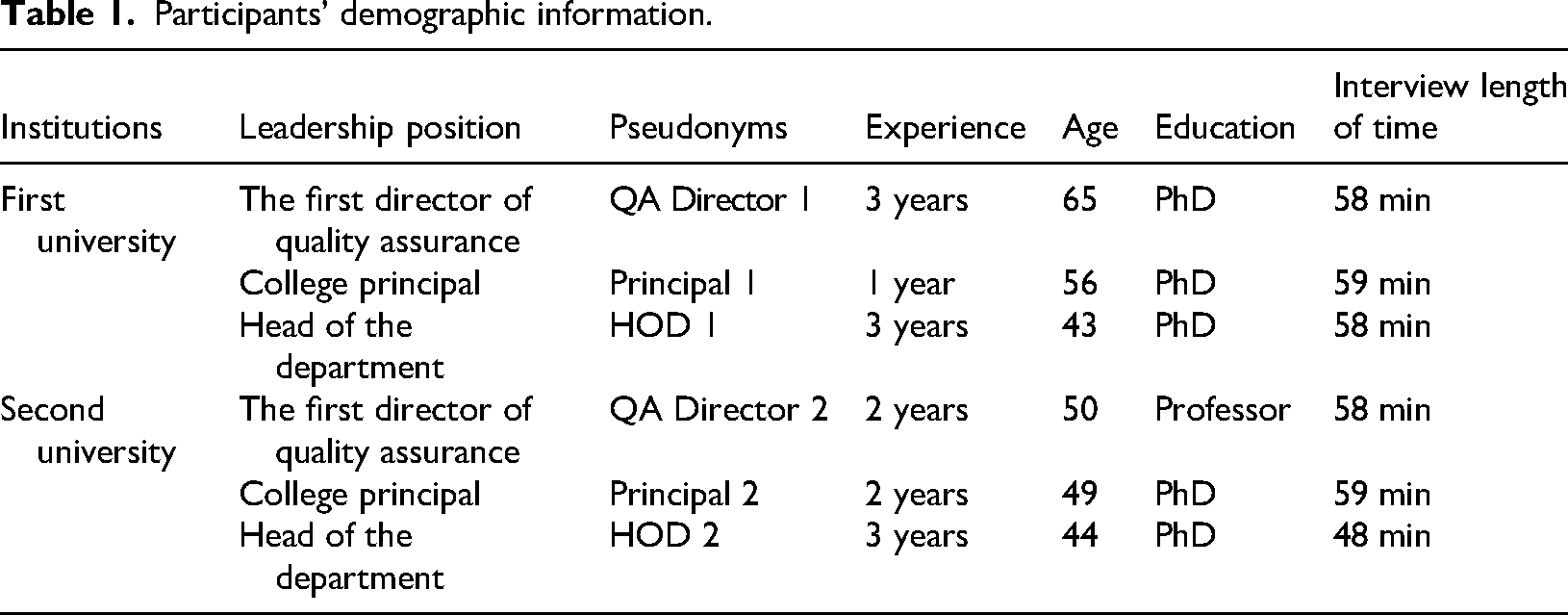
Participants’ demographic information.
Ethical consideration
All ethical procedures involving human participants adhered to the standards, and the Ethics Committee approved the research permit from the authorized university. A consent form was provided to the participants to obtain their consent and ensure their free will, while respecting their autonomy. Once accepted, participants were required to sign a consent form. A pseudonym was assigned to protect participants’ identities and maintain confidentiality throughout the investigation. Each interview was recorded on an audio tape recorder with participants’ consent from start to finish, and subsequently transcribed for analysis.
Results
Before exploring the central research question, the investigation assessed participants’ demographic details to determine whether they aligned with the study objectives and research focus. A thorough analysis revealed that participants’ demographic information, such as leadership position, work experience, and maturity level in terms of education and age, aligned with the study objective. For more details, see Table 1.
The results indicate that the participants were correct informants because they were new leaders in their current positions. Most participants had 3 or fewer years of experience, indicating they were new to their positions. Thus, they possess the knowledge and expertise required to provide valuable insights into the issue under investigation.
The primary goal of this study is to investigate why newly appointed university leaders behave differently immediately after assuming office. This study question was motivated by the need to understand why they changed their behavior, which they had not previously exhibited. After assuming a leadership role, the participants were asked how they felt about themselves. Were they acting in the same manner as before, or had things changed? What caused them to change their behavior? What makes them different is their status and jobs. These were interview questions, and precise responses were provided as narration. A thorough analysis revealed several causes, including discrepancies between skills and duties, new demands and expectations, changing priorities, demands for authority and control, and setting tone and standards. The details of these findings are provided below:
New expectations and requirements
Participants described adjusting their behavior to meet the new challenges, responsibilities, and performance pressures of their new roles. For example, Principal 1 from the first university affirmed this: … I was given a list of new roles encompassing leadership, administration, and academic oversight … Managing the college's operations, budget, and staff while also promoting academic excellence and student success … honestly transformed my approach from being a friendly person to a more task-oriented one … (Principal 1, Interview, June 2024).
Principal 2 echoed this view, noting that the institution's standards and expectations outlined in the appointment letter required immediate behavioral alignment: I would fail miserably as the leader of the entire organization unless I immediately changed my behavior. When I was not in charge, I was not held to the same standards as other leaders and had fewer leadership obligations. Meanwhile, my performance was in service of bolstering the institution's efficiency. Recently, the roles have changed. As stated in my appointment letter, the institution's standards and expectations are mine to fulfill. Consequently, I must change to satisfy everyone's demands (Principal 2, Interview June 2024).
The analysis went beyond verifying whether their behavior before becoming leaders was favorable or unfavorable and examined how their new role required them to change. What are the true behaviors of these leaders before taking the helm? Several responses have been reported; however, a notable response from principal 2 highlights this point. She made clear that Existing personal behavior significantly influences appointing authorities’ perceptions of non-leaders’ known behavior prior to assuming their roles. Nonetheless, job responsibilities can further shape a leader's conduct and actions over time (Principal 2, Interview June 2024).
The findings indicated that behavioral shifts were influenced by new roles assigned to leadership positions, suggesting that job roles, rather than personal choices, caused behavioral changes. These findings indicate that leaders can simultaneously exhibit dual behavior in job and nonjob performance, which may jeopardize organizational effectiveness if the prevailing behavior is not adequately analyzed, assessed, or monitored. More precisely, at the leadership level (e.g., Principal 1 and Principal 2), they emphasized broader institutional expectations, such as budget management and promoting excellence, which led to a shift toward task-oriented behaviors to align with high-level stakeholder norms. In contrast, HoDs (e.g., HoD 1 and HoD 2) highlighted department-specific pressures such as daily oversight, which amplified perceived difficulties in adapting without disrupting team dynamics. QA Directors (e.g., QA Director 1 and QA Director 2) focused on standard settings, showing moderate shifts influenced by cross-institutional visibility. These differences suggest hierarchical variations in TPB elements: stronger subjective norms for principals due to wider accountability and lower perceived behavioral control for HoDs in resource-constrained operational roles.
Shifting priorities from individual growth to institutional growth
New leaders frequently redirected their focus, time, and energy from their personal development to institutional goals. HOD 1 explained: Initially, I was concerned about my well-being … but things have changed. I no longer behave the same way; my behavior, attitude, thoughts, energy, and time are now dedicated to the institution's growth (HOD 1, Interview, June 2024).
HOD 2 similarly described spending most of his time on leadership duties at the expense of personal research. Immediately after being appointed head of the department, everything changed. I spent most of my time in the office, fulfilling leadership responsibilities and struggling to find time for research that could advance my career. As I have no choice, I must adapt to this new way of life for the interests and development of my institution (HOD 2, Interview June 2024).
These findings indicate that new leaders change their behaviors primarily because they must shift their focus from individual to institutional priorities. Their mindsets, actions, and practices are devoted to institutional growth. Consequently, the adjustment of their behavior was unavoidable.
The need for control and authority
Several participants intentionally adopted more authoritative behaviors to establish influence and ensure compliance. QA Director 1 stated: I occasionally change my tone when giving orders to indicate the seriousness of the instruction … giving orders with a smile and a friendly demeanor … diminishes the authority and power of the instruction (QA Director 1, Interview, June 2024).
QA Director 2 emphasized the importance of quickly establishing a tone of authority to prevent chaos. To help my followers understand my leadership style, I swiftly establish a tone of authority and set clear standards. If this is not executed promptly, the leadership process could become chaotic. Therefore, my actions from the outset of my interactions with my followers have contributed to achieving the organisation's objectives (QA Director 2, Interview, June 2024).
The above findings indicate that new leaders alter their behavior after assuming command to exercise the authority and power conferred by their leadership positions. This was done intentionally to ensure compliance with instructions issued to their followers.
Tone-setting and standards
Closely related to authority, the participants described intentional behaviors that they used early in their tenure to set organizational tone and standards, such as adjusting their tone of voice, gestures, or directives to convey seriousness and expectations. This was evident in the responses, which emphasized the need to establish clear norms to prevent chaos and achieve objectives.
Distinguishing by level, QA Directors (e.g., QA Director 1) highlighted changes in instruction tone to ensure compliance, reflecting subjective norms in TPB, where perceived expectations demand immediate signaling of standards. For instance, QA Director 1 noted that adjusting the tone when issuing orders was necessary to underscore authority because a friendly demeanor might undermine the efficacy of instructions (QA Director 1, interview, June 2024). Principals (e.g., Principal 2) emphasized the importance of swift tone setting to establish leadership styles, stating that the early establishment of standards prevents disorganization (paraphrased from an interview, June 2024). The HoDs showed less emphasis here, possibly because closer team dynamics require relational rather than authoritative ones. This theme illustrates how tone-setting bridges control needs with cultural expectations in constrained Tanzanian university environments, and moderates behavioral shifts through perceived behavioral control.
The disparity between prior abilities and new leadership responsibilities
Participants highlighted a mismatch between their previous experiences and the demands of their new roles. Principal 2 reflected: Upon beginning my role as a college principal … I have come to understand that my previous experience, skills, and attributes do not match the current job positions. Consequently, I needed to shift from a more directive approach to a collaborative one … (Principal 2, Interview, June 2024).
These findings illustrate how role demands prompt intentional behavioral adjustments among newly appointed leaders.
Additionally, when comparing interviewees’ responses across the theme of institutional expectations and requirements through the TPB elements, specific patterns emerged. Attitudes toward new roles were generally positive, as reflected in Principal 1's shift, which enabled a task-oriented approach that met institutional goals and reflected favorable evaluations of leadership outcomes. Subjective norms were prominent in the pressures from stakeholders, with Principal 2 noting that expectations outlined in appointment letters drove behavioral alignment. The PBC emerged as a key differentiator in constrained environments. The HoD 1 reported a lower PBC owing to time constraints for personal research, highlighting perceived difficulties in resource-limited settings, whereas QA Director 1 reported a higher PBC through collaborative adaptations. This comparison highlights how PBC mitigates shifts in underresourced universities, with HoDs exhibiting greater vulnerability to external constraints than do higher-level leaders.
Discussion
The analysis revealed five interconnected factors driving behavioral shifts among newly appointed university leaders in Tanzania: new role expectations and requirements; shifting priorities from individual to institutional growth; the need for control and authority; tone-setting and standards; and the disparity between prior abilities and new leadership responsibilities. These findings align closely with the TPB, which posits that attitudes, subjective norms, and perceived behavioral control shape behavioral intentions and actions (Ajzen, 1991; Ajzen and Fishbein, 2005; Bosnjak et al., 2020). The results demonstrate how role demands in resource-constrained, hierarchical Tanzanian universities activate these TPB components, prompting intentional behavioral adjustments during first promotion transitions. These intrapersonal processes complement rather than replace the predominantly structural and practice-oriented frameworks in ELM scholarship. While distributed leadership (Lumby, 2019; Mifsud, 2024) and instructional leadership (Liu et al., 2021; Shaked, 2023) emphasize shared practices, collaboration, and organizational outcomes, they pay limited attention to individual cognitive and motivational adjustments that occur at the precise moment of role transition (Bush, 2022; Hallinger and Kovačević, 2022). By illuminating these microlevel shifts through a TPB lens in a sub-Saharan African context, this study responds to calls for greater focus on individual role transitions within the ELM (Hallinger, 2018) and extends prior work on leadership in African educational settings (Zuze and Juan, 2020).
New role expectations and requirements have emerged as the primary drivers. Participants consciously aligned their behavior with the heightened responsibilities and performance standards outlined in their appointment letters. Principals facing broad institutional accountability shifted toward task-oriented behaviors, reflecting strong subjective norms. The HoDs experience more operational pressures and lower perceived behavioral control due to resource constraints and closer team dynamics. These patterns illustrate how external role demands shape attitudes and intentions, consistent with the TPB (Conner, 2020) and earlier observations that new leaders must rapidly adapt to changing institutional requirements (Ζαρκαδούλα, 2024).
Shifting priorities from individuals to institutional growth represents a profound reorientation. Many participants, particularly HoDs, reported redirecting their time and energy away from personal research and career advancement toward institutional goals. This role identity shift from individual contributor to institutional leader mirrors the findings of Maurer and London (2018) and Ford et al. (2017), who described incremental to radical transformations in role identity during leadership transitions. Within the TPB framework, such changes reflect altered attitudes toward behavioral outcomes, where institutional success becomes the dominant evaluative criterion.
The need for control and authority, coupled with tone-setting and standards, prompted participants, especially QA Directors and Principals, to adopt more directive communication styles early in their tenures. Adjusting the tone, gestures, and seriousness of instructions served to establish credibility and prevent chaos. These behaviors operationalize subjective norms and positional power, aligning with research showing that early norm setting influences follower perceptions and organizational outcomes (Razak et al., 2018). They also reflect the temporary authoritative shift often required before more collaborative or distributed practices can take root (Adriasola and Lord, 2019; Sy and McCoy, 2014).
The disparity between prior abilities and new leadership responsibilities was a recurring source of adaptive pressures. Several leaders noted that the skills honed in teaching, research, or consultancy proved insufficient for administrative demands, leading to behavioral adjustments, such as moving from directive to collaborative styles. This finding resonates strongly with the literature on the Peter Principle (Benson et al., 2019; Elazier and Strohschen, 2023; Ghinea et al., 2019) and longitudinal evidence of personality and behavioral changes upon assuming leadership roles (Asselmann et al., 2023; Li et al., 2021). This underscores the limitations of assuming that prior performance predicts leadership success and highlights the importance of perceived behavioral control in TPB.
Clear variations have emerged across leadership levels, extending prior role transition research (Maurer and London, 2018). The HoDs exhibited more pronounced shifts in priority and greater vulnerability to resource constraints (lower PBC). Principals responded to stronger subjective norms from stakeholders with authority-focused adaptations. QA Directors showed more balanced shifts centered on standards and tone setting. These hierarchical differences illustrate how leadership level moderates TPB components in collectivist and hierarchical contexts, and align with recent IPA studies on leadership competencies and identity development (Aquino et al., 2025; Marais, 2022; Martin, 2022).
The proposed solutions, rigorous vetting, structured succession planning, seniority considerations, and performance-based selection, directly address the identified root causes. Targeted mentoring and induction programs can bolster perceived behavioral control, reduce negative shifts, and support smoother integration (Dopson et al., 2019; Maurer and London, 2018). However, universities must balance these with inclusive strategies to avoid disadvantaging early career academics, women, and underrepresented groups, thereby advancing Sustainable Development Goal 4.
This study contributes to leadership literature by explaining why newly appointed leaders exhibit behavioral shifts beyond what traditional training anticipates. University administrators should consider: (1) How well do candidates’ prior skills align with their role demands? (2) What mechanisms support the transition from individual priorities to institutional priorities? (3) How can early authorities be balanced through collaborative approaches? (4) What succession plan prepares candidates for these inevitable shifts? By grounding in the analysis of participants’ lived experiences and TPB, this study offers both theoretical extension and practical guidance for higher education contexts.
Conclusion
This study suggests that in the context of Tanzanian universities, multiple factors contribute to behavioral shifts among newly appointed university leaders as they move from nonleadership to leadership roles. These factors include new expectations and requirements, shifting priorities from individual to institutional growth, the need for control and authority, tone-setting and standards, and disparities between prior abilities and new leadership responsibilities. The findings align closely with the TPB, which offers a practical and predictive framework for understanding how attitudes, subjective norms, and perceived behavioral control shape intentional behavioral changes during leadership transition. Institutional plans and role demands appear to exert a strong influence on how newly appointed leaders adjust their behavior, underscoring the practical relevance of this research in resource-constrained higher education settings.
Although the findings provide rich insights into behavioral shifts among newly appointed university leaders, the idiographic nature of IPA and the small, purposive sample (n = 6 from two similar public universities) means that the results are context-specific and not statistically generalizable. In keeping with IPA principles, credibility was strengthened through member checking of theme summaries, cross-verification with participant demographic data (Table 1), and ongoing researcher reflexivity, rather than traditional triangulation across independent data sources. Consequently, the relatively small number of participants per institution (n = 3) limited the extent to which respondent triangulation was possible. Additional perspectives, such as follower perceptions, direct observation, or documentary analysis of appointment letters and role descriptions, were beyond the scope of this exploratory study but are strongly recommended for future research to complement these self-reported accounts and further enhance trustworthiness. Notwithstanding these limitations, this study generates valuable hypotheses about behavioral shifts in African higher education settings and offers practical implications for leadership appointment processes in resource-constrained contexts.
Nevertheless, distinguishing between leadership levels has important practical implications. Appointment processes should adopt level-specific vetting, while succession planning should incorporate tailored mentorship programs that address the operational challenges faced by the HoDs and the strategic demands placed on college principals. Prioritizing performance and seniority over personal connections can help foster more positive behavioral shifts and reduce potential negative consequences for institutions and followers.
Furthermore, while TPB provides a clear and useful lens, its emphasis on rational choice may underplay emotional and identity-related drivers of behavioral change. Future studies could therefore adopt an enhanced TPB framework that integrates identity constructs, as demonstrated in recent work on intentional behavior change (Thomas, 2025), or combine TPB with distributed leadership perspectives to examine how initial behavioral shifts evolve into shared leadership practices (Baștea et al., 2023; Mifsud, 2024). This study also highlights the need to mentor new leaders during boundary transitions. Grounded in participants’ accounts of role mismatches and adaptive struggles, such as on-the-job refinements, well-designed mentoring and induction programs, can improve skill alignment, strengthen perceived behavioral control, and support smoother transitions that benefit both individual leaders and organizational health.
Footnotes

Funding
The author received no financial support for the research, authorship, and/or publication of this article.
Declaration of conflicting interests
The author declared no potential conflicts of interest with respect to the research, authorship, and/or publication of this article.
Data access statement
All relevant data are within the article, including the supporting information and details.