






Abstract
Stressors in the principalship are plentiful, but few studies have examined their differential impacts on work-stress and mental health, particularly from a systems perspective. Guided by Lazarus and Folkman's occupational stress theory and Bronfenbrenner's ecological theory, we conducted an embedded mixed-method design with a quantitative-dominant crossover analysis for hierarchical regression to identify emergent stressors, the systems from which they originate, and whether stressor systems, cumulatively and differentially, predict negative psychological outcomes including work-stress, anxiety, and depression. We identified ten thematic stressors that were organized into five systems based on proximity to the principalship and degree of control: nanosystem, microsystem, macrosystem, exosystem, and chronosystem. In our sample, principals reported high work-stress, moderate anxiety, and mild to moderate depression symptoms. Regression analyses showed that the cumulative number of stressors significantly predict work-stress. However, only system-level stressors, especially nanosystem stressors, predicted anxiety, and depression symptoms. Our study suggests that the amount of stressors shape principals’ perceptions of stress, but only personal impacts from work spillage predicts mental health symptoms.
Introduction
Decades of research have demonstrated that principals experience tremendously challenging careers. Principals work long hours; make complex, tenuous decisions; work with multiple, sometimes contradictory stakeholders; and work within growing, unspoken expectations (DeMatthews et al., 2021; Goldring and Taie, 2018; Mahfouz, 2020). Principals manage various aspects of school organizations including budgets, school safety, building infrastructure, and handle the day-to-day decisions and crises that arise (DiPaola and Tschannen-Moran, 2003; Mahfouz, 2020). Additionally, principals are school leaders who ensure the progressive learning of students by building teachers’ curricular and pedagogical capacities and positive school cultures (Fullan, 2016; Hallinger, 2003). In recent decades, principals have had to focus more on accountability pressures and narrowed areas of student academic performance that fuel educational inequities through performance-based funding, school competition, and school choice (Duarte, 2023; Mitani, 2018). Yet, they are simultaneously expected to be catalysts of transformative change working to rectify the many societal inequities that emerge in schools and be adept at recognizing the injustices and inequities within their specific context (Bogotch, 2002; Shields, 2010). This educational landscape where principals are asked to “do more with less” is a perfect storm for high stress and poor overall wellbeing which threatens their confidence and ability to sustain their careers (Su-Keene et al., 2026b: 116).
Though stressors are abundant in school leadership, stress is a subjective experience that becomes shaped by various environments and systems within education including major chronological events such as the recent pandemic (Arnold et al., 2021; Brown et al., 2023; Su-Keene and Bogotch, 2025). As such, we argue that perceived stressors are contextual, ever-changing, and in need of continuous investigation. Further, as the list of stressors in the principalship continues to grow, the impact on principals’ psychological outcomes has been relatively underexplored. While an emerging body of literature has documented principals’ stressors and the associations with burnout, wellbeing, and turnover (DeMatthews et al., 2021; Mahfouz, 2020; Su-Keene, 2026), fewer studies have empirically examined the impact of stressors on factors related to principals’ wellbeing. Current studies identify stressors descriptively but rarely examine how the origin of these stressors shape principals’ psychological experiences. In this embedded mixed-method study, we ask three main research questions:
QUAL: What are the emergent stressors in the principalship and what systems of education do these stressors originate? QUAN: To what extent are principals experiencing work-stress, anxiety, and depression symptoms and are there significant differences based on stressor systems? MIXED: To what extent do cumulative stressors and stressor systems predict work-stress, anxiety, and depression symptoms?
In what follows, we provide an overview of the literature on stressors in the principalship, a description of our methodological approach, our methods, the findings, discussion, and limitations, followed by a conclusion.
Stressors in the principalship
Both pervasive and novel stressors have emerged from educational leadership literature over several decades. Gmelch and Swent (1984) noted the top seven stressors from a large group of Oregan school leaders which included rules and regulations, meetings, paperwork, lack of support, school conflicts, evaluating performance, and making decisions as the top stressors which were also significantly correlated with perceptions of poor health status. A decade later, Carr (1994) found similar reports of declining support, but also role ambiguity, accountability pressures, and lack of autonomy which were descriptively linked to anxiety and depression symptoms. In 2012, top stressors among 50 principals in Connecticut, USA included interpersonal conflicts, time-related issues, school crises, policy and mandates, budget constraints, fear of failure, and negative media publicity (Sogunro, 2012). Since then, the number of stressors has steadily increased as the expectations and demands of the job rise. Researchers have identified a mountain of stressors related to heavy workload; diminishing financial, human, and material resources; increasing relational conflicts with teachers, parents, and students; negative emotions and secondary trauma from supporting marginalized student populations; accountability pressures; increasing competition in free-market school systems; and general unknowns and surprises of daily school operations (DeMatthews et al., 2019; Kaufman, 2019; Mahfouz, 2020; Mitani, 2018; Wang, 2025).
Work-related stressors have been identified as a global issue in educational leadership particularly in countries with similar educational models to the United States (Branson et al., 2024; Elomaa et al., 2023; Marsh et al., 2023; Scott et al., 2024). For example, Finnish school principals noted health concerns as a major stressor (Elomaa et al., 2023) which has been documented in the United States, though not cited as major stressor suggesting a deprioritization of self. In Poland, principals cite continuous educational changes, social media, and crisis issues like climate change and ongoing war as major stressors associated with burnout (Kołodziejczyk et al., 2025). In Malaysia, researchers identified heavy workloads and meetings as the two primary drivers of stress among a large group of school principals (Ling et al., 2022) In Australia, sheer quantity of work, lack of time to attend to instructional leadership, insufficient resources, and expectations of the employer were top sources of strain (Riley, 2013). While these educational contexts vary in policy, structure, and governance, there is an emerging and critical throughline that school leaders are experiencing psychological challenges in their work from various sources. However, the differential impact of these stressors remains empirically elusive.
Personal and professional consequences of work-related stressors
Workplace stressors threaten effective school leadership, sustained school improvement efforts, and leadership stability. Stressors have been significantly correlated with negative personal consequences including poorer perceptions of overall health, higher levels of anxiety and depression, poor wellbeing, burnout, and isolation as a result of job demands (Doyle Fosco et al., 2025; Mahfouz, 2020; Su-Keene et al., 2026b). In the sample of 33 school leaders in the northeast United States, “25% of leader responses indicated risk for depression, and 41% were at risk for an anxiety disorder. Overall, 72% of educational leaders had at least mild risk for mental health concerns; 31% were at moderate or severe risk” (Doyle Fosco et al., 2025: 592). After the pandemic, studies found that principals continue to struggle with depression, burnout, and decreased wellbeing at a greater rate than the general population (Reid, 2022; Steiner et al., 2022). Similarly, researchers in Australia found that the proportion of school leaders in the “high” and “severe” categories of burnout were greater after 2020 and can be attributed to the overall deterioration of school leaders’ mental health due to the uncertainty, stress, and depression caused by the pandemic (Arnold et al., 2025). Diotaiuti et al. (2020) found that stress is also tied to physical health outcomes, “the results of the study confirmed the association between high levels of stress and somatization…migraine, stomach problems, back and/or cervical pains, respiratory problems (e.g. asthma, bronchitis)” (pp. 10–11). Authors of this article found that stress disrupted healthy behaviors like exercise, healthy food consumption, and sleep which increased principals’ risks of mental and physical health disorders (Su-Keene and DeMatthews, 2025; Su-Keene et al., 2026b). Lastly, researchers note that stressors have spillover effects into principals’ personal lives creating additional emotional, cognitive, and motivational demands that affect their wellbeing (Doyle Fosco et al., 2025).
High-stress and poor wellbeing is also a school organization issue. Work-related stress can lead to negative emotions that interfere with positive school leadership practices. For example, Branson et al. (2024) found that stressors created “professional disillusionment and burnout among Australian school leaders” (p. 1) leading to negative perceptions of their work and threatened leadership sustainability. In another study, a Croatian principal shared, “when I have conflicts with coworkers, I often bring that tension and unpleasant emotions … Such situations negatively impact my daily professional duties, and I become ineffective. In such situations, I'm in a bad mood, and my family rightfully points that out” (Marinac et al., 2024: 9). This study highlights stressors impacting emotion which, in turn, affects perceptions of leadership effectiveness. Other studies have found significant associations between stress and leadership self-efficacy—a critical indicator of a school leader's engagement with their work (Sebastian et al., 2024; Skaalvik, 2020; Su-Keene et al., 2026a). Given that one of the main components of self-efficacy is an individual's physiological and emotional state, it stands to reason that work stress would negatively impact one's confidence in their work (Bandura, 1982). In a recent study, we identified depression symptoms, not anxiety, as a significant mediator of work-stress and self-efficacy (Su-Keene et al., 2026a). Other researchers found that stressed principals “notice reduced concentration and motivation, feelings of anxiety, tension, and sometimes panic, as well as a lower tolerance threshold towards colleagues in the work environment” (Marinac et al., 2024: 10). Together, the literature suggests that stress affects the cognitive and emotional skills required to engage in positive, sustained school improvement.
Work-stress also reduces principals’ longevity in their positions. One study showed that 42% of principals were thinking about leaving their position, 32% considered moving schools, and 19% considered leaving the principalship altogether due to heavy workload and unresponsive, unsupportive districts, which are frequently cited stressors (Levin et al., 2020; Mahfouz, 2020). Studies combined suggest that leadership self-efficacy serves as a critical mediator between work-related stress and principal turnover (Fuller, 2012; Skaalvik, 2020; Su-Keene, 2026). For example, “low self-efficacy may, on the other hand, result in higher levels of emotional exhaustion and lower levels of engagement which in turn increases the motivation to leave the position” (Skaalvik, 2020: 492). Other researchers found that principals are changing schools to find positions in contexts that are less stressful. One of the major stressors for principals is the ongoing teacher shortage, and researchers have found that principals move to schools that are easier to staff—preferring higher achieving schools and schools with higher socioeconomic status where stressors tend to be fewer (Beteille et al., 2012; Grissom and Bartanen, 2019).
Differential impacts of stressors remain elusive
Understanding the impact of stressors on leadership stress and mental health is challenging because (1) stressors are subjective and contextual needing continuous understanding across contexts and (2) studies on stressors to date are generally descriptive and have not been tied to psychological outcomes like stress or mental health symptoms (Doyle Fosco et al., 2025; Gmelch and Swent, 1984; Mahfouz, 2020). While the number of stressors has both increased and shifted due to changes in federal and state policy (e.g. accountability from No Child Left Behind, school choice, and voucher programs), sociocultural movements (e.g. Black Lives Matter) or crises (e.g. COVID-19) (Mahfouz, 2020; Mitani, 2018; Su-Keene and Bogotch, 2025), studies have not explored stressors as systems within education and the impact on principals’ stress and mental health. Since autonomy and control play an important role in the appraisal of stress, the origin, proximity, and impact of stressors are important to consider. For example, School leaders cannot control the behaviors of others, or change certain situations, tasks or responsibilities. However, some of the other stressors mentioned, such as lack of work–life balance, a lack of self-care and compassion fatigue, are more internally constructed in the sense that school leaders can do something to mitigate negative impacts on their lives if they have the tools, resources or skill. (Mahfouz, 2020: 453)
Conceptualizing an ecological stress system framework
This study is guided by Lazarus and Folkman's (1984) Transactional Model of Stress and Bronfenbrenner's (1979) Ecological Theory frameworks. Lazarus and Folkman (1984) conceptualize occupational stress as being dependent on the appraisal of stressful events, that is, interpretation. Using this model, scholars have argued that “some perceived stressors can be powerful and lead to immediate reactions, while others might be quite mild and have a cumulative effect over time” (Spector, 1998: 154) and the degree of control plays a role in stress appraisal (Lazarus and Folkman, 1984; Spector, 1998). Occupational stress, therefore, is subjective and contextual needing continual revisitation and understanding in literature particularly from a qualitative perspective. We use the transactional model of stress in this study as a guiding theory for the identification of emergent stressors.
We use Bronfenbrenner's Ecological Theory (1979) to organize emergent stressors from various systems within education. According to Bronfenbrenner, humans develop, change, and learn within a context that includes aspects both proximal and distant. “The ecology of human development involves the scientific study of the progressive, mutual accommodation between an active, growing human being and the changing properties of the immediate settings in which the developing person lives, as this process is affected by relations between these settings, and by the larger contexts in which the settings are embedded” (1979: 21). The Ecological Theory depicts systems organized into concentric circles that represent the individual, microsystem (immediate environments), mesosystem (interactions between micro and exo), exosystem (indirect environments), macrosystem (societal and cultural values), and chronosystem (time changes) that interact with the individual creating a holistic sphere of influence. These system definitions guided the organization of emergent stressors from most proximal to most distal to the principalship. Theoretically, principals have more control over proximal stressors than those more distant. For example, stressors originating within the school, though not fully controllable, are within the role expectation compared to those originating at the district or state level.
Bronfenbrenner's ecological systems theory offers more than just a framework for organizing and categorizing stressors. It provides a mechanism for understanding how proximity of stressors and the perceived control of the principal can shape psychological experiences. Stressors originating more proximally may be interpreted or appraised differently than those emerging from more distal sources because principals have varying degrees of agency, responsibility, and emotional investment across these systems. Thus, organizing stressors ecologically allows for an empirical examination of how systemic origins of stressors shape psychological outcomes. Together, we use the Transactional Model of Stress (Lazarus and Folkman, 1984) and Ecological Theory (Bronfenbrenner, 1979) as guiding frameworks to identify emerging stressors among our sample, the system of origin, and their differential impacts on principals’ stress and mental health.
Embedded, mixed-method approach
This study uses an embedded, mixed-method approach where quantitative and qualitative data are collected simultaneously and analyzed together to inform a phenomenon. Specifically, this study uses a QUAN + qual mixed-method design where primarily quantitative data on work-stress and mental health are supplemented with a qualitative question on workplace stressors in a survey where the integration of stressor and mental health constructs are guided by the overarching theoretical framework (Creswell and Plano Clark, 2018). Unlike traditional parallel or concurrent mixed-methods approaches, the embedded, crossover approach analyzes each type of data separately and then integrates both qualitative and quantitative data into one dominant crossover analysis. Here, we take a quantitative dominant approach where qualitative findings are quantitized to perform quantitative statistical analyses (Hitchcock and Onwuegbuzie, 2020; Johnson et al., 2007; Onwuegbuzie et al., 2007; Onwuegbuzie and Combs, 2010; Sandelowski et al., 2009). Mixed-method approaches have numerous strengths in research particularly as they overcome some limitations of individual paradigmatic approaches. By integrating both approaches, methodologists argue that integrated crossover analyses can be greater than the sum of individual approach inferences, for example, 1 + 1 = 3 (Fetters and Freshwater, 2015; Hirose and Creswell, 2023). In this study, the strength of using an embedded, mixed-method design is to allow for an expansion in the breadth of research where the limits of one method ends, the other can begin creating opportunity for deeper questioning and knowledge generation (Creswell and Plano Clark, 2018) which is particularly relevant for the gap in literature that this study addresses.
Participants and study context
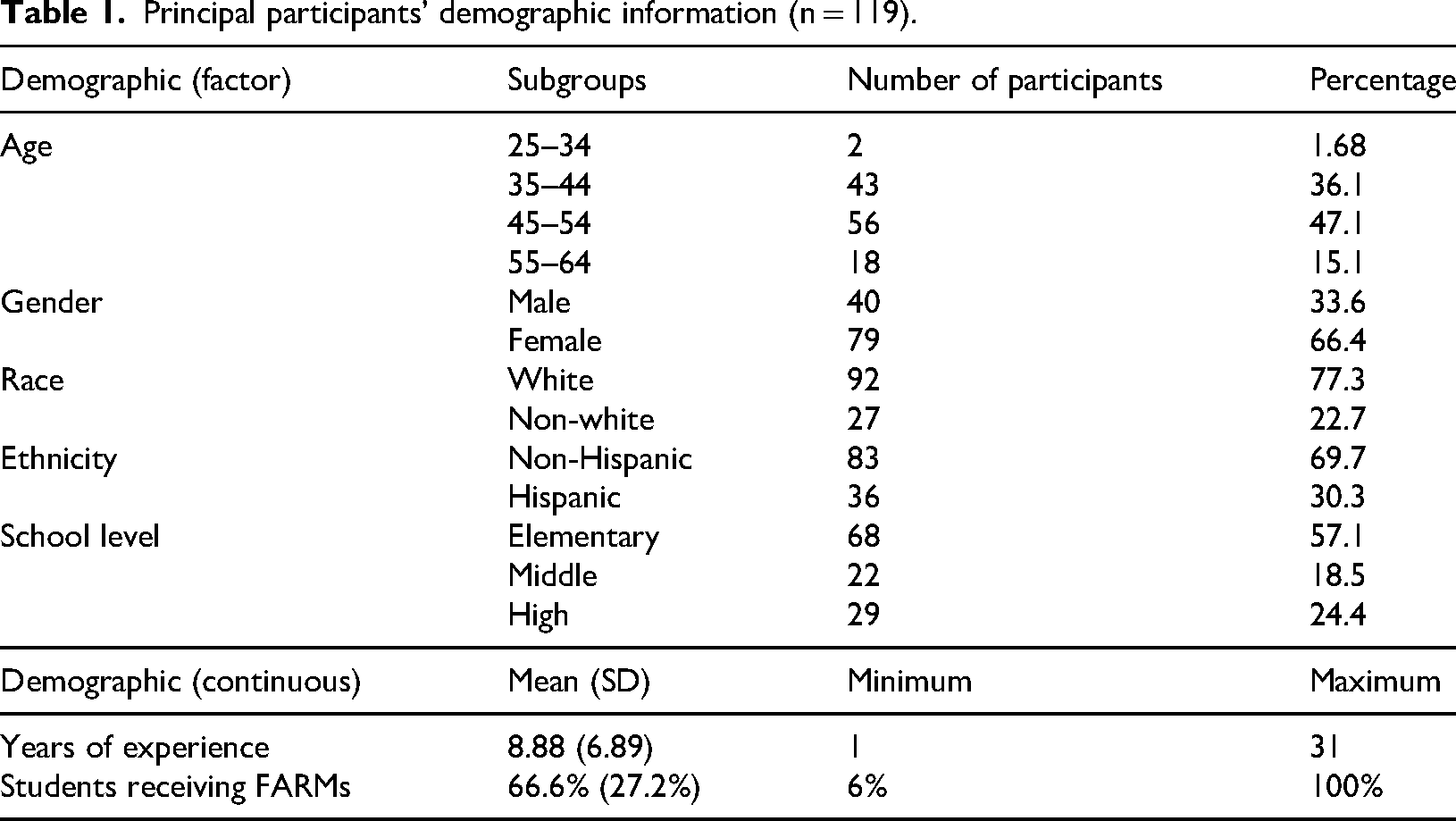
Principals from public, noncharter schools in the state of Texas, USA were recruited to participate in a survey. Principals were recruited using convenience sampling strategies such as an annual leadership conference directory, leadership preparation program alumni from two Texas higher education institutions, word of mouth, social media, and direct emails. Participants were recruited between March and May 2024. After reviewing the survey for incomplete responses, duplicates, checking administrative titles, and missing qualitative and quantitative data points, 119 participants’ data were used for the study. Almost half of the principals were between the ages of 45 and 54 and led an elementary school. Most principals identified as female (66.4%), white (77.3%), and non-Hispanic (69.7%). On average, principals in our sample had 8.88 years of experience (SD = 6.89), and on average, they worked in schools with 66.6% of students receiving free and reduced lunch (SD = 27.2%). Compared to recent state demographics, our sample reflected similar gender patterns though less principals of color (22.7% compared to 44%; Dematthews et al., 2024). A breakdown of principals’ demographic information can be found in Table 1.
Principal participants’ demographic information (n = 119).
This study takes place in Texas which a geographically, politically, and racially diverse state. In recent census data, Texas harbors five of the top 15 most populous cities in the country and simultaneously, nearly 4000 small rural, unincorporated communities (Texas Almanac, 2021). Latine individuals make up the biggest population group at 40.2% followed by non-Hispanic white (39.8%), Black or African American (11.8%), Asian (5.4%), American Indian or Alaska native (1.5%), Native Hawaiian or other pacific islander (0.2%), with the remaining individuals identifying as two or more races (Ura, 2023). While Texas is diverse, current right-wing politics and mandates have made it difficult for principals to lead schools, particularly for diverse youth. Executive orders banning instruction related to sexual orientation, mental health programs for queer youth, and gender affirming care have impacted schools’ ability to validate and support LGBTQ + children (Runnels, 2025). At the time of data collection, funding for schools remained stagnant for nearly a decade while a concerted push for a state voucher program threatens to funnel taxpayer funds to support private school tuition (Edison and Reid, 2025). While this context is unique to Texas, anti-public school sentiments; banning diversity, equity, and inclusion practices; and insufficient public school funding are trends found across the United States and other countries.
Data collection
Data for this study were extracted from a larger survey study examining the overall wellbeing and health in principals working in K-12 public, noncharter schools in the state of Texas, USA. The survey included personal and school demographic questions such as age, gender, race, ethnicity, years of experience, school level, school geography, and percentage of students receiving free and reduced lunch as a measure of school socioeconomic status. We used three scales to measure stress and mental health which included principals’ perceptions of stress at work (Perceived Stress Scale, PSS-4; Cohen et al., 1983), anxiety symptoms (General Anxiet Disorder, GAD-7; Spitzer et al., 2006), and depression symptoms (Personal Health Questionaire, PHQ-9; Kroenke et al., 2001). Additionally, we collected qualitative data on principals’ stressors by asking participants to identify “major sources of job-related stress” through an open-ended qualitative question. The purpose of the qualitative question was to identify emergent stressors across a broad and large sample of practicing principals that could then be integrated into the quantitative analysis. An opened ended qualitative survey question allowed for participants to identify stressors most significant in their context. Given the, sometimes, brief responses, the ability to probe for deep analyses was limited.
Data analysis
Qualitative data were initially pool together and underwent inductive, in-vivo coding to develop descriptive codes by the lead researcher and student researcher (third author). The student researcher, a psychology major, received training by the researcher in qualitative coding procedures. The student and lead researcher coded the qualitative data through in-vivo and descriptive coding techniques to develop an initial codebook. The student and lead researcher engaged in several reflexive conversations to clarify questions and discrepancies and to compare codes. Since faculty and student collaborations involve power dynamics, the lead researcher emphasized open dialogue and disagreement for consensus building. The student's background in psychology allowed for additional perspectives for dialogue and stressor interpretations.
The qualitative data was inductively coded for stressors from participants’ responses and deductively organized using Bronfenbrenner's Ecological Theory (1979). Stressors more proximal to the principal were organized in the inner concentric circles, whereas stressors more distal were organized in outer concentric circles. When differences in inductive stressor coding or deductive organizing occurred, differences were thoroughly discussed based on theory and leadership practice (e.g. “budget” vs. “funding”). Additionally, consensus was achieved by examining formal definitions and colloquial understandings of such terms within K-12 practice to determine the code, theme, and system that fit best.
Once the qualitative data analysis was complete, the presence of stressor systems in participants’ responses were quantitized (i.e. 1 = present or 0 = absent). The researchers then scored each of the three quantitative scales which required a summation of each item as instructed in the seminal papers. The perception of stress (PSS-4) scale adapted to work included four items, the anxiety symptoms (GAD-7) scale included seven items, and the depression symptoms scale included nine items (PHQ-9). Internal consistency tests for work-stress (α = .74), anxiety (α = .92), and depression (α = .89) demonstrate acceptable, excellent, and good internal consistency, respectively. Higher scores on each scale represented higher stress, anxiety, and depression. We performed descriptive statistics on each psychological variable and independent t-tests between the presence or absence of each stressor system (independent variable) and work-stress, anxiety, and depression scores (dependent variables) to determine significant differences in mean. F-tests were conducted to confirm equal variance prior to independent t-test analyses.
Prior to analysis, regression assumptions were tested. Residual plots indicated no substantial deviations from linearity or homoscedasticity. Normal probably plots suggested approximate normality of residuals. Variance inflation factors ranged from 1.05 to 1.52 indicating no evidence of multicollinearity. Examination of Cook's distance and leverage values showed no influential observations. After checking assumptions, we ran a series of hierarchical regressions. We first ran full models (model 1) with demographic factors (age, gender, race/ethnicity, years of experience, rural status, school level, and percentage FARMs) as predictors for each of the three outcomes (stress, anxiety, and depression). We then added the stressor systems as predictors (model 2: Stressor Systems). We did not conduct a model with individual stressors to preserve degrees of freedom given the sample size N = 119. However, we did conduct multiple regressions examining cumulative or dosage effects of thematic stressors on each outcome (model 2: Cumulative).
Findings
Emergent qualitative stressors and stressor systems
To answer research question one, we identified ten thematic stressors from principals’ qualitative responses: work demands and personal impacts, school and teacher-related, parent-related, district-related, inadequate funding, systemic educational issues, accountability pressures, political attacks, anti-public school culture, and lingering COVID-19-related issues. In Table 2, we provide several examples of in vivo codes that were extracted from qualitative responses to support the development of descriptive and subsequently, thematic codes. When quantitized, we found that school- and teacher-related stressors, which included descriptive codes like student behavior, instructional leadership, and conflict with teachers, were the most frequently cited stressors (61.3%). This was followed by work-demands and personal impacts (33.6%), and parent-related stressors (29.4%). Other stressors, given the sociopolitical context of Texas, such as accountability pressures (21.8%) and political attacks (9.24%), were also documented. Percent frequencies for other thematic stressors are detailed in Table 2.
Stressor systems, embedded thematic stressors, in vivo coding examples, and frequency.
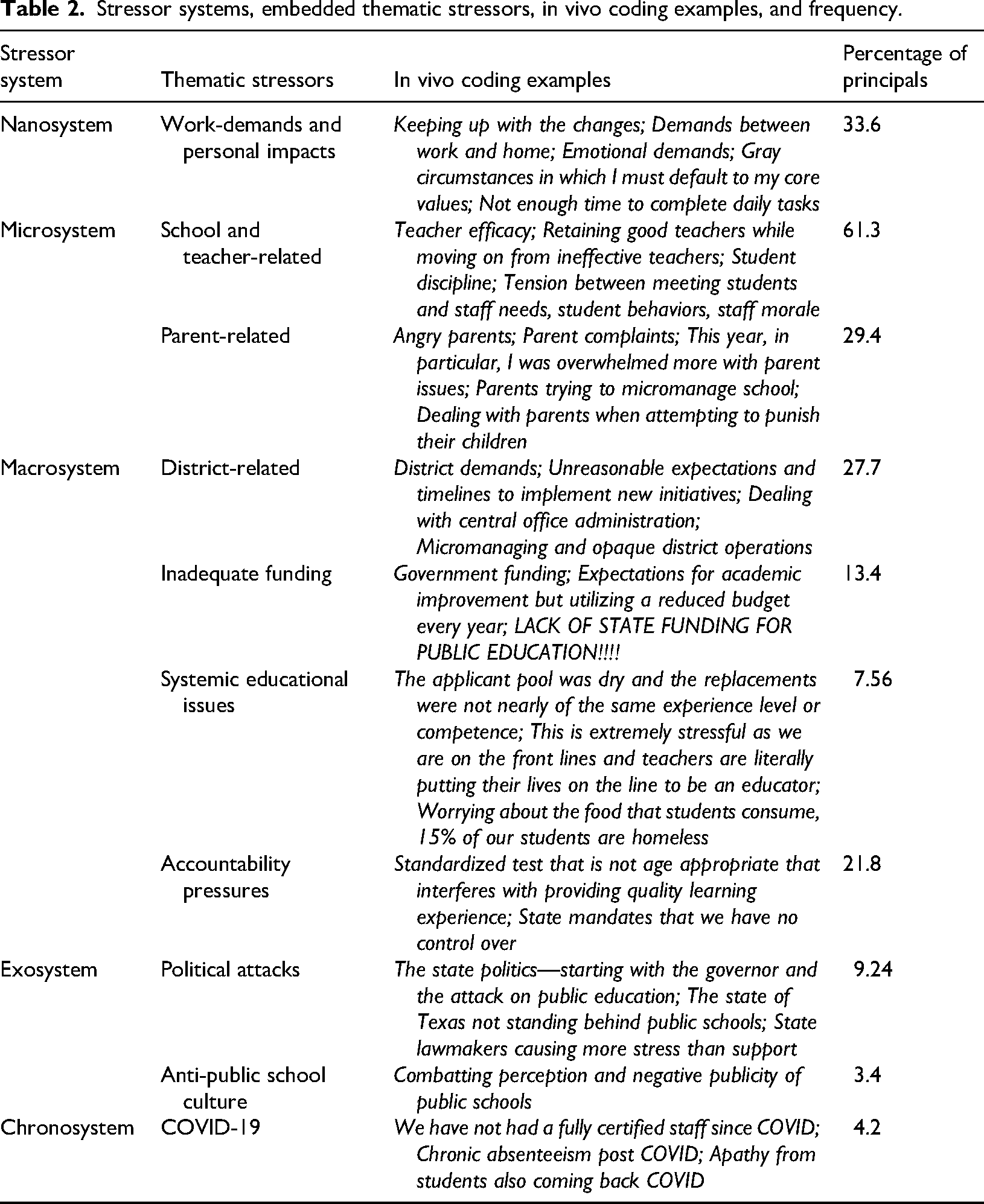
Once stressors were identified, we used Bronfenbrenner's Ecological Model (1979) and definitions of each system to organize the ten thematic stressors into systems within education. We categorized school- and teacher-related and parent-related issues into the microsystem—the immediate environment within which principals work and have the most control over. We categorized district-related stressors, inadequate funding, systemic educational issues, and accountability pressures into the macrosystem—which occupy a more distal, indirect environment concerned with school operations. Political attacks and anti-public-culture were categorized as exosystem stressors because they reside within the broader societal and cultural aspects of education. COVID-19-related stressor was the only theme categorized in the chronosystem given the temporality, yet lingering impact of the event. In Bronfenbrenner's (1979) model, the interactions between the micro- and macrosystems are labeled as the mesosystem which highlights the fluidity between the two and its relationship to human development. In our analysis, work-demands and personal impacts seemed to occupy a similar space between the individual and stressors from the microsystem. For example, descriptive codes like “demands between work and home” and “emotional demands” were situated in a space between their personal lives and work. Hence, we created a system between the individual and the microsystem which we named the nanosystem and represents work-demands and personal impacts stressor themes (Table 2).
Principals’ perceptions of work-stress, anxiety, and depression
To answer research question 2, we examined principals’ perceptions of work-stress and mental health symptoms and identified differences in these variables based on the presence or absence of stressor systems. On average, principals in this study struggled with work-stress, anxiety, and depression symptoms. Principals scored an average of 6.39 (SD = 2.37) on perceptions of work-stress scale where scores of 6 and above indicate high levels of stress. On average, principals scored 10 (SD = 5.71) on the GAD-7 anxiety scale and an average of 9.45 (SD = 6.27) on the PHQ-9 depression scale. Interpretations of these scores suggest principals are experiencing moderate levels of anxiety and mild-moderate levels of depression symptoms. Individuals who score a 10 or higher on these two instruments have a 5 to 1 likelihood of receiving a general anxiety or major depressive disorder diagnosis, respectively (Kroenke et al., 2001; Kroenke et al., 2007). In our sample, 64 principals (53.7%) scored a 10 or higher in anxiety and 52 principals (43.7%) scored a 10 or higher in depression which suggests a large fraction of principals are at clinical risk of a mental health disorder.
Independent t-tests of psychological perceptions in the absence or presence of stressor systems showed that principals who identified nanosystem stressors had significantly higher work-stress (t(117)= −2.35, p = .02), anxiety, (t(117)= −3.02, p = .003), and depression (t(117)= −2.29, p = .024) symptoms compared to principals that did not cite nanosystems stressors. Also, principals who noted macrosystem stressors (e.g. district, funding, systemic educational issues, and accountability) had significantly higher work-stress scores than principals who did not cite macrosystem stressors (t(117)= −3.17, p = .0019). All other presence and absence of stressor systems did not yield significant differences in work-stress, anxiety, or depression scores.
Stressor systems that predict work-stress, anxiety, and depression
To answer research question 3, we conducted a series of hierarchical regressions to determine the role of demographic data, stressor systems, and by contrast, cumulative stressors on principals’ work-stress, anxiety, and depression (Table 3).
Hierarchical regressions of stressor systems and cumulative stressors.
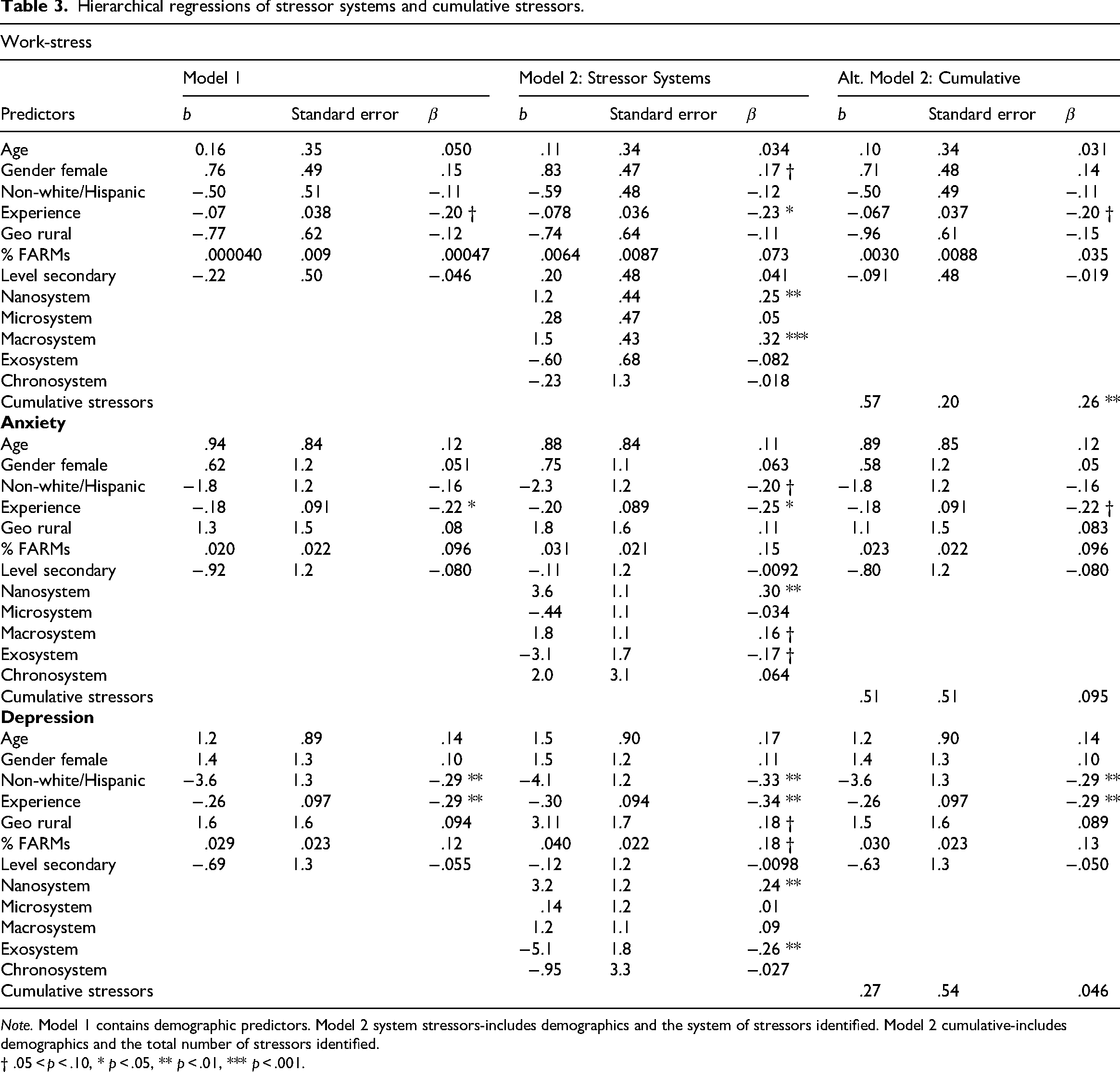
Note. Model 1 contains demographic predictors. Model 2 system stressors-includes demographics and the system of stressors identified. Model 2 cumulative-includes demographics and the total number of stressors identified.
† .05 < p < .10, * p < .05, ** p < .01, *** p < .001.
Work-stress. Model 1 with demographic variables was not statistically significant (F(7, 109) = 1.37, p = .22) and accounted for a small portion of variance in principals’ work-stress (R2=.08). When the five stressor systems were added in model 2, model fit improved significantly (ΔR2 = .15, F(5, 104) = 4.01, p = .002) and increased the total explained variance (R2=.23, F(12, 104) = 2.58, p = .005). Macrosystem (b = 1.54, p < .001, β = .32) and nanosystem stressors (b = 1.23, p = .007, β = .25) were associated with higher stress and years of experience was associated with less stress (b = −0.08, p = .034, β = −.23). An alternative model 2 with cumulative stress also improved fit beyond demographic factors (ΔR2 = .06, F(1, 108) = 7.93, p = .006). However, stressor systems explained more variance in stress (ΔR2 = .15 vs. .06) suggesting that the origin of stressors is more consequential for work-stress than the sheer number of stressors experienced.
Anxiety. Model 1 with demographic variables was not statistically significant, F(7, 109) = 1.20, p = .31, and accounted for a small portion of variance in anxiety (R2 = .07). Years of experience was a significant negative predictor (b = −0.18, p = .049) suggesting that experience is linked with lower anxiety. In model 2, the five stressor systems were added and significantly improved the model, ΔR2 = .13, F(5, 104) = 3.46, p = .006, increasing the total explained variance (R2 = .20, F(12, 104) = 2.22, p = .016). Nanosystem stressors predicted higher anxiety (b = 3.63, p = .001) and years of experience remained a negative predictor (b = −0.20, p = .025). A separate cumulative stress model did not improve fit beyond demographics (ΔR2 = .01, F(1, 108) = 1.01, p = .317). Unlike work-stress, the sheer number of stressors did not predict anxiety symptoms.
Depression. Model 1 with demographic variables was statistically significant, F(7, 109) = 2.38, p = .027, indicating that demographics accounted for 13% of variance in depression symptoms. Race/ethnicity was negatively associated with depression (b = −3.60, p = .007) indicating lower symptoms associated with racially and ethnically diverse principals. Years of experience was also negatively associated (b = −0.26, p = .009) with depression. In model 2, the five stressor systems were added and significantly improved the model, ΔR2 = .12, F(5, 104) = 3.35, p = .008, increasing the total variance to 25%, F(12, 104) = 2.93, p = .002. Nanosystem stressors were positively associated with depression (b = 3.18, p = .007). Exosystem stressors were negatively associated with depression (b = −5.05, p = .005). Race/ethnicity (b = −4.08, p = .001) and years of experience (b = −0.30, p = .002) remained significant negative predictors of depression. A separate cumulative stress model did not improve fit beyond demographics, ΔR2 = .002, F(1, 108) = 0.26, p = .615. Like anxiety, predictors of depression were not associated with the accumulation of stressors, but linked to specific systems of stressors.
Discussion and limitations
Studies in educational leadership have identified a growing list of stressors in the principalship (Doyle Fosco et al., 2025; Gmelch and Swent, 1984; Mahfouz, 2020). Our study adds to this literature by identifying emergent stressors and their origins within the educational system using Bronfenbrenner's (1979) ecological theory to examine how stressors systems predict principals’ stress and mental health. We find that systems from which stressors originate play a critical role as predictors of psychological outcomes. Macrosystem pressures (e.g. systemic educational issues, district demands, funding constraints, and accountability pressures) was the strongest predictor of work-stress highlighting structural and policy level conditions outside of a principal's sphere of influence. In contrast, nanosystem stressors were strongly associated with more mental health symptoms suggesting that proximal factors were more consequential for mental health. The sheer number of stressors was associated with work-stress, but not mental health outcomes.
Our study also found that certain demographic factors (i.e. principals experience and racial/ethnic background) may serve as a protective buffer against psychological distress. Principals’ years of experience, not surprisingly, was a protective factor predicting lower stress and mental health symptoms. These results align with other studies that find veteran principals to be more resilient through the continued development of coping mechanisms, efficacy, or skills that minimize the impact of work challenges (Patterson and Kelleher, 2005). We also found that ethnically and racially diverse principals were associated with less depression symptoms which is contrary to recent literature (Steiner et al., 2022). On one hand, cultural and racial stigma in reporting depression symptoms may influence responses (Brown et al., 2010; Krill Williston et al., 2019); however, critical scholars have shown associations between cultural capital and wellbeing among communities of color including principals of color (Acevedo and Solorzano, 2023; Beausaert et al., 2023; Koh, 2025; Yosso, 2005). Given the historical oppression and continued marginalization of people of color, researchers have argued that racially, ethnically diverse people particularly in leadership positions have experienced a lifetime of building resilience, navigating struggle, and forging hope from culturally affirming communities (Koh, 2025; Lomotey, 2019; Peters and Miles Nash, 2021). As researchers of color (first and third author), we argue that there is a habitual way of (well)being that is deeply embedded within people of color fortified from experiences of marginalization within white supremist contexts that might be highlighted in these results. Perhaps relatedly, our study also found that anti-public school culture and political attacks predicted less depression symptoms which may be aligned to educators’ and educational leaders’ resistance, critical hope, and action to fight for schools, teachers, and students (Lopez, 2017; Ravitch, 2020). No doubt, these surprising findings warrant further exploration regarding contextual or cultural factors that may be shaping reporting or resilience. We recognize that one of the limitations is the small sample size of principals who identify as non-white (22.7%) and Hispanic (30.3%) which may also account for this finding and warrants more research from qualitative and longitudinal perspectives.
Notably, commonly cited stressors related to school operations, parents, and student behavioral challenges (microsystem stressors) were present in more than of half of principals’ responses, though this stressor system was not a significant predictor of any psychological outcomes. In a separate study, one author of this article found that stressors which fell within the traditional expectations of the principalship did not negatively affect principals’ psychological experiences to the same degree as those that fell outside of the principal's role suggesting that a mis-match of expectations may play a role in this article (Su-Keene and Bogotch, 2025).
This study has several limitations in addition to the small proportion of racially and ethnically diverse principals. Our sample size of 119 principals is small compared to the total number of Texas principals which is approximately 8000. We also collected data through convenience sampling strategies, and with a low response rate, our sample may reflect bias toward principals who had interest and motivation to participate in a study on leadership wellbeing. Second, in using qualitative data, we were able to determine current and emergent stressors that were reflective of principals’ local and state context. Texas is a large, diverse state that has undergone numerous anti-diversity, equity and inclusion initiatives, funding restrictions, and school policies that have shaped these findings which limits the generalizability to other contexts. Another limitation is our quantitizing approach where denoting the presence of a stressor in participant responses cannot fully capture the absence of other stressors. That is, we asked principals to note “major stressors” but that does not reflect a true absence of a stressor in principals’ experiences (i.e., the interpretive difference between a stressor that simply was not mentioned versus a stressor that is truly absent from experience) (de Block and Vis, 2019; Sandelowski et al., 2009). Thus, a potential consequence for analysis is overweighting stressors coded as present and underweighting stressors coded as absent.
Conclusions
Overall, these findings reinforce the urgent need to address the intensifying professional burdens affecting school principals. While systemic and environmental factors remain important, this study suggests that stressors that are personally harmful is a critically urgent area to target for principal wellbeing which has implications broadly for positive school improvement. Such interventions should focus on what we identify as the nanosystem stressors or those at the interface between the work environment and the individual. We emphasize a need to integrate stress management, workload management, emotional support, and physical health support as essential trainings for both in-service and pre-service principals. Findings from this study suggest mitigating and buffering the impact of stressors at the individual level may be one of the most beneficial avenues for improving principals’ mental health in the short term while systems catch up to these needs. As others have suggested, we believe that school leadership preparation programs have a role in developing more resilient, psychologically attuned principals who can ebb and flow with the daily challenges of school leadership (DeMatthews et al., 2021). Additionally, school districts, superintendents, and principal supervisors can provide relational supports, revise policy and performance standards, conduct workload audits, trim nonessential tasks, and examine health-related benefits to lessen the individual demands being placed on school leaders.
Footnotes

Ethical consederations
The study was conducted in accordance with and approved by the Institutional Review Board of Texas A&M University (IRB2023-0915 M Approved 02/23/2024) for studies involving humans. Informed consent was obtained from all subjects involved in the study.
Funding
The authors received no financial support for the research, authorship, and/or publication of this article.
Declaration of conflicting interests
The authors declared no potential conflicts of interest with respect to the research, authorship, and/or publication of this article.
Data availability statement
The raw data supporting the conclusions of this article will be made available by the authors on upon request though some data may be excluded due to the sensitive nature.