







Abstract
In 2014, an orchestrated campaign of online abuse known as Gamergate overtook the global video game industry, calling unprecedented attention to the scope of gendered harassment on social media. Using Gamergate as an example, this article argues that explanations of online abuse that focus on its cultural or technological dimensions fail to capture the mediating role of online platforms in facilitating and rationalizing harassment and reputational damage. The concept of technological rationality pulls into focus the shared logics that shape platform design and administration as well as practices of online abuse. Proposed solutions to online abuse that fail to address technological rationality will ultimately leave in place the sociotechnical arrangements that make such abuse possible and impactful.
Figure 1 shows a tweet from video game developer Zoe Quinn describing the ongoing effects of the orchestrated abuse campaign that became known as “Gamergate”. Quinn satirically nicknames herself “shitpost” (slang for an online comment or blog post deemed deliberately offensive and without value) in recognition of how indelibly her name has been linked to a defamatory article posted online by her ex-partner Eron Gjoni. Embittered by Quinn’s decision to end their brief relationship, Gjoni, also a video game developer, circulated a long article inferring that Quinn’s position in the video game industry was due to sexual favours. While this allegation was demonstrably false, the article stoked outrage amongst a critical mass of video game players who felt threatened by the growing presence and influence of women as both players and industry participants. What followed was a semi-coordinated campaign of online abuse and harassment of perhaps unprecedented scope. From late 2014 and throughout 2015, the topic of Gamergate dominated social media as well as the video game industry, attracting attention from the international press and civil society. The lives of those women targeted by Gamergate, as Quinn states above, were forever changed. Although the peak of Gamergate harassment has now passed, “living differently” in its aftermath means constant hyper-vigilance, heightened security at public appearances and ongoing threats against Quinn and others. The subsequent incorporation of Gamergate into the so-called “alt right”, an online coalescence of misogynist and racist politics with links to hard-right groups, underscores the significant role of online abuse in conflicts over public participation and technological power.
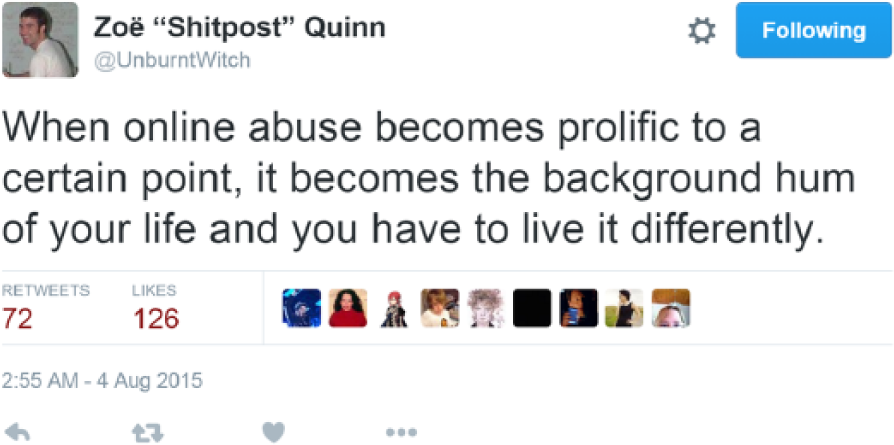
Tweet from Zoe Quinn.
Using the example of Gamergate, this article emphasizes the emergence of online abuse from within the dialectic relationship between reactionary formations of masculine identities and computing technology. The article begins with a brief gendered history of computing and its links to “geek masculinity”, in which technological mastery forms the basis of masculine esteem and status. In Gamergate, the masculine impulse to defend particular technologies, such as video games and the internet, from perceived encroachment by women and more diverse users illustrated the fragility of geek masculinity and its dependence on inequitable forms of technological hegemony. However, it is not a coincidence that particular online platforms, particularly 4chan, 8chan, Reddit and Twitter, proved so conducive to Gamergate’s misogynist campaigns. This article recognizes how “technological rationality” (Marcuse, 1985), or the particular logics and values instantiated within technology, can promote the instrumental attitudes and exploitative relations that naturalize gendered inequalities and drive mass campaigns of online abuse. Amidst recurrent calls for law enforcement and education in order to address misogynist online abuse, this article suggests that online abuse is symptomatic of the gendering of the technological base and that its amelioration requires cultural, technological and industry responses.
Masculinizing computers
Western culture has long conflated masculinity with technology, giving rise to processes whereby technological power accrues disproportionately to men and boys (Wajcman, 1991). The widespread stereotype that men have a greater skill and affinity with technology than women is so pervasive it “translates into everyday experiences of gender, historical narratives, employment practices, education, the design of new technologies, and the distribution of power across a global society in which technology is seen as the driving force of progress” (Bray, 2013: 370). These stereotypes have been present since the early days of electronic computing in the mid-20th century, albeit mediated by divisions of labour and professional status in perhaps surprising ways. In the 1940s, one of the earliest electronic computers, the University of Pennsylvania’s EANIAC (Electronic Numerical Integrator and Computer) machine for ballistics calculation, was programmed by a group of six women who are now recognized as the world’s first computer programmers (Light, 1999). Their work had a significant effect on the design of EANIAC and subsequent computers, and some went on to work at the highest level of electronic computing (Ensmenger, 2010). During the same period, women also staffed Britain’s codebreaking Collosus computer, although their career progression was more constrained by the secretive and highly regimented military context of the project (Abbate, 2012).
The early recruitment of women as programmers was facilitated by a male labour shortage during the war years, but also because (male) computer engineers underestimated the complexity of programming, and saw it as a feminized “clerical” activity (Ensmenger, 2010). As the intellectual sophistication and importance of programming was recognized in the post-war period, there were concerted efforts to “masculinize” programming in order to bolster its professional status and erase its origins as low-paid “women’s work”. For instance, the promotion of the term “software engineering” from the 1960s was an attempt to recategorize programming under the auspices of the male-dominated and more prestigious field of engineering (Abbate, 2012). Nonetheless, the masculinization of programming was never complete or total. The dramatic growth of the programming workforce created a demand for labour that included many female employees, with women constituting a quarter of programmers in the United States in 1970, albeit with a gender distribution skewed towards the lower end of the professional hierarchy (Abbate, 2012: 41).
During the 1980s, as computers and networked technology took centre stage as fulcrums of globalization and macro-economic change, the conflation of masculinity with computing was amplified. In advertising, in software design, in burgeoning fan cultures such as “hacking” and video gaming, in pop culture, in educational and training contexts and in computing-related professions, a singular message emanated: computers were for boys and men. Femininity and computing were positioned as antithetical to one another across multiple domains. Computer advertising depicted women’s relation to computing as primarily administrative or as the “sex object” to be obtained by the technologically skillful man (Ware and Stuck, 1985). The software and computer games of the 1980s were dominated by themes of militarism and male violence, alongside highly sexualized depictions of women (Lien, 2013). Representations of high technology in pop culture took on a fetishistic quality as comics, movies and television depicted men overcoming obstacles and asserting their will using sophisticated weaponry (Gibson, 1994). Computer science training and related “hacking” subcultures idealized masculine norms of competitiveness and aggression in ways that alienated girls and women (Turkle, 1984). From the mid-1980s, there was a significant drop-off in female enrolment in computer science courses, and women’s participation in computing industries fell around the world (Panteli et al., 2001; Wilson, 2003).
There is no single explanation for the dramatic reduction in women’s already low participation in computing from this period. Instead, it points to the intensified gendering of socio-technical arrangements, with significant implications for the gendering of technology and the role of technology in gender identity. The masculinization of computing industries and cultures has invited intense emotional investments and psychological identifications from men and boys, to the point of generating technology-focused permutations of masculine subjectivity and relations such as “geek masculinity” (Massanari, 2015; Taylor, 2012). Geek masculinity describes a technologically-fused form of masculine subjectivity that requires, for its coherence, the maintenance of gendered stereotypes about male technological skill and female ineptitude (Murray, 1993). A need to protect the male exclusivity and control of technology has been evident in geek spaces and activities from the “machismo” of 1980s video arcades (Kaplan, 1983) to the male dominance of online communities of the 1990s (Kendall, 2002) and the “griefing” and insults that characterize the online gameplay in the new millennia (Higgin, 2015). While sometimes described as a subordinate or relatively powerless masculine formation (Connell, 1995), geek masculinity has come to play a major role in the design of new technologies, the formation of online communicative cultures and the perpetration of gendered online abuse. The following section examines how the construction of masculine identities and relations grounded in technological control has drawn geek masculinity into close affinity with organized misogyny as a method for the perpetuation of gendered technological hegemony.
Geek masculinity and technological hegemony
Geek masculinity describes a formation of gendered subjectivity in which boys and men claim technological knowledge and aptitude as a basis for masculine identity (Murray, 1993). The stereotype of the geek emerged out of early characterizations of programmers and computer engineers as socially awkward but brilliant loners (Ensmenger, 2010) which were internalized and reclaimed by boys and men for whom technology offers an alternative pathway to masculine identification (Bell, 2013). In geek masculinity, masculine self-esteem and social capital are built through specialized technical knowledge and skills, rather than through mainstream indices of masculinity such as athletic or heterosexual prowess (Taylor, 2012: 111). Resistance to hyper-masculinity can facilitate an appreciation of diversity and inclusivity in geek subcultures and identities, however the “default” geek subject tends to be white, male, middle class and heterosexual (Kendall, 2011). Geek masculinity thus contains a contradictory construction, in which a victimized “outsider” posture can obscure relations of dominance which are maintained through the control and assertion of technological power. This power is exercised between and over other men and boys in competitions for status and respect from which girls and women are often excluded, or may only participate by acting like “one of the boys” (Kendall, 2002).
Kendall (2002) theorized geek masculinity as simultaneously resistant to and complicit in gender inequality; a “not-quite hegemonic” formation of masculinity (Kendall, 2002: 272). However, as technological skill has become recognized as a route to wealth and the kind of “superstardom” exemplified by Bill Gates or the late Steve Jobs, much of the stigma surrounding geeks has faded to be replaced by an enthusiasm for their purported value within a destabilized economic landscape (Bell, 2013). The development and rolling-out of “high” or “cutting edge” technology in the service of capital has become integral to a class of internationally mobile men with prominent roles in the global economy (Connell and Wood, 2005). Dyer-Witheford (1999: 97) describes this group as follows:
Highly paid, frenetically creative, technologically compulsive, often enjoying substantial entrepreneurial activities, this elite workforce has been the subject of innumerable adulatory media reports, making their exploits an important part of the information revolution romantic mythology.
The “mythology” of the information revolution is grounded in ideals of individualism, competitiveness and aggression that have been normative in geek masculinity since the early days of networked computing (Turkle, 1984; Turner, 2010). This ethos continues to shape the working conditions of technology industries in ways that reinforce the conflation of masculinity with technical competence and innovation, limiting women’s professional opportunities but also informing how technology is conceptualized and designed (Ranga and Etzkowitz, 2010). For instance, the design of many online and social media platforms reflects foundational “geek” conceptualizations of the internet as a “new frontier” to be invaded and colonized through force and bravado (Phillips, 2015). These governing ideals have encoded combatitive modes of communication and laissez faire approaches to platform governance, facilitating online environments that are unfriendly if not hostile to female users in particular (Salter, 2017). This has, in turn, reinforced perceptions of the internet as the privileged domain of “geeks” and tech-savvy young men. Similar feelings of ownership have been extended to other technological fields such as video and computer gaming, where games are primarily designed by and marketed for the presumptive straight, white, male “geek” consumer (Condis, 2015).
Emotional investments in technology as the grounding for masculine identity and esteem have always been unstable and contested, due in no small part to the ongoing participation of girls and women in technological pursuits and interests. However, this instability has grown more apparent in recent years as the ubiquity of computers, mobile phones and social media has promulgated technological literacy well beyond the confines of “geek” specialization. The influx of female and more diverse users into social media, video gaming and other technology-related fields has made the masculinity-technology conflation upon which geek masculinity rests increasingly untenable. This development has been met with notable escalations in gendered abuse and harassment originating within, but also extending beyond, geek-dominated spaces and subcultures. Geek efforts to preserve a sense of control over their preferred technological domains have included online threats and insults against women and other perceived “outsiders”, including racially and sexually diverse groups (Higgin, 2015); sexual harassment in technology industries and fan cultures (Salter and Blodgett, 2012); and, as this article will argue, the formation of alliances with other reactionary male identity movements, notably anti-feminist men’s rights activists and white supremacists. These efforts to maintain gendered technological hegemony have been met with widespread condemnation but they are privileged, in significant ways, by the instantiation of norms and assumptions within a range of technologies which makes those technologies differentially available as instruments of gendered abuse and control.
The online abuse campaign Gamergate is an important illustration of the sociotechnical congruence between geek masculinity and online abuse. Gamergate describes an unprecedented wave of online abuse that originated from within the video game industry and gaming subcultures, facilitated by major online platforms, notably 4chan, 8chan, Reddit and Twitter. Gamergate is the subject of a burgeoning scholarship, including Massanari’s (2015) insightful analysis of the role of platform design, governance and culture in enabling the formation of “toxic techno-cultures”. Braithwaite (2016) has analyzed the particular narrative dimensions of the Gamergate “techno-culture”, emphasizing how those feelings of victimization and alienation common to geek masculinity informed the efforts of Gamergate participants to preserve masculine technological control via online misogyny. In the analysis presented by this article, the cultural and technological aspects of Gamergate merge within the “technological rationality” described by Marcuse (1985). Gamergate’s abuse campaign became endemic because its underlying rationalities were evident in the design, governance and communicative culture of a range of online platforms. This is no coincidence; the architecture and administration of those online platforms emanate from the very same “geek” cultures and related industries as Gamergate. In online abuse, this article suggests, technology is always already symbolically and strategically implicated in assertions of masculine aggression.
Gamergate
The catalyst for Gamergate occurred in August 2014, when video game developer Eron Gjoni circulated a defamatory article about his ex-partner Zoe Quinn in retaliation after she ended their brief relationship. In the rambling 9000+ word article, Gjoni accused Quinn of multiple infidelities, alongside the false suggestion that her modest success in the video game industries was due to sexual favours. He initially linked the article to the discussion boards of geek forums such as the websites Something Awful and Penny Arcade, however his posts were quickly removed by moderators. Instead, Gjoni turned to the imageboard 1 4chan, which provided a much more receptive audience for his claims.
Since its launch in 2003, 4chan has been a major online hub for geek masculinity, drawing millions of users each month into anarchic discussions of video games, cartoons and pornography amongst other subjects (Phillips, 2015). Gjoni was aware that 4chan was host to a critical mass of gamers already hostile to Quinn, since she had been the target of their online abuse for over a year (Pless, 2014). In 2013, Quinn had become somewhat infamous in gamer circles for her game Depression Quest, which is a relatively simple text-based game that aims to illustrate the experience of depression from a first-person point of view (Smith, 2013). Quinn’s game subverted the violent norms of gamers’ preferred game genres but also articulated a female experience of depression that appeared to stir up incredulity amongst geeks, particularly for those who blamed their own feelings of alienation and isolation on women’s perceived sexual unavailability (Quinn identified that at least some of her abuse originated on Wizardchan, an imageboard site for adult male virgins, see Smith 2013). Quinn reportedly began receiving emails encouraging her to kill herself, as well as sexually harassing phone calls and rape threats delivered to her home address (Kotzer, 2014; Smith, 2013).
This history of online victimization made Quinn particularly vulnerable to further abuse on a geek and gamer-orientated forum such as 4chan. Throughout August 2014, Gjoni actively participated in 4chan discussions about the online abuse of Quinn (Pless, 2014). The secretive orchestration of hoaxes, pranks and abuse is a normal part of 4chan culture, facilitated by its online architecture in which “old” posts are automatically deleted to make way for new posts, giving rise to a sense of impunity and disinhibition amongst users (Auerbach, 2012). The communicative culture of 4chan frequently crosses over from a libertarian insistence on freedom of speech to a libertine “anything goes” ethos, such that users entering the boards are “likely to witness a nonstop barrage of obscenity, abuse, hostility, and epithets related to race, gender, and sexuality” (Auerbach, 2012). Some scholars argue that expressions of vulgarity and prejudice on 4chan operate as “a discursively constructed border fence meant to keep the uninitiated … far, far away” (Coleman, 2014: 40). While much of the verbiage on 4chan can be read as a form of “anti-political correctness” and self-satire, “ironic” expression of prejudice on 4chan can blur into organized harassment campaigns, as Gamergate would make very clear.
Gamer hostility to Quinn was animated by an escalating sense of defensiveness amongst gamers who objected to growing criticisms of the excesses of their subculture and preferred games. The presence of explicitly racist, imperialist and misogynist representations and themes in video games, and the concomitant normalization of abuse and prejudice in gamer subculture, has come under increased scrutiny over the last 10 years (Consalvo, 2012; Dyer-Witheford and De Peuter, 2009). The counter-response from gamers has been to claim that women and their progressive allies (known pejoratively as “social justice warriors” or SJWs, with male critics of Gamergate widely denounced as “white knights”) are colluding with journalists and other critics to “politicize” video games and destroy “gamer” subculture (Salter, 2017). Within this febrile atmosphere, Gjoni’s article about Quinn appeared to be the “smoking gun” that gamers had been looking for to prove that women were using their sexual wiles to infiltrate and destroy gaming from within. Via 4chan, large numbers of gamers began planning and rolling out a mass abuse campaign against Quinn and a range of other targets, primarily women, as punishment for perceived infractions against video games and gamer culture (Johnston, 2014).
Their cause received support from existing right-wing figures, such as actor Adam Baldwin, well-known for his vocal libertarian views. On 27 August 2014, on the social media platform Twitter, Baldwin tweeted a link to a YouTube video containing further slanderous claims about Quinn, and coined the hashtag #Gamergate. The suffix “-gate” reinforced the proposition that Gjoni’s post had uncovered some kind of mass conspiracy a la Watergate, with Baldwin subsequently linking Quinn to the “authoritarian Left” who, he claimed, are seeking to indoctrinate young people by politicizing video games (Kaufman, 2014). Baldwin’s intervention gave momentum to the escalating abuse campaign against Quinn and other women in the video game industry and press. The hashtag #Gamergate became a viral phenomenon on Twitter amongst tens of thousands of gamers who used it to focus abuse and harassment on a number of select targets, under the banner of protecting “ethics in video game journalism” 2 amongst a number of evolving and often inscrutable rationales (Mortensen, 2016). Gamergate rhetoric took on a grandiose quality as participants imagined themselves as “crusaders” in a war against feminists and other perceived enemies, often inflected with anti-Semitic, racist, homophobic and transphobic invective (Braithwaite, 2016).
Within the veritable tsunami of Gamergate social media activity were recurrent patterns of serious and likely criminal abuse, including online rape and death threats, doxing (gathering and releasing personal information online) and SWATing (sending false tips to the police to trigger a raid on someone’s home address). By the end of 2015, Quinn’s digital records of online abuse were reportedly in excess of 16 gigabytes (Jason, 2015). She was forced to leave her house and stay with friends when her home address and contact details were released online (Jason, 2015). Those video games developers and journalists who spoke up in support of her were also hacked and doxed (Romano, 2014). Games journalists and developers who wrote articles critical of Gamergate were subject to a barrage of online abuse and threats of such intensity that some left the video game industry altogether (Cox, 2014). Others were forced to cancel public talks and appearances following threats of violence (Alberty, 2014).
Gamergate was the subject of considerable controversy in the video game industry and press, and began to attract mass media criticism. In September 2014, 4chan administrators, who rarely intervene on the site, took the unusual step of banning discussion of Gamergate. Gamers then migrated in large numbers to 8chan, another imageboard site where user activity is entirely unregulated (to the point of enabling illegal activity such as the distribution of child abuse material), and the organization of the abuse campaign continued (Howell O’Neill, 2014). The discussion board Reddit also played an important role in the coordination of Gamergate activity, albeit by providing a more “respectable” face to the campaign. While there is considerable overlap in users and interests between 4chan, 8chan and Reddit, Reddit offers a more accessible bulletin board system in which communication is clearer and easier to follow in comparison to the imageboard sites (Massanari, 2015: 6). Reddit’s accessibility seems to have facilitated a sense of transparency and accountability amongst gamers. While gamers established a Gamergate discussion board on Reddit known as KotakuInAction (KIA), 3 it has generally avoided outright incitement of abuse, instead organizing email writing campaigns and boycotts of companies deemed to be too sympathetic to “social justice warriors”.
While 4chan and 8chan provided the main “staging grounds” for the abuse campaign, Gamergate primarily “played out” on social media, and on Twitter in particular (Mortensen, 2016). Twitter is an influential “micro-blogging” social media site that recorded 304 million monthly active users in 2015.
4
Users can “follow” one another, and post or read “tweets” containing short 140-character messages. Drawing on a range of sources, Mortensen (2016) estimates that, at its peak, up to 10,000 Twitter users actively involved or linked to Gamergate in some way. The hashtag #Gamergate was being tweeted hundreds of thousands of times per month, with the majority in support of the abuse campaign (Baio, 2014). The hashtag was closely policed by gamers, and Twitter users who included the hashtag in “tweets” that criticized Gamergate were flooded with abusive and threatening responses. This effectively shut down any potential dialogue between Gamergate and its critics, or proper scrutiny of the movement on Twitter. As technology designer Caroline Sinders (2015) noted:
Using the hashtag in a tweet became akin to saying “Bloody Mary” three times in a mirror, except Bloody Mary actually showed up and she brought a bunch of friends. People, particularly women in games, couldn’t talk about Gamergate publicly without getting harassed, so they just stopped talking about it on Twitter.
Twitter proved highly conducive to the Gamergate movement for reasons that are pertinent to both the cultural and technological dimensions of the platform. The culture of Twitter is orientated towards a more public, broadcasting, “town hall” style of social media debate between strangers, in contrast to other large platforms like Facebook that are more inwardly-focused on networks of family, friends and acquaintances (Van Dijck, 2013). This culture is underpinned by the platform design of Twitter, where the default setting of “tweets” is public and accessible to anyone. Unlike other social media platforms, users cannot remove or delete another user’s response to their tweets, which empowers users to directly contest (or abuse and ridicule, a fine line on Twitter) each other in the knowledge that this contestation is highly visible and unlikely to be censored or regulated in any way. This has, at times, enabled users to confront and name injustices that might otherwise have gone unnoticed (Salter, 2013), although it has also promoted a culture in which individual users can be subject to mass targeting and abuse on the platform in a way highly damaging to their reputation, employment and psychological health.
Another tier of complexity was added to the Gamergate saga as individuals began capitalizing upon the controversy for profit and professional advantage. For example, Milo Yiannopolous, journalist for the far-right website Brietbart, was an obscure figure until he began championing the cause of Gamergate. After disavowing his previous disparaging remarks about gamers, he built an online following amongst Gamergate participants that he has parlayed into a significant media presence (Salter, 2017). Phil Mason (known online as “thunderf00t”) was a modestly successful blogger who rose to prominence with a series of YouTube videos insulting Anita Sarkeesian, video game critic and Gamergate target (Allen, 2015). Mason’s videos have become core Gamergate texts, and explicitly justified the online abuse of Sarkeesian as “part of the public marketplace of ideas” (Allen, 2015). Some of these videos have been watched hundreds of thousands of times, and since YouTube video creators receive a portion of the revenue raised from advertising on their videos, they are likely to have raised considerable sums of money for Mason (Pless, 2015). Mason also has a Patreon crowdfunding account, in which individual “patrons” pledge typically small amounts of money in exchange for content from their preferred creator. This enabled gamers to pledge sums of money to Mason in order to finance further anti-feminist, pro-Gamergate videos. From 2013 to 2015, Mason’s Patreon income varied from between around US$2000 to almost US$7000 dollars a month (Pless, 2015).
Mason is just one of a number of Gamergate figures who used Patreon to “crowdfund” their ongoing participation in the abuse campaign. This included Gjoni, who used Patreon and other crowdfunding options in order to fund his appeal against the restraining order that Quinn filed against him, raising over US$50,000 (Romano, 2016). Quinn has complained about Gjoni’s use of crowdfunding to counteract her legal efforts to prevent further abuse and harassment, noting “every time something happened or the case was updated, he’d run back to the mob and make promises and jokes and pleas for more money” (Quinn quoted in Romano, 2016). Problematically, it was not only Gamergate instigators who generated income from the abuse campaign. Since social media and crowdfunding sites also receive a share of income from user activity, they profit directly from the major spikes in traffic associated with controversies such as Gamergate (Massanari, 2015). This implicates platforms financially in online abuse in disconcerting ways, raising unanswered questions about their business model and their duty of care to users.
The ferocity of Gamergate has largely abated; however, it has left behind a legacy of fear within gaming and social media. As game developer Elizabeth Sampat noted, “the truth about Zoe Quinn is that every woman in the industry is one unhinged ex-partner away from being Zoe Quinn” (quoted in Allen, 2015). While media attention to Gamergate promoted increased awareness of the seriousness of online abuse, the cultural and technological conditions that gave rise to Gamergate remain intact. Gamergate’s core narrative that treasured symbols of techno-masculinity, such as video games or the internet, are being destroyed in a “culture war” waged by feminists and progressives has merged with other reactionary masculine identity movements and taken on unexpectedly virulent forms. 4chan and associated forms of geek masculinity have been prominent in mobilization for the American president Donald Trump in ways that have blurred the boundaries between mainstream politics, organized misogyny and white supremacy (Wilson, 2016). Gamergate’s journalistic champion Milo Yiannopolous has become a major figure in the resurgent far-right politics of reactionary racist and misogynist sentiment known as the “alt right”. So too has his former employer, Steve Bannon, who was the executive chair of Breitbart before his appointment as chief strategist to President Donald Trump. Geek themes have been opportunistically integrated into white supremacist recruitment strategies, 5 while the Gamergate rhetoric of “social justice warriors” is now a regular part of the vocabulary of right-wing politicians and pundits. Far from being a niche issue, the disproportionate role of geek masculinity in online abuse and hate campaigns has become a matter of international attention and concern.
The technological rationality of online abuse
Marcuse’s (1964) notion of “technological rationality” offers a way of understanding the intersections of the cultural and the technological in online abuse. Technological rationality describes those forms of reason that are embedded within technological design and practices. Marcuse (1985: 138) denies the independence of material technology from human beings, “[f]or they are themselves an integral part and factor of technology, not only as the men [sic] who invent or attend to machinery but also as the social groups which direct its application and utilization”. His conceptualization of technology extends beyond particular devices and instruments to encompass technology as “a mode of production … a mode of organizing and perpetuating (or changing) social relationships, a manifestation of prevalent thought and behavior patterns, an instrument of control and domination” (Marcuse, 1985: 138–139). In short, the material aspects of technology embody and reproduce social relations and hierarchies to the point of being inseparable from them, particularly in contemporary settings where sophisticated technology has become central to social, political and economic relations. This technological rationality is fundamentally individualistic, instrumental and competitive. Marcuse (1985: 139) explained that:
In the course of the technological process a new rationality and new standards of individuality have spread over society … These changes are not the (direct or derivative) effect of machinery on its users or of mass production on its consumers; they are rather themselves determining factors in the development of machinery and mass production.
The theory of technological rationality suggests that neither technology nor users are the sole origin of online abuse, but rather their interaction is mediated by the dominative and instrumental rationality that characterizes the technological base; a rationality that is gendered and deeply entrenched in technological cultures, industries and associated subcultures. In this regard, the differential availability of platforms such as 4chan, 8chan, Reddit and Twitter for mass abuse and harassment speaks to the underlying rationales that informed their design and shaped their governance. Indeed, the sheer pandemic force of Gamergate as it spread virally across these platforms suggests a fundamental alignment between the structural design and administration of these platforms and the claims and abusive conduct of gamers. The aggressive and competitive qualities of geek masculinity emerge in this analysis not only as a mode of gendered subjectivity but also as a worldview that is simultaneously encoded into, and privileged by, online platforms. This produces an enclosed set of social and technical arrangements that mirror the other to normalize and amplify online abuse and harassment.
It is not that geek masculinity is inherently abusive but rather than it draws together specific configurations of masculine identification and technological practice that reproduce themselves through exclusionary and sexist tendencies. Combativeness, aggression and competition are pronounced dimensions of masculine identity in gamer subculture (Consalvo, 2012), albeit actively encouraged and facilitated by video game marketing and advertising (Der Derian, 2009). Hence misogyny has been a particular and long-standing challenge in the video game industry and the fan cultures that it nurtures (Thornham, 2008). However, the encoding of these gender norms into online platforms has given these misogynist strands of geek culture a position of technological hegemony. The communicative culture and interactive mechanics of 4chan, 8chan, Reddit and Twitter interact in ways that tend towards abusive or heated exchanges while providing few, if any, mechanisms for users to protect themselves or others from abuse. Male dominance on the imageboards and Reddit perhaps explains why they featured so prominently in the orchestration phases of Gamergate, after which gamers then shifted to the more gender-equal terrain of Twitter to launch attacks on women and other “SJWs”. However, despite its more diverse user base, Twitter’s combative mechanics and lack of content moderation contributed significantly to the success of these attacks. Indeed, Twitter’s metrics of “likes” and “retweets” acted as a kind of “scorecard” in the “gamification” of online abuse, and arguably encouraged gamers to accelerate the abuse campaign as it accrued them “followers” and other indicators of popularity on the platform (Salter, 2017). The active commodification of Gamergate by some users through YouTube advertising revenue and crowdfunding, and indeed the generation of profit from abuse and harassment by various platforms, only underscores the congruence of the abuse campaign with the underlying logics of online architecture and governance.
In this sense, online abuse is illustrative of the intersections of gender inequality and capitalist values within technological rationality. Marcuse (1964: 218) described how technological rationality “predefines” the experience of the subject according to capitalist imperatives and values, so that objects and people appear within an “a world of instrumentalities” to be assessed according to their utility within competitions for status and accumulation. Technological systems structured according to such commodifying and alienating logics reveal and reinforce specific forms of masculine aggression and competition, often embodied in the ideal of the liberal “entrepreneur”: the competitive “self-made” individual achieving success in an aggressive marketplace (Garlick, 2013: 235). This subject position is not only idealized in the technology industries but evident in the extraction of value from social media platforms by companies who treat their users as free-floating, atomized and largely interchangeable agents to whom the platforms do not owe any particular duty of care. Concerns about the corporate and social (ir)responsibility of social media platforms have been heightened recently with revelations that “fake news” (that is, deliberately misleading stories) are being promoted via Facebook and other sites in ways that are directly impacting on political dialogue and democratic processes, notably the 2016 American election (see Lewis, 2016). However, communication on social media platforms is envisaged by their owners as an exchange within the “marketplace of ideas” rather than a situated interaction vitiated by underlying inequalities or manipulated by vested interests. Where communication is framed in such individualistic and competitive terms, the aggression, prejudice and misinformation that animated Gamergate did not appear out of the ordinary to many users. Despite the significant impact it was having on the lives of those targeted, and the potential implications for video gaming as both a hobby and industry, Gamergate could be rationalized on Twitter as just another heated disagreement rather than an orchestrated hate campaign.
Indeed, this appeared to be the attitude of Twitter administrators as Gamergate gathered steam. Users found that the platform’s safety team did not view explicit threats of rape, death or blackmail as a violation of their terms of service (West, 2014). This mentality has, until quite recently, been a point of pride for many online platforms, including Twitter. In 2012, Tony Wang, then UK general manager of Twitter, described the company as the “free speech wing of the free speech party” (Halliday, 2012). However, Jeong (2015) suggests that this libertarian ethos occludes the strong commercial interests of online platforms in insisting on user self-regulation since it exculpates them from the costly responsibility of paying for moderation and content regulation. User and content regulation is expensive and runs contrary to the “Web 2.0” business models underpinning social media services in which income is generated by encouraging and commodifying, rather than restricting, user engagement and activity (Salter, 2017). There are genuine practical and financial challenges to content regulation on mass platforms. However, the laissez faire approach of online platforms to abuse and harassment to date, legitimized by appeals to the principles of decentralization and user autonomy and responsibility, has largely ignored the active role of platform design and administration in creating the conditions in which abuse can flourish.
The theory of technological rationality contradicts the oft-cited vanity of online platforms such as Twitter that they aspire to be nothing more than neutral “utilities” (McCarthy, 2009). Instead, this article suggests that some platforms are effectively occupied by a gendered form of technological domination which is enabled by platform design and administration. This enabling process has included a high level of tolerance for online misogynist abuse, as technology is shaped within a techno-masculine imaginary that has proven intolerant of heterogeneity. For Murray (1993: 7), male resistance to women’s technological participation:
springs not just from a protection of power and privilege. I would suggest that it also comes from a deeper motive to protect a masculine reality that has secured itself in the symbolic and processual significance of science and technology.
Precisely how much was at stake in Gamergate – namely, the right of women to participate in cultures and industries to which technology has become central – only came to be recognized due to the active resistance of Quinn and other targets such as Sarkeesian. The women targeted by Gamergate documented and publicized the intensity of the abuse and harassment, circulating evidence on social media as well as engaging mass media journalists to cover the abuse campaign. They have made active contributions to civil society, driving calls for the criminalization of online threats and harassment (Merlan, 2015), as well as generating new social infrastructure for responding to online abuse and supporting victims. Frustrated with the inaction of online platforms and law enforcement, Quinn has founded the Crash Override Network, a pro bono support, advice and referral service for victims of large-scale online abuse. 6 American software designer Randi Lee Harper, who has also been the target of mass harassment, founded the Online Abuse Prevention Initiative to support research and advocacy for victims of online abuse. 7 Sarkeesian has been particularly outspoken about the ferocity of online abuse and its impacts, and in recognition of her work was named as one of TIME magazine’s 100 most influential people in 2015 (Wheaton, 2015). Women’s resistance to Gamergate also appears to be leveraging change within the gaming industry, including improvements in female representation in video games (Kubas-Meyer, 2015) and increased awareness about sexism and misogyny in the gaming industry and in fan cultures (Mortensen, 2016). These developments suggest that online platforms and technological industries and cultures are not captured or predetermined by technological rationality, and that opportunities for critical discourse exist in the very cultures and networks that facilitate abuse and harassment.
Conclusion
By any reasonable measure, Gjoni’s publication online of a defamatory article about Quinn can be understood in terms of domestic violence. A woman’s decision to end a relationship is a major risk period for the initiation or escalation of violence and abuse, increasingly facilitated by online technologies as boys and men seek to publicize personal (mis)information to humiliate and punish an ex-partner (Salter, 2016). However, explanations for online abuse that take for granted the availability of online platforms and websites for such conduct are arguably structured by the same technological rationality from which the propensity for online abuse arises. The possibility of online abuse only appears natural if it is seen as inevitable: the product of male aggression and the particular qualities and capabilities of online technology. However, without the underlying misogyny of geek masculinity and the technological rationality that sustains it, Gjoni’s article would likely have been another obscure, if hurtful, blog post. It was the lifeworld of geek masculinity and its correspondence with online technological architecture and administration that formed the condition of possibility for the abuse campaign that followed. This suggests that assuring women’s safety from online abuse and equality of access to technological power requires more than cultural change or law reform, but a degendering of the technological base and increased scrutiny of the gendered assumptions and worldviews embedded within, and reproduced by, technology.
The analysis presented in this article indicates that the struggle by women and others to participate more equitably in technological cultures and industries faces an uphill battle due to the masculinization of the technological base, which privileges male efforts to defend gendered hegemonies. This should not be read as a functionalist account of the motives of gamers and other perpetrators of online abuse. The notion that technology is being deployed en masse in a conscious attempt to maintain the status quo assumes an unlikely degree of intentionality and collective coordination (Feenberg, 2002). Instead a more complex albeit powerful set of socio-technical relations is at work, informed by the anxieties and fantasies that animate gender identity against a shifting economic and technological backdrop. The consolations of geekdom, such as technological mastery and obsessive knowledge of “lowbrow’” culture such as video games, comics and cartoons, can become emotionally vital, if somewhat fragile, props for masculine pride. Video games, in particular, produce spectacles that channel and fulfill the sexual and aggressive drives of individuals, such that experiences of psychological distress, social dislocation and relative deprivation are obscured within faux-conflicts. The desperate attempts of gamers to drive women and other users from gaming and social media can be understood, paradoxically, as a defence of their defence mechanisms, demonstrating both the inherent fragility of geek masculinity in its fetishization of technology and the opportunism of gaming and marketing industries in tapping into and nurturing such fetishism. This is suggestive of the complex co-imbrication of gender inequality with capitalist alienation, and the displacement of inchoate masculine frustrations onto girls and women within the phenomenon of online abuse. As the so-called “alt right” becomes a force of international significance, the role of technology in mediating and mobilizing sentiments of masculine entitlement and aggression is an important area of future research.
While it is certainly true that technology can be misappropriated and misused, it is also the case that the possible scope of technological use is predetermined, to a large degree, by the assumptions embedded in their design. This is particularly the case with online technologies and social media, in which the very possibility of interaction and communication must be encoded and administered. There is increased attention being paid to the role of platform architecture and governance in social media and internet research (Gillespie, 2015). However, the notion of technological rationality reaches beyond platform design and policy to question underlying ideologies of socio-technical relations. It suggests that gendered capitalist values are instantiated within online architecture in a way that promotes styles of communication and interaction that naturalize treating others as instrumental means for the accumulation of social, cultural and economic capital. Through this specific permutation of technological rationality, the imperatives of gender inequality are expressed through online abuse. The specific danger of leaving these logics unchallenged is that, as technology becomes integral to cultural as well as material production, “it circumscribes an entire culture; it projects a historical totality – a ‘world’” (Marcuse, 1964: 154). Internet and social media platforms dominated by this technological rationality project a horizon within which masculine technological control and aggression is normalized and expected, which in turn corresponds with and reinforces broader structures and cultures of gender inequality. Demystifying the dominant logics of technological rationality is integral to the transformation of technologically-rationalized inequalities and domination (Marcuse, 1964).
Solutions to online abuse have generally focused on law reform and enforcement, and education and social marketing programs; however, by leaving technological rationality unchanged, these measures overlook how deeply gender inequality is intertwined with technological power. Existing online mechanics and metrics tend to characterize communication in certain ways: in effect, as a competition between users adjudicated by a larger audience. The role of bystanders online is largely limited to “liking”, ignoring or registering dislike for the content of other users, while the possibility of protective intervention (which is now recognized as a central component of the prevention of abuse and harassment, see Banyard et al., 2007) is almost entirely disenabled. Such rationalities are not inherent to technology but rather, as this article has shown, are historically contingent; other more liberatory forms of technological rationality are possible. There are examples of interactive mechanics that facilitate bystander intervention in abuse and the formation of protective communicative cultures as well as algorithmic detection and prevention of harassment (Hess, 2015). The generation of safe and supportive online platforms is possible but requires a broader view of communication as a socially situated accomplishment shaped by underlying cultural or structural forces.
The generation of alternative technological rationalities cannot be accomplished in a vacuum. Almost inevitably, they reflect the conditions of their emergence. This calls attention to ongoing gender inequalities in women’s cultural and structural position vis a vis technology. The representation of women’s engagement with technology in advertising, consumer culture and the mass media offer opportunities for the disruption of simplistic gender binaries in relation to technological skill and aptitude. Perhaps more crucially, the technology sector and computer industries, and the gendered distribution of decision-making power in relation to technological development more broadly, are key sites in the projection of technological gender inequality and thus major fulcrum points of potential transformation. Assigning appropriate culpability to perpetrators of online abuse and pursuing educative efforts to prevent abuse should not detract from the need for cultural renewal and change within the technological sectors and fan cultures from which much of the force of online abuse arises.
Footnotes
Declaration of conflicting interests
The author(s) declared no potential conflicts of interest with respect to the research, authorship, and/or publication of this article.
Funding
The author(s) received no financial support for the research, authorship, and/or publication of this article.