







Abstract
Drawing on depictions of bath salts use in two different mediated contexts (110 local news reports, 109 individual user reports), in this study we highlight the incongruence between accounts of use and harm in news media versus drug users’ own narratives. Findings reveal that depictions of bath salts use in local news stories drew on three overlapping frames of risk and harm: a medical/health frame, a typifying example/atrocity story frame, and a legal/regulatory frame. User narratives were comparably neutral and richly descriptive, with tempered accounts of drug effects, psychopharmacological and other experiences while using, as well as tactics used to counter unpleasant effects. We find that both media forms limit discussions of drug use and risks of harm and are similarly dependent on a medical/health frame to legitimate them. The problem with news accounts is the denial of complex social and cultural contexts and possibilities regarding alternative drug policies. The problem with user narratives is the extent to which their accounts are moderated or excluded in order to manufacture a coherent public presentation of self, serving alternate ideological aims.
Despite rates of most forms of illicit drug use in the US having either declined or plateaued over the last several decades (Substance Abuse and Mental Health Services Administration (SAMHSA), 2016), news media reporting has repeatedly created the conditions for what Jock Young (1971) and Stanley Cohen (1972) have termed moral panics regarding drug use. This entails journalists and media commentators describing drugs like heroin, cocaine, or methamphetamine with terms such as “plague,” “epidemic,” or “scourge,” often providing news consumers with a misunderstanding of the scope of drug problems, rates of use, and incidence of harm (Chiricos, 2006; Hughes et al., 2011). While drug panics have been a recurring theme in US history since at least the mid-20th century, they have intensified in more recent decades, particularly since the 1980s (Deseran and Orcutt, 2009; Goode and Ben-Yehuda, 1994) when media reporting on the “crack epidemic” and its conflation with violent crime prompted public support for harsh criminal justice responses to address even casual drug use (Armstrong, 2007; Bogazianos, 2012; Reinarman and Levine, 2004). The archetypical crack panic remains a key referent for subsequent drug panics that look far different, such as with methamphetamine in the 2000s (King, 2006; Linnemann, 2013). As Michelle Brown has observed:
these leaps are not unusual in the cultural vocabularies surrounding drug use in the United States, but rather constitute the classical mode of representation – a superficial and asociological approach to explanation, albeit one that is routinely widespread and available in the cultural discourses surrounding drugs. (Brown, 2007: 13)
More recently, media attention has coalesced around novel psychoactive drugs (NPDs), or designer drugs: a broad and elastic category of substances that includes salvia divinorum, synthetic marijuana, sizzurp, and, perhaps most notably, a class of engineered stimulants referred to as bath salts in American vernacular (Ross et al., 2011; Spiller et al., 2011; Stogner and Miller, 2013). The mediated anxiety surrounding bath salts appeared around 2010 and ebbed quickly, underscoring the episodic rhythms of panics over NPDs. However, recent drug panics have also appeared more frequently and overlapped (Miller et al., 2015), suggesting a “permanent condition of… insecurity” as noted by Feeley and Simon (2007: 44, also see Linnemann, 2013). As the 24-hour news cycle and the archival capacity of the Internet have increased access to media coverage, panics can rapidly spread and then dissipate via replacement more quickly than in decades prior (e.g. Miller et al., 2015). Thus, a panic surrounding a particular drug that may have previously taken years to generate can be cultivated with rapidity, as well as readily highlighting “new” drugs of concern, with digital technology fanning the flames.
While dominant understandings of drug use derived from news media routinize atrocity to cultivate fear and intrigue among consumers (Altheide, 1997; Altheide and Michalowski, 1999), a competing paradigm circulating in the cultural ether challenges these hyperbolic depictions and constructs an alternative vision. Internet forums and web spaces provide a platform for recreational drug users and subcultural group members to network and share drug experiences, as well as resist dominant discourses that depict drugs like bath salts as inevitably unfurling horrifying consequences on their users. Such communities are better able to account for the complex and highly varied conditions under which drug experiences manifest, and provide a radical break from the opportunistic and decadent sensationalism of contemporary news reporting. While the use of the Internet to consume news has become ordinary in late modern societies, specialized forms of information such as user generated narratives of drug use tend to be relegated to less visible outlets. Nancy Fraser has referred to these spaces as subaltern counter-publics that function as “discursive arenas where members of subordinated social groups … circulate counterdiscourses, which in turn permit them to formulate oppositional interpretations of their identities, interests, and needs” (Fraser, 1990: 67).
In this article we aim to highlight the incongruence and divergences between depictions of bath salts use and risk of harm in two mediated contexts. To do so we draw on accounts of use and consequence in 110 local news stories, and contrast them with depictions presented in 109 individual user stories culled from a publicly available digital forum housed within a nonprofit educational webspace that serves as a repository of archived and continually updated material on psychoactive plants and chemicals. While our principal interest is in highlighting the disjunction between representations of bath salts use in these two contexts, we also uncover some broader points of convergence between them. We conclude by highlighting the sociocultural norms that undergird mediated representations of drug use in both dominant and alternative domains.
Bath salts: Autopsy of a panic
Bath salts refers to a varied group of synthetic stimulants also marketed as “insect repellant” or “plant food,” sold legally at convenience stores, tobacco shops, head shops, truck stops, and tattoo parlors in the US through 2011 when the DEA moved to prohibit them under Schedule I of the Controlled Substances Act. The substances mimic the effects of cocaine, methamphetamine, and MDMA and were sometimes marketed as legal alternatives to these drugs. While the first bath salts case appeared in 2007, the bounded media panic began in late 2010 (Miller et al., 2015; Ramoz et al., 2012; Ross et al., 2012) and had all but concluded by 2013 (Miller et al., 2015). In what has been described as a “mundane” drug panic (Linnemann et al., 2014), the anxieties surrounding bath salts use followed a familiar protocol. Various prevalence estimates placed it among the least used drugs in the US across multiple data sources (Mowry et al., 2016; Johnston et al., 2013; Stogner and Miller, 2013). In 2010, exposure calls to poison control centers for bath salts cases indicated only 304 total calls nationally.
In 2011, the year prior to the full federal ban taking effect, poison control center calls indicated a pronounced increase to 6138 calls for bath salts cases (Gershman and Foss, 2012). Even with this sharp rise, calls for bath salts were far lower than for other drugs like opioid analgesics, antidepressants, and alcohol, and even lower than for NPDs like synthetic marijuana (Mowry et al., 2014, 2016). Bath salts calls declined markedly from their 2011 peak to 2654 calls in 2012, further declining to 995 in 2013, and with just 582 calls nationally in 2014 (Mowry et al., 2016). Other data indicate that use has hovered between 0.3 and 1% in localized samples, even during the “peak years” of 2011–2012 (Johnston et al., 2013; Stogner and Miller, 2013).
As Joel Best (2008) reminds, a rapid increase in incidents that typify a troubling condition provide fertile cultural opportunities for claims to gain traction and prompt legislative action. News media played a key role in this regard. Preceding the ban on bath salts in 2012, several news reports all appearing within a short timeframe in 2011 recounted various atrocity stories associated with the drug, including depictions of murder-suicide, bestiality-transvestitism, and self-mutilation (see Khey et al., 2014). In a study of bath salts coverage in 25 major US newspapers, Miller and colleagues (2015) found that news reports rose markedly in late 2010, peaked in summer 2012, and declined through 2013, corresponding with data indicating poisoning calls were tapering off. They also found the timing of the most sensational stories preceded bath salts’ “emergency” federal restriction by just 200 days. This trajectory is indicative of the tightly focused, formulaic, routinized character of the panic over other NPDs as well, with “objective” indicators of harm prompting panicked reporting by news outlets, quickly culminating in the prohibition of various chemicals used to make the drug.
Perhaps the most striking aspect of the mediated panic surrounding bath salts is that the landmark narrative representing the drug’s potential for horror involved a case where the subject had decidedly not ingested the substance. In May of 2012, 31 year-old Rudy Eugene attacked an older homeless man on Miami Florida’s MacArthur causeway, chewing his face for 18 minutes. The assault concluded only when Miami police arrived on the scene and shot and killed Eugene. Because of the timing of the incident and its extreme nature, the attack prompted the nurturance of a speculative media discourse pitting bath salts as the proximate cause, with some news outlets entertaining the possibility of a “zombie apocalypse” (Linnemann et al., 2014). This discourse was shaped in unison by prominent local news publications like the Miami Herald and the New York Daily News (Neal, 2012), partisan cable news networks like CNN (Simon, 2012), and tabloid/gossip sites like Gawker (Beckmann, 2012), and was further cultivated in the online comment forums of mainstream and fringe news sites (Martinez, 2012; Swalve and DeFoster, The President of Miami’s Fraternal Order of the Police served as a media mouthpiece, stating unequivocally that bath salts use was the cause of the attack, claiming the drug “causes [users] to go completely insane and become very violent” (Swalve and DeFoster, 2016: 105). Roughly one month after the attack, the toxicology report released in June 2012 indicated no evidence of bath salts use by Eugene. The media provided a cursory reporting of this fact, and the panicked reports claiming the Miami attack resulted from bath salts use receded from the media landscape (see Figure 1).
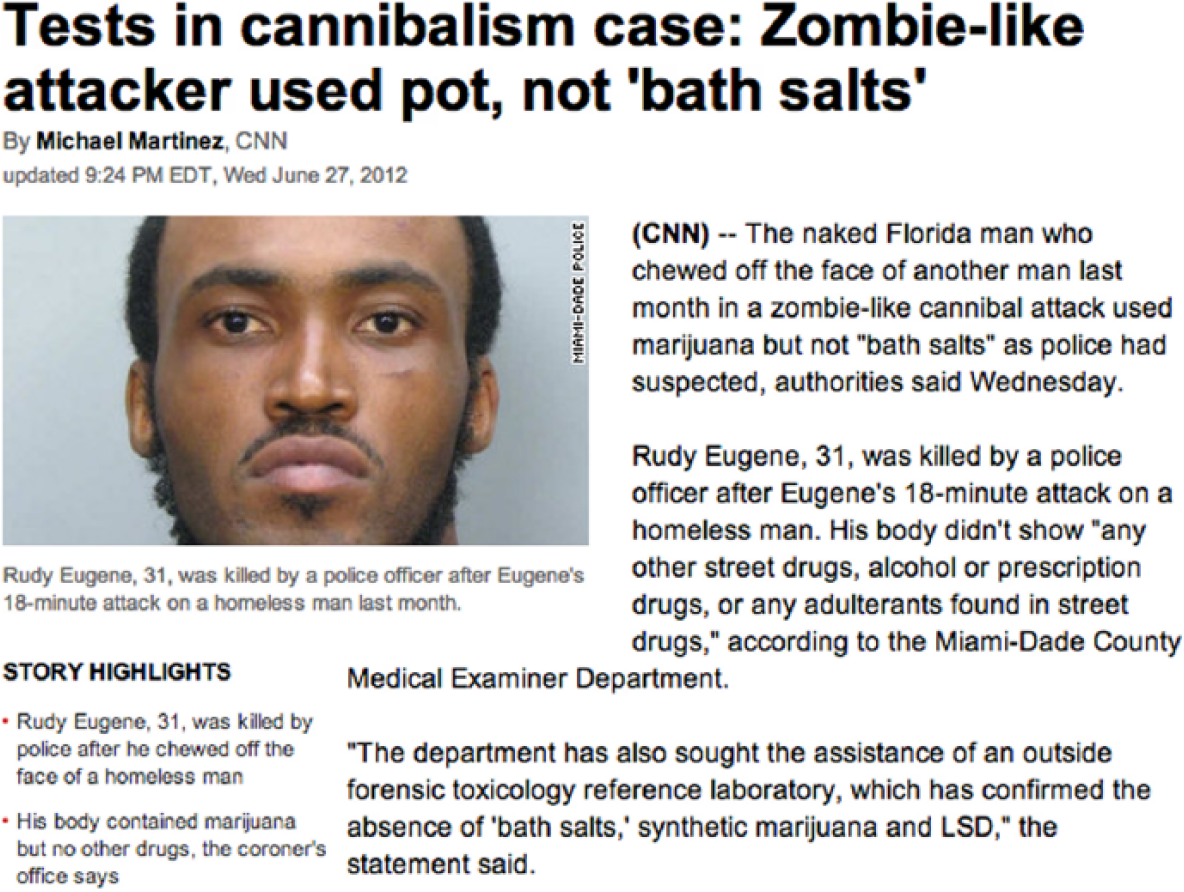
The panic peaks and then recedes, summer 2012.
Although the Miami cannibalism story was widely discredited, as Linnemann and colleagues (2014) have observed, this fact has failed to dispel the conflating of bath salts use with doomsday tales of zombies and corresponding acts of horrific violence in popular culture. The stubborn entrenchment of the bath salts-zombie trope serves as a reminder of the importance of folklore and legend in the construction of drug panics (e.g. Best, 2008; Linnemann et al., 2014).
To wit, roughly six months after major media outlets confirmed no trace of bath salts in Eugene’s system, and after reports of bath salts-related harm had begun declining (Mowry et al., 2014), the US Navy released a dramatized public service announcement (PSA) with a video rendering of a young man on a bath salts “trip” (Khey et al., 2014: 90). Set to “dubstep” music (Miller et al., 2015), the PSA depicts a sailor snorting bath salts, becoming nauseous, assaulting his girlfriend who he hallucinates as a zombie/demon, and collapsing in terror as medical personnel restrain and work to treat him (Ferran, 2013). Figure 2 shows two screen captures from the PSA video.

US navy bath salts “zombie” PSA video, winter 2013.
The comment thread below the story and embedded video reveals a bifurcated view of bath salts and risk of harm in the public consciousness, with some seemingly accepting of the Navy’s bath salts-psychosis-zombie representation, whereas others criticized the depiction as trafficking in hyperbole and fear-mongering to the point of parody. The following comments are illustrative:
Comment 1: Yet marijuana is still classified as a schedule 1 narcotic … nice. Legalize weed and maybe you wouldn’t have so many meth heads and bath salt psychotics running around.
Comment 2: Recreational drugs can have their problems, but when will you learn that the more you sensationalize the ill effects of drugs the more you convince anyone who has tried them … that NONE of your drug warnings hold true. This is just the new “Reefer Madness.” I know people who decided since the lies about marijuana were so obvious, the authorities must be lying about other drugs too. Shame on the mass media, and shame on the navy for being so completely inane.
Digitally archived narratives of drug use and harm
While mainstream and tabloid media work in concert with the state to construct and disseminate worst-case scenario claims of bath salts use inevitably leading to violence and psychosis, digitally archived drug user narratives offer a competing construction. Despite the homogenized representation of bath salts use by the conglomerate media, as McRobbie and Thornton (1995; see also Garland, 2008) have observed, in an increasingly multi-mediated social world featuring an ever-expanding network of audio-visual, alternative print, and digital media platforms, manufacturing consent over drug scares is not as streamlined a process as in decades prior. The publicly archived criticism and mocking of the Navy’s PSA we reference in the previous section is but one example. More relevant is the Internet’s facilitating the development of online forums allowing drug users to network and share stories with similarly motivated others. Such stories are often shared in a context of alternative knowledge construction that is “relational, dialogical, and participatory,” broadly reflecting “the transition from the age of mass media to the age of networked media” (Boothroyd and Lewis, 2016: 297). Here, social practices such as drug taking are what Giddens (1990) terms reflexive; that is, they may be continually reflected on and reformed in light of incoming information about those very practices, thus altering their character.
However, as McRobbie and Thornton (1995: 571) remind, these accounts are not pure and untainted; rather, “these versions of reality [are] also impregnated with the mark of media imagery rather than somehow pure and untouched by the all-pervasive traces of contemporary communications.” Practices to surveil discourse and actively moderate it are routine in new media environments (Hughey and Daniels, 2013), and textual material may be expunged from forum archives, censored, or otherwise modified to fit a preconceived ideological vantage (Kavanaugh and Maratea, 2016). These criticisms notwithstanding, alternative discourses developed and transmitted online have emerged and gained a degree of traction with some audiences in an increasingly diversified mass media environment.
While digital platforms allow for alternative understandings of drug use and risks of harm to be generated and transmitted with increased rapidity (and legitimacy), these discourses are pitted against dominant institutionalized understandings that derive from news media. This style of oppositional framing thus necessitates a concerted attempt at a coherent, public presentation of a group self (Johnston et al., 1994), and we may read the production of “alternative” discourses of drug use and harm as an ongoing communal project aimed at legitimating a broader public health/harm reduction logic. This variant of “harm reduction” emphasizes the creation of techniques directed at the self, developed through a reflected appraisal process that encourages ethical practice (Foucault, 1997; see also Boothroyd and Lewis, 2016). 1 Here knowledge is self-referential and communal and emerges from the bottom up—a competing paradigm that challenges sensationalized mainstream news reports that fuel moral panics and justify prohibition logics. As Judith Butler (2004: 13) has argued in her analysis of the muting of critical discourse following the terrorist attacks on the US in 2001, such oppositional framings construct an irreconcilability, as “the framework for hearing presumes that one view nullifies the other,” with both frames competing for ownership of the drug problem, vying for readership and legitimacy.
Data and methods
With the aforementioned considerations in mind, in this study we examine depictions of bath salts use and risk of harm in two mediated contexts. One context is mainstream news media, and here we culled 110 stories published in local news outlets, between 2009 and 2013; the time frame over which the bath salts panic began, accelerated, peaked, and declined. We opted to focus on local online news sources rather than on “mainstream” news to provide a point of departure from studies that have examined bath salts coverage in legacy outlets such as the Washington Post and New York Times (e.g. Miller et al., 2015; Swalve and DeFoster, 2016). The second context is a digital archive of bath salts user narratives, nested within a nonprofit educational webspace that serves as a repository of archived and continually updated material on psychoactive plants and chemicals. From this archive we culled 109 narratives of bath salts use published between 2009 and 2017.
News articles were located using the LexisNexis Academic News Sources database, applying the search terms “bath salts” and “MDPV.” This generated 1600 stories. We excluded those that did not reference NPDs (i.e. articles on bath salts intended for bathing), articles published in legacy news outlets (i.e. the New York Times, Chicago Tribune, Washington Post, Boston Globe, and LA Times) that have been examined in prior studies, articles published in international news outlets, as well as duplicate articles, leaving a total of 851. From this, a sample of 110 was extracted. News articles were then analyzed using qualitative document analysis (QDA) (Altheide, 1996; Berg, 2003). All of the articles were copied into a MS Word file using the print screen function for QDA. An initial analysis of each story was performed in order to create a preliminary list of frames. Then, using each individual news story as the unit of analysis, we employed a ‘‘tracking discourse’’ approach, examining them “to become familiar with formats and emphases, while suggesting topics and themes that emerge or remain consistent over time” (Altheide, 1996: 70). We then performed a second round of coding to collapse redundant frames. The accuracy of frames was verified by having the authors cross-reference their coding and re-read each story in the sample. The final sample of user-generated accounts comprised all narratives published on the website that featured the terms “bath salts” or “MDPV” between 2009 and 2017. All 109 narratives were included in our analysis. We employed the same analytic strategy for user narratives as for news stories.
Bath salts use and risk of harm in local news
Our analysis of local news stories indicated they principally utilized one of three frames. The majority of stories (43%) were situated within a medical/health frame; 32% of stories featured a typifying example/atrocity story; 22% of stories featured a legislative frame, or provided legal/regulatory information; and 3% of stories drew on multiple frames, generally pairing a medical/health frame with a typifying example/atrocity story.
That the bulk of local news stories we analyzed were situated within a medical/health frame is notable in that it offers a veneer of scientific legitimacy, clinical empiricism, and expert authority to understandings of bath salts use and risk of harm, beyond what may be provided by the police. Of course, the claims of medical experts are often truncated by reporters and co-opted by law enforcement, who sometimes work cooperatively with health professionals to legitimize broader assumptions about drug dangers (Alexandrescu, 2014; Young, 2011). The following section of a 2011 story out of Bangor, Maine illustrates how such institutional partnerships work to legitimize worst-case scenario discourses, in detached and descriptive fashion:
The state medical examiner’s office has determined that a man who took bath salts and died at Eastern Maine Medical Center last July overdosed on the synthetic street drug. Ralph E. Willis, 32, had consumed “a toxic level” of … MDPV, a key ingredient of bath salts, Mark Belserene, administrator of the medical examiner’s office, said Wednesday. It’s the “first confirmed case” in Maine of a death associated with bath salts, Belserene said. At least three people in the Bangor area have died as a result of using bath salts, Dr. Jonnathan Busko, an EMMC emergency room doctor, said in mid-December. Willis was delusional when he was found running around and yelling at people on Center Street on July 22, Bangor police Sgt. Paul Edwards said at the time. “He said he was on [bath salts] and needed to get off them,” the sergeant said. (Ricker, 2012)
Drawing on the expertise of another medical practitioner, a story out of New Hampshire is further illustrative:
Dr. Harnett Sethi, chairman and medical director of the Emergency Department at Chesire Medical Center/Dartmouth-Hitchcock Keene, said patients suffering from the effects of bath salts started trickling into the emergency room about a year ago. “Most are coming in by either police or EMS or a combination of police or EMS,” Sethi said … People on bath salts place a huge drain on hospital resources, as well as take an emotional toll on the nursing staff. The patients also keep police officers in the ER when they would normally return to their patrol … Sethi estimates that over the past three months the emergency room has seen between two to six bath salts patients a month. At first it was drug-users known to ER staff, but the use of bath salts has since spread to a wider population of people, Sethi said. (Pierce, 2012)
The warning given here is less dire than in the prior recanting of a bath salts-induced death, but is notable in that the claimant refers to drug harms neither as a fear appeal nor to elicit sympathy for drug users, but rather to highlight the onerous burden placed on hospital staff and police. Having to manage unruly “bath salts patients” rather than perform other essential professional duties means devoting a restricted supply of emotional and material resources to health care work, all in a futile effort to stymie a problem that is only “spreading.” By framing bath salts as a matter of organizational strain on hospitals and police, claimants are conveying information about drug users who cause harm not just to themselves and their families, but also to health care workers and police officers and, by extension, the general public. This manner of segmenting bath salts users from the rest of society allows for frustrated, unsympathetic, and punitive constructions to gain traction.
In order to further justify the need for, and value of, legal responses focused on banning psychoactive substances, claimants must also construct compelling narratives, which identify both an immediate criminal threat and medical danger that must be addressed in a swift, no-nonsense manner. Articles with headlines such as “Family of dead man: He’d used bath salts” (Conrad, 2012) conjure imaginings of the inevitability of death as a consequence of use and are effective in generating outrage and mobilizing public support for drug prohibition. The following news report from southern Oregon is illustrative:
The [Oregon] man who died after a violent struggle with police last week might have used the dangerous drug “bath salts” hours before his death, according to family members … “If he hadn’t of used that stuff, he would be alive today,” said an emotional Christoph LaDue Sr. “This bath salts stuff killed my boy.” The family struggled with LaDue before he broke free and ran to the neighbor’s house. Police arrived and battled with LaDue, using Tasers that seemed to have no effect. Finally, the officers fought LaDue to the ground and were able to handcuff him. LaDue’s heart stopped shortly afterward. Nearby medical personnel, who had come to the initial call for help and had been standing by, immediately attempted to resuscitate LaDue before transporting him to Rogue Regional Medical Center. He died an hour later. LaDue suffered from schizophrenia but had no history of violence, his father said … Dr. James Hammel, a psychiatrist who graduated from Harvard Medical School, has seen the devastating effects of bath salts in a number of patients in recent years … He said LaDue’s condition was common among bath salts patients. “I didn’t not treat (LaDue), but this is the classic description of what happens when someone does bath salts,” Hammel said. “You have the elevated temperature, the violence …“This drug is going to be a problem in our community for years to come,” Hammel said. “It’s something we are going to struggle with.” (Conrad, 2012)
Here the tragedy of death experienced (presumably) as the result of ingesting bath salts, and the threat to both neighbors and police worked to obscure a potentially important point. That is, a discussion of serious mental illness—in this case, schizophrenia—and the possibility of toxic interactions with legally prescribed psychotropic medication as it may impact drug effects and outcomes (Swalve and DeFoster, 2016). This subject was raised in interview with LaDue’s father, but does not inform the news story at any point following its initial mention. Rather, the reporter consults a medical expert to provide commentary on a death case he was not involved with, and to further speculate on the supposed intractability of the bath salts problem. As Chermak (1997: 713) has found, “media coverage of drug cases illustrates … how the media routines that result from organizational needs allow politicians and law enforcement officials to accomplish system-legitimizing goals.” Medical and health professionals are complicit in this legitimization as well, and drug problems are jointly “owned” by claimsmakers working in (or across) both law and medicine (Best, 2008).
Other tactics used to frame typifying examples were multi-mediated, with reports accompanied by a close-up photograph of the victim, sometimes in mug-shot style (see Figure 3), but more often as a neutral or flattering image, presumably intended to “humanize” the supposed epidemic of death associated with bath salts use. The slideshow in Figure 3 is a rendering of Florida area victims through late 2012 in the Tampa Bay Times (Vander Velde, 2012).
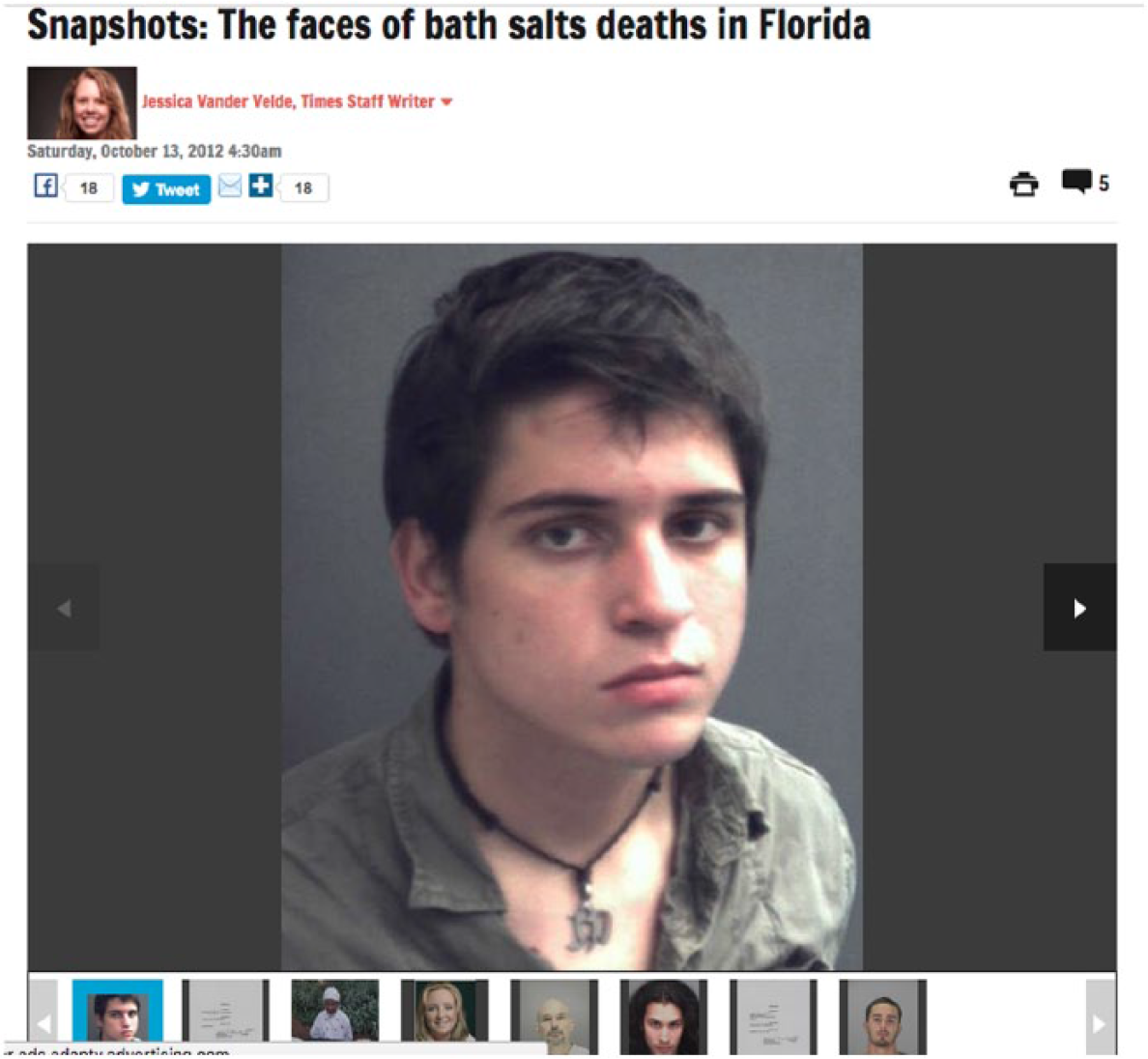
“Humanizing” bath salts deaths.
Below each image is a brief depiction, which includes the victim’s name, age, cause of death, and circumstances occurring prior to their death, such as:
Kristofer Herrera, 21; Date and place of death: July 24, 2011, in Orlando; Cause: Intoxication by methylone (bath salts) and oxymorphone; Herrera was found unresponsive in his apartment on July 24, 2011, after a party the previous night. Witnesses said he had been drinking alcohol and taking “unknown pills.”
What is notable about this case is that the cause of death is stated in the article as toxicity via bath salts and oxymorphone (a schedule II opioid), and the brief depiction of the circumstance stated the victim had been drinking alcohol. In this regard it is worth noting that oxymorphone was removed from the market in June 2017 at the request of the US FDA, with drug warnings indicating that fatal side effects can occur if oxymorphone is used with alcohol. Put simply, this was an opioid-alcohol combination death, or poly-drug death, mischaracterized by local news as a bath salts death. Even more egregious cases are forced to fit this framing. For example: “Frank S. Vierra, 49; Date and place of death: March 14, 2011, in Volusia County; Cause: Self-inflicted gunshot wound to the head. Other factor: MDPV (bath salts).” With no reference to toxicology (as was given for Herrera), mental health, or potentially relevant circumstances other than cherry-picked details such as that “[i]nvestigators found sales receipts for bath salts from Internet retailers,” the uncritical reader is left to infer a simple cause-effect sequencing, with bath salts use implied as the “real” factor in Vierra’s suicide.
These “snapshots,” presented with the authority of coroner and police reports, and juxtaposed with the soft, tasteful aesthetic of a funeral home obituary, hold “remarkable implication for how the public comes to know about drugs … and risk” (Linnemann, 2013: 52). As Alexandrescu (2014: 31) has similarly observed, such a presentation offers an imagining “of the events in which [bath salts’] decisive contribution to the victims’ demise is suggested as fact.” To the degree that media narratives help shape how audiences make sense of the world (Smith, 2005), such reporting works to manipulate public perception toward a preconceived agenda espoused by the reporter, in concert with the police and medical professions.
Bath salts use and risk of harm in digitally archived narratives
The Erowid Foundation has provided a digital repository of archived information about psychoactive drugs and other methods of consciousness alteration for over two decades (Erowid, 2005). One focus of the foundation has been the publication of narratives submitted by users describing experiences with various drugs. According to Erowid, the process for vetting narrative accounts has undergone several changes since it began in 1995, but the current system uses a triage process to filter through the large number of accounts they receive (Erowid, 2016). The foundation has stated they receive more than 25 reports daily (Erowid, 2002; Erowid and Erowid, 2006), with each account reviewed by multiple volunteers, then examined by a site administrator prior to publication (Erowid, 2016).
In addition to a narrative of their drug experience, users’ accounts also feature basic demographic information (age, sex) and drug-specific information (drug dose, route of administration, length of high, prior drug experience). Site administrators also organize the narratives thematically. Themes used to group bath salts narratives into a coherent order were: General; First times; Drug combinations; Retrospective/summary; Difficult experiences/bad trips; Health problems/habituation-addiction; Glowing experiences/health benefits. Some narratives were cross-listed under multiple subheadings.
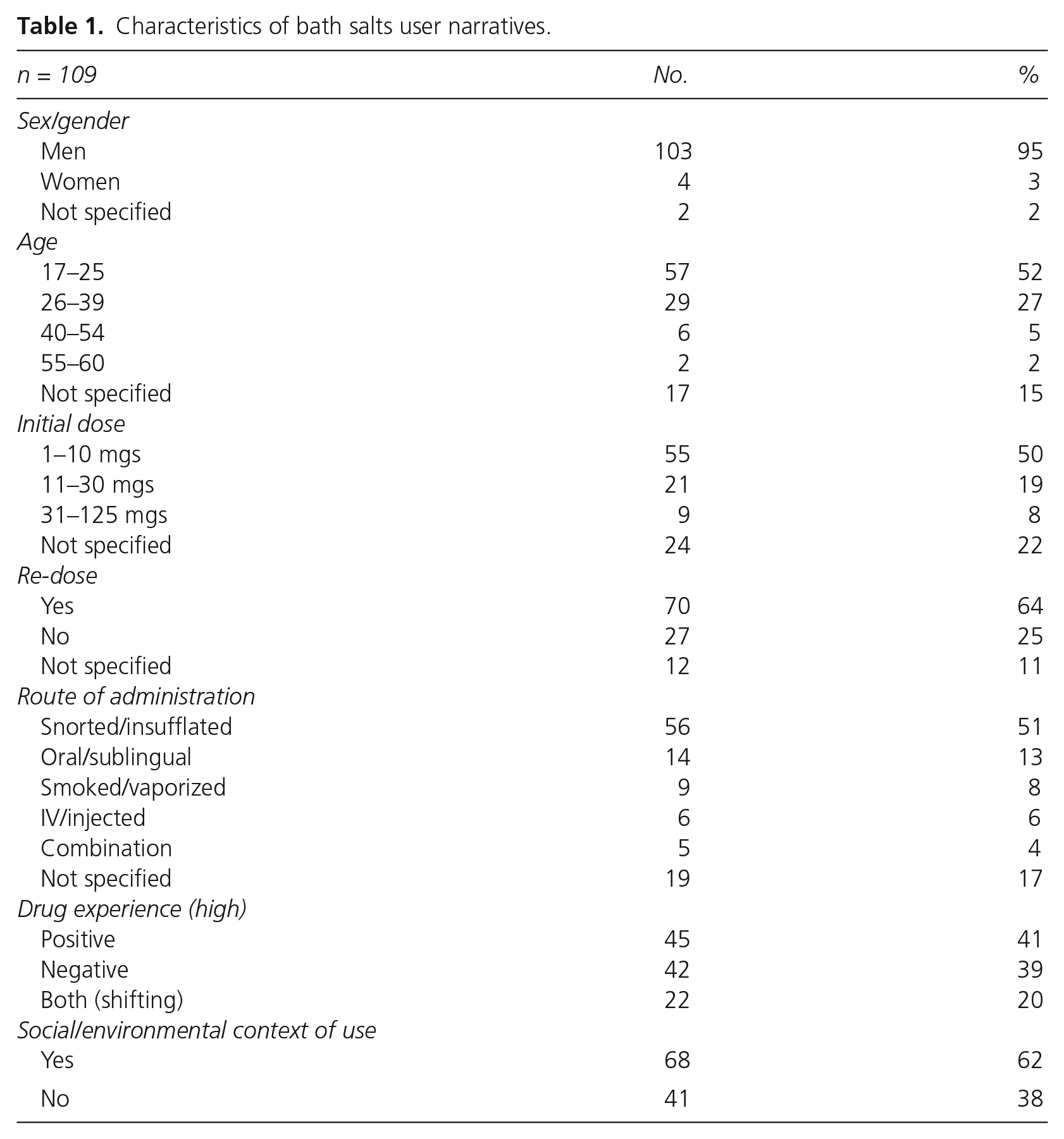
Per Table 1, bath salts use narratives were overwhelmingly authored by younger men, by a factor of about 25:1. 2 We also observed disparities by author sex for other (similar) drugs, but they were not nearly as pronounced as for bath salts. 3 Other information extracted from user narratives to compile Table 1 pertains to style of drug use, drug experience (positive or negative), and the social and cultural circumstances surrounding use. Narratives also specified the length of high (range of 1–11 hours without re-dosing; range of 5–72 hours with re-dosing). The categories depicted in Table 1 indicate that narratives of bath salts use align neatly with Norman Zinberg’s (1984) classic drug, set, setting model of controlled intoxicant use. Here Zinberg reminds us that drug outcomes and experiences are complex, multifaceted, and wholly mediated by the fluctuating and contingent interactions between the biochemical and other properties of the drug (dose, route of administration), the mindset and ascribed characteristics of the drug user (set), and the social and environmental context that drugs are consumed in (setting). Zinberg argues that American culture minimizes the importance of social factors and drug knowledge that can enhance our capacity to have controlled, positive drug experiences. Narratives thus reflect drug use styles that are “controlled and responsible” and are broadly suggestive of a self-conscious “presentation of self” both on the part of Erowid contributors and site administrators.
Characteristics of bath salts user narratives.
Given this, accounts of use and descriptions of risks were neutral and descriptive, and many narratives took an almost clinical tone. Overall, experiences indicated feelings of euphoria, with most reporting feeling “energized.” The most commonly expressed negative experience was severe insomnia, with trips sometimes lasting for well over 10 hours. Of those 42 accounts that described unpleasant effects after dosing, 36 also described tactics used to mitigate or manage these effects. The following snippet of a narrative written by an 18 year-old male is illustrative:
15:15- Effects waning down. Beginning to feel slightly uncomfortable, something a joint instantly cures, for now at least. Gonna take my dog for a walk, fresh air and light exercise does wonders for comedowns. 15:55- Took a 5htp and drank a cup of green tea a while ago. Pretty much no uncomfortability at the moment, feels good to just lie down. 18:32- Still enjoying the effects. Met with some friends and was talkative and had fun. They kept complaining how cold it was, and I was walking in sandals. Epilogue: The uncomfortability never returned, in fact I felt cozy the whole next day, albeit tired. There was some trouble falling asleep though, but that was probably because I redosed too many times with weed, next time I will be wiser. The access to 5-htp, I-thyrosine, vitamins, magnesium and the like really makes the experience smoother.
Across narratives, tactics used to manage unwanted effects centered principally on drinking tea, taking vitamins and herbal supplements, eating food, and using other drugs (over-the-counter sleep medicines, alcohol, marijuana).
Erowid’s vetting of user narratives has apparently become more intense in recent years. Nearly 70% of submitted reports were volunteer-reviewed in 2016, compared with less than half in 2006 (Erowid, 2016). Volunteers are given training to familiarize themselves with a generic grading system and examination of pre-evaluated user accounts to ensure accuracy (Erowid, 2016). After a training period, reviewers are able to access and grade narratives for potential publication. Ratings are “Great,” “Good,” and “Acceptable” for reports that may be published as is, or after slight modification such as adding paragraph breaks, capitalization, or punctuation (Erowid, 2016). Others are rated “Marginal” for those deemed valuable, if not publishable; “Unacceptable” for reports that should be deleted for being too unorganized, off-topic, or unintelligible; and “Cellar” meaning unacceptable but with some relevant data points included. Multiple volunteers review each narrative before a final vetting by a site administrator (Erowid, 2016). Guidelines for the ratings include spelling, grammar, believability, as well as depictions of harm. Quality of reports varies by drug; for some drugs, fewer than 50% of reports are deemed publishable, whereas others exceed 90% (Erowid, 2005).
Quite naturally and given their civic function, we may presume that Erowid privileges narratives that are rational and tempered, and excludes those that are irrational or hyperbolic. The following narrative is illustrative:
Initially, I found it useful in improving my concentration and creativity with very few negative side effects. But as I continued using this drug, I found myself spending increasingly more time inside working, even when there was nothing to work on. My friends commented that they did not see much of me anymore. Around my third week of daily use, I began to develop the stereotyped behavior of twirling the “soul patch” on my goatee. Soon after this, I began hearing an incomprehensible voice coming from the walls. At this point I began weaning myself off the drug. My doses had climbed to 50 mg, and I had to get down to less than 10 before I felt comfortable discontinuing. All of these results are typical for long-term stimulant abuse, but I was amazed at how quickly they came on with MDPV. I do not recommend using it as a replacement ADHD drug. As an occasional study drug, it would probably be much more beneficial.
Although only 14 of those 60 narratives that specified “reasons for use” indicated taking bath salts for study purposes or to meet educational demands, other reasons were similarly unremarkable. Motivations such as “to enhance music,” “as an ADHD replacement drug,” “wanted a little something to keep me going,” and “relaxation” were all stated in at least one user report. Notably, four narratives indicated that “extreme” stories of bath salts in the news media had piqued their interest in using, with three excitedly referencing their anticipating “feeling like a zombie.” While comprising just 6% of those who stated reasons for using, a similar phenomenon has been observed in the UK, where “extended media coverage of the alleged harms caused by mephedrone actually increased the prevalence of use, as people understood that most of it was exaggerated” (Nutt, 2012, quoted in Alexandrescu, 2014: 34).
User narratives are also lightly edited in the final review process to promote quality and readability (Erowid, 2002). While changes such as punctuation or text spacing are performed routinely for the sake of readability, the foundation claims to take a stance against substantial changes for fear of removing the author’s voice (Erowid, 2002). Administrators also remove details such as full names, addresses, or product names where appropriate to preserve anonymity (Erowid, 2005, 2016). Most notably, in a number of instances, site administrators interject their own information into the rigorously vetted and “lightly edited” narratives. While additions to the narrative in this manner were not overly common (26 of the 109, or 24% of narratives, featured interjected information), this further underscores the influence of site administrators on the user narratives they select for publication.
Modifications of this sort came in three variations. A white edit was the least intrusive, and the text was the same color and style as the narrative itself. White edits were used to include important information that was otherwise absent from the narrative, or difficult to identify—generally to more clearly specify and prominently feature the reported dose taken. Yellow edits were used to clarify technical (pharmacological) information; for example, that chemical composition of drugs can vary across cases, the dangers of “eyeballing” measurements, or other public service-like information. Red edits were rarely used (occurring just twice in the narratives analyzed), and flagged cases involving clearly hazardous use of the substance that could, or in one case apparently did, result in severe health consequences.
As Figure 4 shows, the yellow text is bracketed and set apart from the author’s voice, and alerts readers to the importance of carefully measuring the drug dose. The purple text that immediately follows in this example provides a hyperlink to an Erowid article offering the reader further information on this topic. Significantly, these narrative interjections, pitched within an “alternative” medical frame of controlled intoxicant use as harm reduction, depend on a privileging of individualism and free will and the belief in a completely rational actor. This, of course, stands in stark contrast to panicked news reports of irrationality and loss of control that feed prohibition logics. As Keane (2003: 230, emphasis added) reminds us, the “tension between a demand for … protection by the state [from dangerous drugs] and a demand for freedom from state regulation” is one that has long framed drug debates. The two contexts examined here present audiences with oversimplified and modified claims, and both are partially dependent on medical-health jargon to legitimate them. Both frames, then, exist as cultural contradictions, and illustrate how knowledge of drug use and risk of harm is made (and deconstructed) culturally, in bifurcated contexts.
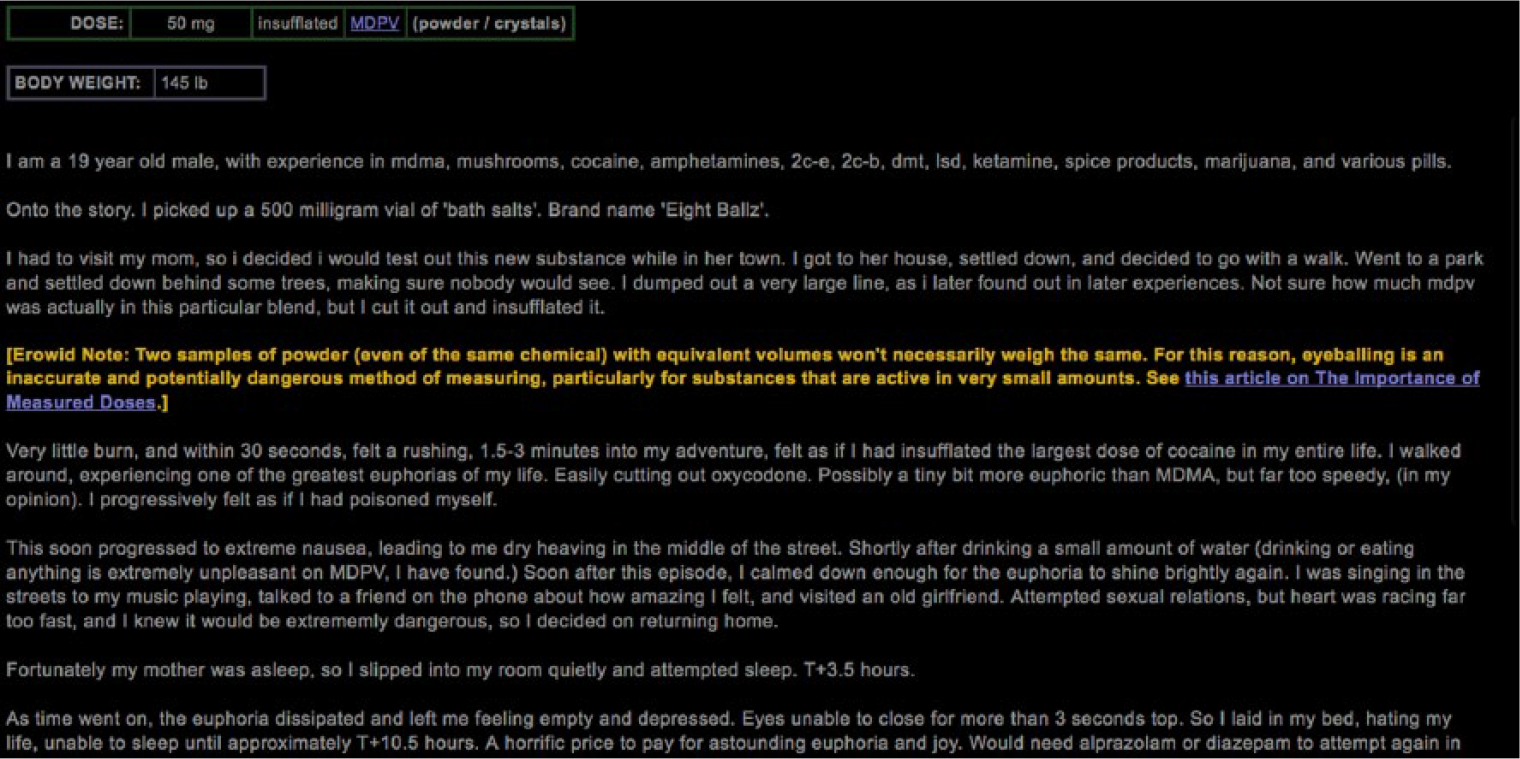
An administrator-moderated user narrative.
Conclusion
Drawing on depictions of bath salts use in 110 local news stories and 109 individual user stories, our aim was to highlight the incongruence between accounts of use and harm in local news reports versus drug users’ own narratives. Findings revealed that depictions of bath salts use deriving from news reports drew largely from medical and police professions, and emphasized three overlapping frames of risk, presented as typifying examples/atrocity stories, medical/health information, and legal/regulatory information. Conversely, Erowid user reports of bath salts use were neutral and richly descriptive, with tempered accounts of drug effects, physiological and social experiences while using, contexts of use, as well as tactics used to manage undesirable effects and maximize the pleasure of the drug experience. News media reporting of psychosis, death, and unprecedented danger wrought by bath salts overlooks the agency of individual drug users to uniquely manage and optimize their drug use experiences. Perhaps unsurprisingly, such worst-case scenario framings have had little impact on the desire to experiment with bath salts, at least among the user narratives in this sample. Rather, dramatized reports of harm served to undermine the credibility of news reports as a viable source of information on drug effects and possible risks and, paradoxically, functioned to pique interest in bath salts experimentation in several instances (see also Alexandrescu, 2014).
By focusing on what has been described as a “mundane” drug panic (Linnemann et al., 2014), the news media representations analyzed here show how the drug war logic of prohibition is legitimated by medical science so that fear becomes inscribed into the public consciousness and accepted as matter of fact, in routinized fashion and in deference to “experts.” This reporting style inevitably alienates casual drug users and raises serious concerns for public health regarding the accuracy of the information disseminated. 4 As with more protracted drug panics such as the archetypical crack scare of the 1980s, routinized and short-lived panics with “new” drugs such as bath salts work to reinforce prohibition logic as cultural hegemony.
The period of news media coverage captured here provides a useful point of analysis, but we do not suggest that the story of “bath salts” concluded in 2013. Evidently there remains a great deal of work to be performed by the US law enforcement apparatus since the Synthetic Drug Abuse Prevention Act was signed into law in 2012. The (former) director of the US ONDCP recently acknowledged that:
as of December 2015, the United Nations estimated there were over 600 identified NP[D]s available on the global market, with the vast majority … not controlled under United Nations (UN) drug treaties or domestic drug control authorities. Although the UN, the US Government, and all 50 states … have developed regulatory responses to control these substances, the rapidity and ease that [NPDs], and in particular new analogues of recently controlled substances, can be manufactured, makes control through traditional regulatory, legislative, and law enforcement responses challenging. (Boticelli, 2016: 2)
It would then seem, as Linnemann has observed, that US drug policy resembles “a game of ‘whack-a-mole’ where law enforcement barely keeps pace with new threats as they arise” (Linnemann, 2013: 52). With the ever-present futility of drug prohibition as the backdrop, local news media continue to generate new (or revive and repackage old) panics about bath salts and related substances, drawing on discredited and/or fantastical renderings of use. Figure 5 is illustrative of this.
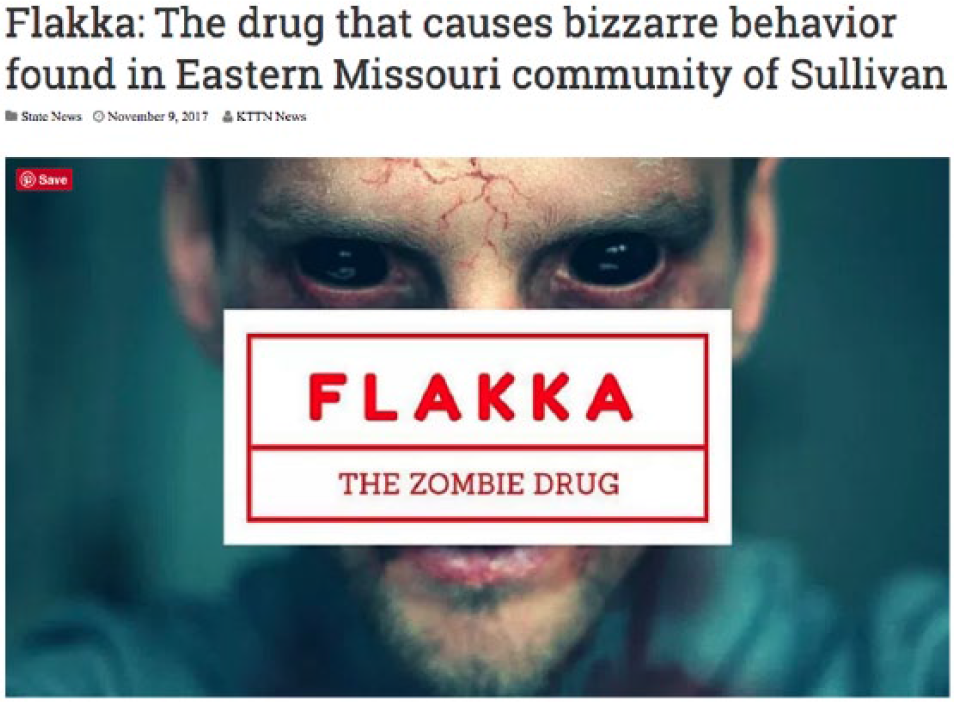
Local news story on new “zombie” NPD, autumn 2017.
While the image accompanying the news story in Figure 5 trafficks in the familiar “zombie” imagery that has emerged as the default representation of bath salts users since 2012, portions of the story hint, however uncritically, at the fruitlessness of prohibition and its unwitting exacerbation of drug-related harm (KTTN Radio, 2017):
The man-made drug causes a high similar to cocaine but can be much more dangerous … Flakka is made from a compound called alpha-PVP, a chemical cousin of cathinone, the amphetamine-like drug found in bath salts. While the active ingredient in bath salts was officially banned in 2011, its newer relative, alpha-PVP, was not.
The point that engineered stimulants such as flakka only emerged to bypass cocaine prohibition is never engaged with by the reporter, nor is it that synthetic black market analogues to other prohibited drugs such as heroin and cannabis—like fentanyl-related substances and synthetic marijuana—are more potent and dangerous than the drugs they mimic. 5
Despite the quick move to prohibit various NPDs by the government in 2012, and an ever-growing arsenal of chemical analogues occupying current legislative attention, drug overdose deaths in the US continue their steep climb (Centers for Disease Control (CDC), 2017; National Institute on Drug Abuse (NIDA), 2017). Notably, roughly two-thirds of deaths involve heroin or other (legal) opioids such as hydrocodone and fentanyl-related substances, which are often combined with legal drugs like alcohol and acetaminophen (e.g. Hart, 2016). The bulk of the remaining overdose deaths result from the legal (mis)use of benzodiazepines- a class of drug marketed to “treat” ailments endemic to late capitalist societies such as anxiety and panic disorders, nervousness, sleep problems and alcohol dependence. 6 Similarly, overdose deaths with benzodiazepines often involve circumstances where the user combined them with other drugs like antidepressants, alcohol or opioids (NIDA, 2017). Conversely, deaths resulting from bath salts and newer variations such as flakka are so low that the state does not even track them (Centers for Disease Control and Prevention (CDC), 2016).
Drug combination-toxicity issues notwithstanding, in this article we have contrasted local news media reports of bath salts use and risk of harm with those presented in a digitally archived forum of user narratives to highlight a competing construction. This construction envisions a “healthier” and more “rational” relationship to drug using, and the clinical/public health tone often incorporated or forced into user narratives borrows broadly from mainstream medical discourses on health and well-being (Boothroyd and Lewis, 2016). However, it is important to remember that while the Internet has facilitated spaces promoting the textual circulation of “alternative” discourses among drug users, the “emancipatory potential” that Fraser (1990: 68) has ascribed to subaltern groups is restricted in that these spaces are not wholly theirs to control (Kavanaugh and Maratea, 2016). Dependence on an external platform run by site administrators ensures that economic, legal, or other (ideological) considerations exist beyond simply enabling subaltern communique.
Our observations suggest a utilitarian logic on the part of Erowid that works to restrict the selection of user narratives presented for public consumption to privilege those judged to be useful, functional, and sensible. As Foucault has noted, all discourses, but especially those that counter dominant institutionalized ones, are plagued by the possibility of descent into irrationality. As such, “prohibitions, barriers, thresholds and limits [are] set up in order to master, at least partly, the great proliferation of discourse in order to remove from its richness its most dangerous part …” (Foucault, 1981: 66). Erowid thus engages in matter-of-fact practices of moderation and censor in its aim for legitimacy, as site administrators are (self)conscious of the fact that the viability of a nonclinical counterdiscourse on drug use and harm reduction is partially contingent on its rational containment.
Although often vetted, excluded, and otherwise altered by site administrators and those working under them, we nevertheless maintain that if the state wishes to formulate approaches to drug harm beyond prohibition, it might do well to incorporate the expertise of a group of experienced drug user narratives that are both richly descriptive and situated in a public health-harm reduction frame that aligns with the principles of controlled intoxicant use (Zinberg, 1984). Reflecting late modern approaches to crime control, this manner of framing may be viewed as a specialized kind of responsibilization strategy (Garland, 2001), where authority is self-referential, emerges from a small group of non-credentialed, anonymous (lay)experts, and is predicated on the development of a proficiency in, or mastery of, drug use. Perhaps, then, “it maybe lays the foundation for a new civic culture” (Alexandrescu, 2014: 34); that is, still describing drug use and depicting risks of harm, but in a comparably rational manner and without being uncritical or celebratory. Given the current cultural and political climate in the US, however, we are not so optimistic. As myriad “fake news” stories and unverifiable claims of extreme drug-related harm continue to rue the day, efforts to present a competing paradigm that is both coherent and rational (and emerges from the bottom up) in a way that gains serious, enduring traction in mainstream public arenas will likely remain challenging.
Footnotes
Acknowledgements
We would like to thank the anonymous reviewers at Crime, Media, Culture for their helpful comments on an earlier draft of this manuscript.
Declaration of conflicting interests
The author(s) declared no potential conflicts of interest with respect to the research, authorship, and/or publication of this article.
Funding
The author(s) received no financial support for the research, authorship, and/or publication of this article.