






Abstract
Coaching can be viewed as inherently improvisational, yet has rarely been researched as such. This paper explores how coaches experience improvised theatre and the insights they gain for their coaching practice. Eleven executive coaches participated in a qualitative study using interpretative phenomenological analysis. The findings highlight the power of improvisational theatre exercises as experiential learning for coaches, including in self-awareness and presence, empathy and rapport-building, and comfort with co-creation and the unknown. Application of improvisational principles and exercises within coaching practice as part of a more playful, experimental and creative approach is also explored, to support client growth.
Introduction
Coaching can be described as “partnering with clients in a thought-provoking and creative process that inspires them to maximise their personal and professional potential” (ICF, 2019). It is an increasingly popular form of learning and development, helping people navigate and adapt to an uncertain and ever-changing business environment (Athanasopoulou & Dopson, 2018). Coaching, as a dialogic, client-focused practice, can be viewed as an inherently improvisational activity (Read, 2013), yet improvisation has so far barely been mentioned within the coaching literature. We believe this is the first study to explore the relevance and impact of improvised theatre exercises for coaching.
The concept of improvisation has been applied in both organisational and therapeutic contexts. Improvisation can be viewed in an organisational setting as “creativity, adaptation and innovation under time pressure” (Ratten & Hodge, 2016, p. 149) and in therapeutic contexts as “an unpremeditated spontaneous activity emerging within an interactive context” (Romanelli et al., 2017, p. 12). In both contexts, the application of theatrical and comedic improvisation (improv) has been of interest. Improv “is a style of theatre performance where the actors perform without a script and make up the play as it is being performed” (Ratten & Hodge, 2016, p. 150). There has been interest in the leadership and management literature in the conceptual and practical parallels between improv and how leaders and teams can operate more optimally in climates of uncertainty (Eppehimer & Pintar, 2021; Ratten & Hodge, 2016). Focus on the conceptual and practical links between improv and therapy has dwelt on opportunities for therapists to develop their flexibility and presence, through the lens of therapy as an improvisational, co-created encounter (Romanelli & Berger, 2018). Training exercises derived from improvised theatre and comedy have been used widely within corporate environments over the last three decades, promising to build collaboration, confidence, spontaneity, and creative thinking (Leonard & Yorton, 2015). The evidence base for their impact is increasing, though still limited, and includes benefits with respect to themes such as flexibility of thinking, collaborative behaviour and psychological safety (Felsman et al., 2020; Kirsten & Du Preez, 2010).
Professional competency frameworks recognise the need for coaches to develop skills, behaviours and ways of being that are associated with improvisation, including presence, co-creation and active listening (ICF, 2019), yet the concept is largely overlooked within the coaching literature (Read, 2013). This means that coaching, an eclectic profession which draws widely on a range of philosophies and disciplines (Hardingham, 2006), is potentially failing to capitalise on a conceptually relevant and impactful field of practice. Given the increasing research evidence base around the potential benefits for individuals and teams of engaging in improvisational theatre activities (Felsman et al., 2020; Ratten & Hodge, 2016), as well as evidence from therapeutic contexts on benefits for therapist development (Romanelli & Tishby, 2019; Romanelli et al., 2017), it is important to ensure that coaching as a profession explores improvisation and improvisational theatre exercises, from both a coach development (identity and practice) and a client perspective.
Literature Review
The Development and Application of Improvisational Comedy and Theatre
Improvisation is a form of unplanned collaborative performance (Halpern et al., 1994). Modern improvisational theatre (often simply referred to as improv) is most well-known as a form of spontaneous, often comedic, performance, associated with a number of theatres and training schools in the USA and Canada, and television shows such as Whose Line Is It Anyway? (Leonard & Yorton, 2015). This modern improv has its roots in European theatre, including in commedia dell’arte, a spontaneous form of performance dating from the sixteenth century (Frost & Yarrow, 1990; Halpern et al., 1994). Core principles include ‘yes, and’, which is about building on, rather than blocking, others’ ideas (Halpern et al., 1994; Johnstone, 1979). This principle of agreement is seen to offer an environment of experimentation because actors can stretch themselves, knowing they are in a climate of safety and not being judged for their choices (Vera & Crossan, 2005).
Many of the exercises and games used to train improv performers to develop the skills needed to work spontaneously and collaboratively are now used in organisational, educational, and other settings. These originate from the work of Viola Spolin and Keith Johnstone. Spolin's ground-breaking work in the mid-twentieth century with immigrant and socially disadvantaged families in the USA focused on developing concentration, confidence, and creativity (Schinko-Fischli, 2019). Johnstone's writing, which originally aimed to enable actors to develop more spontaneity and creativity, provides a blueprint for much of modern improv, has been adapted in organisational learning settings to meet the challenges faced by leaders and teams (Johnstone, 1979).
Improvisation as a Leadership and Organisational Discipline
Organisational improvisation, which considers improvisation as a workplace phenomenon, has become the subject of increasing academic and practitioner interest over the last three decades (Barbosa & Davel, 2022; Hadida et al., 2015). Vera and Crossan (2004) argue that: improvisation has gained recognition as a strategic competence that supports twenty-first-century firms’ requirements for change, adaptability, responsiveness to the environment, loose boundaries, and minimal hierarchy. (p.727)
The recognition of the need for a different, more adaptive approach to address ‘wicked’ issues, such as climate change, within complex systems, is recognised within both the management and coaching literature (Clutterbuck, 2020; Hawkins & Turner, 2020; Senge, 2006), although is rarely referred to as improvisation. For many years, conceptual discussion of improvisation in organisations focused on the jazz metaphor, which Hadida et al. (2015) note was attractive for both its sense of intrinsic value, when people choose to improvise, and instrumental value, when they have to do so, in response to unforeseen events or changes in the external environment. Whilst organisational improvisational thinking has moved beyond the jazz metaphor to provide a more in-depth taxonomy (Hadida et al., 2015; Kamoche et al., 2003), theatrical improvisation has become popular as both a metaphor and a more practical and accessible approach to skills development.
Given modern leadership challenges, it is easy to see the natural attraction of applying both the metaphor and training techniques of improvised theatre within the workplace. Improvisational theatre training exercises are not about ‘performance’ per se, but about equipping players with the skills, behaviours and way of being to work together as a creative team, in the uncertain environment of an empty stage, making use of audience suggestions. Modern organisational climates are also uncertain, requiring leaders and team members to collaborate and adapt in new and often challenging ways to create new ideas and solve problems. Vera and Crossan (2004) argue that: improvisational theatre is about embracing the uncertain, trusting intuition, acting before thinking, adapting to circumstances, and working as a group in a process of creation. (p. 731)
The Emerging Evidence Base for Improv in Learning and Development
Improvised theatre exercises have been used as a training and development intervention in organisational and other settings for a number of decades, promoted as offering benefits such as improved collaboration, creativity and enhanced listening. Ratten and Hodge (2016) argue that: the bulk of current literature on improv theatre training in a business setting is theoretical and not grounded in a specific application of the principles to actual participants. (p. 150)
Studies in the realm of team development and interpersonal skills also point to findings that may be relevant to both leadership and the developing field of team coaching. A quasi-experimental study by West et al. (2017) shows that creative teams which engaged in improv training demonstrated increased playfulness and creativity. A previous quasi-experimental study by Kirsten and Du Preez (2010) suggests that improvised theatre training is beneficial for teams through the creation of climates for innovation, drawing out impact in areas such as trust and support, acceptance and listening and awareness.
Although limited in number, these studies suggest promising findings with respect to the impact of engaging in improvised theatre exercises as a self-awareness, learning and skills development tool. This is relevant to coaching as a discipline that seeks to integrate evidence-based approaches within eclectic practice, and that supports clients to work on a wide range of personal development themes.
The Role of Improvisation Within Coaching and Related Disciplines
Professional coaches are working with clients in an uncertain and rapidly changing environment, in which “the need for deeper self-awareness, psychological flexibility, deep collaboration, curious conversations and co-creation is growing” (Palmer & Whybrow, 2019, p. 5). However, improvisation has only been briefly introduced and explored in the coaching literature (Read, 2013, 2014), and never with respect to improvisational theatre. It has relevance as a concept within coaching, recognising that, if coaches need to be able to improvise, they need to engage in development to help them to be confident and comfortable doing so. There is also the potential to explore the practical application of improvised theatre exercises to support client learning and growth, as well as that of the coach, based on findings from research in other related fields. Increasing interest is also emerging within the coaching literature on the role of playfulness in its many forms to support client self-awareness and learning (Wheeler & Leyman, 2023). This includes the importance of relationship, authenticity and presence in their development of playfulness, in order to bring benefits such as the deepening of the relationship, space and lightness (Wheeler, 2020). Improvisation is potentially one way to develop and explore playfulness.
The concept of improvisation is more established within the therapeutic context. For Kindler (2010, p. 222), it “embodies the idea of a cooperative effort at keeping the play, or creative conversation, going forward” and is an important concept and skill for therapists to facilitate learning and growth in the therapeutic relationship. Recognised concepts in both therapy and coaching, such as presence, self-awareness, co-creation, being ‘in-the-moment’ and integrated practice could all be described in some way as improvisational.
“Professional coaching is improv” remarked one participant in Read's (2013, p. 50) qualitative study of how far coaches improvised within their own practice. The study found that improvisation, defined by him in the study as “a spontaneous and creative attempt at finding a new way of doing things” (Read, 2013, p. 56) was used extensively by coaches (Read, 2013, p. 52). This echoes work by Romanelli et al. (2019), building on their qualitative study of therapists’ experiences of improvisational or ‘spontaneous peak moments’ in their practice, suggesting they are “out-of-the-box, creative, and surprising interventions and interactions occurring within the framework of the therapeutic encounter” (p. 297). This could include a whole range of interventions with a client, and could be akin to anything in coaching from a provoking question, an extended metaphor, or a freeform creative experiment’, to the direct application of an improvised theatre exercise or game.
Romanelli and Tishby (2019) draw parallels between improv theatre guidelines and competencies, behaviours and skills relevant to clinical social work. Arguably, many of these are also very relevant to coaching, as a dialogic, helping relationship. These include staying curious; listening and watching (including for what emerges in you); accepting and building on the other's reality; and making clear offers to move the co-creation forward (Romanelli & Tishby, 2019). Their well-designed mixed-methods study looks at the impact of a semester-long improv theatre course on flexibility and therapeutic presence amongst 35 graduate-level clinical social work students (Romanelli et al., 2017 and Romanelli & Tishby, 2019). The qualitative findings indicate an increase in flexibility, open-mindedness, therapeutic presence, self-disclosure and self-awareness following the training.
The promising findings from therapy and organisational settings, coupled with the lack of any research on improvised theatre exercises in coaching, suggest there is a gap in the literature that is worthy of further exploration, especially through interventional, exploratory research. This paper addresses that gap producing findings that respect experiential learning in coach development, and explore practice to support client growth in an emergent, playful and experimental way.
Methodology
The research involved the participation of 11 experienced coaches in a 90-min experiential workshop (delivered virtually by the researcher), during which they took part in eight exercises drawn from improvised theatre training. Following a period of reflection, participants were interviewed about their experiences in individual semi-structured interviews. Given the very limited research on improvisation and coaching, and absence of any studies using improvised theatre exercises, a qualitative, exploratory approach seemed well-suited, offering a potential richness of data and analysis. IPA, which “aims to explore in detail participants’ personal lived experience and how participants make sense of that personal experience” (Smith, 2003, p. 40) was chosen as the research methodology.
Participants
Participants were recruited via callouts on the lead author's professional networks. The inclusion criteria used to recruit participants included: a practising leadership/ organisational/business coach; a postgraduate-level coaching qualification; at least three years’ post-qualification coaching experience; at least 50 h of coaching practice in the last 12 months; and coaching primarily in English. Applicants who were friends, clients or collaborators/associates of the researcher were declined, in order to ensure a broad range of perspectives. Experienced coaches were sought to enable insights based on wide practitioner experience.
Eleven participants were recruited to the study. Whilst Smith et al. (2009) argue that one case could represent a suitable unit of analysis for IPA, typical studies have more participants; between six and 12 would be usual. Demographic data was collected for the group, in preparation for publication. Seven out of 11 participants responded to the request. Four participants were male, two were female and one person preferred not to say. Six participants were white, and one was of mixed heritage. One participant was over 65 years of age at the time of the study. Five were between 55 and 64 years and one participant was in the 45–54 years age bracket.
Procedure and Data Collection
Participants were invited to book in to one of two identical workshops, facilitated by the researcher. Four participants attended the first workshop and seven the second. Each workshop lasted 90 min and comprised eight practical exercises drawn from improvised comedy and theatre. The workshops were conducted via Zoom. The researcher had practical experience of adapting and using improvisation exercises virtually. They included a mixture of whole group, paired and small group exercises. They were drawn from the researcher's own training and experience, but all were derived in some way from the work of Johnstone (1979) and Koppett (2001).
The researcher offered instructions at the beginning of each exercise on the ‘mechanics’ but did not include learning objectives, provide de-briefs after each, or allow for group reflection and discussion. This was in order to try to ensure that the subsequent interviews would represent individuals’ own lived experiences of the exercises, rather than seen through the lens of layers of group or facilitator interpretation. Instead, participants were asked to make their own reflective notes after each exercise, which they then drew on during the interviews.
Data collection took place via individual semi-structured interviews, conducted by the researcher via Zoom in the three weeks following the workshops. Willig (2013) highlights the importance of IPA questions being open-ended and non-directive as the researcher is attempting to enter the lived world of the participant, not to test constructs, hypotheses or theories. This informed the semi-structured prompts used in the interviews.
Data Analysis
Analysis of the interviews took place based on the step-by-step IPA methodology outlined by Smith et al. (2009), which involves engaging with each transcript at depth in turn to achieve higher levels of abstraction. In line with the idiographic tradition, only once such super-ordinate themes have been identified within each separate transcript, are patterns sought across the 11 cases.
As a highly interpretative approach, which relies on the ‘double hermeneutic’, IPA will always offer findings which represent a co-creation between participants and researcher. The researcher engaged in reflective practice and received support and challenge through discussion with the second author throughout the process. This completed research paper was circulated for participant validation prior to final submission, with no concerns raised.
Results
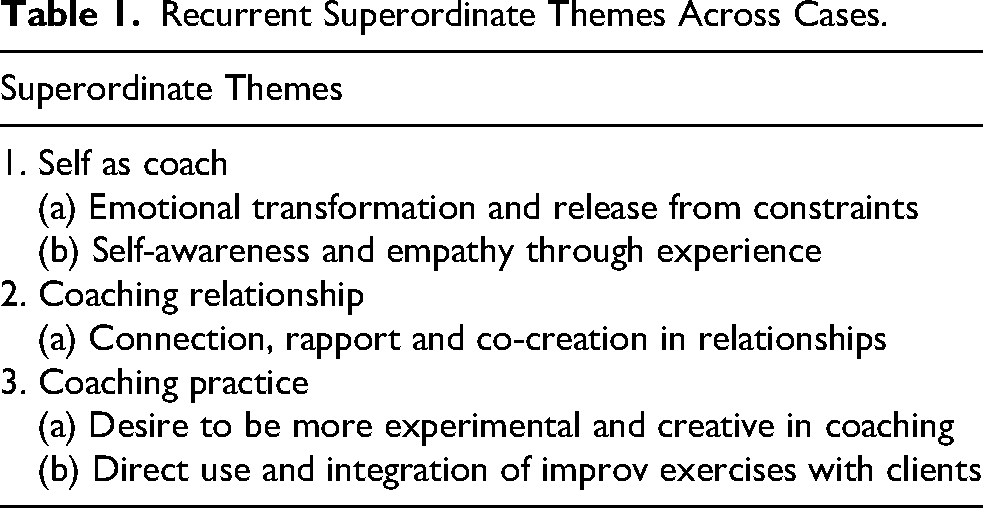
Three superordinate themes were identified, which could be broken down into five sub-themes in total. Each of the themes is explored with specific reference to individual cases, acknowledging the potential for “considerable variation” across the cases and that “the same…superordinate theme may look very different in how it is evidenced across different participants” (Smith et al., 2009, p. 107) (Table 1).
Self as a Coach: Emotional Transformation and Release from Constraints
Participants were asked about their emotional experiences within the interviews and, whilst all spoke of changes in their emotions and many moments of fun, for seven people this exhibited itself as a more transformative experience, resulting in very positive emotions by the end of the workshop session. All these participants contrasted this emotional release or refreshment with some form of constraint within themselves, their professional practice as coaches, or within wider society. The physical and other constraints relating to Covid-19 and virtual working, also surfaced within participants’ accounts, highlighting the relevance of contextual factors in analysis of experiences.
For Participant 8 the experience resulted in a strong sense of energy, following initial apprehension: “I became very energised, really, really energised. I was really into my element.” The transformation dramatically changed their feelings and energy levels, giving a boost that they relived within the interviews. Similarly, Participant 9 compared this end state to their lower mood on arrival: “I’m pretty sure [my mood score] would have gone up dramatically; properly energised and quite bubbly.”
For Participant 3, the experience was explicitly identified as being childlike in its playfulness. This had a mischievous and subversive quality, bringing a sense of wanting to push boundaries and subvert norms. They said: “It was like play, it was childlike” and that they felt a sense of release and joy to subvert expectations, “I did notice I wanted to go smutty.” For Participant 6, it was refreshing to break free of professional expectations for a while: “Just being able to be a bit silly and let our guard down and not have to be terribly professional for an hour was quite refreshing.” They also contrasted this with the weight of responsibility that they feel within a coaching encounter: “Quiet, quite releasing actually…because normally…the responsibility is with us.”
Participant 5 also revelled in reliving the childlike quality of the experience: “Genuinely, I was really excited…like a big child.” However, this also provoked a strong, almost visceral reaction to what Participant 5 perceived as the constraints on creativity, both for themselves and wider society. They used emotive, repetitive language of incarceration to convey that “there's stuff there that's locked up” and “it's locked away,” in relation to their own creativity, and commented, “we’re walking round in the shadows, half-asleep.” Participant 7's reflection on personal playfulness and creativity was softer in tone, drawing on the sleep metaphor to remark that: “Things like my imagination…it's not used that much. It was sort of like waking it up again” and “I just let my imagination run a little bit free, which was quite refreshing to do.”
Self as a Coach: Self-Awareness and Empathy Through Experience
The role of direct experience through the exercises in heightening awareness of feelings, thoughts and behaviours was a common theme in eight of the cases. This appeared to offer insight both as an individual and as a coach, particularly with respect to levels of comfort in being ‘in the moment’, coping with uncertainty and reacting spontaneously.
Participant 11 reflected on how exposed they felt as a coach when they were uncertain about what to do next: “you have to feel professional even when you don’t feel it in a coaching relationship.” Participant 8 shared a sense of pressure to do well and highlighted the benefits of being able to move beyond the filters and self-judgement within the exercises: “Once we got past this notion…so obsessive [of] getting it right but just give it a go…you’d be amazed what the outcome was.” This enabled them to reflect on how they could support and be more comfortable with emergence within coaching: “When I just allow myself to relax, I give myself permission…magic seems to happen with clients.”
For Participant 1, initial discomfort was accompanied by a positive sense of surprise at stretching or pushing themselves out of their comfort zones, recognising that: “I was really struggling. And then it was my turn, and I wasn’t.” For Participant 10, the freedom of going with their ‘gut’, rather than ‘over-thinking’ offered both insight and delight: “I suddenly said, oh, it's a…! And I thought, where's that come from?” That sense of self-discovery was experienced by Participant 3 as the opportunity to surface different, surprising sides of themselves, challenging their own sense of self or their limiting beliefs: “I’m not spontaneous and yet in this setting I can be.”
For Participant 6, the experience promoted a stronger and explicit empathy with clients during a coaching encounter, especially with respect to feeling put ‘on the spot’ or challenged by the coach: “Whether I realise it or not…I’m stretching them out of their comfort zone all the time. And I’m so used to doing it now that I forget…what it feels like.” Similarly, for Participant 4, the experience of the workshop led to empathy with clients: “I suspect there might be a lot of pressure on them to feel they’ve got to respond. I think that's one of the biggest learnings really.”
The Coaching Relationship: Connection, Rapport and co-Creation in Relationships
The speed of the building of relationships, safety and sense of rapport within the group was strongly remarked upon by nine participants.
Participant 8's personal experience of the speed and safety of group connection was important in helping them overcome their initial “apprehension and fear; how much of myself do I want to reveal?” Participant 6 commented on: “That camaraderie…such a simple process and approach that can build that level of connection… fascinating… surprising.” Similarly, Participant 5 drew out conceptual and practical links to the coaching relationship, through reflection on their experiences in certain exercises and the overall experience of feeling part of a group, particularly with a group of strangers in the virtual environment. For instance, they experienced surprise and delight at the warmth of relationships: “Two strangers…and literally, at the end of that, I wanted to go on a daytrip with them!”
Participant 10 reflected on the power of particular paired exercises in building strong rapport, safety and intimacy, commenting that: “We just sort of seemed to blend seamlessly, without any effort.” Participant 2 conceptualised the experience with reference to co-creation and building rapport within coaching relationships: “to demonstrate somebody leading and following … working with each other in the co-creation of something.” For them, that also related to confidence and comfort with emergence, a theme touched on in a number of ways in the research: “That confidence to realise that that is okay, that … the exploration is happening as you’re going along. And to be comfortable with that, in the moment.”
For Participant 5, safety was crucial to how they and others reacted: “I was reflecting, if you didn’t feel safe, you might feel quite threatened by it.” Participant 6 reflected the importance of creating the conditions for participants to take greater risks, experiment more and engage in co-creation: “If we can put in place the right conditions for our clients…empathy, trust, and lack of judgement … where they’re feeling relaxed … it's like a chemical reaction.” Participant 9 also talked about equality in the coaching relationship and how improv helped to illustrate that: “Quite often there's an underlying script … about who's in control … It's very democratic, isn’t it? Improv. Very respectful and open.”
Coaching Practice: Desire to be More Experimental and Creative in Coaching
A common theme for nine of the participants was the desire and motivation to be more experimental and creative in their coaching practice, linked to their sense of identity and who and how they are as a coach. This included finding the courage and confidence to stretch themselves and to continue to learn and to work in a more adaptable and improvisational way with clients. This was often rooted in a sense of possibility in helping clients to access greater self-awareness, creativity and adaptability, through being more playful, creative and experiential in their coaching.
Participant 6 questioned their own current comfort and confidence in working with the unknown within coaching, reflecting on their own practice. They asked themself the question: “Do I coach in the amber zone at all of really stretching myself?” Participant 5 talked about courage and challenging self: “I don’t think I’m being brave enough.” They highlighted previously unseen opportunities: “I love the idea of leaving the chair. I’ve been sitting here for ten months; all the space behind me doesn’t get used; refreshing to use the space.” Similarly, Participant 11 experienced a realisation that they could experiment more and disrupt existing patterns: “Just try and experiment with me for a moment…see what happens.”
For Participant 2, the experience acted as a powerful reminder of the potential impact of creativity within a coaching relationship: “more than anything, this continues to remind me of the value of creative interventions.” Whilst Participant 9 acknowledged that seeking to experiment, including with improv, was part of their love of the new: “I look for opportunities all the time…I like the unusual”, they were also motivated by the experience to develop and deepen their coaching in other ways, “(it) inspired me to try and bring more warmth and humanity to my work.”
For Participant 7, the experience opened a door to possibilities within coaching, with them expressing a sense of discovery and revelation: “It was a bit of an eye-opener” and “I need to start thinking about…bringing in an element of where I can reach my creativity.” However, their intention was less well-formed: “I’m not quite sure how that would work, to be honest.” Participant 4 experienced a desire to explore bringing more fun and lightness into their coaching but was concerned about appropriateness, especially in the context of a pandemic: “I want to say the word fun…Perhaps lighten the coaching, although a lot of clients I’ve had recently are going through such terrible times.” Participant 10 also explored striking the right balance in their coaching style, through incorporating more playfulness: “playfulness is the word…because everything nowadays is just so, so much uncertainty and unpleasantness, and lots of people feeling very stressed” but “it's got to be done with sensitivity.”
Coaching Practice: Direct use and Integration of Improv Exercises with Clients
All participants drew some parallels between improv and coaching and highlighted ways in which learnings from the exercises could be used within coaching conversations. For six participants, this was expressed as a clear desire to directly use some of the improv exercises and techniques within their coaching practice. The exercises were viewed as a way of widening the repertoire or toolkit of an experienced coach, opening-up greater opportunities to work effectively with clients and to use coaching as an experiential and reflective space in powerful and interesting ways.
For Participant 5 improv had a revelatory quality, which they saw as particularly powerful within team coaching: “It's…like a gem out there…from a team coaching [perspective]” and has “massive application in the whole area … transformation … creativity and innovation.” However, they were less sure about direct application in 1:1 coaching. Participant 11 felt more confident about the integration of improv exercises in individual coaching. They saw the exercises as very adaptable, potentially helping to raise client awareness and challenge in the moment, through direct experience: “if someone was lacking confidence or saying they’re not creative … you could demonstrate it's not always true.” Participant 9 was also struck by powerful experiential quality of the techniques, in contrast to some more traditional coaching approaches: “better than words … better to use an exercise or two to demonstrate.”
Participant 4 reflected on the benefits for both client and coach of: “varying it up, more variety … offering clients different opportunities and experiences. So I’m not using the same model and doing the same thing with everybody.” For Participant 1, improv represented a powerful and, perhaps, unorthodox addition to their coaching toolkit: “It helps me to have an array of tools that can be ‘other’.” They touched on the learning potential of disrupting patterns and expectations through direct experience: “these interventions just interrupt [expectations] in such an interesting way. That sense of slicing through reality.”
Discussion
This study demonstrates that improvisation is both a relevant and recognisable concept within coaching and coaching relationships. It also offers improvisational theatre as a useful and accessible conceptual framework for improvisation within coaching, as well as a source of practical principles and exercises. Improvisational theatre training exercises offer a simple yet powerful form of experiential learning, both for coaches, in the development of their self-awareness, relationships and creative partnership with clients, and ultimately their identity, as well as in direct application within coaching, to support client outcomes.
The Relevance of Improvisation Within Coaching Relationships
Read (2013) introduced the concept of improvisation to the coaching literature by demonstrating that practising coaches recognise the need to engage in spontaneous creativity and adaptation within coaching relationships. The findings from this study support the notion that coaches do engage, and feel the need to engage in, improvisational activity. These include reflections on emergence, spontaneity, co-creation, creativity and experimentation. The fact that participants drew parallels between improvised theatre exercises and coaching supports the conceptual argument that improvised theatre is a relevant and accessible metaphor for improvisational behaviour in other fields (Hadida et al., 2015; Vera & Crossan, 2005).
The notion of creative partnership and embracing a state of ‘not knowing’ in the ‘dance of coaching’ is inherently improvisational. By naming and exploring the concept, in relation to improvised theatre exercises and coaching, this study explicitly highlights the importance of improvisation and what it means for coach development and practice . In fact, improvisation may be at the heart of advanced coaching. Passmore (2007), in his work on integrative coaching, recognises the importance of coaches being able to adapt and flex, in response to and in partnership with the individual client, integrating and blending different approaches in a client-centred way. This adaptability and resourcefulness has parallels with the definition of improvisation as “the conception of action as it unfolds … drawing on available material, cognitive, affective, and social resources” (Cunha et al., 1999, p. 302).
Implications for Self as Coach: Emotional Transformation, Self-Awareness and Empathy
The emotional transformation described by a number of the participants, along with the powerful positive feelings, including of joy, playfulness and release, offer interesting insights into the potential power of improvised theatre to build resourcefulness and enhance learning. This may support the findings of Felsman et al. (2020) with respect to the beneficial impact of improv exercises on positive affect. The cultivation of positive emotions is associated with broadening our thinking patterns and building our personal resources (Fredrickson, 2009). The findings of this study suggest that the speed and nature of emotional transformation offered by improvised theatre exercises may be helpful as a precursor to any form of experiential learning or be powerful in its own right with respect to the cultivation of positive emotions. This may be helpful both for coach development, and also for coaches’ work with clients.
The level of self-awareness gained by the participants from engaging in the improvised theatre exercises is a powerful finding. This included in-the-moment awareness of thoughts, feelings and behaviours, and reflections on the ways in which the imaginary ‘felt real’. This may be relevant to coach development and the cultivation of coaching presence and self-disclosure. Bachkirova (2021) explains presence as a level of self-understanding, which enables a coach to use themselves as instrument and “notice their own emotions, hunches and subtle messages from their body as they occur, and utilise them in the session” (p. 43). She recommends practising developing the focus of attention outside direct coaching relationships. Improvised theatre could be one of way of doing that. Similarly, Carden et al. (2022) cite the importance of developing self-awareness amongst coaches within coach training, so they can, in turn, support their clients to gain greater self-awareness. They highlight the role of experiential learning in a climate of trust and safety as part of that development approach.
Improv may offer a practical alternative to techniques such as mindfulness to develop coach presence and self-awareness, alongside experiential learning and reflection through coaching practice. Romanelli et al. (2017) describe improv exercises as offering a “unique contribution” of “high risk, high gain, here-and-now, outward focused, co-created atmosphere.” (p. 19). This is supported by the increased levels of therapeutic presence, flexibility, and vitality witnessed amongst clinical social workers who had engaged in improvisational theatre training (Romanelli & Tishby, 2019).
The level of empathy expressed by participants for how clients may feel within coaching relationships was an interesting and, perhaps, unexpected finding. Whilst Boggs et al. (2007) argue that improvisation may lack the power of other drama-based techniques by being less related to participants’ ‘real-world’ situations and less suitable for exploring challenging situations, the findings in this study suggest that, through reflection, participants could make conceptual leaps to the real world. The level of discomfort experienced by many at certain points suggests that the experience mimicked ‘real-world’ feelings. It also seems to support Romanelli et al.'s (2017) conclusion that: The challenging and visceral nature of improvisational theatre training may enable participants to not only develop skills to navigate the ever-changing moment-to-moment inter-personal reality of the therapeutic encounter but also build empathy with client difficulties or challenges within it. (p. 20)
Implications for the Coaching Relationship: Connection, Rapport and co-Creation
The depth and speed of connection, safety and rapport that many of the participants experienced is an exciting finding that may be relevant to how coaches can build effective coaching relationships, including in the virtual space. The quality of the coach-client relationship is crucial for effective coaching and is a product of the interrelations and interactions within the relationship and the level of interdependence experienced (De Haan & Gannon, 2017). The role of safety, trust and rapport is therefore crucial. Similarly, research on improvisation suggests that a safe context is required for it to be effective (Crossan & Sorrenti, 1997; Vera & Crossan, 2005). Core to successful improvisational behaviour are strong relationships, and theatrical improvisation succeeds through the trust and rapport created within the ensemble (Leonard & Yorton, 2015). Some of the literature on improvisation focuses heavily on spontaneity and creativity, and perhaps less on the importance of connection and strong relationships; the latter is a key finding of the current study.
The experiences reported by the participants show that certain specific exercises stood out as helping to build connection, safety and rapport, providing the conditions for co-creation. These included a simple mirroring exercise and one that involved the giving and receiving of imaginary gifts. Read (2013) focuses on improvisation within different activities within coaching but does not take account of the potential role improvisation can play in the building of safety and rapport within the coaching relationship. The findings from this study therefore offer new insights into how learning from improvisation may support the building of rapport and trust within coaching, as well as within a coach learning environment. The selection of exercises is also rarely discussed within studies of the application of improvised theatre yet, given the breadth of skills and behaviours demonstrated by different exercises, this could be a rich seam of research with respect to relationships. Otherwise, there is a risk that improvisational theatre exercises can be seen as fun but superficial, or focused too heavily on creativity and spontaneity.
Implications for Coaching Practice: Experimentation, Creativity and Direct Application in Coaching Practice
An interesting feature of the findings was the level of interest and motivation that participants seemed to have to bring greater experimentation and creativity to their coaching, linked to their sense of who they are as a coach. For some, this was a sense of greater playfulness, enhanced by their own experiences of the feelings associated with engaging in the exercises. Wheeler and Leyman (2023) argue that: playfulness if largely about your willingness to play, to be curious, experiment, explore, prepared to not know and improvise, creating the space to enable your clients to do so. (p. 198)
The direct application of improvised theatre techniques within coaching is also a potential area of fruitful discovery and future exploration. Given that the use of improvisational theatre exercises is associated in the literature with positive intrapersonal development in areas such as presence, creativity, trust, self-awareness and flexibility, as well as collaborative team behaviours (Ratten & Hodge, 2016), the exercises may be naturally aligned with many client goals within coaching relationships. Indeed, in the context of greater uncertainty, such exercises may directly support the need for leaders and teams to build their improvisational capabilities. Kolb and Kolb (2006) argue that an increasing body of evidence demonstrates the effectiveness of experiential learning in enhancing metacognitive abilities, the capacity to apply newly acquired skills and knowledge to real-life situations, and the ability to become a self-directed learner. This is relevant to coaching as a form of reflective development that seeks to impact in areas such as affective outcomes, including emotional improvements, and skills, such as leadership and interpersonal skills (Jones, 2020). Coaching is a profession that draws on a wide range of evidence-based approaches, as well as many intuitive ones, and so the emerging literature around the potential benefits of improvised theatre techniques may support their inclusion in an experienced coach's repertoire.
Research Limitations
The sample of participants was selected based on certain criteria to try and ensure as homogeneous a group as possible, but the study can only draw conclusions and make recommendations based on the experiences of the participants. Also, although close contacts were excluded, the participants were self-selecting and therefore included some people who had already had some exposure to improvisation or were interested in the concept, which may have influenced their experience of participating.
The role of researcher bias and reflexivity is also relevant. The researcher acted as the facilitator and interviewer, as well as researcher. The researcher has an existing practitioner interest in the application of improvised theatre exercises within the workplace, which could have influenced the interpretation. To develop greater reflexivity, the researcher engaged in self-reflection through reflexive journalling, supervision and peer discussion, bringing greater awareness of beliefs, thoughts and attitudes that may interplay within the research process.
Conclusion
This study introduces active engagement in improvised theatre exercises as a potentially powerful experiential coach learning intervention, raising coach presence, self-awareness and empathy, enhancing relationships, and building confidence, skills and motivation around experimentation, playfulness and creativity within coaching. This may be particularly beneficial for coach advancement, enabling more adaptive, spontaneous and co-creative practice, based on strong self-awareness and a sense of coaching identity.
The research contributes to the increasing body of empirical evidence on the application of improvised theatre exercises within fields such as leadership, team development and therapy. The study also extends our knowledge by contributing to our understanding of the wider potential for experiential learning within both coach development and coaching practice. It points to the potential utility of improvisation exercises in enriching the client learning experience, as part of a more creative and responsive coaching practice and through direct use and application of exercises, building on the wider evidence base around their application in training and development for leaders and teams. This has strong relevance in the context of uncertain and rapidly changing environments and situations, as encountered by many coaching clients, enabling coaches and clients to adapt, respond and remain relevant and effective.
Recurrent Superordinate Themes Across Cases.
Footnotes
Acknowledgements
The authors would like to thank the participants who took part in this study.

Funding
The authors received no financial support for the research, authorship, and/or publication of this article.
Declaration of Conflicting Interests
The authors declared no potential conflicts of interest with respect to the research, authorship, and/or publication of this article.