






Abstract
Executive managers in small-to-medium enterprises represent a high-risk demographic for occupational stress, yet they are underserved by traditional Employee Assistance Programmes due to severe time constraints. This conceptual paper integrates cognitive behavioral coaching, solution-focused brief therapy, and problem-solving coaching methods into a novel, geographically independent, and cost-effective psychoeducational three-session limited stress management intervention. The article details the framework, sessions, the specific intervention architecture, and a step-by-step implementation strategy. By aligning contrasting modalities, this protocol offers organizational psychologists and coaches a replicable, time-efficient tool to target cognitive stress appraisal and promote resilience, bridging the gap between clinical theory and applied practice.
Keywords
Executive managers in startups and small businesses regularly encounter high levels of occupational stress. In addition to managing their own stress, they must guide employees through episodes of high work demands and organizational change (Dawkins et al., 2018). While large organizations have the financial resources to access and maintain effective, individual-focused, but costly and time-consuming stress management programs, brief, cost-efficient interventions that target startups and small businesses are rarely researched and less readily available (Martin et al., 2020). Executive management is tasked with building and driving business success, making daily decisions that may incur significant losses, and ensuring employee performance. This is especially relevant in startups and small businesses, where critical decisions are often made by a small group of executive managers or the company founders directly. They are faced with the significant challenge of promoting high performance while alleviating and detecting the accompanying work-related stress symptoms and possible impairing effects of chronic stress among their employees. Executive leadership has been shown to influence employee job satisfaction, job performance, and mental health (Winkler et al., 2015). Their management style, especially when stress-impaired, can elicit distress and act as a contagion negatively affecting employee stress levels. Frequent organizational change, downsizing efforts, and job losses in startups and small businesses introduce further uncertainty, and the stress experienced by employees who retain their job is similar to those terminated employees experience—leaving them with low morale, lower productivity, and impaired job performance (Banerjee & Mehta, 2016).
Work has been recognized as a universal and persistent source of stress for over a decade and is the second most cited health problem in Europe, causing over 50% of all sick leave reported (American Psychological Association, 2017; International Labour Organization, 2017). The European Agency for Safety and Health at Work (EU-OSHA, 2015) reports the cost associated with occupational stress and related disorders at around 617 billion euros yearly. Organizations carry the majority of the cost due to sick leave and absenteeism, with anxiety, chronic fatigue, an impaired immune system, and a slew of other health problems increasing the social and economic burden for individuals and public healthcare services (Hassard et al., 2018). Hence, executive managers are faced with guiding employees who exhibit in growing numbers elevated stress levels, necessitating a psychoeducational intervention that elevates their experience and perceived wellbeing while expanding their ability and knowledge to elevate others. With reported working times of 62.5 hours a week and conducting on average 37 meetings, of which 25% are directed at developing people and relationships—proactively inoculating and enriching executive managers’ knowledge with a brief individual-focused stress-management intervention can significantly alleviate stress symptoms and help detect early-on stress-related reasons for decreased job performance in other employees (Porter & Nohria, 2018). Working with a busy schedule riddled with last-minute changes and frequent long-distance travel requires a flexible intervention design that can, if necessary, be conducted or continued geographically independent via internet-based video communication.
Despite the clear need, interventions specifically tailored to the time constraints and high-pressure environment of Small and Medium-sized Enterprise (SME) executives remain scarce. Traditional therapeutic approaches are often too time-intensive for this demographic. To address this gap, this article proposes a novel, hybrid intervention framework combining Cognitive Behavioral Coaching (CBC) and Solution-Focused Brief Therapy (SF-BT). The following sections detail the theoretical rationale, the three-session intervention design, and guidelines for organizational deployment.
Intervention Design
Identifying and managing key factors that lead to the accumulation of stress and preventing the onset of potentially devastating effects of chronic stress with an accessible and brief intervention format is of significant importance. It can improve physical and psychological wellbeing and potentially mitigate the economic burden for businesses, individuals, and public healthcare services. Especially dyadic interventions derived from cognitive behavioral methods, such as coaching and counseling, have been shown to be more effective than other approaches to stress management (Vanhove et al., 2016). CBC and SF-BT are both recognized as effective treatment approaches for managing psychological disorders and can decrease perceived stress, fatigue, and prevent burnout (Franklin et al., 2017; Grant, 2017; Schmit et al., 2016). This publication presents a framework for combining evidence-based CBC, SF-BT, and problem-solving coaching methods into a new, brief, geographically independent, cost-effective, psychoeducational three-session limited, stress management intervention. Moreover, the development of a hybrid, brief, and cost-efficient Solution-focused CBC (SF-CBC) intervention for executive managers has rarely been addressed in the research (Martin et al., 2020). This article aims to close this gap and contribute a conceptual, affordable, feasible, and testable intervention design that can enable practitioners to deploy it in high-pressure organizational settings.
The intervention design combines evidence-based and stress-reducing components that are linked to relevant behavioral main change principles derived from CBC, SF-BT, and problem-solving coaching methods into a new brief and cost-effective three-session SF-CBC intervention design with the overarching goal of promoting stress resilience, cognitive flexibility, and psychological health. Building on the theoretical underpinnings of the transactional model of stress (Lazarus & Folkman, 1984) and the cognitive behavioral model (Beck, 2007), the intervention seeks to (1) increase the participants ability to deal with and withstand stress during organizational change and educate them about coping strategies, (2) introduce cognitive restructuring to improve their potential to dispute unrealistic beliefs, and (3) advance their ability to co-create behavior needed to achieve increased resilience (see Table 1).
SF-CBC Intervention Design.
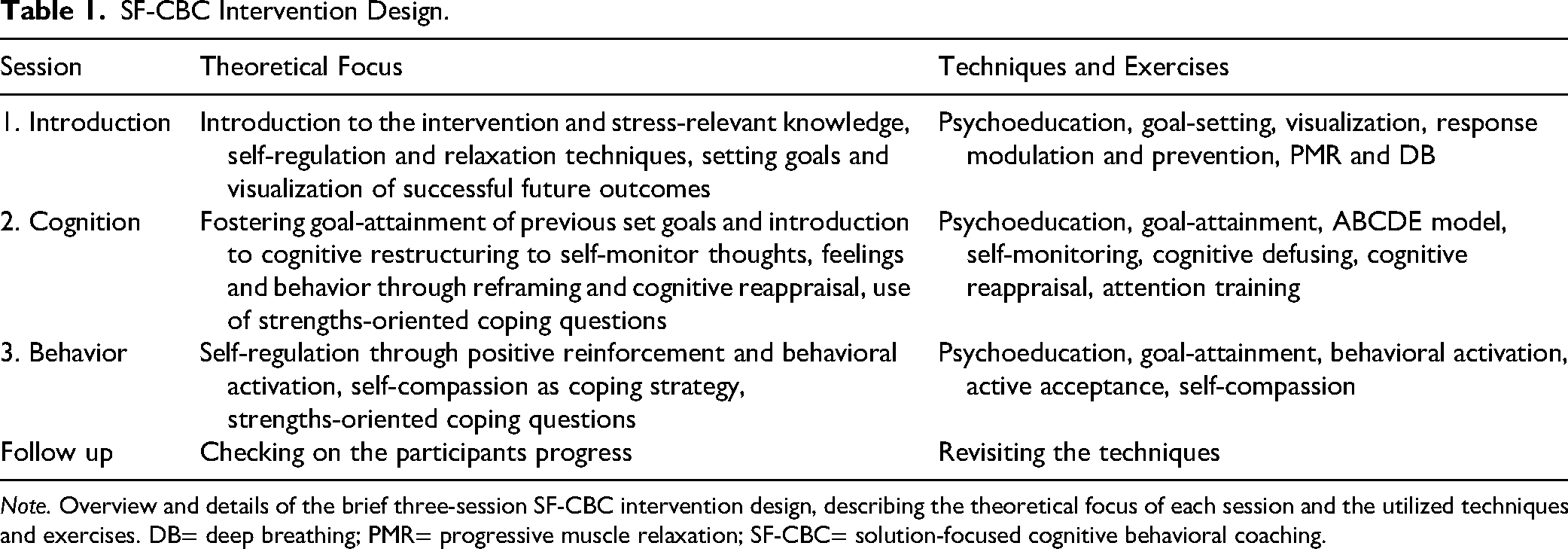
Note. Overview and details of the brief three-session SF-CBC intervention design, describing the theoretical focus of each session and the utilized techniques and exercises. DB= deep breathing; PMR= progressive muscle relaxation; SF-CBC= solution-focused cognitive behavioral coaching.
In alignment with these goals, the intervention aims to facilitate through Socratic questioning and guided discovery the participants ability to (1) self-reflect, (2) identify potential future outcomes, (3) articulate a precise goal description, (4) formulate action plans and recognize available resources, (5) acknowledge personal strengths and past successes to build self-efficacy and self-esteem, (6) endow them with strategies and methods to self-monitor and self-regulate, and (7) evaluate and modify their action plans while allowing for the utilization of location independent internet-based video communication for all but the initial session (Erbe et al., 2017; Wheeler, 2022).
The SF-CBC-based brief intervention design consists of three 90-minute dyadic sessions, held once a week over 3 weeks, and is followed by a 20-minute follow-up session 1 month after the last session (see Figure 1). One or 2 weeks before the intervention, participants complete a 10-item Perceived Stress Scale (PSS) questionnaire to establish a preintervention baseline of the individual's perceived stress level, which is repeated postintervention and again before the follow-up session 1 month later (Lee, 2012). Additionally, at the end of each session, participants are asked to rate their satisfaction with a range of questions aimed at (1) the overall session and (2) the practitioner with six response categories ranging from very satisfied to highly dissatisfied.
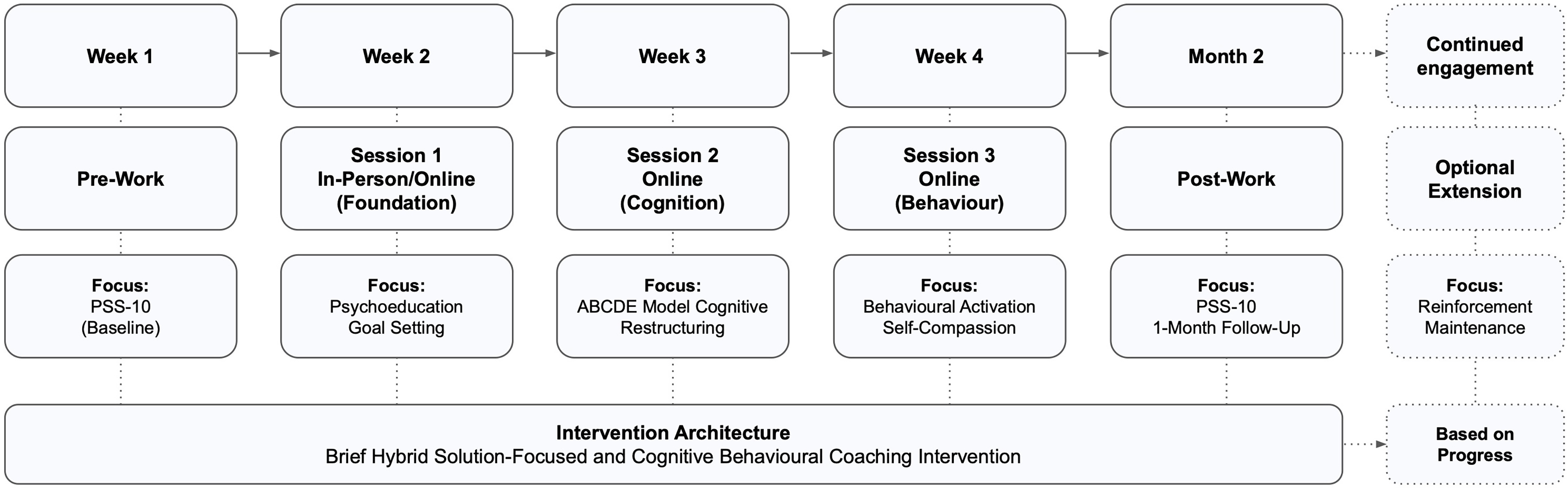
Intervention timeline and structural overview. Note. Visual representation of the timeline and structural overview of the brief hybrid SF-CBC intervention. SF-CBC= solution-focused cognitive behavioral coaching.
Each session adapts the solution-focused, strength-oriented approach and offers separate tools and techniques for self-experimentation between sessions.
First Intervention Session
The first intervention session is divided into seven stages with the following structure:
Opening: Focuses on establishing a relationship with the participant, explains the intervention's background and goals, and serves as a psychoeducational introduction to building stress-relevant knowledge and skills that are necessary and applicable in the participant's professional and personal life. The opening is used to educate about the transactional model of stress, the autonomic nervous system, the fight-or-flight response, occupational stress factors, acute and chronic stress symptoms, and to normalize psychological and physiological reactions to counteract negative beliefs associated with them (e.g., stress being a sign of weakness). While building rapport and establishing the participant's strengths, another focus is getting to know the participant's current state and letting them rank their current problems, complaints, and highlighting exceptions—when their perceived problem or stress-related symptoms are not present. Contracting: At this stage, the practitioner establishes what the participant hopes and wants to achieve from the intervention. Defining together a practical outcome as a means to understand the problem. This stage helps the participant gain a sense of purpose, verbalize their own goals regarding personal or occupational stressors, and then focus on the solution they seek. Breaking down the goals according to the theory of goal-setting into specific, measurable, achievable, relevant, and time-bound subgoals, the participant is guided through a self-reflective process toward goal attainment, during which they gain a better understanding of their available resources to achieve change (Williams, 2014). Goal attainment and successive scaling of achievements enable the participant and practitioner to measure and highlight progress throughout the intervention. Additionally, research has shown that goal-setting, goal-striving, and attainment are positively linked with greater wellbeing and self-efficacy, which, in turn, influence positive coaching outcomes and increase intervention effectiveness (De Haan et al., 2019; Guterman, 2014). Visualizing: At this stage, the participant is invited to describe in vivid detail the future state in which their hopes have been met. This stage aims at gathering the full meaning of the previous stage. Leading the participant to envision in great detail how their life will be if they woke up one morning and the problems they perceive are gone, “what they will do,” “what will be different,” and “what that will mean to them.” Carefully using the present tense of will instead of the past tense would serve to suggest the imagined future as a determined reality and helps with the visualization process. Imagining this possible future breaks the confines of the current stressful reality. It makes room for other possibilities to arise and has been shown to be effective in motivating participants to take action (Kayrouz & Hansen, 2020). Success: At this stage, the practitioner attempts to identify examples or signs of success on their way to achieving the described future state, already today. The practitioner utilizes it to further normalize the process of change and highlights that it is constantly happening. Highlighting and complimenting the participant's already present strengths and resources, whether known or unknown, strengthens the coaching alliance and motivates and encourages them toward further goal achievement (Guterman, 2014). Scaling: Establishes the usage of scales from zero to 10 to measure their perception of progress and to evaluate complaints, problems, and goals. While 10 would represent their fully achieved goals, zero would signify no progress. Scaling questions highlight a participant's positive progress that has already been achieved, assuming that some answers yield ratings higher than zero. Scales are especially helpful in identifying small differences in how the participant perceives a problematic work situation, stressors, and coping strategies. Scaling questions have been shown to encourage participants if they feel nothing has changed or is not working for them (Shennan, 2014). Experimentation and planning: This stage offers the participant techniques and tools for self-experimentation and improvement. The practitioner provides experiments that can be performed the following week and in-between future sessions. The first session experiment will focus on self-regulation and provide recovery and relaxation techniques, including progressive muscle relaxation (PMR) and deep breathing (DB) exercises that can be performed daily. PMR exercises reduce stress and anxiety by having the participant tense and progressively relax each muscle. The exercise provides an immediate feeling of relaxation, with numerous studies demonstrating its effectiveness in reducing perceived stress (Toussaint et al., 2021). DB exercises contract the diaphragm while slowly exhaling, and expanding it while deeply inhaling. Research has shown that DB exercises provide immediate relaxation and reduce stress by increasing blood oxygen levels and lowering cortisol levels (Ma et al., 2017). Both exercises and the ensuing relief enable participants to lower perceived stress levels and gain control over their stress responses (Toussaint et al., 2021). Closing: The closing stage summarizes the session, acknowledges struggles expressed by the participant, highlights and compliments signs of success.
Second Intervention Session
After defining the participant's goals, expectations, strengths, and visualizing their ideal future state, the following two sessions focus on achieving progress. Therefore, stages 2 and 3 will not be repeated from the second session onwards. Stage 1 will be modified to include questions about progress and experiments performed between sessions, followed immediately by stage 4. If the participant cannot report progress or reports that things are worse, stage 5 will include the use of coping questions and looking for exceptions to the problem. After conducting the initial in-person session to build rapport, this and the following sessions can, if necessary, be conducted online. With systematic reviews and meta-analyses suggesting equivalent treatment effects, especially if initial rapport has been established, instant internet-based video communication can transfer the approach from in-person to video chat (Beauchemin et al., 2022; Esfandiari et al., 2021; Novella et al., 2020). Therefore, session 2 follows, online and in-person, the same five of the previous seven stages in the following order:
Opening: The participant opens the session and continues the relationship with the participant, focusing on their progress since the last session and letting them share their results and thoughts while experimenting with the suggested tools and techniques in-between sessions. Following the previously agreed action plan to achieve the goals is usually not enough, as irrational beliefs, negative thoughts, and counterproductive behaviors may hinder the participant's goal attainment (Grant, 2014). For that reason, session 2 is used to further cognitive flexibility and deepen understanding of cognitive restructuring through the introduction of the ABCDE model of emotion (Ellis, 2004). The practitioner explains the model's five stages. The (A) stands for antecedents, an activating event or trigger; (B) for beliefs about the activating event; and (C) consequences caused by the now established beliefs. The intervention then moves to (D) disputing irrational beliefs that have led to negative consequences, leading to (E) effective new beliefs that replace the identified irrational beliefs with positive ones (David et al., 2018). Success: At this stage, the scales, as established in session 1, are utilized to measure the participant's perception of progress. Re-evaluating their complaints, problems, and goals from 0 to 10, and rating the effectiveness of the in-between sessions’ experiments with relaxation techniques. Scaling: At this stage, the scales, as established in session 1, are utilized to measure the participant's perception of progress. Re-evaluating from zero to 10 their complaints, problems and goals and rating the effectiveness of the in-between sessions performed experiments with the relaxation techniques. Experimentation and planning: The experiment provided in this session revolves around cognitive restructuring and self-monitoring. Building on the ABCDE model discussed at the beginning of this session, the participant is provided with a cognitive reappraisal worksheet to self-monitor thoughts, feelings, and behavior associated with negative work experiences (see Appendix). The exercise and worksheet enable the participant to examine the evidence for the validity of those negative beliefs, dispute them, and offer a positive reappraisal with three alternatives of new positive beliefs. This exercise aims to challenge irrational or negative self-talk and elicit how thoughts impact behavior. Cognitive reappraisal and the ability to positively reframe activating events or triggers are among the most researched and effective strategies for emotional self-regulation (Buhle et al., 2014). Additionally, the participant will be introduced to mundane task focusing, to focus and refocus one's full attention on a mundane task while keeping the mind from wandering, and distraction—redirecting one's attention temporarily in great detail on something else—to break rumination and regulate aversive emotions. Both techniques have been demonstrated to be effective in reducing negative thinking (McEvoy et al., 2015). Closing and coping questions: If the participant is not able to report progress or reports that things are worse, the practitioner extends and preludes the closing stage with coping questions in the likes of “What does work for you to minimize this problem from occurring” or “How did you manage to get work done nevertheless that this problem occurred” and “What will it take to improve this problem even a little, and push your measure of the scale towards progress—from zero to one.” Coping questions are used to acknowledge that the problem is occurring while uncovering the participants’ strategies and resources they have used to overcome other problems or cope with in the past. Returning the participant to their strengths and the possible solution maintains a solution-focused and strengths-oriented focus (Guterman, 2014). After this, the practitioner will close the session by summarizing the session, acknowledging the struggles expressed, highlighting and complimenting signs of success.
Third Intervention Session
The third session continues with the same structure as session 2. However, it will be modified to introduce at stage 1 the topic of behavioral activation and corresponding, at stage 4, tools and techniques to activate behaviors that result in positive emotions:
Opening: As in session 2, this stage focuses on the participants’ progress since the last session and lets them share their results and thoughts in-between sessions while experimenting with the cognitive reappraisal worksheet. This stage is then used to further elicit the participants’ ability to co-create the behavior needed to achieve self-regulation and resilience by introducing the benefits of positive reinforcement through behavioral activation. To that end, the participant is asked to explore what behaviors they enjoy and which social relationships and activities elicit positive emotions. The practitioner educates the participant on how making time for those activities, especially in busy times, can reduce the response to occupational stressors and increase one's resilience. Additionally, the topic of self-compassion will be discussed to educate about the importance of coping strategies, such as self-acceptance, while addressing negative beliefs the participant might hold about indulging in recreational wellness activities. Success: As with the previous session, this stage is used to acknowledge and identify signs of success on their way to achieving the described future state since the last session. The practitioner compliments the participants’ accomplishments and efforts toward their goals and demonstrates active listening, further strengthening the coaching alliance (Guterman, 2014). Scaling: At this stage, the scales, as continued from session 2, are utilized to measure the participant's perception of progress. Re-evaluating their complaints, problems, and goals from 0 to 10, and rating the effectiveness of the in-between sessions, performed experiments with the cognitive reappraisal worksheet and mundane task focusing. Experimentation and planning: Building on session 3’s opening topic of behavioral activation, the participant is provided with a worksheet that enables them to cultivate positive feelings and increase wellbeing. This is achieved through scheduling activities based on their input, such as those they have enjoyed in the past or new activities that they always wanted to try. Following the activity, they note with the help of scales how rewarding they perceived the experience and track how they felt afterwards. Behavioral activation reinforces positive emotions and has been demonstrated to increase psychological wellbeing and decrease responses to stressors (Mazzucchelli et al., 2010). Intervention closing and coping questions: At this stage, if necessary, the practitioner will again utilize coping questions to help the participant focus on what they are already doing successfully to cope with the stressful circumstances rather than their perceived problem. The practitioner reflects on this session and the individual's progress throughout the intervention. Together they then review the intervention, including the previous two sessions, discuss the progress, and the learning that emerged in relation to the set goals. The practitioner acknowledges the expressed struggles and highlights and compliments signs of success. The participant is encouraged to incorporate the strategies employed throughout the intervention regularly, and a postintervention follow-up 1 month later is scheduled. After which, the practitioner will close the session.
After the intervention closes, the participant is asked to complete the PSS questionnaire to obtain a postintervention measure of their perceived stress level. One month after the last session, a 20-minute follow-up session will be conducted to revisit the learnings and maintain the participant's progress. Based on the progress maintained and the results of one additional PSS follow-up questionnaire before the follow up, the practitioner will decide with the participant whether further intervention is needed and suggest appropriate steps, such as one or two additional sessions.
Baseline Assessment and Tracking Impact
The protocol is designed for rapid deployment during periods of high organizational demand. Session 1 (Foundation) focuses on psychoeducation and identifying stressors. Session 2 (Cognitive Restructuring) introduces the ABCDE model to challenge maladaptive thought patterns, and session 3 (Behavioral Activation) shifts to resource activation and self-regulation strategies.
Consistent with the transactional model of stress, the participant's perceived stress level is monitored throughout the coaching engagement to gauge the intervention's immediate impact. Efficacy in an SME context is defined by functional resilience rather than by symptom reduction alone. This framework recommends that practitioners track progress using “Scaling Questions” (0–10) at the start of each session. A move from a 3 to a 4 on a “Coping Scale” often signifies a major behavioral shift. Additionally, to ensure the intervention is targeted effectively, practitioners should establish a baseline using the 10-item Perceived Stress Scale (PSS-10) (Lee, 2012). In this framework, the PSS-10 serves not as a rigid research variable but as a diagnostic feedback tool. Administering this brief scale 1 or 2 weeks prior to the first session validates the executive's subjective experience and provides a concrete “starting point” for the coaching conversation. In order to better understand the interventions’ overall effectiveness and complement the executive managers’ self-reported PSS measures, organizational impact should be monitored by tracking key performance indicators such as comparing the number of sick days taken, absenteeism, and performance review outcomes in the period before and after the intervention (EU-OSHA, 2015).
These primary and secondary evaluation measures combine subjective and objective performance measures to provide data for assessing the effectiveness of the practical intervention. The obtained measures are compared from baseline to follow up to determine whether a change has occurred. If there is a change, the intervention might have had an effect on the participant. Postintervention success may be indicated by the executive's ability to autonomously apply cognitive restructuring during real-time crises, reducing the contagion effect of stress on their wider teams.
Illustrative Case Application
To demonstrate the practical utility of the hybrid SF-CBC framework, this section presents a case vignette. This scenario depicts a representative application of the protocol within a high-pressure environment, specifically modeling a boutique financial trading firm (“Apex Capital”). The characters and data points presented are composite constructions designed to demonstrate the intervention's mechanics and typical trajectory.
Context
Following a financial quarter defined by unprecedented market volatility and geopolitical instability, the executive team presented with symptoms of acute occupational stress. These included persistent sleep disruption, decision fatigue, and “cognitive tunneling,” an inability to see strategic alternatives during market downturns. This stress had begun to manifest as interpersonal conflict, creating a contagion effect that was negatively impacting the morale and risk tolerance of junior traders. Two weeks prior to the intervention, a baseline assessment using the PSS-10 revealed an average score of 27, indicating “High Perceived Stress.” While symptom intensity was high, a preintervention screening confirmed that all participants remained functional in their roles and did not meet the threshold for clinical referral. Qualitative interviews highlighted a pervasive maladaptive belief: “If I step away from the screens for even a minute, I miss the move, and we lose money.” This reactive hyper-vigilance was perceived as a potential threat to the firm's Sharpe ratio—its overall risk-adjusted return—necessitating a time-efficient intervention strategy to mitigate the impact of stress on decision making within the constraints of their demanding schedules.
Intervention
The intervention followed the three-session hybrid protocol, though the delivery was tailored to the cohort's skepticism.
Session 1 (Foundation & Psychoeducation): Initial resistance to “therapeutic” interventions was high. The practitioner addressed this by framing the intervention through a neurobiological lens, explaining their physiological arousal not as a professional weakness, but as an “Amygdala Hijack” that biologically inhibited their prefrontal cortex and trading performance. Once buy-in was established, the solution-focused “Miracle Question” was utilized to visualize a preferred future. One trader articulated: “I want to be able to close a losing position based on the algorithm, without the physiological panic spiral that usually follows.” Session 2 (Cognition & Restructuring): The core work utilized the Cognitive Reappraisal Worksheet (see Appendix) to deconstruct a specific, live trading scenario. The group analyzed a recent “Trigger” (A), a sudden 5% drawdown in a key asset class. They identified the “Irrational Belief” (B) driving their stress: “This loss means I have lost my edge and investors will withdraw capital.” Using the worksheet, the practitioner guided them to “Dispute” (D) this belief by examining the evidence: “I am up 12% year-to-date; drawdowns are a statistical inevitability in this strategy, not a character flaw.” This cognitive shift produced a “New Effect” (E) of calm, data-driven execution rather than emotional freezing. Session 3 (Behavioral Activation): To counteract the sedentary persistence of their role, the group agreed on a behavioral experiment termed “Mandatory Cognitive Recovery.” This protocol required leaving the trading desk for 10 minutes every 2 hours to engage in deep breathing or walking. While initially viewed as “risky,” the scaling data from the previous sessions provided the rationale that recovery time would actually increase their net decision-making speed.
Projected Outcomes
In this representative scenario, the intervention aims to facilitate a shift from “High” to “Moderate” stress. A successful application of the protocol typically yields a reduction in PSS-10 scores (e.g., from a baseline of ∼27 to ∼20.0). Qualitatively, the goal is to achieve a cognitive buffer, allowing executives to interpret volatility as data rather than a threat, a shift often described by clients as moving from reactive panic to strategic execution.
Discussion
While large enterprises have the financial and human resources to access and maintain effective, but costly and time-consuming, individual-focused stress management programs, interventions targeting executive managers in startups and small businesses are rarely researched and less readily available (Dawkins et al., 2018). The described theory-driven practical intervention aims to close this gap by combining evidence-based CBC, SF-BT, and problem-solving coaching methods into a brief, geographically independent, and cost-effective three-session limited psychoeducational stress management intervention for executive managers in startups and small businesses. With the goal of addressing key factors that lead to the accumulation of stress and preventing the onset of potentially devastating effects of chronic stress, the intervention utilizes, in accordance with current research results, the most effective type—a cognitive behavioral individual-related dyadic intervention approach as it can be found in counseling relationships between therapist and patient, or practitioner and client (Vanhove et al., 2016).
One major strength of the intervention design is its theory-driven, evidence-based framework, which blends psychoeducational material with self-experiments to generate insights and awareness that can guide participants’ future behavior. The intervention is built on available evidence for the efficacy of goal-setting, solution-focused, and strength-oriented approaches, integrating well-researched and effective cognitive reappraisal and behavioral activation methods with relaxation techniques into a seamless framework (Franklin, 2016; Theeboom et al., 2016; Weer et al., 2016). Moreover, utilizing a Socratic question-driven approach prompts, as studies have demonstrated, a self-reflective process that brings to awareness present strengths, helps build self-reliance and confidence, and focuses on establishing solutions, which increases resilience and mediates positively job performance (Franklin, 2016). Additionally, since research on single-session psychotherapy and SF-BT frameworks has demonstrated that a single-session can improve clients’ perceived problems considerably and that the first couple of counseling sessions regularly carry the most favorable therapeutic outcomes, the adaptation of three sessions to achieve meaningful change is particularly promising considering the costliness associated with interventions of the dyadic type and coaching in general (Hoyt, 2021; Hymmen et al., 2013).
Summary and Conclusion
The presented theory-driven intervention design is a brief individual-related psychoeducational stress management intervention that aims to promote with its solution-focused and strength-oriented approach (1) stress resilience, (2) cognitive flexibility, and (3) general psychological health. The intervention components are linked to relevant behavioral main change principles that lead participants through a self-reflective process toward increased self-efficacy. Facilitating, through guided discovery, a better understanding of the participants available resources and strengths to achieve increased resilience and withstand stress during organizational change. The intervention achieves the main aims through (1) educating participants about occupational stress factors and coping strategies such as PMR and DB exercises that can provide an immediate feeling of relaxation; (2) furthering cognitive flexibility and deepening the understanding of cognitive restructuring via the introduction of attention training and the ABCDE model of emotion, which demonstrates how cognitive reappraisal can replace irrational beliefs with positive new ones; and (3) increasing self-regulation and resilience by introducing the benefits of positive reinforcement through behavioral activation and self-compassion, which enables participants to cultivate positive feelings. Since the development of time-efficient stress management tools for SME executives is critical, the described practical intervention and theoretical research offer a conceptual, affordable, feasible, and testable intervention design that can help close this gap and enable organizations to integrate it into leadership development programs. This framework suggests that a synthesis of evidence-based components of SF-BT, CBT, and problem-solving coaching approaches may offer a potent mechanism for decreasing an individual's cognitive stress appraisal within a condensed timeframe. Furthermore, by facilitating work performance-related outcomes, the intervention enables further organizational cost savings and broader accessibility, especially for startups and small businesses.
Footnotes

Ethical Considerations
This manuscript is a conceptual paper and does not report on empirical data collected from human participants. The case vignette presented (“Apex Capital”) is a composite constructed solely for illustrative purposes to demonstrate the theoretical application of the intervention framework. Therefore, approval from an Institutional Review Board (IRB) or ethics committee was not applicable.
Consent to Participate
As this manuscript is a theoretical practitioner's guide and the presented case study uses composite characters for illustrative purposes only, informed consent was not applicable. No human participants were recruited, and no personal data was processed.
Declaration of AI-Assisted Technologies in the Writing Process
During the preparation of this work, the author used Grammarly (Premium version) to improve the readability, clarity, and conciseness of the text. After using this tool, the author reviewed and edited the content as needed and takes full responsibility for the content of the publication.
Funding
The author received no financial support for the research, authorship, and/or publication of this article.
Declaration of Conflicting Interests
The author declared the following potential conflicts of interest with respect to the research, authorship, and/or publication of this article: The author is the founder of Yourwell Limited (a digital well-being platform). This specific manuscript was produced as independent academic research.
Data Availability Statement
Data sharing is not applicable to this article as no new datasets were generated or analyzed during the current study.
Author Biography
Appendix
Cognitive Reappraisal Worksheet with Scaling.