






Abstract
This study examined the dynamic relationships among ethical political leadership, the public’s confidence in political leaders, commitment to the nation, and the perception of being safe from a terrorist attack. Based on a U.S. national random sample (n = 1604), we found that the public’s confidence in political leaders mediates the effect of ethical political leadership on the public’s commitment to the nation and the perception of being safe from a terrorist attack. Both theoretical and practical implications are discussed.
Keywords
With terrorist attacks occurring around the world in an increasing number of locations, the public will inherently rely on their political leaders to reduce the threat from such terrorist attacks and increase their confidence in a changing and dynamic situation and environment. Terrorist attacks exact a significant amount of physical, psychological, and financial costs on their victims, and leaders are expected to protect the public from these sufferings. The public also look to their leaders to help them understand the origins, reasons, responses, and actions respective to terrorism both domestically and globally. Political leadership does more than initiate economic and national policies; it also inspires the people, motivates a nation, and reflects the collective national values, missions, goals, and aspirations (Denton, 2005; Schippers, 2000). Political leadership subsequently impacts law-abiding habits and ethical perceptions among citizens, which are critical for a nation’s survival and sustainable development.
Ethical political leadership is defined as political leaders’ demonstration of their own moral values and orientation, and making decisions by placing the interests of the majority of the public, or national interests, over those of the individual and/or of particular interest groups. Ethical political leadership may instill trust, confidence, more active citizenship, positive emotions and behaviors from the public (Denton, 2005). However, relatively few research efforts have examined the underlying influence processes through which political leadership affects the public, including their attitudes toward or commitment to the nation. As pointed out by Denton (2005), the action/behavior of political leaders, especially the President, or head of state, is symbolic, and to a large degree is a representation of values, ideas, and identity in a specific country. Moreover, and more importantly, political leaders inspire and motivate a nation and maintain the public’s confidence and resilience, especially in a difficult crisis situation. However, few empirical studies have been conducted to examine how national political leadership affects citizens’ attitudes toward the nation and psychological feelings during a crisis.
To this end, we sought to accomplish the following two goals. First, we intend to address the degree to which the public’s perception of ethical political leadership affects the public’s commitment to the nation, and the perception of feeling safe from a terrorist attack. The second goal is to investigate whether the public’s confidence in political leaders mediates or explains the means by which ethical political leadership affects the public’s commitment to the nation and their perception of feeling safe from a terrorist attack.
Hypotheses development
Researchers of organizational sciences have proposed that leaders are obligated to set a moral example for organizational members and to determine those organizational activities which may be detrimental to the values of society in general (Aronson, 2001). In the same vein, political leaders must be a moral example for citizens to foster the development of both ethical attitudes and ethical behaviors among the public. Political leaders exhibit ethical behaviors when they are doing what is morally right, just, and good for the country, and when they help to elevate public moral awareness.
Defining main constructs
Ethical political leadership
Scholars propose that ethical leaders have two important components: the “moral person” and the “moral manager.” Being a “moral person” means that ethical leaders possess such moral traits as honesty and trustworthiness, along with moral values and principles such as being fair, righteous, caring, and considerate.
Ethical organizational leaders are also described as being motivated to influence followers’ moral perspectives and are seen by others as being “moral managers.” For example, ethical leaders communicate their ethical standards and moral values to followers, as well as serve as followers' role model. In their role as moral manager, leaders would also be expected to establish reward and punishment systems to address ethics-related behaviors and violations. Ethical leadership was found to significantly predict followers’ willingness to report ethical problems to their leaders as well as their organizational commitment (Brown et al., 2005), which refers to one’s relative strength of identification with and involvement in a particular organization (Mowday et al., 1982).
Commitment to the nation
Mowday and his associates (1982: 56) identified leadership as one of the critical organizational factors that influenced employee commitment. For example, it has been found that commitment to the organization is greater for employees whose leaders encourage their participation in decision making (e.g. Jermier and Berkes, 1979; Rhodes and Steers, 1981), are more considerate (Bycio et al., 1995), treat followers fairly (Allen and Meyer, 1990), and are supportive (e.g. Allen and Meyer, 1996; Mottaz, 1988). In this study, we define commitment to the nation as an individual’s relative strength of identifying with and involvement in one’s nation, and willingness to make sacrifices for the nation when it is necessary. Such commitment to the nation is seen in cases of increased patriotism and volunteerism to the nation (e.g. military service) after the September 11, 2001 terrorist attacks on the United States.
Confidence in leaders
In the organizational management field, confidence in leadership is defined as “the extent to which constituents are willing to put their faith, trust, and commitment in the organization’s leader” (Martineau and Tornow, 1994: 9). In this study, we extend this definition in two ways: generalizing to the political field, and including confidence in leaders’ capacity to deal with a specific challenge. Therefore, confidence in national political leadership is defined here as the extent to which the public believe that their political leaders are able to deal with existing challenges confronting the country, and the extent to which the public are willing to put their faith, trust, and commitment in their political leaders. This construct is based on collective efficacy beliefs directed at national political leadership (Bandura, 2006).
Perception of being safe from a terrorist attack
In the organizational management field, psychological safety is defined as “feeling able to show and employ one’s self without fear of negative consequences to self-image, status, or career” (Kahn, 1990: 708). In an organizational context, employees feel “safe” when they believe that they will not be punished for authentically expressing their true opinions and viewpoints. In a psychologically safe work environment, individuals will understand what acceptable behaviors and organizational constraints are. However, in a psychologically unsafe work condition characterized by an ambiguous and unpredictable environment, employees are more likely to feel threatened. Ethical leaders are more likely to be more supportive of followers and to establish effective and positive relationships with their followers (e.g. Brown, and Treviño, 2006; Detert and Treviño, 2010), which, in turn, may positively develop employees’ psychological safety (May et al., 2004). Similarly, in this study, we defined “perception of being safe from a terrorist attack” as the public feeling psychologically safe when they believe that their political leaders are able to deal with a potential terrorist attack.
The effects of ethical political leadership on the public
As indicated above, ethical political leaders are those leaders who have moral character, meaning these leaders seek to discover the truth, to decide what is right, and to demonstrate the courage and commitment to behave ethically (Denton, 2005; Trevino et al., 2000; Trevino et al., 2006). Moral character helps shape one’s beliefs, attitudes, and values. Ethical political leaders help develop citizens’ responsibilities and empower citizens to uphold civil responsibilities and roles (Burns, 1978). Ethical political leaders also establish their own moral vision, pursue egalitarian goals, challenge and engage citizens, and offer hope to the public (Genovese, 1995).
Erickson (2006) argued that in order to win the public’s confidence and trust, political leaders need to be honest, truthful, ethical, and principled. One possible mechanism through which political leaders influence the public’s commitment to the nation is through influencing the public’s perception of social justice by demonstrating fairness and integrity (Dirks and Ferrin, 2002), which can also help improve the public's trust and confidence in political leaders'. Prior research (e.g. Brockner and Siegel, 1996; Dirks and Ferrin, 2002) suggests that followers' perceptions of fairness and justice lead to higher levels of followers' confidence and trust in their leader. Taking this perspective, it is also possible that, if the public believe political leaders are ethical, they will also perceive there is social justice and equality in their country. The rationale is that if the public believe their political leaders are ethical, they will also perceive that political leaders will make ethical decisions, subsequently increasing social fairness as a whole. The perception of social justice is likely to increase the public’s confidence in political leaders by making them believe that these leaders are able to make fair decisions, and consequently the public are likely to have a higher level of commitment to their nation.
Furthermore, it is expected that ethical political leaders place concern for the people’s security as a top priority and pay serious attention to protecting the public. Under that type of situation, the public may tend to perceive that their country is more secure, and is typically characterized by a clear, predictable, and peaceful environment. In this type of safe environment, the public are more likely to feel less threatened and feel more psychologically secure. Furthermore, if the public believe that their political leaders are more ethical, they may also believe that their political leaders would place collective interest over personal gains and make more ethical decisions in their government policies, including establishing more effective and productive strategies to deal with a terrorist attack. This is also consistent with the work of Becker (1973), who argued that humans rely on an elaborate and symbolic psychological defense mechanism against human mortality, which in turn acts as emotional, intellectual, and social responses to basic survival mechanisms. This mechanism can help explain how the public depend on their political leaders to provide effective leadership to ensure their psychological safety.
Furthermore, terror management theory (TMT: Greenberg et al., 1986; Greenberg et al., 2008; Pyszczynski, 2004; Pyszczynski et al., 1999) also provides theoretical justifications as to why the public rely on their political leaders to demonstrate effective crisis leadership. Terror management theory is mainly based on cultural anthropologist Ernest Becker’s (1973) work, which attempts to provide a comprehensive account of the motivational forces that shape human behaviors and actions. TMT starts from the assumption that human beings are both similar to, and different from, other animals. Like all other animals, human beings possess biological traits and characteristics to attempt eternal survival, but are uniquely able to recognize the futility of this fundamental biological imperative through humans’ sophisticated and advanced cognitive capacities. Only human beings understand fully the inevitability of human death and the process can happen any time due to the many factors that are beyond human control or anticipation. Human beings use their intellectual and cognitive abilities to respond to possible fear that will influence their lives. To summarize, according to TMT, individuals have a universal security need to cope with a potential threat like a terrorist attack.
One of the effective strategies to satisfy such a need is to have an effective political leader who can lead successfully in preventing a potential terrorist attack or respond effectively to a current terrorist attack. Consequently, the public are likely to feel psychologically safe and perceive that their country is more secure from a potential terrorist attack if they believe that their political leaders are ethical and more competent. Lipman-Blumen (2006) has argued, elaborating on Becker, that “toxic leaders,” who are by virtue of their “dysfunctional personal characteristics” and “destructive behaviors,” unethical by nature, may use “protection from harm” as a tool to gain control over followers. Riggio (1987) has made a social exchange argument using “negative/evil” charismatic leaders (e.g. Hitler), suggesting that these despots offer protection from harm in exchange for loyalty. In both explanations, once the leader’s unethical nature is revealed, the followers feel exploited and resentful.
Social exchange theory (Blau, 1964; Homans, 1958) suggests that when the public feel their political leaders are ethical and exert efforts to show that they care for the citizens, the public will reciprocate with higher levels of commitment to the leader and (perhaps) to their nation. This is particularly true if past leaders have not shown care for citizens and the public felt that their commitment and support for the leader was misplaced, creating a perception of imbalance in levels of commitment between leader and followers. Furthermore, if the public believe their political leaders are ethical, they tend to believe that their political leaders will create a just and fair environment by making decisions that are perceived by the public to be fair, which will consequently increase the public’s confidence in leaders and their being more committed to the nation (e.g. Denton, 2005; Schippers, 2000). Taken together, we suggested that if the public believe governmental leaders have a strong set of personal ethical standards, they are more likely to reciprocate by having a higher level of trust in leaders and loyalty to the nation, resulting in a higher level of commitment to the nation. In addition, citizens are likely to believe that ethical political leaders would place the collective interests as a high priority and be concerned more with protecting the country from a terrorist attack.
With a well-developed sense of ethics, political leaders are able to earn the credibility they need to motivate the public to follow them toward their visions, dreams, missions, purposes, and goals (Morrison, 2001). The public also need to be treated authentically, fairly, and with respect by their political leaders. At the same time, the public need to believe that their political leaders are engaged in authentic moral behaviors (May et al., 2003) which are consistent with the interests of society as a whole. The public are able to believe that they can rely on these leaders to do what they say, and in turn, tend to feel psychologically safe (Kahn, 1990; May et al., 2003), including when facing a terrorist attack situation.
Denton (2005) also proposed that ethical political leaders will be honest with citizens and will be transparent in their decision making by providing authentic information and guidance, which will influence both citizens’ trust and confidence in their leaders, and their personal commitment to the nation. Furthermore, when facing a crisis situation, ethical political leaders are more likely to respond to a crisis, such as a terrorist attack, by being more attentive and committed to protecting the public. Thus, based on the above arguments, we propose:
Hypothesis 1: Ethical political leadership is positively related to the public’s confidence in political leadership. Hypothesis 2: Ethical political leadership is positively related to the public’s commitment to the nation. Hypothesis 3: Ethical political leadership is positively related to the public’s perception of being safe from a terrorist attack.
Mediating effect of confidence in leaders
According to Martineau and Tornow (1994), leaders can improve followers’ confidence if followers believe that: (1) their leader will tell them the truth, (2) their leader will listen to people inside and outside the organization, and (3) there is open communication and candor between the leader and followers. Therefore, when political leadership follows these standards, the public are more likely to think that leaders will tell them the truth, understand their needs, and take proper action to address national interests. Consequently, the public will be more confident in the leader, be more committed to the nation, and have a perception of being safe from a terrorist attack.
Ethical political leaders will need to create and communicate to the public a clear vision of what they stand for, what they value, what they want to achieve, and what they expect from others (Gini, 2004). In this way, the public are more likely to have confidence in their political leader’s predictability, reliability, dependability, integrity, and regularity. The public are more likely to consider their leader to have a higher level of consistency, which means they are more likely to believe that leaders will behave consistently across different environments and situations. As a result, the public may be more likely to think that they can predict their leader’s future behaviors since they are confident in their ability to make such predictions given the consistency of the leader’s past behavior.
Based upon ethical (Brown et al., 2005) and authentic (Avolio et al., 2004; Luthans & Avolio, 2003) leadership theory, we argue that ethical political leadership has the characteristics of predictability, reliability, and minimal variability. With predictability, the public know what to expect from political leaders, and political leaders know what to expect from the public. When political leaders are reliable, the public believe that political leaders do what they say, or that it will be done as promised. When acting with integrity, political leaders are likely to minimize their behavioral variability and surprises. All of these ethical behaviors will enable the public to have a higher level of confidence in leaders, which may lead the public to be more committed to the nation and to feel safer from a terrorist attack.
As suggested above, the public expect that ethical political leaders are more likely to consider their interests, needs, and desires, and to protect their basic human rights of dignity and autonomy (Burns, 1978), placing them in a position where they can experience increased psychological safety. Such political leaders are also likely to treat the public with respect, rather than treat them simply as a means to an end (i.e. in the position of power or gaining their vote). Respect for the human dignity of the public should result in the public experiencing a strong sense of confidence because their own goals and their long-term interests are taken care of by the political leaders. Such caretaking is likely to increase the public’s commitment to the nation, and their perception of being safe from a terrorist attack.
Ethical political leaders are more likely to provide opportunities to help the public to better understand both the leader’s position and their impact on the nation overall (Burns, 1978). We expect that the public who are more confident in their political leaders will be more committed to their nation. Furthermore, if the public feel more confident in their political leaders, they will place themselves in a position where they will voluntarily serve the nation when necessary. Additionally, research on confidence, trust, and organizational citizenship behavior (e.g. Singh and Srivastava, 2009) suggests that individuals who feel more confident in their political leaders will also trust the leader’s ability to handle their job requirement of dealing with a terrorist threat. Based on the above arguments, we propose the following two hypotheses:
Hypothesis 4: Ethical leadership will lead to the public’s higher confidence in political leaders, which, in turn, leads to the public’s commitment to the nation. Hypothesis 5: Ethical leadership will lead to the public’s higher confidence in political leaders, which, in turn, leads to follower perception of feeling safe from a terrorist attack.
Data and methods
Sample
The data for this study was obtained through telephone interviews of a representative sample of adults (18 years of age or older) in the continental United States in September 2006. Survey data were collected by TSC, a division of the research firm Yankelovich, Inc, which is a non-party-affiliated organization, and is considered a leading consumer research company that has conducted research and surveys in the field of consumer values and behavior since 1958. More detailed information about this company is available at http://www.yankelovich.com/.
A total of 1604 respondents were interviewed. Random-digit dialing was used to ensure that individuals with unlisted numbers would also be included in the study. US census data were used to weigh key demographic dimensions to ensure that the study was representative of the adult population. In the sample, 48.3% (775) were male, 56.2% (902) were married, and 74.1% (1189) were White. In terms of education, 25% (401) of the respondents had a college degree or above, and approximately 18.1% (290) had a family income of $100,000 or higher. As to political affiliation, 34.1% (547) were Democrats, 26.9% (432) were Republican, and the others were Independent.
Measures
Ethical political leadership
The scale of ethical political leadership (four items) was specifically created for this study. Respondents indicated whether they agreed with the statements on a four-point Likert scale ranging from 1 = “Strongly disagree” to 4 = “Strongly agree.” A sample item is “Most political leaders have high ethical standards.” Cronbach’s alpha for this scale was .69. Exploratory factor analysis (EFA), using principal axis factoring, indicated a one-factor structure with loading values ranging from .63 to .81.
Confidence in political leadership
Confidence in leadership was measured with four items developed for this study. Respondents were asked to indicate how much confidence they have in “The executive branch, including the president, vice president, and advisors” across four areas on a five-point Likert scale ranging from “1 = Not at all” to “5 = Great deal.” These four areas include: 1) their knowledge, skills, and abilities, 2) honesty, integrity, and ethics in the personal lives of political leaders, 3) honesty, integrity, and ethics in the professional lives of political leaders, and 4) the ability to inspire followers’ loyalty and enthusiasm. Cronbach’s alpha for this scale was .92. Exploratory factor analysis (EFA), using principal axis factoring, indicated a one-factor structure with loading values ranging from .85 to .92.
Commitment to the nation
Cook and Wall’s (1980) organizational commitment scale was adapted to measure a citizen’s commitment to the nation. Respondents indicated whether they agreed with the statements on a four-point Likert scale ranging from “1 = None at all” to “4 = Great deal.” Sample items included: “To what extent are you proud to tell foreigners that you are part of America?” and “To what extent do you really care about the fate of America?” Cronbach’s alpha for the scale was .81. Exploratory factor analysis (EFA), using principal axis factoring, indicated a one-factor structure with loading values ranging from .56 to .76.
Feeling safe from a terrorist attack
This construct was measured with a three-item scale that was designed specifically for this study. One sample item asked respondents to rate the statement “Your degree of optimistic level that the United States is free from terrorist attack?” on a five-point Likert scale ranging from “1 = Very pessimistic” to “5 = Very optimistic.” Cronbach’s alpha for the scale was .65. Exploratory factor analysis (EFA), using principal axis factoring, indicated a one-factor structure with loading values ranging from .84 to .85.
Results
Descriptive statistics and correlations.
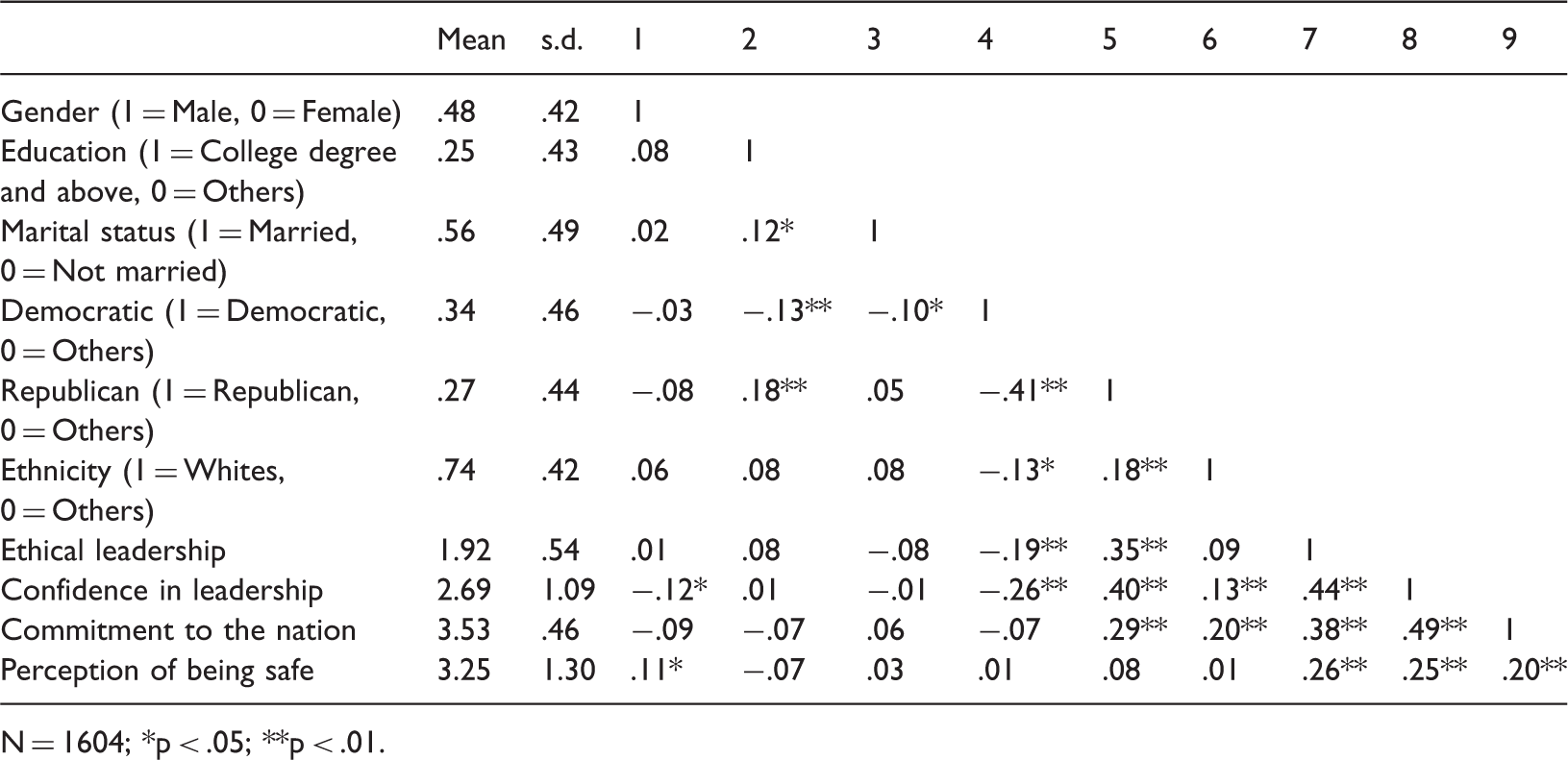
N = 1604; *p < .05; **p < .01.
Ethical political leadership had a significant positive relationship with confidence in political leadership (r = .44, p < .01), commitment to the nation (r = .38, p < .01), and perception of being safe from a terrorist attack (r = .26, p < .01). Confidence in political leadership was significantly related to commitment to the nation (r = .49, p < .01), and to the feeling of being safe from a terrorist attack (r = .25, p < .01). Moreover, commitment to the nation was significantly related to the feeling of being safe from a terrorist attack (r = .20, p < .01).
Hypotheses testing
Results for mediation tests.
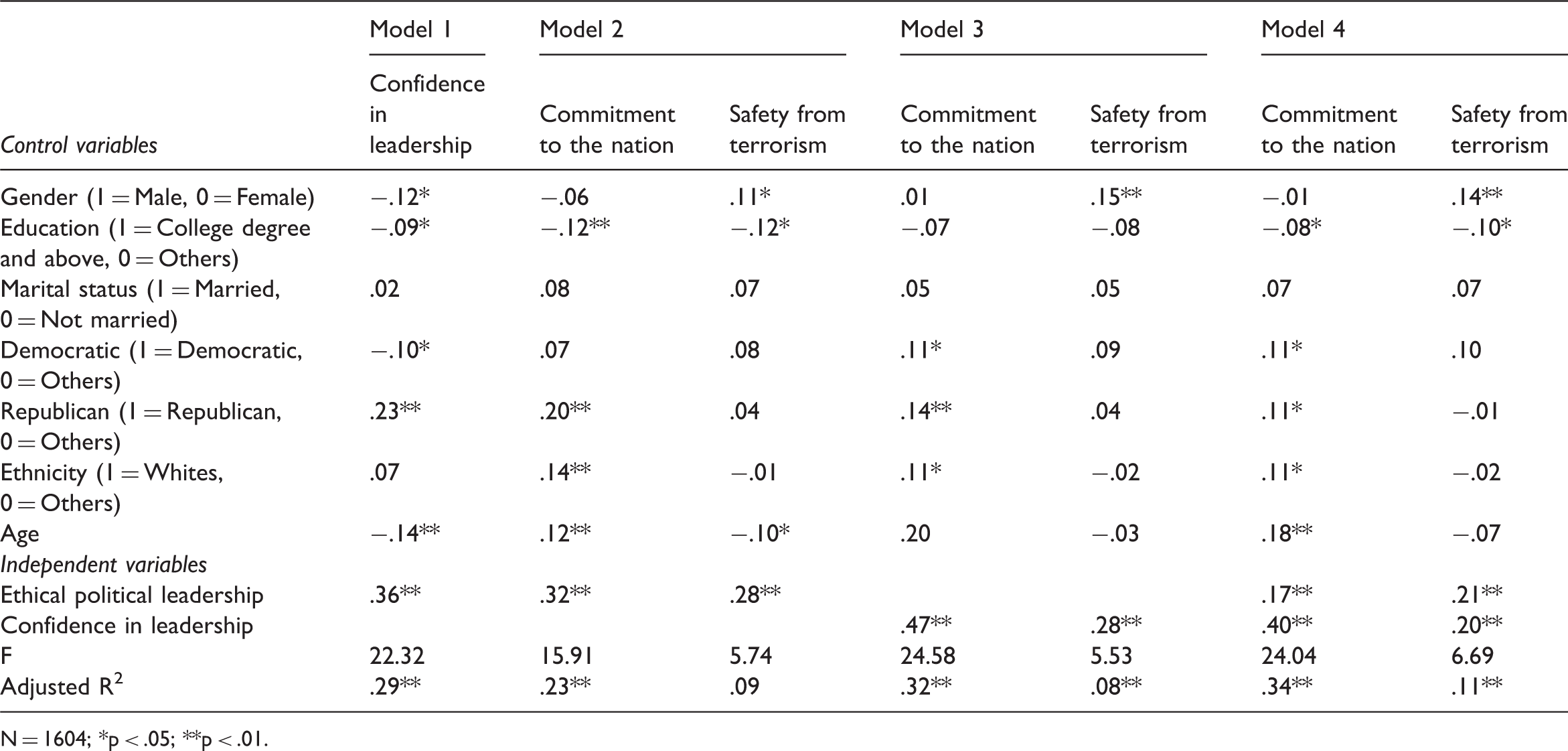
N = 1604; *p < .05; **p < .01.
As shown in Table 2 (Model 1), ethical political leadership was significantly related to confidence in political leadership (β = .36, p < .01), which indicates that Hypothesis 1 was supported. Model 2 shows that ethical political leadership was significantly related to citizen’s commitment to the nation (β = .32, p < . 01), providing support for Hypothesis 2, and feeling of being safe from a terrorist attack (β = .28, p < .01), which provided support for Hypothesis 3. Also, these results provide support for mediation condition 2 that the independent variable was positively related to the dependent variable. Model 3 shows that confidence in political leadership was significantly related to commitment to the nation (β = .47, p < .01) and feeling of being safe from a terrorist attack (β = .28, p < .01), satisfying mediation condition 3. As shown in Model 4 of Table 2, after confidence in political leadership was added into the regression model, the initially significant relationship between ethical political leadership and commitment to the nation (β = .40, p < .01) and feeling of being safe from a terrorist attack (β = .20, p < .01) were still significant, although the relationship was lower when the mediating variable was added to the model. These results indicate that confidence in leadership has a partial mediating effect on the relationship between ethical political leadership and the public’s commitment to the nation and perception of being safe from a terrorist attack. Thus, Hypotheses 4 and 5 were also supported.
The issue of common method variance
Although we didn’t expect serious problems with common source/method variance, we nonetheless assessed the extent to which our results could have been contaminated by common method/source bias, given that we collected ratings from the same source. We adopted one strategy recommended by Podsakoff et al. (2003) to examine this possible influence.
Specifically, we used Harman’s one-factor test (Podsakoff et al., 2003) to examine the extent to which a common or single method factor existed that would account for the variance in our findings. To do this, we performed an exploratory factor analysis (EFA) by entering all four scales used (i.e. ethical political leadership, confidence in leaders, commitment to the nation, and perception of being safe from terrorist attack) in this study and results showed more than one factor emerged. The general factor explained only 28.47% of the total variance, which suggested that common method/source variance was likely not a serious problem in the present study.
General discussion
This study is one of the first empirical studies to examine the effect of ethical political leadership on the public’s commitment to the nation, their perception of being safe from a terrorist attack, and the influence process through which ethical political leadership impacts these outcomes. We found that the public’s confidence in political leadership partially mediated the positive effects of ethical political leadership on the public’s commitment to the nation and their perception of being safe from a terrorist attack. This study helps cast light on how ethical political leadership positively affects the public, in terms of having a higher commitment to the nation and a perception of being safe from a terrorist attack.
In the field of leadership, particularly ethical leadership, few studies have empirically examined the effect of ethical political leadership on the public. As such, this study has potentially begun to fill a significant gap by examining the relationship between ethical political leadership and the public’s commitment to the nation, and their perception of being safe from a terrorist attack.
This study also makes a theoretical contribution to the study of commitment in organizational behavior. The concept of organizational commitment has grown in popularity and has received a great deal of attention in the organizational behavior and work psychology literatures (Mathieu and Zajac, 1990). However, the public’s commitment to the nation (commitment at the national level) has not received attention in prior research. We extend the commitment research in the field of organizational behavior into the field of public administration. We found that commitment is not just an organizational level variable, but also could be extended into a higher level, namely, the national level presented in this study.
The first practical implication of this study is that leaders need to strengthen the public’s confidence in leaders if they want to increase the public’s commitment to the nation and if they want the public to have a feeling of being safe from a terrorist attack. After establishing the public’s confidence in their leaders, the public are likely to be more committed to the nation, and will perceive that they are safer from a terrorist attack.
The second important practical implication is that, in order to develop the public’s commitment to the nation and perception of being safe from a terrorist attack, the government needs to develop ethical leadership across different government levels. Results showed that political leaders need to be ethical if they aspire to develop the public’s confidence in them. More importantly, political leaders need to be consistent with their own words, values, and moral behavior and they need to set high standards for moral and ethical conduct, and be ethical role models for the public (Bass, 1985; Burns, 1978). All of these moral behaviors have a positive effect on the public’s confidence in leadership, their level of commitment to the nation, and their feeling of being safe from a terrorist attack. With strong moral values and goals, ethical political leaders may promote ethical policies, procedures, and processes when they are making decisions and generating and implementing policies. Demonstrating idealized influence (i.e. as highly ethical role models or moral exemplars) to encourage the public to establish their own internal set of moral principles and ideals, ethical political leaders also may help establish a basis for the public’s confidence, and ultimately higher commitment to the nation and their feeling of being safe from a terrorist attack.
Another important practical implication is that political leaders should serve as moral role models for society since their behaviors reflect the values, hopes, and aspirations of the nation. This is particularly true of the President (or other head of state). The President must be held accountable for behaving ethically and demonstrating a moral example to the public because of the President’s unique position of being prominent in both national and international decisions. As a result, political leaders need to act and behave consistently with their moral beliefs and values.
These theoretical and practical implications should be interpreted within several limitations of our study. First, a major constraint in our study is from the methodology employed. We relied on a cross-sectional research design, which limits inferences regarding causal direction. To have a better understanding of the relationships among ethical political leadership, confidence in political leadership, and other dependent outcomes, we recommend that longitudinal studies be carried out to further examine the impact of ethical political leadership on the public’s confidence in leadership, their commitment to the nation, and their perception of being safe from a terrorist attack. Such a research design would allow researchers to trace the dynamics and perhaps the direction of the relationship, and, as a result, better understand these relationships.
Second, this study did not directly address the role of individual differences and other factors, such as a strong intelligence branch and surveillance resources, in the impact of ethical political leadership on the strengthening of confidence in political leadership, and consequently higher commitment to the nation and perception of being safe from a terrorist attack. For example, individuals with a high level of moral identity and conscientiousness might be more likely to be responsive to a political leader’s ethical leadership behaviors, and ultimately be more committed to the nation and feel safer from a terrorist attack. Furthermore, ethical leaders, coupled with a strong intelligence branch and surveillance resources, are more likely to be considered as more competent and should attain higher confidence from the public. Future studies should further explore the role of individual differences and other important factors in affecting the dynamics and complexity among these relationships.
A third limitation is that this study contained scale items whose language was not constructed according to the most rigorous scientific wording guidelines due to the fact that this original survey was a national poll. Although, the scales have demonstrated acceptable initial reliability and validity as shown above, we believe it would be important to conduct validation studies to further establish the reliability and validity for these scales, which would be of use for future studies in this field.
Furthermore, though it is significant to adopt organization management theory to explore the impact of ethical political leadership on the public’s confidence in political leadership, commitment to the nation and perception of safety from a terrorist attack, it should be noted that there are some differences between a regular organization and a nation. Compared to an organization, a nation has a longer historical tradition and more extrusive politics, in addition to the fact that it is on a much larger organizational scale. A nation has a much stronger political orientation and is more deeply affected by the long-term historical and civic culture than an organization. Although it is true that commitment to the nation is affected by civic culture formulated in the long-term history, it is still not immune to the influence of the ethical level of current political leadership. However, it is of great importance if other theoretical perspectives, such as civic culture theory (Almond and Verba, 1989), could be adopted to further explain the complexity and dynamics of the relationship between ethical political leadership, the public’s commitment to the nation, and the perception of being safe from a terrorist attack.
Despite these limitations, one of the biggest strengths of this study lies in the national random sampling. Our random sampling of a national population suggests that our study findings could be generalized to the national level. This study implies that ethical political leadership has a positive effect on the public’s confidence in political leadership, commitment to the nation, and perception of being safe from a terrorist attack. Furthermore, we found that confidence in political leadership partially mediated the effect of ethical political leadership on commitment to the nation and the feeling of being safe from a terrorist attack. We hope this preliminary study provides further impetus for examining the role of political leadership in influencing the public’s attitudes toward the country, which may affect both the public’s well-being and the nation’s sustainable growth.
Footnotes
*
The results reported in this manuscript are secondary analyses of the National Study of Confidence in Leadership (NSCL), a data set collected by the Center for Public Leadership at the John F. Kennedy School of Government, Harvard University. Additional information on the NSCL survey program can be found in Pittinsky, T., Rosenthal, S., Bacon, L., Montoya, M., and Zhu, W. (2006).