







Abstract
A longitudinal, qualitative case study was conducted to explore if a cause-related sporting event could inspire participants to serve others and how the event achieved this. Servant leadership theory, social leverage theory, and social capital theory were used to inform the investigation. Findings revealed the event encouraged servant leadership. The structural mechanisms and social processes which helped to achieve this were: (a) creating event-related social events to build a community; (b) encouraging themes and hosting ceremonies to create a culture of storytelling and safe spaces; and (c) facilitating formal and informal gathering places to foster celebration. These structural mechanisms and social processes then generated individual-level impacts, which helped participants practice servant leadership by: (a) developing broader identities; (b) nurturing participants’ abilities to see they can make a difference; and (c) strengthening awareness of the healing power of service. A conceptual framework emerged from the data to describe how a cause-related sporting event can create a sustainable community of servant leaders.
Keywords
Introduction
For centuries, sport has been a tool for social and personal change, and has been considered an accepted ideological truth worth pursuing (Green, 2008). Scholars suggested sporting events have the multifaceted ability to promote social change by engaging a diverse audience, fostering collective social responsibility, contributing to health and wellness, improving participants’ self-concept and self-efficiency, promoting social inclusion, and by advocating values such as cooperation, respect, and awareness of others (Kaufman and Wolff, 2010; Sherry, 2010). However, the method for encouraging leadership in participants of these events to create the social change remains unclear. To date, the research on sporting events has focused on their economic or social impact and has not evaluated their social leverage (i.e. influence to create change) or provided an understanding of why outcomes occur (Chalip, 2006). Thus, we sought to address this research gap by examining how leadership, specifically how servant leadership, can be inspired through cause-related sporting events.
Hosting a cause-related sporting event has become an increasingly popular and effective intermediary for non-profit organizations (NPOs) to connect to consumers and create social capital (Higgins and Lauzon, 2003). NPOs’ financial resources do not come “directly from those who receive the benefits which the organization produces” (Lewis, 1998: 436). Therefore, it is essential for NPOs to inspire participation from individuals and organizations with no previous association with the NPO in order to develop both financial and human capital (Taylor and Shanka, 2008). Cause-related sporting events serve as a catalyst for change by providing an important and tangible activity for disparate groups to come together and support a specific cause (Deloitte, 2010). The celebratory nature of these events creates a “liminoid” space – a felt energy – engendering a sense of community (communitas), which can create social change by building social capital (Chalip, 2006). Thus, event organizers need to “enable, optimize, and then use liminality” (Chalip, 2006: 112) to nurture participants’ commitment to serve and inspire individuals to make the conscious choice to serve by adopting the mission of the NPO and championing it.
Inspiring participants’ altruistic motivations to help others aligns with servant leadership theory, which recognizes that human beings need each other, can accomplish more working together, and are the best resource to build a good society (Keith, 2008; Prosser, 2010). Servant leadership, first described by Greenleaf (1977), is distinguishable from traditional power-oriented “leader-first” paradigms, which extol a Darwinism and capitalist approach to operating organizations. Servant leadership theory changes this paradigm by building “people first” organizations that emphasize service to others and recognize that the role of organizations is to create people who can build a better tomorrow. A servant leader is primus inter pares (first among equals), and leadership is not limited to established positions or authority figures (Greenleaf, 1977). As Greenleaf (1977: 60) said, “the only way to change a society (or just make it go) is to produce people, enough people, who will change it (or make it go)”. At the core of cause-related events is the far-reaching and intangible goal of inspiring others to serve. Therefore, servant leadership could be a critical success factor helping NPOs hosting cause-related sporting events achieve their missions.
The purpose of this study, therefore, was to investigate the encouragement of servant leadership in participants of a cause-related sporting event, and to determine how the event facilitated this. The investigation focused on the National Kidney Foundation’s (NKF) U.S. Transplant Games, a cause-related sporting event. The mission of the Transplant Games is to foster personal change through participation while simultaneously cultivating community-level engagement and increasing the awareness of organ donation across the nation. The research questions for this endeavor were as follows: (a) Do the Transplant Games encourage the practice of servant leadership and help inspire participants to serve others? If so, (b) How do the Transplant Games inspire them to achieve this? In synthesizing the findings and discussion, we present a conceptual framework that emerged from the data describing a cause-related sporting event’s ability to inspire participants to serve.
Theoretical framework
To understand the encouragement of servant leadership in participants of the Transplant Games, and to explain the structural mechanisms and social processes of the event that aided in achieving this outcome, we utilized Greenleaf’s (1977) servant leadership framework coupled with Chalip’s (2006) social leverage theory and social capital theory (Putnam, 1995).These three lenses were combined because they have been used to assess outcomes of sport, and their underlying principles complement and reinforce each other. Fisby and Miller (2002) emphasize the importance of research that encompasses individual and community benefits of sport. These frameworks acknowledge people’s need for a deeper purpose and meaning, and the power of people working together (i.e. social capital) to create positive change. Given our analysis takes places at the organizational, group, and individual levels, we utilized both leadership and social theories to inform our investigation.
Servant leadership theory
Greenleaf (1970: 7) introduced servant leadership into an organizational context with the publication of The Servant as Leader, and defined it as a way of life, which begins with “the natural feeling that one wants to serve, to serve first”. The choice to serve first – a moral calling – embarks the servant on an inward life-long journey where she or he “views any problem in the world as in here, inside oneself, not out there.” (Greenleaf, 1977: 57). This conscious choice of “doing” and “being” comes from the servant leaders’ primary motivation to serve (what they do) and their self-construction (who they are), which inspires them to lead (Sendjaya and Sarros, 2002). Greenleaf (1977: 7) believed the best test of servant leadership was if a leader could answer the following questions in the affirmative: “Do those served grow as persons? Do they, while being served, become healthier, wiser, freer, more autonomous, more likely themselves to become servants?”. Servant leaders inspire followers to become servants themselves by helping followers grow while serving others and cultivating a sense of togetherness. Greenleaf (1977) emphasized that a servant leader is primus inter pares (first among equals) and held that no person is complete, but a group of equals can build upon one another’s talents. Servant leadership creates an opportunity for others to become leaders themselves.
Spears’ (1998) 10 characteristics of a servant leader.
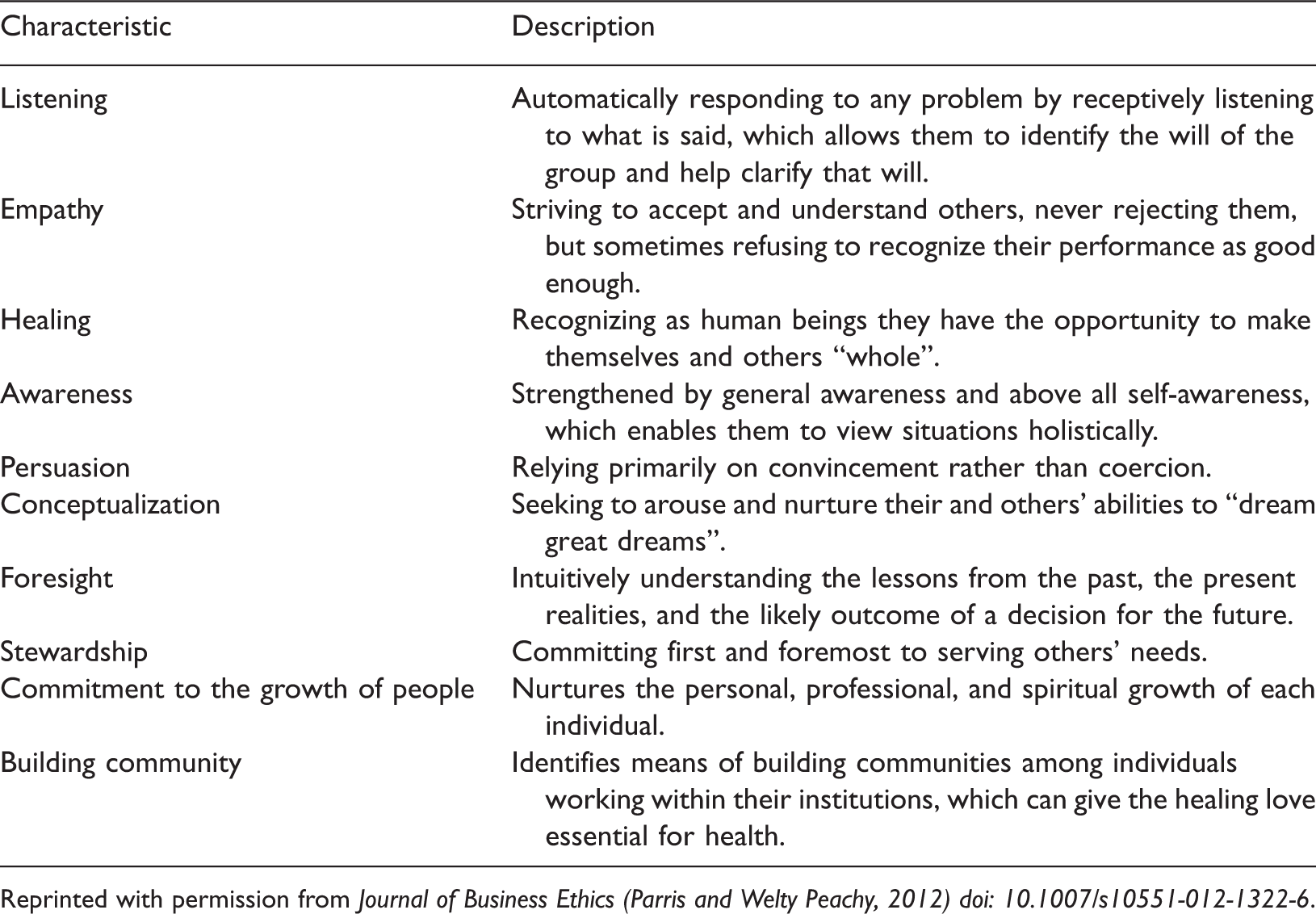
Reprinted with permission from Journal of Business Ethics ( Parris and Welty Peachy, 2012 ) doi: 10.1007/s10551-012-1322-6.
Studies have shown that servant leadership theory is applicable in a sport setting – specifically as an effective coaching behavior. Athletes coached by servant leaders had an increase in motivation, higher mental acuity, were more satisfied, and performed better than those led by a non-servant leader in several studies (Hammermeister et al., 2008; Rieke et al., 2008; Taylor, 2008; Westre, 2003). Our work extends these previous studies on servant leadership theory in sport into the NPO sector and event management context.
Social capital theory and social leverage theory
In addition to the theoretical framework of servant leadership, we used social capital theory and social leverage theory to inform our study. According to Putnam (2000), cause-related sporting events can provide a venue for civil engagement that have the ability to create and strengthen network bonds, bridge distinct groups, and build a level of trust and commitment among community members. Social capital is defined as the “features of social organization such as networks, norms, and social trust that can facilitate coordination and cooperation for mutual benefit” (Putnam, 1995: 66). Social capital assumes participation in an activity which involves similar levels of engagement from others and has stated goals and outcomes leads to the accrual of social capital for the participants (Spaaij, 2009). Social capital is produced by and invested in the inherit characteristics and values of social life. Participation in sporting events is a complex compilation of social practices that involves the development of relationships with a diverse range of individuals and the development of both personal and shared goals (DeGraaf and Jordan, 2003; Portes, 1988; Sherry, 2010).
Social capital theorists have identified three different types of social capital: bonding, bridging, and linking (Coleman, 1988; Putman, 1995). Bonding social capital describes the close ties with family, friends, and individuals within one’s community, such as neighbors (Putman, 1995). The concept of bridging social capital refers to individuals and groups that have more distant ties to similar others who share common interests and goals with the NPO or other types of organizations (Putnam, 1995). The final concept is linking social capital, which describes relationships between individuals and groups that cross boundaries and emerge from disparate situations (Woolcock, 2001). It is linking social capital that allows organizations to unite dissimilar groups around a cause or event, which then creates a larger group that can draw from an even larger pool of resources.
Sustainable social capital is the desired outcome of cause-related sporting events. Social leverage theory argues that sustainable social capital can be achieved by encouraging social interaction and a sense of celebration. Chalip (2006) advanced that participants of sporting events should be recognized as social resources, and event organizers need to leverage the celebratory nature of these events to create lasting social value. In social leverage theory, Chalip (2006) linked liminality and communitas as two essential themes for building social capital and strengthening the social fabric. The celebratory nature of sporting events gives people a sense that something more is happening – a sense that is felt more than understood, which is defined as liminality. Liminality creates a collective energy and provides a safe place where participants can “probe, test, and cultivate their identity with reference to their social context” (Chalip, 2006: 111). From this shared energy emerges a communal atmosphere with a heightened sense of community among participants called communitas. Thus, Chalip (2006) argued these positive feelings are leverageable resources to help foster social capital, build networks, address social issues, inspire community action, and bring entrepreneurial success.
To foster celebration (liminality), camaraderie (communitas), and social capital, Chalip (2006) recommended the following five strategies and mechanisms for event organizers to employ: (a) enabling sociability – opportunities for participants to share time, space, and activities with each other; (b) creating event-related social events – social mixers for participants such as running events and parades; (c) facilitating informal social opportunities – ongoing festivities such as food, pin trading, and meeting places; (d) producing ancillary events – arts and music activities; and (e) developing themes – visual cues with multiple interpretations that signal a celebratory atmosphere and reinforce a felt sense of meaning for participants. Several scholars have incorporated social leverage theory to help understand the impact of sporting events, and to develop guidelines for designing them (Kellett et al., 2008; Misener and Mason, 2010). Our work builds upon social leverage theory by examining the structural mechanisms and social processes through which a cause-related sporting event leverages social capital to inspire participants into action – serving others.
NKF U.S Transplant Games
The setting for this research was the 2010 NKF U.S Transplant Games, held in Madison, Wisconsin. This event is a 4-day Olympic style competition held every 2 years since 1990. The 2010 Games had 45 teams representing all 50 states and attracted over 1,500 athletes and 7,000 supporters. The competition is open to “all recipients of life-supporting allografts and hemopoetic cell transplants, as well as to living donors, who are eligible to compete in selected events in their own division” (NKF, 2010). Every attendee registered for the Games was a member of a team that had been established in a statewide or regional area near a local NKF office. The teams’ responsibilities include recruitment, marketing, media relations, community outreach, fundraising, budgeting, and team competition coordination and planning. Each team has a team manager; donor family liaison; planning, public relations, and team uniform committees; and a team captain. The purpose of the local teams is to extend the reach of the Games into communities outside the host city, and continue to promote the message of the Games during the off year as well as during the competition. The NKF U.S Transplant Games are driven by six objectives:
To demonstrate to the public the collective and individual successes of the life-restoringtherapy of organ transplantation. To utilize the media to promote the success of organ donation and transplantation. To call attention to the need for organ donation through events and support activity before, during, and after the event. To contribute to the successful rehabilitation of the national transplant patient community. To involve the entire transplant community, including physicians, allied professionals, patients, donor families, living donors, and related organizations in a collaborative effort for the benefit of organ donation. To provide an opportunity for these goals to be achieved locally by NKF Divisions and Affiliates and other participating organizations (NKF, 2010).
Thus, the event is designed to foster personal change through participation, build a community dedicated to helping others touched by the cause, and serve as an impetus for social change. Unlike other cause-related sporting events that focus on raising money and awareness for one NPO’s cause (i.e. kidney disease), the Transplant Games is structured to involve the entire transplant community in a collaborative effort for the benefit of organ donation.
The 2010 Games had 47 competitive events contested within 14 sports for transplant recipients, and living donors also competed in selective events. Some of the sports included in the Games were: table tennis, 3-on-3 basketball, cycling, swimming, track and field, bowling, racquetball, ballroom dancing, and golf. Athletes ranged from 2 to over 80 years old. On top of the sporting events, the Games featured additional activities designed to involve everyone touched by donation or transplantation. These included:
Exhibitions of the 350-foot National Donor Family Quilt commemorating deceased donors – open all through the event and is accompanied by a quilt pinning ceremony. Expo – provides information and products for the transplant community. 5 K race for organ, eye, and tissue awareness. Pre-opening tailgate party – meet and greet, facilitated by trading pins. Opening Ceremony – team processions, torch lighting, and pre-show. Educational workshops. Living donor and donor family ceremonies. Youth excursions. Sharing sessions – coffee houses with an open microphone forum. Closing Ceremony and farewell party. Donor–recipient golf outing.
Over the past 20 years, more than 50,000 transplant athletes, living donors, donor families, healthcare professionals, family members and supporters have participated in the Games. The event is designed to unite the transplant community across the U.S. with the common goal of increasing organ donation “by building awareness of the miracles of transplantation, by honoring the courage and selfless gifts of our country’s donors and their families, and by calling attention to the critical need for more donations” (Souvenir Program 2010 NKF Transplant Games, 2011).
Method
We used an exploratory, qualitative case study methodology to investigate the structural mechanisms and social processes of serving others and social capital generated through individuals and their collective involvement in the NKF U.S. Transplant Games. Burnett and Uys (2000) argue that sport programs which aim to bring about social change should be measured using three levels of analysis: macro, where the focus is at the event level and societal impact; meso, which is situated at the team and community level; and micro where the focus resides on the individual as a participant of the sporting event. Thus, we adopted a multi-level approach in order to examine the interconnectedness between the organization and its members. A longitudinal approach was utilized including multiple data collection points beginning at the event and ending 1 year after the Games (Burnett, 2006; Welty Peachey, 2009). Exploratory data analysis can be used to uncover multi-dimensional impacts, discover unanticipated patterns in data, and consequently gain new insights in understanding natural phenomena (Berg, 2009).
Since our aim was to contribute to leadership theory and social capital theory, we searched for an extreme case (Pratt et al., 2006). We selected this event as the context of our investigation because it is designed to cultivate community-level engagement while also fostering individual participation as an impetus for social change and enhancing awareness of organ donation across the U.S. An antecedent to being a participant in the Games is one’s personal history of being touched by the cause. Research shows one’s personal history of life experiences can be a starting point for leadership development (Avolio, 2003, 2005; Gardner et al., 2005). The event honors living donors and donor families because they selflessly gave the gift of life and are connected to most recipients’ appreciation for their second chance of life (NKF, 2010; Souvenir Program 2010 NKF Transplant Games, 2011). Many of the Games' participants, including the caregivers, can be considered “servants”. These personal histories of Games' participants create a unique environment to deepen our understanding of servant leadership theory, examine sport as a social agent, and analyze how to further inspire servanthood.
Sample
This case study specifically examined Team Florida – the third largest state team – which consisted of 124 members, including 54 transplant recipients, four living donors, donor families, supporters, and caregivers. The Florida team was selected because the first author of this article has volunteered with the NKF of Florida for 5 years, which built trust with the organization. This is important given qualitative interviews are influenced by the rapport established in that context (Lincoln and Guba, 1985). It is important to note that the interviewer, who is the first author, was a first-time Games; team member, a Florida resident, and a family donor. The first author’s mother suddenly passed away and upon her wishes the family donated her organs. Being a family donor allowed the first author to be a participant in events and activities, which helped to establish a personal connection to the Games and form a common bond with participants. Longitudinal case design extended the research setting to also include team events, social gatherings, and funerals of team members occurring in Florida 1 year after the Games.
Data collection
This study was conducted from July 2010 to July 2011. All participants were over 18 years old and from Team Florida. Purposive sampling was used to ensure that “certain types of individuals or persons displaying certain attributes are included in the study” (Berg, 2001: 32). The sample consisted of a representative mixture of transplant recipients, living donors, donor families, medical professionals, supporters, and caregivers, all from Team Florida. Participants’ attendance at the Games ranged from one (first-time in attendance) to 20 years (i.e. maximum of 10 Games as the event is held every 2 years).
Several data gathering techniques were utilized in order to allow for cross examination. Furthermore, in an event setting with the challenges of scheduling, manpower, and participants’ exhaustion from 5 days of activities, multiple data collection methods were best suited for maximizing participation. First, we conducted three focus groups, consisting of two pre-event (n = 6 and 12 participants, respectively) and one post-event (n = 10). Participants who could not attend the post-focus group, but were available on the same day were interviewed individually (n = 3); however, some participants were unavailable (n = 5). Second, we administered open-ended, qualitative questionnaires pre- and post-event (n = 26) to focus group participants (n = 11) and non-focus group participants (n = 15). Third, the first author directly observed the following during the event: athletic competitions (n = 23), educational workshops (n = 7), ceremonies (n = 3), sharing sessions (n = 4), ancillary events (n = 3), and social gatherings (n = 25). There were also additional social gatherings (n = 5) held after the event that were observed. Fourth, a document analysis was conducted, which included: game programs (n = 3), websites (n = 1), social media (blogs and message boards) (n = 5), memorabilia videos (n = 12), and media publications (n = 10). Finally, semi-structured personal interviews were conducted 9 months after the event (n = 14). Half of the participants of the follow-up interviews (n = 7) also participated in the earlier survey and/or initial focus groups, while the other interviewees were identified by asking study participants to suggest other potential respondents. Thus, a loop of purposive “snowball” sampling was created by identifying participants who may have otherwise been overlooked (Lincoln and Guba, 1985).
In qualitative research literature reviews and peer debriefing are utilized to design focus group, personal interview, and qualitative survey questions. Peer debriefing allows a peer to serve as an auditor with the purpose of “exploring aspects of the inquiry that might otherwise remain only implicit within the inquirer’s mind” (Lincoln and Guba, 1985: 308). Thus, our questions were informed by a review of the servant leadership literature (i.e. Greenleaf, 1977; Spears, 1998), social leverage theory (Chalip, 2006), social capital theory (Putnam, 1995), and by peer debriefing with NPO executives (who were not part of our sample). Lincoln and Guba (1985) acknowledge peer debriefing as a strategic tool in designing non-biased interview questions. Similar questions were asked in the focus groups, interviews, and surveys to allow for cross examination (i.e. triangulation). Focus groups fostered interaction among participants, which allowed participants to ask questions of each other and open discussion to different avenues of exploration that the researcher may have otherwise ignored. Focus groups and interviews were conducted in a semi-structured format – an interview guide provided structure while questions were allowed to naturally emerge (Lincoln and Guba, 1985). The questions were designed to evaluate and understand the role of team membership, individual and group involvement, and personal change from participation. All focus groups and interviews were conducted by the first author in a private setting, lasted between 40 and 90 min, were digitally audio recorded, and transcribed verbatim. Last, the first author, as a participant by virtue of being a family donor, maintained documentation and field notes in a reflective journal before, during, and up to a year after the event (Glense, 2006).
Data analysis
Consistent with Creswell (1998) and Strauss and Corbin (1990), open, axial, and selective coding were used to analyze the data and to form conceptual codes. Initially, open coding was utilized to condense the data into preliminary categories. Based on recommendations from Miles and Huberman (1994), some codes were assigned a priori based on the literature on servant leadership (i.e. Greenleaf, 1977; Spears, 1998), social leverage theory (Chalip, 2006), and social capital theory (Putnam, 1995), while others emerged from the data. For example, several of the open codes included: a desire to serve (moral calling); each of Spears’ (1998) 10 characteristics of servant leadership (each characteristic was a distinct open code); liminality (felt energy) and communitas (sense of community); fostering social interaction (enabling sociability, event-related social events, informal social opportunities); and prompting a feeling of celebration (ancillary event and themes). After the open coding process, preliminary codes were organized into axial codes (the themes presented in the findings and discussion section below) by clustering and linking the codes together to discover key analytic categories (Neuman, 2006). In the last stage of analysis, selective coding was utilized to integrate the data from all data collection methods to support the emerging conceptual codes (Creswell, 1998). We stored and integrated the data with NVivo 9.
Trustworthiness in a qualitative study is determined by “how accurately the account represents participants’ realities of the social phenomena and is credible to them” (Creswell and Miller, 2000: 124). A qualitative study has trustworthiness if the investigation has credibility (an analog to internal validity), transferability (an analog to external validity), dependability (an analog to reliability), and confirmability (an analog to objectivity) (Lincoln and Guba, 1985; Schwandt, 2007). Credibility was established through triangulation of measures, including member checks with participants where participants reviewed and provided feedback on their interview transcripts and study interpretations (Janesick, 1994). In addition, we used multiple data collection methods as outlined above to corroborate findings and reinforce themes. Transferability was achieved by the first author keeping a reflective journal that provided a contextual narrative that others can use to examine the degree of similarity to their organization (Lincoln and Guba, 1985). In order to improve dependability and confirmability, the second author, who was not involved in data collection, served as an auditor and reviewed all codes, analyses, and interpretations (Erlandson et al., 1993).
Findings and discussion
Our analysis draws on an assessment of the personal experiences of Games' participants, and how their involvement has encouraged them to serve others. We also explore how the event’s objectives are achieved by building an extended community with the common goal of creating social change and awareness for organ donation. This investigation encompasses multi-level analysis in order to deepen our understanding of leadership as emerging from complex interactions between the individual, the social processes, and the organizational environment (Day, 2001). As such, we first present the impact of the Games on an individual level before exploring how the event’s design encouraged participants to collectively and independently serve others.
Games' participants inspired to serve others
Our first research question sought to discover whether the Transplant Games encouraged servant leadership and inspired participants to serve others. Informed by Greenleaf’s (1977) conceptualization of a servant leader and Spears’ (1998) 10 characteristics of servant leadership, our findings revealed the event had a pronounced positive impact on participants’ desire to serve others. This supports social leverage theory (Chalip, 2006) where event participants become social resources (i.e. social capital). The Games is designed such participants “in their own unique way, has been moved, inspired and changed by the bravery, the passion, and the love in evidence throughout each event, each program, and each personal encounter” (Souvenir Program 2010 NKF Transplant Games, 2011). Human capital is grounded in the individual model of leadership (Day, 2001), and stems from organizations’ investment in individuals’ capabilities to enable them to imagine and take action in new ways (Coleman, 1988). Social capital, however, is ground in the relational model of leadership (Day, 2001), and the primary focus is on building and using interpersonal competence through building networked relationships based on commitment, trust, and respect (Putnam, 1995). Servant leadership goes beyond knowledge, skills, and abilities typically associated with leadership roles requiring an internal transformation where the will to make life better for others becomes part of one’s psyche (Parris and Welty Peachey, 2011). Our findings support the integration of these theoretical lenses as a means to investigate the encouragement of servant leadership. We have crystallized the impacts of the Games, which have inspired participants to make the conscious choice to serve others and help to build a community of servant leaders, into three main themes: (a) self-awareness: developing broader identities – altruistic self-identifications and identity groups; (b) self-efficacy: nurturing participants’ abilities to see they can make a difference; and (c) emotional awareness: strengthening participants’ awareness of the healing power of service.
Representative quotations demonstrating Spears’ (1998) 10 characteristics of servant leadership: A community of servant leaders.

Developing broader identities
Becoming a servant leader as Greenleaf (1977) emphasized is an inward journey that starts inside oneself, where one identifies himself or herself as a servant first. One facet of encouraging servant leadership is helping Games' participants develop their self-awareness by expanding and deepening their self-concepts (i.e. identities). Research has shown identities of “leaders” expand from the individual to include other individuals (relational identity) and groups (collective identity), which shifts the focus from self-development to the development of others (Day and Harrison, 2007). Given that helping others is a central tenant of servant leadership, our analysis examined how participants identified themselves. When asked questions regarding their involvement in the Games, describing themselves and their actions, the majority of participants labeled themselves using altruistic self-identities such as: supporter, caregiver, advocate, and volunteer.
The following recipient’s response on his survey is representative of the majority of participants’ self-constructions (who they are): “Transplant recipient, Games' participant, volunteer, fundraiser.” These altruistic titles imply that participants have committed themselves to serving others first, which is defined by Spears (1998) as stewardship. These lists extended beyond participants’ name tags, which everyone wore throughout the Games identifying them as either donor family, living donor, recipient, or supporter. Often participants would ask one another, “Tell me your story”, referring to the name tags as an indicator of each other’s connection to the cause. As the first author, a first time attendant from a donor family observed and listened to these responses, usually after receiving a heartfelt hug from the stranger, the participants would begin with how they were touched by organ donation and transplantation, and then the majority would talk about their altruistic actions to help the cause. From their experience at the Games, many of the Team Florida members increased their level of service within their local communities. The following quote from a follow-up interview is indicative of these stewardship actions taken by a donor family member, who stated before attending the Games she was paralyzed with grief; however, after attending the Games she was inspired to make a difference: Once you attend these Games you go back home and talk about your experience. I … wrote … articles … [have] given presentations to hospital [staff] … community clubs … support groups … health fairs … TV interviews and … high school classes.
The leadership and desire to help others inspired through the Games through social interaction and numerous activities, along with the knowledge gained at the Games, enabled participants to go back home and serve others in their local communities. These altruistic identities (who they are) along with participants’ descriptions and observed actions of service (what they do) indicated that the Games do inspire participants to serve, and through this service they aspire to lead (Sendjaya and Sarros, 2002).
Another identity formed at the Games, which provides further support for participants adopting a service-first orientation and becoming a community of servant leaders, is a group-level identity formed at the state or regional level. According to the Games Team Member Handbook, each team’s philosophy should reflect the spirit of organ and tissue donation – a selfless act of love and compassion from one person to another. In this spirit of altruism, each team member is encouraged to “pay it forward” by adopting the philosophy that “their involvement extends beyond the personal to serve the greater good of the community” (NKF, 2010: 5). The team’s philosophy, culture, and structure are designed to build a community committed to the growth of people, which represents two essential attributes of servant leadership (Spears, 1998). The identification of Team Florida members went beyond wearing their team T-shirts, hats, and pins to encompass who they are and what they do. A representative statement of all team members is captured by this donor family member’s response on the survey: “I am a part of team Florida … we are here to spread a unique story … so others can find hope.” Being a Team Florida member meant being part of a “family” to many participants, which provided them with necessary help and support and enabled them to help others. The team identity allowed members to invite others to participate, cultivate helping behaviors, persuade members to take initiative, and facilitate development of members’ abilities (Ebener and O’Connell, 2010). Servant leaders use persuasion (Spears, 1998). This use of persuasion is illustrated in the following invitation to serve by a family donor, who volunteers with multiple NPOs along with starting an awareness program at his workplace: “If I can do it, I know you can do it better than me. So I encourage you to press on and do better than me” (follow-up interview). This further confirms servant leadership builds a trusting, collaborative, and helping culture that can enhance both individual and organizational effectiveness (Parris and Welty Peachey, 2012).
Nurturing participants’ ability to see they can make a difference
Servant leaders through conceptualization seek to nurture their and others’ abilities to ‘dream great dreams’ (Spears, 1998). Another aspect of encouraging servant leadership is helping Games' participants develop their self-efficacy by providing a motivational force to seek out opportunities to serve others. The conceptualization that the advocacy of one person can be the engine for change is exemplified and nurtured throughout the Games. For example, the majority of participants spoke about how hearing a double lung recipient play “The Star Spangled Banner” on the bagpipes, one of the most physically demanding instruments (The Power of Two, 2011), gave them hope and sparked their imagination. As a family donor stated in her survey response, the role of the Games helps participants “recognize that life is valuable and all of us can make a difference.” Many attendees described a heightened awareness of the role of advocacy, along with a vision of what they could do to help. This foresight, a characteristic of servant leadership (Spears, 1998), helped provide and maintain a positive feeling among the community, as crystallized by the following recipient’s statement: “The main benefit … in the Games … is to meet people from other states, to learn … to hear … to see … how we can help the community advance transplantation … and … make it a cohesive effort” (focus group). Thus, some participants of the Games who are exhibiting servant leadership behaviors lead other participants (followers) by encouraging creativity, helping behaviors, and well-being of followers. Servant leaders influence others to practice servanthood by serving them and helping them to see how they can also serve others (Parris and Welty Peachey, 2012; Russell and Stone, 2002). This supports Greenleaf’s conceptualization of servant leaders as primus inter pares and that servant leaders create positive outcomes by nurturing followers (Babakus et al., 2011; Jaramillo et al., 2009; Rieke et al., 2008).
A basic tenet of servant leadership is that serving others “requires community, a face-to-face group in which the liability of each other and all for one is unlimited” (Greenleaf, 1977: 52). This belief is not only fostered and practiced at the Games for 5 days every 2 years, but participants continue to share this sentiment the other 725 days between the Games. As one recipient declared during a post-focus group, “I’ve said many times before, if the world operated like the Transplant community does, it would be a better place to live.” The encouragement of servant leadership through the Games has created an environment of support and service to others.
Strengthening participants’ awareness of the healing power of service
Greenleaf (1977: 50) suggested servant leaders make the conscious choice to serve others because they are motivated by their own healing. An additional component of encouraging servant leadership is helping Games' participants develop their emotional awareness by strengthening their understanding of the healing power of service. As Greenleaf stated, “implicit in the compact between servant leader and led, is the understanding that the search for wholeness is something they share”. Healing and awareness are two characteristics identified by Spears (1998) that are represented by a donor family member’s description of the healing role of the Games: Strangers on the bus were thanking me for making the donation of my son’s organs … knowing without people like me … they might not be alive. I lost a son and that will never change, but … I can now make a difference by bringing awareness to organ transplantation (NKF, 2010).
Servant leaders have the potential to heal themselves and others (Spears, 1998). Another donor family member echoed this sentiment 9 months after the Games, when he said: “What I know … is [it’s] got to be a way of life … we need to let our voices, and our ideas be documented, be heard, and we’re going to get results.” The majority of participants attributed the healing role of the Games to their amplified awareness and empathy, which was gained through listening to others’ stories. According to Spears (1998), healing, awareness, empathy, and listening are all tenets of servant leadership. In a post-survey a donor family member replied that the skills and knowledge she gained from the Games was: “To listen … to hear … to feel for others.” This open environment based on the healing power of service creates a positive climate, which has been shown to improve followers well-being (Black, 2010; Jaramillo et al., 2009; Neubert et al., 2008) and increase greater organizational commitment (Cerit, 2010; Hamilton and Bean 2005; Hale and Fields, 2007; Han et al., 2010; Pekerti and Sendjaya, 2010).
In summary, the Games inspired participants to serve others and encouraged the practice of servant leadership, which is evident by many participants practicing Spears’ (1998) 10 characteristics of servant leadership. By the Games helping participants develop broader identities, it inspired them to practice stewardship, build a community, commit to the growth of people, and use persuasion to invite others to join the cause. Through nurturing participants’ ability to see they can make a difference, the Games enabled participants to conceptualize a better tomorrow while having the foresight as to how this can be achieved. Last, through listening to others’ stories, participants developed a deeper level of empathy while heightening their general awareness and their self-awareness, which led to an understanding that they should choose to serve others “for one’s own healing” (Greenleaf, 1977: 50). Our results imply that many Team Florida Games' participants have been encouraged to practice servant leadership for their own healing, because of a renewed ability to “dream great dreams” along with the foresight of how to make them a reality, and because they recognize that they are no longer alone but are part of a community of servant leaders that fosters a belief that if each person does his or her part, together we can make a difference.
Structural mechanisms and social processes that inspire servant leadership
Our second research question sought to understand how the Games inspired participants to serve. We identified three structural mechanisms and social processes of the Games which helped to achieve this: (a) creating event-related social events and producing ancillary events to build a community; (b) encouraging themes and hosting ceremonies to create a culture of storytelling and safe spaces; and (c) facilitating formal and informal gathering places to foster an atmosphere of celebration. The social processes of these structural mechanisms help to produce the individual level impacts of the Games, and as our findings for research question one suggest. These impacts led to the practice of servant leadership by participants, and the outcome a sustainable community of servant leaders.
In integrating our findings, we developed a conceptual framework to describe a cause-related sporting event’s ability to inspire participants to serve, and to become servant leaders. This conceptual framework starts with the objectives of the Games summarized into their goals: (a) creating awareness for the cause; (b) helping those touched by the cause; and (c) building advocacy for the cause locally and nationally. Next, the model demonstrates structural mechanisms of the Games designed to generate a specific social processes (research question two), which then led to individual-level impacts on participants that inspired them to serve. These individual impacts leads to the practice servant leadership by participants (research question one). The model ends with the overall outcome of the creation of a sustainable community servant leaders (See Figure 1). We next discuss the structural mechanisms and social processes of the Games and how these contributed to encouraging servant leadership.
Creating event-related social events and producing ancillary events to build a community
The Games has been coined the “Transplant Family Reunion” (NKF, 2010). To create this fun family atmosphere and a sense of communitas (Chalip, 2006), the Games includes additional activities such as event-related social events (meet and greets, sharing sessions, team photos) and ancillary events (Expo and 5 K run). These additional events help build a community (i.e. an extended family) through the three different types of social capital – bonding, bridging, and linking (Putman, 1995, 2000). Each participant of this study said they left the Games being part of an extended community. The links between event-related social events, building a community, developing broader identities, and participants practicing servant leader attributes are illustrated in Figure 1.
Proposed conceptual framework through which a cause-related sporting event inspires particpants to serve.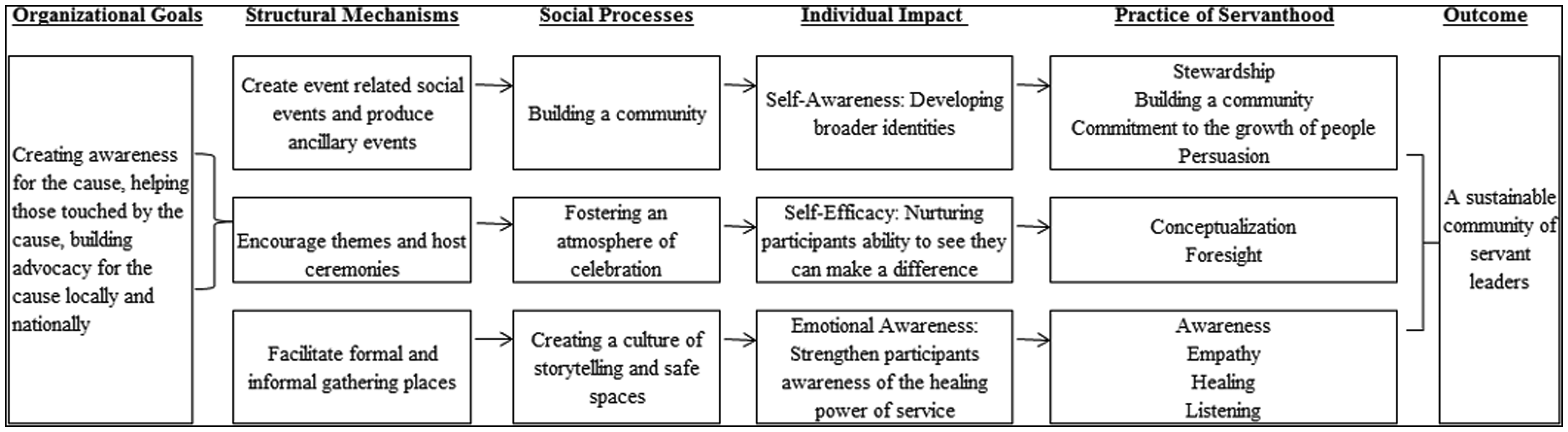
One of the broader identities developed at the Games is being part of the Transplant Games Family, and this sentiment is reflected in a recipient’s statement during a follow-up interview at the social events: “You … build a network and you … call it your transplant family, because that's how close you get. They become your family members.” The Games hosts multiple event-related social events to bond donor families and donors with transplant recipients, which previously was uncommon, if not impossible. As many participants highlighted, these are two different sides of the same coin. For instance, a donor family member said that, “It is no longer my mother’s liver, it is his liver, but he’s my family now, he’s part of us,” while a recipient stated that “I came to honor my donor family. I’ve never met them, but I owe my entire life to them” (NKF, 2010). Events that facilitate this interaction include meet and greets, displaying of the Donor Family Quilt throughout the Games, sharing sessions, hospitality suites for donor families, living donors, and teams, and team photos. The majority of participants stated that they enjoyed these additional events because they were places where donor families, recipients, and supporters could be “on common ground [where] we were more comfortable and relaxed to share and listen to stories and the meeting of new families and recipients” (donor family follow-up interview). Although all stories are different, they do share a commonality, as one supporter summarized during a post-focus group: “the bonding of the transplant community, whether it be the donor, the recipients, the caregiver … becomes a cohesive group … It’s meaningful to everyone in their own specific way, but as a community.”
These events with their family atmosphere allowed space for participants to be themselves and develop broader identities. The first author recalls a donor family visiting the display of the Donor Family Quilt, where she experienced and witnessed emotions ranging from tears of happiness and sadness, to rejoice, love, moments of peaceful silence, and laughter. After an impromptu game of tag with a heart recipient, who teased that he could out run her as “a regular” (i.e. non-recipient), the first author met a donor mom who was knitting. When asked who the shawl was for she said: I volunteer for Threads of Compassion [a NPO in Wisconsin], that knits or crochets comfort shawls given to organ and tissue donor families at the time of their loved donation. This is how I heal and help others by giving families comfort in their time of sorrow and transition.
She went on to tell stories of her son, how she learned of this community of volunteers at the last Games, and how another donor mother persuaded her to start knitting, healing, and helping others. The display of the Quilt and the giving of the shawls are only two examples of event-related social events at the Games, which help build a community where participants can develop broader identities. This encourages participants to become servant leaders by practicing stewardship, building a community, committing to the growth of people, and by using persuasion (Figure 1). Servant-led communities built on trust and love cultivate norms which affect an individual’s tendency to volunteer, increases organizational citizenship behavior, and improve collaboration (Ebener and O’Connell, 2010; Ehrhart, 2004).
The transplant family of the Games also includes the medical field, which is invited to participate as volunteers and as sponsors of the ancillary events, such as the Expo and the 5 K run. The Games fosters bridging social capital through nurturing relationships and creating links between similar groups that share support for a common cause by hosting additional events that include the whole transplant community (Burnett, 2006; O’Brien and Chalip, 2007). For those in the medical field the Games offers a unique experience beyond the hospital setting to witness the celebration of life for both recipient and donor families. The exhibition hall at the Games creates an opportunity for sponsors to connect with consumers, and as one sponsor commented: “The Transplant Games is completely different than traditional conventions. For us, it’s about community and social responsibility, not product awareness. In fact, we didn't even have one mention of our product at the exhibit hall” (NKF, 2010). A recipient recalled from “speaking to nurses … dialysis technicians, [and] administrative personnel who attended the Games … [it] changed their perspective not just about transplantation but about the human spirit. Resilience and just never losing hope” (follow-up interview). A medical professional also stated that the Games “gave me reassurance as a transplant coordinator that what I do is valuable!” (NKF, 2010). Figure 1 illustrates that the connection made at these ancillary events between professionals, recipients, and donor families helps extend the transplant community and provides a persuasive message that the commitment of medical professionals to the growth of people works. The Games provides the medical professionals a community, support, and the inspiration to continue doing what they do.
The opportunity to create lasting social leverage by being servant leaders was realized when Games attendees shared their experiences upon returning home, which was fostered by the Games Team structure. Games Teams, at the state or regional level, are encouraged through NKF National’s “Give Back” program to “pay it forward” (i.e. inspire and uplift) their communities by hosting additional outreach events throughout the year (Souvenir Program 2010 NKF Transplant Games, 2011). These local events facilitate the linking social capital that allows individuals or organizations to unite dissimilar groups around a cause which then creates a larger group that can draw from an even larger pool of resources (Woolcock, 2001). Florida team members were inspired to help people attend the Games that could not afford to go. To do this, these members have become leaders – servant leaders – of a charity hosting various fundraisers (car shows, bowl-A-thons, 5Ks, barbeques, excursions, selling items) (Figure 1). As one member said “we do whatever we can to raise money … It helped send a family to the last Games who probably would not have made it otherwise” (follow-up interview). The first author observed throughout the Games and at local gatherings after the event that Florida team members continued to collaborate and seek ways to make a difference by reaching out to the community, companies, and individuals. In summary, creating event-related social events and producing ancillary events helped to build a community, which led to individuals developing broader identities. These identities inspired and enabled event participants to express four attributes of servant leadership: stewardship, building a community, commitment to the growth of people, and persuasion (Figure 1).
Encouraging themes and hosting ceremonies to foster an atmosphere of celebration
The second key element for the creation of liminality is engendering a sense of celebration, which nurtures participants’ ability to see they can make a difference. This leads to the practice of conceptualization and foresight, two attributes of servant leadership (Spears, 1998). Celebration can be a source of social imagination and innovation strengthening the social fabric (Chalip, 2006), as articulated by a donor family member, who said that “your body cannot heal without play. Your mind cannot heal without laughter. Your soul cannot heal without joy … this is what the Games does in many ways” (follow-up interview). The Games fosters a fun, celebratory atmosphere through creating themes and hosting multiple ceremonies, which adds appeal and highlights the liminoid character of the event (Chalip, 2006). This celebratory space nurtures participants’ ability to see they can make a difference through helping them conceptualize and have foresight that tomorrow can be better (Figure 1).
The atmosphere of celebration at the Games acknowledges that the journey of transplantation and organ donation can be difficult while the celebratory atmosphere of the Games recognizes that life is a gift, and we are here, so let’s celebrate! Visual cues that indicate a celebration is taking place at the Games includes: “T-Shirts, ball caps, jackets, banners, flags, jewelry, and miscellaneous theme items … [for] every state team … A lot of thought goes into the colors, design, by the volunteer committees” (donor family follow-up interview). As one recipient said, “everybody enjoys seeing the different uniforms, or pins, or hats that have been created. It is a lot of interaction among the team” (follow-up interview). Another recipient recalled how the themed ‘party’ fostered interaction between states: “Team Maryland had crab hats, the lobster hats. And … I … had a flamingo hat for Florida. And everybody trades hats” (follow-up interview). All participants expressed that the team themes reinforced a sense of social camaraderie and helped to create a fun atmosphere. This helped to build a unified spirit, with many team members chanting “Celebrate, support, educate” (personal observation).
The sense of celebration was further engendered through the multiple ceremonies at the Games. The Games started with an Opening Ceremony, which all participants compared to the Olympic Games Opening Ceremony. Echoing them, a supporter in a follow-up interview stated: “I think there is no better celebration of life than the Opening Ceremony … Each state is announced. They all walk in together. It is a whole procession.” First, the recipients walk with their teams holding their state banners and are seated, then the living donors and donor families march in and “there is loud cheering for the donor families by the recipients! At that point, all recipients become our recipients! I have chills just talking about it now” (donor family follow-up interview). For many donor families they never know who received their loved one’s donation, nor do many recipients know their donor(s); however, at the Games a connection is made where the focus shifts from who to us (i.e. all recipients become our recipients or all donors become our donors). The sense of celebration extends beyond the festivities, the development of new and lasting relationships, and the joys of competition to include celebrations of life and talents, commemorating deceased donors while also rejoicing for tomorrow’s possibilities.
In addition to the Opening Ceremony there are donor and living donor recognition ceremonies, and the Closing Ceremony, all of which have performances by those touched by the cause. The emphasis on celebration and the experience was illustrated when event organizers willingly changed the donor family recognition ceremony’s schedule to allow a donor mom, a performer, to watch her son’s heart recipient compete (YouTube, 2011). These performances by other Games’ participants helped attendees see that they, too, can make a difference, which enhanced their ability to dream big dreams and to see how they can make these dreams come true (Figure 1). All participants reminisced about how these “successful stories … breed [grow] more people willing to go out there and make that gift available to their loved ones or maybe to strangers” (personal observation – a caregiver’s statement). In summary, we found that the structural mechanisms for fostering an atmosphere of celebration included encouraging themes and hosting ceremonies (Figure 1).
Facilitating formal and informal gathering places to create a culture of storytelling and safe spaces
The Games fostered social interaction by creating safe places for participants to tell stories (Chalip, 2006) while also making storytelling a part of the culture. The Games encouraged storytelling through both formal and informal social gatherings, which generated a sense of social camaraderie – one of two key elements for the creation of liminality (Chalip, 2006). For example, one recipient described her Games experience during a follow-up interview: It was overwhelming … You laughed you cried … You meet people just like you; you hear their stories and you realize maybe yours is not so bad after all. And you really witness human willpower to overcome and do things.
Also, a caregiver said: “If I had to use one word to summarize the atmosphere of the Transplant Games, I would say emotional. Very emotional” (follow-up interview). The atmosphere of the Games was described by all participants using the words: loving, friendly, supportive, life altering, energetic, encouraging, uplifting, fun, sad, understanding, warming, and welcoming. The most common question asked during the Games was “Tell me your story?” (personal observation), which occurred at formal social gathering events (tailgate party, sharing sessions, meet and greets), and informal social gatherings (hotel lobbies, waiting for the bus, team dinners). Scholars across disciplines agree story telling is the currency of human contact, which helps individuals, groups, and organizations make sense of their history, beliefs, experiences, and self-constructions; provides a means to reconstruct and supplement memories; creates and sustains cultures; and enhances their ability to address problems (Barge, 2004; Barry, 2007; Boje, 1991).
Storytelling helps to create a collective energy – a liminoid space (Chalip, 2006), providing a safe place for participants to explore their identities. The Games begins with a pre-opening tailgate party, and as one recipient recalls “we had our own team table, and then we could go mingle with other teams [and] trade pins” (follow-up interview). Informal interaction throughout the Games was facilitated by trading pins; each state or regional team had a pin. One recipient, who tried to get as many pins as possible, described: “You have to give a pin to get a pin … And from that, you can always start a conversation” (follow-up interview). The pin trading created an open culture that encourages storytelling and listening to others, as another recipient, echoing many attendees, stated: “I had no trouble walking up to complete strangers and introducing myself” (NKF, 2010). There were many stories shared at the Games about meeting strangers and then forming friendships. Several of the participants discussed using social media to keep in touch with people from across the country and to use it as a form of advocacy. As many participants highlighted, informal interactions began in the airport when you saw another person wearing a Games T-shirt, and continued on buses to venues, in hotel lobbies, in the bleachers, at dinners, and while touring the host city.
Formal interaction for storytelling at the Games was facilitated at workshops and coffee houses. The majority of participants emphasized “that the diversity in the sense of activities allows people to feel comfortable with whatever they want to do” (recipient follow-up interview). The workshops were one example of this, as these educational sessions were designed to help those touched by the cause by facilitating conversation on topics such as advocacy, healing, understanding, and ways to help others. The workshops brought healing and comfort to donor families, for as one donor family stated: “we were able to build a lot of relationships and friends. We were able to share our story … Other families talked about their children and there were moments of laughter … sadness, and tears” (follow-up interview). The coffee houses created “a place for people to relax and talk and get to know one another” (supporter follow-up interview), with an open microphone forum to encourage people to tell their stories. As one recipient stated: “The coffeehouse enabled me to hear stories and better understand the experiences and feelings of donor families” (NKF, 2010).
Another formal and informal social gathering space was created around the display of the National Donor Family 350-foot Quilt, called “Patches of Love.” NKF provided a patch-making handbook and workshops at the Games to help donor families be creative in designing a patch to honor their loved ones. A quilt pinning ceremony was where a “[donor] family member can bring their patch, tell why they chose the theme in memory of their loved one and pin it on the quilt” (donor family follow-up interview), while other attendees were encouraged to be there for support. At any time throughout the Games, as one supporter described, you can visit the Quilt “to read the different stories on the piece of quilt” (follow-up interview). These formal and informal spaces for sharing along with the storytelling culture of the Games facilitated opportunities for healing, joy, love, friendship, gratitude, humility, and rejoicing.
The storytelling culture of the Games, as an outcome of the formal and informal social gatherings, helped strengthen participants’ awareness of the healing power of service (Figure 1). This was exemplified by a donor family member who became acutely aware at the Games that his identity of being a donor dad was powerful: he could empathize with other donor families, and listen to recipients’ experiences with unconditional love, as he did with his son. Encouraged by the healing power of storytelling, he continued to tell his story when he returned home from the Games and approached his employer, a national organization with offices across the U.S. Telling his story resulted in that organization “trying now to have a workplace partnership that we will share organ donation with the entire company” (follow-up interview). Thus, facilitating formal and informal gathering places creates a culture of storytelling and safe spaces (Figure 1).
Limitations
As with all studies, this investigation did have limitations. The context of our investigation is an extreme case where the antecedents of participants personal histories includes them being touched in some manner by the cause, therefore some of the respondents may have had a service mentality before attending the event. The study incorporated findings focusing on the Games experience of one team, Team Florida, and thus the findings might not generalize to other teams. The pre-post focus group and survey method may have not given time for participants to adequately reflect upon the Games’ impacts. We attempted to mitigate this concern by incorporating a longitudinal design where participants could reflect upon their experiences at a later time, and we could ascertain if these impacts had lasting effects. Due to logistics of an event setting and limited resources, some respondents were unable to participate in all parts of the study; however, using multiple data collection methods permitted more participants to be included in the study. As a qualitative study the data represent the experiences, understanding, and perspectives of participants that might lead to biases (Miles and Huberman, 1994). To mitigate bias the first author collected and analyzed the data, while the second author reviewed codes and interpretations. In addition, conclusions were tested with participants, who confirmed the findings (Erlandson et al., 1993). Last, even though the findings revealed a positive link between participants’ desire to serve and the structural mechanisms and social processes of the Games, this does not eliminate alternative explanations to the success of the Games or indicate that servant leadership will be effective in all NPOs.
Implications and future research directions
To date, Parris and Welty Peachey’s (2012) systemic literature review on servant leadership theory revealed only three studies (Hamilton and Bean, 2005 – leadership development; Savage-Austin and Honeycutt, 2011 – organizational change; Dingman and Stone, 2007 – succession planning) that attempted to understand how to adopt and develop servant leadership in a organization, and five empirical studies that supported Spears’10 characteristics (Boroski and Greif, 2009; Crippen, 2004; Crippen and Wallin, 2008a, 2008b; Sturm, 2009) within three different settings (schools, community, and nursing). Thus, this study is one of the first investigations attempting to understand how servant leadership can be encouraged and the structural mechanisms, social processes, and individual impacts necessary to achieve this (Figure 1). Servant leadership theory has been researched across cultures (11 countries), contexts (educational, corporations – financial services, nursing, public organizations, religious institutions, communities), and across a diversity of research foci (leadership, education, business, psychology, nursing, management, personal selling and sales management, parks and recreation, service marketing, sports) (Parris and Welty Peachey, 2012). This implicates that our conceptual model, drawn out of a NPO sport context, could also be applied in a variety of other organizational settings. While our study participants were attendees of a cause-related sporting event, these findings and proposed framework might be useful to inspire employees, board members, and communities in a variety of contexts.
This study contributes to the understanding of why people would make the conscious choice to serve others – to serve first – by expanding on Greenleaf’s (1977) theory of servant leadership. These findings provide supporting evidence that servant leaders make the conscious choice to serve others that begins with the motivation for one’s own healing (Keith, 2008). The servant leaders identified in this study confirm that servant leadership is a way of life that goes beyond actions (what they do) and becomes part of their identity (who they are) (Sendjaya and Sarros, 2002). In addition, this study adds further validation for the practice and applicability of Spear’s (1998) 10 characteristics of servant leadership.
This research demonstrates how a cause-related sporting event (an organization) can inspire participants to serve (Figure 1), which supports Greenleaf’s (1977) sentiment that human beings are the best resource to build a better society and Chalip’s (2006) identification of event participants (organizational members) as social resources (social leverage theory). Theoretically, we identified three structural mechanisms and social processes which helped to cultivate servant leadership: (a) creating event-related social events and producing ancillary events to build a community; (b) encouraging themes and hosting ceremonies to create a culture of storytelling and safe spaces; and (c) facilitating formal and informal gathering places to foster an atmosphere of celebration. These structural mechanisms and social processes impacted the participants by: (a) developing broader identities; (b) nurturing participants’ abilities to see they can make a difference; and (c) strengthening participants’ awareness of the healing power of service. It is important when designing a cause-related sporting event or building an organizational structure and culture that organizers understand the connections between structural mechanisms, their social processes, the impact on participants, and their desired end goal of building a community of servant leaders that is dedicated to improving the cause and making tomorrow better (Figure 1). Thus, this conceptual framework can also help event organizers (organizations) create, optimize, and then use liminality and communitas (Chalip, 2006) to nurture participants’ commitment to serve and inspire individuals to become servant leaders adopting the mission of the NPO (an organization’s mission) and championing it. Although it is said nothing lasts forever, inspiring the practice of servant leadership, as demonstrated in our study, encourages service to others while the structural mechanisms and social processes of the organizational structure and culture help to ensure organizational members continue to make a difference. Thus, encouraging servant leadership can be a crucial success factor helping organizations achieve their missions while improving the well-being of their members and building a better society.
This study is the first to apply servant leadership in sport in the NPO sector. To date, the applicability of servant leadership in a sport setting has only been examined as an effective coaching behavior. In addition, this is also the first attempt at defining a conceptual framework for how a cause-related sporting event hosted by an NPO (an organization) can foster servant leadership. Future research should test and refine the conceptual framework presented here. Further investigation on how to adopt, develop, and foster servant leadership in a variety of contexts is also needed. In addition, researchers need to address challenges of managing servant-led organizations, such as logistics, marketing, finances, services, public relations, human resources and operations. Finally, researchers should explore how to not only build servant-led organizations and events, but also how to create programs, structures, and cultures that help foster continued service and build a community of servant leaders in other organizational settings and contexts that contributes to potential lasting social leverage.